
虚拟语气+定语从句
This is the second book that I have ever written.
2. all, everything, something, nothing few, the one, none, much, none 等不定 代词作先行词时
Everything that we saw in this film was true.
which, who, whom, whose, that
定语从句的用法:
当先行词是物时, 用which 或that引导
These are the trees which were planted last year.
当先行词是人时, 用who, whom, whose, that引导
who, whom, whose, that用法区别.
5. 当先行词被 the last , the very 和 the only 修饰时。 • This is the very pen that I am looking for. 这正是我找的钢笔。
• The only book that I want to read is missing. 我唯一想看的书不见了。
5. They should have arrived by now. 6. Should I have time, I would read the book again. 7. I wish I hadn’t done that. 8. He talked as if he had seen it with his own eyes.
who 作定语从句的主语或宾语.
The man who is speaking at the meeting is a worker.
The man is a worker. 分解 The man is speaking at the meeting. 作主语
Whom 作定语从句的宾语 The woman whom they wanted to visit is a teacher.
1. I have a friend ________ likes who/that listening to classical music. 2. Yesterday Emily was wearing the which/that new dress __________ I gave her. 3. The man whose leg broke in a ______ match used to be a football player.
虚拟语气用于非真实条件句
真实条件句VS非真实条件句 试比较: If it rains tomorrow, we’ll have to stay at home. If I were you, I would accept the offer. 虚拟语气在非真实条件句中的假设通常有三种情况: ①与过去事实相反 ②与现在事实相反 ③与将来事实可能相反。
分解 The woman is a teacher. They wanted to visit the woman.
作宾语
whose 作定语从句的定语. I know the girl whose mother is a teacher.
I know the girl. 分解 The girl’s mother is a teacher.
与过去事实相反(例句)
• If I had known her telephone number, I would have called her. 假如我当时知道 她的电话号码,我就会给她打了电话。 (The fact is that I didn’t call her because I didn’t know her telephone number.) • If he had got up earlier, he could have caught the train. 假如他早点起身的话, 他本来能赶上那趟火车。
不宜用that 的情况
1. 关系代词前有介词时 This is the room in which Lu Xun lived. 2. 非限制性定语从句中 He has a daughter, who works in a hospital. 3. 先行词本身是that The book is that which tells people the time.
虚拟语气用于宾语从句
表示“要求、建议、命令”等动词后面的宾 语从句中的虚拟语气从句中用“should +动 词原形”构成。而且should可以省去。用于 此结构的动词常见的有:advise, ask, decide, desire, insist, order, prefer, propose, request, suggest, recommend等。 例如:
• I suggested that the meeting (should) be put off. 我建议会议延期举行。 • The doctor ordered that she (should) stay in bed for a few days. 医生要她卧床 休息几天。 • They demanded that their pay (should) be raised. 他们要求增加工资。
1. God bless you. 2. If he were here, he would know what to do. 3. If you had come a little earlier, you would have met her. 4. She suggested that we should keep emailing each other.
与将来事实可能
相反
If sb.+ A. 过去式 B. were to do C. should +动词 原形
sb.+ would (should, could, might) +动词原 形
与现在事实相反(例句)
• If I were rich enough, I would travel around the world.假如我很富有,我就会周 游世界。(The fact is that I can’t travel around the world because I don’t have enough money.) • If I had a car, I should be very happy. 假如我有一辆汽车,我应该很高兴。 • If I were a bird, I could fly freely in the sky. 假如我是一只鸟儿,我就会在空中自由飞翔。
would rather
接从句,用虚拟语气。用一般过去式时,表示一个 现在或将来的愿望;用过去完成式时,表示一个过 去的愿望。例如:
• I’d rather you paid the money yourself. • I’d rather she painted the wall green next time. • I’d rather she hadn’t sent me the text message that day.
4. 当先行词既指人又指物时。 例如:
• The professor and his achievement that I heard about are admired by them. 我听说的那位教授和他的成就得到他们的赞美。
• Let's talk about the persons and the things that we can remember. 让我们谈论能够想起的人和事。
定语从句
• 先行词: 定语从句所修饰的名词或代词。 • 关系词: 引导定语从句的词,分为关系代 词(who, whom, that, which, whose) 和关系副词(where, when, why)。
合并句子:
1. The man is a worker. 2. The man is speaking at the meeting.
虚拟语气
虚拟语气用来表示说话人所说的话并不是 事实,而是一种假设、愿望、怀疑或推测。 例如:
If I had time, I would certainly go to the movie with you.
I wish I were a white cloud.
虚拟语气的表现形式
虚拟语气通过谓语动词的特殊形式来表示。例如:
I have nothing that is worth reading.
I mean the one that was bought yesterday.
3. 当先行词被 all, every, no , some, few , little, much, both 等修饰时。
This is all that I want to say at the meeting. 这就是我在会上要说的。 Have you any books that are worth reading? 你有值的看的书吗?
与将来事实可能相反(例句)
• If she were to marry Jack, she would be happy.如果她嫁给杰克,她会幸福的。 • If I should go abroad, I would go to America. 假如我要出国,我就会去美国。 snowed(常用形式) • If it were to snow(可能性较小) tomorrow, I should snow(可能性较大) should(would) stay at home.
非真实条件句中谓语动词形式
条件从句 主句 If sb.+过去式(be的 sb.+ would (should, 与现在事实相反 过去式是were) could, might)+动词原 形 sb.+ would (should, 与过去事实相反 If sb.+ had done could, might) + have done
虚拟语气在从句中的用法

虚拟语气在从句中的用法1.主语从句中的用法(1)在以 it 为形式主语的复合句中,虚拟语气在主语从句中表示建议、要求、命令等,谓语动词用 should be 型或 be 型虚拟式,在美国英语中常用be 型虚拟式。
如:It ’ s natural that she should do so.她这么做是很自然的事。
It is essential that we should tell her the news.我们有必要告诉她这个消息。
It is important that we should make full use of our mineral resources.对我们来说,充分利用我国的矿产资源是重要的。
It is strange that the result of the experiment should be unsatisfactory.奇怪的是实验结果竟然如此令人不满意。
It is desired that we should get everything ready by tonight.希望一切在今晚准备好。
It was arranged that Mr Sam should go and help Bettie.他们作了安排,由萨姆先生去帮助贝蒂。
(2) 主句的谓语为某些动词的被动语态,常用在It is (was) desired (suggested, settled ,proposed, recommended, requested, decided, etc.) that...句型中。
It is suggested that the question should be discussed at the next meeting.有人建议在下次会上讨论这个问题。
It is vital that he should be warned before it is too late.在还不太晚的时候警告他是非常必要的。
虚拟语气用法总结及详细解析
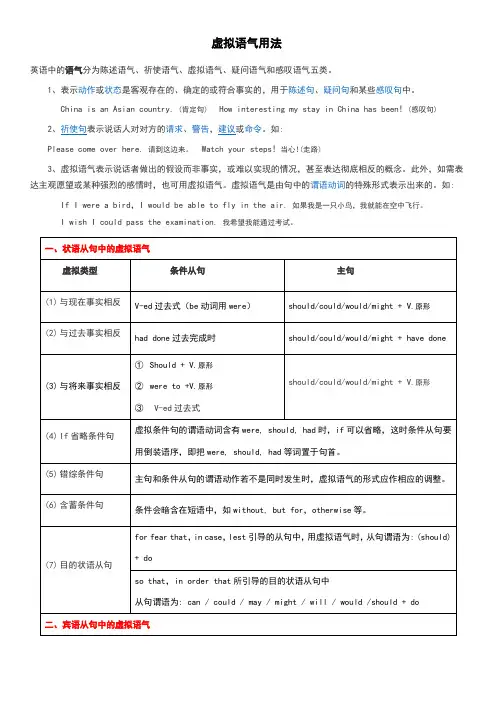
虚拟语气用法英语中的语气分为陈述语气、祈使语气、虚拟语气、疑问语气和感叹语气五类。
1、表示动作或状态是客观存在的、确定的或符合事实的,用于陈述句、疑问句和某些感叹句中。
China is an Asian country. (肯定句) How interesting my stay in China has been! (感叹句)2、祈使句表示说话人对对方的请求、警告,建议或命令。
如:Please come over here. 请到这边来。
Watch your steps! 当心!(走路)3、虚拟语气表示说话者做出的假设而非事实,或难以实现的情况,甚至表达彻底相反的概念。
此外,如需表达主观愿望或某种强烈的感情时,也可用虚拟语气。
虚拟语气是由句中的谓语动词的特殊形式表示出来的。
如: If I were a bird,I would be able to fly in the air. 如果我是一只小鸟,我就能在空中飞行。
I wish I could pass the examination. 我希望我能通过考试。
If there were a heavy snow next Sunday, we would not go skating. 如果下周日下大雪,我们就不能去滑冰了。
If she were to be here next Monday, I would tell her about the matter.如果她下周一来这儿的话,我就会告诉她这件事的始末。
4、有时,虚拟条件句中,结果主句和条件从句的谓语动作若不是同时发生时,虚拟语气的形式应作相应的调整。
这种条件句叫错综条件句。
①从句的动作与过去事实相反,而主句的动作与现在或现在正在发生的事实不符。
If I had worked hard at school, I would be an engineer, too.如果我在学校学习刻苦的话,我现在也会成为一个工程师了If they had informed us, we would not come here now. 如果他们通知过我们的话,我们现在就不会来这里了。
高中虚拟语气用法解析

高中虚拟语气用法解析(完整版)一.虚拟语气在非真实条件句中的应用非真实条件句:if引导的条件状语从句,但是实现该条件的可能性极小或不可能实现1.表示与过去事实相反Eg.If my car had been more reliable,I would have driven to my office.2.表示与现在事实相反Eg.In fact,it is certain that we would not be able to understand it if we heard it today.3.表示与将来事实相反Eg.If you succeed,everything would be all right.Grace doesn't want to move to New York because she thinks if she were to live there,she wouldn't be able to see her parents.4.注意事项(1)W as不可以替代were,虚拟语气中,从句中be动词只有were(2)错综时间条件句:条件句的行为和主句行为发生的时间不一致,动词的形式按照主句和从句各自的时间调整。
Eg.If he had listened to me, he would not be in such trouble now. If it had not been raining too much, the crops would be growing much better.(3)虚拟条件句中的谓语动词含有were/ should /had 时,if可省略,而将were/ should /had 置于主语前面Eg.What would have happened had Bob walked farther as far as the river bank?Should he agree to go there, we should send him there. Were it Sunday tomorrow, we should go to the great wall.两个固定搭配:①Were it not for 要不是...就②Had it not been for 要不是...就If it were not for (Were it not for)the bad weather now, we would go to the park to fly kites.If it had not been for(Had it not been for) the bad weather yesterday, we would have gone to the park to fly kites. (4)含蓄虚拟条件句:有时假设的情况不是以if条件句来表示。
虚拟语气的用法归纳

虚拟语气的用法归纳关键信息项:1、虚拟语气在条件状语从句中的用法2、虚拟语气在宾语从句中的用法3、虚拟语气在主语从句中的用法4、虚拟语气在表语从句和同位语从句中的用法5、虚拟语气在定语从句中的用法6、虚拟语气在状语从句中的其他用法7、虚拟语气在一些特殊句型中的用法11 虚拟语气在条件状语从句中的用法111 与现在事实相反若表示与现在事实相反,条件从句的谓语用过去式(be 动词通常用were),主句谓语用“should / would / could / might +动词原形”。
例如:If I were you, I would take his advice (如果我是你,我会接受他的建议。
)112 与过去事实相反若表示与过去事实相反,条件从句的谓语用过去完成式(had +过去分词),主句谓语用“should / would / could / might + have +过去分词”。
比如:If you had come earlier, you would have caught the bus (如果你早点来,你就赶上公交车了。
)113 与将来事实相反若表示与将来事实相反,条件从句的谓语有三种形式:过去式(be 动词通常用 were)should +动词原形were to +动词原形主句谓语用“should / would / could / might +动词原形”。
例如:If it were to rain tomorrow, we would stay at home (如果明天下雨,我们就待在家里。
)12 虚拟语气在宾语从句中的用法121 wish 后的宾语从句wish 后的宾语从句要用虚拟语气。
与现在事实相反,用一般过去时;与过去事实相反,用过去完成时;与将来事实相反,用“would / could +动词原形”。
例如:I wish I were as tall as you (我希望和你一样高。
虚拟语气最全面的用法介绍
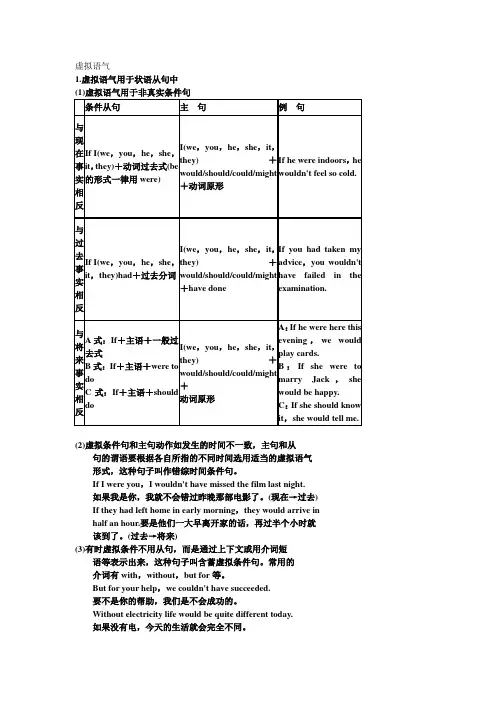
虚拟语气1.虚拟语气用于状语从句中(1)虚拟语气用于非真实条件句条件从句主句例句与现在事实相反If I(we,you,he,she,it,they)+动词过去式(be的形式一律用were)I(we,you,he,she,it,they)+would/should/could/might+动词原形If he were indoors,hewouldn't feel so cold.与过去事实相反If I(we,you,he,she,it,they)had+过去分词I(we,you,he,she,it,they)+would/should/could/might+have doneIf you had taken myadvice,you wouldn'thave failed in theexamination.与将来事实相反A式:If+主语+一般过去式B式:If+主语+were todoC式:If+主语+shoulddoI(we,you,he,she,it,they)+would/should/could/might+动词原形A:If he were here thisevening,we wouldplay cards.B:If she were tomarry Jack,shewould be happy.C:If she should knowit,she would tell me.(2)虚拟条件句和主句动作如发生的时间不一致,主句和从句的谓语要根据各自所指的不同时间选用适当的虚拟语气形式,这种句子叫作错综时间条件句。
If I were you,I wouldn't have missed the film last night.如果我是你,我就不会错过昨晚那部电影了。
(现在→过去) If they had left home in early morning,they would arrive in half an hour.要是他们一大早离开家的话,再过半个小时就该到了。
定语从句的引导词与状语从句的分类与并列连词的用法与虚拟语气的用法

定语从句的引导词与状语从句的分类与并列连词的用法与虚拟语气的用法定语从句是英语中的重要语法结构,用于修饰名词或代词。
而状语从句则是用来修饰句子中的动作、情况或情态的。
本文将重点讨论定语从句的引导词、状语从句的分类、并列连词的用法以及虚拟语气的用法。
一、定语从句的引导词定语从句的引导词包括关系代词和关系副词。
关系代词有that, which, who, whom, whose,而关系副词有where, when, why。
关系代词“that”在定语从句中作主语或宾语,后面没有逗号,常用于修饰人或事物。
例句:He told me a story that happened last night.关系代词“which”用于修饰事物,在句中作主语、宾语或介词的宾语。
例句:This is the book which I bought yesterday.关系代词“who/whom”用于修饰人,在定语从句中分别作主语和宾语。
例句:The girl who is singing is my sister.关系代词“whose”用于修饰人或事物,在句中作定语。
例句:The house whose windows are broken is abandoned.关系副词“where”用于修饰地点。
例句:I still remember the place where we first met.关系副词“when”用于修饰时间。
例句:I will never forget the day when we got married.关系副词“why”用于修饰原因。
例句:Please tell me the reason why you didn't come to the party.二、状语从句的分类状语从句可以分为时间状语从句、地点状语从句、原因状语从句、条件状语从句、目的状语从句、结果状语从句、方式状语从句等。
高中英语语法:常见虚拟语气
高中英语语法:常见虚拟语气高中英语经常会遇到虚拟语句,我们就要掌握常见的虚拟语句语法,下面小编就同大家整理高高中英语语法:常见虚拟语气,希望有所帮助!一、虚拟语气的概念虚拟语气包含两种:一种指与事实相反或不可能发生。
“虚拟条件句+虚拟主句”的结构都属于这一类;even if、even though、as if、as though引导的状语中如果需要用到虚拟语气也属于这一类;wish、would rather后面接的宾语从句表示不可能实现的愿望,还是属于这一类。
另一种指与事实实际是否发生没有直接关系。
如suggest、order、demand等表示建议、命令、要求等相关的名词性从句都属于这一类。
二、名词性从句中的虚拟语气1.表达和建议、要求、命令、主张等含义相关的名词性从句,一律用主语+should+动词原形(should可以省略)结构。
具体涉及到这些动词以及它们的名词形式:一坚持(主张):insist二命令:order,command三要求:require,request,demand四建议:suggest,advise,propose,recommend2.表示重要性、必要性、吃惊等时,一律用it is+形容词+that+主语+should+动词原形(should可以省略)结构。
3. ① wish 后面所跟的宾语从句,其谓语动词用虚拟语气(意为“要是/但愿…就好了”),其形式主要有三种:表示对现在情况的虚拟:wish+一般过去时的宾语从句;表示对过去情况的虚拟:wish+ 过去完成时的宾语从句;表示对将来情况的虚拟:wish+would/could+动词原形。
if only 后接从句也用虚拟语气,其形式与wish的用法一致。
② would rather 后面所跟的宾语从句,其谓语动词用虚拟语气(意为“宁愿......”),其形式主要有两种:表示对现在/将来情况的虚拟:wish+一般过去时的宾语从句;表示对过去情况的虚拟:wish+ 过去完成时的宾语从句三、虚拟条件句中的虚拟语气1.表示与现在事实相反的情况从句:If+主语+did(be动词用were)主句:主语+ should/would/might/could+do2.表示与过去事实相反的情况从句:If+主语+had+done主句:主语+should/would/might/could+have done3.表示与将来事实相反的情况从句:①if+主语+were to do②if+主语+should+do③if+主语+过去式(be动词用were)主句:主语+should/would/might/could+do四、其它从句中的虚拟语气1.虚拟语气用在状语从句中① 由as if 或 as though 所引导的方式状浯从句,若从句与事实相反,则要用虚拟语气。
高中英语语法——虚拟语气和定语从句
5.as if/as though;if only(要是...就好了);wish引导6.would rather+句子①通常用一般过去时②有了表示过去的时间状语或从语境中读出是对过去的动作的虚拟,用过去完成时7.建议命令要求坚持主张+(should)do8.It’s necessary/essential/important/strange+that+(should)do9.It’s a pity that+(should)do10.It’s high time that +should do/一般过去时二、定语从句1. 关系代词who, whom, whose, which, that, as.关系副词when, where, why2.①如果先行词是all, much, anything, something, nothing, everything, little,none ,few.等不定代词②如果先行词被序数词、形容词最高级修饰③如果先等词被the only ,the very , the same ,the last修饰,关系代词常用that,不用which.This is the only book that I really like.He was the only person in the office that was invited to the ball.④先行词有两个,一个指人,一个指物⑤who ,which开头的特殊疑问句中⑥关系代词作表语时,关系代词用that.⑦当主句“there be “开头时,关系代词要用that 引导的定语从句修饰该句型的主语。
4.只能用which的情况①非限制性定语从句中,不能用关系代词that,作宾语用的关系代词也不能省略。
②those/that +名词后的定语从句用which引导。
不能用关系代词that。
③介词后只用which④which还有一种特殊用法,它可以引导从句修饰前面的整个主句,代替主句所表示的整体概念或部分概念。
虚拟语气的用法
[虚拟语气] 虚拟语气的用法虚拟语气表示说话人的愿望、假设、猜测或建议,而不表示客观存在的事实。
虚拟语气通过谓语动词的特殊形式来表示。
下面分别介绍虚拟语气在各种句式中的用法。
1.虚拟语气用于条件状语从句注意:主句中的should通常用于第一人称,would可用于任何人称,同时也可根据意思用情态动词could,might等代替should,would。
1)表示与现在事实相反: If 主语+过去时,主语+should(could, would, 或might)+动词原形,If I were you,I should stay at home.If the peasants could farm the land themselves,food production would be much higher.If fewer cash crops were grown,more food could be produced and there would be less or no starvation.2)表示与过去事实相反: If 主语+had+过去分词,主语+should(could, would, 或might)+have+过去分词,如:If you had come yesterday,you would have met him.If the hurricane had happened during the daytime,there would have been many deaths.3)表示与将来事实相反:主语+should(could…)+ 原形 doIf you came tomorrow,we would have the meeting.If it were to/should rain tomorrow,the meeting would be put off.If it should rain,the crops would be saved.4)当条件状语从句表示的行为和主句表示的行为所发生的时间不一致时,动词的形式要根据它所表示的时间来调整。
定语从句中虚拟语气的运用规则
定语从句中虚拟语气的运用规则在语法学中,定语从句是一种修饰名词的从句,它用于对名词进行进一步的说明或限定。
在定语从句中,虚拟语气是一种特殊的语气形式,用于表示与事实相反的假设或推测情况。
本文将介绍定语从句中虚拟语气的运用规则,并以例句进行说明。
1. 与现实相反的假设:当定语从句中的主句和从句之间存在与现实相反的假设时,可以使用虚拟语气来表示。
此时,虚拟语气的动词形式多为过去时态,并且在第二人称和第三人称中要加上"were"。
例句:I wish I were a bird.(我希望我是一只鸟。
)2. 表示建议或要求:在定语从句中,虚拟语气可以用来表示建议或要求的情况。
这种情况下,动词形式多为过去时态,但在第一人称单数(I)和第三人称单数(he/she/it)中,动词形式要使用动词原形。
例句:It is necessary that he speak to his boss about the problem.(有必要他向老板提出这个问题。
)3. 表示命令、要求、建议的否定:在定语从句中,如果表示否定的命令、要求或建议,虚拟语气的动词形式多为过去时态,并加上"should"。
例句:It is important that you shouldn't drink and drive.(很重要的是你不要喝酒后驾车。
)4. 表示对能力或可能性的怀疑:当定语从句中表示对某人的能力或可能性的怀疑时,虚拟语气的动词形式多为过去时态,并带有"could"或"would"。
例句:The doctor suggested that she could take some rest.(医生建议她应该休息一下。
)5. 表示推测或假设:在定语从句中,如果表示对事实的想象或假设的话,虚拟语气的动词形式多为过去时态,并加上"should"或"would"。