
定语从句讲解和练习
定语从句复习提纲※定语从句三步:第一找出先行词;第二看先行词在定语从句中的语法功能(做主语、宾语或状语);第三选择合适的关系词。
一,只用that不用which的情况1,当先行词是all, little, few, much, something, everything, anything, nothing, none等不定代词时。
如:Everything that happened then was like a nightmare.I will tell him all that you told me at the ball.2,当先行词被only, any, few, little, no, all, just, very(恰好的,表示强调)等词修饰时。
例如: The only thing that we could do was to wait.That’s the very thing that we can do.3、当先行词是序数词、形容词最高级或先行词被序数词或形容词最高级修饰时。
例如:The first place that we visited was the Great Wall.This is the best novel that I have ever read.4、被修饰词为数词时。
例如:Yesterday I caught two fish and put them in a basin of water. Now you can see the two that are still alive.5、主句是There be结构,修饰主语的定语从句宜用that作关系代词修饰物。
例句:There’s still a room that is free.6、先行词中同时包括人和物时。
例如:We talked about the people and the villages that we remembered.He asked about the factories and workers that he had visited.7、当主句中有who, which时,而定语从句中也要用到who或which时,为了避免who…who, which…which等重叠,定语从句要用that引导。
例如:Who is the man that is standing by the door?Which of the two cows that you keep produces more milk?8、人或物在定语从句中作表语时,用that引导定语从句,而that通常也可以省略。
例如: He is no longer the man that he was.二,修饰物时只用which不用that的情况1,引导非限制性定语从句时。
例如:Bamboo is hollow, which makes it light.2,当关系词前有介词时。
例如:This is the room in which Chairman Mao once lived.3、在一个句子中有两个定语从句,其中一个定语从句的关系代词用了that, 另一个宜用which。
例如:Let me show you the novel that I borrowed from the library which was newly open to us.4、当关系代词后面有插入语时。
例如:Here is the English grammar which, as I have told you, will help improve your English.5、先行词为that时。
例如:The clock is that which can tell us the time.钟是报时的装置。
三,修饰人时只用who不用that的情况1、先行词为one, ones, anyone, those指代人时。
如:The person I want to learn from is one who studies hard and works well.2、在There be结构中,修饰主语的定语从句宜用关系代词who指代人。
例如:There’s a gentleman who wants to see you.3、当先行词有较长的后置定语时。
例如:I met a foreigner in the park yesterday afternoon who could speak Chinese very well.4、一个句子中带有两个定语从句,其中一个定语从句的关系代词是that, 另一个宜用who以避免重复。
例如:The student that was praised at yesterday’s meeting is the monitor who is very modest and works very hard.注意:当关系代词前面有介词时,只能用whom。
例如:The person to whom this letter was addressed died three years ago.四、way在定语从句作先行词的用法当先行词为way,关系词在从句中作状语时,定语从句的引导词可用in which, that或省略引导词。
但如果关系词在句中作主语或宾语时,则用which或that 引导。
如:This is the way (that /in which) I do such things.比较: Please do the experiment in the way(that/which)I have shown you.I don’t like the way (that /in which)he looks at me.The way that/in which/不填 he explained the sentence to us was not difficult to understand.The way that/ which/不填 he explained to us was quite simple.What surprised me was not what he said but _____ he said it.A. the wayB. in the way thatC. in the wayD. the way which五、在定语从句中作状语的关系副词when, where, why的用法1、先行词为"时间名词",可用when引导定语从句,when在定语从句中作状语;还可以用which或that 引导,which或that在从句中作主语或宾语。
比较: I still remember the day when /on which my brother joined the army.(作状语)Next month, when you will be in your hometown, is just around the corner.I still remember the days when(=on which)we lived together.I still remember the days which/that we spent together. (作宾语)Next winter which/that you'll spend in Harbin, I'm sure, will be exciting.2、先行词是"地点名词",定语从句可用where引导,where在从句中做状语;还可用which或that引导,which/that 在从句中作主语或宾语。
比较: This is the factory where /in which he worked last year. (作状语)The treatment will continue until the patient reaches the point where he can walk correctly and safely.I think you have got to the point where a change is needed, or you would fail.Government reports, legal papers and most business letters are the main situations where English is used.He's got himself into a dangerous situation where he's likely to lose control of the plane.The small mountain village where we spent our holiday last month lies in what /the place which is now part of Hubei.This is the park which/that they visited last year. (作宾语)Not having been there before, he simply had no idea about the place, which everyone says is worth visiting.※如果定语从句分别修饰point, situation, part, condition和case等表示抽象意义的词,常用where 引导,意思是“到了某种地步,在某种境况中”(前提是从句中缺少状语)。
※“from where” 中的where 是关系代词,可以引导定语从句。
例如:She stood near the north window, from where she could see the whole garden. (= through which) He climbed up to the top of the temple, from where he could see nothing but trees.That’s the place from where the river branches out.3、先行词是表示原因的名词reason 时, 可以用why 引导定语从句,why在定语从句中作原因状语,可用for which替代;当关系词在从句中作主语或宾语时,则用which或that 引导。
(完整版)高中英语定语从句讲解及练习题(含答案)
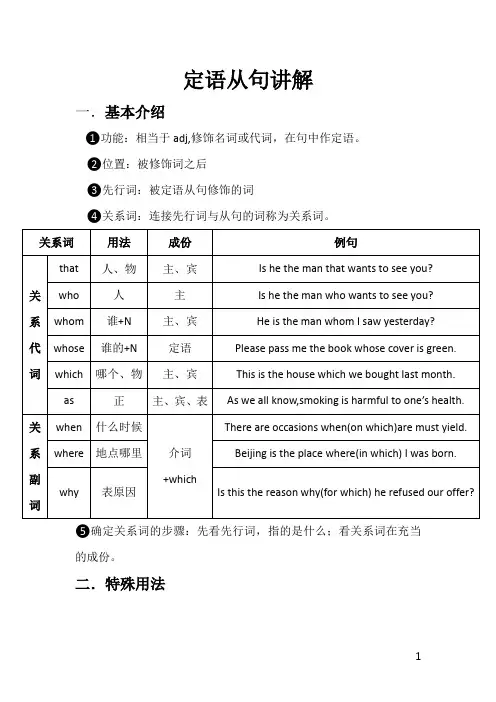
定语从句讲解一.基本介绍❶功能:相当于adj,修饰名词或代词,在句中作定语。
❷位置:被修饰词之后❸先行词:被定语从句修饰的词❹关系词:连接先行词与从句的词称为关系词。
❺确定关系词的步骤:先看先行词,指的是什么;看关系词在充当的成份。
二.特殊用法1.He was looking pleasantly at the children and parcels______filled his bus.2.The village is no longer the one ___it was five years ago. 5.Such books____you bought are useful.23.Which are the books____you bought for me? 6.____ is known,the earth is round.4.There is a room,_____window faces the river. 7.There is lots of air in loose snow,_____can keep the cold out.3高中定语从句练习(整理)1. They talked for about an hour of things and persons _____ they remembered in the factory.A. whichB. thatC. whoD. whom2. We are going to spend this Spring Festival in Beijing, _____ live our grandparents and some relatives.A. whichB. thatC. whoD. where3. There are many areas in the world _____ lack experienced doctors.A. whereB. in whichC. whichD. what4. The years and months _____ we spent together are really wonderful to us all.A. whenB. on whichC. in whichD. that5. _____ has been described above, it is a general rule that solids expand as the temperature increases and contract when they are cooled.A. ItB. AsC. ThatD. Which6. A. who’s B. which C. whose7. Susan is not the brilliant writer _____ she used to be. D. thisA. whichB. thatC. whoD. whom8. I, who _____ your friend, will try my best to help you.A. beB. amC. areD. is9. The size of the audience, _____ we had expected, was well over 1600.A. asB. thatC. whichD. who10. They have started an investigation, _____ are being kept secret.A. whose detailB. whose the detailsC. the details of whichD. the detail of it11. Have you ever asked him the reason _____ may explain his absence?A. whyB. for whichC. whichD. what12. There were two rooms in the beach house, _____ served as a kitchen.A. the smaller of themB. the smallest of whichC. the smaller of whichD. smallest of which13. He imagined various ways _____ he could teach her how to learn English well.A. /B. thatC. in whichD. A , B & C14. The speed _____ light travels is said to be the maximum in the universe.A. in whichB. by whichC. at whichD. from which15. Can you think out a situation _____ this idiom can be used?A. in whichB. thatC. whereD. A & C16. China has hundreds of islands, _____ is Taiwan.A. in which the largestB. its largest of whichC. of which the largestD. which the largest17. We ate in a luxurious restaurant but it wasn’t such a good dinner _____ she had promised us.A. thatB. whichC. asD. what18. They stayed with me for three weeks, _____ they drank all the wine I had.A. whichB. which timeC. during whichD. during which time19. She was dressed in the same way _____ she was when I saw her last time.A. thatB. asC. onceD. in which20. The fire started on the first floor of the hospital, _____ patients are mostly elderly people.A. itsB. whichC. whoseD. their21. The company official _____ I thought would be fired received a raise.A. whomB. whoeverC. whoD. of whom22. Alec asked the policeman _____ he worked to contact him whenever there was an accident.A. with himB. whoC. whomD. with whom23. We are living in an age _____ many things are done on computer.A. at whichB. thatC. whenD. which24. The factory produces half a million pairs of shoes every year, 80% _____ are sold abroad.A. whichB. which ofC. of whichD. of that25. The road conditions there turned out to be very good, _____ was more than we could expect.A. itB. whichC. whatD. that26. He’s such a good teacher _____ we all love and respect.A. thatB. as C who D. whom27. Today, more and more people are concerned about the way _____ the environment is being destroyed.A. whichB. in thatC. in whichD. how28. The old man finally got a chance to visit the school, _____ he used to study, _____ he had beendreaming of for years.A. that…whichB. where…thatC. in which…whatD. where…which29. This is the least interesting book _____ during my holidays.A. that I have ever read itB. what I have ever readC. I have ever readD. which I have ever read30. The result is not the same _____ they had expected, _____ was rather disappointing.A. which…asB. as... thatC. that…whichD. as…which31. We interviewed the old lady, _____ had been killed in the air crash last week.A. whose all childrenB. all her childrenC. all of her childrenD. all of whose children32. There are altogether eleven books on the shelf, _____ are mine.A. of which fiveB. in which fiveC. five of whichD. A & C33. ---Is this dictionary _____ you want to buy?---Yes, this is the very dictionary _____ I need.A. which…thatB. the one…whichC. the one…/D. the one that…which34. I’ll give you my friend’s home address, _______ I can be reached most evenings.A. whichB. whenC. whomD. where35. The friendship is like health, _____ is seldom known until it is lost.A. its valueB. the value of itC. the value of whichD. whose the value36. I can think of many cases _____ students obviously knew a lot of English words and expressions butcouldn’t write a good essay.A. whichB. in whichC. whereD. B & C37. The artist _____ the judge gave a prize is the teacher _____ I have been taught painting for two years.A. from whom…by whomB. to whom…whoC. to whom…by whomD. from whom…who38. American women usually identify their best friend as someone _____ they can talk frequently.A. whoB. asC. about whichD. with whom39. Last night I took a taxi, _____ took me straight home.A. and itB. itC. whichD. A & C40. I shall never forget the days _____ I lived in the countryside with the farmers, _____ has a great effecton my life.A. when…thatB. when…whenC. when…whichD. which…which41. The town _____ you visited last month is the one _____ Einstein was born.A. where…whereB. which…whichC. that…whereD. that...which42. He’s got himself into a dangerous situation _____ he is likely to lose control over the plane.A. whereB. whichC. at whichD. in that43. Tom’s mother kept telling that he should work harder, _____ didn’t help.A. but itB. asC. whichD. A & C44. I’m looking for a present for my mother’s birthday, _____ she can use and at a reasonable price.A. thatB. oneC. whatD. which45. There isn’t much _____ I can do, _____ makes me disappointed.A. that…whichB. which…thatC. that…thatD. which…which46. That e-book is no larger than an ordinary book with a screen _____ you can read novels.A. in whichB. thatC. whereD. of which47. "Who moved my cheese?”, _____ is a best-selling book, is written by Spencer Johnson.A. whichB. thatC. itD. whose48. Shirley said that she would have a two-week holiday in July, _____ I think, is impossible.A. itB. thatC. whenD. which49. It was an exciting moment for these football fans this year, _____ for the first time in years their teamwon the World Cup.A. thatB. whichC. whenD. while50. I was so angry at all _____ he was doing _____ I walked out.A. that…thatB. which…thatC. which…whichD. /…which51. The moment he set his foot in the new country, to his great surprise, he was surrounded by friendlypeople_____ he could turn for help.A. from whomB. to whomC. on whomD. by whom52. It was not until Mum agreed to take her to KFC, _____ was her favorite, _____ the spoilt girl stoppedcrying.A. that…thatB. that…whichC. which…thatD. which…which53. You can use a large plastic bottle, _____ cut off, as a pot to grow flowers in. Which is wrong?A. the top of which isB. whose top isC. its top isD. with its to54. The British are not so familiar with different cultures and ways of doing things, ______is often thecase in other countries.A. thatB. soC. whatD. as55. Keep the drug _____ is out of children reach.A. in a place whereB. whereC. in a place whichD. in which56. When we talk about the cities in United States, the first _____ comes into our mind is New York.A. oneB. cityC. thatD. which57. He arrived in Shanghai in 2003, _____, some time later, he became a teacher.A. whenB. whereC. thatD. which58. The challenge is to create a system, _____ the farmers can teach the world about plant medicine.A. whereB. whichC. whenD. for which59. Jogging on the road was one of the reasons _____ 21 people, including 20 students and 1 teacher, diedand another 16 were injured in the accident in Shanxi Province.A. becauseB. whichC. for whichD. how60. It was in the Beihai Park, _____ they made a date for the first time _____ the old couple told us their love story.A. where…thatB. that…whereC. that…thatD. where…when定语从句Key1. BDCDB 6. CBBAC 11. CCDCD 16. CCDBC 21. CDCCB 26. BCDCD 31. DDCDC 36. DCDDC 41. CADB A 46.CADC A 51.BCCDC 56. CBACA。
定语从句超详细讲解和练习无答案

定语从句定语从句的构成:两个简单句:A man is sta nding there.The man is my brother.= 主从复合句:The man who is standing there is my brother.先行词:行,走路的意思。
先行词就是放在从句前面的词,但是本身为定语从句中的一部分。
所以先行词在从句中作什么成分从句中就用什么样的引导词。
关系词:代替先行词承担从句中的句子成分,放在句首引导从句,所以也叫引导词。
(1.关系代词:在从句里代替先行词充当_______________ 、_________ 、__关系词的种类::I 2.关系副词:在从句里代替先行词充当 _________________关系词的作用:①代替前面的先行词在从句中充当一定的成分② 把两个句子连起来一、关系代词:注意:⑴、当先行词在从句中作宾语的时候可以省略引导词把下列两个简单句合成一个主从复合句1. He wants to see the man. + The man is in Shanghai.① __________________________________________________________________________② __________________________________________________________________________2.1 have a sister. + She works in Hebei.① __________________________________________________________________________② __________________________________________________________________________4.Do you know the girl? + Her mother works here.① __________________________________________________________________________② __________________________________________________________________________5.1 live in a room. + Its door faces south.① __________________________________________________________________________② __________________________________________________________________________⑵先行词做宾语时who与whom的区别一般情况下不进行区分,除非是紧跟在介词之后1. This is the man. The police are looking for him.—This is the man who/whom/that ) the police are looking for.【who/whom/that 可以省略】其中介词for可以提前—This is the man for whom the police are looking.介词在引导词前面只能用whom,而且不能省略,因为介词之后只能接宾格注:that不能放在介词之后2. John is the driver. We talked about him.—Joh n is the driver _________________ we talked about.—Joh n is the driver about __________ w e talked.、关系副词:把下列两个简单句合成一个主从复合句This is the house. + I was born in the house.—对比:This is the house. The house was built 10 years ago.T ______________________________________________________________________________________________________________________________________________________________________________________________ 总结:____________________________________________________________________________ We will never forget the day. + We will hold the Olympic Games on the day.T ______________________________________________________________________________________________________________________________________________________________________________________________ T ______________________________________________________________________________________________________________________________________________________________________________________________ 对比:I will never forget the day . I spent the day with you last year.T ______________________________________________________________________________________________________________________________________________________________________________________________ T ______________________________________________________________________________________________________________________________________________________________________________________________ 总结:____________________________________________________________________________ I don' t know the reason. + He left here for the reason.T ______________________________________________________________________________________________________________________________________________________________________________________________ T ______________________________________________________________________________________________________________________________________________________________________________________________ I don 't know the reason. He has told others the reason.T ______________________________________________________________________________________________________________________________________________________________________________________________ 总结:____________________________________________________________________________ 介词加which 可以等于when、where 或whyThis was a terrible war. + Many people were killed in the war.T① This was a terrible war. + Many people were killed in ___________ .-②_______________________________________________________________________________ -③_______________________________________________________________________________ It is the largest farm in my hometown. A monument stands on the farm.T① It is the largest farm in my hometow n. A monument sta nds on ______ .-②_______________________________________________________________________________ 一③______________________________________________________________________________ The police soon arrived at the sce ne现场).There was a man lying at the sce ne.T① The police soon arrived at the sce ne现场).There was a man lying at ______ .一②______________________________________________________________________________ T③ ________________________________________________________________________________________________________________________________________________________________________________________ 总结:where二介词+which,介词是由_____________________ 所决定的。
初中英语定语从句专项讲解与练习
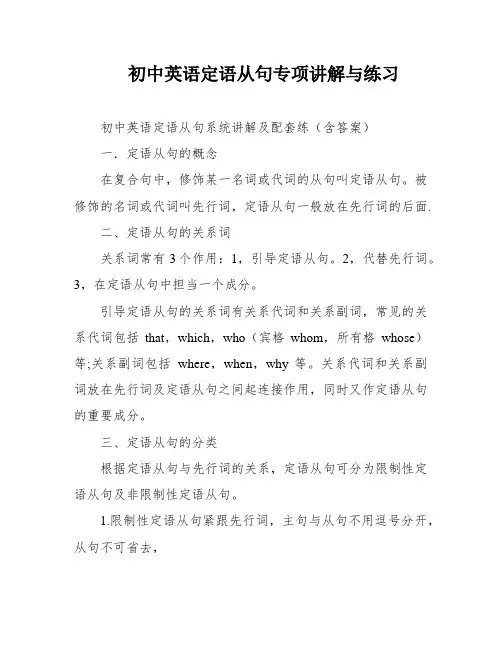
初中英语定语从句专项讲解与练习初中英语定语从句系统讲解及配套练(含答案)一.定语从句的概念在复合句中,修饰某一名词或代词的从句叫定语从句。
被修饰的名词或代词叫先行词,定语从句一般放在先行词的后面.二、定语从句的关系词关系词常有3个作用:1,引导定语从句。
2,代替先行词。
3,在定语从句中担当一个成分。
引导定语从句的关系词有关系代词和关系副词,常见的关系代词包括that,which,who(宾格whom,所有格whose)等;关系副词包括where,when,why等。
关系代词和关系副词放在先行词及定语从句之间起连接作用,同时又作定语从句的重要成分。
三、定语从句的分类根据定语从句与先行词的关系,定语从句可分为限制性定语从句及非限制性定语从句。
1.限制性定语从句紧跟先行词,主句与从句不用逗号分开,从句不可省去,限定性定语从句是先行词在乎义上不成短少的定语,假如去掉的话,主句的意义就不完全,意义就表述不明。
这类句型普通定语从句紧接先行词,如:I was the only person in myoffice who was invited.2.非限定性定语从句主句与从句之间有逗号分隔,起弥补申明感化,如省去,意义仍完全。
非限制性定语从句。
它与主句的关系不十分密切,只是对其附加说明,也就是讲即便去掉定语从句,句意也不受影响,仍然清晰明了。
这样的定语从句要在它和主句之间加一逗号分开。
且关系代词不引导这种非限制性定语从句,如:Michael Jaskon,who is the greatest singer in the world,passed away in 2010.如:Mary lived in the city of Hongkong,where used to be a small poor countryside.4、干系代词的用法1.that既可以用于指人,也可以用于指物。
在从句中作主语或宾语,作主语时不可省略,作宾语可省略。
定语从句讲解及练习

定语从句1.定语从句:定语从句是由关系代词或关系副词引导的从句,其作用是作定语修饰主句的某个名词性成分,相当于形容词,所以又称为形容词性从句,一般紧跟在它所修饰的先行词后面。
2.关系词:引导定语从句的关联词称为关系词,关系词有关系代词和关系副词。
关系代词有that, which, who, whom, whose, as等;关系副词有where, when, why等。
关系词常有 3 个作用: 1 ,引导定语从句。
2 ,代替先行词。
3,在定语从句中担当一个成分。
注:关系代词有主语.宾语之分。
一般whom 作为宾语。
4.定语:定语用来限定、修饰名词或代词的,是对名词或代词起修饰、限定作用的词、短语或句子,汉语中常用 , ⋯⋯的 ?表示。
主要由形容词担任。
此外,名词,代词,数词,分词,副词,不定式以及介词短语也可以来担任,也可以由一个句子来担任.单词作定语时通常放在它所修饰的词之前,作前置定语。
短语和从句作定语时则放在所修饰的词之后,作后置定语。
(一)关系代词(在句中作主语、宾语或定语)1. that 既可代表事物也可代表人,which 代表事物;它们在从句中作主语或宾语,that 在从句中作宾语时常可省略关系词,which 在从句中作宾语也可以省略。
[eg :this is the book(which)you want。
]而且,如果which在从句中作“不及物动词+介词”的介词的宾语,注意介词不要丢掉,而且介词总是放在关系代词which 的前边,但有的则放在它原来的位置2. which作宾语时,根据先行词与定语从句之间的语义关系,先行词与which 之间的介词不能丢3. 代表物时多用which ,但在带有下列词的句子中用that 而不用which ,这些词包括当先行词是anything, everything, nothing , none等不定代词时,或者是由every, any, all, some, no, little, few, much等修饰时等,这时的that 常被省略还有先行词前有序数词或形容词最高级修饰时,或先行词就是序数词或最高级时.以及先行词中既有人又有物时 .还有句中前面有which 时 ,都只能用that4. who 和 whom 引导的从句用来修饰人,分别作从句中的主语和宾语,whom 作宾语时,要注意它可以作动词的宾语也可以作介词的宾语5. whose 是关系代词,修饰名词作定语,相当于所修饰成分的前置所有格.它引导的从句可以修饰人和物, 当它引导的从句修饰物体时, 可以与of which调换,表达的意思一样。
高中英语2025届高考语法复习定语从句知识讲解练习
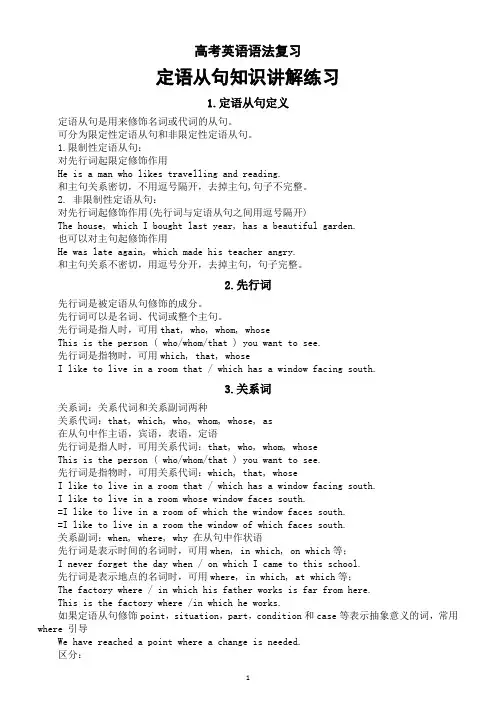
高考英语语法复习定语从句知识讲解练习1.定语从句定义定语从句是用来修饰名词或代词的从句。
可分为限定性定语从句和非限定性定语从句。
1.限制性定语从句:对先行词起限定修饰作用He is a man who likes travelling and reading.和主句关系密切,不用逗号隔开,去掉主句,句子不完整。
2. 非限制性定语从句:对先行词起修饰作用(先行词与定语从句之间用逗号隔开)The house, which I bought last year, has a beautiful garden.也可以对主句起修饰作用He was late again, which made his teacher angry.和主句关系不密切,用逗号分开,去掉主句,句子完整。
2.先行词先行词是被定语从句修饰的成分。
先行词可以是名词、代词或整个主句。
先行词是指人时,可用that, who, whom, whoseThis is the person ( who/whom/that ) you want to see.先行词是指物时,可用which, that, whoseI like to live in a room that / which has a window facing south.3.关系词关系词:关系代词和关系副词两种关系代词:that, which, who, whom, whose, as在从句中作主语,宾语,表语,定语先行词是指人时,可用关系代词:that, who, whom, whoseThis is the person ( who/whom/that ) you want to see.先行词是指物时,可用关系代词:which, that, whoseI like to live in a room that / which has a window facing south.I like to live in a room whose window faces south.=I like to live in a room of which the window faces south.=I like to live in a room the window of which faces south.关系副词:when, where, why 在从句中作状语先行词是表示时间的名词时,可用when, in which, on which等;I never forget the day when / on which I came to this school.先行词是表示地点的名词时,可用where, in which, at which等;The factory where / in which his father works is far from here.This is the factory where /in which he works.如果定语从句修饰point,situation,part,condition和case等表示抽象意义的词,常用where 引导We have reached a point where a change is needed.区分:there’s one point that we must insist on.先行词是表示原因的名词时,可用why, for which等。
高中英语语法基础 ——定语从句知识点总结归纳讲解(附同步练习)(有答案)

高中英语语法基础——定语从句知识点归纳讲解(附同步练习)★先行词:被定语从句修饰的名词或代词叫先行词。
通常情况下,引导词前面的名词即为从句的先行词。
★关系词:引导定语从句的词叫关系词。
也可以称作引导词。
①关系代词:who,whom,which,that,whose,as,在从句内作主语、宾语等名词性成分。
②关系副词:when,where,why在从句内作状语。
(一). 使用who、whom、which、that的定语从句1. whoThis is the boy who plays basketball very well.This is the teacher who is teaching us English.▲who 指人, 在从句中作主语。
2. whomThis is the boy (whom) I often help.The man is our headmaster (whom) you met just now.I met the girl (whom) you often praise.▲whom 指人,在从句中作宾语, 可省略。
3. whichThis is the farm which keeps many cows.This is the farm (which ) I visit every year.▲which 指事物, 在从句中作主语或宾语,作宾语时可省略。
4. that以上三种情况均可用that。
指人或指物,可作主语和宾语,作宾语时可省略。
(二). 使用whose的定语从句Do you know the girl whose father is mayor.I used to work in an office whose window faces north.I work in a school whose students are excellent.▲whose 指人或物的所属关系,表示“某人的”或“某物的”。
定语从句详解及经典习题
定语从句1. 定语从句的结构及理解2. 定语从句的关系词的使用3. 定语从句的简化表达知识总结归纳(一)定语从句的结构:在复合句中,修饰某个名词或代词的句子(做这个名词或代词的定语)叫定语从句,定语从句一般放在被修饰的名词或代词后面,被修饰的名词或代词叫做定语从句的先行词,它与定语从句之间要有一个词连接,这个词指代先行词的内容叫做关系词(关系代词或关系副词:that, which, who, whose, when, where, why)。
先行词在定语从句中充当主语,宾语,时间,地点,原因状语。
结构:先行词+关系词+定语从句。
1. There she saw a wall of water that was quickly advancing towards her.2. In Japan, someone who sees another person making the gesture will think it means money.3. A theme park is a collection of rides, exhibitions or other attractions that are based on a common theme.4. The park has a conservation center that helps protect marine animals and their habitats in the rivers and coastal waters of Asia.5. Visitors can go on exciting rides where they can feel what it is like to do the things they have seen their heroes do in the movie.6. Oprah Winfrey is a black woman whose rise to fame is an inspiring story.(二)定语从句分为限定性定语从句和非限定性定语从句:限定性定语从句:从句对先行词进行必要的描述或说明,缺少它,则句义显得不完整,从句与先行词紧密相连。
(2024版)中考定语从句讲解与练习
可编辑修改精选全文完整版中考定语从句讲解与练习一、定语从句的概述在复合句中修饰或限定名词、代词的从句叫做定语从句。
被定语从句修饰或限定的名词、代词叫做先行词;引导定语从句的词叫做引导词。
定语从句放在所修饰、限定的词(先行词)之后。
例1:The boy who is reading a story book is my brother. 那个正在读一本故事书的男孩是我的兄弟。
在这句话中,who is reading a story book.是定语从句。
它修饰、限定the boy,the boy是先行词,引导定语从句的who是引导词。
二、定语从句的分类:定语从句可分为限制性定语从句和非限制性定语从句。
1. 限制性定语从句一般紧跟在先行词的后面,用来说明先行词的性质、身份、特征等状况,与先行词的关系非常密切,翻译时一般要译到先行词的前面;如果去掉,则整个句子的意思含混不清。
A doctor is a person who looks after people's health. 医生是照顾人们健康的人。
2. 非限制性定语从句起到补充说明作用,译为汉语时常不译作定语,而是根据句意译为相应的其他形式的从句。
它与主句的关系不如限制性定语从句密切,只是对先行词作附加说明,既使去掉,主句的意思依然清楚。
非限制性定语从句前往往有逗号与主句隔开,如非限制性定语从句放在句子中间,其前后都需要用逗号与隔开。
Yesterday, Jimmy left for Canada, where he had stayed two years.昨天,吉米动身到加拿大去了,他曾在那儿呆了两年。
三、定语从句的引导词引导定语从句的词称为引导词,它一方面连接先行词和定语从句;别一方面又在定语从句中充当句子成份,引导词一般不能按照疑问代词或疑问副词的意义进行翻译,一般情况下应译为“……的”。
定语从句的引导词可为分为关系代词和关系副词。
定语从句的详尽讲解和相关练习.doc
学习必备定语从句在复合句中修饰名词或代词的从句叫做定语从句。
被定语从句修饰的名词或代词叫做先行词。
定语从句必须放在先行词之后,对其起限定作用。
例句分析: This is Xiao Wang.这是小王。
Xiao Wang gave us a talk yesterday小.王昨天给我们作了个报告。
我们可以将这两个句子合并为:This is Xiao Wang who (that) gave us a talk yesterday.(先行词)(定语从句)定语从句中的 who (that) 是关系代词,在这个定语从句中作定语从句的主语。
因为先行词是人,需用 who 或 that 引导定语从句。
在翻译时 who 不必译为“谁”,应译为“ 的”。
引导定语从句的关系代词,一是放在先行词与定语从句之间引导定语从句;二是在定语从句中充当某个成分。
引导定语从句的关系代词有:who,whom,whose,that,which引导定语从句的关系副词有:where,when,why一、who,whom,that 引导的定语从句。
这三个代词指人,它们引导的定语从句所修饰的先行词必须是人。
1.who 在从句中作主语。
如:This is the doctor who camehere yesterday这.就是昨天来的医生。
2. Whom 在从句中作宾语,可以省略。
如:The man (whom)you saw lasy week has left the town.上周你看见的那个人已离开城镇了。
注意:在从句中着介词宾语时,介词一般可放在whom 之前,也可放在原来的位置上。
在含有介词的固定动词词组中介词只能放在原来的位置上。
如:a. The man from whom I borrowed the book is Li Lei . →The man whom Iborrowed the book from is Li Lei.我借书的那个南人是李磊。
定语从句讲解及练习
定语从句一定语从句(Attributive Clauses)由关系代词或关系副词引导的从句,其作用是作定语修饰主句的某个名词性成分,被修饰的名词,词组或代词即先行词。
定语从句一般紧跟在它所修饰的先行词后面,由关系词(关系代词或关系副词)引出。
关系代词有that, which, who, whom, whose, as等;关系副词有where, when, why等。
关系词常有3个作用:①引导定语从句。
②代替先行词。
③在定语从句中担当一个成分。
二关系代词引导的定语从句举例关系代词所代替的先行词是人或物的名词或代词,并在句中充当主语、宾语、定语等成分。
关系代词在定语从句中作主语时,从句谓语动词的人称和数要和先行词保持一致1.who(主格,在定语从句中做主语), whom(宾格,做宾语),两者“代替的是人”。
(1) Is he the man who wants to see you? 他就是想见你的人吗?(who在从句中作主语)(2) He is the man (whom) I saw yesterday. 他就是我昨天见的那个人。
(whom在从句中作宾语,可省略)2.whose是所有格,用来指人或物,(只用作定语, 若指物,它还可以同of which互换)(1) They rushed over to help the man whose car had broken down. 那人车坏了,大家都跑过去帮忙。
(2) Please pass me the book whose (of which) cover is green.请递给我那本绿皮的书。
3.which指物,在定语从句中做主语或宾语。
作宾语时刻省略。
(1) Tom lost his favorite book, which made him very upset.汤姆丢了他最喜欢的书,这让他很不开心。
在非限制性定语从句中,which可指代前面讲到的整件事。