
预算编制-成本预算英文版课件87页 精品
• Return is the increased future cash inflows attributable to the long-term asset
▪ Reduce an organization’s flexibiliቤተ መጻሕፍቲ ባይዱy
11-4
Meaning of Capital Budgeting
• Capital budgeting can be defined as the process of analyzing, evaluating, and deciding whether resources should be allocated to a project or not.
machinery • Where to locate manufacturing facility?
11-7
Investment and Return
• Investment and return form the foundation of capital budgeting analysis, which focuses on whether the expected increased cash flows (return) will justify the investment in the long-term asset
▪ The amount of money committed to the acquisition of capital assets is usually quite large
▪ The long-term nature of capital assets creates technological risk
11-8
The Time Value of Money
Which would you rather have -- $1,000 today or $1,000 in 5 years?
Obviously, $1,000 today. Money received sooner rather than later allows one to use the funds for investment or consumption purposes. This concept is referred to as the TIME VALUE OF MONEY!!
11-9
Time Value of Money
A dollar today is worth more than a dollar a year from now since a dollar
received today can be invested, yielding more than a dollar a year from
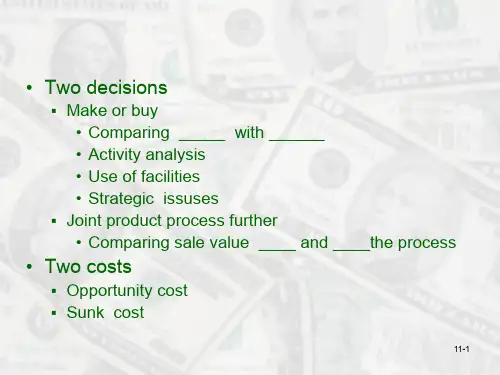
• Two decisions
▪ Make or buy • Comparing _____ with ______ • Activity analysis • Use of facilities • Strategic issuses
▪ Joint product process further • Comparing sale value ____ and ____the process
▪ Organizations are usually committed to long-term assets for an extended time, creating the potential for • Excess capacity that creates excess costs • Scarce capacity that creates lost opportunities
• Capital assets create these capacity-related costs
11-3
Need to Control Capital Assets
• Organizations have developed specific tools to control the acquisition and use of long-term assets because:
11-5
11-6
Types of Capital Budgeting Decisions
• Should we add a new product to our existing product line?
• Should we expand into a new market? • Should we replace our existing machinery? • Should we buy fully automatic or semiautomatic
• Capital budgeting has three phases:
▪ Identifying potential investments, ▪ Choosing which investments to make, and ▪ Follow-up monitoring of the investments.
• Two costs
▪ Opportunity cost ▪ Sunk cost
11-1
Capital Budgeting
Chapter 11
Long-Term (Capital) Assets
• Capital assets are equipment or facilities that provide services to the organization for more than one fiscal period.
《预算编制》PPT课件 (2)

“下”是信息的向下流动,就是财政部门下达预算控 制数和预算修改意见或将人大最终批复的预算传达给部门。
整理课件
21
部门预算
二、部门预算编制流程(二上二下):
“一上”:支出部门在收到财政部门的年度预算编制通 知后,对部门下一年度收支进行测算,然后报送给财政部门。
预算的准确性和真实性得不到整必理课要件 的保证。
5
我国预算周期的特殊性和问题
四,在立法机关预算审查批准方面的问题更为严重。 1,审查批准时间太短。可以说,我国立法机关审查批准
政府预算草案的时间只是每年一度人民代表大会开会的这一段 时间。由于每年一度的人民代表大会会议需要审议的事项很多, 除当年政府财政预算和上年政府决算外,还有“两院报告”和上 年国民经济和社会发展计划执行情况和本年度计划报告等,因 而,严格意义上的政府预算草案审查批准时间更是非常有限。 在这样短的时间内完成对政府预算草案的审查批准程序是不可 想象的。
部门预算既是政府管理的重要内容,也是人大预算审查 和监督的基础。
要求把一个部门下一年度不同性质的所有财政资金统一
编制到一个部门的预算中,支出由财政部门按照资金需求及本
级财力情况,依照人员经费、公用经费和专项经费三部分核定
。
整理课件
20
部门预算
二、部门预算编制流程(二上二下):
“上”、“下”是财政部门和支出部门之间的正式沟通 过程。
整理课件
4
我国预算周期的特殊性和问题
三,政府预算的编制期限太短(续)
在这样短的时间内编制出的政府预算草案,显然是不可能
很充分的。
这一是因为在这样短的时间内不可能高质量地完成对政
《预算编制》课件

预算绩效评价指标体系
预算执行情况:险和 应对措施
收集数据:收集与评价目标相关的数据,包括财务数据、业务数据等
分析数据:运用统计分析方法,对收集到的数据进行处理和分析
撰写评价报告:根据分析结果,撰写预算绩效评价报告,提出改进建议 和措施
反馈与改进:将评价结果反馈给相关部门,并根据反馈进行改进和优化
预算绩效评价结果的应用和管理
绩效评价结果作为预算调整的依据 绩效评价结果作为预算执行情况的反馈 绩效评价结果作为预算编制的参考 绩效评价结果作为预算管理的重要指标
预算编制的技巧
明确预算目标:确定预算编制的目的和范围,确保预算与公司战略目标一致 详细预算编制:详细列出各项预算项目,包括收入、成本、费用等,确保预算全面、准确 预算控制:制定预算控制措施,确保预算执行过程中不超支 预算调整:根据实际情况,对预算进行调整,确保预算与实际情况相符
预算编制的风险控制
期成果
收集数据:收集与预 算相关的历史数据、
市场数据等
分析需求:分析各部 门、项目的需求,确
定预算分配
制定预算方案:根据 需求分析结果,制定
预算方案
审核预算方案:对预 算方案进行审核,确 保其合理性和可行性
批准预算方案:经过 审核后,由相关部门 或领导批准预算方案
执行预算方案:按照 批准的预算方案执行 预算,确保预算目标
的实现
预算编制的方法
确定预算目标:明确预算编制的目的和预期成果 收集数据:收集与预算相关的历史数据、市场数据等 分析需求:分析企业内部各部门的需求,确定预算分配 制定预算方案:根据需求分析结果,制定预算方案 审核预算方案:对预算方案进行审核,确保其合理性和可行性 实施预算方案:按照预算方案进行实施,并定期进行监控和调整
成本预算英文版课件(PPT87页)
a
Annuity, or equal amount, received or paid at the end of each
period for n periods
r
Rate of return required, or expected, from an investment
opportunity; the rate of interest earned on an investment
• For simplicity, the following notation is used:
Abbr.
Meaning
n
Number of periods considered in the investment analysis;
common period lengths are a month, a quarter, or a year
Reduce an organization’s flexibility
11-4
Meaning of Capital Budgeting
• Capital budgeting can be defined as the process of analyzing, evaluating, and deciding whether resources should be allocated to a project or not.
11-13
Types of Interest
Simple Interest
Interest paid (earned) on only the original amount, or principal borrowed (lent).
预算法 英文版

预算法英文版Budgeting is a fundamental aspect of financial management that allows individuals and organizations to plan and control their spending. In this article, we will explore the concept of budgeting and discuss its importance in both personal and business finance.Budgeting, also known as the budgetary process, involves the estimation of future income and expenses and the allocation of resources to achieve specific financial goals.By creating a budget, individuals and organizations can track their income and expenses, identify areas of overspending, and make informed decisions about how to best allocate their resources.In personal finance, budgeting is crucial for achieving financial stability and long-term goals. By creating a budget, individuals can track their income, expenses, and savings, and identify areas where they can cut costs or increase savings. A budget canalso help individuals plan for major expenses, such as buying a home or paying for education, and ensure that they are living within their means.In business finance, budgeting plays a critical role in ensuring the financial healthand success of an organization. By creating a budget, businesses can plan for future expenses, allocate resources to different departments or projects, and monitor their financial performance. A well-planned budget can help businesses identify areas of inefficiency, make strategic decisions about resource allocation, and achieve their financial goals.There are several different budgeting methods that individuals and organizations can use to create a budget. One common method is zero-based budgeting, where all expenses must be justified for each budgeting period. This method can help individuals and organizations identify unnecessary expenses and prioritize spending based on their financial goals.Another popular budgeting method is the 50/30/20 rule, which suggests allocating 50% of income to needs, 30% to wants, and 20% to savings and debt repayment. This methodcan help individuals strike a balance between meeting their basic needs, enjoying discretionary spending, and saving for the future.In conclusion, budgeting is a critical aspect of financial management that allows individuals and organizations to plan and control their spending. By creating a budget, individuals and businesses can track their income and expenses, identify areas of overspending, and make informed decisions about resource allocation. Ultimately, budgeting is essential for achieving financial stability, meeting financial goals, and ensuring long-term financial success.。
《预算编制》课件

某部门费用预算编制案例
总结词
精细化分类管理,合理控制费用支
详细描述
某部门在编制费用预算时,对各项费用进行了精细化 分类管理。根据部门职能和工作特点,将费用划分为 固定费用、变动费用、专项费用等不同类别。针对每 一类费用,部门制定了合理的预算标准和支出计划。 同时,部门加强了对费用支出的监控,及时发现和纠 正不合理的费用支出,确保预算目标的实现。
感谢您的观看
THANKS
预算执行的分析与反馈
分析预算执行情况
定期对预算执行情况进行深入分析,找出存 在的问题和改进点。
反馈意见和建议
将分析结果反馈给相关部门和人员,提出改 进意见和建议,促进预算管理水平的提升。
05
预算编制的优化与改进
提高预算的准确性
01
02
03
详细分析历史数据
对历史财务数据进行深入 分析,了解预算编制中的 误差来源,提高预算的准 确性。
职责
高层管理者负责制定组织战略目标和预算政策;部门经理负责制定部门预算计划 ;财务人员负责汇总各部门预算,形成总预算;其他相关部门人员负责提供预算 编制所需的各类信息。
02
预算编制的基础
经营计划与目标
总结词
经营计划和目标是预算编制的核心,它们为预算提供了明确 的方向和目标。
详细描述
在预算编制过程中,首先需要明确公司的经营计划和目标, 以确保预算与公司的战略发展方向保持一致。经营计划包括 对市场需求的预测、产品策略、销售策略等,而目标则是指 公司在一定时期内期望达到的业绩水平。
详细描述
零基预算能够消除过去不合理的支出,更加关注未来的需求和机会。它需要深入分析每个项目的必要性和优先级 ,因此编制过程较为复杂和耗时。
成本预算英文版课件(PPT87页)

Meaning of Capital Budgeting
• Capital budgeting can be defined as the process of analyzing, evaluating, and deciding whether resources should be allocated to a project or not.
a
Annuity, or equal amount, received or paid at the end of each
period for n periods
r
Rate of return required, or expected, from an investment
opportunity; the rate of interest earned on an investment
• Investment is the mon organization gives up to acquire a long-term asset which are often called capital outlays.
• Return is the increased future cash inflows attributable to the long-term asset
The Time Value of Money
Which would you rather have -- $1,000 today or $1,000 in 5 years?
Obviously, $1,000 today.
Money received sooner rather than later allows one to use the funds for investment or consumption purposes. This concept is referred to as the TIME VALUE OF MONEY!!
预算编制培训课件
目录
• 预算编制基本概念与原则 • 预算编制方法与技巧 • 预算编制中常见问题及解决方案 • 预算执行、监控与调整策略 • 预算考核、评价与激励机制设计 • 现代信息技术在预算编制中应用
01
预算编制基本概念与原 则
预算定义及作用
预算定义
预算是企业未来一定时期内经营 、资本、财务等各方面的收入、 支出、现金流的总体计划。
,为管理层提供决策依据。
建立预警机制
设定预算执行的预警线,当实际 支出超过预警线时,及时发出预 警信号,提醒相关部门采取措施
。
预算调整条件及程序
1 2
明确预算调整条件
在预算编制时,应明确预算调整的条件和范围, 如市场环境发生重大变化、企业战略调整等情况 下允许进行预算调整。
制定预算调整程序
建立规范的预算调整程序,包括申请、审批、执 行等环节,确保预算调整合规、有序进行。
预算周期与流程
01
02
03
04
预算编制
根据预算目标,结合实际情况 ,编制各项预算。
预算执行与控制
按照预算编制的计划和要求, 执行预算并加强过程控制。
预算分析与调整
定期对预算执行情况进行分析 ,发现问题及时调整预算。
预算考核与评价
对预算执行结果进行考核和评 价,总结经验教训,持续改进
预算管理。
02
大数据技术在预算编制中应用
数据收集与整合
大数据技术能够实现对海量数据的快速收集和整合,为预算编制提 供全面、准确的数据基础。
数据分析与挖掘,为预 算编制提供更加科学的依据。
预算调整与优化
大数据技术能够实时监测预算执行情况,为预算调整和优化提供数据 支持。
EAS预算编制和维护指导22446页PPT
【2019-销售二部】)
路径:管理会计-预算管理-预算处理-预算编制
选择新增的部门,新增预算表,完成后,待总部审批。
2、上级部门编制预算调整(审批后)
路径:管理会计-预算管理-预算处理-预算调整
选择 “2019-销售二部”的上级部
注:调整后,逐级向上调
选择 “预算调整” 出现 编辑界面
整
选择 “组织汇总”,
2020/4/29
18
预算调整—成本中心调整
2020/4/29
19
预算调整—成本中心调整
2020/4/29
20
预算调整—预算项目表调整
2020/4/29
21
预算调整—Leabharlann 算项目表调整2020/4/29
22
预算调整—经营分析表调整
2020/4/29
23
实际数据日常维护
一、实际数据日常维护 1、是对实际发生的数据,在项目间、 部门间或者公司间进
2020/4/29
11
3、预算上报后的处理
预算上报后发现预算表有错,让总部打回预算表。 对打回的预算表,进行修改。 如果要删除预算表,操作如下:修改—>保存—>删除。
2020/4/29
12
4、修改预算表—末级部门
路径:管理会计-预算管理-预算处理-预算编制 1、选择预算表 2、修改 3、保存
注:修改要从 末级 部门开始做,逐级 向上“修改”,重 新 进行“组织汇总”
行调整。 2、实际数据维护要求按月进行。 3、路径:管理会计—预算管理—预算处理—实际数据—实
际数据日常维护 二、操作分类 • 涉及到部门间【部门内项目间】的实际发生数据的调整 • 不涉及部门之间的实际数据调整
成本预算编制.pptx
Байду номын сангаас
12、损益附表四(管理费用预算表)
单位:RMB万元
序号
1 2 3 4 5 6 7
科目明细
工资 业务开发费 广告宣传费 折旧费用 差旅费用 业务佣金 其他
合计
预算金额 预算比例 1月
12月
37
• 9、春去春又回,新桃换旧符。在那桃花盛开的地方,在这醉人芬芳的季节,愿你生活像春天一样阳光,心情像桃花一样美丽,日子像桃子一样甜蜜。2 0.10.2420.10.24Saturday, October 24, 2020
。2020年10月24日星期六下午3时48分18秒15:48:1820.10.24
• 15、会当凌绝顶,一览众山小。2020年10月下午3时48分20.10.2415:48October 24, 2020
• 16、如果一个人不知道他要驶向哪头,那么任何风都不是顺风。2020年10月24日星期六3时48分18秒15:48:1824 October 2020
•
T H E E N D 17、一个人如果不到最高峰,他就没有片刻的安宁,他也就不会感到生命的恬静和光荣。下午3时48分18秒下午3时48分15:48:1820.10.24
谢谢观看
• 10、人的志向通常和他们的能力成正比例。15:48:1815:48:1815:4810/24/2020 3:48:18 PM • 11、夫学须志也,才须学也,非学无以广才,非志无以成学。20.10.2415:48:1815:48Oct-2024-Oct-20 • 12、越是无能的人,越喜欢挑剔别人的错儿。15:48:1815:48:1815:48Saturday, October 24, 2020 • 13、志不立,天下无可成之事。20.10.2420.10.2415:48:1815:48:18October 24, 2020
预算法 英文版
预算法英文版Budgeting LawIntroductionBudgeting plays a crucial role in the financial management of organizations, whether they are government entities or private businesses. In order to effectively manage and allocate resources, it is essential to have a well-defined budget that outlines the planned expenditures and revenues. This article aims to provide an overview of the budgeting law, its importance, and the key elements that should be considered when developing a budget.Definition of Budgeting LawBudgeting law refers to a set of regulations and guidelines that govern the process of budget preparation and execution. It outlines the principles and procedures that need to be followed to ensure transparency, accountability, and efficient financial management. The budgeting law varies from country to country, with each jurisdiction having its own specific regulations and requirements.Importance of Budgeting LawThe budgeting law serves several important purposes. Firstly, it promotes transparency and accountability in the allocation and use of public resources. By clearly outlining the budget preparation and execution process, it ensures that all financial decisions are made in a fair and equitable manner. Additionally, the budgeting law facilitates effective planning and resource allocation, helping organizations achieve their strategic objectives.Key Elements of the Budgeting Law1. Budget Preparation ProcessThe budget preparation process is a critical aspect of the budgeting law. It involves the identification and estimation of income and expenditures for a given period. The budgeting law should specify the timeline, responsibilities, and procedures for preparing the budget. It should also outline the guidelines for estimating income, such as taxes, grants, and other sources of revenue, as well as the criteria for determining expenditure priorities.2. Budget Approval and AdoptionOnce the budget is prepared, it needs to be reviewed, approved, and adopted by the appropriate authorities. The budgeting law should clearly define the roles and responsibilities of different stakeholders in the approval process. This may include government officials, legislative bodies, or boards of directors, depending on the organizational structure. The law should also outline the criteria for evaluating the budget proposal, such as its alignment with the strategic goals and financial feasibility.3. Budget Execution and ControlAfter the budget is approved, it needs to be effectively executed and monitored to ensure compliance and efficient resource utilization. The budgeting law should provide guidelines on the procedures and controls to be followed during the execution phase. This may include regular financial reporting, monitoring of expenditures, and mechanisms for addressing budget deviations. The law should also outline the consequences of non-compliance with the budget, such as penalties or legal actions.4. Budget Evaluation and ReviewPeriodic evaluation and review of the budget are essential to assess its effectiveness and make necessary adjustments. The budgeting law should require organizations to conduct regular performance evaluations to measure the outcomes and impact of the budget. This may involve comparing actual results with the budgeted figures, identifying variances, and conducting root cause analysis. The law should also mandate regular reviews of the budget process to identify areas for improvement and address any deficiencies.ConclusionIn conclusion, the budgeting law is a vital tool for effective financial management. It ensures transparency, accountability, and efficient allocation of resources. The key elements of the budgeting law include the budget preparation process, budget approval and adoption, budget execution and control, and budget evaluation and review. By adhering to the budgeting law, organizations can achieve their financial goals and objectives while maintaining good governance practices.。