
【高中英语新教材】1.4 Reading for writing 导学案(2)-人教版高中英语必修第一册
Unit 1 Unit 1 Teenage LifePeriod 4 Reading for writing导学案1.学习本板块内涉及的词汇和表达2.了解并掌握建议信的结构和写法重点:1. 掌握本小节重点词汇和句型2. 了解建议信的框架和完成建议信的写作难点:1.完成建议信的写作和修改。
一、重点词汇和短语1.掌握下列短语寻求建议ask for some advice 担心be worried about 焦虑be anxious 打游戏play computer games 某人的行为举止one’s behavior网络世界the online world 聚焦focus on成瘾become addicted to 聚精会神于……concentrate on2.重点单词1)adventure n. 冒险;奇遇(短语)take adventuresadj. adventurous 冒险的;奇遇的2)survival n. 生存;幸存;幸存事物vi. survive 幸存;活下来Vt. 幸免于;比……活得长eg. Some strange customs have survived from earlier times.有些奇怪的风俗是从早年留存下来的。
3)expert n. 专家;行家(短语) an expert in … 在某方面的专家adj. 熟练的,内行的(短语)be expert at 擅长4)attract Vt. 吸引;引起……的注意(短语)attract one’s attention 吸引某人的注意be attracted to 喜爱n. attraction 注意力adj. attractive 吸引人的5)focus vi. 集中注意力; (使)调节焦距(短语)focus on 特别关注focus one’s attention on 注意6)addicted adj. 成瘾的;入迷的(短语)be addicted to doing sth. / sth.根据汉语提示或所给词的正确形式完成下列句子1) Interesting stories always draw people’s attraction (attract) easily.2) It is common that children are attracted (attract) to novel things.3) I went through about four years of being addicted to video games.我大约有4年时间沉迷在电子游戏中。
4) Today, we will focus on the problem of teenager education in rural areas.今天,我们会关注农村地区的青少年教育问题。
5) She was the last surviving member of the family.她是这家人中仅存的一员.6)Our team of experts will offer help and advice whenever we are in need.我们的专家小组将随时提供帮助和建议。
二、掌握重点句型1.I recommend that you talk to your friend about his behavior.解析:recommend / suggest / advise 等表示建议类的动词后面接宾语从句时从句部分使用…. (should)do 的形式,should 可以省略。
He recommended that we (should) stay in a nice hotel by the seaside because he had just spent a holiday there.他推荐我们待在海边一个不错的小旅馆,因为他刚刚在那里度过假。
2. It's not unusual for teenagers of your generation to be attracted to computer games and the online world.解析:“It is (not)unusual for sb. to do sth.” 形式主语句型,“某人做某事并不是很特殊(或很见)”It is unusual for my father to tell a joke. 我爸爸很少讲笑话。
3. But spending too much time online is unhealthy and makes it very difficult to focus on other things in life.解析:Doing sth.is unhealthy and makes it difficult to do sth.1) 动名词做主语动词或动词短语位于主语位置时使用动名词的形式2) makes it adj. to do sth. it做形式宾语:当it做形式宾语时,常替代动词不定式短语或宾语从句,其结构为:主语+谓语动词+ it + adj /n + to do sth / that…,常用于此结构的及物动词有believe/feel/find/make/consider/think/……等。
He thinks it important that we try to do some housework after school.他们认为放学后试着做一些家务是重要的。
5. Why not discuss the problem together?解析:Why not do sth? 用来表示建议,意为“为什么不做某事?”,还可以用“Why don’t you do sth?”这种形式。
1)Our teacher makes it a rule never to talk in class.我们老师立下一个规矩,课上不能讲话。
2)In fact, I still find it hard to make good friends with her.事实上,我还是很难跟她成为好朋友。
3) It is unusual for Adam to give up when he faces difficulties.对于Adam来说,面对困难的时候放弃是很不正常的。
4)Why not have a talk with your school adviser about which course to choose.为什么不和你的学校顾问谈一谈选课的问题。
三、巩固练习You may like 1. ______(read) novels for fun. But there are something you need to pay attention if you are reading a novel for school. Here are some tips.First, it is important 2. _______(pay) attention to characters(人物). What do they do in the novel? What do they want? Everything about a character can be 3. ______(help) to understand him, from his appearance to the kind of food he eats.Besides, why not focus 4.______the order of the story and the plot ? Make sure that as you read, you make a quick note of 5. ______ happens in each chapter. This will help you bring the things you have noticed about the character, setting, language and so on together. 6._______, it's also helpful for you to retell the story after you have read 7.______.Next, 8. _______( know) the theme( 主题) of the novel is a must if you want to fully appreciate the novel. Perhaps love is a major theme, or justice, or9_______( survive).Furthermore, novels are made up of language. Writers use language in a special way to make their novels 10. _______(attract) . They may use metaphors(比喻), invent symbols, or show different characters' personalities through their speech styles.【答案】:1. to read 2 .to pay 3. helpful 4.on 5.what6.Besides7.it8.knowing9.survival 10.attractive。
【新教材】1.4-Reading-for-Writing-教学设计-人教版高中英语必修第三册
普通高中英语(2019版)必修第三册Unit 1 Festivals and Celebrations 教学设计Period 4 Reading for writing该板块的活动主题是“写你的节日经历”( Write about your festival experience从活动标题可知,该板块延续了前一板块的话题,但语言输出形式的要求有所不同。
听说板块( Listening and Talking):要求学生就各自的过节经历进行口头交流,写作板块的最终目的是要将交流的内容转化为文字,完成一篇有关节日经历的文章。
一般来说,人们大多会在日记、博客日志或旅行攻略中介绍自己独特的节日经历,因此该板块选取了一篇关于“那达慕大会”的日记供学生阅读和模仿写作。
通过阅读和学习这篇日记,学生不仅能够了解我国蒙古族“那达慕大会”这一传统节日,还能从文中感受到蒙古族人民的性格特色、娱乐精神及其浓厚的文化氛围,这也有助于培养学生的文化意识,让学生学会欣赏和珍惜多姿多彩的民族文化。
1. Read the diary about "Naadam Fair", master the content elements of the festival and the features of the text language;2. Can deeply understand the plot of the story according to the cause, process and result of the story, and find out the impact of the rock on different passers-by and their emotional and behavioral reactions to understand in detail;3. Able to deeply discuss and reflect on the impact of social development and changes on traditional festivals; able to analyze the text according to reading comprehension, prepare for the content conception, framework construction and text writing, and complete the writing of a story review.Importance:1. Guide students to analyze the deep connotation of moral stories through the comparison of characters'words and deeds;2. Help students to express their own opinions and opinions based on real life cases;3. Instruct the students to write a clear and structured story review.Difficulties:1. Systematically express my own opinions and opinions on real life cases in English;2. Independently write a story review with clear viewpoints and distinct layers.1. Read the passage in advance, understand the meaning of the new words and phrases in the text and understand the content of the article by referring to the context and the dictionary.2. Understand the literary genre of allegory, the concise and incisively language, the simple but expressive plot, the decorative techniques used and the profound truth of the educational significance revealed.Step 1 Learning new wordsThe teacher shows the pictures or uses the stick figure to draw the new words or phrases in the teaching text.Step 2 ReadingActivity 11.Students read the diary quickly and answer the first two questions in activity 1.(1)What does "Naadam" mean? Which events does it include?(2)What Naadam Festival customs did you learn about?Suggested Answers:(1) Naadam means"games"in Mongolian,and it includes horse racing,wrestling, and archery.(2) Wrestling and horse racing.2.Students read the diary carefully again with the last two questions from activity 1.After reading thediary, the students share their views in groups. Then the teacher asks some students to answer the questions.(3) What in your opinion is the most impressive thing about the festival?(4) What else would you like to know the fe stival and writer’s experience?Suggested Answers:(3) The horse racing is the most impressive, as it involved little children.(4) The writer did not talk about food or music, but surely they should have been interesting parts ofthe festival.Activity 21.Teacher asks Ss to study organization and language features.Ss read the sentences and rewrite theopening sentences of the article.2.Read the sentences and rewrite the opening sentences of the article.●This was my first time spending three days experiencin g the Naadam Festival in China’s InnerMongolia Autonomous Region and it was an enjoyable and exciting experience for me./I'll never forget my experience at the Naadam Festival because it was my first time to watch the exciting Mongolian games of horse racing, wrestling, and archery so closely./I'll always remember my first experience at the Naadam Festival in China’s Inner Mongolia Autonomous Region because it was because it was anenjoyable and exciting experience for me.Step 3 Analyzing article structureActivity 31.Teachers raise questions to guide students to analyze the chapter structure of this diary and thinkabout how to describe the festival experience.(1)What should be included in the opening/body/closing paragraph(s)?(2)How did the writer arrange his/her ideas?(3)What kind of interesting details did the writer describe?(4)How did the writer describe his/her feelings/emotions during the event?2. Students read and compare the three sentence patterns in activity 2. Try to rewrite the first paragraphof the diary with these three sentence patterns. After that, students exchange corrections with their partners.Such as:●This was my first time spending three days experiencing the Naadam Festival in China’s InnerMongolia Autonomous Region and it was an enjoyable and exciting experience.●I'll never forget my experience at the Naadam Festival because it was my first time to watch theexciting Mongolian games of horse racing, wrestling, and archery so closely.●I'll always remember my first experience at the Naadam Festival in China’s Inner MongoliaAutonomous Region because it was so amazing to spend three days witnessing a grand Mongolian ceremony.Step 4 Accumulation of statementsActivity 41.Ask the students to read the diary again. Look for sentences that express feelings and emotions,especially those with the -ing form and the past participle.Such as:● …horse racing, wrestling, and archery, which are all so exciting to watch.● some amazing performances● I was surprised to see…● I was a little worried about...● feeling really tiredOther emotional statements:●I absolutely enjoyed the archery, too, but the horse races were my favourite part.●I'm finally back home now, feeling really tired, but celebrating Naadam with my friend was totallyworth it.●He invited me back for the winter to stay in a traditional Mongolian tent and cat hot pot. I can’twait!2.In addition to the use of the -ing form and the past participle, the teacher should guide the students inthe appreciation of these statements, ask them to memorize them, and encourage them to use them reasonably in writing practice.Step 5 Writing taskActivity 51.Writing preparation.Students review their recent holiday experiences and list in short phrases all theactivities, events and feelings related to the holiday.2. Draw an outline.Students review the discourse analysis method of Activity 2, and fill in the name,content details and emotional feelings of the festival or celebration in the outline form of Activity 3, and draw up the writing outline of the diary.3. Write a first draft.Then write an opening sentence that introduces the topic and overall feeling of thearticle, a rich body paragraph, and a conclusion summarizing the holiday experience.4. Peer review.Students work in pairs to exchange the first draft, review each other according to the sixpoints in activity 3, and write Suggestions for revision.Students further modify the essay based on feedback from their peers.5. Writing and sharing.Students can share and discuss in groups after finishing the revision, andrecommend excellent compositions to be displayed or read aloud in class.The teacher comments on the students' work, points out the advantages and suggests the modification.In addition, the teacher can also post the excellent composition in the classroom for everyone to appreciate.Step 6 Sharing writingActivity 6T call some Ss to share their writing.Step 7 Homework1. Read the passage in this section to better understand the passage.2. Carefully understand the hierarchical structure of the article, and deeply understand the plot of thestory according to the causes, process and results;3. Independently complete the relevant exercises in the guide plan.1、通过本节内容学习,学生是否理解和掌握阅读文本中的新词汇的意义与用法;2、通过本节内容学习,学生能否掌握日记中关于节日见闻的内容要素及文本语言特点;3、通过本节内容学习,学生能否根据故事的起因、经过和结果来深入理解故事的情节,从而了解文章的层次结构;4、深入探讨和反思社会的发展变化对传统节日的影响,能够根据阅读理解对文本进行分析,从内容构思、框架搭建和文本撰写上做准备,完成一篇有关节日活动经历的记叙文写作。
2.4 Reading for writing 导学案(2)-人教版高中英语必修第一册

Unit 2 Travelling aroundPeriod 4 Reading for writing导学案1.学习本板块内涉及的词汇和表达2.培养不同方式表达表达相同含义句子的能力3.完成书信写作任务重点:1. 掌握本小节重点词汇和句型2. 了解和掌握整体构架书信和明确其分段落中心的能力难点:1结合景点介绍和熟悉写作,完成写作任务一、重点词汇和短语1.掌握下列短语进展顺利________ 兵马俑________ 惊人的场面________雕像statue 在现代社会________ 期待________作为……而著名________ 开始观光________ 收到……的消息________即将到来的假期________2.重点单词或短语1.make up 和解;和好;组成;构成;编造,虚构(故事、借口等);给…化妆;为…打扮;凑足,补齐(数量);(加班)补足,补上(耽误的时间);和解;和好;配(食品、药等);铺(床);搭(铺)根据汉语提示或所给词的正确形式完成下列句子I think it's very unkind of you ________.我认为你编造他的谣言很不厚道。
They'll have to ________ lost during the strike.他们不得不加班弥补罢工耽误的时间。
Her mother ________.她母亲在她曾经住过的房间里铺好了一张床注意:1)be made up of 表示整体有部分组成;make up 表示部分组成整体New Zealand ________ two islands.Two islands ________ New Zealand.新西兰由两个岛组成。
2)其他和make 有关的短语be made in 在……生产be made of 由……制成(比较容易看出原材料)be made from由……制成(很难辨认原材料)make …into 把……制成……2.sight v. 看到,发现(期待的事物)n. 视力;视觉;看见;视力范围;视野(短语)at first sight 第一眼;乍一看catch (或get a) sight of 看到;突然注意到in sight 看得见的lose sight of 再也看不见out of sight 看不见了根据汉语提示或所给词的正确形式完成下列句子。
人教必修一Welcome_unit_Period4_Reading_for_writing_导学案2
Welcome unit Period4 Reading for writing 导学案(1)1. To write a good profile using some writing skills properly.2. To master some writing words related to a person’s profile.1. To have a good understanding of a person’s profile.2.To write a good profile using some writing skills properly.1. Read the student profile on page 8 and discuss the questions. 1. What is Ann like?2. What are Ann’s hobbies?3. What is Ann’s dream?4. Where does Thando come from?5.What is Thando’s dream?6.What kind of person is Thando?7. What does “you will never see me without a book or a pen” mean?2. Fill in the formMain aspects about profilesName, age,Personali tyFavorite subjectLearnin g styleHobbies f uture plansand dreams3: Read to write down the phrases that Ann and Thando use to describe their personalities and the sentences that they use to describe their learning styles. Ann:Phrases that Ann uses to describe her personalitiesThe sentences that Ann uses to describe her learning styles. Thando:Phrases that Thando uses to describe his personalitiesThe sentences that Thando uses to describe his learning styles.4: Use what you have learnt to write your own student profile. 1. Complete the outline and use it to draft your student profile. OutlineYour student profile draft【答案】1. Read the student profile on page 8 and discuss the questions.1. What is Ann like?She is active, athletic, curious, and hardworking.2. What are Ann’s hobbies?Dancing and skating3. What is Ann’s dream?To become an engineer in the future4. Where does Thando come from?South Africa5. What is Thando’s dream?To start his own IT computer6. What kind of person is Thando?He is healthy, hardworking, and smart.7. What does “you will never see me without a book or a pen” mean? It means he is hardworking. He likes reading books and taking notes.2. Fill in the form3: Read to write down the phrases that Ann and Thando use to describe their personalities and the sentences that they use to describe their learning styles.Ann :Phrases to describe her personalities :an active person be curious aboutSentences to describe her learning styles:I often ask questions, but I learn best by doing.ThandoPhrases to describe his personalities :Think fast, play hard,Sentences to describe his learning styles:You will never see me without a book or a pen. If I am not in class, I’m either in the library or in the computer lab.4: Use what you have learnt to write your own student profile.1. Complete the outline and use it to draft your student profile.OutlineYour student profile draft。
Unit4ReadingforWriting教案高中英语人教版(2)

Unit4阅读课教案"A Night the Earth Didn't Sleep"一、Teaching Objectives:1. Students will be able to understand and interpret the content of the article about the Tangshan Earthquake.2. Students will be able to analyze the causes, impact, and rescue efforts related to the earthquake.3. Students will be able to express their opinions and understanding of the earthquake through writing or discussion.二、Teaching Key Points & Difficulties:1. Key Point 1: Students need to prehend the details of the earthquake and its aftermath, including the physical destruction, casualties, and rescue operations.2. Key Point 2: Students need to identify the causes of the earthquake, which include natural phenomena and human factors.3. Key Point 3: Students need to analyze the response and rescue efforts of the government and people during the disaster.4. Difficulty 1: Some vocabulary or technical terms may be challenging for students to understand, such as "earthquake," "rescue workers," or "miners."5. Difficulty 2: Students may have difficulty in grasping the sequence of events and their impact on each other in a plex situation like an earthquake.6. Difficulty 3: Students may find it challenging to express their thoughts and opinions in English, especially when discussing a sensitive topic like natural disasters.三、Teaching Process:1. Warmup (10 minutes)●Begin by asking students if they have ever experienced a natural disaster or heardabout one before. Encourage them to share their experiences briefly.●Then, introduce the topic of the article "A Night the Earth Didn't Sleep" and askstudents if they have any prior knowledge or interest in this topic.2. Reading prehension (30 minutes)●Direct students to read the article carefully while highlighting or underliningimportant information.●After reading, ask some questions to check their prehension, such as "Whathappened in Tangshan?" or "Who were the rescue workers?"●Guide students to summarize the main points of the article in their own words orthrough a group discussion.3. Analysis (20 minutes)●Discuss with students the causes of the earthquake, including both natural andhuman factors. Ask openended questions to encourage critical thinking andanalysis.●Analyze the impact of the earthquake on Tangshan and its people, including thephysical destruction, casualties, and rescue operations.●Encourage students to think about how different factors contributed to thedisaster and its aftermath.4. Writing activity (20 minutes)●Divide students into small groups and give them a scenario related to a naturaldisaster. Ask them to write a short paragraph or a dialogue expressing their thoughts and opinions on how to handle such situations.●Encourage students to use appropriate vocabulary and sentence structures toconvey their ideas effectively.●Collect and review each group's work, providing feedback and suggestions forimprovement.5. Closing (10 minutes)●Have a class discussion on what they learned from the article and their groupwriting activity. Ask openended questions to encourage reflection and sharing of insights.●Conclude the lesson by summarizing the key points and encouraging students toapply what they have learned in reallife situations.。
Unit4 Reading for Writing 导学案 教师版
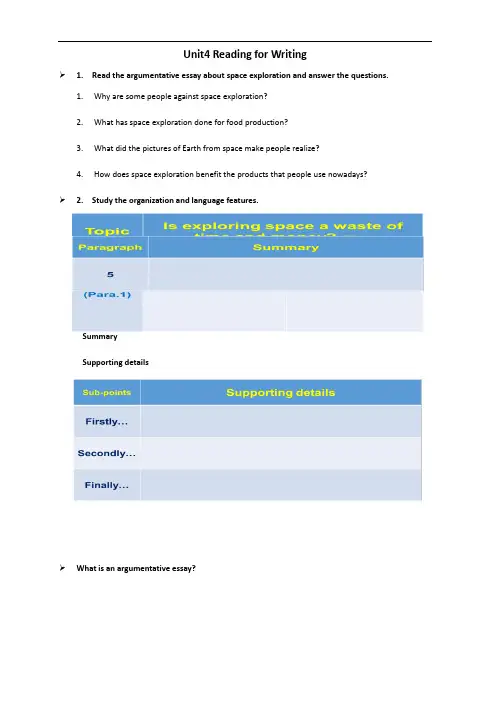
Unit4 Reading for Writing➢ 1. Read the argumentative essay about space exploration and answer the questions.1.Why are some people against space exploration?2.What has space exploration done for food production?3.What did the pictures of Earth from space make people realize?4.How does space exploration benefit the products that people use nowadays?➢ 2. Study the organization and language features.SummarySupporting details➢What is an argumentative essay?➢Structure of an argumentative essay➢Study the organization and language features.➢Useful expressionsPara. 1 Different opinions & Your opinion∙Currently, there is a widespread concern over the issue that…∙Opinions are divided on the question. Some people are in support of it while others have different opinions.∙As far as I’m concerned, I am in favor of the latter/former.Para. 2 Sub-point 1, Sub-point 2, Sub-point 3∙First of all, … A case in point is that . . .∙Furthermore, I hold the opinion that . . .∙However, the difficulty/trouble/problem lies in …∙Similarly, special attention should be paid to. . .∙In this respect, we are supposed to … For one thing,… For another,…Para. 3 Summary∙All in all, I will conclude by saying. . .∙Therefore, we have the reason to believe that. . .∙It may be safely said that. . .∙From what has been discussed above, we may safely draw the conclusion that…∙It can be concluded from the discussion that. . .➢衔接词顺序关系:first, first of all, in the first place, next, secondly, then, l ater, in the end, at last, eventually, last but not least…递进关系:what’s more, in addition, furthermore, besides, moreover…转折关系:but, however, on the contrary, nevertheless因果关系:because, since, thanks to, owing to, as a result of, f or the reason that让步关系:though, although, while, even if, even though, in spite of the fact that条件关系:if, unless, as long as, on condition that, only if…表列举:for example / instance, take…for example, that’s to say, in other words, as follows, on the one hand …on the other hand,表总结:in short, in brief, in conclusion, in a word, all in all…➢Writing Assignment人们对于学生网上交友持有不同意见。
1.4 Reading and Thinking 导学案(2)-人教版高中英语必修第三册

Unit 1 Festivals and CelebrationsPeriod 4 Reading for Writing导学案1. Read quickly to get main idea; read carefully to get the detailed information about Naadam Festival.2.Learn the structure of the reading article and language.3.Write an article about a festival experience4.Learn to use the psychology, emotions and feeling in the writing.1. Write an article about a festival experience.e the structure of the reading article and language.Step 1 Lead in ---Small talkFor Chinese, there are many important traditional festivals such as the Spring Festivals and Mid-autumn Day, at that time people always gather together to have a big meal and do something together. But what do the ethnic people do in their local festivals like the Dai people ?Step 2 Before reading---Analyze the titleMy amazing Naadam ExperienceFrom the title, we can know the article is about that ________________________________________ _____________________________________________________________________________________ Step 3 While reading ---Task 11.Find out the main idea of each paragraph.Para 1 A. the wrestling competition at the Naadam Festival.Para 2 B. something about the Naadam FestivalPara 3 C. the horse races and the riders at the Naadam FestivalPara 4 D. many people attended the Naadam FestivalPara 5 E. the author’s feeling2.The article is about_______________________________________________________. Step 4 While reading ---Task 2Read the text again and answer the following questions:Q1: What does “Naadam” mean ? Which event does it include ?Q2: What Naadam Festival customs did you learn about ?Q3: What in you opinion is the most impressive thing about the festival ?Q4: What else would you like to know about the festival and the writer’s experience ?Step 5 Post reading---Study the organisation and language features1.Read the sentence patterns below and use them to rewrite the opening sentence of the article.2.Underline the sentences that describe the writer’s emotions and feelings.3. Study the organisationStep 6 Writing ---organise the outlineoutline The name of the festival/celebration:___________________Step 7 Writing假设你是李华,你留学在美国,2019年7月4日---美国独立日那天,你和你的寄宿家庭一起去乡下进行了一次烧烤、制作冰淇淋、游泳和骑马活动,看了焰火表演,你感觉很惬意。
【新教材教案】1.4 Reading for writing 教学设计(1)-人教版高中英语必修第一册
Unit1Teenage LifePeriod 4 Reading For Writing教学设计This teaching period mainly deals with reading for writing a letter of advice. Students are expected to learn the knowledge about how to write a suggestion letter. The teacher is expected to enable students to master some writing skills concerning suggestion letters and learn to write one.1. Get students to have a good understanding of how to write a suggestion letter properly.2. Enable students to use some writing skills flexibly.3. Develop students’ writing and cooperating abilities.4. Strengthen students’ great interest in writing discourses.1. How to enable students to have a good understanding of the skills of writing a suggestion letter2.How to enable students to write a good recommendation letter using some writing skills properly.Step 1: Lead inBegin the class with the lead-in questions: how to write a letter for advice? What kinds of aspects should be included? It is strongly recommended that the teacher should ask students to discuss the topic freely with their partners and brainstorm some ideas concerning the topic. In this way, students can come up with more ideas and avoid being nervous at the beginning of the class.Step 2: Read to discover details concerning advice letters’ writing style.The teacher is expected to ask students to read a letter offering some advice on page 18 silently and then request students to discuss the questions below.In this step, what should be highlighted is that the teacher ought to give students enough time to read individually and think independently. There is no need for them to discuss the detailed questions. In this way, students can develop their individual logical thinking ability and promote their skills of findingdetails.1. What is Worried Friend’s problem?2. Do you think Ms Luo’s advice is useful? Why or why not?3. What other kinds of advice would you give?Step 3: Read to sum upAfter learning the passage on Page 18, the teacher leads students to figure out the organization of the letter and appreciate its language features.1.Find and mark the parts of the letter that match the following points.A.I know what the problem is. B I understand how you feel.C.This is my advice and reasons D I think my advice will help.2.What expressions does Ms Luo use to make suggestions? Circle them in the letter.Step 4: Use what you have learnt to write a letter of advice to one of the teenager below.In this step, the teacher asks students to sum up some ideas regarding the following topic:1.Work in groups. Choose one of the teenagers and discuss his or her problems. List possible suggestionsand reasons. Eric 15, ChicagoXu Ting 14 HangzhouStep 5: Use what you have learnt to draft a letter offering advice to any of those students above.1. Complete the outline and use it to draft your writing.2. Exchange draftsAfter each student finishes their own writing, ask them to exchange the drafts with their desk mates andevaluate the drafts with the following criteria.Use the checklist to give feedback on your partner’s draft.√Are all the parts of a letter included and organized in a good order?√Does the writer give reasons for the advice?√Does the writer use proper expressions to give suggestions?√Does the writer use commas and stops correctly?√Is the handwriting easy to read?3.Write down some writing expressions and models concerning advice letters.。
2022届新人教版高中英语必修第一册Welcome unit Period 4 Reading for writing 导学案(2)
新人教版必修第一册Welcome UnitPeriod 4 Reading for writing导学案姓名:_________ 班级:____________1. To read two profiles of Ann and Thando and try to summarize what aspects should be included when writing a profile;2. To write and finish a profile about yourself and use the checklist to improve the draft.To read and find out the aspects when writing a profile.To understand the aspects to make a good composition.学生对于个人信息的介绍并不陌生,不同于语文课的是,英语课的个人信息介绍一方面包含英语语言知识,从词汇到短语再到句式,而且还包含语言思维,也就是说高级词汇和句式的堆砌并不能保证一篇作文的非常好的交际性和连贯性,所以知识的迁移和整合都非常重要,我们要通过语言学习来了解和掌握一篇文章的写作角度,然后通过学习语言来充实。
Part 1 writing for the 1st draftWrite down a self introduction and think about what you will usually include in your introduction.______________________________________________________________________________________ ______________________________________________________________________________________ ______________________________________________________________________________________ ______________________________________________________________________________________ ______________________________________________________________________________________ ______________________________________________________________________________________ ______________________________________________________________________________________ What does your introduction include?A. name, age, grade, schoolB. personalityC. favourite subjectD. learning styleE. hobbiesF. future plans and dreamsWhat aspects are included in Ann’s profile?Ann, 15Lakeside High SchoolUSAMy name is Ann Wells and I 'm a Grade 10 student at Lakeside high school. I 'm an active person and I love sports. I'm curious about everything. I often ask questions, but I learn best by doing. My favorite subject is physics. Dancing and skating are my hobbies, and I also like to read short stories. I plan to become an engineer in the future.【答案】A: Ann, 15 Lakeside High School I 'm a Grade 10 student at Lakeside high school.B: I'm an active person and I love sports. I'm curious about everything.C: My favorite subject is physics.D: I often ask questions, but I learn best by doing.E: I love sports. Dancing and skating are my hobbies, and I also like to read short stories.F: I plan to become an engineer in the future.What aspects are included in Thando’s profile?I'm Thando Gowon. I'm 16 this year. I come from South Africa. I'm a Grade 10 student at South Hill High School. I look good, think fast, and play hard. You'll never see me without a book or a pen. If I'm not in class, I'm either in the library or in the computer lab. On the weekends, I play computer games if I'm not busy studying. My dream is to start my own IT companyA:I'm Thando Gowon. I'm 16 this year. I come from South Africa. I'm a Grade 10 student at South Hill High School.B: I look good, think fast, and play hard.D: You'll never see me without a book or a pen.E: If I'm not in class, I'm either in the library or in the computer lab. On the weekends, I play computer games if I'm not busy studying.F: My dream is to start my own IT company.Part 2 improvements on each part, age, grade, schoolTranslate the following sentences.1.我是来自于红星中学的高一学生,我叫李华。
人教版必修第一册UNIT4 Reading for Writing板块教案
人教版必修第一册UNIT4 Reading for Writing板块教学设计教材分析:【What】阅读材料1 TSUNAMI HITS ASIA:OVER 6500 DEAD是一篇2004年有关亚洲海啸的新闻报道。
报道中主要提及海啸发生的时间、成因(近40年来最强烈的一次地震)及其对沿海国家印度尼西亚、索马里半岛、斯里兰卡、印度、泰国等国家造成的人员伤亡情况;材料2 summary是前一篇报道的摘要,简明扼要地介绍了海啸发生的时间、地点、造成的伤亡情况。
材料3:The Night the Earth didn’t Sleep为本单元第2、3节课的一篇新闻报道,主要讲述了唐山大地震发生的整个过程;【How】新闻报道的特点是,文字简洁明了不啰嗦,所表达的观点客观中立不偏向。
材料一是运用大量数词说明海啸造成的严重后果,并分国家列出。
材料2 Summary部分仅用3句话概括了此次海啸情况。
语言高度凝练概括。
材料3 the Night the Earth didn’t Sleep 的语言精练,准确,信息含量大。
文章前后逻辑关系较强,联系紧密。
【Why】新闻报道的目的是为了说明何时、何地发生了何事。
这样的文体写作能让读者很快抓住文章主旨,获取信息。
材料1和材料2进行对照,起到很好的比较、归纳的作用。
学生不仅能够循序渐进地掌握概要写作的定义及方法。
材料3以其清晰的文章脉络结构及语言组织,使得学生比较容易归纳出各段的段落大意,而这恰恰是概要写作的重要一环。
学情分析:1.高一年级学生有一定的形象思维能力,能够进行简单的推理。
但相比先被告知定义再去做练习的演绎法,学生更容易接受从现象到本质的归纳法,所以读写结合的方法也正是为了适应学生的思维发展特点而采取的一种教学方法。
但是,学生的总结规律,发现事物的能力还不是很强,所以需要老师给予适当的引导和帮助。
2.通过前几节课的学习,特别是第2、3节课对材料3的精读,学生已经初步掌握了一些关于自然灾害的词汇,并已经梳理出了每一段落的段落大意,学生在此基础上能够很快找出各段落中的主要信息。
人教必修一Unit4 Reading for Writing 素养导学案
Unit4 Reading for Writing 素养导学案课前预学区I. 概要写作认真阅读第50页的课文,用约60个词概括课文大意。
_____________________________________________________________________ _____________________________________________________________________ _____________________________________________________________________Ⅱ. 速读教材第54页课文内容,回答问题What’s the main idea of the passage?The passage is mainly about ______________________________________________ ________________________________________. (no more than ten words)课中导学区研读教材Task 1阅读理解速读教材第54页课文内容,选择最佳答案。
1. What caused the tsunami?A. Hurricane.B. Typhoon.C. Flood.D. Earthquake.2. Why were food and supplies hard to deliver?A. Because there were not enough food and supplies.B. Because rescue teams dared not go.C. Because conditions were hard and roads were destroyed.D. Because governments didn’t organize rescue teams.核心考点Task 2 supply n. [pl.] 门补给品;供应(量);补给vt. 供应;供给(P52)The supplies which were provided to the disaster area were collected from around the country. 向灾区提供的物资是从全国各地收集来的。