
人教版(新起点)-英语-二年级上册-Unit 6 Lesson 1 教学
人教版(新起点)二年级下册英语unit 2 lesson 1优秀教学课件

4.如图所示是某学校为学生配备的智能学生证。智能学生证
除了记录学生个人信息资料外,还具有定位(判断学生“在
校”或“离校”)及紧急呼救等功能。智能学生证实现定位
或呼救功能时,主要是利用( )
A.超声波
B.次声波
C.无线电波 D.红外线
C
5.在地震救灾中,我们利用“北斗卫星导航系统”对发生灾
情的位置进行定位,卫星导航传递信息主要依靠( )
)
B
A.甲的波长大于乙的波长
B.甲的波长小于乙的波长
C.甲的波速大于乙的波速
D.甲的波速小于乙的波速
电磁波是个大家族,通常用于广播、电视和移动电 话的是频率为数百千赫至数百兆赫的那一部分,叫做无 线电波。
电磁波是个大家族,通常用于广播、电视和移动电 话的是频率为数百千赫至数百兆赫的那一部分,叫做无 线电波。
电磁波是个大家族,通 常用于广播、电视和移动电 话的是频率为数百千赫至数 百兆赫的那一部分,叫做无 线电波。
把一个移动电话放在真空罩中,并给 这个移动电话打电话。这个移动电话能够 收到此信号吗?
由实验可以看到,放在真空罩中的 移动电话可以收到罩外传给它的电磁波。 这说明电磁波在真空中可以传播。
月球上没有电磁波,声音无法传播。但是电磁波可 以在真空中传播。所以宇航员在月球上可以用电磁波通 信。
月球上没有电磁波,声音无法传播。但是电磁波可 以在真空中传播。所以宇航员在月球上可以用电磁波通 信。
在一系列水波的传播过程中,凸起的最高处,叫 做波峰;凹下最低处,叫做波谷。相邻的两个波峰 (或波谷)的距离叫做波长。
在某个确定位置,1s内有多少次波峰或波谷通过, 波的频率就是多少。水波不停地向远处传播,用来描述 波的传播快慢的物理量叫做波速。
人教版(新起点)英语六下unit 2《all around me》(lesson 1)教学设计
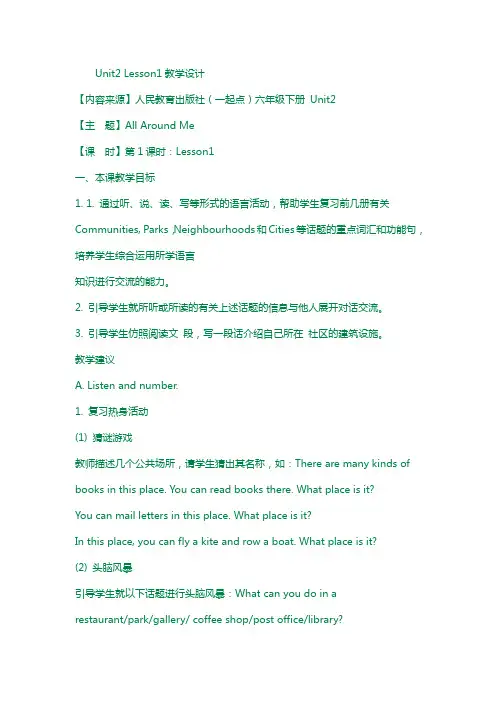
Unit2 Lesson1教学设计【内容来源】人民教育出版社(一起点)六年级下册Unit2【主题】All Around Me【课时】第1课时:Lesson1一、本课教学目标1. 1. 通过听、说、读、写等形式的语言活动,帮助学生复习前几册有关Communities, Parks,Neighbourhoods和Cities等话题的重点词汇和功能句,培养学生综合运用所学语言知识进行交流的能力。
2. 引导学生就所听或所读的有关上述话题的信息与他人展开对话交流。
3. 引导学生仿照阅读文段,写一段话介绍自己所在社区的建筑设施。
教学建议A. Listen and number.1. 复习热身活动(1) 猜谜游戏教师描述几个公共场所,请学生猜出其名称,如:There are many kinds of books in this place. You can read books there. What place is it?You can mail letters in this place. What place is it?In this place, you can fly a kite and row a boat. What place is it?(2) 头脑风暴引导学生就以下话题进行头脑风暴:What can you do in arestaurant/park/gallery/ coffee shop/post office/library?2. 听前做好准备教师引导学生看A项插图和文字,并根据这些信息推测将要听到什么内容,如:Look! What places do you see in part A? Ted is showing Bill around the city. What places do you think they are going to visit? What do you think Ted will say to Bill? Just have a guess.在学生就上述问题简短讨论后,进入下一步:Now, let’s listen to the tape to see if your guess was right. 请学生把注意力集中到A项情境图,做好听音标号的准备。
【人教版(新起点)】英语一上:Unit 6《Fruit》(第1课时)课件
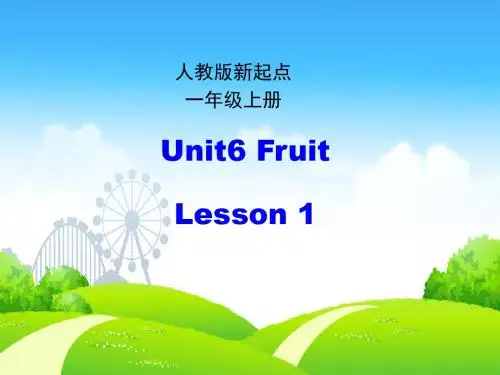
Practice
ban1ana
Choose and say.
pe2ar
ap3ple
ora4nge
忍别人所不能忍受的痛,吃别人所不能吃的苦,是为了收获别人得不到的收获!加油!!!忍别人所不能忍受的痛,吃别人所不能吃的苦,是为了收获别人得不到的收获!加油!!!忍别人所不能忍受的痛,吃别人所不能吃的苦,是为了收获别人得不到的收获!加油!!! 保持健康心态,勇敢面对中考;合理饮食,合理睡眠;预祝金榜题名,万事如意!保持健康心态,勇敢面对中考;合理饮食,合理睡眠;预祝金榜题名,万事如意!加油!!!专业1
Practice
Listen and do. Show me an apple..
忍别人所不能忍受的痛,吃别人所不能吃的苦,是为了收获别人得不到的收获!加油!!!忍别人所不能忍受的痛,吃别人所不能吃的苦,是为了收获别人得不到的收获!加油!!!忍别人所不能忍受的痛,吃别人所不能吃的苦,是为了收获别人得不到的收获!加油!!! 保持健康心态,勇敢面对中考;合理饮食,合理睡眠;预祝金榜题名,万事如意!保持健康心态,勇敢面对中考;合理饮食,合理睡眠;预祝金榜题名,万事如意!加油!!!专业1
Practice
Listen and do.
like:喜欢 I like pears.
忍别人所不能忍受的痛,吃别人所不能吃的苦,是为了收获别人得不到的收获!加油!!!忍别人所不能忍受的痛,吃别人所不能吃的苦,是为了收获别人得不到的收获!加油!!!忍别人所不能忍受的痛,吃别人所不能吃的苦,是为了收获别人得不到的收获!加油!!! 保持健康心态,勇敢面对中考;合理饮食,合理睡眠;预祝金榜题名,万事如意!保持健康心态,勇敢面对中考;合理饮食,合理睡眠;预祝金榜题名,万事如意!加油!!!专业1
六年级下册英语教案-Unit 2 All Around Me Lesson 1人教(新起点)
六年级下册英语教案-Unit 2 All Around Me Lesson 1人教(新起点)一、教学目标1. 知识目标•掌握词汇:canteen, playground, library, computer room, music room, gym。
•掌握句型:Where is/are the…? The … is/are in/on/under/near the…2. 能力目标•能够描述学校周围的环境。
•能够听懂和运用简单的英语口语表达。
3. 情感目标•激发兴趣,培养学生热爱学校的情感。
•培养学生的合作意识和团队精神。
二、教学重难点1. 教学重点•掌握新词汇和句型。
•运用所学的语言描述周围的环境。
2. 教学难点•如何正确运用介词in/on/under/near the…。
•学生口语表达能力的提高。
三、教学过程1. 教学准备•多媒体课件。
•PPT幻灯片。
•绘本、模型等教学辅具。
2. 教学步骤Step 1:Warm-up(3 mins)Welcome the students with a big smile and greet them in English. Then ask the students to sing a song about their school. You can choosea suitable song according to the level of students. Here are some recommendations:•My School (https:///watch?v=1fDDlNlrmd0)•The School Song (https:///watch?v=nPxR1BZU-W0)Step 2:Introduction(5 mins)Introduce the new words and phrases to the students using PPT slides. Repeat each word several times and ask the students to repeat after you. After introducing each word, show the students a picture of the place where it can be found (e.g. canteen, playground, library, computer room, music room, gym). Point to each picture, and ask the students to namethe place in English.Step 3:Presentation(10 mins)Tell the students that you are going to describe your school to them, but you’re going to leave out some important details. Ask the students to listen carefully and guess where each place is. For example:A: Where is the canteen?B: I don’t know. Where is it?A: It’s in the… (pause for a few seconds) cafeteria!Describe the places in random order, so that the students can’t guess the next one based on the order of the places. After describing each place, ask the students to repeat the sentence.Step 4: Practice(15 mins)Divide the students into pairs. In each pair, one student will ask where a place is, and the other student will answer. Encourage the students to make their own sentences using the new words and phrasesthey have learned. For example:A: Where is the gym?B: The gym is near the playground.Walk around the c lassroom and listen to the students’ conversations. Correct any mistakes you hear, and help the students who are struggling.Step 5: Consolidation(10 mins)Bring out the pictures of the six places and place them on the board. Ask the students to come up and point to the correct picture when yousay the name of the place. Repeat with different students until all six places have been correctly identified. Encourage the students to say the sentences they have practiced earlier.Step 6: Summary and Homework(2 mins)Summarize what the students have learned in this lesson, and remind them to review the new words and phrases regularly. Assign homework,such as writing a short paragraph about their own school in English, or drawing a picture of their school with labels in English.3. 教学亮点本节课通过生动有趣的教学活动,旨在培养学生对学校的归属感,并通过听、说和读的方式提高学生的英语口语表达能力,使学生在英语学习中体验语言等知识得到实际应用和升华的过程。
(人教版)(新起点)二年级下册英语 Unit 2 Lesson 1优秀教学课件
人民教育出版社 二年级 | 下册
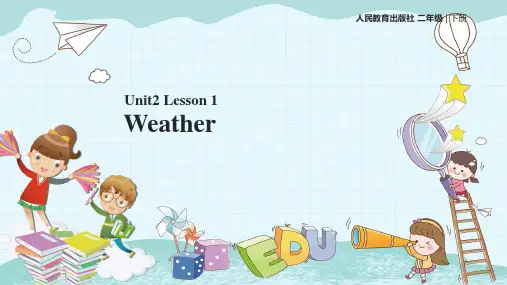
sunny It’s sunny.
人民教育出版社 二年级 | 下册
windy It’s sunny.
人民教育出版社 二年级 | 下册
rainy It’s rainy.
人民教育出版社 二年级 | 下册
umbrella an umbrella
人民教育出版社 二年级 | 下册
畅言教育
Practice
人民教育出版社 二年级 | 下册
3
1
4
2
畅言教育
3 2
人民教育出版社 二年级 | 下册
4 1
畅言教育
What’s the weather like in …?
人民教育出版社 二年级 | 下册
It’s …
畅言教育
Summary
人民教育出版社 二年级 | 下册
autumn
人民教育出版社 二年级 | 下册
Autumn is cool.
畅言教育
人民教育出版社 二年级 | 下册
畅言教育
winter
人民教育出版社 二年级 | 下册
Autumn is cold.
畅言教育
人民教育出版社 二年级 | 下册
畅言教育
人民教育出版社 二年级 | 下册
畅言教育
Look and say
四个季节用英语怎么说呢?
spring
summer
畅言教育
人民教育出版社 二年级 | 下册
autumn
winter
畅言教育
人民教育出版社 二年级 | 下册
四个季节的特点是什么呢?
warm
hot
cool
新起点小学英语二年级上册教案一年级起点

2015---2016学年第一学期二年级英语教案教学安排:从学习者的角度来讲,根底教化最重要的任务是学会学习。
开展学习策略,培育学生学习实力,是素养教化的重要组成局部。
老师要用生动简洁,通俗易懂的方式把学习策略介绍给不同年龄段的孩子,渐渐培育开发他们的自主学习实力,养成良好的学习习惯。
一、教学目的激发学生学习英语的主动看法,使他们建立初步的学习英语的自信念,培育学生肯定的语感和良好的的语音语调,并初步打下良好的英语根底,培育良好学习习惯,培育他们初步用英语进展简洁日常交际的实力。
同时,注意培育学生的视察、记忆、想象和创建实力。
二、教学内容目的听、做:1、能依据听到的词语,识别或指认图片或实物。
2、能听懂课堂指令并做相互相应的反响。
3、能依据指令做事情,如:画图、涂色、做动作、做手工等。
4、能在图片和动作的提示下听懂小故事,并作出反响。
说、唱:1、能听录音并进展仿照2、能依据图片或实物说出单词。
3、能依据表演猜意思,说词语。
4、能依据表演状况要求说出最根本的话语。
玩、演1、能在老师的指导下,用英语做嬉戏,在嬉戏过程中,能依据情景须要,用简洁的英语进展沟通。
2、能表演歌谣和歌曲3、能依据故事情节进展角色表演。
力求使教学面对全体学生,为学生供应自主学习和互相沟通的时机,以及充分表现和自我开展的空间,激励学生通过体验、理论、探讨、合作等方式,开展语言技能。
Unit 2 Boys and Girls (第一课时)Lesson 1I. Teaching AimsKnowledge Aims: A .Pupils can understand and read the new words of this unit.B Pupils can read a rhyme.II. Language input and Key pointsA.Words: classmate, friend, woman, man, girl, boyB.Sentence: He/ She is a ….C. A rhymeIII. Difficult pointsPupils can understand “woman” and “man” refer to adults and girl and boy refer to child. Then they can use “he” and “she” to describe these words correctly.IV. Teaching Aidspictures video tapeV. Teaching procedure1.Warming-upAsk Ss to read the rhyme and sing the song of Unit 1.2. Lead in and presentationA. Let Ss look at the picture on page 12 and ask “Who is he/she?” to lead in the new lesson.B. Show Ss the video of the rhyme.C. Show some pictures and teach the new words.3 Practice1. Show some pictures and words then ask Ss to draw lines to match them.2. Ask them to match the words “woman, man, girl, boy” with “he” and “she”.4. A rhymeLet Ss listen to the tape for 2 times. Guide and ask the pupils to clap hands whilelistening to the tape. Read and repeat the rhyme. After they can recite the rhyme, ask some pupils to perform in class.5. Sum upA.T says the words in Chinese and Ss translate into EnglishB. Ss read the rhyme together6.HomeworkReview the words learned this class and read the rhyme.7.BlackboardUnit 2 Boys and Girls (第二课时)Lesson 1I. Teaching AimsKnowledge Aims: A .Pupils can understand and read the new words of this unit.B Pupils can read a rhyme.C Pupils can use the sentences “He/ She is a ….”to describe aperson.II. Language input and Key pointsC.Words: classmate, friend, woman, man, girl, boyD.Sentence: He/ She is a ….C. A rhymeIII. Difficult pointsPupils can understand “woman” and “man” refer to adults and girl and boy refer to child. Then they can use “he” and “she” to describe these words correctly.IV. Teaching Aidspictures video tapeV. Teaching procedure1. Warming-upA. Greet the Ss and review what they learnt in the last class.B. Play a game: Sharp eyes.2. Lead in and presentationShow the pictures and lead Ss to use “ He/ She is a ….” to describe them. T gives the example first, and then leads Ss to describe by themselves.3. PracticeReview the words of family they learnt in the last unit. Show Ss some pictures and ask them use “He /She is a …..He/ She is my…..” to describe the pictures.4. A rhymeAsk Ss to read the rhyme and try to recite it. Then have a group competition.5. Sum upA.T says the words in Chinese and Ss translate into EnglishB. Ss recite the rhyme together6.HomeworkReview what they learn this class.7.BlackboardUnit 2 Boys and Girls (第三课时)Lesson 2I. Teaching AimsKnowledge Aims: A .Pupils can understand and read the new words “his” and “her”.B Pupils can use “his” and “her” to make new phrases.C Pupils can use the sentences “He/ She is a …. His/Her nameis …” to describe a person.II. Language input and Key pointsA.Words: his, her, nameB.Sentence: He/ She is a …. His/Her name is …III. Difficult pointsPupils can understand “his”is a adjectival possessive pronoun refers to male, and “her”is a adjectival possessive pronoun refers to female. Then they can use them correctly.IV. Teaching Aidspictures video tapeV. Teaching procedure1. Warming-upA. Review the words and sentences learnt this unit.B. Recite the rhyme.2. Game: Listen and say.T says out a name of a student, ask Ss to say out “He is a boy” or “She is a girl”.3. Lead in and presentationShow the pictures of a boy and a girl and use “his” and “her” to describe their body parts. And ask Ss to guess the meaning of the new words. Then teach the new words.4. PracticeA. Ask Ss to use “his” or “her” to describe something of their desk mates.B. Show the pictures of some cartoon figures to practice the sentence pattern “He/ She is a …. His/Her name is …”C. Ask some students to use the sentence pattern “He/ She is a …. His/Her name is …” to describe their classmate.5. Sum upT says the words in Chinese and Ss translate into English6.HomeworkReview what they learn this class.7.Blackboard教学反思:Unit 2 Boys and Girls (第四课时)Lesson 2I. Teaching AimsKnowledge Aims: A. Pupils can read out the conversation fluently.B. Pupils can sing a song.II. Language input and Key pointsSentences:-What’s his/her name?-His/Her name is …..III. Difficult pointsPupils can use the target language to ask about others’ name.IV. Teaching Aidspictures video tapeV. Teaching procedure1. Warming upRead out the rhyme and conversation learnt in the last class.2. RevisionShow the pictures of some cartoon characters and ask Ss what their names are.3. BrainstormingAsk Ss to ask their classmate’s name.4 Learn a song5ummarySummarize what they learnt in lesson 1 and lesson 2.6HomeworkRead lesson 1 and lesson 2 with your classmates.7. Blackboard DesignUnit 2 Boys and Girls (第五课时)Lesson 3I. Teaching AimsKnowledge Aims: A. Pupils can play a guess game to ask and answer others’ name.B. Pupils can pronounce the letters Q to U.II. Language input and Key pointsLetters: Ee Ff Gg HhSentences:What’s his name? Who is he?III. Difficult pointsPupils can read the sounds of the letters correctly.IV. Teaching Aidspictures video tapeV. Teaching procedure1. Warming upRead the rhyme and sing a song.2. RevisionRead the letters and their sounds learnt before. Then play a guessing game to ask and answer others’ name.3. Ask and answerSs ask and answer follow T’s pictures4.Learn the letters and sounds.Learn the letters Ee to Hh and their sounds one by one.5. PracticeT reads the letters and Ss read out the sounds.Ss follow T to spell the word.6. SummarySummarize what they learnt in lesson 1 and lesson 2.7. HomeworkRead lesson 1 and lesson 2 with your classmates.8.Blackboard Design教学反思:Unit 2 Boys and Girls (第六课时)Lesson 3I. Teaching AimsKnowledge Aims: Pupils can read the story and act it out.II. Difficult pointsPupils can act out the story.III. Teaching Aidspictures video tapeIV. Teaching procedure1. Warming upRead the rhyme and sing a song.2. RevisionRead the letters and their sounds learnt before.Ss ask: What’s this? and answer follow T’s pictures.Groups practice.3. Story time.Ss watch the video and answer T’s question.What animals can you see in the video?What happened?Ss follow T to read the story.Circle the difficult word and practice more.Ss try to read follow the video.Ss try to read by themselves.Role play.5. SummarySummarize what they learnt in lesson 1 to lesson 3.6. HomeworkRead Unit 2 after class.7. Blackboard Design教学反思:。
PEP人教版(新起点)英语二年级上册Unit 1《My Family》(第2课时)教学设计
Unit1 第2课时教学设计【内容来源】人民教育出版社(一起点)二年级上册Unit1 My Family【课时】第2课时一、教学目标能够听懂、会说有关询问和回答人物身份的功能句:Who’s he/she? He/She is ...二、教学建议A. Look, listen and repeat.1. 热身活动(1) 让学生听Lesson 1,A项歌谣并跟录音说唱。
(2) 教师出示单词卡片,或用简笔画画人物图,让学生说出相应单词。
(3) 教师说单词,让学生举相应卡片。
2. 呈现新的学习内容(1) 引导学生观察单元主情境图,了解本课功能句在生活中的使用语境,体会语言的意义。
T: Our friends are showing their family photos. Let’s take a look. Who can you see?S: ...T: What are they talking about?S: ... (family)(2) 教师继续提问:Who can you see in the photos? 并引导学生回答。
3. 语言学习引导学生从主情境图聚焦到本课A项图片:(1) 听录音,看图理解对话。
(2) 再听录音,指认人物对话。
(3) 第三次听录音,跟读对话。
注意引导学生模仿对话的语音和语调。
4. 语言操练(1) 师生示范:师生分别扮演Yaoyao和Andy,表演A项对话。
(2) 生生示范:邀请几组语言水平较好的学生示范表演对话。
(3) 让学生在座位上结对表演对话。
(4) 随机邀请几组学生上讲台表演对话。
B. Show and say.1. 引导学生听录音并观察图画,了解活动如何进行。
2. 师生示范教师手持自己的家庭合影,请几个学生分别指照片中的人物提问Who’s he/she? 教师回答He/She is my ...3. 小组活动引导学生四人一组,仿照以上示范就家庭合影互相问答,每人轮流接受提问。
新起点人教版二年级英语上册《Unit1_Lesson1_名师教案【河南南阳】》
二年级上册Unit1 My FamilyLesson 1教学设计教学目标:1. 知识目标:理解新词“family” “father”, “mother” “brother”, “sister” 的意思,并能正确发音。
2. 能力目标:熟练运用This is my…句型介绍自己的家人。
3. 情感目标:通过形式多样的活动,激发学生学习英语的兴趣,使学生在课堂中体验成功,感受快乐,从而爱上英语这门学科。
教学重点:“family” “father”, “mother” “brother”, “sister”, This is my…教学难点:使学生能够很好的理解和运用。
课前准备:学生自带家庭合照、PPT、MP4教学过程:Teaching Procedure:一. Lead-in Warming-upT: Hello, boys and girls.S:Hello, teacher.T: How are you today?S: I’m fine, thank you.T: Nice to meet you.S: Nice to meet you, too.Before the class, let’s enjoy a song 《Finger family》.(创设英语学习氛围,激发学生学习积极性。
)Who can tell me , what is this song about ?Yes, family. Today, we will learn about family.二. StudyT: This is Tony’s family photo. He love his family very much. Do you love your family? S: Yes.T: Now, look the picture, how many people are there?S: Four.T: Yes, there are 4 people in Tony’s family. They are father、mother、brother、sister.(领读单词,强调father、mother、brother中”th”的发音技巧)Now, read words one by one. (开火车读单词,注意及时评价)T: Let’s chant:Family family I love family. Father father I love father. Mother mother I love mother. Brother brother I love brother. Sister sister I love sister.T: We have learnt some words about family, now, let’s learn new sentences to introduce our family.引出句型This is my…①This is my father. We can also call “father” “dad”. ②This is my mother. We can also call “mother” “mum”. ③This is my brother. ④This is my sister.⑤This is me.Read sentences together. Introduce your family, have a try! (让学生尝试介绍自己的家人,注意及时评价鼓励)三. ShowTalk together. Introduce your family. 小组上台展示,介绍自己的家庭成员。
三年级下册英语教案-Unit6MyHomeLesson1∣人教新起点
三年级下册英语教案Unit 6 My Home Lesson 1∣人教新起点教学内容教学目标1. 知识目标:学生能够听懂、会说、会读本节课的重点单词和句型。
2. 能力目标:学生能够运用所学单词和句型,描述自己的家庭环境和家庭成员。
3. 情感目标:培养学生对家庭的热爱和责任感,增强家庭观念。
教学难点1. 单词的记忆与运用,特别是对于相似单词的区分,如bedroom和living room。
2. There be句型的正确使用,理解其表示“存在”的含义。
教具学具准备1. 教学课件:包含本节课的重点单词、句型以及相关图片。
2. 学生练习册:用于课堂练习和课后作业。
3. 家庭场景图:用于学生进行角色扮演和描述家庭环境。
教学过程1. 导入:通过播放一首关于家庭的英文歌曲,激发学生的学习兴趣,引入本节课的主题。
2. 新课内容展示:利用教学课件,展示本节课的重点单词和句型,引导学生跟读并模仿。
3. 互动练习:组织学生进行角色扮演,运用所学单词和句型描述家庭环境,加强实际运用能力。
4. 小组合作:学生分组,每组设计一个家庭场景,用英语进行介绍,提高合作能力和口语表达能力。
5. 巩固练习:通过练习册上的练习题,巩固本节课所学知识,检测学生的学习效果。
板书设计1. 课程Unit 6 My Home Lesson 12. 重点单词:bedroom, living room, kitchen, bathroom, study, parents, brother, sister3. 句型:There be作业设计1. 完成练习册上的相关练习题。
2. 用英语描述自己的家庭环境,不少于5句话。
3. 收集并学习更多关于家庭的英文词汇和表达。
课后反思本节课通过丰富的教学活动,激发了学生的学习兴趣,提高了他们的英语口语表达能力。
在小组合作环节,学生积极参与,课堂氛围活跃。
然而,在课后作业的批改中,发现部分学生在描述家庭环境时,还存在一些语法错误,需要在下一节课中进行针对性讲解和练习。
二年级上册英语教案-Unit 5 In the Park Lesson 1|人教新起点
二年级上册英语教案-Unit 5 In the Park Lesson 1|人教新起点一、教材分析1.1 教材内容本课是二年级上册英语教材中 Unit 5 In the Park 的第一课,主要围绕“我爱公园”展开,让孩子们了解公园里有哪些设施、它们的作用以及如何保护公园的环境。
1.2 教学目标•能正确地听、说、读、写单词tree 、 path 、 fence等和句型 Look at the tree. / It’s a path./ Don’t touch the flowers.•能听懂、熟练表述关于公园的设施、环境的句型•能积极参与小组讨论,了解自己身边的公园、公园中的设施和环保意识•能在活动中加深对英语学习的理解和应用1.3 教学准备•教学课件•课本、笔、纸等教学用具•活动小组材料二、教学过程2.1 导入1.播放公园场景的视频,引起孩子们的兴趣。
2.让学生围绕自己家附近的公园,谈一谈自己在公园中的经历和感受。
2.2 新课讲解1.通过幻灯片或展示卡片,教授或复习单词tree、path和fence,并引导学生进行跟读、操练。
2.展示公园里的各种设施图片,进行名词教学和操练。
3.展示神奇的小盒子,小盒子里装着小小公园的各种设施卡片,让孩子们翻翻卡片,快速识别卡片中的设施,并用英语表述。
4.教学句型Look at the tree. / It’s a path. / Don’t touch the flowers. ,并进行操练。
2.3 听力训练1.播放公园中相关场景的录音,让学生听懂句子的意思。
2.在录音中适当加入一些细节和语气,让学生能够分辨出情绪和语调差异。
2.4 学生互动1.将学生分成小组,让小组选择一座公园作为主题,一起讲述公园里各种设施的功能和注意事项。
2.在小组中进行角色扮演,比如有人扮演“鸟”,有人扮演“树”,让他们通过语言交流表达出对于一个公园的认知。
3.让孩子们回忆和描述自己在公园中所进行的活动,如何保护公园环境等。