
仁爱版八年级英语下册教案:Unit7Topic3SectionD教案
基于“课程标准、中招视野、两类结构”八(下)Unit7 Topic3 Section D教案设计(新授课)制作学校:张明一中修订人:王轶斌一、学习目标确定的依据:1、课程标准相关要求:《英语课程标准》(2011年版)要求学生能够会读会写知汉意的单词和短语单词:regularly ;diet ;conclusion短语:1. in short2. not only ...but also3.in a right way4.both...and...语法:复习总结副词的比较级和最高级的用法2、教材分析:本节课为该话题的第四节课,建议用1课时上完。
主要是通过阅读1a, 使学生了解如何保持健康的饮食,并复习总结了副词的比较级和最高级的用法。
3、中招考点:副词的比较级和最高级的用法,是学生必须掌握的知识要点,所以一定要让学生弄明白副词的比较级和最高级的用法。
4、学情分析:八年级上册已学过形容词的比较级和最高级,Section C 部分已重点讲过副词比较级和最高级的用法,在此基础上复习总结副词的比较级和最高级,难度不大。
二、学习目标1.会读,会写P77-78页的生词.2.分析P77 Grammar部分,复习总结副词的比较级和最高级的用法。
3. 通过学习1a,使学生能运用1a中的知识点熟练做题。
三、评价任务1、针对目标1,通过学习P77—78的生词,让学生并能熟练说出、写出P77—78的生词,并能进行英汉互译。
2、针对目标2,通过分析P77 Grammar部分并举一些例句,让学生能够说出副词的比较级和最高级的用法,并能熟练做题。
3、针对目标3,通过熟读1a,能够说出1a的知识点,能够熟练做题四、教学过程学习目标教学活动评价要点要点归纳目标1能说出、写出P77—78的生词,并能进行英汉互译自学指导11.自学内容:课本P77—78的生词。
2.自学方法:先根据音标试读,同桌互相正音,提问。
3.自学时间:3分钟4.自学要求:会读,知道其汉语意思,并能英汉互译。
Step3学生看书自学,教师巡视辅导。
Step4自学检测1regularly adv.有规律地,定期地diet n.日常饮食,日常食物in short 总之,简言之conclusion 结论,推论通过学习P77—78的生词,让学生并能熟练说出、写出P77—78的生词,并能进行英汉互译。
学习目标教学活动评价要点要点归纳目标2、复习总结副词的比较级和最高级的用法。
目标3:能运用自学指导2自学内容:课本77页Grammar自学方法:从Section A--C中找出含有副词比较级和最高级的句子,并结合77页Grammar部分总结规律.自学时间:6分钟自学要求:完成Grammar,并能说出其句式规律自学检测2Comparative and Superlative Degrees of AdverMaria cooked very successfully.Jane cooked _______ successfully.I cooked ___________ successfully.自学指导3自学内容:课本77页1a自学方法:听录音和扫读2.学生通过分析P77Grammar部分,能够总结出副词的比较级和最高级的用法。
3、通过学习1a,使学生能运用1a中副词比较级的用法与形容词比较等级基本相同。
1.表示比较双方程度相同时,常用“as+ 副词原级+as"结构2.两者之间比较时,常用”副词比较级+than"结构。
3.三者或三者以上比较时常用“副词最高级+in\of..."结构(副词最高级前可省去the)1a中的知识点熟练做题。
自学时间:6分钟自学要求:学习1a,完成1b自学检测31b :Complete the following tasks1. Write a good title for the passage.2. Color the introduction and conclusion part.3. Underline the topic sentences of Paragraphs2—4.4. Answer the following questions.1) What kinds of food should we eat to keephealthy? Why?2) How should we eat to be healthy?3) What should we do to keep healthy?当堂训练:一、根据汉语提示完成句子。
教材讲解P186(Ⅰ)1. _________ _________(健康的饮食)isimportant for us.2. _____ _____ ______ (据说)that she is verybeautiful.3. _____ _______(总之),we should have healthyeating habits to keep healthy.4.We have _________ _________(足够的食物)toeat.5.她不仅写了正文部分,而且还挑选了插图。
she _____ _____ wrote the text _____ _____selected the illustrations.二、单项选择。
( )1. —It’s difficult _____t hem_____finish the task in such a short time.—Let’s give them a hand. 同步练习册P85(二、2)A. of ;toB. to ;forC. for ;toD. of ;for( )2. —The wind blows _____ thanyesterday.同步练习册P85(二、5)—Yes ,you’re right .We’d betterclose the window.A. strongerB. more stronglyC. strongestD. most strongly( )3. —Which season do you like _____,winter or summer—Summer.五年高考三年模拟P38第19题的知识点熟练做题。
要点归纳1. It' said that halfof the studentsdon't havebreakfastregularly or don'teat anything at allin the morning.据说有一半学生吃早饭没有规律或者早晨什么也不吃。
It is saidthat ... 据说/听说......E.g:据说政府打算在这个村庄建造一家医院。
It's said thatthe governmentwill build ahospital in thevillage.类似的句型还有:It is reportedthat ... 据报道......;It is known that ...众所周知......;It is believedthat ... 人人都相信...... ;It isthought that ... 人们认为......。
2. In short,weshould not onlyeat enoughfood,healthy foodbut also eatregularly.总之,我们不仅应该吃足A. wellB. betterC. bestD. the best ( )4. It’s important _____ the piano well.A. of him to playB. for him to playC. of him playingD. for him playing ( )5. Not only he but also I _______ from Chongqing.A .am B. is C. are D. were 够的,好的,健康的食物,而且也要吃得有规律。
in short 总之;简而言之not only ... but also ... 不但...... 而且......,通常连接两个对等成分。
not only ... but also ...连接主语时,谓语动词的人称和数应服从“就近原则”,最靠近谓语动词的部分,即but also 后面的部分(名词或代词)决定谓语动词的数。
如:Not only I but also he likes English.我和他都喜欢英语。
仁爱八年级英语下册Unit7Topic3SectionC优秀教学案例
c. What are the key words and expressions in this passage?
2.教师讲解生词和短语,如Christmas, Halloween, Santa Claus, turkey等。
2.学生分享自己对西方节日的了解,如圣诞节、万圣节等。
3.教师简要介绍本节课的学习内容:仁爱八年级英语下册Unit7Topic3SectionC,讨论西方节日的来历和庆祝方式。
(二)讲授新知
1.教师引导学生观看SectionC的短文,并回答以下问题:
a. What is the main idea of this passage?
2.学生互相评价、自我评价,了解自己的优点和不足,激发学习动力。
3.教师对学生的学习成果进行评价,关注学生的知识掌握和能力提高,给予肯定和鼓励。
4.定期进行阶段测试,检查学生的学习效果,及时调整教学策略。
四、教学内容与过程
(一)导入新课
1.教师播放一首西方节日的歌曲,如《Last Christmas》,引导学生思考:这首歌是关于哪个节日的?
2.小组成员共同讨论节日的来历、庆祝方式和相关习俗。
3.每组派代表进行汇报,其他小组成员进行评价和补充。
(四)总结归纳
1.教师引导学生总结本节课所学的内容,如西方节日的来历、庆祝方式和相关词汇。
2.学生分享自己的学习心得和感悟。
3.教师强调西方节日的重要性,鼓励学生尊重和了解不同文化的节日。
(五)作业小结
4.通过写作训练,培养学生的写作能力,提高写作技巧和写作策略。
5.通过小组讨论、角色扮演等活动,培养学生的合作能力和团队精神。
仁爱版八年级英语下册第七单元TopicSectionD教案
Unit7 Topic1 SectionD精品教案Ⅰ. Material analysis本节课建议用1课时完成。
主要活动为Section D的1a和2。
本课学习活动通过呈现Kangkang和小伙伴们为美食节制作的海报来展开,要求学生能读懂并解释海报提供的信息,复习有关邀请的句型,复习邀请函的写法,并能为身边的活动写出简单的邀请函。
本课是本话题的最后一课,要求学生通过本课的学习活动,复习本话题的重点词汇、短语和有用的表达方式,对that引导的宾语从句的用法作以总结。
鼓励学生要有学习英语的愿望和兴趣,乐于参与各种英语实践活动。
Ⅱ. Teaching aimsKnowledge aims:1. 总结that引导的宾语从句的用法。
2. 复习有关邀请的句型。
3. 复习邀请函的写法。
Skill aims:1. 能听懂接近正常语速的有关美食和美食节话题的语段,识别主题,并获取主要信息。
2. 能就邀请他人参加美食节的话题进行交谈。
3. 能从所给海报中找出有关信息。
4. 能写出简单的邀请函。
Emotional aims:有学习英语的愿望和兴趣,乐于参与各种英语实践活动。
Ⅲ. The key points and difficult pointsKey points:1. 总结that引导的宾语从句的用法。
2. 复习有关邀请的句型。
3. 复习邀请函的写法。
Difficult points:从所给海报中找出有关信息,并用含有宾语从句的句子进行讨论。
Ⅳ. Learning strategies在学习中善于结合图文信息深入理解主题。
Ⅴ. Teaching aidsComputer multimedia projector, two or three postersⅥ. Teaching proceduresⅦ. Blackboard designUnit7 Topic1 SectionD精品教案Ⅰ. Material analysis本节课建议用1课时完成。
仁爱版八年级英语下册教学设计:Unit7Topic3SectionD
(一)导入新课
1.教师通过展示一组社会公益活动的图片,如志愿者服务、捐款现场等,引发学生对公益话题的关注。
2.邀请学生分享他们对这些图片的感受,以及在生活中参与公益活动的经历。
3.引导学生关注本章节的主题——社会公益活动,为新课的学习做好铺垫。
(二)讲授新知
1.词汇教学:教师呈现本节课的关键词汇,如volunteer, donation, charity, fundraising等,引导学生学习和记忆。
-组织学生进行句型转换练习,巩固时态知识。
3.阅读理解:指导学生阅读课文,提取关键信息,理解文章主旨。
-提问:“What is the main idea of this section?”;
-指导学生通过略读、寻读等策略,了解文章大意;
-分析文章结构,讲解重点句型。
(三)学生小组讨论
1.教师提出讨论话题:“What kind of charity activities do you think are important?”,要求学生用英语发表观点。
-摘录文章中的重点词汇和表达;
-概括文章大意;
-写出自己对文章的理解和感悟。
4.课后实践:鼓励学生利用周末时间参与一次社会公益活动,如志愿者服务、捐款等,并记录下自己的经历和感受。在下一节课分享给同学们。
5.词汇复习:要求学生利用课余时间,通过词汇卡片、在线词汇游戏等形式,巩固本章节所学词汇。
教师应在下次课前收集学生的作业,并进行认真批改和反馈。通过作业的布置与检查,了解学生的学习进度和存在的问题,为下一步的教学提供依据。同时,鼓励学生在完成作业的过程中,积极思考、主动探究,提高自己的英语综合运用能力。
此外,学生在情感态度与价值观方面,对社会公益活动的认识相对有限,需要教师在教学过程中加以引导和培养。通过本章节的学习,学生将有机会拓展视野,增强社会责任感,培养关爱他人、回馈社会的意识。
仁爱版八年级英语下册教案:Unit7Topic1SectionD教案
仁爱版八年级英语下册教案:Unit7Topic1SectionD教案基于“课程标准、中招视野、两类结构”Unit7 Topic1 SectionD教案设计(新授课)制作人:张庄二中主备人:崔方方一、学习目标确定的依据:1、课程标准相关要求:《英语课程标准》(2011年版)要求学生能够会读会写知汉意的单词和短语单词:comegtrue短语:1、have a sweet tooth2、such as3、what’s more4、be sure that5、plan to do语法:(1)so that与so…that区别2、教材分析:本节课为该话题的第四节课,主要学习that引导的宾语从句3、中招考点:that引导的宾语从句4、学情分析:学生英语学科基础较差,部分学生学习兴趣不是很足,鉴于这一点,上课前应当充分备足课,知识点应让学生在掌握的基础之上还要多加练习,努力提高学生的学习兴趣。
二、学习目标1.复习that引导的宾语从句以及本话题重要词组并会运用2.学习本节词组并会灵活运用3.学习某国,某国人的复数形式并会运用三、评价任务1、针对目标1,通过学习SectionA-C的生词,让学生并能熟练说出、写出生词,并能进行英汉互译。
2、针对目标2,通过熟读1a,能够说出1a的知识点,能够熟练做题。
3、针对目标3,会运用so that与so…that四、教学过程教学活动评价要点要点归纳学习目标目标1:通过学习Sectio nA-C 的生词,让学生并能熟练说出、写出生词,并能进行英汉互译自学指导11.自学内容:复习课本sectionA-C的重要词组2.自学方法:自学+讨论3.自学时间:6分钟4.自学要求:会读,会运用所学词组。
词组复习1.向…寻求帮助2.和…取得联系3.考虑4.尽全力做…5.对要做的事遗憾6.与某人作斗争7.以便,为了8.结果9.感谢...10.爱吃甜食11.足够好12.而且13.我相信…14.邀请某人去做某事自学检测1( )1. She didn’t sing the song ____ at the party last night.A. enough goodB. well enoughC. enoughwell D. good enough( )2. Jenny’s teeth are not good, because she ____.A. has a sweet toothB. has sweet toothC. have a sweet toothD. have sweet teeth( )3. Yesterday I rode to school instead____ a taxi.A. takingB. of takingC. tookD. of took( )4. When you have some difficult math problems, you can ____ your math teacher.A. turn toB. to askC. turnD. ask for1.通过复习P5生词,让学生练说出、写出生词,并能进行英汉互译。
仁爱版英语八年级下册Unit7教案

3. Role play: Ordering the food in the food festival.
Activity-based approach
Teaching procedures
Steps Step 1 Step 2
Step 3
Contents
Aims
Lead- in 1. Play a short video. 2. Welcome students to the food festival as a host
4. To fully master the sentence patterns of how to order the food and take the bill.
5. To emotionally lead students to learn to care about others.
1. Difficult words: salad, apple pie, fried rice, roast duck, beef curry, tofu soup, coke, Tsingtao
Let’s care about them: Show the students a short piece of children
suffering from the lack of food with teacher’s emotional monologue.
Teach students to learn to care
Let’s listen and imitate. 1. Listen and read after the dialogue sentence by
sentence repeatedly while watching them. 2. Read again in class
仁爱版八年级英语第七单元Unit 7教案
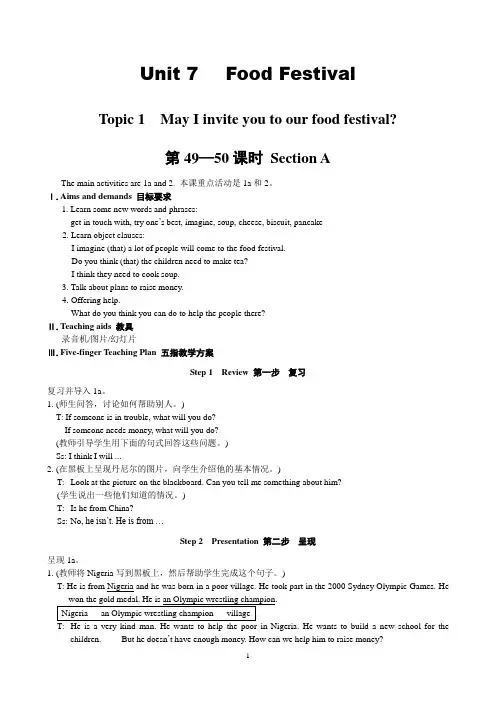
Unit 7 Food FestivalTopic 1 May I invite you to our food festival?第49—50课时Section AThe main activities are 1a and 2. 本课重点活动是1a和2。
Ⅰ.Aims and demands 目标要求1. Learn some new words and phrases:get in touch with, try one’s best, imagine, soup, cheese, biscuit, pancake2. Learn object clauses:I imagine (that) a lot of people will come to the food festival.Do you think (that) the children need to make tea?I think they need to cook soup.3. Talk about plans to raise money.4. Offering help.What do you think you can do to help the people there?Ⅱ.Teaching aids 教具录音机/图片/幻灯片Ⅲ.Five-finger Teaching Plan 五指教学方案Step 1 Review 第一步复习复习并导入1a。
1. (师生问答,讨论如何帮助别人。
)T: If someone is in trouble, what will you do?If someone needs money, what will you do?(教师引导学生用下面的句式回答这些问题。
)Ss: I think I will ...2. (在黑板上呈现丹尼尔的图片,向学生介绍他的基本情况。
)T: Look at the picture on the blackboard. Can you tell me something about him?(学生说出一些他们知道的情况。
仁爱版八年级英语下册Unit7Topic3SectionA教学设计
1.创设情境:利用多媒体展示环境问题图片,引发学生对环境保护的关注,激发学习兴趣。
2.互动教学:
-采用小组讨论、角色扮演等方式,让学生在实际情境中运用所学词汇、语法和句型。
-鼓励学生提问、分享观点,培养他们的口语表达能力和思维能力。
3.任务型教学:
-设计不同难度的任务,使学生在完成任务的过程中,掌握重点知识,克服难点。
(五)总结归纳
1.教学活动设计:教师带领学生回顾本节课所学知识,总结环境保护的相关词汇、语法、句型等。
2.学生反思:学生谈谈自己在学习过程中的收获和不足,互相交流学习心得。
3.教师寄语:教师强调环境保护的重要性,鼓励学生在日常生活中积极采取行动,为保护环境贡献自己的力量。
五、作业布置
为了巩固本节课所学知识,提高学生的英语综合运用能力,特布置以下作业:
3.采用任务型教学法,引导学生主动探究、发现和解决问题,培养学生的自主学习能力。
4.通过阅读练习,提高学生的阅读速度和理解能力,培养学生获取、筛选和整合信息的能力。
5.通过写作练习,引导学生运用所学知识表达自己的观点,培养学生的写作能力和创新思维。
(三)情感态度与价值观
在本章节的学习过程中,学生将形成以下情感态度与价值观:
2.学生在阅读、写作、口语表达能力方面的发展水平,关注学生的个体差异,为不同层次的学生提供合适的学习任务。
3.学生在小组合作中的参与度,培养学生的团队协作能力,提高学生的沟通技巧。
4.学生对环境问题的认识程度,结合学生的生活实际,引导他们关注环境保护,提高学生的环保意识。
5.学生在学习过程中的情感态度,关注学生的学习兴趣和自信心,激发学生的学习积极性。
1.增强环保意识,认识到保护环境的重要性,自觉承担起保护环境的责任。
仁爱版八年级下册英语unit7 topic3教案
Unit7 Topic 3Section ASection A 需用1个课时。
重点活动是1和2a。
教学目标:1.复习有关食物的词汇。
2.学习点和提供不同的食物和饮料。
教学过程:第一步:复习1.复习有关食物的单词。
①Talk about your favorite food.I like...best.My favorite food is...②Write down the names of food as many as you can.2.复习:How to start a formal western dinner?Unfold a napkin first. And then you should keep the knife in your right hand and the fork in your left...第二步:呈现1.听2a,在新单词下面划线。
menu beer wine smell bill2让学生读对话,学习如何点和提供食物。
所用目标语言:— May I take your order?— Sure. I’d like to try...— Which kind of drink do you prefer, beer, wine or tea?— I’d like...— May I have the bill?— Let me see. ¥71.50.第三步:巩固1.独立完成2b。
2.小组活动。
让学生结伴练习2a的对话,完成2c。
老师应该先准备一些食物或饮料作为学生表演的道具。
第四步:练习1.向学生展示一幅国际美食节举办的图画或让学生看1部分,回答下列问题:①What foods are on sale?②What are the people doing?③What are the girl and the boy saying?2.播放录音,学生跟读。
3.假如你们在举办美食节,你会怎么做和怎么说呢?Students act it out. Some students are servers. Some students are customers. Some students are selling foods. A boy and a girl are hosting it.第五步:综合探究活动1.搜集尽可能多的食物的英文名称。
仁爱版英语八年级下册教案:Unit 7 Topic 3 Section D
Section DSection D needs 1 period. Section D需用1课时。
The main activities are 1a and 4. 本课重点活动是1a和4。
Ⅰ. Aims and demands 目标要求1. Learn some phrases:balanced diet, in short, not only ... but also2. Review comparative and superlative degrees of adverbs with multiple syllables:Jane cooked m ore successfully.Jane cooks more successfully than she/her.I cooked the most success fully.3. Learn healthy eating and its importance:We need to have enough food, never too much or too little.It’s very important for us to keep a balanced diet.We should eat regularly.We should not only eat enough, good and healthy food but also eat regularly.Ⅱ. Teaching aids 教具录音机/小黑板或多媒体课件/图片Ⅲ. Five-finger Teaching Plan 五指教学方案Step 1 Review 第一步复习(时间: 5分钟)复习食品名称,导入新课。
1. (头脑风暴:复习食品名称,为讨论健康饮食做准备。
)T: Brainstorming: We have learned many different kinds of foods. Please speak out the names of foods that we have learned as many as possible. Then let’s see who will be the winner.S1: …S2: ……(学生说完之后,教师给予评价,并让学生完成1a中的表格。
仁爱版八年级下册英语第七单元教案Topic3
Unit7 Topic3 SectionA参考教案Ⅰ. Material analysis本节课为该话题的第一节课,建议用1课时上完。
主要活动为Section A 的1a和2a。
本话题的主题是描述“国际美食节”。
本课开门见山地描述了“国际美食节”召开的热闹场景,让学生接触如何致开幕词,接下来自然而然地过渡到人们在美食节上点菜就餐的场景,呈现了点菜进餐的功能用语。
通过让学生参加一系列的学习活动,培养他们学习英语的愿望和兴趣,乐于参与各种英语实践活动,并能让学生在生活中接触英语时,乐于探究其含义并尝试模仿。
Ⅱ. Teaching aimsKnowledge aims:1. 了解如何致开幕词。
2. 学习就餐用语。
Skill aims:1. 能听懂有关开幕和就餐的对话,识别主题,并获取主要信息。
2. 能在教师的指导下,参与角色扮演有关开幕和就餐的对话。
3. 能读懂有关开幕和就餐的对话。
4. 能写出简单的就餐的对话。
Emotional aims:1. 有学习英语的愿望和兴趣,乐于参与各种英语实践活动。
2. 在生活中接触英语时,乐于探究其含义并尝试模仿。
3. 遇到问题时,能主动向老师或同学请教,取得帮助。
Ⅲ. The key points and difficult pointsKey points:1. 学习就餐用语。
2. 了解如何致开幕词。
Difficult points:根据所给信息写出就餐的对话。
Ⅳ. Learning strategies在课内外学习活动中能够用英语与他人交流。
Ⅴ. Teaching aidsComputer multimedia projector;A menu;A bill;The pictures of beer, corn and salad.Ⅵ. Teaching proceduresIntroduction(8 minutes)1. Greet students ready for learning.2. Teacher asks the students to talk about eating habits in different countries in pairs, using object clauses as much as possible:Example:A: Do you know if people in the north of China like eating noodles?B: Yes, I think so…?A: …3. Teacher asks the students to report the homework. Let them read the passage about how to cook their favorite food, using adverbs of sequence and manners: First… Next… Then… Finally… and finely, carefully, lightly, slowly…4. Teacher evaluates students’ homework and tells them that if they want to learn English well, it’s important to review the knowledge they have learnt.5. Teacher leads to the new lesson: Kangkang and his friends have prepared many kinds of delicious foods for the International Food Festival. Today the first International Food Festival is open. Would you like to go and enjoy it with me? OK, let’s begin our wonderful trip now!Presentation (10 minutes)1. Teacher lets students look at the picture of 1a. Introduce the scene and teach the new words: we can see many guests in the pictures. And there are many delicious foods are for sale. Can you remember what they hold the food festival for? Let’s listen to the recording and try remembering it.2. Teacher plays the recording of 1a, lets students listen and underline the new words.3. Teacher asks students to tell the reason of holding the food festival. Teach the new word kind- hearted.4. Teacher plays the recording again and lets students listen and fill in the blanks of 1b.5. Teacher asks two students to tell the answers.6. Teacher asks students to read 1a and find out the expressions about opening speeches.7. Teacher asks students to tell the expressions about the opening speeches. And write them down on the blackboard. Teach the new words.(1) Ladies and gentlemen, welcome to …!(2) … is now open!(3) Thanks for coming!(4) Let’s wish them success!(5) Enjoy yourselves!Consolidation (10 minutes)1. Teacher plays the recording sentence by sentence.2. Teacher plays the recording without stopping.3. The teacher asks students to find out the difficult points, and lets other students help them explain them. Write down the key points on the blackboard:(1) for sale(2) send… to …(3) wish to do sth.wish … to …4. Teacher lets students read 1a in pairs. And let them try to act it out as hosts with their partners. Encourage them to add more their own words or expressions in the opening speeches. ( Pay attention to leaving enough time to them)5. Teacher lets two or three pairs of students act out 1a. Let other students pay attention to the pronunciations of the new words.6. Teacher lets other students evaluate the acting.7. Teacher asks students to read the new words and keys points after him or her. Practice (10 minutes)1. Teacher shows a bill to the students to teach the new word bill. Then let the students look at the bill of 2a. Teach corn and salad by showing their pictures. Ask them to talk about the names of the foods and the prices of them.2. Teacher lets students read the conversation of 2a. Let them complete the conversation based on the bill. Ask them to underline the new words.3. Teacher teaches new words menu by showing a real menu to students. Teach new words beer by showing the pictures of it to the students.4. Teacher plays the recording of 2a, and lets students listen to the conversation and check the words they have filled in.5. Teacher lets two students tell the answers. Stress the expressions May I have the bill, please? and Here’s your change.6. Teacher plays the recording again and lets students listen and read after it. Ask them to pay attention to the pronunciation and intonation.7. Teacher asks students to read 2a by themselves, and then fill in the blanks of the passage in 2b.8. Teacher lets students tell the answers.9. Teacher lets students to practice the conversations.Production (7 minutes)1. Teacher lets students observe the table of 3 to prepare for the listening practice.2. Teacher plays the recording for students, and lets them listen to the conversation and complete the table.3. Teacher lets students listen to the conversation again and check their answers.4. Teacher lets two students write down the answers on the blackboard.5. Teacher lets students discuss in groups and make a conversation as 2a based on the information in the table.6. Teacher asks two or three pairs of students to act out their conversations.7. Teacher evaluates their productions. Stress the expressions about how to order and offer food and drinks.8. Teacher shows the summary of this section to the students.9. Teacher assigns homework:(1) Review the summary after class.(2) Prepare to act out a conversation about ordering and offering food.(3) Preview the conversation of Section B.Teaching ReflectionThe students have known about how to make an opening speech. Teacher may let them to design a new opening speech for a class party. Remind students to prepare some objects they may need for the acting.Ⅶ. Blackboard designUnit 7 Food FestivalTopic 3 The food festival is now open!Section AThe opening speeches:1. Ladies and gentlemen, welcome to …!2. … is now open!3. Thanks for coming!4. Let’s wish them success!5. Enjoy yourselves!1. for sale2. send… to …3. wish to do sth.wish … to …Order and offer food and drinks:1. May I take your order?2. Anything else?3. May I have the bill?4. Here’s your change.Unit7 Topic3 SectionB参考教案Ⅰ. Material analysis本节课建议用1课时上完。