
牛津译林版英语2下2b unit 4 story
小学二年级牛津2B英语第四单元复习要点
小学二年级牛津2B英语第四单元复习要点二年级英语第四单元复习要点单词:salad carrot fish chicken banana色拉胡萝卜鱼鸡肉香蕉soup meat hamburger pizza noodles汤肉汉堡匹萨面条rice grass cake hand hen米饭草蛋糕手母鸡句型:What do you like eating? I like eating(不可数名词/可数名词复数)Unit 3 Animals I like单词:giraffe snake zebra bear monkey长颈鹿蛇斑马熊猴子panda elephant lion wolf lovely熊猫大象狮子狼可爱的词组:in the toy shop very much long tails在玩具店非常长尾巴句型:What are they? They are Do you like? Yes, I do. / No, I dont.Can I help you? , please. Here you are. Thank youThey are They haveThey likeModule 3 Things around usUnit 1 The four seasons单词:spring summer autumn winter warm春天夏天秋天冬天温暖的hot cool cold sunny windy炎热的凉爽的寒冷的晴朗的有风的cloudy sun zoo多云的太阳动物园词组:in spring in summer in autumn在春天在夏天在秋天in winter in the water on the ice在冬天在水里在冰上eat fruit make snowmen four seasons吃水果堆雪人四季句型:Spring is nice and warm. I like riding my bicycle in the park.Summer is sunny and hot. I like swimming in the water.Autumn is cool and windy. I like flying a kite in the park.Winter is cold. I like skating on the ice.In spring/summer/autumn/winter, we likeUnit 2 Rules单词:salad carrot fish chicken banana色拉胡萝卜鱼鸡肉香蕉soup meat hamburger pizza noodles汤肉汉堡匹萨面条rice grass cake hand hen米饭草蛋糕手母鸡句型:What do you like eating? I like eating(不可数名词/可数名词复数)Unit 3 Animals I like单词:giraffe snake zebra bear monkey长颈鹿蛇斑马熊猴子panda elephant lion wolf lovely熊猫大象狮子狼可爱的词组:in the toy shop very much long tails在玩具店非常长尾巴句型:What are they? They are Do you like? Yes, I do. / No, I dont.Can I help you? , please. Here you are. Thank youThey are They haveThey likeModule 3 Things around usUnit 1 The four seasons单词:spring summer autumn winter warm春天夏天秋天冬天温暖的hot cool cold sunny windy炎热的凉爽的寒冷的晴朗的有风的cloudy sun zoo多云的太阳动物园词组:in spring in summer in autumn在春天在夏天在秋天in winter in the water on the ice在冬天在水里在冰上eat fruit make snowmen four seasons吃水果堆雪人四季句型:Spring is nice and warm. I like riding my bicycle in the park.Summer is sunny and hot. I like swimming in the water.Autumn is cool and windy. I like flying a kite in the park.Winter is cold. I like skating on the ice.In spring/summer/autumn/winter, we likeUnit 2 Rules相关信息:2014年小学二年级英语知识点单词大全小学二年级英语常用短语汇总。
二年级英语下册 2B Unit4 In the park(4-6)教案 沪教牛津版
2B Unit4 In the park【教学设计(TEACHING DESIGN)】第四课时 (4th PERIOD)一、主要新授内容(new contents)Let’s play—Spotty can …Let’s learn—tree, umbrella二、学习目标(Objectives)1、学生能够运用句型Spotty can …,看图说话。
2、学生能够掌握游戏的规则和游戏的方式。
3、通过游戏的形式,增加学生之间的合作学习和交流的机会,培养学生的语言交际能力。
三、教学建议1、任务前期准备阶段(Pre-task preparation section)通过能够激发学生学习兴趣的游戏形式来巩固复习前几节课的内容,并导入新知,使学生能够将新知与旧知进行比较、联系,对所要掌握的语言知识有更深入的感知。
Activity 1 (Watching the video)1、教学辅助(Aids)1)电脑(2B-U4-10)2)屏幕Activity 2 (Quick response)1、教学辅助(Aids)图片Activity 3 (Guessing game)1、教学辅助(Aids)图片2、任务中期实施阶段(While-task procedure section)通过跟读录音机,培养学生良好的听、读习惯,在机械性操练的同时增加具有趣味性的竞猜及变换声音,调节课堂气氛,尽可能地降低学生学习的焦虑度。
Activity 1 (Repetition)1、教学辅助(Aids)图片Activity 2 ( Pair work )Activity 3 (Changing voices)1、教学辅助(Aids)图片提供给学生熟悉的场景,使学生能够运用他们所学的语言知识对人物,动物等进行描述,并通过游戏、竞赛、表演的形式加以巩固反馈,以熟练掌握句型单词的运用。
Activity 4 (Watching and guessing)1、教学辅助(Aids)1)电脑(2B-U4-11)2)屏幕Activity 5 ( Guessing game )1、教学辅助(Aids)1)电脑(1B-U4-12)2)屏幕Activity 6 (Looking and saying)1、教学辅助(Aids)图片Activity 7 (Acting and guessing)3、任务后期完成阶段(Post-task activity section)根据学生的知识水平和年龄特征,设计相应的任务,学生能够通过合作学习的方式,对所学的知识进行综合运用,完成任务。
上海版小学英语牛津教材2B教材分析

Learn the letters: t-tiger, cat
Task: Different sounds (不同的声音) P13 A Colour and say (给你熟悉的物品涂上颜色,然后说一说它们发出什么声音) B Ask and answer(根据练习A的图,互相回答)
M2U2 My favourite food Review: soup, meat, hamburger, pizza, noodles, rice, biscuit Vocabulary: salad, carrot, fish, chicken, banana
Learn the letters: s-sun, bus z-zebra, zoo
Task: My favourite seson (我最喜欢的季节) P29 A Say and tick(说出你最喜欢的季节,然后根据它们的特点,在表格里打勾) B Colour and say (给下面的图上色,然后根据提示说一说)
M3U2
Rules
Vocabulary: light, go, stop, wait Drill: Look at ... It’s ...(2A) Let’s ... Learn the letters: m-mouth, jam n-nose, ten
Task: In the street (在街上) P33 A Listen and say (听录音,学儿歌) B Ask and answer (根据练习A的图,互相回答)
M3U3 My clothes Review:T-shirt, shorts, dress, blouse
Vocabulary: trousers, sweater, shirt, coat Further aims: jeans, skirt, jacket…
二年级英语下册 2B Unit4 In the park教案 沪教牛津版

Unit4 In the parkThe first period Let’s learnTeaching Aims:Basic aims:Using verbs to identify momentary actions: e.g. walk, climb, skip, swing, fly, ride Difficult points: Using the verbs to say sentences Education Aims: To love sports and deep a good health Materials: Picture and word cardsTeaching essayThe second periodLet’s actTeaching Aims :Basic aims: Using imperatives to express prohibitione.g. Don’t walk on the grass.Difficult points : Using imperatives to express prohibition Education Aims : To protect the surroundingMaterials : PictureThe third periodTeaching Aims:Basic aims : 1. Using the modal verb “can” to express abilitiese.g. I can climb.2.Asking “Wh-“ questions to find out particular information abouta persone.g. What can you do?Difficult points : Using verbs to indicate momentary actionse.g. I can skip.Education Aims : To love sportsMaterials : PicturesTeaching essayThe fourth period Teaching aims:1)Using nouns to identify things. e.g. tree umbrella2)Learning the letters: T t, U uDifficult points:Writing the letters correctly.Materials:Pictures, cassette, word cardsThe fifth periodTeaching aims:ing modal verb ‘can’ to express abilities.e.g. Spotty can climb.ing verbs to indicate momentary actions.e.g. Spotty can skip.Difficult points:Using modal verb ‘can’ to express abilities.e.g. Spotty can climb.Materials:Cassette, picture, dice, countersThe sixth period Teaching aims:ing verbs to describe movements.e.g. Walk like a cat.2. Using prepositional phrases to describe locations.e.g. On the floor.Difficult point:Using modeled phrases to communicate with other learners. Education aims:To love sports and the animals.Materials:Cassette, cassette player, pictures。
二年级英语下册 2B Unit4 In the park教案 沪教牛津版

Unit4 In the parkThe first period Let’s learnTeaching Aims:Basic aims:Using verbs to identify momentary actions: e.g. walk, climb, skip, swing, fly, ride Difficult points: Using the verbs to say sentences Education Aims: To love sports and deep a good health Materials: Picture and word cardsTeaching essayThe second periodLet’s actTeaching Aims :Basic aims: Using imperatives to express prohibitione.g. Don’t walk on the grass.Difficult points : Using imperatives to express prohibition Education Aims : To protect the surroundingMaterials : PictureThe third periodTeaching Aims:Basic aims : 1. Using the modal verb “can” to express abilitiese.g. I can climb.2.Asking “Wh-“ questions to find out particular information abouta persone.g. What can you do?Difficult points : Using verbs to indicate momentary actionse.g. I can skip.Education Aims : To love sportsMaterials : PicturesTeaching essayThe fourth period Teaching aims:1)Using nouns to identify things. e.g. tree umbrella2)Learning the letters: T t, U uDifficult points:Writing the letters correctly.Materials:Pictures, cassette, word cardsThe fifth periodTeaching aims:ing modal verb ‘can’ to express abilities.e.g. Spotty can climb.ing verbs to indicate momentary actions.e.g. Spotty can skip.Difficult points:Using modal verb ‘can’ to express abilities.e.g. Spotty can climb.Materials:Cassette, picture, dice, countersThe sixth period Teaching aims:ing verbs to describe movements.e.g. Walk like a cat.2. Using prepositional phrases to describe locations.e.g. On the floor.Difficult point:Using modeled phrases to communicate with other learners. Education aims:To love sports and the animals.Materials:Cassette, cassette player, pictures。
小学英语二年级下册第二模块第四单元第四课时优秀课件
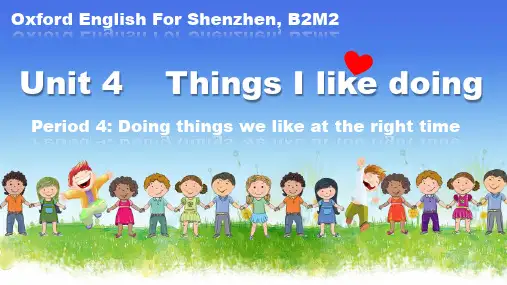
No. I like running with my father.
I like reading books with my mother. I like dancing with my grandmother.
Do you like dancing too?
Look and read
I like skipping. Do you like skipping?
No. I like reading.
Allen. You can hop. Do
you like hopping?
Yes. I like hopping.
Different people like doing
Yes.
No.
singing
dancing
running
riding a bicycle
skipping
reading
Do you like s_i_n_g_i_n_g iinn tthhee aafftteerrnnoooonn?? …No.
What do you like doing in the evening?
Oxford English For Shenzhen, B2M2
Unit 4 Things I like doing
Period 4: Doing things we like at the right time
DoEvyeroyounelliikkesedo(indgodiifnfegre)n…t ? Yes./ No. Itlhiiknges.(doing)…
Oh. That’s fun.
牛津译林版 英语二年级下册 Unit 4 I have big eyes
Let’s learn.
Look at this tiger.
I have a small nose.
Let’s learn.
Look at this tiger.
I have a small mouth.
Let’s read.
My face I have big eyes. I have big ears.
会唱歌曲My face. 通过学唱歌曲来理解, have句型的用法。 以及see和look at 用法。
Let’s learn.
Hello! Su Hai. A balloon for you.
Drills.
Group work!
1.What does Charlie look like?
I have big eyes. I have a big nose. I have a big mouth.
Hello.I’m Tutu.
Let’s learn.
1.What does Charlie look like? 2.What does Su Hai look like?
Let’s learn.
Hello! I’m Charlie.
Let’s learn.
Hello, Charlie.
Let’s learn.
2 3
Let’s learn.
I have a/…
I have a face.
Let’s learn.
I have a/…
I have eyesI. have small eyes.
Let’s learn.
I have a/…
I have ears.I have big ears.
牛津版二年级下册精品资源2B教案 Unit4 In the park(1-3)
Unit4 In the park单元分析(UNIT ANALYSIS)】一、教材地位(UNIT POSITION)1、本单元教材的内容是围绕“在公园里”这个主题展开的,学生通过对一些行为动词、情态动词can引导的句型以及祈使句的否定形式的学习,学会对人物的能力进行初步的描述、学会劝说某人不要干什么的表达方式。
2、学生在二年级第二学期Unit 3学习了Close the window, please. Open the window, please. Clean your room, please.等祈使句的基础上,本单元又增加了Don’t walk on the grass. Don’t ride a bicycle here. Don’t climb the tree.用来表示不要干什么的祈使句的否定形式。
3、词汇方面,二年级第一学期学习了动词play, draw, write,在此基础上,本单元又增设了walk, skip, swing, climb, fly, ride这些表示行为的动词。
4、句型方面,主要是学习以情态动词can 主导的陈述句I can … Spotty can …、来表示某人会做的动作,以及相对应的特殊疑问句What can you do? What can Spotty do? 来进行问答。
二、学习目标(LEARNING OBJECTIVES)1、学生能够理解本单元中祈使句的含义,并且能够根据这些祈使句做出相应的反应。
2、学生在原有的基础上,能够运用所学的语言知识对人物能够做的动作进行描述。
3、学生通过儿歌的学习,能够体会到人与动物的友好关系。
三、教学资源(TEACHING RESOURCES)1、现代技术支撑(I.P. support)♦录音机♦电脑♦实物投影机2、视听材料辅助(Audio-visual aids)♦图片♦实物3、学习材料(Materials)♦学生用书♦配套练习册♦教学参考书四、课时划分(PERIOD DIVISION)2B Unit 4 In the park【教学设计(TEACHING DESIGN)】第一课时(1st PERIOD)一、主要新授内容(new contents)Let’s learn—skip, swing, flyLet’s talk—What can you do? I can …二、学习目标(Objectives)1、学生能够用英语表示动作skip, swing, fly。
牛津译林版英语2下Unit4Ihavebigeyes
牛津译林版英语2下Unit4Ihavebigeyes小学英语学习材料金戈铁骑整理制作课题:2B Unit4 I have big eyes Story time (Period 1)授课时间教学设计:一、教学目标Learning objectives:1. Read and know the new words: ear, eye, nose, face, hair, mouth, Charlie, balloon.2. Read and know the new sentence pattern: I havea big/small… I have big/ small… I have long hair.二、教学重难点:重点:Important points:1. Read and know the new words: ear, eye, nose, face, hair, mouth, Charlie, balloon.2. Read and know the new sentence pattern: I havea big/small… I have big/ small… I have long hair.难点:Difficulties:Read and know the new sentence pattern: I have a big/small… I have big/ small… I have long hair.三、教学时间: 1 课时四、学情分析:Analysis of the students: Students may have difficulties in pronunciations of the new words; I should concern about their needs and pay more attention to them.五、教学准备:Preparations: PPT cards六、教学方法: Teaching methods:Interesting stimulating methodTask-based teaching method七、教学过程:T eaching procedures:Step 1. Warming up1.Greetings.T:Good morning, boys and girls.Ss:Good morning, Miss Lu.T: Let’s sing the song: EnglishStep 2. Presentation(1)1.Show a picture of a faceT: Look, we have different parts on this face.Teach: face (Use different ways to drill)2.Look and say:①Today, we’ll learn different parts on your face.二次备课T: We have two on our face. What are they? Ss: eyes, earsTeach: eye (Use different ways to drill)ear (Use different ways to drill)②T: We have only one on our face. What is it? Ss: nose Teach: nose(Use different ways to drill)③Pair work: A: I have big/small eyes.B: I have big/small ears.④Use the similar way to teach: mouth hair(Use different ways to drill)Step3. Presentation(2)Story time1.Watch and answer: What’s the name of the clown?2.Read and answer:①Who has a big mouth?②Does the clown have a big nose?③Who has long hair?Teach: I have a big/small…I have big/ small…I have long hair.(Use different ways to drill)3. Listen and imitateRead together/ in groups/ in pairs.4.Act it outStep4. Consolidation1. Magic eyesTo review the new words and sentences.2. Introduce yourself.A: I have a big/small…B: I have big/ small…3. Let’s talk八、作业设计:Homework:1. Read Story time after the tape2. Copy and recite the new words九、板书设计Unit4 I have big eyesA: I have a big/small… nose/ mouthB: I have big/ small…ear/ eyehair教学评价:课题:2B Unit4 I have big eyes Fun time 授课时间(Period 2)二次备课教学设计:一、教学目标Learning objectives:1. Understand and use the key words: ear, eye, nose, face, hair, mouth, Charlie, balloon.2. Understand and use the sentence pattern: I havea big/small… I have big/ small… I have long hair.3. Apply the sentence patterns to similar situations.二、教学重难点:重点:Important points:Ss can understand and use the key words: ear, eye, nose, face, hair, mouth, Charlie, balloon.Ss can understand and use the sentence pattern: I have a big/small… I have big/ small… I have long hair.难点:Difficulties:Ss can apply the sentence patterns to similar situations.三、教学时间: 1 课时四、学情分析:Analysis of the students:Some students may have difficulties in sentence patterns, the teacher need to focus on the key points and create more real situations for students to practice.五、教学准备:Preparations: PPT, cards六、教学方法: Teaching methods:Situational teaching methodTask-based teaching method七、教学过程:T eaching procedures:Step1 Warming up:T: Class begins.Ss: Stand up.T: Good morning, boys and girls.Ss: Good morning, Miss Lu.T: Sit down, please.Enjoy the song: EnglishStep2 Revision:1. Magic eyes(ear, eye, nose, face, hair, mouth, Charlie, balloon, I have a big/small…I have big/ small…I have long hair.)2. Let’s chantSample 1Big eyes, Big eyes, I have big eyes.Small nose, small nose, I have a small nose.Long hair, long hair, I have long hair.Sample 2Big , big , I have bigSmall , small , I have a smallhair, hair, I have hair.3. Let’s match4. I can spellStep3. Fun timeShow the picture of Fun Time, and guide Ss to practice.八、作业设计:Homework:1.Recite story time2.Recite the new words and get ready for a dictation九、板书设计Unit4 I have big eyesBig , big , I have bigSmall , small , I have a smallhair, hair, I have hair.教学评价:课题:2B Unit4 I have big eyes Rhyme time授课时间(Period 3)二次备课教学设计:一、教学目标Learning objectives:1、Strengthen the new words and sentence pattern of this unit.2、Sing and perform the song: My face3、Learn the new words: face, my, can you see重点:Important points:1、Strengthen the new words and sentence pattern of this unit.2、Sing and perform the song: My face3、Learn the new words: face, my, can you see难点:Difficulties:1、Strengthen the new words and sentence pattern of this unit.三、教学时间: 1 课时四、学情分析:Analysis of the students:Some students may have difficulties in key sentence patterns, the teacher need to focus on special students.五、教学准备:Preparations: PPT, cards六、教学方法: Teaching methods:Situational teaching methodTask-based teaching method七、教学过程:T eaching procedures:Step 1. Warming upT: Good morning, boys and girls.Ss: Good morning, Miss Lu.T: Let’s enjoy the song: Big Henry has a mealStep 2 Revision1. Quick respond:(ear, eye, nose, face, hair, mouth, Charlie, balloon, I have a big/small…I have big/ small…I have long hair.)2.Guessing game:Please ask and answer in pairs.Each picture you will have ten seconds to practice. The pair who ask and answer questions correctly can win the points for their group.(show some pictures of different body parts )3. Let’s dubWatch the Cartoon.Students in a group to dub the story.5. Role-playInvite 5 students to act the story.Step 3 Presentation1. Show the picture of Song time2. How many tigers can you see in the picture?3. Ask and answer:The cat has eyes and ears.The cat has mouths and noese.4. Teach: face, my, can you see(Use different ways to drill)5. Sing the song together/ in group/ pairs八、作业设计:Homework:1. Finish the exercises on the exercise book.2. Read and recite the new words of this song.九、板书设计Unit4 I have big eyesface, my, can you see教学评价:课题:2B Unit4 I have big eyes Review授课时间(Period 4)二次备课教学设计:一、教学目标Learning objectives:1、Strengthen the new words and sentence pattern of this unit.2、Develop the ability of speaking and writing.二、教学重难点:重点:Important points:1、Strengthen the new words and sentence pattern of this unit.2、Develop the ability of speaking and writing.难点:Difficulties:1、Develop the ability of speaking and writing.三、教学时间: 1 课时四、学情分析:Analysis of the students:Some students may have difficulties in pronunciations and spelling, the teacher need to pay special attention to them.五、教学准备:Preparations: PPT, cards六、教学方法: Teaching methods:Situational teaching methodTask-based teaching method七、教学过程:T eaching procedures:Step 1. Warming up1.Sing the song: My face2.ReviewRead the storyAct the storyStep 2. Revision1. Quick respond:(ear, eye, nose, face, hair, mouth, Charlie, balloon, I have a big/small…I have big/ small…I have long hair.)2. Spellingr y hn se f ce m th3. I say, you saya. earb. Chinesec. behindd. bigf. haveg. I have big eyes.Step 3 Consolidation(1)Sing the song: My face1. Show the song2. Listen to the song3. Sing the song together4. Change the lyrics of the songStep4 Consolidation(2)Do Exercise on《补充习题》.1. T introduces the pictures in the exercise.2. T makes an example with one student.3. Ask the Ss to finish the exercises.4. Check the answers in class.八、作业设计:Homework:1. Recite the new words of Unit 42. Preview Unit 5九、板书设计Unit4 I have big eyes Spellingr y hn se f ce m thI say, you saya. earb. Chinesec. behindd. bigf. haveg. I have big eyes. 教学评价:。
牛津版二年级下册精品资源教案 unit4 Lesson2
(沪教牛津版)二年级英语下册Unit4Unit 4 In the parkThe second period一、主要新授内容(new contents)Let’s learn—walk, climb, rideLet’s talk—What can … do? … can …二、学习目标(Objectives)1、学生能够用英语表达相关的动作。
(walk, climb, ride)2、学生能够掌握情态动词can 所引导的问答句,并表达自己和他人会做的事情。
3、根据学生的认知水平,教师可适当补充一些动词或动词词组,丰富对人物描述。
4、学生能够就自己或他人会做的事情进行描述和会话。
三、教学建议1、任务前期准备阶段(Pre-task preparation section)教师创设情景,在情景中巩固复习旧知,并从中引出新知,使学生对所要学习的语言知识有初步的感知。
Activity 1 (Looking and saying)1、教学辅助(Aids)1) 电脑(2B-U4-4)2)屏幕2、活动过程(Process)Steps Contents Methods Purpose1 The video 教师让学生观看电脑屏幕,呈现男孩Sam 从小到大以呈现孩子成长照片的形式进行导的照片,并提问:Who’s he? How is he? 入,调动学生的学习积极性。
2 The video 照片依次分别呈现Sam开始学走路,开始会骑自行车,会爬树,跳绳,放风筝,荡秋千,教师让学生观察Sam逐渐会做的事情,并不断提问,Can he walk/ skip a rope/climb the tree? 等,让学生进行简单回答,加深对新知的了解。
教师通过呈现Sam的成长过程,将新授的内容穿插于其中,既能激发学生学习的兴趣,又能将所要新授的语言知识提前渗入,给学生一个初步的感知。
Activity 2 (Quick response)1、教学辅助(Aids)图片2、活动过程(Process)Steps Contents Methods Purpose1 I can …教师快速出示图片让学生进行说话训练。