
八年级英语下册Unit5 Topic1 SectionA教学设计 最新仁爱版
Unit5Topic1You look excited.教学设计Section AⅠ.Material analysis本节课为话题的第一节课,建议用1课时上完。
主要活动为1a和3。
本课通过Jane询问Kangkang兴致勃勃的原因,引出对话的主题:描述情绪与表达情感。
对话呈现了本课所要学的语法重点:linking verb+adjective,并呈现了新出现的短语:invite sb.to do sth.,复习了已学过的重点短语prepare sth.for sb.,say thanks/goodbye/hello/sorry to sb.和a ticket to…的用法,同时在对话中呈现了交际功能用语:How are you doing?Very well,thank you.Guess what!和What a pity!帮助学生学会如何表达和描述情绪。
通过Kangkang的父母邀请Jane,Maria和Michael的父母去看电影The Sound of Music,把小伙伴们留在家里小聚,以及Mr.Brown没有买到The Sound of Music的票引出描述情绪的相关词汇和表达。
要求学生在学会课本语言知识的同时,培养他们的互助互爱的精神,在能够正确处理个人情绪的同时帮助他人排解不良的情绪。
Ⅱ.Teaching aimsKnowledge aims:1.学生能正确拼读并运用以下词汇:(1)单词表中的黑体单词invite(2)连系动词:be,look,feel,taste,smell和sound(3)描述情绪的形容词:excited,happy和disappointed2.学生能正确运用以下短语造句:invite sb.to do sth.prepare sth.for sb.say thanks/goodbye/hello/sorry to sb.a ticket to…3.学生能自如地运用以下功能句进行交流:How are you doing?Very well,thank you.Guess what!What a pity!Skill aims:1.能听懂有关情绪的询问与表达的简单对话和陈述。
2.能正确地运用本课的交际功能用语问候或表达情绪。
3.能正确朗读课本的有关情绪描述的文本材料及难度相当的材料。
4.能正确地运用本课连系动词加形容词作表语的语法结构,以及交际功能语言写出简单的问候和询问情绪的对话。
Emotional aims:通过对Section A的学习,学生能够在学会描述和表达自己情绪的同时,学会控制不利于自身的消极情绪,并且能够学会关注他人的情绪,在别人情绪低落时主动帮助排解不良的情绪,互助互爱。
Ⅲ.The key points and difficult pointsKey points:学生在交流中能自如地运用系表结构和以下短语:invite sb.to do sth.prepare sth.for sb.say thanks/goodbye/hello/sorry to sb.a ticket to…Difficult points:1.学生对功能用语How are you doing?的理解。
2.描述他人情绪时连系动词正确形式的运用。
Ⅳ.Learning strategies通过听力训练,鼓励学生通过图片和形容词的感情色彩大胆预测即将听到的内容,对所要完成的题目进行初步的判断。
Ⅴ.Teaching aidsComputer multimedia projector,the flash of the song,Do Re Mi.Ⅵ.Teaching proceduresStep Interaction patternStudent activity Teacher activityIntroduction (8minutes)1.Thewholeclasswork.2.Thewholeclasswork.3.Thewholeclasswork.4.Pairwork.1.Focus theirattention on theteacher.2.Students describetheir own feelings:Yes,we are veryhappy.3.Students observethe picture andanswer the question:Yes,they do.4.Students ask andanswer according tothe given pictures,words and theexample on thescreen.Picture2:-How does the foodtaste?-It tastes delicious.Picture3:-How do they look?1.Greet the studentsand get them ready forlearning.The teacherplays the flash of thesong,Do Re Mi.2.The teacher asks thestudents if they arehappy to see eachother after the winterholiday.3.The teacher shows thethird picture of2onthe screen:Do they lookhappy?4.Show all the pictures,words and the exampleof2on the screen oneby one.Let thestudents ask andanswer in pairsaccording to theexample.Let thestudents pay moreattention to the form ofthe verbs.Finish2.(The teacher candivide the studentsPresentation (10minutes)1.Thewholeclasswork.2.Thewholeclasswork.3.Thewholeclasswork.4.Thewholeclasswork.1.Observe the pictureof1a and answer thequestion.2.Students make surethey understandwhat the statementsmean.3.Students try to findout the wordsexpressing feelingsand have their ownanswers withoutwatching the flash.4.Students catch thegeneral idea of thedialogue and matchthe three parts tomake correctsentences.5.Students watch theflash for the secondtime,paying1.Ask the students toobserve the picture of1aand answer thequestion:Do Kangkang,Jane,Maria andMichael look excited?Lead to the learning ofthe conversation.2.The teacher asks thestudents to read thestatements in1b.3.The teacher asks thestudents to read theparts firstly and thengive a judgment.4.The teacher plays theflash of1a for the firsttime without stopping.Let the students listento and match the threeparts of1b.5.The teacher plays1afor the second time,stopping whennecessary.6.Ask two students totellConsolidation (10minutes)1.Pairwork.2.Thewholeclasswork.3.Thewholeclasswork.4.Thewholeclasswork.5.Thewholeclasswork.1.Students ask andanswer questions inpairs based on1b.2.Read1a andcomplete the passagein1d.3.Volunteers writethe answers on theblackboard.4.Students read theconversation after therecording sentence bysentence.5.Students try tofollow the speed,paying attention tothe pronunciationand intonation.6.Students read theconversation bythemselves anddiscuss in groups tofind out thedifficult points andsum up the mainpoints.1.The teacher lets thestudents ask andanswer questions in pairsbased on1b.Finish1c.2.The teacher asks thestudents to read1a andcomplete the passage.The teacher gives two orthree minutes to thestudents to finish1d.3.The teacher lets thestudents correct thewrong words.4.The teacher plays therecording sentence bysentence.5.The teacher plays therecording withoutstopping.6.The teacher lets thestudents read1a,and thenasks them to learn in groupsto find out the difficultpoints.At last let them sumup the main points of theconversation.Practice (10minutes)1.Thewholeclasswork.2.Thewholeclasswork.3.Thewholeclasswork.4.Thewholeclasswork.5.Groupworkandindividualwork.1.Students look at thepictures and guessthe feelings of thepeople in pictures3.2.Students listen toand finish A in3first.3.Students check theanswers.4.Students writedown their answers intheir books.5.Students check theiranswers to B in3.They may discuss ingroups.6.Four students fromeach group showtheir answers on theblackboard.7.Ask and answerquestions in pairsbased on3.Example:-How does theteacher feel?-She feels angry.1.The teacher encouragesthe students to look atthe pictures in3andguess the feelings of thepeople.Give a forecast tothe adjectives ofdescribing feelings theywill fill in the blanks.2.The teacher plays therecording.3.Let two or threestudents tell theiranswers.4.The teacher plays therecording and pausesafter eachconversation.5.The teacher plays therecording the thirdtime without stopping.6.The teacher checks thestudents’answers,asking four studentsfrom each group toshow their answers onthe blackboard.Theteacher corrects theProduction (7minutes)1.Thewholeclasswork andpair work.2.Thewholeclassworkand pairwork.3.Thewholeclasswork.1.Students make upthe conversations,using the linkingverbs and theadjectives.-How are youdoing,Mike?-Very well,thankyou.Y ou look happy.Why?-Because we willgoto the movies thisafternoon.2.The students actout their ownconversations in pairs.3.Learn to care forothers’feelings.4.StudentssummarizeSection A with theteacher.5.Students finishafter1.The teacher organizesthe students to make upthe conversations,usingthe linking verbs and theadjectives in4in pairs.Help students to reviewthe ways of greetings.Encourage them to usemore expressions.2.Let the students showtheir own productions byacting out theirconversations.The teacher givessuitable points to theirproductions.3.The teacher sums upthe students’conversations.Teach them to care forothers’feelings.4.The teacher shows thesummary to thestudents.5.The teacher assignshomework:(1)Review theTeaching ReflectionIt’s easy for the students to understand the structure of “linking verb+adjective”.But it’s a little hard for the students to use the correct form ofthe linking verbs in their own conversations.Teacher should design moreoral practice for the students.Ⅶ.Blackboard designUnit5Feeling ExcitedTopic1You look excited.Section A1.-How are you doing?-V ery well,thank you.G1G2G3 G42.linking verb+adjective24123.Guess what!322 24.invite sb.to do sth.122 25.one of+最高级+名词复数6.prepare sth.for sb.7.say thanks/hello/sorry/goodbye to sb.8.a ticket to…。
【公开课教案】仁爱版八年级下册unit5 topic 1 sectionA教学设计

八年级英语下册Unit5 Topic 1 Section A 教学设计一、教学课题:Unit 5 Feeling Excited Topic 1 You look excited. Section A二、教学思路设计利用图片、多媒体、录音机等创设情景,帮助学生在设定的语言环境运用英语。
在具体教学过程中以学生为主体,采用对话教学策略,使他们在学习过程中主动地用英语表达,达到培养和强化学生的语言实践能力的目的。
三、教材分析本课是仁爱版八年级英语下册Unit5Topic1You look excited.的第一课时。
本课通过孩子们的对话,呈现了孩子们的高兴以及Mr.Brown没有买到票而失望,引出对话的主题:描述情感与表达对事物的感觉。
对话呈现了有关情感的形容词和短语,同时也呈现了交际功能用语:How are you doing? Very well, thank you.和What a pity! 帮助学生学会如何表达感觉和描述情绪。
要求学生在学会课本语言知识的同时,培养他们的互助互爱的精神,在能够正确处理个人情绪的同时帮助他人排解不良的情绪。
四、学情分析本人所教的八年级(1)班大多数学生为女生,少部分男生。
由于我校地处农村,这些学生当中绝大部分为农村留守儿童,性格比较内向。
学生英语接受和学习能力比较差,同时没有一个好的语言学习氛围和充足的教学资源,导致班内大多数学生英语基础知识较差,应用能力薄弱,尤其听说能力较差。
对于女生来说,语言类的科目相对掌握得比较好,大部分女生主观学习英语的愿望较强,能做好课前预习,课后复习。
八年级下学期所学的语法知识点比较多,导致部分学生产生了恐惧心理。
上课注意力不够集中,部分学生对英语失去学习兴趣。
大部分学生比较胆小内向,上课不敢积极发言。
因此,教师在教学中要培养学生学习英语的兴趣,针对不同层次的学生开展不同的教学活动。
五、教学目标(一)知识目标1. Key vocabulary:Master the new words: invite, disappointed, film, smellLinking Verb: be, smell, feel, look, sound, tasteSome adjective about feelings: excited, happy, disappointed2. Be able to make sentences with the key phrases:invite sb. to do sth.prepare sth. for sb.say thanks toa ticket to3. Learn some useful expressions to describe feelings:--How are you doing? –Very well, thank you.Please say thanks to your mom for us.4. Learn the structure of “Linking Verb + Adjective”You look excited.They feel happy..(二)能力目标To train students’ listening skill and communication skill.(三)情感目标1.Know how to describe feelings and learn to deal with negative feelings.2.Learn to care about others’ feelings, and help each other to deal with sadness.六、教学重难点(一)教学重点:1. Key words: invite, disappointed, film, smellLinking Verb: be, smell, feel, look, sound, taste,excited, happy, disappointed Key phrases: invite sb. to do sth, prepare sth. for sb, say thanks to, a ticket to 2. Master the structure of “Linking Verb + Adjective”(二)教学难点Use the structure of “Linking Verb + Adjective” to describe feelings.七、教学方法:Listening, practicing, situation teaching method, dialog teaching八、教具:Recorder, cards and pictures, computer, PPT.九、教学过程教学反思:本课主要采取对话策略来进行教学,通过新年这一话题来引起学生兴趣,让学生运用已学过的相关语言知识进行师生对话,引入课文内容。
+Unit+5+Topic+1++大单元教学设计 仁爱科普版八年级英语下册
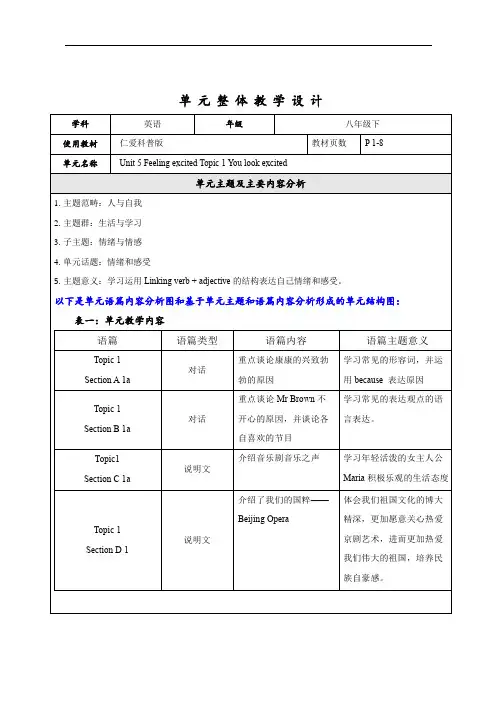
单元整体教学设计学科英语年级八年级下使用教材仁爱科普版教材页数P 1-8单元名称Unit 5 Feeling excited Topic 1 You look excited单元主题及主要内容分析1.主题范畴:人与自我2.主题群:生活与学习3.子主题:情绪与情感4.单元话题:情绪和感受5.主题意义:学习运用Linking verb + adjective的结构表达自己情绪和感受。
以下是单元语篇内容分析图和基于单元主题和语篇内容分析形成的单元结构图:表一:单元教学内容语篇语篇类型语篇内容语篇主题意义Topic 1Section A 1a 对话重点谈论康康的兴致勃勃的原因学习常见的形容词,并运用because 表达原因Topic 1Section B 1a 对话重点谈论Mr Brown不开心的原因,并谈论各自喜欢的节目学习常见的表达观点的语言表达。
Topic1Section C 1a 说明文介绍音乐剧音乐之声学习年轻活泼的女主人公Maria积极乐观的生活态度Topic 1Section D 1说明文介绍了我们的国粹——Beijing Opera体会我们祖国文化的博大精深,更加愿意关心热爱京剧艺术,进而更加热爱我们伟大的祖国,培养民族自豪感。
表二:单元大观念:主题大观念小观念1:学会表达自己的情绪与情感小观念2:学会与他人分享自己的情绪,并学会给出建议帮助他人走出坏情绪小观念3:认清生活中影响的心情的事物,正确对待,积极面对单元大观念:关注情绪问题,积极健康生活输出:能够准确表达自己的感受与情绪;学会根据别人的情绪问题,给出建议;理清生活中影响心情的因素,正确对待,积极健康输出:能够准确表达的感受与情绪输出:学会根据别人的情绪问题,给出建议输出:理清生活中影响心情的因素,正确对待,积极健康生活Topic 1 You look excited.Topic 2 I’m feeling better nowTopic 3 Many things canaffect our feelings核心素养的综合表现:学会表达的情绪与感受;学会与人分享自己的感受,并学会给出他人建议,帮助他们走出坏情绪;认识生活中影响感受的因素,积极健康生活。
八年级英语下册Unit5 Topic1 SectionA教学设计 最新仁爱版

Unit 5 Topic 1 You look excited.教学设计Section AⅠ. Material analysis本节课为话题的第一节课,建议用1课时上完。
主要活动为1a和3。
本课通过Jane 询问Kangkang兴致勃勃的原因,引出对话的主题:描述情绪与表达情感。
对话呈现了本课所要学的语法重点:linking verb + adjective, 并呈现了新出现的短语:invite sb. to do sth., 复习了已学过的重点短语prepare sth. for sb., say thanks/ goodbye/ hello/ sorry to sb. 和a ticket to … 的用法,同时在对话中呈现了交际功能用语:How are you doing? Very well, thank you. Guess what! 和What a pity! 帮助学生学会如何表达和描述情绪。
通过Kangkang的父母邀请Jane, Maria 和Michael的父母去看电影The Sound of Music, 把小伙伴们留在家里小聚,以及Mr. Brown没有买到The Sound of Music的票引出描述情绪的相关词汇和表达。
要求学生在学会课本语言知识的同时,培养他们的互助互爱的精神,在能够正确处理个人情绪的同时帮助他人排解不良的情绪。
Ⅱ. Teaching aimsKnowledge aims:1. 学生能正确拼读并运用以下词汇:(1)单词表中的黑体单词invite(2)连系动词:be, look, feel, taste, smell和sound(3)描述情绪的形容词:excited, happy和disappointed2. 学生能正确运用以下短语造句:invite sb. to do sth.prepare sth. for sb. say thanks/ goodbye/ hello/ sorry to sb.a ticket to …3. 学生能自如地运用以下功能句进行交流:How are you doing? Very well, thank you.Guess what!◆What a pity! Skill aims:1. 能听懂有关情绪的询问与表达的简单对话和陈述。
仁爱版八年级英语下册Unit5Topic1SetionA教学设计
3.语法练习:完成课后练习册中的一般现在时和一般过去时练习,巩固语法知识。
4.口语练习:与同学合作,选择一个志愿者活动,进行角色扮演,模拟真实场景,提高口语表达能力。
5.阅读拓展:阅读一篇关于志愿者活动的英文文章,总结文章大意,并尝试用英语简要介绍文章内容。
1.针对词汇和语法的教学,教师可以采用以下设想:
a.利用图片、实物等直观教具,帮助学生形象记忆词汇。
b.设计各种任务,如:填空、造句、角色扮演等,让学生在实际语境中运用词汇和语法。
c.通过小组合作,鼓励学生互相交流、讨论,提高词汇和语法的运用能力。
d.针对不同难度的词汇和语法,进行分层教学,使每个学生都能在原有基础上得到提高。
1.针对学生的词汇量,注重拓展与话题相关的词汇,帮助学生巩固已学词汇,提高语言表达能力。
2.针对学生语法水平,结合本节课的重点语法,设计不同难度的练习,使学生在实际语境中运用语法知识。
3.考虑到学生的听说能力,教师应充分利用课堂时间,组织多样化的听说活动,提高学生的听说水平。
4.关注学生的阅读理解能力,通过引导性问题,帮助学生理解文章内容,培养阅读策略。
1.教师呈现本节课的重点词汇和短语,如:volunteer, foundation, opportunity, treatment, illness等,通过图片、实物等直观教具,帮助学生理解和记忆。
2.讲解一般现在时和一般过去时的用法,通过示例句子,让学生学会描述人物的经历和感悟。
3.播放听力材料,让学生跟读并模仿,提高学生的语音语调。
2.提问学生:“What do you know about volunteers?”,让学生分享他们对志愿者的认识和了解。
2020-2021学年仁爱科普版英语八年级下册Unit5 Topic1 SectionA教案

Unit 5 Feeling ExcitedTopic 1 You look excited.Section ABackground informationSchool:Weining Y ulong Junior High SchoolTeacher:Fu ChangyinStudents:Great EightType of lesson:listening &speaking classⅠ. Teaching aims1.Knowledge aims:(1)学习并掌握新单词:invite,film,smell,disappointed(2)学习look,smell,feel,sound,taste等感官动词的基本用法。
2. Skill aims:能够运用本课所学到的系表结构表达自己的看法、感受。
如:—How do the flowers smell ?—They smell nice.3. Emotional aims:学生能够乐于表达自己的观点、看法和情感并能主动关心他人的感受。
Ⅱ. The key points and difficult points1. Key points:学生在交流中能够熟练地运用感官动词。
2. Difficult points:感官动词look,smell,feel,sound,taste的基本用法。
Ⅲ.Teaching aidsPPT,word cards ,whiteboard ,picturesⅣ.Teaching procedures:Step one:Lead-in1.Greeting the students.T:Good morning ,everybody.Nice to see you!Ss:…2.—How are you feeling ?/How is she/he feeling ?(show some pictures about feelings to the students)—We’re/I am feeling…—She/he is feeling ...Step two:PresentationFirst,study the new words of this part.invite,film,smell,disappointedSecond,listen to 1a and let the students predict the answers to1b,then ,listen again ,check the answer to finish 1b.Third,understand the dialogue in 1a.Let the students scan the dialogue and find out the key points &phrases.1.How are you doing ?= How are you ?2.linking verb + adjective look excited系动词 + adj →系表结构feel happy3.invite sb to do sth sounds greatone of +名词复数...Step three,consolidation1.Let students practice the conversation in pairs,then act it out together.2.Ask and answer the questions in pairs based on 1b to finish 1c.Step four,Practice1.Look at the pictures .Then ask and answer in pairs to finish2.2.Let some groups act them out.Step five,SummarySum up the vocabulary ,sentence patterns and key points of this section. Step six,Homework1.Review the key points and practice the dialogue in 1a.2.Finish 1d and 3 on page 2.Step seven,Whiteboard designUnit 5 Topic 1 You look excited.Section AVocabulary: Key points:invite 系动词 + adj →系表结构filmsmelldisappointed invite sb to do sth a ticket tosmelltaste lookfeelexcited s o undgreat。
仁爱版八年级英语下册Unit5topic1SectionA教学设计

针对八年级学生,他们在英语学习方面已具备一定的听说读写能力,但对语法的掌握程度参差不齐。在本章节的学习中,学生将面临以下挑战:
1.对一般现在时和一般过去时的被动语态掌握不够熟练,需要教师在教学过程中进行针对性指导。
2.部分学生对词汇的运用能力较弱,尤其是对重点词汇和短语的运用,需要在课堂教学中加强练习。
(1)结合社会热点,让学生了解社会公益活动,提高学生的社会责任感。
(2)联系学生的生活实际,让学生在实际情境中运用所学知识,提高实际运用能力。
5.课后作业与评价:
(1)设计富有针对性的课后作业,巩固所学知识,提高学生的自主学习能力。
(2)采取多元化的评价方式,关注学生的全面发展,激发学生的学习兴趣。
仁爱版八年级英语下册Unit5topic1SectionA教学设计
一、教学目标
(一)知识与技能
在本章节的学习中,学生将掌握以下知识与技能:
1.掌握并运用仁爱版八年级英语下册Unit5topic1SectionA中的重点词汇和短语,如:volunteer, opportunity, participate in, make a difference等。
(2)学生回答问题,教师总结:They are volunteering for the environment. They want to make the world a better place.
(3)教师引出本节课的主题:Today we will learn about volunteers and their work for the environment.
3.提高阅读理解能力,引导学生通过预读、细读和总结等步骤,逐步提高阅读水平。
4.鼓励学生积极参与课堂讨论,创设轻松愉快的氛围,降低听说焦虑。
最新仁爱版八年级英语下册Unit 5 Topic 1 Section A市级优质课课件
Exercise
1. - How is your father doing? well (good/well). Thank you. - He is very _____ 2. The Sound cf Music is _____ my favorite one _____ of movies 最喜欢的电影之一) . _______( invite 邀请) some friends to 3. David wants to _______( his birthday party this Friday evening. look _______( unhappy 看起来不高兴) . 4. - Helen, you ______ What’s the matter? a _____ ticket _____(…… to - I can’t find _____ 的票) Han Hong’s concert(音乐会). 5. You must ______ say _____ thanks _____( to 道谢) him or her if getting one’s help.
Read 1a and complete the passage.
Kangkang looks ______ because his parents want to excited ______ Jane’s parents to go to see the movie, The Sound invite of Music, this _______. The children plan to ______ the Saturday spend evening at his house. His parents will prepare some
八年级英语下册Unit5 Topic1 SectionA优质课教案 最新仁爱版
Unit5 Topic1 SectionA优质课教案教学设计思路:本节课主要活动为Section A -1a和2。
本节课的课型为听说课。
教学目标的重点是系表结构的用法。
在导入部分教师介绍寒假的一次旅行经历,通过师生交谈的方式让学生充分感知系表结构。
在Pre-listening环节中,使用目标语言练习2,同时总结系表结构的用法,为听力扫除障碍。
通过预测1b的答案,巩固使用系表结构的同时了解对话大意,降低听力的难度。
While-listening环节,重点在于听力的训练。
在多次反复听的过程中,完成由易到难的任务,同时兼顾说的训练。
Post-listening环节以语言的运用为主,进一步巩固系表结构用法。
Ⅰ. Teaching aims1. Knowledge aims:(1)学习并掌握新词汇Invite, film, smell, disappointed(2)掌握感官动词,如:look,smell,feel,sound,taste等的基本用法。
(3)能够运用本课所学到的表示问候与转达感谢、惋惜、询问和表达个人观点和看法以及引出话题的表达法进行日常的交流。
①问候—How are you doing? —Very well, thank you.②转达感谢Please say thanks to your room.③惋惜What a pity!④询问和表达个人观点和看法How do the flowers smell?⑤引出话题Guess what!⑥描述感受You look excited.2. Skill aims:能使用表示问候与转达感谢、惋惜、询问和表达个人观点和看法以及引出话题的表达法进行日常的交流。
3. Emotional aims:⑴能够乐于表达自己的观点、看法和情感。
⑵无论我们每天心情如何,都应该笑对人生,以积极的心态度过每一天。
Ⅱ. The key points and difficult points1. Key points:学生在交流中能自如地运用感官动词2. Difficult points:感官动词的用法。
仁爱版英语八年级下册 Unit 5 TOPIC 1 Section A 教案
Unit 5 TOPIC 1 Section A 教案教学目标〔1〕.知识目标要求学生牢记Section A所有新学的四会单词.短语和重点句型;掌握系动词+形容词构造的用法。
〔2〕.技能目标:能听懂谈论个人情感的比拟熟悉的话题,能就关于情感的话题进展交谈。
〔3〕.情感目标能在英语交流中注意并理解他人的情感。
教学重点和难点(1).重点:谈论关于情感的话题。
(2).重点和难点: 系动词+形容词构造的用法。
教法与学法按照课程改革的要求,遵循“教师由主演变导演,学生由配角变主角〞的角色转换,采用把课堂交给学生的教学理论运用自由讨论.分组工作.结对练习.问答练习等方法,借助录音机,图片等教学手段,设置特定的语言环境,让学生在轻松愉快的气氛中理解.运用英语。
课前准备:教学挂图,教学录音磁带,单词卡片教学过程:第一步:复习师生问候。
谈谈寒假生活及过春节的感受。
如:Teacher: How are you? / How are you doing?Student1: Fine,thanks!Teacher: You look so happy, why?Student1: I come back to school again, so I’m glad to see my classmates.Teacher: Did you have a good winter holiday?Student2:Yes,I did.Teacher: How about your Spring Festival?Student2:I had a wonderful Spring Festival. I got...Teacher: Why all the smiling faces?Students: Because today is the first day of this term...第二步:呈现1.在师生对话之后,教师板书呈现课题。
仁爱英语八年级下册英语Unit5 Topic1sectionA的教案新部编本
教师学科教案[ 20 – 20 学年度第__学期]任教学科:_____________任教年级:_____________任教老师:_____________xx市实验学校仁爱英语八年级下册英语Unit5 Topic1Section BSection B 需用1~2课时。
重点活动是1, 2和3。
教学目标:1.能利用恰当的句子表达自己的情感。
2.能就个人情感的话题,进行简单的交流。
3.掌握原因状语从句。
4.能简单地谈论关于电影的话题。
教学过程:第一步:复习1.请学生朗读自己完成的上一节课的作品。
2.教师提问:Is the poor man kind or cruel?Is the rich man popular or unpopular?Is the poor man happy or unhappy?How does the rich man feel?第二步:呈现1.教师提问:①How does Mr. Lee feel?②Why is he disappointed?③Do es Kangkang like Peking Opera?④What does Kangkang like best?2.放录音1,请同学们听录音,并从所听对话中找到答案:①He feels disappointed.②Because he can’t get a tickets to The Sound of Music.③No, he doesn’t. He doesn’t like it at all.④He likes Love Me Once More, Mom.3.打开课本,请同学们跟读课本1的对话,核对自己的答案。
教师同时在黑板上写出关键词:disappointed—favorite—Peking Opera—moving4.学生看着关键词,四人一小组进行角色对话,让学生试着表演对话。
第三步:巩固1.练习询问及回答原因的句型:Why...?Because...2.用图片或实物教学生词:proud, ID card, passport, monitor3.完成2。