
牛津译林版七年级英语上册教案:Unit2 Grammar(2)
Now Daniel and Simon are talking about their weekends too. Complete their conversation with the correct forms of the verbs in brackets.
---, do you play computer games every day?
Does --- play computer games every day?
Step3. Activity二
What do you often do at weekends?
(Ioften shop/go shoppiake conversaton about what we say.
Step5. Exercises and homework
Finish the exercises in the textbook.
教学随笔:讲练结合,进一步巩固语法的相关内容。
Work in pairs.
Step4. Activity三
1.Iwant to know more about you, your family and your friends. Please write five sentences to introduce your/their habits, hobbies and abilities.
课题
7A Unit2
Let’s play sports
总课时
8
第5课时
Grammar(2)
撰稿人
备课时间
授课时间
教学目标
1.Tounderstand the simple present tense of the verb to do
2. Tomake negative sentences and ask answer questions using the verb to do in the simple present tense
评讲习题
Step2. Activity一
Let’s play a game.Ihave many flashcards in this box. They are all about some sports and daily activities. ----, please take one card out and show it to us.
3. To make conversation using the simple present tense
教学重点
To use do/does correctly.
教学难点
To make conversation using the simple present tense
教学过程
备注
Step1. Lead-in
译林牛津版七年级英语上Unit2 Let’s play sports !---Grammar教案

课题7上Unit2 Let’s play sports ! 课时 5 授课日期教学目标知识目标:to extract information from an article. 能力目标:to obtain information from listening. 情感目标:to make students love sports.教学重、难点Extract and obtain in formation Complete an article教、学具 a tape recorder, a multi-media computer system, a computer projector 预习要求Try to fill some blanks in books.教师活动内容、方式二次备课Step1 Check out the previewStep2 Free talkDo you like sports?What sport do you usually play? / What sportdo you like?(show the pictures of sports to thestudents)Who do you like best?What sport does he/she like? (show the picturesof players to the students)Step3 PresentationThe students in Class One, Grade Seven liketo play different kindsof sports. Can you tell me what they are? (showthe pictures of sports to the students)Step 4: ListeningMr. Wu is asking his students about theirfavourite sports. Let’s listen totheir conversation and help Mr. Wu write thecorrect letters in the boxes.Step5PractiseA: What sport does …like?B: She/He likes…Step 6Completing the notesComplete the notes according to theinformation on P25.Check the answers and remind the students topay attention to some important points.Step 7 Speak up1) Sandy and Millie are talking about what theyoften do after school.Let’s listen to their conversation and answer some questions.Q1: What does Sandy often do after schoo l? She often plays basketball.Q2:Does Millie like reading?Yes, she does. She reads a lot of interesting books.2) read the conversations and doT or FMusic makes Sandy feel great.Sandy also likes playing volleyball.Millie like s listening to music.Millie plays volleyball with friends.Millie reads a lot of interesting books3)Act out4) Language points:else a lot of = lots ofhave fun doing sthIt’s great fun to do sth. = Doing sth. is great funmake sb. feel +adj. 使某人感觉怎么样5) What do you often do after school? Work in pairs and talk about your after-school activities. Step 8: Exercise教后记。
(译林版)七年级上册 Unit 2 Grammar2 (共13张PPT)

5. He flies to Beijing. (改为否定句) He doesn’t fly to Beijing.
6. I am from Nanjing. (同上)
I am not from Nanjing.
7
注意: 用一般 现在时
时,不能 同时使用 be动词 和行为 动词3).WΒιβλιοθήκη ere__D_ he______?
A. does, from
B. is , from
C. does, come from D. B and C
4).-----What __C___Sandy’s brother do?
------He is a teacher. He ______English in a school.
6. Tony_g__o_e_s___a_l_w_a__y_s_ to school at eight o’clock.always goes 7. Does your parents like watching TV? Do
8. Lily_h_a__v_e_s_ lunch at school. has
3
请找准动词 和主语
7.What ___d_o___they often __d_o____(do) on Saturdays? 8._____D_o_ your parents __re_a_d___(read) newspapers every day? 9.There ___is_____(be) some water in the bottle. 10.I _a_m_____(be) ill. I’m staying in bed. 11.Liu Tao __d_o_n_'t__(do) not like PE. 12.The child often __w_a_t_c_h_e_s__(watch) TV in the evening.
Unit2Grammar学案牛津译林版英语七年级上册
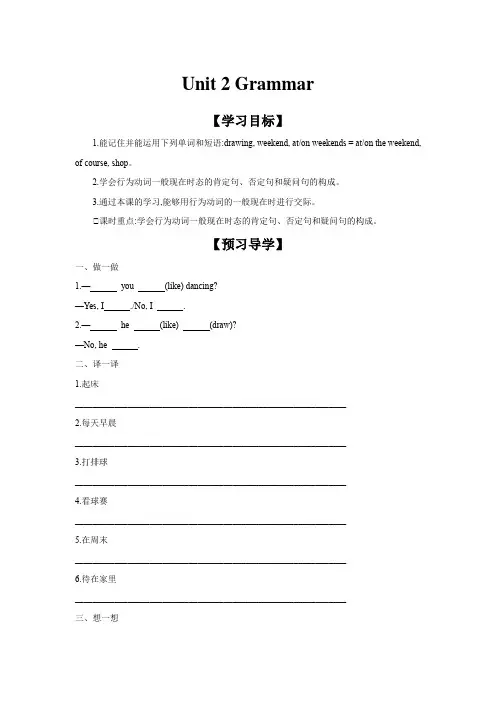
Unit 2 Grammar【学习目标】1.能记住并能运用下列单词和短语:drawing, weekend, at/on weekends = at/on the weekend, of course, shop。
2.学会行为动词一般现在时态的肯定句、否定句和疑问句的构成。
3.通过本课的学习,能够用行为动词的一般现在时进行交际。
◉课时重点:学会行为动词一般现在时态的肯定句、否定句和疑问句的构成。
【预习导学】一、做一做1.— you (like) dancing?—Yes, I ./No, I .2.— he (like) (draw)?—No, he .二、译一译1.起床______________________________________________________________2.每天早晨______________________________________________________________3.打排球______________________________________________________________4.看球赛______________________________________________________________5.在周末______________________________________________________________6.待在家里______________________________________________________________三、想一想1.在含有行为动词的一般现在时态中,句子的主语是第一人称I,后面连用的行为动词用; 句子的主语是第二人称you,后面连用的行为动词用; 句子的主语是第三人称单数she, he, it,后面连用的行为动词用; 句子的主语是单数名词,后面连用的行为动词用; 句子的主语是复数名词,后面连用的行为动词用。
牛津译林版七年级英语上册复习教案: Unit 2 Grammar 2

课题7上Unit 2 Grammar 2 课型New 教学目标To master the simple present tense o f the verb to do教学重点To master the simple present tense of the verb to do教学难点To master the s imple present tense of the verb to do教学过程集体备课备课札记Step 1 RevisionWe use the Simple present tense of the verb to do whenwe talk about:Things that we often do.Things that are always true.Things that are true now.For example:I live in a flat.I have a pet at home.I go to work by bus.I watch TV at weekends.I do the housework every evening.Step 2 Presentation当主语为第三人称单数时 ,谓语动词用三单现形式。
You have known sth. about me.Now can you tell your partner about these?You can begin wit h “She….”She lives in a flat.She has a pet at home.She goes to work by bus.She watches TV at weekends.She does the housework every evening.动词的三单现变化规则如下:(1) 一般情况加-s, 例如:read—reads cook—cooks bring—brings use—uses(2)以s,x,sh,ch结尾的动词,加-es. 例如:miss— , finish— ,teach--________watch— fix—(4)以o 结尾的动词加-esgo -- ______________ do -- ________________(5) have 变成hasIshow you a picture of Simon. Look carefully and then answer my questions.(1) Does he like playing football? Yes. He does. Simon likesplaying football.(2)Does he wear glasses? No, he doesn’t. Simon doesn’t wear glasses.(3)Pay attention to the underlined part and work out the rule(4) 当主语是第三人称单数(he, she, it)时,其否定句要借助于does not/ doesn’t,后面的动词用原形。
Unit2+Grammar课件2024-2025学年译林版(2024)七年级英语上册
No, she doesn’t. She likes papercutting.
No, he doesn’t. He likes jogging.ຫໍສະໝຸດ do does学习理解
Practice
Does Does Does
Do
formal(正式的) informal(非正式的)
No, she doesn’t. =No, she No, she doesn’t. does not. Yes, he does. No, they don’t.
Daniel, a fan of science
What does science do? Science changes people’s lives.
Things that are true now
What does he like to do? He likes to take things apart.
Please underline all the verbs, put them into different groups according to different changing rules and work out the rules.
2. His mother likes fishing because her cat likes eating fish. She often goes fishing but never catches any fish.
3. Ben is his best friend! He often flies kites at weekends because he likes to be outdoors. He also loves cooking and he always tries new things because he enjoys eating delicious food.
【最新】牛津译林版七年级英语上册unit2 Grammar2 导学案
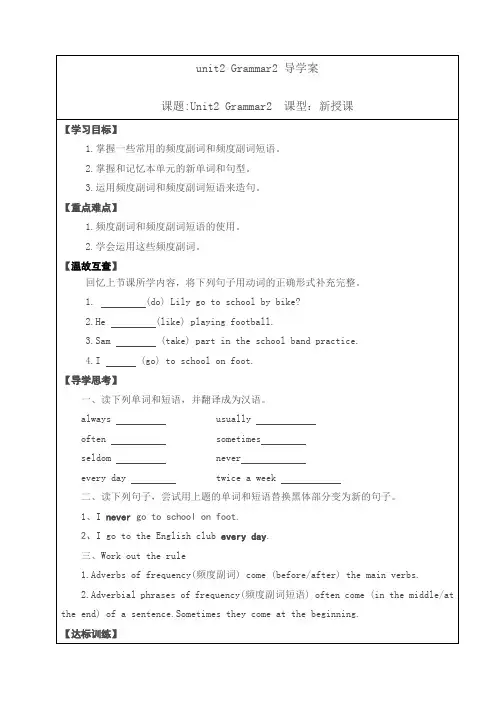
unit2 Grammar2 导学案课题:Unit2 Grammar2 课型:新授课【学习目标】1.掌握一些常用的频度副词和频度副词短语。
2.掌握和记忆本单元的新单词和句型。
3.运用频度副词和频度副词短语来造句。
【重点难点】1.频度副词和频度副词短语的使用。
2.学会运用这些频度副词。
【温故互查】回忆上节课所学内容,将下列句子用动词的正确形式补充完整。
1. (do) Lily go to school by bike?2.He (like) playing football.3.Sam (take) part in the school band practice.4.I (go) to school on foot.【导学思考】一、读下列单词和短语,并翻译成为汉语。
always usuallyoften sometimesseldom neverevery day twice a week二、读下列句子,尝试用上题的单词和短语替换黑体部分变为新的句子。
1、I never go to school on foot.2、I go to the English club every day.三、Work out the rule1.Adverbs of frequency(频度副词) come (before/after) the main verbs.2.Adverbial phrases of frequency(频度副词短语) often come (in the middle/at the end) of a sentence.Sometimes they come at the beginning.【达标训练】Mandy meets Sam on the internet again.She is asking Sam some questions about his life.Write Sam’answer in the complete sentences.Mandy:How often do you watch television?Sam:.(1) I watch television every night. (every night)Mandy: How often do you eat out?Sam:.(2) (sometimes)Mandy: How often do you play table tennis with your father?Sam:.(3) (once a week)Mandy: How often do you win?Sam:.(4) (seldom)Mandy: How often do you visit other cities?Sam:.(5) (four times a year)Mandy: How often do you play computer games?Sam:.(6) (never)。
最新牛津译林版中学七年级英语上册《Unit 2 Let's play sports》Grammar教案
Let’s play sports!教学目标1. to make positive and negative statements and ask questions with the verb "to be"2. To le arn to use the simple present te nse to talk about things.重点The Simple present tense.难点The Simpl e pres ent tense.教学准备教学设计详案二次备课内容Step1 Revision1. The teacher presents some pictures to lead in the usingof simple present tense of the verb to do2. Ask some studen ts to write the sentences on theblackboard and help them find out the differences.3. Help students read the table on page 23 together and makeconclusion s.Step 2 Practice.Present some simple present tense verb and ask students todo it.Help students do the exercises on the book, tell them“Millie is writing about herself and her classmates.Pl ease help her co mplete the sentences in Part A with thewords in the box.Step 3 PresentationEncourage students to introduce himself/herself within 5sentences.“I want to know more about you, your family and yourfrie nds.”Step4.PracticeScene: Millie and Simon are talking about their favoritesports. Please read their conversation.Help students master the using of negative sentences and ask and answer questions using the verb “to do “in the simple present sentence.Lead the students master the table on page 23.Step5 ConsolidationDo some e xerciseHomeworkFinish off the exercise作业设计教学反思。
牛津译林版7A Unit2 Grammar教案
牛津译林版7A Unit2 Grammar 教案Unit 2 GrammarStudying aims:1.Ask students to make positive and negative statements and ask questions with Simple present tense of the verb to do.2.Ask students to use the simple present tense to talk about things that are always true,things that are true now and things that we do regularly.3.Ask students to master some new words and phrases.Studying difficulties and importance: the simple present tense Teaching aids: a computer and multimediaTeaching steps:Step1: To show the studying aims to the students.Step 2: Lead in-- Review and check up (5mins)Ask students to do some exercises of Simple present tense of the verb to be and check the answers.Step 3: Simple present tense of the verb ‘to do’ (30mins)1.Go through the tables with students on Page 23.2.Ask students to read the sentences on their own.3. Show them the three conditions to use Simple present tense of the verb to do.●are always true●are true now●we do regularly (habits,jobs,school work,etc.)4. Give three sentences and ask students to number the three sentences and say out what kind of condition it is.5. Ask students to complete Part A on Page 24. Ask several students to read out their answers. Check for correct pronunciation.6. Ask students to go through the table with students. Ask students to master verb form changes for the simple present tense in the third person singular.7. Ask students to write down the third person singular of some words.8. Ask students to do some exercises and pay attention to the third person singular.Check the answers.9. Ask students to master how to make positive sentences, negative sentences and question sentences in the simple present tense.10. Ask students to complete Part B of P24 on their own. Then check the answers.11. Give some pictures and phrases, ask students to use the phrases to make a dialogue with their partners. Pay attention to how to answer question sentences in the simple present tense.12. Ask students to complete Part C of P24. Ask students to read the dilogue and check the answers.Step4: Class exercises. (10mins)。
牛津译林版-英语-七上-2单元 Grammar 教案
Unit 2 Let’s play sports!GrammarI. Teaching aims and learning objectivesBy the end of the lesson, students should be able to:1. be clear abou t the usage of the simple present tense of the verb to do;2. use this tense to make up positive and negative sentences, ask and answer questions;3. talk about something about themselves and their classmates using this tense;4. finish the exercises o n the textbook correctly.II. Teaching contents1. New words and phrases: drawing, weekend, at/on weekends, of course, shop2. New structures: I/You/We/They like sports.He/She/It likes sports.I/You/We/They do not/don’t like sports.He/She/It does not/doesn’t like sports.Do I/you/we/they like sports?Yes, you/I/we/they do.No, you/I/we/they don’t.Does he/she/it like sports?Yes, he/she/it does.No, he/she/it doesn’t.III. Focus of the lesson and predicted area of difficultySum up how to use the simple present tense of the verb to do to make up positive and negative sentences, ask and answer questions.Sum up the rules of the third person singular form.IV. Teaching proceduresStep 1 Lead-inT: Today we’ll learn grammar of Unit 2—the simple present tense of the verb to do. Boys and girls, let’s play a guessing game first. There is a photo in my hand. Can you guess who is it? You can guess like this:Is it a man? Is he/she a teacher? Is he/she famous? You are so clever. This is Messi. Can you tell me anything about him? Pay attention to these sentences.He looks strong. He plays football very well.He wants to play in the next World Cup.Many students like him.T: All the sentences are written in the simple present tense of the v erb “to d o”.【设计意图】通过学生比较感兴趣的游戏导入新课,使其迅速进入本课话题,增加了课堂的趣味性,运动员梅西的资料介绍即复习了上节课的一些内容,同时又导出了今天所学的语法项目,一举两得。
牛津译林版七年级上册英语教案:Unit2 Grammar2
课题七上Unit2 Grammar2 主备ZhaoXiurong主核Ma Haixia使用者Lu Li 课型New 使用日期2015.9.23 【学习目标】1.To learn the new words and phrases.2. To learn the three usages of simple present tense.3.To do more exercises about simple present tense.第一次备课(通案)第二次备课(个案)【导入新课】;Do you remember the usage of the be-verb?Do you want to learn more about the grammar?Let’s enjoy the new lesson.(Picture1-6)【板书课题】Unit2 Let’s play sports!(Grammar 2)【学习目标】Studying aims1 .To learn the new words and phrases.2.To learn the three usages of simple present tense.3.To do more exercises about simple present tense.【自学指导】Tell the students three usages of simple present tense.1.Things that are true now2.Things that we often do.3.Things that are always true.实义动词的用法:实义动词在一般现在时中的用法:实义动词就是表示一个实际动作的动词,如:work,play,run,write,read 等。
确定学习目标,让学生能够有针对性的学习,并且让学生课后能够总结自己是否达到本节课学习任务。