
高一英语必修4 Unit 4 body_language-reading
Warming up– I How Sort out the ways of do you communicate communication with your friends?
typing Written language writing
Spoken speakinglanguage ringing
Jordan He moved _______ to me and then _____ Darlene
On the contrary,simply________the girls. Darlene and Tony___________and then______________
Name
Body language Why did Julia Tony Colombia Tony behave like this? ________her ___________Julia, approached touched
Part2(3’)
How did different international students behave when they greeted each other? Name Country Body language Tony ____Julia, _____her shoulder Tony
2. Why did they come to China?
Part1 (1’) They were coming to study at Beijing University
3. What would we do for them? their dormitories We would take them first to _______________ the student canteen and then to ___________________________
Posture
Warming up – II
Game
Act the statements out without speaking. Rules: You are divided into 3 groups. When my finger points at you, your group act it out at once.
gesturing Body language
What is body language
?
Definition for Body Language One form of communication without using any words
Eye contact
Facial Gesture expression
Task2
Careful reading
Read the passage carefully and answer the following questions
1. Where did we meet the international students? Capital International Airport
Britain Japan George
and________her on the ______!She _________appearing surprised and _________ her hands,as if in defence. George reached his_____________ Akira,however,Akira______
Reading Read the following passage
and answer several questions
TASK1
TASK2
TA (4’)
Read the passage quickly to divide it into 4 parts and then match the main idea of each part. Para 1 Part1 Para 2 Para 3 Para 4 Part3 Para 5 Part4
Pre-reading
• As we know, there are many different ways to greet someone using words. • And we also can use different ways to greet by body language. • Today we are going to learn a passage about different ways of greeting among different cultures.
Summary of body language.
Part2
You are sent to CIA to meet this year’s international students.
Different people has different body language. Examples of learned or cultural “body language”.
Come and join us!
You’re great!
Give me a little time!
Congratulation!
I’m sorry!
I give up.
Just like verbal language(言辞), body language is part of culture. It plays an important role in daily communication. So, it is very important to understand and use it correctly. And for a foreign language learner, it is as necessary to learn the body language as to learn the verbal language.
高中英语必修四4_Unit4_Body_language_Reading新人教版

A conclusion of the passage.
Careful reading
( Read para1-2 Find out the answers to the questions)
1 Who will be present at the meeting?
people from different countries
a Japanese The second mistake
George Cook from (Canada)
He ________ bowed to Mr. Cook and his nose touched Mr. _________ moving Cook’s _______ ________. hand He ________ reached his hand ________ _______ ________ to the out Japanese.
Para.1-2 (example)
people present local businessmen
people representing the Chinese government
2 Why are people visiting China?
purpose mistakes
interest
People from different countries misunderstand each other.
He approaches Ms Smith Mr. Garcia by touching _______ ______ her from The _________ _______ shoulder and kissing (Columbia ) first her on the ________. cheek mistake She ______ stepped ________ back Julia Smith appearing surprised _________ from and take a few steps (Britain) away from _______ ______ Mr. Garcia.
必修4-Unit4-Body-language-reading课件

Look at the title and picture on page 26 and predict what the passage is about.
Which is the main idea of the text? A. There are different customs in different countries. B. Foreigners should follow the customs of the country where they are visiting. C. People use body movements to send messages and different body movements have different meanings. D. The importance of knowing customs.
Canada shake hands Japan bow
Spain, Italy, South
American countries
approach others closely and are more likely to touch them
France
shake hands and kiss each other twice on each cheek
gesture
Guess the following facial expressions or gestures ?
satisfied unhappy
shocked
Come here.
Bye-bye.
• Victory/win! • Ok!
What is body language ?
Body Language is a set of _姿g_e势_s_t;手u_r_势e_s___, _b_o_d_y_肢_m体_o_动v_e作_m_e_n_t_s_ and _fa_c_ia_l_e_x_p_r_es_s_io_n.s People use to make themselves 面部表情 understood.
高中英语必修四Unit4BodylanguageReading
Unit 4 Body language阅读课一、教学内容Pre-reading (p.25); Reading (p.26); Comprehending (p.27)二、教学目标1. 能力目标让学生通过阅读,能够理解并尊重不同区域的人的身体语言和其文化涵义。
进一步训练学生推测、略读、找读、归纳内容等阅读技巧;培养学生把握篇章中心内容、归纳段落大意、获取关键信息、并且能针对阅读内容表达自己的观点的能力。
2. 语言目标重点词汇与短语greet prediction represent association dormitory canteen flight curiouscuriouly Colombia approach cheek defend defence majormisunderstanding Jordan dash adult spoken Spain Italy likely crossroadsdefend against be likely to in general重点句子结构与用法Yesterday, another student and I, representing our university’s student association, wentto …After half an hour of waiting for their flight to arrive, I saw several young people enterthe waiting area looking around curiously.I stood for a minute watching them and then went to greet them.She stepped back appearing surprised and put up her hands, as if in defence.Then Akira Nagata from Japan came in smiling, together with Japanese student.When Darlene Coulon from France came dashing through the door, she recognizedTony Garcia’s smiling face.三、教学步骤步骤一读前1. 引导学生回顾Warming Up部分和听力材料的内容,布置学生各组不同的任务归纳人和黑猩猩的相似之处。
人教版高中英语必修四 Unit4 Body Language reading 课件
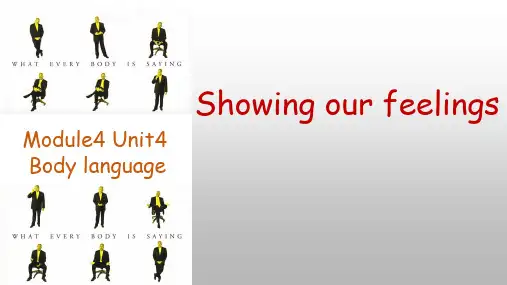
Para1 Body language is one of the most powerful means of communication, often even more powerful than spoken language. People around the world show all kinds of feelings, wishes and attitudes that they might never speak aloud. It is possible to "read" others around us, even if they do not intend for us to catch their unspoken communication. Of course, body language can be misread, but many gestures and actions are universal.
but many gestures and actions are universal. Para7 With so many cultural differences between people, it is great
to have some similarities in body language. We can often be wrong about each other, so it is an amazing thing that we understand each other as well as we do!
Para7 With so many cultural differences between people, it is great to have some similarities in body language. We can often be wrong about each other, so it is an amazing thing that we understand each other as well as we do!
Unit+4+Body+language+Reading+and+人教版(2019)选择性必修第一册
lack: 1. (n.): absence. 2. (v.): to not have.
2. He is so occupied with writing his graduation thesis that he barely bothers eating well.
3. Little children tend to display their interest by staring at something that they like.
4. They ultimately won the game and demonstrated to all football fans that they they wຫໍສະໝຸດ re a powerful team.
Some gestures seem to have the same meaning everywhere.
Some body language has many different uses.
structure
choose the correct structure of the text.
A
Moving you hand in circles over your stomach after a meal
I’m full.
everywhere
Read for Reading Strategy
1. What is the text type of the passage? A. Narration(记叙文). B. Argumentative Essay(议论文). C. Exposition(说明文). D. Practical Writing(应用文).
Unit 4 Body Language Reading教学设计
Unit 4 Body Language Reading "Communication:No problem?" 教学设计正宁一中冯振华一、Type:ReadingBody Language is a narrative description,which mainly deals with different body language in different culture. As we know, body language is a kind of language that can be used to express one’s innermost feelings in a silent way. This passage is designed to help the students understand what important part that body language plays in our daily communication to help the students avoid misunderstanding and cultural shock. As a result, their language communication ability will be improved.二、Analysis of the passage1、Content Unit 4 Body language Reading "Communication: No problem?" (Module 4)2、Dealing with the passageWarming up(Lead-in) while-reading and Comprehending are designed in the reading passage.Those activities can help the students improve their reading skills and oral English ability.3、Teaching aims【Knowledge goal】①To help the students understand that body language iscross-cultural.②To help the students understand the differences among body language in different countries.(2)【Ability goal】①To help the students understand the passage and get the main idea and specific information,thus the reading skills will be developed.②To help the students express their ideas and opinions freely.③To cultivate the students’pragmatic ability of trans-cultural communication in authentic language environment.(3)【Emotional goal】①To help the students learn and respect cultures in different countries.②To develop the students’ international cooperation and their awareness of trans-culture.三、Teaching difficulties and important points(1)Teaching important points①To help the ss learn and use common body language properly in theircommunication;②To get the main idea of the text and some key information.(2)Teaching difficulties①To cultivate the students’ reading skills②To help the students learn some cultural misunderstanding caused by body language in different situations.四、Teaching methodTask-based method & Communicative-cooperation method五、Teaching aidsPPT Project Blackboard Chalk六、Teaching design(一)General designThis is a reading comprehension lesson. The key to teaching is to improve the students’ reading skills and strategies. And the teacher will help the ss improve their cultural awareness.To arouse the ss’ interest in the topic, at the very beginning of the class,the teacher uses the students’ familiar gestures (ok, quiet, stop, great) to lead in the topic and asks some students to guess the meaning of each picture. Then the teacher asks some students to perform some body language, thus the atmosphere in the class is lively. At last,the teacher asks the ss: “What is body language?” As a result ,the new lesson is easily lead-in. The design of the reading activities deals with pre-reading, while-reading and post reading, including getting the main idea of the text, specific information and so on , aiming at improving ss’ reading comprehension ability and oral English ability.(二)Teaching proceduresStep 1.Leading in(1)The teacher shows some pictures on the screen. They are about some common gestures used in our daily life. Then asks some ss to guess the meaning of each gesture.(2)The teacher asks some pairs of students to come to the blackboard to perform some body language, while other students to guess what the body language means.Facial expressions: happy, excited, shocked, angry, etcGestures: Victory, well done, quiet, OK, etcPostures: Shake hands, bow, nod ,hug, etcEye contact: Wide-eyed, wink, roll eyes, etcInstructions:通过学生熟悉的手势导入本课,让学生倍感亲切,很自然地过渡到本课的话题。
新人教版高中英语必修四Unit4 Body Language Reading教学反思与心得体会
新人教版高中英语必修四Unit4 Body Language Reading教学反思与心得体会在这次县里组织的公开课比赛中,回顾过程,反思总结,收获还是挺多的,有可取之处,也有值得探讨尚需改进的地方。
还有幸观摩其他老师的授课,现将教学反思与心得体会总结如下,由于水平有限,反思与心得体会的内容可能很浅薄,望各位老师多多指教。
反思如下:可取之处:1、个人认为本课堂设计的过程给予肯定,贴切生活的问题开始本单元的话题,利用有趣的图片进行解释body language 进而导入主题,然后进行fast-reading和careful reading,对课文进行理解,有显现的简易知识,也有深度的讨论思考。
最后对课文进行升华,进行思考探讨与表达,学到了什么,为什么这么做,该如何做。
2、课堂设计导入leading in借助于当前话题母亲节, 是否向母亲表达爱意,一来教育学生关爱父母,二来引出交流表达的方式,从而导入主题what is body language,不仅实现了对学生的情感教育,而且很好的导入了本课主题。
3.整堂课完整有序,用贴切的生活图片等形式轻松而幽默,很轻易的就调动了学生参与的积极性;运用各种任务,贯穿整个课堂,使文章理解条理清晰;比较充分调动了学生的参与热情,使学生愿意积极配合完成各个环节,课堂气氛活跃。
4.以学生为主体,培养了学生合作思维与表达能力。
通过身势语的展示和the cultural mistakes的表演很好让学生参与到课堂教学过程中。
利用问题Is the author male or female?等问题让学生进行深度思维,交流想法,表达想法锻炼学生的思维能力与表达能力,从而实现“以学生为本”和“课堂有效性”。
不足之处:1. 学生思考的广度不够,阅读中停留在reading for information较多,而缺少reading for thinking,教学过程中基本上基于信息找寻的问题居多,而进行深入思考的的问题过少而且范围狭窄。
新人教版高中英语必修4Unit 4 Body Language Reading(含答案)
高一英语同步练习:必修4 Unit 4 Body Language第2课时Reading基础练习1.Scanning: Find the characters and where they are from?Character Country____________________________________________________________________________ ____________________________________________________________________________ ______________________________________2.Fast-reading : Does body language stay the same in different countries / cultures ? Why?3.Careful reading:read the text, fill the graphCountry Ways to greet each otherBritain ________________________Canada ________________________Japan ________________________Spain, Italy, South American countries________________________________France________________________________________________________________Men from Middle East and other Muslim cultures实战演练一. 英汉互译1. Yesterday, another student and I, representing our university’s studentassociation, went to the Capital International Airport to meet this year’s international students.______________________________________2.我看见几个年轻人走进了等候区,好奇地四周张望。
Unit4BodylanguageReadingandThinking教学设计高中英语人教版选择性
人教版(2019)选择性必修第一册Unit 4 Body LanguageReading and ThinkingTeaching Plans本节课的教材分析:该节课的教材内容主要包括一篇名为《Body Language》的阅读材料,该材料介绍了肢体语言的功能、文化差异以及对人际交流的影响等内容。
在阅读材料之后,还有一些相关的问题和讨论,帮助学生进一步理解和思考肢体语言的特点。
教学目标:1. 通过找主题句来梳理全文的篇章结构,掌握文章主旨大意,了解肢体语言的功能和文化差异性。
2. 通过自主阅读,小组合作,培养逻辑思维、语言表达能力以及团队合作精神。
3. 通过解读文本,思考肢体语言的特点及其对现实生活的意义,体验文化差异,发展批判性思维。
教学重点:1. 掌握文章主旨大意,了解肢体语言的功能和文化差异性;2. 培养逻辑思维、语言表达能力以及团队合作精神;3. 培养学生对肢体语言特点和文化差异的思考能力。
教学难点:1. 帮助学生理解肢体语言对人际交流的重要性,并对肢体语言进行深入思考;2. 培养学生的团队合作精神,让学生在合作中共同完成任务。
学情分析:学生为高一年级的学生,英语水平普遍较低,课本中的阅读材料有一定难度。
学生在日常生活中对肢体语言已有一定的接触和了解,但他们对于肢体语言的功能和文化差异可能还不够清晰。
教学策略:本节课将采用启发式教学策略,通过文本引导学生主动思考和讨论,培养学生的批判性思维能力。
同时,采用小组合作学习形式,通过小组合作完成任务,培养学生的团队合作精神。
教学方法:阅读和讨论、小组合作具体教学过程:1. 导入:根据学生的实际经验,以问题的形式让学生思考肢体语言的重要性和作用。
2. 阅读:让学生自主阅读《Body Language》一文,并在文中找出主题句,理解全文的篇章结构,把握文章主旨大意。
3. 讨论:分成小组进行讨论,分享各自对肢体语言的理解和感受,讨论肢体语言在不同文化背景下的差异。
必修四Unit4BodyLanguageReading课件
1.Why are the people visiting China?
They are coming to study at Beijing University.
2.What parts of the world are not represented by the visitors? Africa, Australia and central America are not represented.
Homework:
1. Recite the new words. 2. Finish the paper for language points.
Shake hands and stand quite close to other men. Nod to women but do not shake hands with them.
Why do we need to study body language?
Key words: help understand communicate learn about cultures avoid cause miXXXderstanding difficulties make a fool of ourselves(闹笑话) Useful expressions: Studying body language can…… If we don’t study……, we may……
• 3、To respect other country’s body languages.
Fast reading
The main idea of the text is that people use body
movements to send messages and different body movements have different meanings .