
八年级英语上册Unit1Wheredidyougoonvacation复习课件新版人教新目标版
02 词汇听写
同学们,本单元的单词你们都掌握了吗? 现在大家来检验一下,点击下面的音频开始听写吧!
03 考点集训
考点一:一般过去时
英语中的动词按其过去式的构成方式可分为规则动词和不规则动词。规则 动词的过去式由词尾-ed构成,而不规则动词的变化因词而异。 1. 规则动词过去式的构成和发音: (1) 一般的动词, 直接加-ed watch→watched,help→helped,work→worked (2) 以字母e结尾的规则动词, 只加-d love→loved,live→lived,arrive→arrived (3) 以辅音字母加y结尾的动词, 变y为i, 再加-ed study→studied,cry→cried,worry→worried
03 考点集训
(4)中间去e末尾加t。 feel→felt,keep→kept,sleep→slept,sweep→swept,meet→met, feed→fed 助记:动词中间两个e,去掉一个后加t;d来结尾,去e之后不加t。
(5)把i变为o。 ride→rode,drive→drove,write→wrote 助记:动词过去式变i为o的单词:“骑(马)”“开(车)”“写(字)”。
⑥ 利用笔记抓住老师的思路。记笔记不仅有利于理解和记忆,而且有利于抓住老师的思路。
2019/7/10
最新中小学教学课件
23
谢谢欣赏!
2019/7/10
最新中小学教学课件
24
03 考点集训
用所给词的适当形式填空。 1. I ___h_a_d____ (have) an exciting party last weekend. 2. ___D__id____ she __p_r_a_c_ti_c_e_ (practice) the guitar yesterday?
No, she __d__id_n_’_t__. 3. ---What ___d_i_d___ Tom __d__o____ (do) on Saturday evening?
(6)ow/aw变为ew。 know→knew,grow→grew,throw→threw,draw→drew
(7)以d结尾的词,把d变成t。 build→built,lend→lent,send→sent,spend→spent
03 考点集训
一般过去式的构成形式
03 考点集训
巧学妙记
动词一般过去时, 表示过去发生的事; be用was或用were, have,has变had; 谓语动词过去式, 过去时间作标志; 一般动词加-ed, 若是特殊得硬记。 否定句很简单, 主语之后didn’t添; 疑问句也不难, did放在主语前; 如果谓语之前有did, 谓语动词需还原; 动词若是was,were, 否定就把not添。
---He _w_a_t_c_h_e_d_(watch) TV and __r_e_a_d___ (read) an interesting book.
03 考点集训
4. They all ___w_e_n_t__ (go) to the mountains yesterday morning. 5. She _d_id_n_’_t_v_i_s_it (not visit) her aunt last weekend. She __s_t_a_y_e_d_ (stay) at
1. Do you have __a_n_y_t_h_i_ng new to tell me? something
2. My watch doesn't work. There is _________ wrong with it. 3. Would you like _s_o_m__et_h_i_n_g to drink? 4. Put it down, Richard. You mustn't read _a_n_y_o_n_e_ else's letter.
④ 紧跟老师的推导过程抓住老师的思路。老师在课堂上讲解某一结论时,一般有一个推导过程,如数学问题的来龙去脉、物理概念的抽象归纳、语 文课的分析等。感悟和理解推导过程是一个投入思维、感悟方法的过程,这有助于理解记忆结论,也有助于提高分析问题和运用知识的能力。
⑤ 搁置问题抓住老师的思路。碰到自己还没有完全理解老师所讲内容的时候,最好是做个记号,姑且先把这个问题放在一边,继续听老师讲后面的 内容,以免顾此失彼。来自:学习方法网
该题要求学生运用一般过去时来叙述发生在过去的事情。 写作时,要先交代时间、人物、地点;再按时间顺序写出活动 内容;最后,写旅行的感受。
04 话题训练
During the summer holiday,_____________________________________ _________________________________________
—Go to see whoyself (我自己) ,yourself (你自己)是反身代词。表示“某人 自己”的词叫反身 代词。归类如下:
03 考点集训
单项填空
1. Don't worry about me. I'm old enough to think for _D___. A. himself B. herself C. yourself D. myself
home and ____d_i_d___ (do) some cleaning.
03 考点集训
考点二:复合不定代词
some, any, no, every与-one, -thing可以组成不同的不定代词。加上where构成不定副词。some-不定代词,通常用于肯定句中;any-不定代词 则多用于否定句、疑问句和条件状语从句中。但some-可用于表请求、邀 请、预料对方会作肯定回答时的疑问句中。 形容词修饰不定代词时,通常要放在不定代词之后。
03 考点集训
5. _E_v_e_r_y_o_n_e likes money,but money is not _e_v_er_y_t_h_i_n_g_. 6. _N__o_o_n_e_ is watching TV. Let's turn it off. 7. _N_o_t_h_in_g_ is more important than life. 8. — _S_o_m_e_o_n_e_is knocking(敲) at the door.
let→let,put→put,read→read,cut→cut
03 考点集训
(2)遇见i改为a。 swim→swam , sing→sang , begin→began , sit→sat , give→gave , drink→drank 助记:游泳(swim)唱歌(sing)后,开始(begin)坐(sit)下来,给(give)点喝 (drink)的吧,i就变成a。 (3)过去式以ought和aught结尾的单词。 bring→brought , buy→bought , think→thought , catch→caught , teach→taught
04 话题训练
Useful expressions: 1. It's an interesting place. 2. It's a beautiful place. 3. They have great fun. 4. It was really a happy trip.
04 话题训练
范文
During the summer holiday, Nick's father took him and their dog Cookie to Red Mountain. It's a beautiful place. They had a happy trip there. In the morning , they went hiking and took many photos on the way. At noon,they had a picnic. In the afternoon, they went boating. It was dark and they had to go home. It was really a happy trip!
03 考点集训
(4) 以重读闭音节结尾的动词, 末尾只有一个辅音字母, 先双写这个辅 音字母, 再加-ed
shop→shopped;stop→stopped 读音规则注意:清辅音后读/t/;浊辅音和元音后读/d/;辅音/t/与/d/ 后读/Id/。 2. 不规则动词的过去式的变化各异, 需要特殊记忆, 每个不规则动词 的变换形式, 都必须牢记。不规则动词的过去式变化没有统一的规则, 但并非一点规律也没有,下面我们就介绍一部分动词过去式的记忆规律。 (1)动词的过去式与动词原形一样。
In the morning ________________________________ At noon ______________________________________ In the afternon ________________________________
It was really a happy trip!
② 根据自己预习时理解过的逻辑结构抓住老师的思路。老师讲课在多数情况下是根据教材本身的知识结构展开的,若把自己预习时所理解过的知识 逻辑结构与老师的讲解过程进行比较,便可以抓住老师的思路。
③ 根据老师的提示抓住老师的思路。老师在教学中经常有一些提示用语,如“请注意”、“我再重复一遍”、“这个问题的关键是····”等等,这些 用语往往体现了老师的思路。来自:学习方法网
编后语
老师上课都有一定的思路,抓住老师的思路就能取得良好的学习效果。在上一小节中已经提及听课中要跟随老师的思路,这里再进一步论述听课时如何 抓住老师的思路。
八上unitwheredidyougoonvacation语法知识讲解复习课件

(3动词过去式变化规则:
1.一般在动词末尾加-ed如:pull-pulled cook-cooked
2.结尾是e加d,如:taste-tasted
3.末尾是辅音字母加一个元音字母和一个辅音字母的 重读闭音节,应双写末尾的辅音字母,再加-ed,如: stop-stopped
4.以辅音字母+y结尾的,变y为i, 再加-ed,如: study-studied
2)There are quite a few birds in the forest. 在那片森林里有很多鸟。
2. I just stayed at home most of the time to read and relax. most意为大多数后跟可数名词或不可数名 词均可
e.g. Most students go to school on foot. 大多数学生步行去上学。
try to do / try doing
try to do sth.设法做某事尽力做某事: He tried to finish the work ahead of time. 他设法提前完成这件工作 try doing sth.试着做某事,试验做某事: -I usually go there by train. -Why not try going by boat for a change --我通常乘火车去那儿。--为什么不换乘船呢? 区别:try to do侧重尽力,为了达到目的而努力。try
I can’t find it _a_n_y_w_h_e_r_e___. 9.Would you like have something?
语法点 2一般过去时
1.定义:一般过去时表示过去某个时间发生的动作 或存在的状态常和表示过去的时间状语 (yesterdaylast week, last month…)连用一般过 去时也表示过去经常或反复发生的动作。
Unit 1 Where did you go on vacation复习课件英语八年级上册

Read the dialogue and answer the questions below.
1. When and where did Helen go on vacation ? She went to Guizhou with her family last month.
2. Did she see Huangguoshu Waterfall? Yes , she did.
Where did you go on vacation? I went to Beijing City.
Where did he go on vacation? He went to the mountains.
Where did she go on vacation? She went to the beach.
一般过去时表示在过去某个中某一段时间内发 生的动作或存在的状态。
练习: 1. My father __C__ ill yesterday.
A. isn’t B. aren’t C. wasn’t D. weren’t
2. __D__ your parents at home last week. A. Is B. Was C. Are D. Were
8. They all __w__e_n_t__ (go) to the mountains yesterday morning. 9. She _d_i_d_n_'t__v_is_i_t_ (not visit) her aunt last weekend. 10. She __s_ta_y_e_d__ (stay) at home and ___d_i_d___ (do) some cleaning.
Where did you go on vacation复习课件(共25张PPT) 人教版八年级上册
注意:反身代词注意与主语保持一致 积累固定搭配,例如 enjoy oneself 等。
语法百宝箱
总结本单元的语法知识,你掌握了吗
三、时态
一般过去时的用法
1.概念
2.结构
3.用法
Eg: —What did you do last week? — I stayed at home.
语法百宝箱
总结本单元的语法知识,你掌握了吗
10. 决定 v. __d_e_c_id_e___ 12. 想知道 v. w__o_n_d_e_r_ 14. 等待 v. _w_a_i_t___ 16. 饥饿的 adj. _h_u_n_g_r_y___
词汇训练营
单词填空,考查综合运用能力!
二、根据提示填空 1.Tom is new here, so he has ___fe_w_____(很少) friends. 2.The view(风景) in Lushan is __w__o_n_d_e_r_fu_l__(绝妙的). 3.You should look after ___y_o_u_r_se_l_f__(你自己)at home when your parents are away. 4.After doing homework for an hour, he feels__b_o_r_e_d___(厌倦的). 5.Do you have __e_n_o_u_g_h___(足够的)money to buy the car?
语法百宝箱
学以致用,各个击破语法点
一、单项选择 4.__B____his kindness, I got a free book. A.Because B.Because of C.Because for D.Because on 5.Do you feel like__C______? A.swim B.swiming C.swimming D.to swim 6.I feel ___A____, so I want to have something to eat. A.hungry B.thirsty C.wonderful D.enjoyable
人教版英语八年级上册Unit总复习课件

17、walk around绕……走,
18、too many 太多(可数名词前面), 19、because of 因为,
20、one bowl of 一碗……,
21、find out 查出来/发现 ,
22、go on继续,
23、take photos 照相,
24、something important重要的事情,
3、go to the mountains 上山/进山 , 4、 go to the beach到海边去,
5、visit museums 参观博物馆,
6、go to summer camp 去夏令营,
7、 quite a few 相当多,
8、study for为……学习,
9、go out 出去,
10、most of the time 大部分时间/绝大多数时间,
人教版英语八年级上册Unit 1 总复习课件(共18张PPT)
三、习惯用法、搭配 1. buy sth. for ab./ buy sb. sth. 为某人买某物 2. taste + adj. 尝起来…… 3. nothing ….but + V.(原形) 除了……之外什么都没有 4. seem + (to be) + adj 看起来 5. arrive in + 大地方 / arrive at + 小地方 到达某地 6. decide to do sth. 决定做某事 7. try doing sth. 尝试做某事 / try to do sth. 尽力做某事 8. enjoy doing sth. 喜欢做某事 9. want to do sth. 想去做某事 10. start doing sth. 开始做某事
人教版新目标八年级上册Unit 1 Where did you go on vacation单元复习
3.I got up at six this morning.
否定句: I didn’t get up at six this morning. Did you get up at six this morning? 一般疑问句: 肯定回答:Yes,I did. 否定回答:No, I didn’t.
• • •
1.There was some water in the cup.
There wasn’t any water in the cup. 否定句: 一般疑问句: Was there any water in the cup? 肯定回答: Yes, there was. 否定回答: No, there wasn’t.
B:It was …
Descriptions
exciting, wonderful terrible ,boring,bored great,enjoyable,interesting , delicious,expensive, cheap, special,excellent, old ,new, good ,bad, wet,cold,humid
• • • • • • • • • •
11.停下来去做另一件事 stop to do sth · · that· · · 12.如此· · · 以至于· · · so· 13.在某人回家的路上 on one’s way home 14.· · · 怎么样? what/how about+n./V-ing 15.去爬山 go to the mountains 16.去海边 go to the beach 17.去夏令营 go to summer camp 18.待在家 stay at home 19.乘坐火车 take a train 20.拍照 take photos
八上第一课时unit1wheredid you go on vacation复习
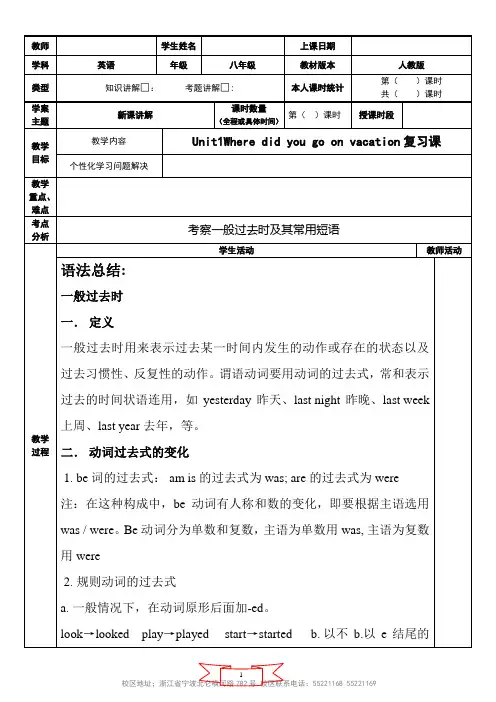
教师学生姓名上课日期学科英语年级八年级教材版本人教版类型知识讲解□:考题讲解□:本人课时统计第()课时共()课时学案主题新课讲解课时数量(全程或具体时间)第()课时授课时段教学目标教学内容Unit1Where did you go on vacation复习课个性化学习问题解决教学重点、难点考点分析考察一般过去时及其常用短语教学过程学生活动教师活动语法总结:一般过去时一.定义一般过去时用来表示过去某一时间内发生的动作或存在的状态以及过去习惯性、反复性的动作。
谓语动词要用动词的过去式,常和表示过去的时间状语连用,如yesterday昨天、last night昨晚、last week上周、last year去年,等。
二.动词过去式的变化1. be词的过去式: am is 的过去式为was; are的过去式为were注:在这种构成中,be动词有人称和数的变化,即要根据主语选用was / were。
Be动词分为单数和复数,主语为单数用was, 主语为复数用were2. 规则动词的过去式a. 一般情况下,在动词原形后面加-ed。
look→looked play→played start→started b. 以不b.以e结尾的动词,在词尾直接加-d。
live→lived use→usedc. 以“辅音字母+ y”结尾的动词,先将 y 改为i ,再加–ed。
study→studied try→tried fly→flied注意stay—stayed play—played这样的词都是以“元音字母+y”结尾的。
d.以重读闭音节(即辅音+元音+辅音)或r音节结尾,末尾只有一个辅音字母的动词,要先双写这个辅音字母后,再加ed。
stop→stopped plan→planned prefer→preferred2. 不规则动词的过去式是需要记忆的,详见书上的不规则动词表三.一般过去时的基本用法1. 表示过去某个特定时间发生的动作或存在的状态。
【2021年】人教英语八年级上册Unit 1 Where did you go on vacation复习课件 (共19张PPT)
语法讲堂
5. 形容词修饰这些复合不定代词,形容词必须后置。如: There is something wrong with your ears
--Something English? I know fish and chips! Would you give me something to drink?
语法讲堂
5.I went to a friend’s farm in the countryside with my family.我和家人一起去了 乡下一个朋友的农场.
写作指导
One possible version: My Vacation Last summer, I went to Beijing on vacation with my father. It was sunny and hot. First we visited the Great Wall. There were a lot of people on the Great Wall. It is really the longest wall in the world. The next day, we visited the Palace Museum and Tian’amen Square. We took many photos there. We also visited some other interesting places in Beijing. We visited a Beijing hutong, too. We had a great time there. I hope to go there again.
八年级英语上册第01单元Wheredidyougoonvacation知识点归纳与复习(扫描人教新
贵州省遵义市桐梓县2017-2018学年八年级英语上册第01单元Where did you go on vacation知识点归纳与复习(扫描版)(新版)人教新目标版
编辑整理:
尊敬的读者朋友们:
这里是精品文档编辑中心,本文档内容是由我和我的同事精心编辑整理后发布的,发布之前我们对文中内容进行仔细校对,但是难免会有疏漏的地方,但是任然希望(贵州省遵义市桐梓县2017-2018学年八年级英语上册第01单元Where did you go on vacation知识点归纳与复习(扫描版)(新版)人教新目标版)的内容能够给您的工作和学习带来便利。
同时也真诚的希望收到您的建议和反馈,这将是我们进步的源泉,前进的动力。
本文可编辑可修改,如果觉得对您有帮助请收藏以便随时查阅,最后祝您生活愉快业绩进步,以下为贵州省遵义市桐梓县2017-2018学年八年级英语上册第01单元Where did you go on vacation知识点归纳与复习(扫描版)(新版)人教新目标版的全部内容。
第01单元 Where did you go on vacation。
Unit 1 Where did you go on vacation 单元复习与练习课件41张ppt
I saw someone interesting,but I didn't buy anything special .
▲another 他们又花费了2个小时才爬到山顶。 They spent another two hours to walk up to the top of the hill. ▲wonder(后面跟句子) 我想知道她正在做什么。 I wonder what she is doing. ▲enough(与名词连用,一般放在名词前;与形容词或副词连用,enough放在后面。) 1. 我希望有足够的钱为父母买一所大房子。 I hope to have enough money to buy a big house for my parents.
I like this place because I can learn something important.
4. 海伦,你昨天下午买了什么特别的东西吗? Helen,did you buy anything special yesterday afternoon? 5. 我看见了有趣的人,但我没买什么特别的东西。
▲其他时态 1. Alice always tries (try) to help me to learn English well. 2. 你的老师正在教室里等你。 Your teacher is waiting for you in the classroom. 3. 我帮迷路的小孩找到了他的父亲. I helped the lost child find his father
2. 雨下得很大,我们都淋湿了。 It rained heavily , so we were all wet. 3. —食物怎么样?—所有的尝起来都不错。 —How was the food?—It tasted really good. ▲序数词 It was my first (one) time to go to San ya. ▲over超过,多余 = more than 我们等了一个多小时的火车。 We over/more than an hour for the train.
人教新目标八年级英语上册Unit 1 Where did you go on vacation_复习教案
1. 词汇运用A)根据句意及所给汉语提示,写出句中所缺单词。
1. Did you write a(n) ______(日记) yesterday?2. I don’t have ______(足够的) money for the car.3. Grandpa keeps ten ______(猪) on his farm.4. We had to ______(等候) twenty minutes for the bus.5. The old ______(建筑物) in the city look very special.B)根据句意,用括号内所给单词的适当形式填空。
6. They ______(decide) to go on vacation yesterday evening.7. Look! There are some ______(duck) in the river.8. My cousin feels like ______(make) model planes this Sunday.9. Tim and Peter, you can buy some books for ______(yourself).10. It ______(seem) that someone is calling.2. 完成句子根据汉语意思完成英语句子,每空词数不限。
11. 上周你去什么有趣的地方了吗?Did you go ___________________ last week?12. 我们今天上午到达了武汉。
We _________________ Wuhan this morning.13. 我想知道你过去长什么样。
I __________________ you looked like in the past.14. 听!雨下得真大。
Listen! It is __________________.15. 森林里有相当多的树。