
unit-3-The-million-pound-bank-note公开课
His friend lost his money, so he asked him to buy a train ticket for him.
“But I don't have enough money to buy two tickets,” he said.
His friend didn't know what to do. “You can hide under my seat when the conductor comes to check the tickets,” he said to his friend.
乞 丐 公 主
More
his famous works
1. Running for Governor
his famous works
2. The Million Pound Bank Note
Mark Twain
Real name Samuel Langhorne Clemens
Meaning of his
His famous stories
The Adventures of Tom Sawyer, The Adventures of Huckleberry Finn
《百万英镑》是马克·吐温的 一篇有名的小说,描绘了美 国的一个小办事员出海游玩, 迷失方向后,幸遇救,随船 来到英国伦敦。他身无分文, 举目无亲,两个富有的兄弟 给了他一张一百万镑的钞票, 并以他在三十天内凭这张百 万英镑的钞票能否活下去而 打赌。在小说的结尾,小人 物不仅活过了三十天,并且 利用这张百万英镑发了一笔 财,还获得了一位小姐的芳 心。小说通过小办事员的种 种“历险”嘲弄了金钱在资 产阶级社会叱咤风云、呼风 唤雨的作用。
One of the best famous writers in America.
Mark Twain
America's short story writer
Humorist
Public speaker
America's best known literary figure
Literary giant
There is a humorous story about a famous American novelist. Can you guess who he is .
He liked to tell funny stories to make people laugh and play jokes on his friends. Once he was traveling with a friend of his.
spend it on food do some science research
buy a big flat
toys
Mark Twain (pen name)
What do you know about Mark Twain?
Real name: Samuel Langhorne Clemens
C.C. an argumentation ( 论说文)
D.D. a drama /play ( 戏剧 )
Elements(要素) of Drama
• Plot 情节 • Character 角色 • Dramatic speech 戏剧语言 • Staging 舞台效果 • Theme 主题
Fast reading
Warming up and reading
1sc.一ene场;现场;场面 2w.a漫nd游er ;漫步 3pa.人vem行en道t 4ba.海y 湾 5sp.o发t 现 6pa.耐tien心ce 7em.大ba使ssy馆 8pa.船ssa费ge ;通道 9ch.a慈rit善y
1se1e.寻k 找 1m2a.k打e a赌bet 1b3e .l迷ost路in 1g4o.a前he进ad,往下说 1b5y.a偶cc然ide;n无t 意中 1st6a.re凝at视;盯着看 1a7cc.o是un…t f的or 原因;解释 1o8n.t正he相con反trary
When the conductor came to check the tickets, he gave the conductor two tickets, one for himself and one for his friend.
He said to the conductor, “My friend is a strange man. When he travels on a train, he does not like to sit on the seat. He likes to lie on the floor under the seat.”
Pre-reading
We are going to study the text “The Million Pound Bank Note” by Mark Twain.
What is the style of this text?
A. narration
(记叙文)
B. an exposition (说明文 )
pen name
the water is two fathoms deep
Birth date
November 30th, 1835
Birthplace
HannibaΒιβλιοθήκη , MissouriPlace where he Hannibal, Missouri,
grew up
along the Mississippi
1sce.1一e.寻nke场找;现场;场面 21wm2.a漫.kn打ed游ea赌rb;et 漫步 31pb3ea.人v.l迷oesm行t路einn道t 41b4a.海.y前go湾进ah,e往ad下说 51sp5.o.发偶t 现然;无意中 6pbya.耐taiecnc心icdeent 71em6.大.ba凝使ss视y馆;盯着看 8psta.a船srsea费aget ;通道 91ch7.a慈.是rit善y…的原因;解释
Book3-Unit3百万英镑公开课概要PPT课件
lot.
观点题:感觉判断(强词夺理)
F 3. 3.When Henry saw the million pound
bank-note, he was happy and proud of it.
事实题:与事实相反
F 4. 4.The owner didn’t believe that the banknote was real and he asked Henry to get
某人做某事是无礼的202120rudemanner用一种粗鲁的态度manner表方式方法举止态度常用单表礼貌礼仪常用复数
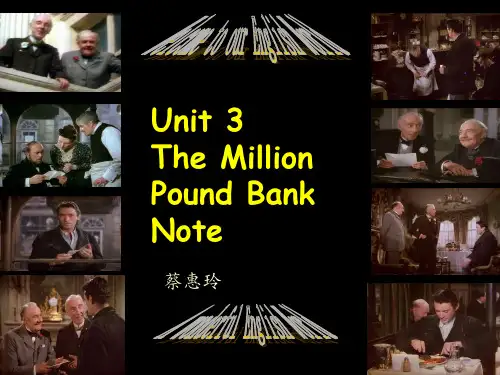
Unit 3 The Million Pound Bank Note
蔡惠玲
warming-up//preparation
Money is not everything
It can buy you a house but not a home,
1. 1.What did the hostess feel when Henry came into the restaurant? How do you know?
1. 2. Why were the owner and hostess shocked when they saw the million pound bank-note in Henry’ hand?
2)how (表现方式202,1 手法等),从对话中10
2. Why were the owner and hostess shocked when they saw the million pound bank-note in Henry’ hand?
Because they never thought that the bank-note belonged to such a person in rags.
高一必修3Unit3TheMillionPoundBank-NoteReading全英文公开课教案
高一必修3Unit3TheMillionPoundBank-NoteReading全英文公开课教案高一必修3 Unit 3 The Million Pound Bank-NoteTeaching Aims:1. Learn more about Mark Twain2. Read and retell the Million Pound Bank-Note3. Learn useful expressions: a large amount of,make a bet, permit sb. to do sth., by chance, stare at, to be honestTeaching Important Points:1. Retell the Million Pound Bank-Note2. Useful expressionsTeaching Difficult Points:How to help students have a correct attitude towards money Teaching Methods:1. Direct perception teaching method;2. Heuristic method;3. Discussing methodTeaching Aids:1. a recorder ;2. a slide projector;3. a computer4. a VCDTeaching Procedures:Step I .Introduction and readingT: Morning, everyone, do you like humor?Ss: Yes, of course.T: Me, too. And I like watching humorous play. Look at the screen; can you guess what play it is?Ss: Yes. It is called THE MILLION POUND BANK-NOTE.T: Then, do you know the writer of the play?SS: Yes. It is Mark Twain.T: What do you know about the American writer Mark Twain?Next, read “ABOUT MARK TWAIN” on page 23 so that you can know more about him.T: Have you finished reading? Ok. Look at the screen and say sth. about MARK TWAIN.T:1. Tell us his wok experiencesS1: Over the next two decades he was a printer, a riverboat pilot, a soldier, a gold miner, a business- man and a newspaper reporter.T: 2.What was his pen name?S2: Mark twainT: Samuel Langhorne Clemens was his real name.T: 3. Tell us the meaning of his pen nameS3: “Twain” is an old word for “two”.“Mark Twain” is to say that the water is two fathoms deep.T: 4.What was his first successful story?S4: His first successful story was about a jumping frog contest.T: 5.What are his most famous books?S5: The adventures of Tom Sawyer.The Adventures of Huckleberry Finn.Life on the MississippiT : Why did you forget this one----THE MILLION POUND BANK-NOTE? As we know, Mark Twain is known as a humorist during his life. And this is reflected in THE MILLION POUND BANK-NOTE. So, today we’ll learn some parts of this famous play. Step II . Listening and ReadingT: First, express your opinions freely. If a rich person gives you a large amount of money to use as you like, for example, one million pound, what will you do? Why? Please discuss in groups of four.S1: I’ll buy a big house, a new car of my own and get married with a beautif ul girl. In my opinion, the most important thing for a person is to enjoy the life. So, if I have a lot of money, I’ll make full use of it to meet my needs for a rich life.S2: I’ll give some money of the one million pound t o the poor people in the west part of our country to help them live a happy life, especially the children. Because they really need help and they can learn more knowledge in order to develop the west part of our country. This way of spending money is meaningful.S3: …T: I think all of you have a good idea. Do you want to know what happened to Henry Adams in THE MILLION POUND BANK-NOTE written by Mark Twain? We’ll learn the story together.1. ListeningT: Now we are going to learn ACT ONE Scene 3. Listen the whole scene quickly and find out the answers to the four questions here.Show the questions on the screen:1. How did Henry Adams come to England?2. Where did Henry work? How much money did he have?3. What did the two gentlemen give Henry?4. When can Henry open the letter?T: Well, class, have you finished reading the whole scene?SS: Yes.T: Ok, who can answer the first question? How did Henry Adams come to England? S1: It was the ship that brought him toEngland.T: Very good. You did a good job. Next, where did Henry work? How much money did he have?S2: He worked for a mining company and he had no money at all.T: Very good. Then what did the two gentlemen give him?S3: They gave him a letter.T: When can Henry open the letter?S4: He can’t open it until two o’clock.T: Ok, great. Next, let’s do some listening.Step III. Reading and comprehendingT: Please listen to the tape and try to find the characteristics of the whole scene.(Students listen to the tape.)T: Well, Can you tell me the characteristics of the passage?SS: Yes. This is part of a play. So, the tale is written in the present tense.T: Ok, all of you did a good job. Next, let’s read the scene again and do some exercises.Reading and comprehending:Why did the narrator say “yo u are aboutto hear the most incredible tale”?What happened to Henry :He was lost at seaHe was given much money forreasons unknown to himHe had no money He couldn't find a jobThese questions in oral may help understand the problem:1.What happened to Henry Adams at sea?2.Did he have any money or work?3.What happened to Henry in a house in London?Step IV Post-reading1. Do comprehending exercises.Get the students to do this exercise by themselves, and then ask them to check their answers with the whole class.2. Explain language points.T: Well, class. What do you think of the scene? Do you think it is difficult to understand some sentences?SS: Yes.T: Now, please look at the screen and let me explain some sentences.(1) a large amount of: a large quantity of; a great deal ofe.g. They bought a large amount of furniture before they moved their new house.(2) permit somebody to do something: allow somebody to do somethinge.g. My mother doesn’t permit me to ride in the street after it raine d.(3)by accident: as a result of chance or mishap.e.g. I only found it by accident.(4) to be honest: to tell you the truth; to be franke.g. To be honest, I don’t think we have a chance of winning.Step IV. Watching part of the movie the Million Pound Bank-NoteT: Well, class, have you got the main idea?SS: Yes.T: What’s the main idea? And would you like to retell it to your parents or your friends?Step V. Retelling the Million Pound Bank-NoteT: Now, look at the key words. Prepare for retelling the wholescene.summer, 1903, Henry Adams, American businessman, rescued, British ship, London, without money, lost, walk down, street, led to, two rich brothers, made a bet, a letter, a million-pound bank-note, open, two o’clock.S1: It was the summer of 1903, and Henry Adams, an American businessman, had some very luck. He was rescued at sea by a British ship that takes him to London where he finds himself without money, friends or the prospect of a good job. He was lost and alone in London. He had no money and did not know what he should do. Walking down the street, he heard someone calling him. Then he came in and was led to two rich brothers, Roderick and Oliver, who made a secret bet and gave him a letter in which there was a one-million-pound banknote. He was aske d to open the letter until two o’clock in the afternoon.T: Good, the next one, who wants to try?(Then another student retells the whole scene.)Step VI. Debate the importance of the moneyT: Ok, class, what do you think of this play? Is money so important?SS: no.T: Some people say that money is everything. What do you think of this opinion? S1: I don’t think so. Yes, money is very important in some occasion. But that doesn’t mean it is everything. For example, when your hometown is flooded a nd you are trapped in the water, can you save yourself even if you have a lot of money with you? No! So, we should not regard money as everything.T: Great! But some people still think that money can bringthem happiness. What do you think of this?S2: I d on’t agree this. Since money doesn’t mean everything, so it can’t bring happiness to us. For example, you have a lot of money but you haven’t a happy family, can’t you say that you are happy? T: So, class, we should have a correct attitude towards money. N ow, let’s look at today’s homework. Step VII. Assignments1. Review the key sentences in this part.2. Act out the play in groups.Step IX .Record after teaching。
必修3 Unit3课件 The Million Pound Bank-note课件
Characters in Scene 3:
Henry
a lost American businessman in London
Roderick a rich Englishman, Oliver’s brother
Oliver a rich Englishman, Roderick’s brother
spot: see or notice a person or thing 发现
account for: to be the explanation or cause of sth. 是....的原因
charity: 施舍
Fast Reading
1. Who was Henry?
An American businessman, who arrived in London by accident, penniless, hungry and lonely.
2. How did Henry Adams come to England?
It was the ship that brought him to England.
3. Where did Henry work before? How much did he have? He worked for a mining company before and he had no money at all.
Characters in the play:
Henry Adams: An American businessman, lost in London without money, friends or a job.
Roderick and Oliver: Two rich brothers, who made a bet.
Unit3 The Million Pound Bank Note 课件

Warming up-II (5m)
About Mark Twain (reading on P17)
Find out more information about Mark Twain and then complete the following chart.
Place he was born in
A British ship, for London, passing by, fortunately saved him.
Pre-reading-II (1m)
Prediction :
What would happen to Henry?
ACT
1 The story SCENE began
3
Reading-I (2m)
Reading-II (3m)
Skimming : answer the following questions:
1. Where does Henry Adams come from?Does he know much about London? 2. What did he do in America? 3. Why did he land in Britain?
What does the brothers choose Henry for?
They wanted to make a bet on Henry.
Jobless, penniless, honest, the right person to choose for betting
gave Henry an envelope and told him not to open it until 2 o’clock
Unit 3 The Million Pound Bank Note课件 新人教版课件

[解析] A 考查宾语从句。本句中what引导宾语从句, what you are going to do作为介词of的宾语,what在从 句中作为动词do的宾语。how在句中不能作宾语。that 在宾语从句中不充当任何成分,只起引导作用。which 是指特定范围之内的某一个。故A正确。
返回目录
第13讲
• • • • • • • • • • • • • • • •
佳 作 晨 读 基 础 梳 理 考 点 探 析 跟 踪 训 练
第13讲 Unit 3 The Million Pound Bank Note
返回目录
第13讲
Unit 3
The Million Pound Bank Note
• • • •
by famous writers. For one thing, they help to improve my writing skills and broaden my horizons. For another, they can enrich my life and provide me with great fun. Isn't it a pleasure to have great calm in mind while you are reading?
返回目录
第13讲
Unit 3
The Million Pound Bank Note
• • • •
• Ⅲ.佳句再现 carried out • 1.Well, towards nightfall I found myself ____________ to sea by a strong wind. 傍晚时分,我发现我被一阵大风刮到海上去了。 基• 础 • 2.The next morning I'd just about given myself up for lost 梳 __________________by a ship. when I was spotted 理• 第二天早上,正当我感到绝望时,一艘轮船发现了 我。 That's why • 3.________________ we've given you the letter. • 那正是我们给你这封信的原因。
高中英语必修三 3.6《《Unit 3 The Million Pound Bank-Note》(共19页)课件

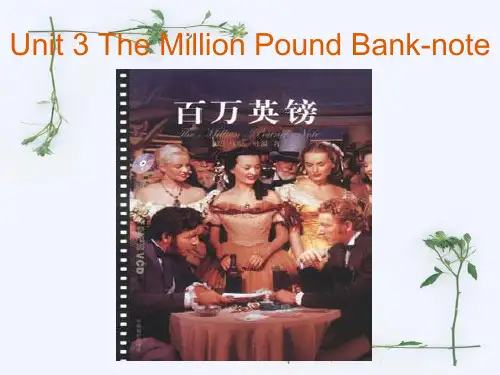
Unit 3 The Million Pound Bank-note
Make a dialogue with the partner according to the following situation:
Henry is smiling as he leaves the restaurant. He has had more than enough to eat. As he is walking down the street, he sees a sign for a barber’s shop. In a shop window, he looks at his own hair. Since it is too long, he decides to get it cut.
新课标人教版课件系列
《高中英语》
必修3-3.6
Unit 3 The Million Pound Bank-note
ACT
1 Listening
SCENE
&
Speaking
5
Listen to Act One, Scene 5 on the tape and answer these questions:
Find out some stage directions in Scene 4: Ex. Seeing Henry’s poor appearance. To the waiter. After sitting down and putting the letter on the table. The waiter leaves for the kitchen. Having just finished every bit of food. Sees the look on the waiter’s face. ……
Unit 3 The Million Pound Bank Note 课件2-优质公开课-人教高中必修3精品
Brainstorming:
buy a house open a shop What will Henry do with the Million Pound Bank-Note?
travel around the world
put it into a bank
buy some new clothes!
snobbish
Discussion(5m)
Discussion
1.What can you learn from the text? 2.Is money everything?
Role play (5m)
Role play:
Please form a group of four and act it out and try to imitate their tones and try your best to make it as funny as possible.
Listen to the tape and underline the sentences that showed the attitude of the owner, waiter and hostess.
ቤተ መጻሕፍቲ ባይዱ
Owner
That one's reserved.
Waiter
It'll cost a tiny bit.
Prediction:
What will happen to Henry? A. He will have nothing. B. He will have everything he wants.
那会花费稍多一点。 It'll cost a tiny bit.
Unit 3 The Million Pound Bank-Note教案
Unit 3 The Million Pound Bank-Note教案Unit 3 The Million Pound Bank-Note锛╋紟鎶€鑳界洰鏍嘢kill GoalsTalk about short stories and dramas.Learn how to act out a play.Learn how to request and order food.Learn Noun clauses as the object and predicative.Write a play or drama.II锛?鍔?鑳?鍙?寮?RequestWould you please come in?Would you mind waiting just a few minutes?May I ask you how much money you have?鈥?Well, to be honest, I have none.Could you offer me some kind of work?I wonder, Mr. Adams, if you mind us asking a few questions? 鈥?Go right ahead.Ordering food ()I鈥檇like some ham and eggs and a nice big steak.I鈥檒l have a nice long glass of beer.璇?姹?1. 鍥涗細璇嶆眹bet, scene, tale, servant, permit, bay, stare, spot, passage, account, appearance, patience, silly, jealous, unbelievable, steak, tiny, wolf, dessert, rude, manner, scream, shoulder, rag, indeed, bow, decade, pilot, humour, novel, character, director, barber2.narrator, incredible, Roderick, Oliver, nightfall, unpaid, charity, willingness, simply, Clemens, issue, fake, boyhood, Hannibal, Missouri, Mississippi, fathom, contest, Yale, loneliness, playwright, script3. 鍥哄畾璇嶇粍make a bet, go ahead, by accident, account for, to be honest, in rags, even if, get into trouble4. 閲嶇偣璇嶆眹bet, make a bet, permit, go ahead, by accident, stare, account for, to be honest, jealous, in rags, indeed, even if, get into trouble璇?娉?Noun clauses as the object ()I can鈥檛say that I have any plans....and he does not know what he should do.I did not know whether I could survive until morning.Noun clauses as the predicative ()That鈥檚why we鈥檝e given you the letter.閲?鐐?鍙?瀛?1. Have you ever made a bet with a friend? If so, what did you bet on?2. He is lost in London.3. Permit me to lead the way, sir.4. As a matter of fact, I landed in Britain by accident.5. His eyes stare at what is left of the brothers鈥?dinner on the table.6. I wonder, Mr Adams, if you鈥檇mind us asking a few questions.7. I earned my passage by working as an unpaid hand, which accounts for myappearance.8. Well, we will have to take a chance.9. (in a rude manner) What鈥檚there to wait for?10. He鈥檚in rags!III锛?鏁欐潗鍒嗘瀽涓庢暀鏉愰噸缁?1. 鏁欐潗鍒嗘瀽?1.1 WARMING UP朵綔鍝? ?1.2 PRE-READING瑕佹眰瀛︾敓灞曞紑鎯宠薄锛屽亣濡傝嚜宸辨湁浜嗕竴寮犵櫨€嬭繖閮ㄧ數褰辩殑璇勪环銆?1.3 READINGenry Adams銆傛暀甯В銆佹劅鍙楁垙鍓хф?1.4 COMPREHENDING 涓璅act or OpinionВ鍜岃繍鐢ㄣ€?1.5 LEARNING ABOUT LANGUAGEВ?骞堕€氳繃鍏堝彂鐜板啀绠€鍗曡В銆佹帉鎻℃湰鍗曞?1.6 USING LANGUAGE Reading and actingenry Adams, 鍏堥伃鍒板喎閬囷紝鑰屽悗鐢变簬鎷垮嚭浜嗕竴寮犵櫨涓囪嫳闀戠殑澶ч挒,鍙堝€嶅彈鍏崇収鐨勬湁瓒f晠浜嬨€備綔鑰呯敤磋劯銆?1.6.1 READING && ACTING ?1.6.2 LISTENING &&WRITING竴姝ュ嵃璇佷簡Henry Adams 璇氬疄姝g洿鐨勫搧鏍笺€?1.6.3 READING ?1.6.4 WRITING?--€?1.7 SUMMING UP?1.8 LEARNING TIP ?2. 鏁欐潗閲嶇粍2.1,Warming up, Pre-reading, Reading, Comprehending鍜孶sing language Reading (about Mark Twain)鐩€?2.2 灏哃earning about language Words and expressions, Using language涓Useful structures涓嶹orkbook Using structures, Using words and expressions??2.3 灏哢sing language listening 锛圓CT ONE Scene 5锛夛紝Workbook涓Listening锛圓CT TWO Scene 2?2.4 灏哤orkbook Talking (ACT TWO Scene 1), Speaking Task (ACT TWO Scene3)鍜孲peaking Task (ACT TWO Scene 4)?2.5灏哢sing language Reading and acting (ACT ONE Scene 4)涓婃垚涓€鑺傗€滈槄璇诲拰琛ㄦ紨璇锯€濄€?2.6灏哢sing language Writing (ACT ONE Scene 5)涓嶹orkbookWriting Task 鍜孋hecking yourself, Learning Tips濄€?3. ?(缁忓垎鏋愭暀鏉??1st period Intensive Reading2nd period Grammar3rd period Listening4th period Speaking5th period Extensive Reading and Acting6th period Writing鈪? ?The First Period Intensive ReadingTeaching goals1. Target languagea. 閲嶇偣璇嶆眹鍜岀煭璇?bet, make a bet, permit, go ahead, by accident, stare, account for, to be honest, jealousb.Expressions on request:Would you step inside a moment, please?Would you please come in?May we ask what you鈥檙e doing in this country and what your plans are?Well, why don鈥檛you explain what this is all about?c. 閲嶇偣鍙ュ瀷1) Have you ever made a bet with a friend? If so, what did you bet on?2) He is lost in London.3) Permit me to lead the way, sir.4) As a matter of fact, I landed in Britain by accident.5) His eyes stare at what is left of the brothers鈥?dinner on the table.6) I wonder, Mr Adams, if you鈥檇mind us asking a few questions.7) I earned my passage by working as an unpaid hand, which accounts for my appearance.2. Ability goalsa. Enable students to read and hear natural language in a dramatic context and increase their self-confidence in using English, which will increase their overall motivation to learn English.b. Enable students to sum up the main idea of ACT ONE Scene 3.c. Enable students to understand the details about the whole scene.d. Retell the scene using the key words of the whole scene.e. Express their opinions by answering the following questions:1) Do you think money is everything? Why?2) Do you agree that only money can bring people happiness?3. Learning ability goalsa. Help students to understand natural language in the dramatic context and increase their self-confidence in using English.b. Help students to sum up the main idea of ACT ONE Scene3.c. Help students to understand the details of the whole scene.d. Get students to retell the whole scene.e. Help them to answer the following questions:1) Do you think money is everything?2) Do you agree that only money can bring people happiness?Teaching important pointsa. How to interpret language through tone of voice and body language, gaining a greater appreciation of the various verbal and non-verbal ways in which language works.b. Discuss the questions:1) Do you think money is everything?2) Do you agree that only money can bring people happiness?Teaching difficult pointsDiscuss the questions:1) Do you think money is everything?2) Do you agree that only money can bring people happiness?Teaching methodsElicitation, discussion, listening, reading and pair work.Teaching aidsA computer, a projector and a tape recorder.Teaching procedures and ways?Step I Warming upMark Twain is probably one of the few American writers with whom students are already familiar. This exercise makes the teacher find out how much the studentsknow about this writer and decide how much they need to know more about the auther before they read the play.T: Morning, everyone! Look at the screen, please. I will show you some pictures of a famous play. Talk about them in your own words. (The teacher shows them some pictures of THE MILLION POUND BANK-NOTE.)Picture one: I just need a suit.Picture tw I know that gentlemen like you carry only large notes.Picture three: Godness me! Six zeros.(Students discuss the three pictures)T: Ok, class. After watching and discussing the pictures, can you guess what the famous play is?Ss: Yes. It is called THE MILLION POUND BANK-NOTE.T: Then, do you know the writer of the play?Ss: Yes. He is Mark Twain.T: Do you want to know about the American writer Mark Twain? Next, read 鈥淎BOUT MARK TWAIN鈥?on Page23 so that you can know more about him.2. Students read this passage about Mark Twain and answer the questions given in the form on Page23.T: What鈥檚the real name of Mark Twain?Ss: Samuel Langhorne Clemens.T: When was he born and when did he die?Ss: He was born in 1835 and died in 1910.T: Do you know all the places where he lived?Ss: He was raised in Hannibal, Missouri, along the Mississippi River, but traveled much of the US, and also lived for a time in Europe.T: Can you name three of his famous stories?Ss: The Adventures of Tom Sawyer, The Adventures of Huckleberry Finn, A Connecticut Yankee in King Arthur鈥檚Court, The Notorious Jumping Frog of Calaveras County, etc.T: Why did you forget this one鈥昑HE MILLION POUND BANK-NOTE? As we know, Mark Twain is known as a humorist during his life. And this is reflected in THE MILLION POUND BANK-NOTE. So, today we鈥檒l learn some parts of this famousplay. Of course, if you want to read more about this great writer, you can go to the library or surf the Internet to find more about him.Step 鈪?Pre-readingGet the students to discuss the question with their partners and then ask them to report their work. Encourage them to express their opinions freely.T: If a rich person gives you a large amount of money to use as you like, for example, one million pound, what will you do? Why? (The teacher draws a picture on the blackboard.)锟?,000.000Money Flied to me from the sky. Everything changed from A to Z.(Students have a discussion on this question. Whatever choice students make here, they should be ready to offer their classmates a good reason for it.)S1: I鈥檒l buy a big house, a new car of my own and get married with a beautiful girl. In my opinion, the most important thing for a person is to enjoy the life. So, if I have a lot of money, I鈥檒l make full use of it to meet my needs for a rich life.S2: I鈥檒l give some money of the one million pound to the poor people in the western part of our country to help them live a happy life, especially the children. Because they really need help and they can learn more knowledge in order to develop the western part of our country. This way of spending money is meaningful.S3: ...T: I think all of you have a good idea. Do you want to know what happened to Henry Adams in THE MILLION POUND BANK-NOTE written by Mark Twain? Have you ever read the story? Have you seen the movie? If so, what do you think of it? So, this class we鈥檒l learn the story together.Step 鈪?While-readingFirst reading: scanningGet the students to comprehend the whole scene quickly and accurately and meanwhile help the students to form a good habit of reading. Teachers give the students a couple of minutes to look through the whole scene. Tell the students to read the text silently and then ask some detail questions about the text on the slide show with their partners. Teacher encourages the students to express their ideas.T: Now we are going to learn ACT ONE Scene 3. Read the whole scene quickly and find out the answers to the four questions here.Teacher shows the questions on the screen:1) How did Henry Adams come to England?2) Where did Henry work before? How much did he have?3) What did the two gentlemen give Henry?4) When can Henry open the letter?Students read the whole scene (ACT ONE Scene 3) for three minutes and try to answer the questions.T: Well, class, have you finished reading the whole scene?Ss: Yes.T: Ok, who can answer the first question? How did Henry Adams come to England?S1: It was the ship that brought him to England.T: Very good. You did a good job. Next, where did Henry work? How much did he have?S2: He worked for a mining company before and he had no money at all.T: Very good. Then what did the two gentlemen give him?S3: They gave him a letter.T: When can Henry open the letter?S4: He can鈥檛open it until two o鈥檆lock.T: Ok, great.Second reading: reading aloudIn this part, students will read the text again and try to understand the sentences and the main ideas of the whole scene.ListeningAfter that the students discuss the questions and then the teacher checks the answers with the whole class.T: Please listen to the tape and try to find the characteristics of the whole scene.(Students listen to the tape.)T: Well. Can you tell me the characteristics of the passage?Ss: Yes. This is part of a play. So, the narration is written in the present tense.T: Ok, all of you did a good job. Next, let鈥檚read the scene again and do some exercises.Step 鈪?Post-readingDo comprehending exercises.T: Read the scene again and do some comprehending exercises.The students begin to prepare for these two exercises. After a while, the teacher starts to check the answers. Later the teacher gives the answers. using a slide projector.Exercise 1T: Have you found out the answers?Ss: Yes.T: Ok! Let鈥檚check the answers. Who鈥檇like to tell us which of the statements are opinions?S1: I think statement 3, 4 and 5 are opinions.T: Very good. Now who will tell us which of the statements are facts?S2: I think statement 1 and 2 are facts.Exercise 2Get the students to do this exercise by themselves, and then ask them to check their answers with the whole class.(Later the teacher gives the answers, using a slide projector.)Explain language points.T: Well, class. What do you think of the scene? Do you think it is difficult to understand some sentences?Ss: Yes.T: Now, please look at the screen and let me explain some sentences.The following are the language points that the teacher will explain:1) a large amount of: a large quantity of; a great deal ofe.g. They bought a large amount of furniture before they moved their new house.2) make a bet: make an arrangement to risk money, etc. on an event of which the result is doubtful.e.g. We made a bet on the result of the match.3) permit somebody to do something: allow somebody to do somethinge.g. My mother doesn鈥檛permit me to ride in the street after it rained.4) by accident: as a result of chance.e.g. I only found it by accident.5) stare at: look at somebody or something with the eyes wide open in a fixed gaze ( in astonishment, wonder, fear, etc)e.g. Do you like being stared at?6) to be honest: to tell you the truth; to be franke.g. To be honest, I don鈥檛think we have a chance of winning.Students read the whole scene again and again and try to retell it.T: Well, class, have you got the main idea?Ss: Yes.T: What鈥檚the main idea? And can you retell it?(Then the students begin to prepare for retelling the whole scene.)Step 鈪?RetellingShow the key words and relevant pictures on the screen, using the computer.Ask the students to retell the whole scene, according to the following key words: summer, 1903, Henry Adams, American businessman, rescued, British ship, London, without money, lost, walk down, street, led to, two rich brothers, made a bet, a letter, a million-pound bank-note, open, two o鈥檆lock.T: Now, look at the key words and pictures, who can retell the reading?S1: It was the summer of 1903, and Henry Adams, an American businessman, had some very luck. He was rescued at sea by a British ship that takes him to London where he finds himself without money, friends and the prospect of a good job. He was lost and alone in London. He had no money and did not know what he should do. Walking down the street, he heard someone calling him. Then he came in and was led to two rich brothers, Roderick and Oliver, who made a secret bet and gave him a letter in which there was a one-million-pound bank-note. He was asked to open the letter until two o鈥檆lock in the afternoon. Roderick believes that a man can鈥檛survive in the city for a month with only a million pound bank-note in his possession but Oliver believes he can. (The play takes us along Henry鈥檚misadventures with humor and surprise to discover who will win the bet.)T: Good, the next one, who wants to try?(Then another student retells the whole scene.)T: You鈥檝e done a good job. Now let鈥檚retell the whole scene together.Step 鈪?Summary and HomeworkT: Ok, class, what do you think of this play? Is money so important?Ss: No.T: Some people say that money is everything. What do you think of this opinion?S1: I don鈥檛think so. Yes, money is very important in some occasion. But that doesn鈥檛mean it is everything. For example, when your hometown is flooded and you are trapped in the water, can you save yourself even if you have a lot of money with you? No! So, we should not regard money as everything.T: Great! But some people still think that money can bring them happiness. What do think of this?S2: I don鈥檛agree with this. Since money doesn鈥檛mean everything, so it can 鈥檛bring happiness to us. For example, you have a lot of money but you haven鈥檛a happy family, can鈥檛you say that you are happy?T: So, class, we should have a correct attitude towards money. Now, let鈥檚look at today鈥檚homework.1. Review the key sentences in this part.2. Preview the words in the second period.。
Book3Unit3TheMillionpoundbanknoteUsinglanguage听说课公开课教案
英语公开课教案授课教师:林燕玲授课内容:Book 3 Unit 3 The Million Pound Bank Note 授课类型:Listening and Speaking授课班级:高一(1)班授课时间:40分钟Book 3 Unit 3 The Million Pound Bank Note公开课教案I.Teaching contents:Using LanguageII.Analysis of the teaching material:In this period, we will mainly deal with the part Using Language on Pages 22——that is Act I, Scene 4 of The Million Pound Bank Note. The purpose of this part is to give students opportunity to imitate the scene in class. The teacher can let the students do the role play. They will read their speeches and try to make their language sound authentic.Ⅲ.Analysis of the students:Class One is the key class in Senior Grade One. Some students in this class do poor in English but in other subjects, However, they show positive attitudes towards learning English.In the first semester, the average score of the end-of-term English examination was 52.6. The highest score was 91 points, and only one student got the score of more than 90. The lowest score was 20. There were six students who got the scores from 80 to 90. There were eight students who got the scores from 70 to 80. There were eight students who got the scores from 60 to 70. There were nine students who got the scores from 50 to 60. There were 23 students who got the scores from 20 to 50.In their daily life, some are shy to open their mouths to speak English. Therefore, Listening and Speaking lesson can give them more chances to speak out their English, and put what they have learned into practice. In this way, they can develop their interests in Oral English and make full preparations for the College Entrance Examination.Ⅳ.Teaching aims:Knowledge aims:Let students learn the expressions of ordering food.Ability aims:1.Let students catch the main information about the play while listening.2.Enable students to understand and role play Act I, Scene 4.3.Develop students’ listening and speaking abilities.Emotion aims:1. Develop students’ sense of group cooperation and teamwork.2. Let the students to know that Money Is Not Everything.Ⅴ.Teaching key points & difficult points1. Develop students’ listening and speaking skills.2. Let students act the play.Ⅵ.Teaching methods1. Communicative Teaching2. Cooperative Teaching Method3. 3P Teaching Method4. Task-based Teaching MethodⅦ.Teaching aids1.Multimedia2.BlackboardⅧ.Teaching proceduresStep1. Revision &Lead—in & Listening1.Revision(衔接语):In the last period, we learned that Henry was given a million pound bank note. Do you know what would happen next? Now please open your boo k and guess what would happen next. First let’s watch a video. After seei ng the play, I would like you to answer my questions.2.Watching a video(衔接语):I’m sure that after watching the video, all of you are ready to “Questions- answering”Games. Before this lesson, I have divided you into 4 groups. If any one of you know the answer, please stand up and speak out your answer. Ok? The teammates who win the competition will receiv e a mysterious gift. Now, Are you ready?! Let’s downcount. 3.2.1 GO!3. CompetitionQuestions:1.Who is the hero of this play?Suggested answer: Henry2.Where did Henry go to eat?Suggested answer: A restaurant3.What kind of drink did Henry order?Suggested answer: Coffee4.What kind of food did Henry order?Suggested answer: Some ham and eggs and a nice big steak and pineapple5.How many times did Henry order the same food?Suggested answer: Twice6. How many characters are there in this scene?Suggested answer: Five.7.How did Henry dress?Suggested answer: He dressed in rags.8.How much money did Henry pay for his bill at last?Suggested answer: None.(As for the bill, sir, please forget it.)9.How much useful expressions did you know about ordering food in this passage?Suggested answers:I’d like some ham and eggs and a nice big steak.And I’ll have a large glass of beer.Same thing again, please.(衔接语):We know that all of the above are useful expressions about orde ring food in the text. Can you think more about it? If a waiter wants to help the customer order food. What could he/she say?If you want to order food, what would you say?Extensive Information:Useful expressions about ordering food.Waiters/Waitress:Can I help you?I’ll take your order in a minute.Are you ready to order, Sir/ Madam? What would you like?Enjoy your meal.Here’s your bill. Customer:I’d like…Do you have…?What do you suggest?I’ll have that.The bill, please.Can I have the check, pleas(教学设计目的):通过回顾上一节课的内容,激发学生的想象力,然后进入新课的学习。
【县级公开课教案】人教版高中英语必修三Unit 3 The Million Pound Bank-Note
Teaching planUnit 3 The million pound bank noteThe analysis of teaching materialsThis is the first reading in Unit 3 of Model 3. It’s also a main part in this unit. Mark Twain is the greatest humorist of the 19th century American literature as well as a great playwright. Many of his plays are known to people all over the world. And The Million Pound Bank-Note is one of the best.The play is one of the most useful and interesting means by which to improve students oral English skills. It will also enable students to read and hear natural language in a dramatic context. Just as importantly, reading and acting these plays aloud will increase students’ self-confidence in using English, which in turn will increase their overall motivation to learn English. This play is a very chance and a good beginning.The analysis of students1.The students are in Class 3, Grade One in Senior High School.2.They are very active, energetic and most of them have great interest inEnglish.3.They have the highly cooperative awareness.4.They don’t have a very good command of English, especially thespeaking abilities.Teaching objectives1.Knowledge aims1)Get students to know more about Mark Twain and his plays.2)Make students know the whole idea of the story by guessing,predicting, and generalizing.3)Let students grasp some important phrases and patterns, especially therequesting expressions.4)Drive students to learn some basic knowledge about drama.2.Ability aims1)Make students be familiar with the ability of fast-reading addetailed-reading.2)Practice students’ retelling ability by enjoying movie clips.3)Enable students to hear and imitate the native language in dramaticcontext and further to act the play out.3.Emotional aims1) Stimulate students’ interests of learning English by reading, listening, and acting this play.2) Drive students to analysis and unearth the characteristics of the heroes in the play so that they can learn the hypocritical aspect of the capitalism at that time and set up a right philosophy about money and humanity.Teaching Difficulties1)How to make students understand the differences between the playand the traditional reading of the passage. So that they can interpret the content through tone of voice and body language and finally gaina greater appreciation of various verbal and non-verbal ways in whichlanguage works.2)Drive students to think about whether money is everything andmoney can bring all the happiness or not.Teaching Key Points1)The whole class mainly develops around how to drive students tomaster the development of the story and to retell it by themselves. 2)Enable students to keep the requesting patterns in mind.Teaching ideology:Tasked-based approach: as students should be the center of the class, it is much better to arrange some tasks for students to practice their English and develop their comprehensive language competence. Though a series of tasks, let students perceive fully, experience actively, practice bravely and learn to go on autonomous study, cooperative study.Teaching aid:Black-board, multi-mediaTeaching Procedure:Step 1: Background KnowledgeActivity 1 Telling something about Mark TwainAsk students to share their knowledge about Mark Twain and fill the following blanks. Teachers should especially emphasize Mark Twain’s passion to the Mississippi River and his famous children’s adventures.设计意图:通过图片以及学生对小段材料的阅读,以及表格任务的分配,学生可对马克·吐温有一定程度的了解。