
新版人教版九年级英语Unit13全单元公开课教案共16页
Review of used to and should.
Look at the pictures and write these words in the boxes below. Then write other words you know.
学科
English
年级
9
班级
课型
fresh
课时
1 / 6
媒体
a tape recorder, CAI
课题
Unit 13 we’re trying to save the earth!Section A 1a~1c
话题
Protecting the environment
功能
Talk about pollution and environmentalprotection
What other things cause pollution?
Ask Ss to complete the activity as a class, then work in pairs to think of more words to add to the lists for eachg to designing some tasks, to train students’ listening ability and to train students’ communicative competence.
情感
态度
Everyone should keep our rivers clean.
2.Grammar:
Present progressive, used to, modal verbs
3.Words and expressions;
(1)Curriculum words:litter, bottom, fisherman
(2)Useful expressions:be full of, put…into, throw…into, clean up, play a part in, close down
Predicting the answers
Ss work in pairs to predict the answers to the activity, then play the recording for Ss to fill in the gaps and review answers as a class.
教
学
目
标
知识
技能
1.Target language:
We’re tryingto save the earth.
Peopleare throwinglitter into the river.
The riverused tobe so clean.
Everyoneshould helpto clean up the river.
1b. To help Ss recognize the target language in natural speech.
Everyone needs to play a part:
In the conversation, the boys are talking about the river in their town being polluted by litter and industrial waste. One of them wants to write to the government about the problem, but the other boy wisely says that cleaning up the river is everyone’s responsibility, not just the government’s.
学习策略
Listening for key words,transforming information.
重点
Target Language
难点
1.How to train students’ listening ability.
2.How to train students’ communicative competence.
教学内容及问题情境
学生活动
设计意图
1a. To introduce Ss to the unit goal, talk about pollution and environmental protection.
Picture:
The four pictures show different forms of environmental pollution. The first picture on the left shows an airplane flyingover some houses. The airplane seems to be flying a quite a low altitude, so the noise level must be quite high foe the people living in these houses. This is considered noise pollution. The second picture shows some vehicles give out exhaust fumes and causing air pollution. In the third picture, we see big chimneys giving off a lo of smoke and polluting the air. The last picture shows a rubbish dump hat pollutes the environment around it.
英语人教版九年级全册unit13 Section A (3a-3b)教案

方法
According to finishing some tasks to train students’ integrating skills and train the ability of expressing students’ own opinions.
情感
态度
Animals are our friends.We must know how to love them and how to protect them.That way, It is good for both animals and us.
学习策略
Reading for specific information.
Taking notes, cooperative learning.
重点
Target Language
难点
How to improve students’ integrating skills..
教学内容及问题情境
学生活动
设计意图
Unit13 SectionA(3a-3b)教案
学科
English
年级
9
班级
课题
Unit 13 we’re trying to save the earthSection A 3a-4c
话题
Protecting the environment
功能
Talk about pollution and environmental protection
3. Have the students fill in the blanks in 3b with the words in the box individually. And check their work with some students.
人教版九年级英语全册Unit13SectionA2(3a3b)优秀教学案例
3.运用合作学习法,鼓励学生互相交流、合作,共同完成写作任务,提高写作能力。
(三)情感态度与价值观
1.培养学生对英语阅读的兴趣,增强学生学习英语的自信心。
2.通过阅读和写作,培养学生对过去的尊重和珍惜,培养学生的思辨能力和创新意识。
3.培养学生团队合作的精神,提高学生的沟通能力和人际关系。
人教版九年级英语全册Unit13SectionA2(3a3b)优秀教学案例
一、案例背景
本案例背景以“人教版九年级英语全册Unit13SectionA2(3a3b)”为例,这是一节关于英语阅读理解的课程。通过对本节课的学习,学生能够掌握如何描述过去发生的事情,提高他们的阅读理解能力和写作能力。
在课程开始之前,学生已经学习了过去时态的相关知识,对于描述过去的事情有一定的了解。然而,他们在阅读理解方面还存在一定的困难,特别是对于长篇文章的阅读和理解。因此,本节课的目标是帮助学生提高阅读理解能力,使他们能够更好地理解和描述过去发生的事情。
3.鼓励学生在课后进行自主学习,巩固所学知识,提高阅读理解和写作能力。
五、案例亮点
1.情景创设:通过播放与文章相关的视频或音频,为学生营造一个真实的语言环境,激发学生的学习兴趣和好奇心。这种情境创设不仅有助于学生更好地理解文章内容和情景,而且能够提高学生的语言运用能力。
2.问题导向:设计一系列有针对性的问题,引导学生通过阅读和思考,逐步深入理解文章内容和主题。问题导向的教学策略能够培养学生的批判性思维和问题解决能力,使学生在学习过程中保持积极的状态。
(四)反思与评价
1.在教学过程中,教师要时刻关注学生的学习情况,及时调整教学策略,以满足学生的学习需求。
新版人教版九年级英语Unit13公开课教案unit13-5
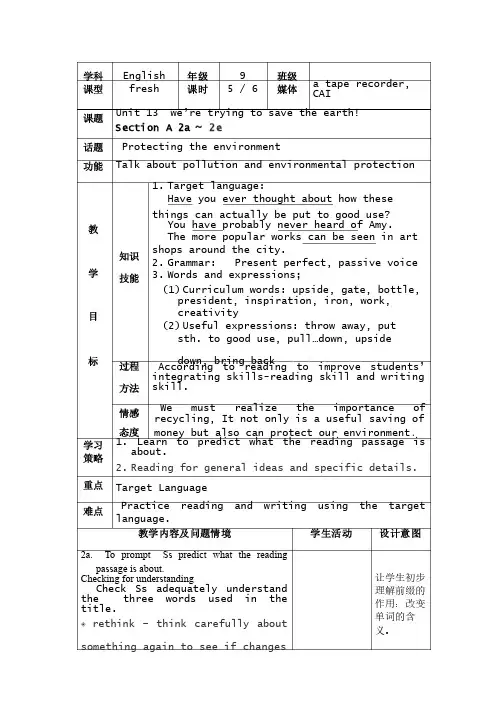
学科 English 年级9 班级课型 fresh 课时 5 / 6媒体 a tape recorder,CAI课题Unit 13 we Unit 13 we’’re trying to save the earth! Section A 2a ~ 2e话题 Protecting the environment功能 Talk about pollution and environmental protection教 学 目 标知识技能 1. Target language:Have you ever thought about how thesethings can actually be put to good use?You have probably never heard of Amy.The more popular works can be seen in art shops around the city.2. Grammar: Present perfect, passive voice3. Words and expressions; (1) Curriculum words: upside, gate, bottle,president, inspiration, iron, work, creativity (2) Useful expressions: throw away, putsth. to good use, pull sth. to good use, pull……down, upside down, bring back X k B 1 . c o m 过程 方法According to reading to improve students’ integrating skills-reading skill and writingskill.情感 态度 We must realize the importance ofrecycling, It not only is a useful saving of money but also can protect our environment . 学习策略1. Learn to predict what the reading passage isabout. 2. Reading for general ideas and specific details.重点 Target Language 难点Practice reading and writing using the target language.教学内容及问题情境学生活动设计意图 2a. To prompt Ss predict what the reading passage is about.Checking for understandingCheck Ss adequately understand the three words used in the title.◈rethink – think carefully about something again to see if changes让学生初步理解前缀的作用:改变单词的含义。
人教版九年级英语全册第十三单元教案
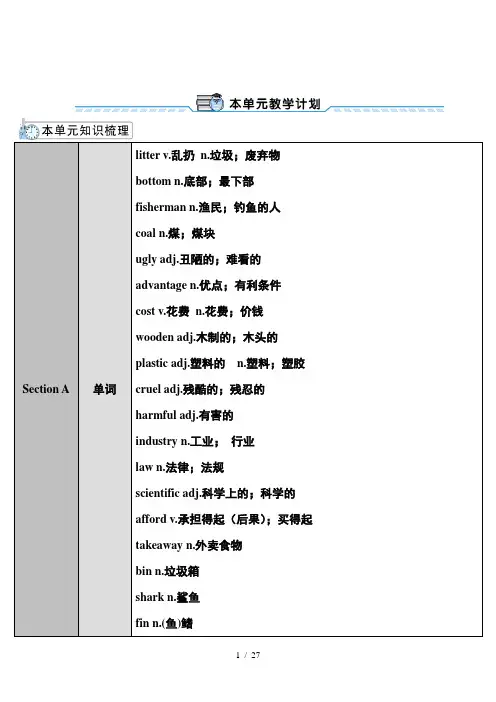
Section A 单词litter v.乱扔n.垃圾;废弃物bottom n.底部;最下部fisherman n.渔民;钓鱼的人coal n.煤;煤块ugly adj.丑陋的;难看的advantage n.优点;有利条件cost v.花费n.花费;价钱wooden adj.木制的;木头的plastic adj.塑料的n.塑料;塑胶cruel adj.残酷的;残忍的harmful adj.有害的industry n.工业;行业law n.法律;法规scientific adj.科学上的;科学的afford v.承担得起(后果);买得起takeaway n.外卖食物bin n.垃圾箱shark n.鲨鱼fin n.(鱼)鳍复习现在进行时、现在完成时和被动语态等的用法。
以“保护环境”为主题,运用本课相关句型与他人展开讨论;能向大家介绍有哪几种污染类型,怎样回收利用废弃物品等。
体会到保护环境的重要性,学会保护大自然、保护地球,从身边的小事做起,号召大家参与到保护环境的行动中来。
【课时建议】本单元建议5课时Section A (1a~2d)……………………………………………………………………………………1课时Section A (3a~4c)……………………………………………………………………………………1课时Section B (1a~1e)……………………………………………………………………………………1课时Section B (2a~2e)……………………………………………………………………………………1课时Section B (3a~3b)……………………………………………………………………………………1课时词汇短语:主要采用多媒体及图片展示法。
基本句子:采用图片展示及交际法(利用多媒体展示两人进行交际时的情景)。
语法:复习现在进行时、现在完成时和被动语态——采用“巧记歌诀”记忆法。
被动语态的用法谁的动作不知道,说出谁做没必要;承受之人需强调,被动语态莫忘了。
新版人教版九年级英语Unit13全单元公开课教案共16页

◈trash/ garbage (American English)- things that people throw away
◈waste- rubbish and unwanted materials left behind after wehave used something, e.g. industrial waste
话题
Protecting the environment
功能
Talk about pollution and environmental protection
教
学
目
标
知识
技能
4.Target language:
Peopleare throwing awaythings every day.
Peopleare litteringin public places.
学生活动
设计意图
2a.To give Ss practice in learning for specific information.
Culture Focus: Throwaway society
In the conversation, Susan identifies “too much rubbish and waste” as a serious environmental problem.
学习策略
Listening for key words,transforming information.
重点
Target Language
难点
1.How to train students’ listening ability.
人教版PEP初中九年级英语全册第13单元Unit 13教学教案
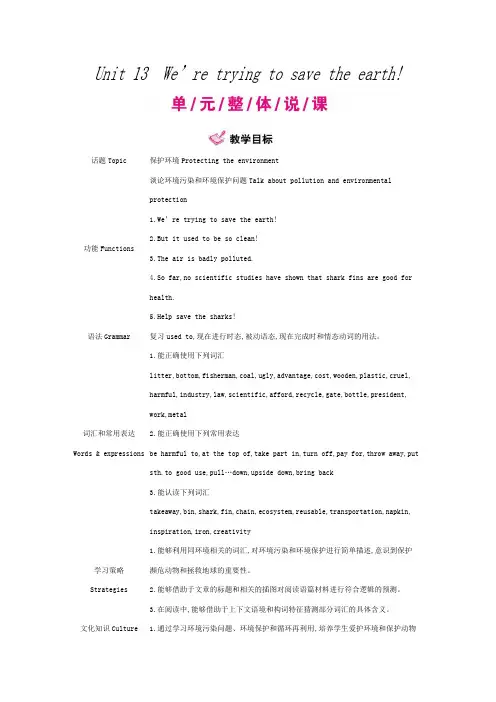
Unit 13 We’re trying to save the earth!话题Topic 保护环境Protecting the environment功能Functions谈论环境污染和环境保护问题Talk about pollution and environmentalprotection1.We’re trying to save the earth!2.But it used to be so clean!3.The air is badly polluted.4.So far,no scientific studies have shown that shark fins are good forhealth.5.Help save the sharks!语法Grammar 复习used to,现在进行时态,被动语态,现在完成时和情态动词的用法。
词汇和常用表达 Words & expressions 1.能正确使用下列词汇litter,bottom,fisherman,coal,ugly,advantage,cost,wooden,plastic,cruel,harmful,industry,law,scientific,afford,recycle,gate,bottle,president,work,metal2.能正确使用下列常用表达be harmful to,at the top of,take part in,turn off,pay for,throw away,putsth.to good use,pull …down,upside down,bring back3.能认读下列词汇takeaway,bin,shark,fin,chain,ecosystem,reusable,transportation,napkin,inspiration,iron,creativity学习策略Strategies 1.能够利用同环境相关的词汇,对环境污染和环境保护进行简单描述,意识到保护濒危动物和拯救地球的重要性。
人教版英语九年级全册Unit13sectionA1a2d优秀教学案例
二、教学目标
(一)知识与技能
1.学生能够掌握一般过去时的构成和用法,理解过去时与现在时在意义上的区别。
(四)反思与评价
1.自我反思:鼓励学生在课后进行自我反思,思考自己在课堂上学习的一般过去时的运用情况,以及如何改进和提高。
2.同伴评价:让学生互相评价对方在小组合作中的表现,包括语言运用、合作态度和创造力等方面,以此促进他们的自我改进和成长。
3.教师评价:教师对学生的学习情况进行评价,包括对一般过去时的掌握程度、参与度和表现,给予积极的反馈和指导,帮助学生进一步提高。
三、教学策略
(一)情景创设
1.生活情境:通过展示学生们熟悉的生活场景,如学校活动、家庭生活、节日庆祝等,让学生在情境中自然地学习和使用一般过去时。
2.故事情境:通过讲述一个有趣的故事,引导学生运用一般过去时描述故事中的事件,增强学生对一般过去时的理解和运用。
3.旅行情境:创设一个旅行scenario,让学生描述他们上周或上个月去过的景点或参加的活动,以此practice使用一般过去时。
2.激发兴趣:我继续展示一些学生们过去的照片,如假期旅行、学校活动等,让学生们描述这些照片中的情景,引导他们思考和运用一般过去时。
(二)讲授新知
1.一般过去时的构成和用法:我通过示例和讲解,向学生们介绍一般过去时的构成和用法。我解释道:“一般过去时用来描述过去发生的事情,表示过去的时间。它由助动词‘did’加上动词原形构成。例如,'I went to the park yesterday.' 'She saw a movie last week.'”
人教版九年级英语全册Unit13SectionB2e3b优秀教学案例
(三)学生小组讨论
在学生对过去完成时有了初步理解后,我会组织他们进行小组讨论。我会让学生结合自己的经历,讨论在过去某一时间点发生的、对现在有影响的事件。学生将有机会运用过去完成时描述这些事件,并在小组内分享自己的观点。这样的讨论将有助于学生深化对过去完成时的理解,并提高他们的语言运用能力。
此外,我还会设计一个评价表,让学生对自己的语言运用能力和团队合作能力进行自我评价。这样既能让学生认识到自己的优点和不足,明确今后的学习方向,又能培养他们的自我反思和评价能力。
四、教学内容与过程
(一)导入新课
在导入新课时,我会利用多媒体展示一组图片,展示一个博物馆的场景,并邀请学生想象自己正在参观博物馆。接着,我会讲述一个故事:一位学生在参观博物馆时,遇到了一个正在寻找失物的游客。学生决定帮助游客寻找失物,但他们都不知道失物是什么样子。我会引导学生思考:在这种情况下,他们应该如何描述失物特征,以便更好地寻找失物?
3.小组合作:本案例将小组合作作为重要的教学策略,让学生在小组讨论和合作中完成任务。这种教学方法不仅提高了学生的语言运用能力和团队合作能力,而且还培养了他们的沟通能力和合作精神。
4.反思与评价:在课堂的最后阶段,本案例组织学生进行反思和评价。学生有机会回顾自己的学习成果,分享小组合作和解决问题的体验,并进行自我评价。这种教学方法有助于培养学生的自我反思和评价能力,使他们能够明确今后的学习方向。
此外,我还将运用多媒体教学手段,如图片、视频等,以激发学生的学习兴趣,帮助他们更直观地理解过去完成时的用法。通过观察和分析例句,学生将能够掌握过去完成时的构成和用法,并在实际语境中进行运用。
(三)情感态度与价值观
在本节课中,我希望学生能够培养对英语学习的兴趣和自信心。通过参与课堂活动,学生将感受到英语学习的乐趣,并在实践中不断提高自己的语言能力。同时,学生将学会关心他人,培养合作精神,通过帮助游客寻找失物的情境,他们能够体会到助人为乐的价值观念。
人教版英语九年级全册Unit13 SectionA(2a-2d)优质课教案
Unit13 SectionA〔2a-2d〕优质课教案Shizhi Middle School Xu WeiTeaching Objectives:1. Knowledge objectivesThe students can master the key words: ugly, advantage, cost, wooden, plastic, takeaway, bin.The students can master the useful expressions: throw away, take the bus, instead of, be good for, remember to do, make a difference, lead to.2. Ability objectivesThe students can learn more about pollution and environmental protection.The students can listen for the key words and talk about what they can do to save the earth.3. Moral objectivesWe have only one earth. Let's join together and save it for our future.Teaching Key Points:1. New words, expressions and some important sentences.2. Learn more about pollution and environmental protection.Teaching Difficult Points:1. Master the main ideas and details of the listening materials.2. Talk with others about what they can do to save the earth.Teaching Methods:Communicative teaching methodTask-based teaching methodTeaching Procedures:Step 1 Revision & Lead-in1. I will greet the class. At the beginning of the class, we will enjoy a song.2. Look and say. What kind of pollution has been shown in this picture? What do you think has caused this pollution?Step 2 Listening 2a &2b1. Listen to the interview. Circle the kinds of pollution that Jason and Susan talk about. Listen for twice if the students need.I will ask two students to share their answers with the class and check them.2. Listen again and complete the sentences. Listen for twice if the students need. I will ask one student to write their answers on the screen and check with the class.Step 3 Take a quiz1. Are you a friend of the earth? What do you usually do?2. Ask some students to choose what they usually do when they finish drinking a can of cola / when there are a lot of old newspapers at your home / when they go shopping / when they write on a piece of paper .Step 4 Watch and think1. Let’s watch a video. What you can see in it?2. Can we do something to save the earth?Step 5 Discussion1. What can you do to save the earth in our lives?2. What can you do to save the earth in our school?Step 6 Summary1. I will ask the students what are learned in this class.2. We will read the phrases on the screen together.Step 7 Homework1. Remember the new words and expressions.2. Write about what you can do to help save the earth in your life.Blackboard Design。
英语人教版九年级全册Unit 13教学设计
人教版九年级全一册 Unit 13 We’re trying to save the earth! 教学设计教材以“环保问题”为话题,以“谈论污染和环保”为交际功能,重点在这些语境中复习正在进行时、完成时和被动语态等。
I.教学目标:理解、掌握和运用关于环境保护、环境污染和循环再利用的生词短语,复习正在进行时、现在完成时和被动语态等。
能够运用正在进行时、完成时和被动语态等描述污染和环境保护问题。
通过讨论污染环境、环境保护培养学生爱护环境的意识。
通过听说读写来提高学生综合语言运用能力。
II. 课堂环节Step1用多媒体给学生播放一些有关环境污染的图片或视频,然后询问学生对环境污染的看法和观点。
Teacher: What kinds of pollutions do you know?What cause the pollution?环节说明:通过视频和课前的一个师生问答互动引入新课的话题Step 2 完成教材1a-1c的任务1. 要求学生翻开课本P97,迅速阅读1a部分的内容。
把方框中的单词按它们产生污染的类型写入相应的栏目中,并添加更多的单词。
2. 检查答案,先要求全班一起给出答案并检查讨论。
然后要求2-3名同学给出自己的答案,并把收集的答案列举在黑板上。
3. 要求学生听第一遍录音,并根据听到的内容完成课本上1b表格中的句子。
然后要求2-3名同学读答案。
(polluted, rubbish, fish Litter rubbish newspaper, stop, clean)4. 要求学生听第二遍录音,并逐句进行跟读。
5. 完成教材1c的任务,要求学生模仿1a内容,编造自己的关于污染的对话并进行对话练习。
并邀请2-3对同学当堂进行演示。
6. 小结训练。
要求学生在规定的时间内完成一个小练习。
并请若干学生给出自己的答案。
有错误的话及时解决纠正。
用所给词的适当形式填空。
1. There are many kinds of pollutions(pollute)in our daily life.2. All of the students should take part in keeping (keep) our school clean and tidy.3. Can you tell us your ideas for improving (improve) your spoken English.4. W e should stop using the wooden (wood) chopsticks toprotect the forest.5. Their grandparents were fishermen (fisherman) near the sea before they moved to the town.环节说明:通过学习1a,使学生对过去完成时态有所了解,并拓宽了思路;通过1b,锻炼学生的听力及抓取关键信息的能力;通过1c的训练锻炼学生的口头表达能力,同时巩固对本课内容的认识。