
外研版八年级英语上册教案Module 5 Unit 1
Module 5 Unit 1I wanted to see the Beijing Opera .教材分析本课为Module 5的第一单元,对话以玲玲带贝蒂前往老舍茶馆观看京剧为主题,讲述了贝蒂在茶馆内的所见所闻,并简单介绍了京剧、作家老舍及其代表作《茶馆》。
教学目标1. Function: Talking about intentions and plans.2. Structure: Infinitive structures (1): infinitives as objects; verbs followed by infinitives.3. Skills:1) Listening and understanding familiar topics (Beijing Opera) finding specific information.2) Describing intentions and plans in simple language.3) Reading and understanding the sequence of events.4) Writing a short passage about favourite play or film.教学重难点Infinitive structures (1): infinitives as objects; verbs followed by infinitives.课前准备A tape recorder, multimedia and some pictures教学过程Step 1 Warming-up1. Enjoy a play: Lao She Teahouse2. Show some pictures.3. Look at the pictures, and talk something about the pictures.4. Introduce the new words.5. Learn the new words.6. Read the new words.【设计意图】本活动的目的是让学生看图片学习新单词,为本课接下来的学习做准备。
Step 2 Work in pairs.1. Ask the students to read the words in the box in Activity 1.actress dance music play sing teahouse theatre traditional2. Look at the pictures in Activity 1, and talk about them.3. Work in pairs. Use the words from the box to help you.【设计意图】本活动通过插图与词汇的引入导出相关话题,为听力和对话做话题和语言上的铺垫。
Step 3 Listening practice.1. Ask the students to read through the sentences in Activity2.1) Betty often sees / wants to see some traditional Beijing opera.2) Betty knows / doesn’t know Lao She Teahouse.3) Lingling says that the opera is easy / difficult to understand.2. Play the recording once without stopping.3. Listen and underline the correct words.4. Play the recording again and ask the whole class to check with a partner.5. Check the answers.【设计意图】本活动旨在培养学生在听力活动中辨认细节的能力。
Step 4 Listen and read.1. Show some pictures, and ask the students to talk about them.2. Ask the students to read the conversation silently.3. Play the recording and ask the students to listen and read the conversation.4. Read the conversation.5. Act it out.6. Learn “Everyday English”1) How was it?2) You know, …3) That’s the main thing.4) No idea.Step 5 Check the true sentences.1. Ask the students to read the conversation again.2. Now check the true sentences.1) Tony went to Lao She Teahouse with Betty and Lingling.2) Betty understood the opera.3) Lingling and Betty stayed longer than they planned.4) Betty enjoyed the opera.5) Betty would like to go to the opera again.6) Betty knew about Lao She before she went to the teahouse.3. Ask the students to check with a partner.4. Check the answers.【设计意图】本活动旨在促使学生通过听读掌握文章大意,并检测学生对课文内容的理解和运用能力。
Step 6 Complete the passage.1. Ask the students to read the words in the box in Activity 4.actress difficult end main offer2. Read through the passage.Betty wanted to see the Beijing opera, so Lingling (1) ________ to take Betty to Lao She Teahouse.The words of the opera were (2) ________ to understand, but the actors and (3)__________ were excellent. They only planned to watch for an hour, but in the (4) ________, they stayed for three hours. Betty thought it was interesting — that was the (5) ________ thing!3. Complete the passage with the correct form of the words from the box.4. Ask the students to check with a partner.5. Check the answers.【设计意图】本活动旨在让学生在充分理解课文对话的基础上运用所学关键词完成小短文。
Step 7 Listen and repeat.1. Play the recording once without stopping.2. Play the recording again and ask the whole class to repeat.1) — Do you want to see the Beijing opera?—Yes, I’d love to.2) — Do you want to come to Lao She Teahouse with me?—Yes, please. I’d like to go with you.3. Ask the students to listen and mark the intonation.4. Now listen again and repeat.【设计意图】本活动的目的是让学生掌握语句中的重读规则,及对所强调的信息进行重读。
Step 8 Work in pairs.1. Ask the students to read the conversations in Activity 5 aloud.2. Make true sentences.1) I want to ___________ next week.2) They offered to ___________.3) I hope to ___________ one day.4) My parents agree to ____________ on Saturday.3. Talk about something you’d like to do or see.— I want to go to Xinjiang and ride horses.—…【设计意图】本活动让学生两人一组进行,重点练习疑问句的语调以及问答中关键信息的重读。
Step 9 HomeworkShare one of your favorite play with your classmates and tell them why you like it.教学反思本单元的教学中,教师重视信息量的输入,而不要急于总结语法现象。
还可以通过还原不定式短语的主语位置来加深学生对句子的理解。
Module5Unit1IwantedtoseetheBeijingOpera.教案外研版八年级英语
Objectives:➢Learn about Beijing Opera and its cultural significance.➢Develop listening, speaking, reading, and writing skills.➢Improve vocabulary related to theater and performance.➢Enhance understanding of different art forms and cultural traditions. Materials:✓Textbook: New Standard English, Grade 8, Unit 1.✓Audiovisual aids (optional): Pictures or videos of Beijing Opera performances.✓Handout materials: Worksheets, vocabulary lists, and role-play scenarios.Procedure:Warm-up1.Greet the students and elicit any prior knowledge of Beijing Opera.2.Show a picture or video clip of Beijing Opera and ask students whatthey notice about the performance.Introduction to Beijing Opera1)Provide a brief introduction to Beijing Opera, explaining its historyand cultural significance in China.2)Highlight the key characteristics of Beijing Opera, such as elaboratecostumes, specific movements, and unique singing style.3)Engage students in a discussion about the importance of preservingcultural traditions like Beijing Opera.Vocabulary Building1.Introduce vocabulary related to Beijing Opera and theaterperformances, such as repertoire, stage, props, dialogue, etc.e visual aids, context, and real-life examples to help studentsunderstand and remember the vocabulary.3.Practice pronunciation and usage through drills and simple exercises. Listening Comprehension✧Play an audio recording or video clip of a Beijing Opera performance.✧Provide students with a set of questions related to the performancefor comprehension assessment.✧Allow students to discuss their answers in pairs or small groups. Reading and Discussion1.Assign a reading passage from the textbook about a personalexperience related to Beijing Opera.2.Have students read the passage individually or in pairs.3.Engage the class in a discussion about the author’s thoughts andfeelings towards Beijing Opera.Writing Activity1)Ask students to write a short paragraph expressing their ownperspective on Beijing Opera.2)Encourage students to use the vocabulary and expressions learnedearlier in the lesson.3)Collect and review their written work, providing constructivefeedback as needed.Role Play◆Divide students into pairs or small groups.◆Provide each group with a role-play scenario related to Beijing Opera(e.g., buying tickets, rehearsing a scene).◆Allow time for students to prepare and perform their role-plays infront of the class.Wrap-up and Reflection1)Recap the main points discussed during the lesson.2)Ask students to reflect on what they have learned about BeijingOpera and its importance.3)Provide an opportunity for students to ask questions or share theirthoughts.Extension Activities⏹Cultural Research: Assign students to research and present on othertraditional Chinese art forms, such as Peking Opera, Chinese calligraphy, or traditional Chinese painting.⏹Performance Experience: Organize a field trip or invite a guestspeaker to provide a live demonstration or performance of Beijing Opera.⏹Artistic Expression: Encourage students to create their own miniBeijing Opera masks or costumes using craft materials and hold a mini performance in class.Assessment (optional)1.Conduct a short quiz or written assignment to assess students’understanding of Beijing Opera and related vocabulary.2.Evaluate students’participation in discussions, role-plays, andwritten activities.3.Provide feedback and constructive criticism to help students improvetheir language skills and understanding of the topic.Homework❖Assign additional reading or writing tasks related to Beijing Opera or Chinese culture.❖Ask students to write a reflection or journal entry about their experience learning about Beijing Opera.。
新外研版八年级上册英语 Module 5 Unit1 教案(教学设计)
Module 5 Lao She TeahouseUnit 1 I wanted to see the Beijing Opera.单词actress, teahouse, offer, end, in the end,能用动词不定式表达自己的意图和计划, 并培养学生对京剧中国传统文化的兴趣和爱好掌握动词不定式作宾语的用法,并能用动词不定式表达自己的意图和计划等Step 1 Warming up1. Enjoy a play: Beijing Opera.2. Show some pictures.3. Introduce the new words.4. Learn the new words.5. Read the new words.6. Look at the pictures, and talk something about the pictures..Step 2 Work in pairs.1. Ask the students to read the words in the box in Activity 1.2. Look at the pictures in Activity 1, and talk about them.3. Work in pairs. Use the words from the box to help youStep 3Listening practice.1.Ask the students to read through the sentences in Activity2.Step 4 Listen and read.1. Show some pictures, and ask the students to talk about them.2. Ask the students to read the conversation silently.3. Play the recording and ask the students to listen and read the conversation. Step 5 Listen and repeat.1. Play the recording once without stopping.2. Play the recording again and ask the whole class to repeat.Step 6 Work in pairs.Step 7 HomeworkA单词拼写1. They _________ (提供) him a very good job.2. The __________(结局) is very sad.3. The actors and actresses __________ (女演员) were excellent.4. You should try to get the _________ (主要的) idea when you are reading. Keys: 1. offered 2. end 3. actresses 4. mainB. 完成句子:1. 他们提议建一所希望学校来帮助那些贫穷的孩子。
Module 5 unit 1 课件--外研版英语八年级上册

['ti:haus] teahouse n.(尤指亚洲的)茶馆
[ɔfə]
offer v. 提议;提出
[end]
end n.(时间的)最后一段,末尾
v. 结束
in the end 最后;终于
no idea 不知道
Unit1 I wanted to see the Beijing Opera.
same time.
Betty: Yes, please. I’ d like to go with you. You can tell me what’ s
happening.
Lingling: Yes, it’ s quite difficult to understand the story! Just watch
Task 1: Listen and check(多选)
A. Beijing Opera D. A famous play
B. Tea
C. Laoshe Teahouse
E. Laoshe
评价任务三:多层次听读,理解大对话(To aim3)
Task 2: Listen and fill in the blanks.
他们提出放学后打扫教室。
评价任务三:多层次听读,理解大对话(To aim3) 评价要求:通过听文本
Task 3: Listen, read and answer.
能正确选出答案。选对 一题得一星。
Tip: Pay attention to the key words.
✮1. Why didn’t Betty understand Beijing Opera?
2024-2025学年外研版初中英语八年级(上)教案Module5Unit1
Module 5Lao She TeahouseUnit 1I wanted to see the Beijing Opera.设计说明教学反思从谈论对京剧的了解和喜欢程度引入新课。
通过对话的学习和演练,提升学生的朗读能力。
通过听力训练,提升学生在交谈中捕捉细节信息的能力。
学习新单词、短语和句型,学习新语言点,增加学生的语言积累。
初步学习动词不定式作宾语和双宾语的用法。
练习重音,提升学生在英语表达中的规范性和美感度。
通过对应练习,巩固学生对单词、短语、句型和语法的掌握,提升运用能力。
教学目标通过本单元的教学,让学生达成以下目标:1.知识目标掌握本单元新单词及短语:actress,teahouse,offer,end,in the end,no idea。
2.能力目标(1)能听懂关于谈论京剧的对话。
(2)学习使用动词不定式作宾语和双宾语的用法。
3.情感目标通过听说训练,更多地了解中国的京剧艺术,增强文化自信。
重点难点重点:对话朗读,动词不定式作宾语的用法和双宾语的用法难点:动词不定式作宾语的用法和双宾语的用法,句子中单词的重读教学准备PPT课件,有关京剧的图片,活动2、3、5的录音授课时数2课时教学过程Step 1Warming up1. Play the recording of the Beijing Opera to the class.2. Ask the students how much they know about the Beijing Opera and if theylike it.T: Do you know the Beijing Opera?Ss: …T: Do you like it?Ss: …T: Can you sing the Beijing Opera?Ss: …Step 2PresentationWork in pairs. Look at the pictures and talk about them. Use the words in the box to help you. (Activity 1 on Page 34)1. Ask the students to look at the pictures.2. Tell them to read through the words and make sure they know the meaningactress dance music play sing teahouse theatre traditional3. Ask them to describe the pictures in pairs.4. Encourage some pairs to present their conversations.Step 3Listening1. Let the students listen and underline the correct words or expressions. (Activity 2 on Page 34)(1) Ask the students to read the three sentences.(2) Play the recording and ask the students to choose the correct answers.(3) Have the students check answers with their partners.(4) Check answers and read full sentences with the students.Answers: 1 wants to see 2 doesn’t know 3 difficult(5) Play the recording again. Show the tapescript if necessary.Step 4Listening and reading1. Introduce the playwright Lao She and his play Teahouse to the class.2. Play the recording and ask the students to check the true sentences. (Activity3 on P35)(1) Read through the sentences and try to understand them.(2) Listen to the recording. Then check the true sentences.(3) Elicit the answers from the class.Answers: 3√4√5√3. Listen again and try to get answers to the question.1. Who went to Lao She Teahouse last night?2. Did Betty like the Beijing Opera?3. How long did they stay there in the end?4. Does Lingling often go to see the Beijing Opera?5. What is Lao She famous for?(1) Ask the students to read through the sentences and try to understand them.(2) Listen to the recording and try to get the answers. Allow some students toread the conversation if they still can’t get the answers after listening.(3) Elicit answers in full sentences for the class.Answers:1 Lingling and Betty.2 Yes, she did.3 They stayed there for three hours.4 No, she doesn’t.5 He is famous for his play Teahouse.4. Read the conversation again and find out the following phrases. Try to5. Listen to the conversation and read it.(1) Ask the students to listen to the recording and then try to read the conversation on their own.(2) Ask or encourage some students to read the conversation. Correct their mistakes.(3) Ask some students to practice the conversation in different roles.Step 5PracticeComplete the passage with the correct form of the words in the box. (Activity 4 on Page 35)(1) Read through the words in the box.complete it with the correct form of the words in the box on their own.(3) Check answers in groups.(4) Elicit answers from the class.Answers:(1) offered (2) difficult(3) actresses (4) end (5) mainStep 6Language points1. You know,I wanted to see the Beijing Opera,so Lingling offered to take me there. 你知道,我想看京剧,因此玲玲主动提出带我去那儿。
外研版八年级Module5 Unit1 Lao She Teahouse
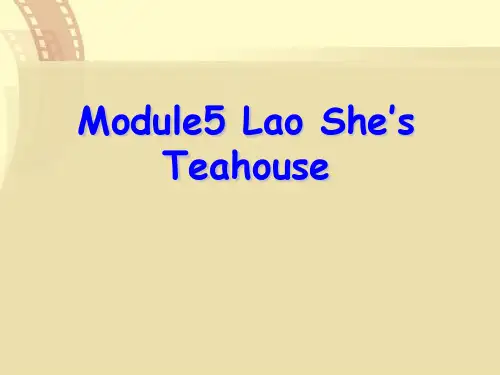
People’s Artist
Great Master of Language
Lao She (1899-1966)
Teahouse
Sishitongtang
Luotuoxiangzi
Yueya yu yangguang
Read paragraph2. Then find out the usage of the key words. 1. send sb to sp His parents sent him to the Teacher’s School in Beijing. send sb sth/sth to sb Sun Yuyao sent me a present last week.
2. teach sb sth/sth to sb From 1924 to 1929 he taught Chinese to the English in London.
Step Six: Summary bring/ show/ tell/ sell/ give/ send/ teach/offer/lend/pass/leave/ sb sth bring/show/tell/sell/give/send/ teach/offer/lend/pass/leave/ sth to sb
动词不定式
• Grammar focus: 动词不定式做宾语: 英语中动词不定式置于谓语动词之后, 做动词的宾语,表明想要、计划或希望做 的事。
Eg: 1. I want to go to the teahouse. 2. She offered to take us there. 3. They planned to stay for some tea. 4. They decided to stay longer. 5. I hope to go there again one day . 6. My parents agreed to take us.
外研版-英语-八上-M5U1教案

M odule 5 Uni t 1教学设计教材内容课型教学方法教学目标Lis ten ing and speakingFormal and in te r ac t ive p rac t i ce,t ask-based ac t iv i t i es To unders tand the conversa t ion con tain ing in f in i t iveTo ge t spec i f i c in f ormat ion f rom the l i s t en ing mate r ia l教学重难点Did you have a good t ime?In t roduce some verbs tha t mus t be fo l l owed by in f in i t ives.教师活动1. Gree t ing Look a t some p ic tures and通过插图与词汇的引入导出情景导入相关话题,为听力对话做语言上的铺垫,在开课伊始抓住学生的注意力。
训练学生理解大意和细节辨认的能力,培养学生听大意、听细节的技巧。
知识新授2.L i s ten and choose the r igh tanswers(Act iv i ty3)2.L i s ten to the t ape andf ind ou t the r igh t a nswers1.L i s ten and read the训练学生读英语和说英语的conversa t ion.能力,以及对课文的理解能力,培养学生的口头表达能力。
情景操练2.Read the conversa t ion and answer the ques t ions(Act iv i ty4)练教师活动学生活动活动目的Show the impor tant th ings on the Reme mber the impor tan t展示本课重点内容,帮助学生blackboard th ings 加深印象。
全国中小学“教学中的互联网搜索”优秀教学案例评选 外研版英语 八年级上 Module5 Unit1
1、运用多媒体信息技术创设情境导入新课。
2、利用课堂活动设计,鼓励学生合作学习。
3、利用对比中西方音乐,提高学生分析问题和解决问题的能力。
五、教学过程
Step1. Lead-in.
Play the video materials aboutMichael Jackson.
/u77/v_NDg0MjA4NzI.html
T: Every group does a great job today. We all learned a lot from you. Thank you vey much. After class, evaluate what we have done today and evaluate our performances. You can evaluate each other’s performance by giving grades.
六、教学反思
本节课是外研版八年级上册Module 5 Western music的听说课,一节课下来我感觉教学过程很顺利,师生间配合也还默契,下面是我对这节课的反思。本课的导入部分我使用了迈克尔杰克逊的视频片段,因为大多数学生对音乐都很感兴趣,而且对杰克逊比较熟悉,所以导入非常顺利,学生们的学习兴趣很高。通过他的歌曲与其他歌曲进行对比分类,使学生对各种音乐类型有了更感性的认识。这样的设计使抽象的知识具体化,使学生更易于理解接受知识,加深了学生的印象。通过中西方音乐的对比研究,拓宽了学生的视野,体会到音乐作为无国界语言的魅力,增强学生的民族自豪感和自信心。学生基本都能学会如何对音乐发表自己的见解和看法。希望通过本次反思,使自己能够取得进步。
Chinese music:/view/35402.htm
Module5Unit1教案-外研版八年级上册英语
一、教学内容
Module 5 Unit 1《Western music》-外研版八年级上册英语。本节课我们将学习以下内容:1.了解西方音乐的基本类型和特点;2.掌握与音乐相关的词汇,如:jazz, classical, rock, country, folk等;3.运用一般现在时描述音乐喜好;4.学会表达自己对音乐的看法和喜好;5.阅读课文,理解作者对不同音乐类型的描述和评价。教学内容紧密结合教材,旨在帮助学生提高英语实际运用能力,同时拓宽他们对西方音乐文化的了解。
3.成果分享:每个小组将选择一名代表来分享他们的讨论成果。
(五)总结回顾(用时5分钟)
今天的学习,我们了解了西方音乐的基本概念、类型和表达个人喜好的方法。同时,通过实践活动和小组讨论加深了对音乐文化的理解。我希望大家能够掌握这些知识点,并在日常生活中灵活运用。最后,如果有任何疑问或不明白的地方,请随时向我提问。
-对于一般现在时的难点,教师可通过示例句、填空练习和角色扮演等方式,让学生在实际语境中熟练运用该时态。
-针对阅读理解的难点,教师可引导学生通过提问、总结和复述等策略,深入理解课文内容。
-口语表达方面,教师可组织小组讨论、模拟采访等互动活动,让学生在轻松的氛围中练习口语,提高表达的流畅性。
四、教学流程
三、教学难点与重点
1.教学重点
-本节课的核心内容包括:
-词汇:掌握与音乐相关的词汇,如jazz, classical, rock, country, folk等。
-语法:运用一般现在时描述音乐喜好。
-阅读理解:理解课文对不同音乐类型的描述和评价。
-口语表达:学会表达个人对音乐的看法和喜好。
-教学过程中,教师应针对性地进行以下讲解和强调:
外研版英语八年级上册Module5《LaoShe’sTeahouse》(Unit1)说课稿
外研版英语八年级上册Module 5《Lao She’s Teahouse》(Unit 1)说课稿一. 教材分析《Lao She’s Teahouse》(Unit 1)是外研版英语八年级上册Module 5的一篇阅读课文。
本节课文主要介绍了老舍的《茶馆》,通过讲述茶馆里的人物和故事,展示了老北京的历史文化。
课文内容丰富,语言生动,充满了烟火气。
本节课主要围绕茶馆里的三位角色——王利发、常四爷和秦仲义展开,通过他们的对话和独白,揭示了各自的性格特点以及他们所代表的社会阶层。
二. 学情分析八年级的学生已经具备了一定的英语基础,能够理解和运用简单的英语进行交流。
但他们在阅读长篇文章时,可能会遇到一些生词和短语的理解困难,因此需要在教学过程中加以引导和帮助。
此外,学生对于老北京的历史文化可能了解不多,需要在课前进行相关背景知识的介绍。
三. 说教学目标1.知识目标:学生能够掌握课文中的生词和短语,理解课文大意,把握人物性格特点。
2.能力目标:学生能够运用所学知识进行口语交流,提高阅读理解能力。
3.情感目标:通过学习课文,学生能够了解老北京的历史文化,增强对祖国文化的自豪感。
四. 说教学重难点1.教学重点:课文生词和短语的学习,阅读理解能力的提高。
2.教学难点:人物性格特点的把握,对老北京历史文化的理解。
五. 说教学方法与手段1.教学方法:采用任务型教学法,让学生在完成任务的过程中,提高英语运用能力。
2.教学手段:利用多媒体课件、图片等辅助教学,激发学生学习兴趣。
六. 说教学过程1.导入:教师通过展示老北京的图片,引导学生谈论自己对北京的了解,为新课的学习营造氛围。
2.读前预测:教师引导学生根据课文标题和图片,预测课文内容。
3.自主学习:学生自主阅读课文,遇到生词和短语时,可以查阅词典或与同桌讨论。
4.合作学习:学生分组讨论,分析课文人物性格特点,总结各自的代表意义。
5.课堂展示:各小组代表向全班同学展示讨论成果,其他同学可进行补充和评价。
外研英语八年级上册Module 5 Unit1 (共44张PPT)
Unit1
第二课时
I wanted to see the Beijing Opera.
翻译下列词组。
• 1.老舍茶馆
o She Teahouse
• 2.昨晚
st night
• 3.想看京剧
3.want to see the Beijing Opera
• 4.喝茶
4.drink tea
4). I hope to understand more next time.
动词不定式作宾语:
• 动词不定式是由“to+动词原形”构成 (有时可以不带to)。其否定 形式是“not+动词不定式”(not不与助动词连用)。动词不定式置 于谓语动词之后, 作动词的宾语, 表明意图, 希望或决定的内容。
他 曾 主 持 了 国独生 子女人 格与教 育、国 城市独 生子女 教育模 式、杰 出青年 的童年 与 教 育 、 向 孩子学 习、我 国小学 生学习 与发展 、儿童 的想像 与幻想 研究、 多元文 化 与 青 少 年 的成长 、小学 生人身 伤害的 处理与 防范等 多项课 题研究 。他出 版的个 人 专 著 20余 部 ,较有 代表性 的教育 著作有 系统介 绍五元 家教法 的《好 父母好 方法》 和 《 好 孩 子 好习惯 》以及 《习惯 决定孩 子命运 ——孙 云晓儿 童教育 12讲》 、《好 的 关 系 胜 过 许多教 育——我 的教 育自述 》等。 作品曾 获国图 书奖、 全国“ 五个一 ” 优 秀 图 书 奖、全 国优秀 儿童文 学作品 奖、全 国优秀 畅销书 奖。10多 年来 ,央各部
学习重点有关京剧和茶馆的单词和短语。
2. To understand a conversation with infinitives