
【译林版】八年级英语上册:Unit 1 Friends教案
6.不规则变化形容词
good-better-best bad-worse-worst little-less-least
形容词比较级用法:A + be +形容词比较级+ than B
28因为Because of+sth Because +句子
Important sentences :
1、我能喝点什么吗?Can I have something to drink?
3、她乐意和朋友分享东西?She is willing to share things with her friends.
比较级:双写最后一个辅音字母+er slim-slimmer big-bigger
最高级:双写最后一个辅音字母+est slim-slimmest big-biggest
5.多音节形容词
比较级:前面+more beautiful-more beautiful important-more important
18、她会成为一名出色的老师。She will make an excellent teacher
19、你会选谁做你最好的朋友?Who would you choose as your best friends?
20、当有事困扰我的时候,我总可以去找她。
When something worries me, I can always go to her.
Unit课时
课题
Friends
课型
Revision
教学目标
1.Learn useful words ,sentences and phrases
2.Grasp grammar rules
教学重难点
.Comparative and superlative adjectives
18、和某人交朋友make friends with sb19、仔细聆听人们listen to people carefully
20、周游世界travel around the world
21、想成为一名社会工作者would like to be a social worker
22、对某人善良/友好/慷慨be kind/friendly/generous to sb.
No other students are cleverer than Millie in her clas
三、Revise grammar
Compar atives and superlative adjectives
一、形容词比较级用于两人或两事物之间的比较;最高级用于三个或三个以上人或物的比较
比较级与最高级构成:
1.单音节形容词
比较级:词尾+er tall-taller small-smaller long-longer
最高级:词尾+est tall-tallest small-smallest long-longest
2.以不发音的e结尾的形容词
比较级:词尾+r nice-nicer fine-finer
12、很有幽默感have a good sense of humour 13、走过walk past
14、把……撞到地上knock sth onto the floor
15、希望做某事Hope to do sth.希望某人做某事Hope +(that)从句
16、说某人坏话say a bad word about sb 17、在未来in the future
21、米莉是他们班最聪明的学生。Millie is the cleverest students in her class.
Millie is cleverer than any other student in her class.
Millie is cleverer than the other students in her class.
形容词最高级用法:A + be + the形容词最高级+名词+表示范围的短语或从句
She is the best student in her class.
四、Do homework
《中考指要》p37-42
Recite useful words、expressions and sentences.
二次备课
9、因为他们从不说谎,你可以信任他们。You can trust them because they never tell lies.
10、当她长大想成为一名歌手。She wants to be a singer when she grows up.
11、他是我们班最高的男孩。He is the tallest boy in our class.
12、当我感到无聊或不开心,我经常去找她。When I feel bored or unhappy, I often go to her.
16、她既是我的邻居又是我最好的朋友。She is both my neighbour and my best friend.
17、我五年前第一次遇见她。I first met her five years ago.
7、在任何时候乐意帮助人be ready to help people any time
8、在家庭作业上帮助我help me with my homework
9、在公交上给某人让座give one’s seat to someone on the bus
10、有需要的人people in need 11、长大grow up
最高级:词尾+st nice-nicest fine-finest
3.以辅音字母+y结尾的形容词
比较级:把y改为i+er easy-easier pretty- prettier
最高级:把y改为i+est easy-easiest pretty-prettiest
4.重读闭音节,结尾只有一个辅音字母
教学方法
Situation method、task-based method
教具准备
tape recorder、
一、Revision:
1.Have a dictation. 2..Revise the contents revised last class.
二、Important words an. expressions and sentences
教学反思
1、保守秘密keep a secret / keep secrets 2、和他说话talk to / with him
3、给我们讲有趣的笑话tell u s funny jokes 4、我最好的朋友之一one of my best friends
5、愿意做某事be willing to do sth .6、和某人分享某物share sth with sb.
在某方面慷慨be generous with sth
23、学习更多关于learn more abou 24、左边的男孩The boy on the left
25、旁边next to 26、面带微笑have / wear a smile on her face
27邀请某人做某事Invite sb. to do sth.
4、她乐于助人,在任何时候都愿意帮助别人。She is helpful and ready to help people any time.
5、她总是将公交车上的座位让给有需要的人。
She always gives her seat on the bus to someone in need.
6、马克斯的腿很长,在课桌底下伸不开。
Max’s legs are very long. They do not fit well under his desk.
7、她经常微笑,而且从不说任何人的一句坏话。
She smiles often and never says a bad word about anyone.
8、他是个什么样的人?What’s he like? / What does he look like?
译林版八年级英语上册Unit 1 Friends教案1
Module 1 Teenage lifeUnit 1 Friends教学设计1一、教学目标1.Knowledge Aims:Teaching contents:Words: honest, joy, sad, believe, teenager, good-looking, musicalPhrases: have something to drink, make somebody happy/special, keep secrets, share one's joy, believe what somebody says, talk to somebody about anything, clean and tidy Sentences: Do you want some? Can I have something to drink?What about some milk? Can I have some more food too?There's nothing else in the fridge.2.Ability Aims:(1).To learn about the new adjectives and expressions(2).To describe the appearance and character of a friend with adjectives(3).To talk about the appearance and character3.Moral Aims:Let the students talk about their friends happily.二、教学重难点some more what about= how about nothing else make sb. + 形容词something to drink/eatnumbers + more else三、教材分析这节课是Unit 1 friends的第一课时welcome to the unit and comic strip.这一课时是整个单元的导入部分,目的在于激发学生对学习本单元的兴趣。
牛津译林版八年级英语上册 Unit 1 Friends 教案
Topic Unit 1 Friends Period 1 Title Comic strip ﹠Welcome to the unit Type of lesson New教学目标1. To learn about the new adjectives and expressions2. To describe the appearance and character of a friend with adjectives3 .To talk about the appearance and character重点难点some more what about= how about nothing else make sb. + 形容词something to drink/eatnumbers + more else教学过程备注Step1 Warm-upT: Hello everyone, glad to see you again! Did you have a nice summer holiday? Are you happy to be back to school and see all your friends?Ss talk about their summer holidays.T: This summer holiday I went to Australia with some of your classmates and friends. We took a lot of photos. Would you like to have a look?Show the pictures and introduce some places of interest and animals in Australia.T: Look, we took a photo with this famous man--- Batman. He's a hero and people's good friend because he helps people in danger. Do you agree? What do you think of him?Step 2 PresentationT: There are some more words to describe people. For example, we can say Batman is good-looking. But we never say he's beautiful! We don't use beautiful to describe a boy or a man. If someone likes music or is good at music, we say he or she is musical.Teach "good-looking" and "musical".Step 3 Practice1. Play a guessing game. Ss describe their best friends in the class and guess who are talked about.2. T: Just now we heard some of the students talk about their best friends. Could you tell me which words are used most often?Ss: friendly, helpful, polite…T: So these are very important qualities of a best friend, do you think so? What other qualities are important to you?Ss complete the table in Part B, P7. Then work in pairs to exchange their ideas and have a debate.3. T: Why do you think he/she is your best friend? What makes him/her so special to you? Can you talk to him/her about anything? Do you talk to him/her when you have problems? Do you believe what he/she says? When you are happy or sad, do you talk to him/her? Why?Teach "sad", "believe", "honest" and "joy". Ss talk about Batman with the adjectives describing appearance and personality, such as friendly, helpful, kind, polite, clever, brave, etc.Sentences may be used:I think my good friend should be very …because…I agree. / I don't agree with you because …It's quite important for a friend to be …? Do you think so?I don't think my good friend must be very …Ss complete Part A, P7 and report individually.4. T explains some language points.Step 4 Presentation1. T: How old is your best friend? What about you?Ss: 15/16 …T: So you are teenagers. We call children between 13 and 19 teenagers. Teach "teenager".T: We have a good friend, Eddie. Is he a teenager?Ss: No.2. T: Who's Eddie's good friend? Why?T plays the tape of the Comic strip and Ss try to find out the answer to the question.(Hobo is Eddie's good friend because they always share things with each other.)3. Ss read the Comic strip and answer the questions:(1) What does Eddie give Hobo?(2) What does Hobo want?(3) Do you think Eddie is a true friend? Why?4. Ss read the dialogue in pairs.5. T explains some language points.Step 5 Practice1. Ss act out the dialogue and they are encouraged to add in something they like.2. Discuss: Who do you like better as a friend, Eddie or Hobo? Why?3. Ss work in pairs to ask and answer about their good friends.Step 6 SummarizeT: Today we have learned some important qualities about a good friend. It seems that we all think appearance is not so important, but a friend should be helpful and honest. And I hope everyone can be like that and you will have more friends.Step 7 Homework1. Describe a good friend of yours with the words and phrases learnt in this lesson.2. Finish the Workbook exercises. A model dialogue:A: Who's your good friend? B: …A: What's he/she like?B: …A: What do you think of your friend?B: …A: What makes him/her so special to you?B: …Can you tell me something about your good friend?板书设计Unit 1 FriendsComic strip ﹠Welcome to the unit1 some more food2 what about= how about3 nothing else4 make somebody happy5 share one's joy share sth. with sb.6 make sb. + 形容词7 something to drink/eat8There's nothing else in the fridge. .9 What about= how about用于询问对方的意见,后接名词或者动名词教学反思Topic Unit 1 Friends Period 2 Title ReadingⅠType of lesson New教学目标1. To learn more about the adjectives to describe the appearances and characters2 .To learn the expressions about the quality3. To understand and grasp language focus of the passage重点难点1.have a good sense of humour, knock off, a true friend, say a bad word about anyone, vote for2.To use adjectives to describe people's appearance and personalities教学过程备注Step1 Leading-inT: Yesterday we learnt to talk about friends. Friends are very important in our lives. Almost everyone needs a friend and almost everyone has a friend, do you think so? Let's look at some interesting English sayings about friends. Please try to guess the meanings of them.Ss read and discuss.Step 2 PresentationT: Why do you think friends are important? What can friends do for you?Ss give different answers.T: Is your friend's appearance very important to you?Ss: No.T: Good. We should never judge a person by his appearance or clothes. But it'll be good for you to learn some words to describe your friends' appearance, right? T shows the pictures and teaches "shoulder-length", "slim" and "poor eyesight". Step 3 PracticeSs do Part B2, P9 individually. After checking the answers, T asks some Ss to give some more details about the appearance of each person in the pictures.Step 4 Presentation1. T: As you all think that appearance is not very important, could you tell me what is important in your opinion?Ss answer with the adjectives they learnt to describe qualities, such as clean and tidy, helpful, honest, etc.T: Excellent. Now I have some good friends here. Can you use some proper words to describe them?Ss fill in the blanks to complete the sentences.T teaches "generous", "joke", "humorous", "have a good sense of humour", "atrue friend" and "be ready/ willing to do sth".2. T: 'Teenagers' magazine is holding a writing competition about good friends. Some students have written some entries for it. Please read and find out whether the following statements are true or false.T plays the tape recorder for the Ss to repeat.Ss read and do Part C1, P10.3. Ss read again and do Part B1 on their own. Tell them that they need to look for specific details, which fit each of the persons described in the articles.Step 5 Practice1. Ss have a group competition by choosing to answer the questions about Betty in the table.2. Fill in the blanks to complete the description about Max.3. Complete the brief introduction about May.Step 6 SummarizeT: What do we usually write about when we describe our friends?Ss: Appearance, personalities …T: Yes, in which paragraph do we usually write about the appearance?Ss: Paragraph 1.T: And in Paragraph 2?Ss: Personalities.T: Right. We also call it personalities. In the 3rd paragraph we can write about their behaviors or future plans.Step 7 Practice1. Ss do Part C2, P10 and find out who each of the personalities will vote for and fill in the blanks. Then check the answers by asking and answering in pairs 'Who will Amy/ Simon/ Sandy vote for?'2. Ss vote for one of the 'best friends' described in the articles and tell the reason why.3. Ss do a class vote for a 'best friend'. Write a brief description about a person they consider as a best friend. Read some of the descriptions and then vote for one of them. Explain why they vote for that particular person.Step 8 Homework1. Retell about the three best friends.2. Recommend a best student in your class and tell the reason why you vote for him or her.板书设计Unit 1 FriendsReadingⅠ1 hold a writing competition 举行一场写作竞赛hold a sports meeting2 invite sb. to do sth.邀请某人做某事3 tell sb.about sth.告诉某人关于某事4 as slim as 和...一样苗条5 one of my best friends我最好的朋友之一one of +复数....之一6 be willing/ ready to do sth.乐意做某事7help sb. with sth.帮助某人做某事help sb. do sthhelp sb. to do sth.教学反思Topic Unit 1 Friends Period 3 Title ReadingⅡType of lesson New 教学目标To learn some useful expressions and use them in different contextTo learn how to describe friends重点难点1.as+形容词/副词的原级+as ,be ready to do sth./ be ready for sth because of/because2.because of/because; as----as教学过程备注Step 1 Revision1. T: For yesterday's homework I asked you to vote for a best student in your class. Now can you tell me your choice and your reason? Please describe that person in details and let's guess who it is. Then we can vote for him or her, OK?2. T: Yesterday we also met three friends in 'Teenagers' Magazine. They're Betty, Max and May. How much do you remember them?Ss have a group competition by answering questions about Max.Step 2 Language pointsT: Wonderful! You have a very good memory. Now let's move on to look at some useful phrases and sentences in the three articles and learn to use them:1. She is as slim as I am.她和我一样苗条。
牛津译林版英语八年级上册:Unit 1 Friends. 教案6
Unit 1 FriendsPeriod 6【教学目标】Knowledge AimsVocabulary: solve, social, future, become, famous, agree, runnerLanguage focus: try to be kind to people / try one’s best to do somethingAbility Aims1.To get specific information from a listening material.2.To talk about a friend.3.To talk about future plans.4.To find the main points of a passage in order to understand and memorize it more easily.Moral AimsLet the students learn English happily.【教学重难点】1.Describe the future plans, language points.2.Describe the future plans.【教材分析】本课时是8A第一单元综合技能课,学生在前面几个课时的学习的基础上,粗略了解了如何介绍自己的朋友。
在前面几个课时中已经对朋友的外貌和爱好等等进行了学习。
这节课的目的是在学习介绍朋友时的计划未来的打算。
通过本课的学习,我们应该为本单元的Main Task 书面表达的学习作好有力的铺垫。
【教学过程】Step 1 Warm-upT: Who is he? Can you describe him?T: Would you like to be another Jack Chen? Why?Step 2 Free TalkT: What does … like doing?What would … like to do in the future?Step 3 ListeningT: Millie is talking to Amy about her future plans. Can you find out what she would like to do in the future? You can listen to their conversation and put a 'Smile face' in the correct boxes in the table.T Check the answers.Step 4 DiscussionT: Discuss with your partner 'What is Millie like?' and 'What does she want to do?Step 5 Blank-fillingStep 6 PracticeTask1 Suppose you are Millie. A reporter from NJTV is interviewing you. Please make a dialogue with your partner, talking about your future plan.Step 7 Speak-upT: Listen and answer:1.Whom are they talking about?2.What would Peter like to do in the future?Task2 Practice in pairs, talking about their appearance and their own plansStep 8 Revision:T:1.Do you have any future plans?2.What are you going to do when you grow up?3.Why?4.What will you do to fulfill your aims?Step 9 Story tellingT: Ask two Ss to repeat the story, and find out which parts are different.T: Make a conclusion, ask Ss to pay attention to the details.What is it about?Who is it about?What happened?Where did it happen?When did it happen?Why did it happen?How did it happen?Step 10 ReadingT: Ask Ss to write down the keywords which refer to the most important information Read the letter, underline the main points and circle the keywords in the letter.Step 11 Exercises用所给单词的适当形式填空1.My best friend has a good sense of ______ (humorous)2.Betty is _________ (friend) to old people only.3.We have _______ (little) snowfall this year than last year.4.I think Mary is __________ (good) girl in our class.5.Peter is __________ (heavy) than Mille.6.Millie's drawing is ___________ (beautiful) than other six students.7.What do I have to do if I want to be ____? (thin)8.She want to be a ______ (sing) when she grows up.Step 12 Homework1.我认为野营不是危险的户外活动。
译林版八年级上Unit1-Friends-教案
译林版八年级上Unit1 Friends 教案Background informationStudents: 40 middle school students grade 2Lesson duration:45 minutesTeaching objectivesBy the end of the lesson,students should be able to:1:describe their own friends2:use the knowledge and the methods to express the qualities of friends3:know the knowledge and methods to express the qualities of friends4:enhance the understanding of friends after classTeaching contentsReading of FRIENDSWhat qualities do your friends have? My friend is generous/beautiful/humorous......Teaching aids: blackboard, chalk, tapesType of the lesson: reading speakingTeaching proceduresStep1:Lead inT:Good morning,welcome to my class,do you have friends?S:Yes.........T;What does she/he looks like?S:She/He is tall/thin/fat/......She/He has long legs..........T:What qualities does she/he have?S:She/He is generous/beautiful........T:Ok,Today let’s talk about our friends.Step2:Fast reading1:T:Teenagers’ magazine is holding a writing competition about good friends,some students have written some notes on page9 b2,please read and find out whether the following statements are true or false.(play the record)2:check the answerRead the article again and finish page9b1,then check the answer.3:read it again and find the main qualities of them.----gengrous helpful----humorous funny----true kindStep3:Read in detailsT:Read the article carefully and then complete the table on the blackboard.Step5;Retell1:T:So,we have got a table about them,and you have known a lot about them.can you say something about them according to the information in the table2:Give Ss 3 minutes to prepare3:Ask 3—4 students to retell the three articlesHome work1:list the words we have learned to describe friends2:write a article about your friend.。
最新译林版八年级英语上册(全册教案)

译林版八年级英语上册全册教案Unit 1 Friends第1课时Comic strip and Welcome to the unit一、教学目标1、To identify the new words and phrases;2、To describe the appearance and personality of a person with simple and proper words.3、To categorize adjectives to describe important qualities of a friend according to personal.二、教学重点To describe the appearance and personality of a person with simple and proper words.三、教学难点To talk about the important qualities of a good friend with proper adjectives.四、教学过程(一)Lead-in(师)T: Hello, boys and girls, do you have a friend? Yes, of course, you do. As we know, every one of us should have at least one or two friends. Time seems to go faster when good friends are together.Ask some open questions:e.g. Who is your good friend?Could you tell us something about your good friend?Why do you choose him/her as your good friend?(生)Talk about these questions with their partners(二)Presentation and Practice(师)T: It’s nice to see Hobo and Eddie again. Do you like them? Yes, they are funny and they can always make us happy.Let’s listen and answerthe questions:(1)What does Eddie give Hobo?(A cake, some milk)(2)What else does Hobo want?(The pizza in Eddie’s bowl)(1)Will they share the pizza? Why or why not?(Yes, they will. Because good friends always share.No, they won’t. Because Hobo already has a big cake.(2)Do you think they are good friends?(Yes, they often share things with each other.)(生)Listen carefully and try to understand what the teacher says.Listen to the recording and answer the two questions.Discuss in pairs(师)Repeat after the recording and pay attention to your pronunciation and intonationGood students can add an ending to it.Choose some pairs to act it out.(生)Read after the recording loudlyPractice in pairs loudly.Act out.(师)Eddie and Hobo are good friends. They often share things with each other. Can you describe your good friends to us? What’s your friend like?(honest, good-looking, tidy, polite, care about sb, keep a secret, never tell lies,etc.)Daniel is reading about a writing competition in Teenagers magazine. Let’s help him Match the qualities on the left with the questions on the right.Daniel and Amy are talking about what qualities are important in good friends .Listen and answer:What do they think good friends should be like? (honest,helpful and interesting )(生)Say out a word or a phrase one by one.Check the answers by speaking out with the complete sentences. Eg:My friend is helpful so he/she is ready to help when I have problems.Listen carefully and try to answer the question.(师)Pay attention to your pronunciation and intonationBoys act Daniel, girls act Amy, then exchange.Walk around and give students some help.Now let’s play a guessing game. One of you will describe your good friend in our class with 4/5 sentences and the others will guess who he/she is.(生)Read loudlyPractice in pairsDescribe, listen and guess(三)Extension(师)Let’s learn some proverbs.A friend in need is a friend indeed.If you want to make friends , you must become good friends.(生)Read the proverbs loudly and write them down on their note books.(四)SummarizeT: Today we have learned some important qualities about a good friend. It seems that we all think appearance is not so important, but a friend should be helpful and honest. And I hope everyone can be like that and you will have more friends(五)Homework(六)当堂训练Best friends are the people who like you and h_______ you the most. They are the ones who are e________ to work with and easy to have fun with.Sometimes it’s d_______ to find a best friend. And sometimes you can f_____ a little lonely. But just because you don’t have a best friend now, it doesn’t mean you won’t have one in the f______. Best friends s_____ to find each other as if by magic. And when you find your best friend, the magic will last forever.(help, easy, difficult, feel, seem)五、教学反思第2课时Reading(1)一、教学目标1、To guess general meanings from keywords and context2、To recognize the use of comparatives and superlatives3、To skim text for overall meanings and scan for details二、教学重点To skim text for overall meanings and scan for detailsTo find out the names, looks and personalities about the friends in the text;三、教学难点To use adjectives to describe people’s appearance and personalities四、教学过程(一)Lead-in(师)1. QuestionnaireLet the students do a questionnaire about “Who will you talk to when you are in such situations,parents, teachers or friends?”1. You are very happy.2. You are very sad.3. You have a secret and you want to tell someone.4. You have problems.5. You want to go shopping.2. Free talkA life without friends is a life without a sun. What makes good friends?(生)1、Discuss these questions with their partners.2、Express their opinions .eg:Good friends should be...(二)Presentation and Practice(师)Show a picture of my friend and learn some words and phrases.Look at this photo. This is mybest friend. Can you say something about her?Present some new words and phrases.(smile, sweet, long straight hair, have a good sense of humour, etc.)(生)Describe the photo in rows.(三)Reading(师)1. Read and answerToday I’ll introduce some friends to you. They are teenagers like you. Let’s see who they are. Open your books on Page 8. Read the text quickly and tell me their names.2.Read and find out their main qualitiesRead quietly and find out the adjectives to describe their qualities.Betty---(generous, helpful)Max---(humorous,funny)May---(true friend, kind)3.Listen to the tape and read again ,then try to answer the following questionsStop the recording after each entry.Betty: Is Betty slim?What does she want to dowhen she grows up?Max: How tall is Max?What about his legs?Betty: Is Betty pretty?Why is she a true friend?4.Repeat after the tape.Repeat after the recording,and pay attention to the pronunciation and intonation.Divide the whole class into three groups. Each group read one entry.5.Read in groups.Read the entries by yourselves loudly and walk around to help those who has problems with the pronunciation.(生)1.Read the text quickly and find out the names.2.Read quietly and find out the adjectives.3.Read the questions first, then listen and read and find out the answers.4.Repeat after the recording loudly.Each group read one entry loudly.Read alone loudly. They can ask for help from teachers or better students when they have problems.(四)Practice(师)plete Part B1 on Page9.Mr Zhou, the editor of Teenagers magazine, is making profiles of Betty, Max and May. Help him complete the information in Part B1.2.Read the sentences in Part B2 to judge whether they are true or false. If they are false, please correct them.(生)plete the information carefully. Ask three students to write down their answers on the blackboard to check the answers.2.Do the exercises carefully then check the answers together.(五)Extension(师)Have a discussion about “Who do you want to choose as your best friend, Betty, Max or May? Why?” in a group of four.(生)Discuss in groups then choose one to report.(六)Homework(七)当堂训练随堂检测(5分钟)根据短文内容回答下面的问题Everyone wants to own the friendship, because without a friend, the world is like a desert. Many people want others to be their friends, but they don't give friendship back. That is one of the reasons why some friendships don't last very long. To have a friend, you must learn to be one. You must learn to treat your friend the way you want your friend to treat you. Learning to be a good friend means learning the following rules.Honesty is where a good friendship starts. Friends must be able to trust one another. Generosity means sharing and sharing makes a friendship grow. You don't have to give your lunch money or your clothes, of course. Instead you share your ideas and feelings. Everyone needs understanding and help with a problem. Turning to a friend can be a first step in solving the problem. So to be a friend you must listen and understand. You must try to put yourself in your friend's place, so you can understand the problem better.1. Is it easy to keep a good friendship?2. What are the three rules to be a good friend?3. Which is the base of friendship among the three rules?(1. No, it isn't. 2. Honesty, generosity and understanding. 3. Honesty. )五、教学反思第3课时Reading(2)一、教学目标1、To learn some useful expressions and use them in different context.2、To introduce Betty, Max and May with the help of a mind map3、To use the key words and expressions to express students’ own ideas二、教学重点To learn some useful expressions and use them in different context.三、教学难点To retell the entries with the help of some key words and expressions 四、教学过程(一)Lead-in(师)Read the entries and complete the table.(生)Read and find out the words and phrases.(二)Retell the entries(师)Try to retell each entry with the help of the table.Give students 2-3 minutes to prepare.(生)Retell each entry with the help of the key words in the table.(三)Practice(师)1. Complete Part B3Mr Zhou is writing about Betty, Max and May. Help him write the correct names in the boxes in Part B3 and find out some related details in the three entries.Ask some students to read out their answers.2. Discuss some important phrases and sentencesWalk around and give students some helpplete Part B4Mr Wu is asking the students who they would choose as their best friends. Complete the conversation with the words in the box .Ask four students to read out the conversation to check the answers.(生)1.Do the exercise on their own.Listen carefully to check the answers.2.First find out some important expressions in the passages, then discuss in pairs how to use them.3.Do the exercise on their own,4.Listen carefully to check the answers.(四)Extension(师)We’ve learnt a lot about Betty, Max and May. If you need to choose one of them as your best friend, who would you choose? Why?Choose some groups to present their conversation.(生)Work in a group of four to make a conversation like Part B4.Present their conversation in the front of the classroom.(五)SummaryLet's cherish friendship and be nice to our friends. If we all have good friends and try to be true friends, our lives will be better and better!(六)Homework(七)当堂训练根据短文回答下面的问题Everyone needs friends. There is an old saying,"Friends are God's way of taking care of us." But how do you find real friendship and keep it?The American writer Sally Seamans tells young students some smart ways to find friends. Sally says finding friendship is just like planting a tree. You plant the seed (种子) and take care of it to make it grow.First, you should choose a friend. A good friend should be kind and patient.To make a friend, you cannot be too shy. You should make each other happy and share your lives.What should you do when you have a fight with your friend? You have to talk to him or her. When there is no one around, have an honest talk. If he or she doesn't want to talk, you could write a letter.Remember that friendship is the most important thing in your life.1. Sally wants to tell students the ways to_____.A. find friendsB. plant treesC. get happyD. keep fit2. What makes good friends? A good friend should _____.A. be lovely and coolB. be kind and patientC. have lots of moneyD. have good looks3. According to the text, you can _____your friend after a fight.A. buy a present forB. never say a word toC. have dinner withD. write a letter to4. What should you do if you fight with your friend?A. Fight till win.B. Say sorry to him or her.C. Have an honest talk or write a letter.D. Tell the teacher.(ABDC)五、教学反思第4课时Grammar一、教学目标1.To learn how to form comparative and superlative adjectives2.To use comparatives to compare two people or things3.To use superlatives to compare three or more people or things二、教学重点1.To introduce the structure of comparative and superlative adjectives2.To change the adjectives into comparative and superlative forms三、教学难点To use comparative and superlative adjectives to compare people or things correctly四、教学过程(一)Lead-in(师)1.Show Sandy and Millie’s pictures.Look at these two girls. Please describe two girls’ appearances.2. Try to compare themCan you find the differences between them?Lead the students to compare them. Ask some better students to say out some sentences.eg:Sandy is taller than Millie.Write down some words on the blackboard: taller, shorter, bigger, longer,etc.Present the sentences on the the screen.(生)1.Describe the two girls one by one in rows.2.Think carefully and try to say out as many differences as they can.Millie is shorter than Sandy.Sandy’s hair is longerthan Millie’s.......(二)Presentation of comparative adjectives(师)1. Try to work out the ruleAsk the students toread these sentencesand try to find the rulesabout comparative.Introduce when we canuse comparative andthe basic structure ofcomparativeadjectives.2. Try to sayShow some pictures. Ask the students to compare them. At the same time, the teacher gives some adjectives to help the students. Lead the students to find what the short adjectives are.3. Try to findAsk the students to observe the comparative of the short adjectives. Let the students find the rules of the forms.4. Try to changeAsk the students to change the adjectives into their comparatives.5. Try to thinkIntroduce the long adjectives and let them list some more long adjectives.6. Try to concludeLead the students to conclude the rules according to the sentences of long comparative adjectives. And introduce the irregular adjectives and their comparative forms.(生)1.Read these sentences on the screen carefully and think carefully.pare the pictures and find the short adjectives3.Observe carefully and find out the rules of the forms.(三)Presentation of superlative adjective(师)1.Introduce the superlative adjectives.Ask three students to come to the front of the classroom. Lead students to think :Who is the shortest /the tallest of the three?Present three pieces of chalk.Lead students to think which one is the shortest/the longest?Write down the sentences on the blackboard and underline the the superlative adjectives2.Try to compare other thingsShow more things in the classroom to ask students to compare using the superlative adjectives.3.Try to concludeLead the students to conclude the rules of superlative adjectives, including the form rules and the sentence structure.(生)Observe carefully and try to say out the answers with a whole sentence.(四)ConclusionAsk students to read the table on Page11 to know more about the forms of comparative and superlative adjectives. Then work out the basic rules of using comparative and superlative adjectives on Page 12.(五)Practice(师)1.Part A on Page12Daniel is writing about his classmates. Help him complete the table in Part A with the correct adjectives.2.Part B on Page12Daniel has made a profile of his classmates. Read the profile and find out some new words. eg: Height, weight, test, etc.(生)1.Ask two students to write down the answers on the blackboard. Then check the answers together.2.Ask three students to write down the answers on the blackboard. Then check the answers together.(六)Extension(师)Work in pairs and make a dialogue comparing people or things. You can choose any of the following topics:animals, sports, food and drink and people in the classroom.(生)Make a dialogue in pairs then act it out.(七)Homework(八)当堂训练In the evening, Kitty and her family are watching TV together. Complete their conversation.kitty:Dad and Mum,l think our family is ________(happy)family in the world.Dad:Yes,my dear.We aren't ________(rich)family in Beijing,but we're happy living together.Mum:Our flat is ________(small)many other people's homes,but we're ________(happy)them.kitty:Daniel is ________(smart)lie’s English is ________(good)mine. Simon is ________(good)me at sports,but l think l have ________(good)family in the world.Mum and Dad,you are ________(generous)people and you are ________(kind)person to me,Grandma.Grandma:And you're ________(wonderful)person in the world,Kitty.Kitty:You too,Grandma.(the happiest, the richest, smaller than, happier, smarter, better than, better than, the best,the most generous, the kindest, the most wonderful)五、教学反思第5课时Integrated skills一、教学目标1、To talk about friends’ looks and personalities2、To talk about friends’ future plans3、To get specific information from listening materials二、教学重点1、To talk about friends’ looks and personalities2、To talk about friends’ future plans三、教学难点To get specific information from listening materials to complete the entries四、教学过程(一)Presentation(师)1.Show a picture of BettyThis is Betty. Do you remember what Betty wants to be when she grows up?2.Talk about this topic in pairsWhat are you going to be when you grow up?Why do you want to be a ......?3. Present the new phrasesWhen I was your age, I wanted to be a social worker. I wanted to help people with their problems.Write down: social worker(生)1.Ask one student to answer: She wants to be a singer.2.Talk about the topic in pairs.3.Listen carefully and learn the new phrases(二)Listening(Nora’s future plans)(师)1. Listen and complete A1Nora is talking to Amy about her future plans. plete A2Let’s listen and find out what her future plans are.Tick the correct boxes in the table.Listen to the tape again and check their answers.3. Read and find out some important sentencesNora is writing about her future plans in her diary. Look at the table in PartA1. Help Nora complete her diary entry.(生)1.Listen carefully and Tick the correct boxes in the table.plete A2 with the information in A1. Ask one student to read the entry to check the answers.3.Read and find out some important sentences.(三)Listening (Sandy’s future plans)(师)1 .Listen and answerRead the entry and find out some important sentences.2. Listen and complete A3Nora would like to be a social worker when she grows up. What about Sandy? What’s her plan? Please listen to Sandy’s conversation with Daniel and find it out.3. Read the diary entry together.Listen to the recording again and help Sandy complete her diary entry.Check the answers in pairs, the check the answers as a class.Read the diary entry together.(生)1.Listen carefully and complete A3.2.Check the answers in pairs3.Read the diary entry loudly.(四)Practice(师)Please make a dialogue with your partner, talking about your future plan.(生)make a dialogue in pairs to talk about their future plans.(五)Presentation(师)Show the picture of Part B and asks who Sandy is.Introduce the sentences: Sandy is the girl on the right.Sandy is the girl with glasses/a ponytail. Teach the new word “ponytail”.(生)Observe carefully.(六)Listening(师)Listen and answerWho’s the boy on the left? What’s he like?Who’s the girl next to him?What’s she like?(生)Listen carefully and find out the answers.(七)Practice(师)Read the dialogue together.Read aloud in groupsRead in rolesPay attention to linking and loss of blasting.(生)Read loudly(八)Extension(师)The teacher asks the students to bring some pictures of their own friends or families to class, exchange the photos and discuss about them(生)Talk about their own photos, using the dialogue as a model.(九)当堂训练Dear Anita,In your last letter you asked me about my plans for the future. First, I will finish high school.Then I will go to college and study to be a doctor. I won’t get married right away because it takes a long time to become a doctor. I want to help sick people. I’m going to learn a lot about illness. Maybe I will find a treatment for cancer. I’ll be famous and I will become very rich.After I become a successful doctor, I’ll get married. I want to marry an interesting person. For example, my wife might be an artist. We will have a wonderful life together. I think we will have one or two children. Doctors get paid quite a lot so I think we will have a nice house. We will travel a lot.I want to visit Australia, Europe, and Africa.Are these plans, or dreams? Do they sound crazy to you? Write soon and tell me about your plans.Your friendJosh 根据短文判断正误。
【译林版】八年级英语上册:Unit 1 Friends教案
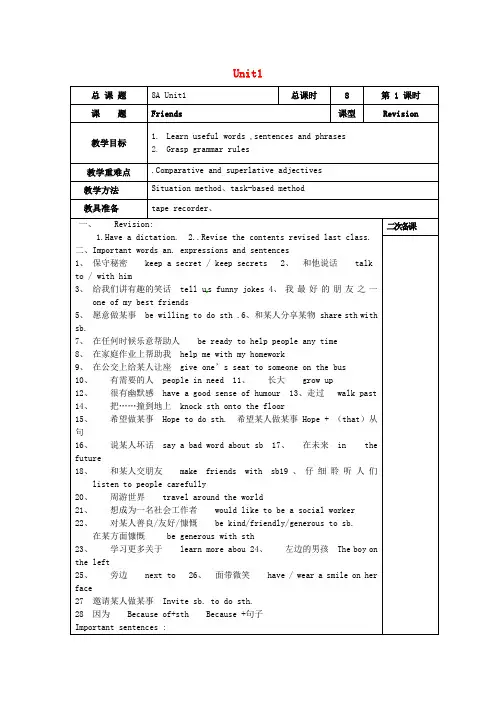
Situation method、task-based method
教具准备
tape recorder、
一、Revision:
1.Have a dictation. 2..Revise the contents revised last class.
二、Important words an. expressions and sentences
Unit1
总课题
8A Unit1
总课时
8
第1课时
课题
Friends
课型
Revision
教学目标
1.Learn useful words ,sentences and phrases
2.Grasp grammar rules
教学重难点
.Comparative and superlative adjectives
21、米莉是他们班最聪明的学生。Millie is the cleverest students in her class.
Millie is cleverer than any other student in her class.
Millie is cleverer than the other students in her class.
12、当我感到无聊或不开心,我经常去找她。When I feel bored or unhappy, I often go to her.
16、她既是我的邻居又是我最好的朋友。She is both my neighbour and my best friend.
17、我五年前第一次遇见她。I first met her five years ago.
Unit 1 Friends第一课时 教案 牛津译林八年级英语上册
译林版英语八年级上册Unit 1第1课时教学设计
11.Explain the meaning of the whole dialogue sentence by sentence,help the students remember the main languages points:
be hungry 感到饿
be thirsty 感到渴
something to drink/eat 一些喝/吃的东西some 或数词+ more + 名词
care about 关心,关怀
keep a secret (for sb.) (为某人)保守秘密share one’s joy/share sth. with sb.与某人分享
make 的用法
there be 句型
what about= how about+n./v-ing/代词用于询问意见学生在书上标注重点单词、
短语及句式。
做练习。
教师引导
学生找出
本课的重
点单词及
短语,进
行讲解,
扫清学生
理解文章
的障碍。
通过综合
练习,考
查学生对
重点知识
的掌握情
况。
课堂小结这一课时从Eddie和Hobo对话的结尾处
为导入本单元及本课时的话题起到了一
个辅垫,引出做为朋友的好的品质。
在接
下来的welcome to the unit中通过partA与
part B的练习加深了学生对朋友品质的了
解和看法,为后面的学习开了个好头。
牛津译林版八年级上册Unit 1《Friends》(Grammar)教学设计
牛津译林版八年级上册Unit 1《Friends》(Grammar)教学设计一. 教材分析《Friends》是牛津译林版八年级上册Unit 1的教学内容,本节课主要讨论朋友和友谊这一主题。
教材通过描述不同人物的性格特点和他们的友谊,引导学生学习一般现在时态的肯定句和疑问句以及一般现在时态的被动语态。
本节课的内容与学生的生活紧密相连,有利于激发他们的学习兴趣和积极性。
二. 学情分析八年级的学生已经具备了一定的英语基础,能够听懂并运用一般现在时态。
但他们在语言表达方面还存在一定困难,需要通过大量的操练来提高他们的语言运用能力。
此外,学生的学习动机和学习态度对他们的学习效果有重要影响,因此,教师需要设计有趣且富有挑战性的教学活动来激发他们的学习兴趣。
三. 教学目标1.知识目标:学生能够掌握一般现在时态的肯定句、疑问句和被动语态,并能够运用所学知识进行简单的交流。
2.能力目标:学生能够通过听力、口语、阅读和写作等多种方式,运用一般现在时态进行表达和交流。
3.情感目标:学生能够理解友谊的重要性,学会珍惜和维护友谊。
四. 教学重难点1.重点:学生能够掌握一般现在时态的肯定句、疑问句和被动语态。
2.难点:学生能够运用一般现在时态进行流畅的口语表达和交流。
五. 教学方法1.任务型教学法:通过设计各种真实且有意义的任务,引导学生参与课堂活动,提高他们的语言运用能力。
2.交际法:通过模拟真实场景,让学生在实际交流中学会运用一般现在时态。
3.情境教学法:通过创设各种情境,激发学生的学习兴趣和积极性。
六. 教学准备1.教学课件:制作含有动画、图片和例句的教学课件,帮助学生更好地理解和记忆。
2.练习册:准备与本节课内容相关的练习册,用于巩固所学知识。
3.听力材料:准备与本节课主题相关的听力材料,帮助学生提高听力技能。
七. 教学过程1.导入(5分钟)通过向学生提问“你的朋友是什么样的人?”等问题,引导学生谈论朋友和友谊,激发他们的学习兴趣。
译林版英语八年级上册Unit1friends教案
3. Ask 2-3 Ss to retell the three articles.
教学过程
(教学环节、教师活动、学生活动)
集体讨
论记录
个人修改记录
Name
Betty
Max
May
Appearance
Slim, short hair
Tall, poor eyesight (wear glasses)
教学过程
(教学环节、教师活动、学生活动)
集体讨
论记录
个人修改记录
Step 1 Revision.
1.What are the most important qualities of a good friend?
2.What are the very important qualities of a good friend?
3.Explain some important words.
Step 6 Brain-storming
T: Do you have any other ideas of a good friend?Can you use some words to describe your best friend?
To learn how to use adjectives to describe people’s appearance and characteristics.
重点、
难点
To learn how to use adjectives to describe people’s appearance and characteristics.
Eyes, nose: big, small
牛津译林英语八年级上Unit 1 Friends Reading教案
Unit 1 FriendsReadingObjectives1. To guess general meanings from keywords and context2. To skim text for overall meanings and scan for details3. To identify specific information about different people form their friends’ descriptions4. To use adjectives to describe people’s appearance and characteristics5. To recognize the use of comparatives and superlativesPart ABackground informationThis section presents three letters about ‘best friends’ for a writing competition held by ‘Teenagers’ mag azine. The context invites students to think about qualities in their friends. Teaching procedures1. Review key vocabulary according to the general ability of the class. Tell the class about a friend or relative. If possible, show his/her photo. Say,.: My best friend is small and thin with long hair. She is very smart and helpful.Then ask questions to check understanding. (Is my friend tall? Is her hair short or long? Is she willing to help?)2. Divide the class into three groups and allocate one article to each group. While students skim the text on their own, ask them to underline the words they do not know. Then go through the words students have underlined.3. On the board, write the headings ‘Appearance’ and ‘Personality’. Ask each group to go thro ugh their letter again and find words or expressions to match each heading. Invite students from each group to come forward and write their words and expressions under the correct heading.4. Write the following questions on the board for students to copy in their books.What does he/she look like? (For appearance)What kind of person is he/she? (For personality)What does he/she do or want to do in the future? (For future plan)Invite students from each group to ask and answer these questions and describe the teenager in each article.Part BTeaching procedure1. Explain the context and check that students understand what an editor of magazine or newspaper does. Then review the adjectives and nouns in the box in Part B1. Ask students to find the words in the articles on page4.2. Ask students to do Part B1 on their own. Tell them that they need to look for specific details, which fit each of the persons described in the articles. Encourage students to check their answers with a partner. Then ask students to read out the completed captions one at a time.3. Explain the context of Part B2 and ask students to find each description in the corresponding letter. Point to the photos in Part B2 and ask more able students to briefly describe each person. For weaker classes, read the sentences to the students and ask them to match them with the correct photos. Students could work individually or in pairs.Game1. Cut out some pictures of people of different height and appearance. Number the pictures or give familiar names to each person in the pictures (Mary, Tom, Peter, ect.). Stick the pictures on the board. Describe one of the people without pointing or even liking at his/her photo. Invite students to guess the person you have described. (That’s picture number five./ That’s Mary.) Then ask individual students to do the same while the rest of the class guess the person.2. Alternatively, you can divide the class into three or four competing teams. Each team can work out description for the other teams to guess. Give a score only for the first correct guess.Part CTeaching procedures1. Explain the context of Part C1 and read the six sentences for weaker classes. Depending on students’ abilities, set this activity either as an individual activity or as a quiz.2. If you use it as a quiz, divide the class into teams of 4-5 students. Set a time limit. The team who gets all the correct answers first is the winner.3. Alternatively, you can ask students to close their books while you are reading each sentence. Give a score to the team who gives the first correct answer.4. Ask students to correct the false sentences.5. Ask more able students to do the extra sentences in Part C1. You can also ask them to correct the false sentences.6. Explain the context of Part C2 and check that students understand the idea of voting for somebody or something. If time allows, organize a class vote. Name a job, ., a class monitor, a student representative, etc. ask stronger classes to make a list of qualities required for the job. Write all the qualities suggested by the students on the board. For weaker classes, provide this table with the adjectives.Then ask the students to vote for each quality. Before each vote, invite more able students to explain why they will vote or not vote for that particular quality. Accept all reasonable answers, .: I will vote for ‘clever’ because it’s important that a class monitor learns and understands things quickly.7. For weaker classes, read the sentences in the speech bubbles before you ask the students to find out who each of the characters will vote for and fill in the blanks. Then ask ‘Who will Amy/ Simon/ Sandy vote for?’ to check the answers.8. Divide students into pairs and ask them to vote for one of the ‘best friends’ described in the articles on page4. Write down the number of votes for each person on the board.Extension activityOrganize a class vote for a ‘best friend’. On a piece of paper, ask students to write a brief description about a person they consider to be a best friend. Invite 6-7 students to put up their descriptions on the board. Then read the descriptions one at a time and ask the class to vote for one of them. Ask individual students why they have voted for that particular person.。