
译林版七年级英语下册Unit 8 Grammar教案
用法举例:
1. Someone _______ (want) to see you at the school gate.
2. There _______ (be) nothing wrong with the car.
3. Mother will buy me _________ ______ (好吃的东西)this afternoon.
4. How is __________ (一切)going?
5. She eats nothing in the morning.
= She ______ ______ ________ in the morning.
Step 6 Exercises
一、用所给词的适当形式填空。
1. There is not _________ (something) in the box.
2. I’m glad to see that __________ (somebody) is here today.
3. _________ (anything) is difficult if you put your heart into it.
4. People in the shop are _________ (friend) to us.
5. My dog is the __________ (clever) animal of all.
二、翻译。
1. Hobo叫Eddie不要对他不礼貌。
Hobo asks Eddie not to ____________ to him.
2. 我的狗是我的一位特殊朋友。
My dog is a ______________________.
3. 金鱼很容易照看。
Goldfish are _____________________.
4. 如果你喜欢,养蛇也没什么不对。
There’s _________ wrong with _____________ if you like.Go through the form with the students.
Do some exercises.
课后作业1. Remember use of adjectives and the indefinite pronouns.
2. Preview the new words in the next lesson.
教学反思形容词和不定代词的用法,学生的掌握情况不是很好,特别是不定代词的后置修饰。
课后应多做题,进一步理解、掌握。
牛津译林版英语七年级下册Unit8Grammar2教学设计
2.在实际情境中,学生可能难以灵活运用一般将来时态描述未来的计划或打算。
3.学生的语言表达能力有限,可能无法准确、流畅地运用目标语言进行交流。
针对以上学情,教师应结合学生的实际情况,设计富有层次性和趣味性的教学活动,引导学生逐步掌握一般将来时态的用法。同时,注重激发学生的学习兴趣,鼓励他们积极参与课堂讨论和交流,提高语言运用能力。在教学过程中,关注学生的个体差异,给予每个学生个性化的指导,帮助他们克服学习难点,增强自信心。通过本章节的学习,使学生在掌握语法知识的同时,提高英语综合素质。
本章节教学设计以牛津译林版英语七年级下册Unit8 Grammar2为基础,围绕一般将来时态展开,旨在帮助学生掌握语法知识,提高语言运用能力,同时注重培养学生的情感态度和价值观。在教学过程中,教师应关注学生的个体差异,因材施教,使每位学生都能在课堂上得到充分的发展。
二、学情分析
牛津译林版英语七年级下册Unit8 Grammar2的教学对象是七年级学生,他们在之前的学习中已经掌握了英语基本语法知识,如一般现在时、一般过去时等。在此基础上,学生对一般将来时态的学习具备了一定的基础。然而,由于年龄特点和认知水平限制,学生在实际运用中可能存在以下问题:
牛津译林版英语七年级下册Unit8Grammar2教学设计
一、教学目标
(一)知识与技能
1.学生能够掌握并运用本节课所学的语法知识,即一般将来时态的构成及其用法,包括will+动词原形和be going to+动词原形两种结构。
2.学生能够运用一般将来时态描述未来的计划、打算以及可能发生的事情。
3.学生能够理解并运用目标语言在日常生活场景中进行交流,如谈论旅行计划、周末活动等。
牛津译林版七年级英语下册Unit8Grammar1优秀教学案例

5.定期对教学过程进行总结和反思,调整教学策略,以提高教学效果。
四、教学内容与过程
(一)导入新课
1.利用多媒体手段,如PPT、视频等,展示与一般现在时相关的真实场景,如日常生活中的习惯、人物特征等,让学生在直观的情境中感受和理解一般现在时的用法。
2.培养学生运用英语进行交流的能力,使他们在日常生活中能够熟练地使用一般现在时进行描述和表达。
3.通过对一般现在时的学习,让学生了解英语时态的多样性,为以后学习其他时态打下基础。
4.提高学生的英语语法知识水平,使他们能够更好地理解和运用英语语法规则。
(二)过程与方法
1.采用任务型教学法,让学生在完成具体任务的过程中,感受和理解一般现在时的用法。
2.设计富有启发性的问题,引导学生运用已学知识,尝试回答有关一般现在时的问题,为讲授新知做好铺垫。
3.教师通过讲述一个与一般现在时相关的故事,激发学生的学习兴趣,引出本节课的主题。
4.组织学生进行简单的一般现在时的句子接龙游戏,让学生在轻松愉快的氛围中进入学习状态。
(二)讲授新知
1.利用PPT展示一般现在时的结构,如主语+动词原形,以及一般现在时的基本用法,如描述人物特征、日常习惯和一般事实等。
2.学生通过讨论,总结出一般现在时的表达方式和注意事项。
3.教师引导学生进行小组竞赛,激发学生的学习积极性,提高他们对一般现在时的运用能力。
4.教师对各小组的表现进行评价,给予肯定和鼓励,促进他们的团队协作精神。
(四)总结归纳
1.教师引导学生回顾本节课所学内容,帮助他们巩固对一般现在时的理解和运用。
3.教师及时批改作业,给予学生反馈,指出他们的错误,帮助他们改进。
牛津译林版英语七年级下册Unit8Grammar优秀教学案例

4.设计一系列练习题,让学生在实践中巩固现在进行时态的知识,提高语法运用能力。
(三)情感态度与价值观
1.培养学生对英语学习的兴趣,激发学生积极参与课堂活动的热情,提高学生的学习动力。
2.培养学生团队合作精神,学会与人沟通、协作,培养良好的团队意识。
2.小组合作学习法:通过小组合作学习,引导学生互相讨论、分享了学生的自主学习能力。
3.多媒体教学资源:运用图片、视频等资源,展示运动会场景,让学生更直观地理解现在进行时态的用法。这种教学资源的使用有助于学生更好地理解和记忆所学知识。
在教学过程中,我还运用了多媒体教学资源,如图片、视频等,来辅助学生理解和记忆现在进行时态的结构和用法。同时,我还设置了一系列的练习题,让学生通过填空、改写句子等形式来巩固所学的知识。
二、教学目标
(一)知识与技能
1.学生能够理解现在进行时态的概念和结构,掌握现在进行时态的构成及其表达方式。
2.学生能够运用现在进行时态描述正在进行的动作,能够运用现在进行时态进行简单的交流。
(三)学生小组讨论
1.分组学习:将学生分成小组,鼓励学生之间的互动与合作。
2.讨论任务:让学生围绕问题进行讨论,如“现在进行时态如何描述我们的日常生活?”、“现在进行时态在交流中有什么作用?”等。
3.分享成果:各小组代表上台分享本组的学习成果,培养学生之间的交流与分享能力。
(四)总结归纳
1.梳理知识点:教师引导学生回顾本节课所学内容,总结现在进行时态的用法。
3.引导学生关注生活中的实际问题,提高学生运用英语描述生活情境的能力。
4.培养学生积极向上、乐观进取的精神风貌,使学生在学习过程中感受到成长的喜悦。
2020-2021学年牛津译林版英语七年级下册Unit8PetsGrammar教案

Unit 8PetsGrammar设计说明教学反思首先通过游戏导入本课节的第一个语法项目——形容词; 通过图片描述, 让学生进一步了解形容词的用法。
然后讲解形容词和连系动词的用法,帮助学生理解和掌握。
通过向学生展示描述宠物的句子, 引出本课节第二个语法项目——不定代词。
然后通过例句讲解不定代词的用法, 帮助学生理解和掌握; 通过对应练习, 检查学生对本课节的掌握情况。
教学目标通过本课节的教学, 让学生达成以下目标:1. 知识目标:(1)掌握词汇: anywhere, repeat, agree, keep, all the time;(2)掌握形容词作定语和表语的用法;(3)掌握不定代词的用法。
2. 能力目标:(1)能使用形容词来描述人和物;(2)能运用不定代词指代人或物。
3. 情感目标:让学生感受语言的趣味性, 同时培养他们学习英语的兴趣。
重点难点1. 重点: (1)能使用形容词来描述人和物;(2)形容词作定语和表语时的位置;(3)不定代词的用法。
2. 难点: (1)形容词作定语和表语时的位置;(2)不定代词的用法。
教学准备PPT 课件。
授课时数1课时教学过程Step 1Lead-inAsk the students to play a guessing game.It’s small.It has four long legs.It has a big mouth.It can jump.It is green.It can live on land and in water.←It’s big.It is brown.It has a big mouth.It has a big nose.It can run fast.It is the king of animals.←It’s tall.It’s thin.It has a long neck.It has two small ears.It has four long legs.It can run very fast.Step 2Presentation1. Show some pictures and ask the students to choose one of the animals to describe.e. g. Rabbits have long ears.Rabbits’ ears are long.A lazy cat is sleeping on the sofa.The cat on the sofa is lazy.2. The teacher explain: We use adjectives to describe people or things. We can put an adjective before a noun or after a linking verb.linking verbs连系动词be become feel get grow keep look seem smell soundtaste turn3. Ask the students to describe the animals with adjectives in groups.Step 3Practice1. Ask the students to finish A1.Daniel is making some notes about pets. Help him make sentences with the words below.1 make/ Birds/sounds/ nice2 are/ clever/ Dogs/ and / friendly3 and/ quiet/ Goldfish/ look after/ to / are/ easyAnswers:1 Birds make nice sounds.2 Dogs are clever and friendly.3 Goldfish are quiet and easy to look after.2. Ask the students to finish A2.Daniel found two passages about pets on the website. Complete the sentencesshe gets (2) , she sleeps anywhere. She miaows when she is (3) . My parrot is a (4) friend of mine. He is very (5) , and he can repeat my words. He says “Hello!” when I come back home. He is (6) all the time.Answers:(1) black(2) tired(3) hungry(4) special(5) clever(6) happyStep 4Grammar形容词定义: 表示人或事物的属性、特征或状态的词叫形容词。
Unit8Grammar教学设计2023-2024学年牛津译林版英语七年级下册
学校
授课教师
课时
授课班级
授课地点
教具
教材分析
《Unit 8 Grammar教学设计》针对的是2023-2024学年牛津译林版英语七年级下册。本章节主要内容是现在进行时态的用法。教材通过日常生活中的情境,引导学生理解和掌握现在进行时态的构成和用法。本节课旨在帮助学生能够熟练运用现在进行时描述正在进行的动作,并能够正确使用相关词汇和句型进行交流。
最后,我认为在课堂上给予学生的反馈不够及时和具体。为了改进这一点,我计划在未来的教学中,及时给予学生反馈,并针对每个学生的表现给出具体的改进建议,帮助他们提高学习效果。
课后拓展
1.拓展内容
(1)阅读材料:推荐学生阅读与现在进行时态相关的英文文章,如《英语学习》杂志中的相关文章,以加深对现在进行时态的理解。
(2)视频资源:推荐学生观看与现在进行时态相关的英语教学视频,如“英语四六级”网站上的教学视频,以提高对现在进行时态的运用能力。
(3)在线练习:鼓励学生利用“英语流利说”等在线英语学习平台进行现在进行时态的练习,以巩固所学知识。
(4)课外阅读:推荐学生阅读一些与现在进行时态相关的英语小说或故事书,如《哈利·波特》系列中的现在进行时态句子,以提高阅读能力。
过程:
各组代表依次上台展示讨论成果,包括主题的现状、挑战及解决方案。
其他学生和教师对展示内容进行提问和点评,促进互动交流。
教师总结各组的亮点和不足,并提出进一步的建议和改进方向。
6.课堂小结(5分钟)
目标:回顾本节课的主要内容,强调现在进行时态的重要性和意义。
过程:
简要回顾本节课的学习内容,包括现在进行时态的基本概念、组成部分、案例分析等。
译林牛津版初中英语七年级下册Unit 8 第3课时Grammar教学案(含课时练习)
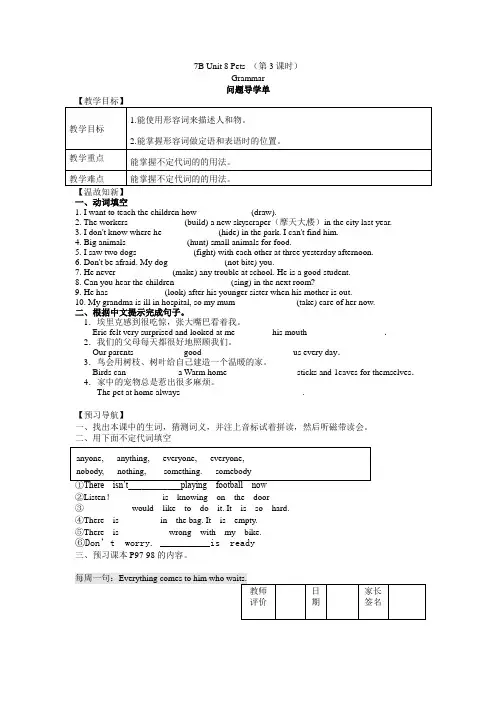
7B Unit 8 Pets (第3课时)Grammar问题导学单教学目标1.能使用形容词来描述人和物。
2.能掌握形容词做定语和表语时的位置。
教学重点能掌握不定代词的的用法。
教学难点能掌握不定代词的的用法。
一、动词填空1. I want to teach the children how____________ (draw).2. The workers ____________ (build) a new skyscraper(摩天大楼)in the city last year.3. I don't know where he ____________ (hide) in the park. I can't find him.4. Big animals _____________ (hunt) small animals for food.5. I saw two dogs ____________ (fight) with each other at three yesterday afternoon.6. Don't be afraid. My dog ____________ (not bite) you.7. He never ____________ (make) any trouble at school. He is a good student.8. Can you hear the children ____________ (sing) in the next room?9. He has ____________ (look) after his younger sister when his mother is out.10. My grandma is ill in hospital, so my mum _____________ (take) care of her now.二、根据中文提示完成句子。
牛津译林版七年级英语下册Unit8Grammar1教学设计
4.巩固练习:设计不同难度的练习题,让学生进行即时巩固。针对学生的错误,进行及时反馈和指导。
5.课堂小结:对本节课的主要内容进行总结,强调一般过去时态的用法和频率副词的运用。
1.学生已具备一定的英语基础知识,如动词的现在式、名词、形容词等,这为他们学习一般过去时态打下了基础。
2.学生在之前的学习中,已经接触过一般现在时态和一般将来时态,对于时态的概念有了初步的理解,这有利于他们更快地掌握一般过去时态。
3.七年级的学生正处于青春期,好奇心强,求知欲旺盛,对于新鲜事物有较高的兴趣。因此,通过生动有趣的故事、情境等教学资源,可以激发学生的学习兴趣。
4.设计不同难度的练习,让学生在巩固知识的过程中,逐步提高自己的语言水平。
(三)情感态度与价值观
1.培养学生对英语学习的兴趣和自信心,使其在轻松愉快的氛围中学习英语。
2.培养学生的合作意识和团队精神,使其学会与他人共同学习、共同进步。
3.通过学习英语,拓宽学生的国际视野,使其了解并尊重不同的文化。
4.培养学生积极向上的生活态度,鼓励他们时,能够根据自己的实际情况进行拓展和提升。
1.导入新课:通过展示一组学生熟悉的图片,如:假期旅行、生日派对等,引导学生用一般现在时态描述图片内容。然后,教师逐步引导学生将这些句子改为一般过去时态,自然引入新课。
2.讲解与示范:详细讲解一般过去时态的构成、用法及频率副词的运用。结合实例,进行示范,让学生直观地感受语法知识在实际语境中的应用。
1.基础练习:设计一些简单的填空、选择、改错题,让学生巩固一般过去时态和频率副词的用法。
2.提高练习:设计一些较复杂的句子创作题,让学生在实际语境中运用一般过去时态。
unit8 Grammar 2课时教案2020-2021学年牛津译林版七年级英语下册
牛津译林版七年级英语下册Unit 8Grammar 2I. Teaching objectives※At the end of this course today, students should be able to master the following knowledge points: use the tone of "must" and "should" to talk about obligations and responsibilities.II. Teaching focus1. ※This lesson needs to focus on the following knowledge points, and talk about obligations and responsibilities in the tone of "must" and "should".2. ※This lesson requires learning and mastering new vocabulary::Once a day [Note: keep in mind]I hope someone will bark a lot of health [Note: keep in mind]At least make too much noise [note: keep in mind]Three times a week [Note: keep in mind]3. ※This lesson requires learning and mastering the new structure:[※Structure ※] I am busy with work all day.[※Structure ※] She is full.[※Structure ※] It is necessary to do something.[※Structure ※] Difficulties Use "should/should't" and "must/mustn't"III. Teaching MethodAlright, students, let’s move on to the next link, task-based teaching method, situational teaching method, humorous teaching methodTeaching procedures Second lesson preparationFirst step demonstration1. Talk about situations involving obligations and obligations. Alright, students, let’s move on to the next link and try to connect them with the background of the Beijing Sunshine Middle School students who are talking about caring for pets. It is useful to point out to students that we can use these modalities for guidance. The teacher summarizes the knowledge points.2. Read the examples on pages 99 and 100 and refer to the degree of necessity. Explain the usage of "should". "should" implies personal opinions. Okay, classmates, let's move on to the next link. It provides suggestions and tells people the best or correct way to do it. The teacher summarizes the knowledge points.Ask students to provide example sentences and write them on the blackboard.3. Alright, students, let’s move on to the next link and ask questions through examples of negative sentences. Write some example sentences on the blackboard. The teacher summarizes the knowledge points.4. Alright, students, let’s move on to the next step, explaining to students that “must” is the strongest word, and expressing the feeling that something is absolutely necessary. The teacher summarizes the knowledge points.Second step task1. Alright, students, let’s move on to the next link, explaining Part B1, the instructions for taking care of pets by students of Beijing Sunshine Middle School. Each point in the comment on the left describes the degree of necessity of the instructions on the right. The teacher summarizes the knowledge points.Read class notes. Then divide the class into two groups and let the students complete the instructions on the right. Encourage students to check the example sentences on pages 98 and 99 to find the correct modal word for each instruction.2. Okay, students, let’s move on to the next link, using class feedback to identify any misunderstandings, as they involve the use of negative forms. The teacher summarizes the knowledge points.3. Alright, students, let’s move on to the next link. Please read the four letters of Part B2 carefully. Make sure they understand the information well. Ask them to remember and check the words in the dictionary. The teacher summarizes the knowledge points.4. Alright, students, let’s move on to the next link. In Part B3, students can read some answers that provide suggestions to the author of each letter. Students check the answers with their partners. The teacher summarizes the knowledge points.5. Alright, classmates, let's move on to the next link, divide the class into groups of four. Before a group comes to the class, each member reads one letter at a time. The representative of the other group read his/her suggestion in response. If the sentence is correct, the group wins. If it is not correct, there is a chance to move on to the next group. Students correct their sentences. The teacher summarizes the knowledge points.The third step activityUse different tones to elicit statements from students to talk about a situation, for example,New students have to join the class. What instructions can you give new students? E.g:The teacher asks the whole class to review the knowledge points just mentioned. You must arrive at school at 8.10 in the morning. [Note: Please think carefully and complete this content as required]The teacher asks all the students in the class to review the knowledge points just mentioned. You should walk slowly on the stairs. [Note: Please think carefully and complete this content as required]The teacher asks all the students in the class to review the knowledge points just mentioned. You should give the homework to the monitor. [Note: Please think carefully and complete this content as required]The teacher asks the whole class to review the knowledge points just mentioned, and the class must choose the monitor. What are his/her duties? [Note: Please think carefully and complete this content as required]For example, he/she must collect exercise books.He/she should ensure that the students follow the school rules.※Create a harmonious classroom atmosphere. Cultivate students' enthusiasm to speak English.IV. Homework1. Today, I learned the key knowledge points of this course and reviewed it.2. Please preview the relevant knowledge points of the next lesson.。
牛津译林版英语七年级下册Unit8Grammar教学设计
(1)上周五,我们去了公园。
(2)他昨天下午在图书馆看书。
(3)她上个月去了北京旅游。
5.阅读理解题:阅读一篇关于某人过去一天活动的短文,回答相关问题。
作业要求:
1.学生需独立完成作业,确保作业质量。
2.家长协助监督,确保孩子按时完成作业,养成良好的学习习惯。
4.鼓励学生进行自主学习,培养其发现问题和解决问题的能力。
(三)情感态度与价值观
1.培养学生对英语学习的兴趣和积极性,使其在轻松愉快的氛围中学习英语。
2.培养学生合作学习的意识,使其学会与他人分享、交流学习心得,提高团队协作能力。
3.培养学生尊重和关爱他人的价值观,通过学习英语,了解不同文化背景,增进国际友谊。
4.培养学生勇于表达自己的观点和想法,增强自信心,提高沟通能力。
在本章节的教学过程中,教师应注重知识与技能、过程与方法、情感态度与价值观的有机结合,以提高学生的英语素养为目标,培养其具备扎实的英语基础和良好的综合素质。在教学实践中,关注学生的个体差异,因材施教,使每个学生都能在愉快的氛围中收获知识,提高能力。
3.提交作业时,请学生认真检查,避免出现低级错误。
2.教学目标:
通过导入环节,使学生初步感知一般过去时态,为后续学习打下基础。
(二)讲授新知
1.教学内容:
a.讲解一般过去时态的定义、用法和结构。
b.演示动词过去式的变化规则,特别是不规则动词的过去式。
c.通过实例句型,展示一般过去时态在实际语境中的应用。
2.教学方法:
利用多媒体课件,结合生动的实例,为学生讲解一般过去时态的相关知识。在讲解过程中,注重师生互动,鼓励学生积极参与,提高课堂氛围。
Unit8Grammar1教学设计2023-2024学年牛津译林版七年级英语下册
5.实践题:
(1)用一般现在时的被动语态描述一个你经常进行的日常活动。
(2)用一般现在时的被动语态描述一个你喜欢的娱乐活动。
(3)用一般现在时的被动语态描述一个你经常参加的社交活动。
回顾旧知:
简要回顾上节课学习的一般现在时的被动语态内容,帮助学生建立知识之间的联系。
提出问题,检查学生对旧知的掌握情况,为一般现在时的被动语态新课学习打下基础。
(三)新课呈现(预计用时:25分钟)
知识讲解:
清晰、准确地讲解一般现在时的被动语态知识点,结合实例帮助学生理解。
突出重点,强调难点,通过对比、归纳等方法帮助学生加深记忆。
核心素养目标分析
本节课的核心素养目标主要围绕英语学科的核心素养进行设计,包括语言能力、文化意识、思维品质和学习能力。
1.语言能力:通过本节课的学习,学生能够掌握一般现在时的被动语态的构成和用法,提高学生的英语语言表达能力,使其能够在适当的语境中正确地使用一般现在时的被动语态。
2.文化意识:通过学习一般现在时的被动语态,学生能够了解西方文化中对于时态和语态的运用习惯,增强对文化差异的敏感性和理解力。
2.鼓励学生进行课后自主学习和探究:
观看英语电影或电视剧:让学生在课后观看英语电影或电视剧,注意观察其中使用的一般现在时的被动语态,并尝试用所学的语法知识进行分析和理解。
进行英语写作练习:鼓励学生课后尝试用一般现在时的被动语态进行英语写作,如写一篇短文或日记,描述自己的生活经历或观察到的事物。
参加英语角活动:学生可以参加学校的英语角活动,与其他同学一起练习英语,运用所学的一般现在时的被动语态进行交流,提高口语表达能力。