
7B Unit3 Finding your way 6
4.Let’s go along the street.(先改为反意疑问句,再改为同义句)
Let’s go along the street, ________ ________? ______ ________ go along the street?
5.To her surprise ,she meets a friend of mine here. (改为同义句)
She _______ _______ ________ _______ a friend of mine here.
6.Lily wants to open the window, but it doesn’t work. (改为同义句)
A. is going to have
B. will have
C. has
D. is going to be
( )3.—It’s a fine day today. Shall we go swimming?
—But we need to be home before six o’clock.(2011宿迁)
灌云县初级中学巩固案学科:七年级英语No: 6
【当堂反馈】
一、单项选择
( )1.( )16. There is somebody at the door. ______ I go and see who it is? (2008徐州)
A. Shall
B. Must
C. Will
D. Would
( )2.It is said that there ___ a new film tomorrow evening.
Will Simon take his umbrella?
任务二:1.把51页C部分的例句转变成一般疑问句和否定句。
2.学习51页Going camping中的词组。3.完成51页Going camping的填空,检查答案。【总结提升】
1.通过本节课的学习,我学会了
2.方法点拨:通过大量Hale Waihona Puke 练习训练,熟练地掌握一般将来时的用法。
②be going to+动词形
Tip:will not=.shall not=.
(二)改否定句和疑问句:
1.We will have a sports meeting next month.
2.Daniel is going to study computer this afternoon.
3.They are going to see the film this evening.
A. Have a nice time!
B. Not at all.
C. You are right.
D. Good idea!
(二)填出括号里所给动词的正确时态,并用红笔圈出每句中表示一般将来时标志性时间状语
1. I ________/________________ (play) football next Sunday.
(三)翻译下列句子
1.你知道去车站的路吗?Do you knowthe bus stop?
2.明天我们要在阳光公园野餐。a picnic in Sunshine Park tomarrow.
3.今天下午你要去超市吗?youthe supermarket this afternoon?
4.桑迪和他的父母亲下个月去北京旅行。
8. They ______________(not work) in that factory from now on.
9. ______we________(go) shopping tonight?
10. _______the bird _________(fly) to its home in an hour?
灌云县初级中学学案学科:七年级英语No: 6
课题
7B Unit3 Finding your way
(The sixth period)
课型
新授
备课时间
2012-2-8
主备人
沈晓萍
审核人
沈晓萍
上课时间
2012-2-20
学习目标
1.知识目标:学会使用will, shall和be going to以及他们的疑问句和肯定,否定回答形式。
Sandy and her parentsto Beijing next month.
5.放学后我们在哪儿会合?Whereweafter school?
【课后拓展】
一、完型填空
1.We are going to havean examnext week.(改为否定句并提问)
2.Tom will seea filmthis evening.(提问)
【课堂导学与互动】
任务一:1.will和shall的区别:
Will用于人称,shall用于第人称,后面都接动词的形。但现代英语倾向于所有人称都使用will而不用shall,shall主要用于口语提出建议或请求。如:
•我们在学校大门口见面怎么样?we meet at the school gate? (请求)
2.检查预习成果,解决预习中出现的问题。
3.两人一组完成51页对话,检查答案。
4.设计问题,检查同学对该对话的理解情况。
What will they do?
When will they meet?
Where will they meet?
How will they travel?
Will her cousin come?
5. The boy ________/______________(grow) taller in the future.
6. My classmates _________(not go) on a trip the coming Sunday.
7. If it rains tomorrow, I _________________(not wash) the clothes.
2.技能目标:学会用will,shall和be going to进行对话,谈论将来。
3.情感目标:学习委婉的邀请和提建议。
学习过程
【预习指导与检测】
一、预习导航(预习P50-51)
本节课主要学习如何使用将来时阐述将来的机会。
二、预习成果
1.一般将来时的意义:用来描述一个即发生的动作;谈论未来的和。
2.一般将来时的基本结构:肯定句:①will/shall+动词形,shall只用于第人称
Lily wants to open the window _______ _______.
2. He_______/______________(eat) an apple later.
3. The old man _______/______________(buy) a colour TV set soon.
4. My grandparents ______/_____________ (visit) Beijing next year.
七年级英语下册Unit 3 Finding your way--Period 5、6牛津版

Unit3 Finding your wayThe Fifth PeriodGrammar B and CObjectives:To recognize the use of “will” “shall” and “be going to” to talk about the future.Step 1. Warm-upToday is a fine day, shall we go to the park?If we do, we’ll be very happy.Step 2. The simple future tenseWe have three ways of showing future.1. will 所有人称2. shall 第一人称 I, WE1.be going toStep 3. Take students through the tables at the top of P46.Make some other sample sentences as a class activity.Give examples of positive sentences, negative sentences, asking and answering questions.Step 4. Ask them to plete the conversation on their own. Set a time limit. Divide the class into pairs and ask them to read the pleted conversation. Check Ss’ prehension and the use of“will”.Step 5. P47 Part CExplain the context.Make sure that we focus on a particular time in the future and the idea of making plans.Go through the sample sentences and provide more examples based on the students’ experience.Help students identify the meaning of the words in the word box, and match them with the pictures. Then ask them to plete the sentences on their own. In pairs, students check their answers.Homework1.Copy phrases2.Finish off workbook,The Sixth PeriodIntegrated skillsObjectives:1.To recognize key expressions about directions.2.To understand directions in a new content of finding a hidden treasure3.To use key information given in instructions and identify the specificorder from listening.4.To develop intensive listening skills by following instructions andmarking a routeElicit from students situations from their own experience. Talk to students about treasure hunts.Make a list on the board and ask others in the class whether they know them, like them and played similar games.Do a surveyStep 2. What is a treasure hunt?Ask Ss to check their knowledge of directions by pleting Part A 1Ss do this Part on their own first.Then they check with a partner.Go through the answers as a class activity.Step 3. ListeningPlay the recording.Ask Ss to listen carefully so that they can identify the order of the directions.Step 4. Read the map and play the recording againSs draw the route on the map using a pencil for the first listening. Then tell Ss to draw a treasure chest in the correct position on the map. Step 5. Giving directionsRevise the ways of giving direction learned before.Play the tape and ask Ss to repeat the sentences as they hear them. Then read Millie’s directions and draw a map.Ask Ss to practise the conversation in pairs and then to change roles.Homework1.Copy the dialogue and recite2.Finish workbookith a new text-script.。
7B Unit 3 Finding your way

牛津7B Unit 3 Finding your wayComic strip & Welcome to the unit教案背景:随着国家经济的迅猛发展,城乡建设进入了一个新的历史时期,交通工具的多样化在为我们生活带来便利的同时,也给我们尤其是给学生带来了新的挑战。
如何辨别方位、如何指明路线成为当代中学生务必需要掌握的生活技能。
教学课题:牛津7B unit3 comic strip & welcome to the unit教材分析:本课内容主要是让学生学会如何表达方位,并能综合运用所学知识指明路线。
教学方法:多媒体和录音机。
教学目标:1. 学会方位词及方位词短语。
2. 能用方位词表达路线,并能运用所学知识画出路线图并指明路线。
教学过程:Step1:Lead-inA 1. Talk about the weather, start with the questions: “what‟s the weather like today?”“Does thesun often shine in the sky?”2. Lead in the sun , present the picture of the sun on the screen.3. Ask: “where does the sun rise up?”4. Lead in the direction: the sun rises up from the east.B 1. Present the picture of the directions on the screen.east2. Let students understand the east by watching the path of the sun‟s rising up.3. Let students watch the path of the sun‟s falling down, then make them speak out the westby answering the question …Where does the sun fall down?‟.4. Teach other directions, such as south、north、northeast、southeast、northwest、southwest。
牛津初中英语7B Unit 3 Finding your way单元分析课时教案及课时练习
7B Unit 3 Finding your way单元分析、课时教案及课时练习【教材分析】本单元先通过去旅游引入有关地点和交通的话题,再由一个传统的逃生故事,设计了几个幸运的转折,进一步让学生学习如何来选择路径,整个单元紧紧抓住学生的兴趣,围绕实际环境,采用丰富的活动形式来教授学生识别方向的表达方式,并运用到实际生活中来。
【单元目标】1.知识与能力:本单元需要学生掌握与方向路线相关的常用见词汇及表达法,要求学生具备一定的听,说,读,写能力。
在掌握相关内容后,学生能熟练运用相关的语言知识,并能够向别人指明路线。
2.能力目标: 通过语言技能的训练以达到本单元的教学目标,不但会指明路线也要能在地图上标记号,能识别图标。
还要注重阅读能力的培养,让学生学会自学习。
3.情感目标: 通过对课文的学习,鼓励学生学会在危境中善于思考,镇定自若,自我解救,做一个正直勇敢,乐于助人,善于思考的人。
【教学的重点和难点】1、词汇及句型。
2、难点:1)运用表示移动方向的介词来指明路线。
2)一般将来时的疑问句、肯定和否定回答形式。
【学情的分析和教学建议】1. 学情分析:表方向的介词的学习是英语学习中非常重要的,要正确掌握和运用方向的表达方式对现在的学生来说还是有一定的困难,毕竟他们生活的活动范围有限,尤其是农村的学生,所以在教授起来有一定的困难,这就要求在教学时要注意教学方法,创设一定的生活情景。
2. 教学建议:根据本年级学生的生理和心理特点和实际情况,教学本单元的指导思想确定为:让学生主体参与,主动探究,合作互动,充分发展。
具体采用情景教学法、分组学习法、计算机辅助教学法、练习法来教授本单元的语言内容,从而起到学以致用的目的。
Comic strip和Welcome to the unit主要是活跃课堂气氛,起着引导的作用,有利于提高学生的兴趣,通过去旅游引出有关的地点和交通的话题,为进入下一步的学习做好铺垫。
Reading是整个单元的主体部分,通过一个传统的逃生故事,设计了几个幸运的转折。
七年级牛津英语7B Unit 3Finding your way课件
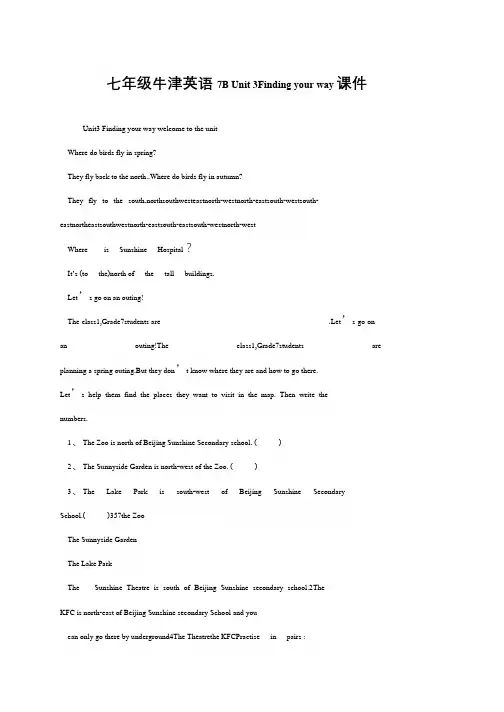
eastnortheastsouthwestnorth-eastsouth-eastsouth-westnorth-west
WhereisSunshineHospital?
B:OK. Butwhereis it ?
A:It is north/south/.... of.....
B:Howcanwegothere?
A:Wecangothereonfoot/bybus/........
Listen and answer
DoesHobo,infact (事实上),knowtheway?
Heoften _______________ to school.
按要求改写句子don’tthinkHowdoesgocomesaftertakesabus
完成句子
1.公园在我们学校的西北方。
2.上海在中国的东方。
3.别害怕。我们可以乘地铁去那儿。
4.让我们帮李老师拿书吧。
5.汤姆正在爬山。
6.有些人害怕狗。
Miss Li said,“F______me to theoffice.”
Don’t be a_____. I’ll go withyou.
The bus stop is n_____ of our school.
The garden is _________ (西南)of the office building.
3、TheLakeParkissouth-westofBeijingSunshineSecondary
School.()357the Zoo
江苏地区牛津初中英语学科7B Unit 3 Finding your way 教案 江苏教育版
“south” and so on. Step 2. Presentation Ask Ss some questions about the article. 1. What did Kitty and Simon do at lunchtime? 2. Who are the two boys? Let Ss read the title and the first Para., and then answer the questions. Play the tape from Line 1-15. Let them find what the boy did and who is their friend. Check the answers and then read after the tape. Step 3. Find the clue words. Let students go through the text as quickly as they can. For 1 minute then ask them to close the books. What word flashes on their mind, and make them speak out. e.g. robbers, uniform, police, green van, knife, building, etc. Write down these words on the Bb, and let Ss imagine
Let Ss talk about “Sunshine Town” T: What’s in Sunshine Town? S1: A park, a school, a shopping mall…. T: Where do the students live? S1: In the tall buildings. Step 2. Presentation 1. Show students a map of Sunshine Town. Point at the places in it and ask: Where is/are…? Answer them by using “be north(…) of” e.g. The school is north of the park. 2. Present and explain: north, south, east, west, north-west, north-east, south-west, south-east Step 3. Practice Look at the map, ask and answer in pairs. e.g. S1: Where is the zoo? S2: The zoo is north of the school.
7B Unit3 Finding your way 课时练习6(Main task & Checkout)
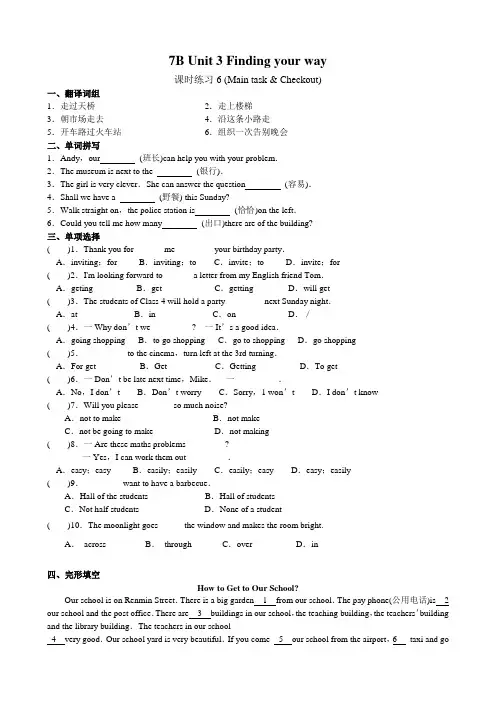
7B Unit 3 Finding your way课时练习6 (Main task & Checkout)一、翻译词组1.走过天桥______________________ 2.走上楼梯____________________________3.朝市场走去____________________ 4.沿这条小路走________________________5.开车路过火车站________________ 6.组织一次告别晚会____________________二、单词拼写1.Andy,our (班长)can help you with your problem.2.The museum is next to the (银行).3.The girl is very clever.She can answer the question (容易).4.Shall we have a (野餐) this Sunday?5.Walk straight on,the police station is (恰恰)on the left.6.Could you tell me how many (出口)there are of the building?三、单项选择( )1.Thank you for_______me_________your birthday party.A.inviting;for B.inviting;to C.invite;to D.invite;for( )2.I'm looking forward to_______a letter from my English friend Tom.A.geting B.get C.getting D.will get( )3.The students of Class 4 will hold a party_________next Sunday night.A.at B.in C.on D./( )4.一Why don’t we _________? 一It’s a good idea.A.going shopping B.to go shopping C.go to shopping D.go shopping( )5.__________to the cinema,turn left at the 3rd turning.A.For get B.Get C.Getting D.To get( )6.一Don’t be late next time,Mike.一__________.A.No,I don’t B.Don’t worry C.Sorry,1 won’t D.I don’t know( )7.Will you please________so much noise?A.not to make B.not makeC.not be going to make D.not making( )8.一Are these maths problems_________?一Yes,I can work them out _________.A.easy;easy B.easily;easily C.easily;easy D.easy;easily( )9._________want to have a barbecue.A.Hall of the students B.Hall of studentsC.Not half students D.None of a student( )10.The moonlight goes _____ the window and makes the room bright.A.across B.through C.over D.in四、完形填空How to Get to Our School?Our school is on Renmin Street.There is a big garden 1 from our school.The pay phone(公用电话)is 2 our school and the post office.There are 3 buildings in our school,the teaching building,the teachers’building and the library building.The teachers in our school4 very good.Our school yard is very beautiful.If you come5 our school from the airport,6 taxi and go7 the highway 8 you see a bridge.Go across the bridge and 9 left.Then go straight along the Bridge Street until you see a market.Then turn left and go along Renmin Street,and our school is 10 the right.( )1.A.across B.in C.on D.behind( )2.A.in B.among C.between D.or( )3.A.two B.three C.four D.five( )4.A.am B.is C.are D./( )5.A.from B.to C.back D.up( )6.A.have B.take C.get D.borrow( )7.A.on B.to C.along D.up( )8.A.when B.after C.until D.as( )9.A.go B.come C.take D.turn( )10.A.in B.on C.at D.Of五、阅读理解Look at the map. You are standing in the footprints (脚印), someone comes to you and asks the way. Can you answer his questions? (看下面地图,假如你正站在脚印的位置,有人过来向你问路,你能回答他的问题吗?)( ) 1. Which street or road am I standing on now?A. New Street.B. Market Street.C. East Road.D. No Answers.( ) 2. How do I get to the library?A. Go along North Road and then turn left into West Road. Then you can see the library on your right.B. Go along North Road and take the second turning on the left, and then turn right. Now you can see the library on the left.C. Go along Market Street and then turn left into Ferry Street. And now you can see the library.D. Go along North Road and take the third turning on the left, and then turn right into River Street. Now you can see the library on your right.( ) 3. Which place is the nearest if I walk there?A. The supermarket.B. The park.C. The police station.D. The swimming pool.( ) 4. Which is the shortest way for me to get to the Ferry?A. Market Street------Ferry Street.B. East Road------Ferry Street.C. Market------Little Street------North Road------Ferry Street.D. East Road------High Street------Market Street------Ferry Street.( ) 5. Which road should I take to go the swimming pool?A. Old Street.B. East Road.C. Market Street.D. North Road.六、句子翻译1.我们盼望着很快收到你的来信。
《Finding-your-way》教案
7B Unit3 Finding your way教案Welcome to the unitTeaching aims and demands:New words: follow, north, north-west, south-westTeaching methods: task-based approachTeaching task: 1. To introduce the topic of places and transport.2. To talk about visits and means of transport using model sentences.Teaching aids: tape recorderTeaching procedures:Ⅰ. Warm-up (presentation)Ask the students on duty to give us a short report about the Sunshine Town.Ⅱ. ListeningListen to the tape, answer my question, “Did Hobo, in fact, know the way?” Help the Ss to answer.Listen again, Ss read after the tape recorder, then do some True or False exercises. Check the answers with the whole class.Language points:1.follow me2.go up and downe.g. Let‟s go down the hill together.3.Don‟t be afraid.e.g. (1) Don‟t be late for school.(2) Don‟t play in the street. It‟s too dangerous.be afraid to do. be afraid of sth.. I‟m afraid that+从句e.g. (1) The little girl is afraid to go out in the evening.(2) Little Tom is afraid of dogs.(3) I‟m afraid that I can‟t go with you. I have a lot of work to do.Ⅲ. Main taskIntroduce the topic of place and transport.Ⅳ. Discussion (task)Talk about visits and means of transport using the model sentence …---Let‟s go to the zoo.---OK. We can go by bus.Language points:1.The zoo is north of Beijing Sunshine Secondary School.north ofsouth, west, north-west, south-weste.g. The library is south of the classroom.The playground is west of the classroom.2. ---How do we get there?---We can go by bus.by air/bus/car/bike/undergroundⅤ.Sum-upGo through the new words and the language points during this lesson.Ⅵ. Homework.Review the contents of this lesson.教后记:7B Unit3 Finding your wayReadingTeaching aims and demands:New words:call, robber, drive, quickly, at once, police, uniform, just, push, van, away, fail, use, knife, work, police station, route, along, right, another, stop, traffic, light, jump, later, suddenly, surprised, catch, in the end, crossroadsTeaching methods: task-based approachTeaching task: 1. Prepositions of movement..2. Simple future tense with “shall” “will”Teaching aids: tape recorder, tapes, slide projector, slidesTeaching procedures:Ⅰ. Warm-upAsk the Ss to give a free talk. .Ⅱ.ListeningNow, listen to the text, please answer the question “Did the robbers run away finally?”Listen again, Ss read after the tape, and do some exercises.Ⅲ. ReadingSs read the articles by yourselves. Do the Exx on Page41and 42. Check the answers with class. Language points:1.nearby=not far awaye.g. I live nearby in the building.2. robber(n.) rob(v.)e.g. The two robbers ran away from the back quickly.3. quickly=fast (adj.) quick (adj.)e.g. She walked quickly away.4. fail失败e.g. Tom failed in his math examination.5. work起作用e.g. Something is wrong with my watch. It doesn‟t work..6. route路线take different routee.g. There‟s another route you can take to get to the cinema.7. suddenly突然地.e.g. Suddenly I found a big tiger standing in front of me.8.surprised adj. 惊讶地e.g. We are surprised to hear him sing.9.in the end =at laste.g. He passed the exam in the end.10.turn right/left into 7th Streete.g. Don‟t tell a lie any more . It‟s not good for you.Ⅴ.Discussion (task)Have a discussion about the story.Ⅵ.Sum-upGo through the new words and the language points learnt during this lesson.Ⅶ. HomeworkReview the contents of this lesson.教后记:7B Unit3 Finding your wayIntegrated skills and Study skillsTeaching aims and demands:Key points: Cross the bridge and turn rightTake the second turning on the right.Cross the road at the traffic light.Walk past the police station.Teaching methods: task-based approachTeaching task: 1.To recognize key expressions about directions.2.To use key information given instruction and undentify the specific order of themfrom listening.3. To produce formulatic responses to specific instruction.Teaching aids: tape recorder, tapes, slide projector, slidesTeaching procedures:Ⅰ. Warm-upAsk the student on duty to give a short talk.Integrated skillsⅡ.Finding treasure1.Ask the Ss to study the pictures in Part 1 carefully. Put a tick in the correct boxes. Check the answers and explain.2.Listen to the tape and tell the Ss to do the Exx on Page48and 49. Listen again if necessary. Check the answers with the whole class.Ⅲ. Speak up1.Listen to the tape recording and read after it.2.Ask the Ss to work in pairs to make up a new conversation for giving direction using the conversation in Part B as a model. Ask a few pairs to present their conversations to the whole class.Ⅶ. Study skills ( Making a grammar pattern book)Take the Ss through the text of this page. Have a discussion about the Internet. What does WWW stands for? Do you know any common browser name, some search engines. Talk about other key aspects about the Internet.Language points:1.Cross the bridge and turn right2.Take the second turning on the right.3.Walk along a path.Ⅷ. Sum-upGo through the new words and the language points learnt during this lesson.Ⅸ. Homework1. Review the contents of this lesson.2. Do the Exx of the workbook.教后记:7B Unit3 Finding your wayVocabulary ﹠GrammarTeaching aims and demands:New words: straight, zebra crossing, entrance, correct, corner, road, hotel, cross, across, round, off, onto, train, tunnel, stair, railway, south, step, side, bridge, join, win, cloudy, paper, campfire Teaching difficulties: 1.prepositions of movement2. simple f uture tense with “will” and “shall”Teaching methods: task-based approachTeaching task: 1.To learn and know about the directions2.To prepositions of movement to give directions3.To recognize the use of “will” and “shall” and be going to talk about the future Teaching aids: tape recorderTeaching procedures:Ⅰ. Warm-upHelp the Ss retell the story “A lucky escape”.Ⅱ. V ocabulary1.Ask the students what road signs they know, and list the names of the signs: e.g. turn left, traffic light, turn right, straight on ,crossroads.2. Ask the students to write the names under the pictures.3. Ask them how to read a map and circle the letters of the correct maps.Language points:turn right/left, cross the road, go straight along the road.Ⅲ.Grammar1.Prepostitions of movementWe use prepositions of movement to express movements. Prepositions of movement: across, along, down, from, into, off, onto, out of, over, round, through, to, upe.g. The bus goes to the airport.Simon is swimming across the pool.A train is going through a tunnel.Millie is walking along the road.Kitty is climbing up the hill.Hobo is walking round the table.Work out the rule: We use prepositions of movement after the verbs.Finish off the exercise on Page45.2. Simple future tense with “will” and “shall”We use “will” or “shall” when we talk about: things that will happen, plans that we are making now.e.g. She will be late for the party.We will take the dog to the park tomorrow.We make negative sentences like this:I/We will not/shall not goHe/She/It/You/They will not goWe ask questions using the simple future tense like:Will/shall I/We like go?Will He/She/It/You/They like go?We answer questions like this:Yes, I/we will/shall. Yes, he/she/it/you/they will.No, I/we will not/shall not. No, he/she/it/you/they will not.We can use “be going to” when we talk about:Fixed plans for a certain time in near future.e.g. I‟m going to take another route.Things that will probably happen.e.g. It‟s so cloudy. I think it is going to rain.We ask and answer questions with “be going to” like this.Am IAre you/we/they going to see the doctor tomorrow?Is he/she/itI am. I am not.Yes, you/we/they are. No, you/we/they are not.he/she/it is. he/she/it is not.Ⅳ. Discussion (task)Have a discussion and find out the differences between the simple future tense and simple present tense.Ⅴ.Homework1. Review the contents of this lesson.2. Do the Exx of the workbook.教后记:7B Unit3 Finding your wayMain task &CheckoutTeaching aims and demands:New words: farewell, barbecue, picnic, invite, exit, everybody, complete, note, page, yours faithfully, monitor, signature, postcard, footbridgeTeaching methods: task-based approachTeaching task: 1. To express direction and information in the contest of writing a letter of invitation.2.To check the use of prepositions of movement, the use of “will” and “be goingto” to talk about the futu re giving of direction.Teaching aids: tape recorder, tapes, slide projector, slidesTeaching procedures:Ⅰ. Warm-upAsk the student on duty to give a free talk.Ⅱ. Main taskAsk the Ss to read the questionnaire, then complete it with students‟ own informa tion.Ask the Ss to read the letter on their own and complete it with information from the questionnaire results on Page51.Ask the Ss some questions to check them.Ⅲ. Writing (task)Ask the students to write an invitation letter for your class‟s farewell party at your school. Draw a map and send it with your letter with the help of B2.Ⅳ. Checkout: Sending postcardsAsk the Ss to fill in the blanks with the correct forms of verbs and prepositions. Check the prepositions of movement and simple future tense.Ⅴ. WordsAsk the Ss to look at the picture and write the correct words to describe each picture.Language points:1. be + adj. + to doe.g. He is sad to fail in the exam.2.invite sb. to do sth.e.g. invite us to her homeLily invited us to have dinner at her home yesterday.3. yours faithfully4. send the postcard to my parents.Ⅷ. Sum-upGo through the new words and the language points learnt during this lesson.Ⅸ. Homework1. Review the contents of this lesson.2. Do the Exx of the workbook.。
(整理版)7B Unit 3 Finding your way
7B Unit 3 Finding your way一、根底词汇名词(n.)1. 北方_______________2. 西北方_____________3. 西南方____________4. 通话_______________5. 抢劫者_____________6. 警察______________7. 制服_______________ 8. 小刀〔复〕__________ 9. 路线______________10. 交通______________ 11. 灯,灯光___________ 12. 十字路口 ________13. 拐角______________ 14. 道路_______________ 15. 饭店_____________16. 火车______________ 17. 楼梯_______________ 18. 南方_____________19. 台阶______________ 20. 侧,边_____________ 21. 桥_______________22. 拐弯处____________ 23. 纸_________________ 24. 便条,注解________25. 页码_______________ 26. 班长_______________ 27. 明星片___________动词(v.)1. 跟随________________2. 驾驶_______________3. 推________________4. 失败________________5. 使用_______________6. 起作用,奏效_______7. 停止________________ 8. 跳,蹦_____________ 9. 抓住,捕获_________10. 穿过_______________ 11. 参加______________ 12. 赢_______________形容词(adj.)1. 另一个,别的 ________2. 吃惊的______________副词(adv.)1. 迅速地______________2. 向远处,离开________3. 往右 ___________4. 后来,以后_________5. 突然________________6. 径直____________介词(prep.)1. 沿着________________2. 穿过_________________3. 从…离开_________4. 到…之上____________代词(pron.)1. 每人___________二、重点词组1. 警察局_______________________2. 接到一个 ____________________3. 住在附近_____________________4. 开车去…〔2〕___________________5. 三个穿警察制服的人___________6. 走不同的路线____________________7. 向左拐进 ____________________ 8. 在交通灯处停下__________________9. 迅速逃跑_____________________ 10. 停止讲话_______________________11. 惊讶得看见 _________________ 12. 最后〔2〕______________________三、句型结构1. Justin stopped talking. (stop 的用法)e.g. 1) 昨天一辆卡车在我面前停了下来。
牛津译林版七年级英语下册Unit3Findingyourway(含答案)
牛津译林版七年级英语下册Unit3Findingyourway(含答案)7B Unit 3 Finding your way复习目标:1.学会阅读剧本故事,能根据语境推测故事内容的发展。
2.正确运用方位介词,across through along over round up down from to into3.一般将来时的用法。
4.本单元的四会词。
Task1:Words1. 默写下列单词(20个左右单词)(1)路线(2)跟随(3)向下(4)害怕(5)北方(6)南方(7)东方(8)西方(9)警察(10)抢劫者(11)害怕的(12)沿着(13)吃惊的(14)失败(15微笑(16)台阶(17)博物馆(18)地面(19)市场(20)局;站2.Do exercises (见随堂检测)Task2: the important phrases and sentences 1.Phrases 英汉互译2.the important sentences(ways: read& remember )(1)The zoo is north of Beijing Sunshine Secondary School.(2 )Paul tries to open the door but fails. He uses a knife and tries again. It works. (3 )Let ’s run to the police station.(4)He is surprised to see the three men in the police station.(5 )Simon is going through a tunnel. (6 )Can you tellme t heway to Sunshine Town R ailway Station from Sunshine Shopping Mall.(7 )We would like everybody to bring their own food and drink. (8)We look fodward to seeing you at our party. 3.Do exercises (见随堂检测 )Task3:Grammar 1.across:横穿过(从一边到另一边).2.through :贯穿,从·····空间穿过。
牛津 7B Unit 3 Finding your way 教案(Integrated Skills)
牛津 7B Unit 3 Finding your way 教案(Integrated Skills)Objectives1. To recognize key expressions about directions2. To develop intensive listening skills by following instructions and making aroute.3.To give directions in an everyday context.4. To recognize key expressions about directions5. To develop intensive listening skills by following instructions and making aroute.6. To give directions in an everyday context.Teaching aids: A recorder Multiple-mediaTeaching proceduresStep1. revision1. a dialogueThe twin brothers Paul and Justin told their friend Sandy about their lucky escape.But Sandy has no idea how they got to the police station after they jumped out of the van through the back door. So the twins use a map to show her their routes. 2. road signsWhen you go out for a trip, you must know how to read a map. When you travel in the city, you can find road signs here and there. Look at these road signs, what do they mean?3. revise some prepositions of movementStep2. presentation1. recognize some simple instructionsDo you know the meaning of this sentence? What should you do ? Which picture will you choose?2. Look at the map. What can you see?These are fields. We can see a few roads across the fields. There is a river across the fields. Over the river, there are 3 bridges. Next to the river, there is a path.Along the path, we can see three young trees. Now, I’d like to know if you can give directions in English correctly.3. The Class 1 Grade 7 students and the exchange students from Britain are goingto play a gamecalled “Treasure Hunt”. There’s some treasure somewhere in the fields. Let’s try to find it. Mr Wu will give us some instructions .a. First listen to the tape and put the instructions into the correct order.b. Listen to the instructions again, ask a student to draw the route and atreasure cheston the map.Step3. speak up: giving directionsYou are inviting a classmate to your home. You need to give him/her directions.Listen to Millie &Neil’s conversation first, then draw the route on the map. Step4. pairworkLet the students make up their own dialoguesHomework中译英1,走过木屋,右转,沿靠河的小路走。