
牛津译林版英语八下Unit 5 Good manners单元测试卷
2015.68B Unit 5 Good manners单元测试卷一、单项填空(20%)( )1.The second Sunday of May is _______ Mother's Day. It's _______ special day for children to show their love for their mothers.A. a:theB. the; aC. /;aD. /; the( )2.-Do you know this town very well?-No, this is the first time I _______ here.A. wasB. was goingC. cameD. have been( )3.-Li Ming is getting a lot better than expected(预料).-But his doctor _______ he shouldn't be in a hurry to return to school.A. noticesB. wondersC. warnsD. asked( )4.Your father used to work in the factory, _______?A.did he B.didn't he C. does he D.usedn't him( )5.-I'd like a cup of black coffee. What about you, Maggie?-I like coffee _______ sugar much better.A. thanB. forC. withD. to( )6.Which sign will you probably see in the museum?A. SOLD OUTB. NO PARKINGC. NO PHOTOSD. LOOK OUT( )7.The bag is _______ heavy for meA. so; that carryB. too; to carry itC. not enough; to carry itD. too; to carry( )8.People won't realize the importance of heath _______ they lose it.A.if B.since C.until D.after( )9.-Just a minute, Tom. Is this the report you need to hand in today?-Oh, yes, Mum. I thought I had put _______ in my sch001 bag.A. everythingB. somethingC. nothingD. anything( )10.These days lots of people are working _______ to get_______ for their living.A. hard enough; enough moneyB. enough hard; money enoughC. enough hardly; m.ney enoughD. hardly enough; enough m.ney( )11.Would you please _______ me _______ to do next?A.to tell;how B.to tell;what C.telling;how D.tell;what( )12.I couldn't get through because your car was _______.A. on my wayB. in my wayC. in some waysD. by the way( )13. -Be quiet please! Have you seen the sign "No Talking"?-Sorry, I _______ it.A. didn't noticeB. haven't noticedC. won't noticeD. don't notice( )14. Please keep quiet. If you make a lot of _______, you may bring people trouble.A. voiceB. noiseC. soundD. singing( )15. Mary as well as her classmates _______ English every morning.A. readB. is readingC. readsD. to read( )16. -Do you think reading aloud is the best way_______ English?-Yes, I think so.A. to learnB. learnC. learnsD. learned( )17. -Is that man in a red T-shirt Mr Smith?-It _______ be Mr Smith. He is in London now.A. musn'tB. canC. shouldn'tD. can't( )18. He'll send us a message as soon as he _______ Shanghai.A. arrivesB. to arrive inC. arrives onD. arrives in( )19. The purpose of new inventions is to make life easier, _______ it more difficult.A. not to makeB. not makingC. not makeD. do not make( )20.-Will you come to the party next Friday?- _______.I will be on holiday in Lijiang by then.A. I'm afraid notB. I hope soC. I think soD. I hope not二、完形填空(10%)Life is not easy, so I'd like to say "When anything happens, believe in yourself."When I was a young boy, I was too 1 to talk to anyone. My classmates often laughed at (嘲笑)me. I was sad but could do nothing. Later, 2 happened, and it changed my life. It was an English speech competition. My mother asked me to 3 it. What a terrible idea! It meant I had to speak 4 all the teachers and students in my school."Come on, boy. Believe in yourself. You are sure to 5 ." Then mother and I talked about many different topics. At last I 6 the topic "Believe in yourself". I tried my best to remember all the speech and practised it over 100 times. With my mother's great love, I did well in the competition. I could hardly(几乎不) believe my 7 when the news came that I had won the first place. l heard the cheers(赞美) 8 the teachers and students. Those classmates who once looked down on (瞧不起) me, now all said "Congratulations!" to me.My mother hugged(拥抱) me and cried 9 .10 then, everything has changed for me. When I do anything, I try to tell myself to be sure. This is true not only for a person but also for a country.( ) 1. A. poor B. ugly C. happy D. shy( ) 2. A. something B. nothing C. anything D. everything( ) 3. A. meet B. take part in C. make D. get( ) 4. A. to B. with C. before D. among( ) 5. A. win B. lose C. beat D. pass( ) 6. A. reached B. brought C. chose D. thought( ) 7. A. speech B. result C. ears D. eyes( ) 8. A. of B. from C. to D. for'( ) 9. A. excitingly B. exciting C. excitedly D. excited( )10. A. Since B. Except C. From D. Before三、阅读理解(20%)(A)Here are some good table rules about eating Western food.As soon as you sit down, you should sit up straight, keep your elbows (肘) off the table. Open your napkin (餐巾) and place it on your lap (大腿). The napkin stays on your lap (except for use) until the end of the meal. If you need to leave the table for a moment, you may leave the napkin on your chair. When the meal is finished, place your napkin well on the left of your plate.Remember the rule: liquids (液体) on the right, solids (固体) on the left. Your water glass ison the right of the plate and your bread plate is on the left. You should pass the dishes from left to right. Do try a little of everything on your plate. Bread should be broken off into small pieces and butter is about a small mouth as you eat it. You may leave some food to one side of your plate if you feel you have had enough. Don't leave your plate so clean that it looks as if you haven't eaten for days! If others ask you for the salt, pass it with both hands together. If the soup is hot, don't blow on it; just wait for it to cool off. When a lady arrives at or leaves the table, it's polite for all gentlemen at the table to stand up.( ) 1. When you eat Western food at the table, you should _______.A. put your elbows on the tableB. keep your elbows off the tableC. keep your elbows straightD. keep your napkin clean( ) 2. According to (根据)the passage, if a person leaves for a while, he has to _______.A. take the napkin with himB. take the napkin in his handC. put the napkin on his chairD. put the napkin on the table.( ) 3. When you finish eating a Western meal, you should _______.A. put your napkin well on the left of you plateB. put your napkin well on the right of your plateC. place your napkin into the dustbinD. take your napkin with you( ) 4. If you pass the dishes, you should _______.A. pass them from right to leftB. stand up and pass them to the person next to youC. pass liquids first, then the solidsD. pass them from left to right( ) 5. Which of the following is true according to the passage?A. If the soup is hot, you can blow on it.B. You should eat all the things up on your plate though(即使)you are full.C. When a lady arrives at the table, it's polite to stand up for a gentleman.D. It's good to leave your plate so clean.(B)There weren't many cars in the parking lot(停车场)outside, but the hall inside was crowded.The people in Paper Town who are out of work have started a Hard Luck Club. Anyone who isn't working can join. The people in the club don't just sit around and feel sorry for themselves. They get together to help each other 'out. If a family hasn't got enough to eat or if they didn't have enough to pay the bills last month, the club gives them food or teaches them how to cut costs. But the thing the club tries to give first is a new job. The group last night came to hear a talk by a man who helps people find jobs. "A person who is out of job shouldn't give up, " he said. "Don't wait for a job to come to look for you. Go out and sell yourself. Send letters to companies all over the country, asking about jobs. Take a course through the mail. Learn a new skill. The people who are going to succeed<成功)are the ones who aren't afraid to try something new."( )6. The Hard Luck Club was started to _______.A. have funB. play togetherC. make moneyD. give help( )7. The club heard a talk about how to find_______.A. jobsB. funC. foodD. parking( )8. The speaker said that people without jobs should try _______.A. their luckB. new thingsC. to waitD. to pay bills( )9. The speaker was trying to_______ the club members.A. laugh atB. encourageC. hireD. worry( )10. Which do you think is true?A. The people in Paper Town are making paper.B. The people in Paper Town all lost their jobs.C. The people in the club just enjoy talking.D. The Hard Luck Club helps people who are out of jobs.四、单词拼写(10%)A)根据句意和汉语注释,写出单词的正确形式1. When I arrived, I found her in_______(谈话)with Mr Li.2. The broken arm has caused great_______(疼痛)and I think I can't stand it.3. He_______(推)me and I fell into the river. We all didn't know why he did that. 4.Water was _______(流动)all over the bathroom floor.5.I will visit this beautiful town_______(某时)in my life again.6. The main_______(目的)of the activity is to raise money for children in poor areas.7. We are sure to find a_______(合适的)way to decide who is the best.B)根据对话内容,写出句中所缺单词8. --Don't _______ in on others, OK? Let people finish their talks first.--Sorry. I won't do that again.9. How could you make your success as a writer?--Well, I'm not clever but I believe the saying " _______ makes perfect".10. --What should we pay attention to(注意)at the table?--To make all the hosts and _______ feel comfortable.五、动词填空(10%)1. Tom and his brother_______ (invite) Kitty to their birthday party already.2. So you risked_______ (fail) your class just to buy your girlfriend a cake?3. It's really bad for people_______ (litter) everywhere.4. He_______ (explain) why he was late for this meeting when we arrived there.5. -Where's your mum?-Oh, she with my grandpa_______ (pick) peaches in the garden.6. My mum_______ (touch) my mobile phone and had a look at the messages.7. Hurry up if you need to go to the toilet. The plane _______ (take) off in a minute.8. Listen! How beautiful the song "You and me"(sound)! Have you heard of it?9. Oh, my god! Little Tom seems to be sad. I guess something_______ (happen) to him.10._______ (save) energy, turn off the hot water after you take a shower.六、翻译句子(15%)1.他太有礼貌,不会在别人面前插队。
最新江苏牛津译林版八年级英语初二下册8BUnit5 Good manners检测题有答案

牛津译林版8B Unit 5 Good manners单元检测卷(总分150分考试时间120分钟)一、单项选择(30分)( )1. Hobo is _________ to learn _________ manners.A. old enough; fromB. enough old; fromC. old enough; aboutD. old enough; about ( )2. ---Don’t _________ litter everywhere! ---Sorry, _________.A. drop; I don’tB. drop; I won’tC. leave; I don’tD. leave; I won’t ( )3. We should keep the library _________ every day.A. cleaningB. cleanC. to cleanD. cleans( )4. In the library, we should keep _________.A. quiteB. quitelyC. quietD. quietly( )5. It is impolite _________ others when they are speaking.A. to cut on inB. to cut in onC. cutting on inD. cutting in on( )6. ---Don’t _________ the tap _________ again! ---Sorry. I won’t.A. let; runB. let; runningC. leave runningD. leave; run( )7. British people only _________ relatives or _________ friends _________ a kiss.A. great; close; byB. greet; close; withC. great; closed; byD. greet; closed; with ( )8. British people are very polite at home _________.A. as well asB. as wellC. alsoD. either( )9. They say “please” and “thank you” all the time. What does “all the time” mean? _________.A. sometimesB. alwaysC. oftenD. usually( )10. British people often keep their voice _________.A. low in the publicB. down in publicC. down in the publicD. low in public( )11. British people don’t like to shout or laugh _________.A. aloudB. loudC. loudlyD. aloudly( )12. ---What is the meaning of “greet”? ---_________.A. a small talkB. say hello to someone or welcome themC. talk with each otherD. hear others speaking( )13. Simon is trying to _________ sure that he remember what Jenny talked about _________ the radio.A. be; throughB. make; onC. make; throughD. be; on( )14. If you _________ others, you should say “Sorry” to them.A. knock atB. bump inC. bump intoD. knock on( )15. It is _________ to push _________ people in British.A. polite; pastB. impolite; passC. polite; passD. impolite; past ( )16. Daniel is writing an article about the _________ manners between the UK and China.A. difference; inB. differences; inC. difference; onD. differences; on ( )17. Amy is talking with Shirley about _________ in public places.A. singles usedB. signs usingC. singles usingD. signs used( )18. Which saying means “You have to do something before others in order to be successful” below?A. The early bird catches the worm.B. many hands make light work.C. Every dog has its day.D. Put all your eggs in one basket.( )19. If you keep _________ English every day, you’ll be better at it.A. practice speakingB. practice to speakC. practicing speakingD. practicing to speak( )20. He ran and ran, but he couldn’t run _________ to catch the bus.A. fast enoughB. enough quickC. enough fastD. enough quickly( )21. Mike is only 15 years old. He is not _________ to get a driver’s license.A. old enoughB. enough oldC. young enoughD. enough young( )22. British people are _________ polite _________ push past you.A. too; toB. very; toC. enough; toD. so; that( )23. The UK is _________ far away for Jenny _________ there on her own.A. so; to goB. too; to goC. very; to goD. quite, go( )24. The bag is _________ heavy for me _________.A. so; to carryB. too; to carry itC. not enough; to carry itD. too; to carry ( )25. Would you please _________ me _________ to do next?A. to tell; howB. to tell; whatC. telling; howD. tell; what( )26. I couldn’t get through because a car was _________.A. on my wayB. in my wayC. in some waysD. by the way( )27. ---Do you think reading aloud is the best way _________ English? ---Yes, I think so.A. to learnB. learnC. learnsD. learned( )28. ---Is that man in a red T-shirt Mr. Green?---It _________ be Mr. Green. He is in Pairs now.A. mustn’tB. canC. shouldn’tD. can’t( )29. ---Will you come to the party next Friday?---_________. I will be on holiday in Australia by then.A. I’m afraid notB. I hope soC. I think soD. I hope not( )30. ---Be quiet please! Have you seen the sign “No Talking”?---Sorry. I _________ it.A. didn’t noticeB. haven’t noticedC. won’t noticeD. don’t notice二、完形填空(20分)ACharlie came from a poor village. His parents had __1__ money to send him to school when he was young. The boy was very sad. Mr. King lived next to him. He found the boy __2__ and had pity on him and lent some money to him. So the boy could go to school. He studied hard and __3__ all his lessons. When he finished middle school, the man introduced him to his friend in the town. And he began to work.Once Mr. King was seriously hurt in an accident. Dying, he asked Charlie to take care of his daughter, Sharon. The young man __4__ and several years later he married the girl. He loved her very much and tried his best to make her happy. He often bought beautiful clothes and delicious food for her. He was good at cooking and he cooked __5__ for her. So she became very fat and she felt it difficult to walk. And one day she found there was something wrong with her heart. Her h usband wasn’t at home and she had to go to __6__ at once. The doctors looked her over and told her __7__ eat meat, sugar, chocolate and things like these. She was afraid __8__ the doctor’s words and wrote all the names of the food on the paper. When she go t home, she put the list on the tableand __9__. When she returned home that afternoon, she found many kinds of food: meat, sugar and chocolate in the kitchen. Charlie was busy __10__ there. As soon as he saw her, he said happily, “I’ve bought all the food you like, dear!”( )1. A. no B. some C. much D. enough( )2. A. lazy B. clever C. careful D. hard( )3. A. did well in B. was poor at C. was working D. was good for( )4. A. was angry B. thought hard C. agreed D. said “No.”( )5. A. a little B. a few C. many D. a lot( )6. A. rest B. sleep C. hospital D. work( )7. A. should B. would C. to D. not to( )8. A. to remember B. to forget C. to catch D. to teach( )9. A. slept B. went out C. cooked D. ate( )10. A. reading B. seeing C. cooking D. writingBEdith Cavell was born in a small English village. She was a clever, hard-working girl and did well at school, especially(尤其)in 1 and French. 2 she left school, her first job was to take care of the children of a rich family in Belgium(比利时).The language they spoke was French, so she found that her school studies were 3 .She could understand them easily,at the same time she taught the children to speak English and play the piano.After 4 that her father was seriously ill, Edith returned home to 5 him She then decided to become a nurse.She did a wonderful job in the hospita1.A Belgian doctor was so impressed(印象深的)that he invited her to his country to organize a 6 school for nurses. The First World War broke out in 1914 and Edith Cavell's school of nursing became a 7 . She stayed there to look after the sick and wounded(受伤的)soldiers.Edith treated them with kindness.8 November 1914 and August 1915 she secretly helped about 200 wounded soldiers and prisoners(囚犯)run away from the Germans. Later the Germans 9 what Edith had done and they caught her. Finally, the Germans killed her, but they 10 kill her memory.A tall statue(雕塑)has been built in Trafalgar Square,London,in honor (纪念)of the brave English nurse.( )1.A. science B. music C. 1anguage D. dancing( )2.A. After B. While C. Before D. As( )3.A. interesting B. helpless C. difficult D. useful( )4.A. seeing B. watching C. listening D. hearing( )5.A. 100k after B. treat C. cure D. leave( )6.A. reading B. training C. caring D. working( )7.A. home B. shop C. museum D. hospital( )8.A. From B. Between C. During D. Since( )9.A found out B looked for C worked out D. were interested in( )10.A. could B. must C. couldn't D. had to三、阅读理解(50分)ALearning the language of a country isn't enough. If you want to know the manners of your foreign friends, you will probably be surprised just how different they can be from yours. A visitor to India should remember that people there are impolite to use the left hand for passing food at table. The left hand is for washing yourself. Also in India, you might see a man shaking his head at another to show that he is disagreeing. But in many parts of India a rotating (转动) movement of the head is to show agreement. In Bulgaria you shake your head to show "yes" , a nod shows "no".In Europe it is quite usual to cross your legs while sitting and talking to someone, even at an important meeting. But doing this could cause offence (反感)to a Thailander (泰国人). Also touching the head of a grown-up. It's just not done in Thailand.Knowing about manners is useful when you are travelling, but you need to know the language used to express for ritual (礼节).( )1. If you are staying in India, you'd better _________.A. not use your left hand to pass food at a tableB. use your left hand to pass food at a tableC. not use your left hand to wash yourselfD. use your left hand impolitely( )2. To shake your head means "Yes" __________.A. in IndiaB. in ChinaC. in BulgariaD. in Thailand( )3. You can easily make a Thai lander angry by __________.A. touching his headB. crossing your legs while you are talking to himC. shaking your headD. Both A and B( )4. The Writer thinks that to know about a country well one must __________.A. only know its languageB. only know its mannersC. know its manners better than its languageD. know its manners and its language( )5. You can infer from the passage that ___________.A. different countries have different mannersB. the manners in Thailand are the same as in ChinaC. you should be careful not to cross your legs at an important meeting in EuropeD. you should not touch a grown-up's head in IndiaBManners at TableThe customs (习惯) in different countries are rather different. If I have dinner with a Chinese host (主人), he always puts more food onto my plate as soon as I have emptied it. That often discomforts (使不安) me greatly. I have to eat the food even if I do not want to. Because it is considered bad manners in the West to leave one's food on the plate. I have also noticed that when a Chinese sits at an American's dinner party, he often refuses the offer of food or drink though he's in fact still hungry or thirsty. This might be good manners in China but is not in the West at all. In the United States, it is impolite to keep asking someone again and again or insist on his accepting something. Americans have a direct way of speaking. If they want something, they will ask for it. If not, they will say, "No, thanks.' When an American is served with beer (啤酒) by the host, for example, he might say, "No, thanks. I'll take some orange juice (汁) if you have it." That is what an American will do. So when you go to the United States, you'd better remember the famous saying: "When in Rome, do as the Romans do."( )6. From this passage we can see that the writer is _________.A. a ChineseB. RomanC. an AmericanD. a European( )7. When a Chinese host kept putting more food onto his plate, the writer felt _________.A. very happyB. sadC. angryD. uneasy( )8. In the West, people consider it bad manners __________.A. to refuse an offerB. to ask for something directlyC. to eat much at a dinner partyD. to keep asking someone to accept something( )9. A guest at an American's dinner party should show his politeness by __________.A. not eating up all the food offeredB. putting more food onto his plate as soon as he emptied itC. refusing the offer of food or drink though he is still hungry or thirstyD. asking for things directly if he wants them( )10. "When in Rome, do as the Romans do" means __________.A. the Romans are people of good mannersB. Americans always do the same things as the Romans doC. the Romans are polite.D. you should get used to the local ( 当地的) customs wherever you goCEating HabitsAn important question about eating out is who pays for the meal. If a friend of yours asks you to have lunch with him, you may say something like this, "I'm a afraid it'll have to be some place cheap, as I have very little money." The other person may say, "OK, I'll meet you at McDonald's."This means that the two agree to go Dutch, that is, each person pays for himself. He may also say, "Oh, no.I want to take you to lunch at Johnson's", or "I want you to try the steak (牛排) there. It's great." This means the person wants to pay for both of you. If you feel friendly towards this person, you can go with him and you needn't pay for the meal. You may just say, "Thank you. That would be very nice."American customs (风俗) about who pays for dates (约)are much the same as in other parts of the world. In the old days, American women wanted men to pay for all the meals. But, today, a university (大学) girl or a woman in the business world will usually pay her way during the day. If a man asks her to dinner or a dance outside the working hours, it means "come as my guest (客人). "So as you can see, it is a polite thing to make the question clear at the very beginning(开始).( )11. In the old days __________ often paid for all the meals.A. womenB. menC. university studentsD. businessmen ( )12. "To go Dutch" means to _________.A. go to play outsideB. eat outC. pay for oneselfD. go to a cheaper eating-place ( )13. "McDonald's" here meansA. a tea houseB. a gateC. an officeD. an eating-place( )14.If you feel friendly to the person,A. you should pay for himB. you needn't pay for himC. you can accept his invitationD. you can't accept his invitation( )15. We'd better know who will pay for the mealA. at the beginningB. at the endC. in the middle of the mealD. after drinkingDGretel had lunch at a self-service (自助) restaurant yesterday. She collected a plate and joined a line. There was plenty of food on show. There was some steak, but Gretel didn't take any of it. Instead, she chose some fish and chips . Then she looked for a sweet. She wanted some apple-pie, but there was none left, so she helped herself to an ice-cream instead. After that, she collected a fork, a knife and a spoon and paid at the cashdesk. Then Gretel carried her plate to a table and had her meal.There are plenty of self-service restaurants in London and the food is quite cheap. There aren't any waiters or waitresses, so you don't have to leave a tip (小费). Gretel have got used to English food, but she often misses good Viennese(维也纳的) cooking.( )16. Choose the best title for this passage.A. Plenty of Self-Service Restaurants in LondonB. Plenty of Food on ShowC. A Cheap MealD. A Meal at a Self-Service Restaurant( )17. Gretel had __________for lunch at a restaurant.A. steak, fish and chips and an ice-creamB. fish and chips and some apple-pieC. a cup of coffee, an ice-creamD. fish and chips, an ice-cream and a cup of coffee ( )18. She paid for her meal __________.A. before she began to eatB. after she had chosen the food and put it on her plateC. after she had had her mealD. both A and B( )19. People don't have to give a tip becauseA. there aren't any waiters or any waitresses at allB. there are so plenty of self-service restaurants in LondonC. Gretel is a foreignerD. the food is quite cheap( )20. "Gretel has got used to English food, but she often misses good Viennese cooking" means _______.A. though Gretel used to eat English food, she now don't like Viennese foodB. though Gretel liked Viennese food before, now she likes eating English foodC. though Gretel was used to eating English food she often thinks of her native foodD. Gretel is used to eating English food, so she doesn't want to eat Viennese foodEAmericans are very straightforward (直率) people. When we want something we say "Yes" and when we don't, we say "No". If we want something different from what is offered (提), we ask for it. Here is an example. Suppose (假设) I arrive at someone's house and he offers me beer (啤酒). But I don't want beer. I will say "No, thanks". If everyone around me is drinking something and I want to be friendly, I would ask for something else, I just say, "No, not beer, but I like tea if you have any." If I do want beer, I simply say, "Yes, please." If there are only a few guests (客人), I might be polite to say, "Please don't trouble yourself." The host (主人) will then say, "It's no trouble at all." Then I would ask directly (直接的) for what I want. Unless they happen to be familiar (熟悉的) with Chinese customs (习惯), Westerners (西方人) will not ask you again or try to persuade (劝) you after you have said no. ( )21. According to the passage, the American people are _________.A. cleverB. fond of beerC. straightforwardD. trouble some( )22. If a Westerner offers you something you like, you had better say “__________”A. No, thanksB. No, thank youC. Yes, pleaseD. Sorry, thank you( )23. If you want something to eat, you can _________ ask for it.A. directB. simplyC. friendlyD. polite( )24. Western customs are __________Chinese customs.A. familiar withB. the same asC. somewhat different fromD. opposite to ( )25. If you want something to drink, you should say "Yes", __________you will remain thirsty.A. andB. butC. orD. so that四、词汇、短语和语法(25分)A) 根据所给汉语意思或者首字母提示,用合适的单词填空(每小题1分,共5分)。
牛津译林版八年级英语下册 Unit 5 Good manners 单元测试题
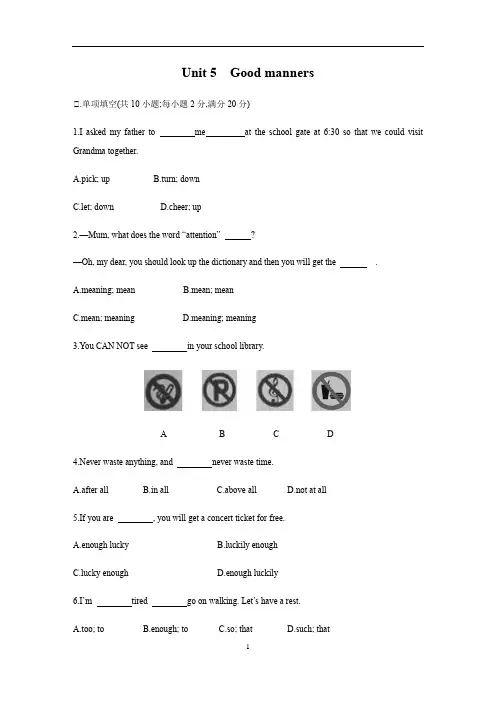
Unit 5Good mannersⅠ.单项填空(共10小题;每小题2分,满分20分)1.I asked my father to me at the school gate at 6:30 so that we could visit Grandma together.A.pick; upB.turn; downC.let; downD.cheer; up2.—Mum, what does the word “attention” ?—Oh, my dear, you should look up the dictionary and then you will get the .A.meaning; meanB.mean; meanC.mean; meaningD.meaning; meaning3.You CAN NOT see in your school library.A B C D4.Never waste anything, and never waste time.A.after allB.in allC.above allD.not at all5.If you are , you will get a concert ticket for free.A.enough luckyB.luckily enoughC.lucky enoughD.enough luckily6.I’m tired go on walking. Let’s have a rest.A.too; toB.enough; toC.so; thatD.such; that7.—Why doesn’t the surgeon stop lunch?—Because he is busy a dying patient in the operation room.A.to have; to saveB.having; to saveC.to have; savingD.having; saving8.The headmaster warns us the school rules, or we’ll be punished.A.to breakB.not to breakC.breakingD.don’t break9.They built a wall to soil being washed away.A.makeB.provideC.avoidD.advise10.—I have spent several nights preparing for the coming exam.—It’s bad for you to stay up too late. As the saying goes, “”A.You are never too old to learn.B.Actions speak louder than words.C.You can’t burn the candle at both ends.D.You can’t put all your eggs in one basket.Ⅰ.完形填空(共15小题;每小题2分,满分30分)“Today I will give you a special test,” said the English teacher with a smile on his face.All the students sat up straight and 11for the test to begin. The teacher began to 12 the test papers to all the students. 13he finished handing out the test papers, he asked them to begin.The students were very 14to see that there was not a question but a black dot(圆点) in the centre of the paper. The teacher 15the students’ surprise and said, “I want you to 16 down what you see there.”At the end of the class, the teacher took all the students’ answer sheets(答题纸) and read the answers. 17of them described the black dot. After reading all the answers, the teacher said, “Here everyone only paid attention to the black dot, 18no one wrote about the white paper.” The whole class listened 19, because they were afraid to fail in the exam.Then the teacher said, “Don’t worry about your 20for this test. I just want you to think about our life. The white paper is like our whole life and the black dot in the centre of the paper 21problems in our daily life.”Our life is a 22given to us by God(上帝), with love and care. 23, we just pay attention to the problems like illnesses and poverty(贫穷), and never see that these problems are very 24compared with everything else we have in our life.So we should try to take our eyes off our problems and 25each moment life gives us.11.A.searched B.looked C.voted D.waited12.A.email B.sell C.give D.donate13.A.After B.Before C.Until D.While14.A.happy B.surprised C.excited D.sad15.A.forgot B.remembered C.noticed D.hated16.A.talk B.write C.hear D.learn17.A.All B.None C.Some D.Many18.A.because B.although C.if D.but19.A.silently B.angrily C.happily D.quickly20.A.presents B.marks C.suggestions D.tasks21.A.helps B.finds C.represents D.solves22.A.problem B.gift C.moment D.door23.A.Still B.Also C.Besides D.Then24.A.serious B.big C.small D.important25.A.refuse B.stop C.waste D.enjoyⅠ.阅读理解(共5小题;每小题2分,满分10分)Few words are spoken more often every day on the streets of Britain than “I’m sorry”. This phrase has become such a common response (反应) that it has taken on a lot of meanings.Saying “Sorry” means to apologize(道歉). This is simple and easy to understand. We learn it both as a native speaker and as a student of foreign languages.But in Britain, it takes on another meaning. It is a cultural expression. Imagine this: a man walks down the street, looking down at his phone. A woman is walking in the opposite direction, towards the man. She sees him, but she can’t get out of the way in time. The man bumps(碰撞) into the woman. Who should say sorry? Naturally, the man should say sorry, because it was he who wasn’t looking where he was going. Yet in Britain, it is common for both to apologize.It is known that British people, like most people, do not enjoy conflict(冲突). So to quickly calm the situation, British people will apologize to each other.Other times it may sound funny to hear “sorry”. Some of my friends say it at restaurants, as they ask the waiter, “Sorry, but can I order another drink?” It is not to apologize, but just to express that we need the waiter. In Britain, sorry doesn’t always mean exactly what you think.26.According to the passage, “saying sorry” is a cultural expression in .A.the USAB.the UKC.the WWFD.the UN27.What does the underlined phrase “take on” mean in Paragraph 1?A.从事B.雇佣C.呈现D.拿起28.The example in the third paragraph is used to .A.describe a situation that people should avoidB.describe how “sorry” has another meaning in BritainC.explain why people should say sorry to each otherD.show how polite British people are29.The restaurant example shows that “sorry” can be used to .A.apologizeB.calm a situation downC.explain what you’re thinking aboutD.ask a waiter to bring something30.What might be a good title for the passage?A.“I’m Sorry” Is More Than just an ApologyB.Traditional British MannersC.How to Best Catch Others’ AttentionD.Finding a Way out of a Difficult SituationⅠ.用所给单词的适当形式填空(共5小题;每小题2分,满分10分)31.We’d better not leave rubbish (care) in order to protect the environment in the tourist attractions.32.Jim (call) you as soon as he gets to Beijing.33. Daniel was too nervous to express (he) clearly at that time.34. When you talk with an Englishman, you should avoid (ask) about his family.35. It’s very important to get to the heart of the (discuss).Ⅰ.根据汉语意思完成句子(共5小题;每小题2分,满分10分)36.戴维花了许多时间给我们解释这些交通规则。
牛津译林版八年级英语下册Unit5Goodmanners单元综合测试卷
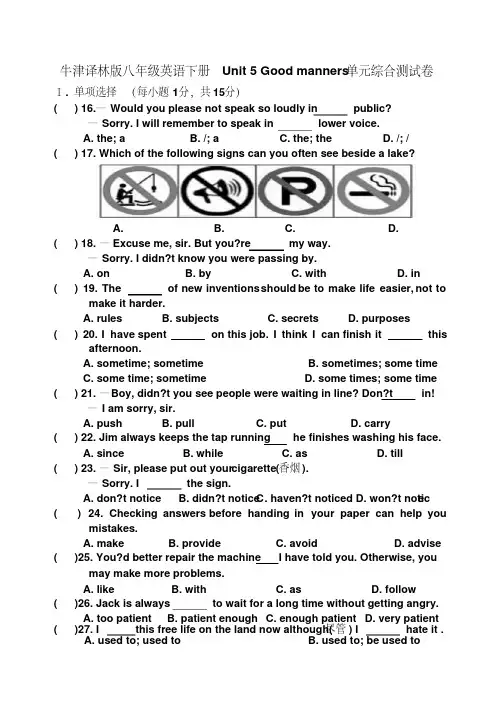
牛津译林版八年级英语下册Unit 5 Good manners单元综合测试卷Ⅰ. 单项选择(每小题1分,共15分)( ) 16.— Would you please not speak so loudly in public?— Sorry. I will remember to speak in lower voice.A. the; aB. /; aC. the; theD. /; /( ) 17. Which of the following signs can you often see beside a lake?A. B. C. D.( ) 18. —Excuse me, sir. But you?re my way.—Sorry. I didn?t know you were passing by.A. onB. byC. withD. in ( ) 19. The of new inventions should be to make life easier, not to make it harder.A. rulesB. subjectsC. secretsD. purposes( ) 20. I have spent on this job. I think I can finish it this afternoon.A. sometime; sometimeB. sometimes; some timeC. some time; sometimeD. some times; some time ( ) 21. —Boy, didn?t you see people were waiting in line? Don?t in!— I am sorry, sir.A. pushB. pullC. putD. carry( ) 22. Jim always keeps the tap running he finishes washing his face.A. sinceB. whileC. asD. till( ) 23. — Sir, please put out your cigarette (香烟).— Sorry. I the sign.eA. don?t noticeB. didn?t noticeC. haven?t noticedD. won?t notic ( ) 24. Checking answers before handing in your paper can help you mistakes.A. makeB. provideC. avoidD. advise ( )25. You?d better repair the machine I have told you. Otherwise, you may make more problems.A. likeB. withC. asD. follow ( )26. Jack is always to wait for a long time without getting angry.A. too patientB. patient enoughC. enough patientD. very patient ( )27. I this free life on the land now although(尽管) I hate it .A. used to; used toB. used to; be used toC. am used, be used toD. am used to, used to( )28. There are many flowers and trees on _____ sides of the Century Road.A. eachB. everyC. bothD. all( )29. — Do you think the question too hard?—I don?t think so. He can answer it easily.A. of Jim to answerB. of Jim to answer itC. for Jim to answerD. for Jim to answer it( )30. —Mrs Green. Do you think I can get an “A” in the final exam if I start working hard now?— Of course. .A. Better late than neverB. Many hands make light workC. You cannot burn the candle at both sidesD. Actions speak louder than wordsⅡ. 完形填空(每小题1分,共10分)Some people bring out the best in you in a way that you might never have fully realized on your own. My mom was one of those people.My father died when I was nine months old, making my mom a singlemother at the age of eighteen. While I was growing up, we lived a very 1life. We had little money, but my mom gave me a lot of love. Each night, she satme on her lap and spoke the words that would ___2____ my life, “Kemmons, you are certain to be a great man and you can do anything in life ifyou work hard enough to get it.”At fourteen, I was hit by a car and the doctors said I would never 3again. Every day, my mother spoke to me in her gentle, loving ____4___, tellingme that no matter what those doctors said, I could walk again if I didn?t wantto be bad enough. She drove that message ___5___deep i nto my heart that Ifinally believed her. A year later, I returned to school-walking on my own!When the Great Depression(大萧条)hit, my mom lost her job. Then I leftschool to support __6__ of us. At that moment, I decided never tobe____7_____again.Over the years, I experienced various(不同类别的)levels of business success. But the real turning point happened on a vacation I took with my wifeand five kids in 1916. I was unhappy with the second-class hotels for familiesand was ____8_____ that they charged(收费)an extra(额外的)$2 for eachchild. That was too 9 for most American families. I told my wife that Iwas going to open a hotel for families that would never charge extra for 10 .There were plenty of doubters at that time.Not 11 , mom was one of my strongest s upporters. She worked behind thedesk and even designed the room style. As in any business, we experienced a lot(扎根)in my heart, Iof hard time. But with my mother? s words deeply rooted12 doubted(怀疑)we would succeed. Fifteen years later, we had the largest13 system in the world - Holiday Inn . In 1979 my company had 1,759 inns(客栈)in more than fifty countries with an income of $1 billion a year.You may not have started out life in the best situations. But if you can find a14 in life worth working for and believe in yourself, 15 can stop you.( )1. A. quiet B. boring C. hard D. strange( )2. A. accept B. change C. disturb D. check( )3. A. study B. speak C. listen D. walk( )4. A. voice B. sound C. noise D. talk( )5. A. so B. such C. very D. quite( )6. A. all B. both C. every D. most( )7. A. excited B. brave C. patient D. poor( )8. A. sad B. happy C. tired D. angry( )9. A. expensive B. fantastic C. different D. special( )10. A. husband B. parents C. children D. wife( )11. A. successfully B. surprisingly C. interestingly D. importantly( )12. A. always B. sometimes C. almost D. never( )13. A. restaurant B. theatre C. library D. hotel( )14. A. task B. hotel C. company D. word( )15. A. nothing B. everything C. something D. anythingⅢ. 阅读理解(每小题1分,共10分)APerhaps you?ve s een the English letters “WC” in your city. They showpublic toilets. But do you know it is far from elegant(优雅的) English? In fact,foreigners from English-speaking countries rarely use the letters.Workers in our city are changing “WC” signs all over the city. The government is spending much money changing all the bad English on signs and restaurant menus. Many other places in China are following our steps.“WC, or water closet, is old-fashioned English. It sounds dirty to me,” says Charlie Shifflet, a young man from the US. The old sign will become“Gents/Men” and “Ladies/Women”.“I see lots of poor English in everyday life, and not only on signs,”“I know what they mean. But they are Chinglish, not real English. For example,when someone says to me ,My hometown is Henan Province?, I know he shouldsay: ,My hometown is in Henan Province?. ,Hometown? i s a smaller place in a province.” The common(通常的) mistakes i nclude “Not Entry”, which shouldshould be changed to “To thebe “No Entry”, “Direction(方向) of Airport” Airport”. And it is “room rate(房价)”, not “room price”. And remember torather than “Care of the green”.“Keep off the grass”,( )41. What does the writer think of the use of “WC”?A. He doesn?t think it means water closet.B. He doesn?t think it old-fashioned English.C. He doesn?t think it proper for a sign.D. He thinks it elegant English.( )42. The underlined word “rarely” means .A. sometimesB. seldomC. often D . always( )43. Charlie Shifflet .A. is a Chinese living in AmericaB. thinks Chinese people are sometimes using incorrect EnglishC. likes to hear or see ChinglishD. sometimes uses Chinglish( )44. Which of the following signs does NOT use Chinglish(中国式英语)?A. B.C. D.( )45. The last paragraph is about .A. why there are so many Chinglish signsB. examples of ChinglishC. where Chinglish signs areD. who uses Chinglish signsBPeople use their mouths for many things. In the English language, there aremany expressions using the word “mouth”. But some of them are not so nice.Sometimes, p eople say something to a friend or a family member. Laterthey regret because it hurts that person?s feelings. Or they tell the person something they didn?t mean(打算) to tell. The speaker might say: “I really put my foot in my mouth this time.” Sometimes w hen one person is speaking, he says the same thing that hisfriend is going to say. When this happens, the friend might say: “You too words right out of my m outh!” Sometimes a person has a bad or sad experiencewith another person. He might say that experience “left a bad taste in myfrightening (可怕的) experience, like mouth.” Or the person possibly has a veryhaving an angry dog running after him. He might say: “I had my heart in my Some people have lots of money because t hey were born into a very mouth.” silver spoon (银勺) inrich family. You might say the person “was born with ahis mouth”. He is the opposite of a person living from “hand to mouth”. person is very poor and only has enough money for the most important thingsin life, like food.( )46. The underlined word “regret” may mean .A. feel sorryB. feel excitedC. feel proudD. feel surprised( )47. When a man says “I had my heart in my mouth”, usually he means he was .A. excitedB. afraidC. surprisedD. happy( )48. Your best friend Tony has said what you are going to say, you might say: “!”A. You were born with a silver spoon in your mouthB. You really put my foot in my mouthC. You really left a bad taste in my mouthD. You took the words right out of my mouth( )49. Tom says he?s living from hand to mouth. He means he is living a life.A. busyB. hardC. easyD. rich( )50. Which of the following might be the best title for this passage?A. Different Uses of MouthB. People and Their MouthsC. Expressions about MouthD. The Importance of MouthⅣ. 填空(每小题1分,共15分)A. 根据所给汉语意思或者首字母提示,用合适的单词填空。
Unit5 Good manners单元检测卷(有答案) 牛津译林版英语八年级下册
牛津译林版八年级下册Unit5 Good manners单元检测一、单项选择。
1.-Have you ever seen _______film Ne Zha?-Yes, I have. It tells us _______different story of Ne Zha.A.a;anB.an; theC.a;theD.the;a2.Allen always behaves _______, so many people like him.A.easilyB.politelyC.friendlyD.lively3. Look at the “No parking” sign. You _______park your car here.A.shouldB.mustC.needn'tD.mustn't4:-Don't _______the waste paper. We can collect and recycle it.-You're right. Everyone should be a greener person.A.blow awayB.put awayC.throw awayD.fly away5.The engineers will keep _______the project with the manager of the company.A.discussB.discussedC.discussingD.to discuss6.She's not strong enough _______up mountains.A.to climbB.climbingC.climbD.climbed7.There is a big stone _______my way _______my way home yesterday.A.at;byB.in;byC.on;inD.in; on8.Livestreaming(直播)_______a new chance for traditional culture artists.A.practisesB.providesC.promisesD.protects9. You two live in the same community now. It's too hard _______you to avoid _______her.A.of;meetingB.for; to meetC.for; meetingD.of; to meet10.-I'm sorry I _______my exercise book at home this morning.-It doesn't matter. Don't forget _______it here this afternoon.A.left; to takeB.forgot; bringingC.left; to bringD.forgot; to bring11. Never put off _______tomorrow what you can do today.A.untilB.beforeC.whenD.as12.The sign with the words “_______” is often found in a hospital or a library.A.Keep quietB.No photosC.No parkingD.Stop13.-We shouldn't worry about Mary.-You are right.She is _______to look after _______A.old enough;herself B big enough;herselfC. enough old; herD.enough big; her14.-You have joined so many clubs.I'm afraid you'll be too tired. Remember, _______. -Thanks,Dad.I can look after myself very well.A. many hands make light workB.you can't burn the candle at both endsC. the early bird catches the wormD.practice makes perfect15.-Must I wear the school uniform on school days?- _______. It's one of the school rules.A. It's beautifulB.I don't think soC.I'm afraid soD.It fits you well二、完形填空。
牛津译林版英语八下Unit 5 Good manners检测题

Unit 5 Good manners检测题(时间:60分钟;满分:100分)一、听力部分(每小题1分,满分20分)第一部分听对话,回答问题本部分共有10个小题,每小题你将听到一段对话,每段对话读两遍。
在听每段对话前,你将有5秒钟的时间阅读题目;听完后,你仍有5秒钟的答题时间。
1. What’s Tom going to make?A. Fried rice.B. Dumplings.C. Hamburgers.2. When will the boy and the girl go hiking?A. On Friday.B. On Saturday.C. On Sunday.3. What does the woman want to buy?A. A volleyball.B. A birthday cake.C. A basketball.4. What did Alice do last night?A. She went to the movies.B. She watched TV.C. She did her homework.5. What does the man hope?A. The weather is fine.B. The weather is hot.C. The bus will come soon.6. What’s Alice’s hobby?A. Playing computer games.B. Playing the piano.C. Playing the guitar.7. What does Lucy’s mother do?A. A doctor.B. A nurse.C. A teacher.8. Where are the two speakers now?A. In a bookstore.B. In a clothing store.C. In a fruit store.9. What does the girl want to drink?A. Some water.B. Orange juice.C. Apple juice.10. What does the woman want to do?A. She wants to know the time.B. She wants to take a seat.C. She wants to buy a bag.第二部分听短文,回答问题你将听到两篇短文,各听两遍。
牛津译林版八年级下册第五单元Good manners综合测试卷(有答案)
一、根据句意和汉语提示,在空白处填入一个适当的单词。
1.Just when I was ready to leave the __________ (停车)place, another car crashed into mine.2.To _________ (避免)the heavy traffic,he goes to work early and drives home late.3.Do you know the saying "Practice makes _________ (完美的)"?4.There is ________ (垃圾)everywhere; you should do some cleaning.5.-Come on,Sandy.Everybody will be lucky or ________ (成功的)sometime in his life.-Thanks. I'll try again.6.The boy wants to choose one of his favourite __________ (话题)to talk about.7.The boy!s mother always uses a morning _________ (亲吻)to wake him up.8.Please make everything in its _________ (适当的)place.9.He lighted a _________ (蜡烛)and walked into the dark room.10.My mum was very _________ (亲密的)to Judy's. I heard they used to be classmates.11.The man has good manners, and he is waiting at the gate __________ (礼貌土也)。
牛津译林八年级下Unit 5 Good manners单元测试
八年级下Unit 5 Manners 检测一. 单项选择(每小题1分,共25分)( )1. Is the tent_______________________________for a family of three ?A. big enough; to loveB. enough big; to live in itC. big enough; to live inD. enough big; live in ( )2. There is a big stone______________my way_________________my way home yesterday.A. at; byB. in; byC. on; inD. in; on( )3. People won't realize the importance of health ____________________they lose it.A. ifB. sinceC. untilD. after( )4. I have spent ______________on this job. I think I can finish it ________________this afternoon.A. sometime; sometimeB. sometimes; some timeC. some time; sometimeD. some times; some time ( )5.-- Boy, didn’t you see people were waiti ng in line? Don’t____________ in! -- I am sorry, sir.A. pushB. pullC. putD. carry( )6. Tom's mother is too busy_____________ housework_______________him with his homework.A. doing; to helpB. to do; to helpC. doing; helpingD. to do; helping( )7. Jim always keeps the tap running ______________ he finishes washing his face.A. sinceB. whileC. asD. till( )8. --Be quiet please! Have you seen the sign "No Talking"? --Sorry, I ______________ it.A. didn't noticeB. haven't noticedC. won't noticeD. don't notice( )9. Checking your answers before handing in your paper can help you _________mistakes.A. makeB. provideC. avoidD. advise( )10.You’d better fi x the machine _____________I have told you, or you may make more problems.A. likeB. withC. asD. follow( )11. Jack is always _________________to wait for a long time without getting angry.A. too patientB. patient enoughC. enough patientD. very patient( )12. How many books can we borrow from the school library__________________?A. at timesB. at that timeC. at all timesD. at one time( )13.--Mum, can you give me some advice on how to behave myself at the table?--Well, I do have some advice. _____________, please keep quiet while eating.A. In allB. Of allC. At allD. Above all( )14.--Do you think the question too hard__________? --I don’t think so. He can answer it easily.A.of Jim to answerB. of Jim to answer itC. for Jim to answerD. for Jim to answer it ( )15. --A homeless man found a big diamond in the mountain. He became rich over night. --_________.A. Many hands make light workB. The early bird catches the wormC. Every dog has its dayD. Practice makes perfect.( )16 . Please check your paper to_________________ there are no mistakes before handing it in.A. think ofB. try outC. find outD. make sure( )17. Lisa is a little poor at Chinese. I think she needs___________________it every day.A. practice to speakB. to practice speakingC. practice speakingD. practicing to speak ( )18. --Remember to turn off the lights when you leave the room. --__________________.A. OK, I willB. No, I won'tC. It doesn't matterD. I know that( )19. --Tom, as well as his parents, ________to the USA, right? --Yes, they won't be back until next week.A. has beenB. have beenC. have goneD. has gone( )20. --Will you come to the party next Friday? -- ____________.I will be on holiday in Lijiang by then.A. I'm afraid notB. I hope soC. I think soD. I hope not( )21. British people don’t like to shout or laugh _____________________.A. aloudB. loudC. loudlyD. aloudly( )22. British people only _________ relatives or _________ friends _________ a kiss.A. great; close; byB. greet; close; withC. great; closed; byD. greet; closed; with ( )23. The bag is _________ heavy for me _________.A. so; to carryB. too; to carry itC. not enough; to carry itD. too; to carry ( )24. If we Chinese work hard together, China Dream will_____________________.A. come outB. come trueC. achieve D cone up( )25. British people are very polite at home ______________________.A. as well asB. as wellC. alsoD. either二. 单词拼写(共30 分)A.根据所给汉语提示,写出单词(每小题2分,共20分)1. As everyone knows, ________________________________(练习) makes perfect.2. If everyone_______________________________ (遵守)the traffic rules, there will be fewer accidents.3. Last month a group of _______________________(罗马人) visited the Great Wall in Beijing.4. The boy wants to choose one of his favourite ______________________(话题) to talk about.5. I had a face-to-face ____________________________________ (谈话)with my students that day.6. There was piles of________________________ (垃圾)on the streets. It smells terrible.7. Tom is my __________________________(亲密的) friend of all the boys.8. Simon lives in a big family. He doesn't know all his___________________________(亲戚) names.9. Sorry, I don't know how to_________________________ (表达)my feelings.10. The main_________________________(目的)of the activity is to raise money for children in poor areas.B. 用所给单词的正确形式填空(每空1分,共10分)Are you going to have dinner at your West ern friend’s home? Then be c _________(1)with your table manners. Good manners will make you a nice g ________(2). You may find Western table manners are d __________(3) from Chinese manners. Here is some good a _________(4) to keep you cool. When you are r __________(5) to eat, sit up straight on the chair. Usually, don’t put your elbows (胳膊肘) on the table. First p _________(6)your napkin (餐巾) up and put it on your lap. You can use it to clean your hands or mouth, but not your face. When you finish eating, put it b ___________(7)on the table. Don’t make any noise when you eat or drink the s oup. It’s not good t o speak when your mouth is f ________(8). If you do that, people will see the food in your mouth. If you want to get some food but you can’t r _________(9)it, ask others to pass the dish to you. Put bones on the edge of the plate. And remember, take bread with your h ____________(10), not with a fork.1. The party was very___________________________________. Everyone had a good time.2. The teacher was angry because Tom _________________________several times when she was speaking.3. Jack was walking along the street in a hurry when he ____________________________ a boy.4. The man warned his son _______________________________________the machine again.5. In public you should avoid _______________________________________ impolitely.6. It is good manners ___________________________________________________________.7. The girl has made her dream ___________________________________ after years of hard work.8. It’s ___________________________________________to shout or laugh loudly in public in the UK.9. Daniel was too excited ___________________________________________________ clearly.10. ________________________________________________________, we sat down, the play started.四、完成句子,根据所给的汉语完成句子(每空1分,共30分)1. The girl is _______________________________________________(很细心注意到) the small changes.2. The maths problem is ___________________________________________(对我来来说太难) to work out.3. Yesterday I met Mr Lee on the street ____________________________________(意外地).4. It’s bad manners ___________________________________________(到处扔垃圾).5. British people are very polite in public _________________________________________(还有) at home.6. Don’t ______________________________________(让水龙头的水一直流) when you brush your teeth.7. Different public signs can ___________________________________________.(使我们安全远离危险)8. The brave young man __________________________________(冒着失去生命的危险) to save the child.9. All the students ________________________________________(忙于准备) the coming exam these days.10. It's not polite __________________________________________________(打断别人说话).。
译林牛津版八年级下册Unit5单元测试卷及答案
译林牛津版八年级下册Unit5 Good manners单元测试卷一、听力(听力)(共20小题;共20分)一、听力部分(20分)Ⅰ.听句子,选出该句的最佳答语(5分)1. A. No, thanks. B. You are welcome. C. It doesn't matter.2. A. Yes, please. B. I'd love to. C. Here you are.3. A. Not at all.B. I hope you have a good visit.C. With my parents.4. A. It doesn't matter.B. Good idea.C. I'm glad that you like it.5. A. Since 2000. B. In 2000. C. Three years ago.Ⅱ.听对话和问题,选择正确的答案(5分)6. A. Shake hands. B. Bow. C. Kiss.7. A. Some flowers. B. A basketball. C. A box of chocolate.8. A. Table manners. B. Some sayings. C. Life.9. A. B. C.10. A. China. B. South Korea. C. Canada.Ⅲ.听语段、对话和问题,选择正确答案(5分)11. What is David doing?A. He is visiting Beijing.B. He is writing his experiences in Beijing.C. He is writing about Beijing.12. How long did David stay in Beijing?A. For a month.B. For a week.C. For two weeks.13. How many places of interest did David visit in Beijing?A. Two.B. Three.C. We don't know.14. Why did David make some mistakes in Beijing?A. Because of the different customs.B. Because of his carelessness.C. Because of the different languages.15. What did Lin Tao do when David made mistakes?A. Laughed at him.B. Helped him.C. Did nothing.Ⅳ.听短文填空(5分)In most Western restaurants and homes there are rules about how to talk and eat.Usually dinner is enjoyed with xvi. , and people are not allowed to talk about xvii. . For example, if someone wants to leave the table to use the toilet, he has to do it without mentioning what he is going to do.Meals are always xviii. . No eating noises are allowed. Therefore, people have to eat with their xix. . While xx. , coffee or wine, "slurping" is also not allowed.16.17.18.19.20.二、单项选择(共15小题;共15分)21. They arrived London a cold winter night.A. at; inB. in; onC. at; onD. in; at22. Oh, look at the ball it's to hold hundreds of people.A. tall enoughB. big enoughC. too tallD. too big23. She is not only a music lover, but she is a sports lover .A. tooB. eitherC. as wellD. also24. --- Excuse me. What did you say you would like to do, Miss White?--- I said I'd better go back to the office. I someone this afternoon.A. would meetB. metC. am going to meetD. was meeting25. I couldn't get through the door because there was a big box .A. by the wayB. on the wayC. out of the wayD. in the way26. Don't talk . Your grandmother is sleeping now.A. loudB. hardlyC. loudlyD. hard27. Tom, afraid of speaking in front of people. You are the best one.A. don'tB. notC. not beD. don't be28. I'd like to buy a big and modern house. , I hope it's in a quiet neighborhood.A. After allB. Above allC. As a resultD. At that moment29. He studies hard get good grades.A. in order toB. in order thatC. so thatD. whether30. Do you think your resolution is too difficult ?A. keep itB. to keep itC. to keepD. keep31. Parents encourage their children to take part in volunteer work. It will have a goodinfluence on them.A. shouldB. mustn'tC. mightD. can't32. Let's the school rules.A. don't breakB. not to breakC. not breakingD. not break33. It's impolite information directly when asking for help.A. askB. askingC. askedD. to ask34. We are going to the Great Wall this year.A. some timeB. some timesC. sometimeD. sometimes35. Parents always their children play football in the street.A. warn; not toB. say; toC. say; not toD. warn; to三、完形填空(共10小题;共15分)Numbers are part of our everyday life. After all, we live with numbers. From buildings to computers, 36 are used everywhere! People started to make lucky numbers long ago. And people also began to look for that unlucky number. Unluckily, 13 became that " 37 " number.It's said that Judas was the 13th person at the Last Supper. He betrayed Jesus (出卖耶稣). So now many people 38 it very bad to have 13 people around a dinner table. People believe that if 13 people have dinner 39 , one of them would die in the year. Many cities in the UK and the U.S.A. don't have a(n) 40 street or floor.People believe that Friday the 13th is very unlucky because it is an unlucky day 41 an unlucky number. 42 , not everyone is afraid of the number 13. A popular 43 called Taylor Swift draws "13" on her hand before every show. She 44 she was successful because of "13" in the last few years. She said, "I was born on the 13th. I turned 13 years old on Friday the 13th.45 first music CD went top in 13 weeks."So, there are no lucky or unlucky numbers. They might become lucky or unlucky only if we think of them as such.36. A. numbers B. signs C. reports D. tools37. A. silly B. dangerous C. safe D. interesting38. A. keep B. expect C. make D. consider39. A. lonely B. together C. forever D. quietly40. A. eleventh B. twelfth C. thirteenth D. fourteenth41. A. with B. behind C. through D. against42. A. Unluckily B. So C. However D. Also43. A. scientist B. nurse C. writer D. singer44. A. hoped B. thought C. feared D. advised45. A. Her B. His C. Your D. My四、阅读理解(共15小题;共30分)AAudrey is a Chinese-American student. She has found many value(价值观) differences between Chinese and Americans.About money1) Americans would like to spend more than they have, so many of them are always in debt(欠债). Chinese usually spend less than they have, so many of them always have money left in the bank.2) American kids love to make money by themselves. Chinese kids always ask their parents for money.3) American parents think it is not useful to send their children to an expensive university. Chinese parents would do anything to send their children to good universities and that might make them very poor sometimes.About school1) Many American girls take part in sports, dancing and singing groups while Chinese girls take part in academic groups.2) Some American students think that "B" is a gift while Chinese students think that "B" is terrible.American parents and Chinese parentsAmerican parents allow their daughters or sons to go out to have some part-time jobs in their free time or at the weekends. Chinese parents usually don't allow their children to do so in middle or high schools.46. What would a Chinese middle school student probably NOT do at the weekends according to the passage?A. Study at home.B. Do part-time jobs.C. Take part in sports groups.D. Do chores.47. Some Chinese people have money left in the bank because .A. they usually spend less than they have.B. they spend more than they have.C. they don't like spending money at all.D. they make a lot of money.48. Which of the following is NOT mentioned in the passage?A. Chinese parents usually give their kids money.B. American children love to make money by themselves.C. The reason why Chinese parents would do anything to send their children to good universities.D. Americans usually spend more money than they have.49. The underlined word "academic" probably means in Chinese.A. 学术的B. 娱乐的C. 运动的D. 休闲的50. The best title for the passage would probably be .A. Differences between Chinese and AmericansB. Chinese Students and American StudentsC. Chinese Parents and American ParentsD. Chinese Values and American ValuesBChristopher's mother now is sitting proudly and watching TV as Christopher is given the "Child of Courage" prize by his favorite TV star. This makes her remember the accident happened to them. Christopher was sitting in the car with his mother, father, sister Rosie, 10, and brother Mac, 7, when his father drove onto a metal barrier(障碍物). Unluckily, the car fell down from a hill into a deep river. Christopher, then 12, swam through a broken window and got out for the fresh air. Then he realized his brother and sister were still in the car.Christopher took a deep breath and swam back into the car. He saved Mac first, then he swam back to look for Rosie, who was under the cold, dark water, in the car. Christopher had to feel for her seatbelt because he couldn't see anything in the water. He took the seatbelt off her, and went up for air. Finally he went back to pull her out of the car.Christopher's mother and father were thrown out before the car rolled down the hill. When his mother came back to her life, she looked for her children hurriedly. She could see Mac on the bank, but she couldn't find the other ones. She was so worried. Then she saw Christopher come up out of the water like a dolphin with Rosie on his shoulder. She shouted excitedly to Christopher down to the river, "I'm so proud of you."The family called for an ambulance(救护车). It took Christopher's father who was badly hurt to a nearby hospital immediately.51. What is Christopher's mother watching on TV?A. Christopher is accepting a prize.B. Rosie is singing with a TV star.C. Mac is taking part in a TV show.D. Her husband is lying in hospital.52. What happened to Christopher's family?A. They got lost on their way to a wild park.B. Their car fell down from a hill into the river.C. A man broke into their car and drove it away.D. Their car broke down and caught a big fire.53. How do you feel about Christopher?A. Brave.B. Careful.C. Polite.D. Humorous.CIt can't be truer that when in Rome do as the Romans do. So it's necessary for you to know what you can talk about with the local people in other countries.In FranceYou'll find that conversations often turn into heated discussions. You'd better give opinions only on subjects that you are knowledgeable about. There is seldom a moment of silence, except when the topic under discussion has been finished, and nothing new has been introduced.Food, art, music and current events or history are welcome topics. The French believe in freedom, and you can criticize(批评) anyone, but not Napoleon, who stands for the French spirit. Moreover, never use the conversation opener "What do you do?"In AustraliaGenerally speaking, the Australians are excited about discussions. Many topics may be open to discussion, including religion and politics. The best way, however, is to wait for Australians to bring up these two subjects; be prepared to listen to what they are talking about.The Australians like to criticize themselves, but they can't stand being criticized by others. Don't talk big. Instead, the Australians prefer to judge(判断) your abilities through your actions. People who show off their education in conversation may be laughed at.In SwitzerlandThe Swiss may seem cold. Once you get close to them, however, you'll find that they are honest, responsible people, who will respect your interests much.They are good listeners and will remember almost everything you say to them. Sometimes they will even take notes while you speak. The Swiss are a very private people, so you should avoid asking personal questions. They can be rather serious, so it is advisable to avoid playing jokes on them.54. According to the passage, it's better not to criticize .A. the RomansB. the FrenchC. the AustraliansD. the Swiss55. What can we infer from the passage?A. The Swiss are not as cold as they seem to be.B. The French can't stand the heated discussions.C. The Australians like to talk about their success.D. The French usually have a conversation about jobs.56. The writer wants to tell us .A. what to introduce to foreignersB. how to live in foreign countriesC. how to get along with foreignersD. what to talk about in foreign countriesDTable manners are how to behave when you eat a meal. They include how to handle knives, forks and spoons and how to eat in a polite manner. To behave well abroad, you are to know some table manners.EATING MANNERSJapan: It is "perfectly" okay to slurp when you eat noodles. Unlike making big noises, slurping slightly is not rude. Japanese also say it tastes better if you slurp.Russia: Your wrists should be placed on the edge of the table while eating, fork in left hand, and knife in the right. It is not good manners to rest them on your lap. Keep your elbows off the table. Leave some food on your plate to show that the host has given you enough to eat.France: Never discuss money or religion over dinner. What is different from the manners in Russia is that finishing everything on your plate is considered good manners.Mexico: Whenever you catch the eye of someone who' s eating, even a stranger, it' s good manners to say "provecho", which means enjoy. In Mexico, dining is more than a meal. It's a social occasion—lunches are seldom quick and suppers can last for hours. Where you sit matters in the country. Before you get seated, look for place cards, or wait until the host seats you. And you must say "enjoy your meal" before you leave the table.DRINKING MANNERSAmerica: If you empty a bottle into someone's glass, it obliges that person to buy the next bottle. It's polite to put the last drops into your own glass.Australia: In a pub it' s usual to buy a round of drinks for everyone in your group. When it' s your turn, say "It's my round". When it's their round, they will buy it for you. Don't leave before you've bought a round.Japan: Don't fill your own glass of alcohol. Instead, you should pour for others and wait for them to do it for you.57. When you are at table in Mexico, you should .A. keep silent if you catch the eye of a strangerB. eat as quickly as you can to save your timeC. wish others happy with eating before leaving the tableD. seat yourself anywhere before the host tell you to58. According to the passage, it is good manners to .A. keep quiet when eating noodles in JapanB. leave some food on your plate in FranceC. put the fork in the right hand in RussiaD. take turns to treat each other in Australia59. Which of the following can be the best title of this passage?A. Eating MannersB. Drinking MannersC. Table MannersD. Country Manners60. The writer tells us the table manners in many countries in order to .A. attract us to these countries to enjoy foreign foodB. help us behave in a polite manner in different countriesC. teach us how to handle knives, forks and spoonsD. make us able to express thanks to different hosts五、单词拼写(根据中文提示拼写单词)(共10小题;共10分)61. I have done a lot of oral practice so that I can (表达) myself in English.62. Were you (成功的) in finding a new house in Australia?63. Some Westerners (避开) the number 13 because they believe it is unlucky.64. “Would you come here?” he asked very (礼貌地).65. We had a (讨论) about the differences between Britain and the US.66. Don't forget to stay in (接触;联系) with your friends.67. It will be a dangerous trip. Are you sure you want to take the (风险)?68. How many (客人) were there at his birthday party?69. Miss White asked me to (解释) how the machine worked.70. I want to have a (谈话) with you in English.六、单词拼写(单句首字母填空)(共5小题;共5分)71. No. 2 Middle School is a p school, not a private(私立的) one.72. People throw l into the river and make it really dirty.73. --- Why do you come here?--- The p of my coming here is to see you.74. It's i to point at others.75. I will have a birthday cake and c .七、翻译(根据中文提示完成句子)(共10小题;共20分)76. 他跑得不够快, 没能赶上公共汽车。
牛津译林版八年级下册 Unit5 Good manners 单元测试卷
8B Unit5 Good manners单元测试卷前进中学一、单项选择(每小题1分,满分10分)1. The second Sunday of May is _____ Mother's Day. It's _____ special day for children to show their love for their mothers.A. a;theB. the; aC. /;aD. /; the2. -He's already been back from Japan, ______? -______. He is on a visit to Shenzhen.A. isn't he; NoB. hasn't he; YesC. isn't he; YesD. hasn't he; No3. —Boy, didn’t you see people were waiting in line? Don’t______ in!—I am sorry, sir.A. pushB. pullC. putD. carry4. -Could you look after my pet dog for me while I am away? - _______.A. No, thanksB. It's my pleasureC. I'm sure you willD. With pleasure5. 一You've spelt the word wrong again, Judy.一Sorry. Maybe I am ______ used to the mistake to think of the right one.A. soB. veryC. quiteD. too6. Checking your answers before _______ in your paper can help you ______ mistakes.A. handing; makeB. hand; makingC. handing; avoidD. hand; avoiding7. Jack is ______funny_______ make us happy after class.A so; thatB too; toC / ; enough toD enough; to8. The room is ______ small for us ______.A. so; to live inB. too; to liveC. too; to live inD. so; to live9. Checking your answers before handing in your paper can help you _____ mistakes.A. avoidB. provideC. makeD. advise10. I have spent ______ on this job. I think I can finish it ______ this afternoon.A. some time; sometimeB. sometimes; some timeC. sometime; sometimesD. some times; some time二、完型(每小题1分,满分10分)Do you know a little boy named Ryan Wang? If not, let me introduce him to you. Ryan Wang is from Vancouver, Canada. He made a 1 for himself with his fantastic music talent. On The Ellen Show, his 2 skills made everyone surprised. And then the talented and cute boy 3 became very popular and famous. People started to 4 him piano genius (天才). The small pianist gave a performance at the famous Carnegie Hall in March, 2013. He was only five years old then. When Ellen asked how he 5 playing at Carnegie Hall, he said, “I just love it, because I love to perform in front of many people.”It’s hard to believe that Wang learned the piano 6 only 18 months. Wang’s mother said, “I was thinking he was 7 young to play the piano. He cannot even 8 the notes (音符). But he liked it. To my 9 , every time he practiced playing the piano, he almost forgot 10 and put his heart into it. In a short time, he remembered music pieces and played the piano very well.”Everyone has something different from others. Maybe you’re also Ryan Wang if you are hard-working enough and put your heart into it.1. A. promise B. success C. mistake D. pressure2. A. violin B. guitar C. piano D. drum3. A. quickly B. probably C. carefully D. seriously4. A. tell B. call C. ask D. laugh5. A. forgot B. finished C. kept D. enjoyed6. A. since B. for C. in D. after7. A. so B. as C. much D. too8. A. read B. see C. hear D. speak9. A. surprise B. opinion C. advice D. question10. A. something B. anything C. nothing D. everything三、阅读理解(每小题2分,满分20分)ABill finds a job on a farm. He is the strongest and youngest. He eats more, sleeps more, but works less. He doesn’t like to use his head, so he knows little. He has to do some unskilled (无需特殊技能的) work. He always says he’s tired and hopes to have a good rest. So he gets less money than others.Winter is coming. The workers are getting ready for the next year. Only Bill does nothing. The farmer tells him to cut down some trees in the forest. The young man has to go there with a chair. He feels lonely in the forest and is afraid of the animals. So he looks around and sings loudly. Nobody knows what he’s singing. After three days, Bill doesn’t cut down any trees. The farmer feels strange. He wants to find out how the young man is working there. To his angry, Bill is sitting on the chair, cutting the tree. “Why are you sitting here to cut the trees?” asks the farmer. “Because I can’t work if lying , sir.”1. Bill doesn’t like to use his head, so ________.A. he has little knowledgeB. he is young and strongC. he tries to be a farmerD. he finds a job on a farm2. Bill gets less money because ________.A. he sleeps moreB. he does some unskilled workC. he isn’t polite to the farmerD. he eats more3. Bill has to cut down the trees because ________.A. he can do nothing except itB. he likes to stay in the quiet forestC. he can’t get on well with othersD. he is very strong4. Bill is ________ to stay in the forest.A. gladB. angryC. safeD. afraid5. Bill hopes to ________.A. make the farmer happyB. get helpC. lie down in the forestD. cut down more treesBIn most cultures,when you meet people you know for the first time during a day,it is usual togreet them. Once a young woman from England went to Hong Kong to work. When she first arrived,she knew little about the Chinese culture of language. On her way to school one day,she went to a bank to get some money. To her surprise,the bank clerk asked her if she had had her lunch. She was surprised at such a question because in the British culture it would mean an invitation to lunch. Between unmarried young people it can also mean the young man's interest in dating (和...约会) the girl. Since this bank clerk was a stranger to the British woman,she was very puzzled,and quickly answered that she had eaten already. After this she went on to school and was even more surprised when one of the teachers asked her the same question.By now she understood that it could not be an invitation but was puzzled (困惑的) about why they asked it. In the following days, she was asked the same question again and again and she spent many hours trying to work out why so many people kept asking her this. At last she thought that these people must be concerned about(关心) her health. She was rather thin at the time,and she thought they must be worrying that she was not eating well!In fact, the question like that has no real meaning at all —it is only a greeting.6.According to the writer, when we meet a stranger, it is ______ to greet him or her.A. interestingB. commonC. importantD. generous7.From the passage, we can know that the writer know _______ about Chinese culture.A. a lotB. a littleC. littleD. much8.In China, a stranger will say “__________” when he meets you for the first time.A. How are you?B. How do you do?D. Nice to meet you? D. Have you had lunch?9.In the writer’s opinion, the Chinese greeting for the first time means “________”.A. popularB. meaningfulC. mannersD. invitation10.The writer’s main purpose in writing this passage is most probably to _________.A. show himself to be interested in Chinese greetingB. advise people to follow the Chinese greetingC. complain about (抱怨) the Chinese greetingsD. point out the differences of the greetings between the different cultures四、词汇检测(每小题1分,满分20分)A) 根据下列句子及所给汉语注释或通过上下文,写出空缺处各单词的正确形式。
牛津译林版英语八年级下册 Unit5 Good manners单元检测卷含答案
Test for Unit 5 of 8B一、单项填空(15%)( ) 1. I can’t remember when exactly the Robinsons left _______ city. I only remember it was _______ Sunday.A. the; aB. a; theC. a; aD. the; the( ) 2. —Mum, can I help you with the cleaning?—Thank you, dear. But you are _______ now. You must wait till you are _______.A. too young; too oldB. too young; enough oldC. so young; enough oldD. too young; old enough( ) 3. There aren’t many tickets left for the match. You’d better _______ that you get one today.A. make sure ofB. make a decisionC. make sureD. make plans( ) 4. Why not leave the door _______? I think the air in the room smells bad.A. openingB. openedC. openD. to open( ) 5. —What do you think of the show in this year’s Spring Gala?—I think it’s _______. But my father thinks it’s much too _______.A. wonderful enough; boredB. enough wonderful; boringC. wonderful enough; boringD. enough wonderful; bored( ) 6. We young people shouldn’t _______ think about the failure (失败) in the past. Instead, we should be _______ to face the future.A. usually; enough braveB. seldom; enough braveC. sometimes; brave enoughD. always; brave enough( ) 7. —Mum, I’ve got a new job in Beijing!—Really? It just sounds _______ to be true.A. so wellB. too goodC. good enoughD. too well( ) 8. She was too busy at that time _______ with me. I was unhappy about that.A. to talkingB. talkingC. talkedD. to talk( ) 9. —Your 12-year-old son doesn’t know much about shopping online, _______ he?—_______, but in fact, shopping online is popular with teenagers these days.A. does; NoB. does; YesC. doesn’t; NoD. doesn’t; Yes ( ) 10. You two live in the same community now. It’s too hard ________ you to avoid __________ her.A. of; meetingB. for; to meetC. for; meetingD. of; to meet ( ) 11. —How many tips did Jim offer on the talk about manners?—_______. He said _______.A. Nothing; nothingB. Nothing; noneC. None; nothingD. None; none ( ) 12. As we know, man’s understanding of nature is developing _______.A. at the right timeB. for the first timeC. from time to timeD. all the time( ) 13. —A homeless man won a big prize. He became rich over night. —_______.A. Better safe than sorryB. The early bird catches the wormC. Every dog has its dayD. Actions speak louder than words( ) 14. The little girl _______ the kite in the tree, but she was not tall enough to _______ it.A. reached for; reachB. reached for; reached outC. reached out; reached forD. reached; reached for( ) 15. —My classmates are playing on the playground. Can I join them, Miss Lin?—_______ Not until you have completed the Maths exercises.A. Why not?B. Will you?C. I hope so.D. I’m afraid not.二、完形填空(10% )On the evening of last Sunday while I was reviewing my lessons in my room, it suddenly began to rain. 1 as usual, I stopped to listen to the rhythm (韵律) of the rain. For many years, whenever it rains, I couldn’t 2 listening to it and thinking of the garden where I spent my childhood in my hometown.When I was a little girl, my family lived in a big house with a big garden in the countryside. The garden was full of flowers and 3 , with some bamboo in front of the wall. Whenever it rained, I 4 to sit in the front of the house, listening to the rhythm of the rain and watching the 5 raindrops.When small drops of rain fall from the heaven (天国) in a row, they became a curtain made up of pearls (珍珠); when the raindrops 6 the ground, a lot of small sprays (水花) will splash (溅出) and then 7 slowly.I have 8 been interested in watching such a scene. As the Indian poet wrote in his novel, “The raindrops kissed the earth and whispered. We are the homesick children, Mother; we come back to you from the heaven.”Listening to the rhythm of the rain, I feel peaceful in my heart. This feeling makes me think a lot about life. We are the 9 of the earth, and one day we will embrace (拥抱) our earth and stay with her forever (永远). Life is short and we should treasure it. Listening to the rhythm of the rain, I learn to understand the 10 of life.( ) 1. A. Surprised B. Sad C. Excited D. Angry( ) 2. A. stand B. stop C. like D. think( ) 3. A. leaves B. animals C. children D. trees( ) 4. A. happened B. wanted C. wished D. used( ) 5. A. falling B. singing C. dancing D. breaking( ) 6. A. see B. get C. reach D. cover( ) 7. A. come B. disappear (消失) C. cause D. rise( ) 8. A. always B. never C. sometimes D. seldom( ) 9. A. children B. owner C. friends D. master( )10. A. length B. meaning C. number D. quality三、阅读理解(20%)(A)I entered a university after years of hard study. I thought my life would be full of happiness and knowledge. But my life in the university is not as what I had expected. Then I became lazy and silent, even puzzled (困惑). I don’t know what my future would be like.Four years in the university is only a short period. And a half of it has passed already. This year, many people, such as my parents and my friends, asked me what I wanted to do and they all told me to make a plan for my life with their thought. I don’t want to take their advice. I want my own style. So I think carefully.I have been a young volunteer for five years. It has been a happy time and it is a big thing for me. Then I have a dream to join the University Student V olunteer Go West Program. I think I can bea teacher in the west. I would like to try my best to help them. I want to see the world clearly. To make it come true, I will work harder in the next two years. There is an old saying “Where there is a will, there is a way”. I think my dream will come true in the near future.At last, I want to say to everybody, “Never give up your dreams, no matter how big or small they are. The path to dream may not be smooth and wide. Even there are some difficulties you will face. But hold on to the end, you can find there is no greater happiness than making our dream come true.”( ) 1. What is the writer?A. A teacher.B. A doctor.C. A college student.D. A reporter. ( ) 2. Why is the writer puzzled?A. Because he is too young.B. Because he is lazy.C. Because he doesn’t know how his future will be.D. Because he is silent.( ) 3. The writer _______ what his friends advised.A. wants to do asB. doesn’t want to do asC. agrees toD. is happy with ( ) 4. The writer wants to be _______ after leaving university.A. a mangerB. a hostC. a famous personD. a teacher ( ) 5. What does this passage mainly tell us?A. Never give up your dreams.B. To listen to others often.C. To be happy when facing difficulties.D. To work harder when needed.A. To list the services offered by Association.B. To make an advertisement for theflats.C. To ask the residents to follow the rules.D. To tell people against possible dangers.( ) 7. According to the text, which of the following is done once a week?A. Rubbish collection.B. Drying the washing.C. Cleaning the main stairs.D. Changing the lights.( ) 8. People should dry their washing on the washing lines _______.A. at the car parkB. in the ground floor flatsC. in the hallwaysD. in the garden ( ) 9. The Association will talk with you if _______.A. lights are not workingB. you make too much noiseC. you let strange people inD. you park your car on the road( ) 10. We can learn from the text that _______.A. people should leave the broken chairs on the stairsB. the Association is always ready to help the residentsC. one can park the car at any numbered parking spaceD. the lights will be on whenever you pass the main stairs四、词形变化(5%)1. Thanks to the local businessmen’s support, the show was really _______________ (success).2. Would you just behave more _______________ (polite) in public places?3. She refused to join our _______________ (discuss) and finished her paper alone.4. I drove around the shopping centre for three times but I couldn’t find a _______________ (park) place.5. As the ________________ (say) goes,“Seeing is believing.”五、单词拼写(10%)1. The farmers were busy _______________ (摘) apples off the trees when we arrived there.2. People like to cut pumpkins into funny faces and put _______________ (蜡烛) inside.3. It’s hard for us to start a _______________ (谈话) when we meet some people for the first time.4. Amy and I always share secrets with each other since we are _______________ (亲密的) friends.5. I think I will go to Brazil for travelling ____________ (在某时) next spring.6. My mum had to take me to hospital last night because I couldn’t take the _______________ (疼痛) any more.7. They have talked about this _______________ (话题) for a few days but still they can’t draw a conclusion.8. He took the _______________ (客人) to the train station and saw them off.9. You should remember British people usually don’t greet people with a ________________ (亲吻).10. Why did he ______________ (冒险做) losing all his money to save this company?六、动词填空(10%)1. This cake ______________ (smell) great, but I have to lose weight.2. —Why didn’t you hear the doorbell?—Because I ______________ (explain) a math problem to my daughter.3. Everything seemed _______________ (happen) so fast before I realized the danger.4. The plate ____________ (drop) from her hands when someone walked past her.5. Why can’t you just understand? I _______________ (tell) you about it so many times!6. You can never think of the fun that we had ________________ (chat) with each other.7. Look! The whole class ________________ (listen) to the teacher carefully.8. People are wondering why the price of flats in big cities_______________ (rise) so fast in the past few months.9. Well, that’s another way I could think of ______________ (share) the same idea with them,10. I believe Tom, my best friend, _______________ (become) the School Best Singer again next year.七、任务型阅读(10%)Taboos (禁忌) of different people’s cultureA taboo (忌讳,禁忌) is a social action that is not allowed. Every culture in the world has its own taboos. The breaking of a taboo sometimes makes people feel uncomfortable. I learned this through my own experience.Last weekend, Wang Lin and I showed two foreigners (外国人) around our city. Mr Singh was from India and Mr. White from USA. When I held out my left hand to shake hands with him, Mr. Singh seemed to be unhappy. Mr. White, however, was quite casual (随意). He said hello to me with a big smile and a wave of his hand.In the evening, we stopped at a restaurant for dinner. I noticed that Mr. Singh didn’t tou ch the beef and Mr. White seemed not to like chickens’ claws (爪). During the meal, Wang Lin said sorry to Mr. Singh and continued to explain that we didn’t know it was a taboo in India to shake one’s left hand. Mr. Singh explained that since oxen (牛) are sacred (神圣的) in India, people don’t eat beef there. Mr. White joined in and said that it was not usual in the USA for people to eat chickens’ claws. He went on to say that Americans don’t usually get into each other’s personal (私人的) space.1. 他们要举办一场有关餐桌礼仪的讲座,真是足够友好。