
机电工程专业英语ppt
1
整体 概述
一 请在这里输入您的主要叙述内容
二
请在这里输入您的主要 叙述内容
三 请在这里输入您的主要叙述内容
2
● Lesson 11 Introduction to Heat Pipe Technology in Machining Process ● Lesson 12 Introduction to Material Forming ● Lesson 13 Material Forming Processes ● Lesson 14 Introduction to Mould ● Lesson 15 Mould Design and Manufacturing ● Lesson 16 Heat Treatment of Metal ● Lesson 17 Virtual Manufacturing ● Lesson 18 Fluid and Hydraulic System ● Lesson 19 Product Test and Quality Control ● Lesson 20 Introduction of Automobile Engine
7
Fig.1.1 Design Process Model
8
Recognition of Need Sometimes, design begins when a designer recognizes a need and decides to do something about it. The need is often not evident at all; recognition is usually triggered by a particular adverse circumstance or a set of random circumstances, which arise almost simultaneously. Identification of need usually consists of an undefined and vague problem statement.
5
Machinery Components The major part of a machine is the mechanical system. [3]And the mechanical system is decomposed into mechanisms, which can be further decomposed into mechanical components. In this sense, the mechanical components are the fundamental elements of machinery. On the whole, mechanical components can be classified as universal and special components. Bolts, gear, and chains are the typical examples of the universal components, which can be used extensively in different machines across various industrial sectors.
3
● Lesson 21 The Automobile Components ● Lesson 22 Mechatronics ● Lesson 23 Industrial Robots ● Lesson 24 An Army of Small Robots ● Lesson 25 Introduction to MEMS ● Lesson 26 Dialogue—At CIMT ● Lesson 27 Virtual Manufacturing
6
Mechanical Design Process Product design requires much research and development. Many concepts of an idea must be studied, tried, refined, and then either used or discarded. Although the content of each engineering problem is unique, the designers follow the similar process to solve the problems. The complete process is often outlined as in Fig.1.1.
4
● Lesson 1 oduction to Machinery Design
●1.1 Text [1]Machinery design is either to formulate an
engineering plan for the satisfaction of a specified need or to solve an engineering problem. It involves a range of disciplines in materials, mechanics, heat, flow, control, electronics and production.
CONTENTS
● Lesson 1 Introduction to Machinery Design ● Lesson 2 Mechanisms ● Lesson 3 Machine Parts (I) ● Lesson 4 Machine Parts (II) ● Lesson 5 Engineering Graphic in the Thirdangle Projection ● Lesson 6 Introduction to CAD/CAM/CAPP ● Lesson 7 A Discussion on Modern Design Optimization ● Lesson 8 Using Dynamic Simulation in the Development of Construction Machinery ● Lesson 9 Engineering Tolerance ● Lesson 10 Numerical Control
整体 概述
一 请在这里输入您的主要叙述内容
二
请在这里输入您的主要 叙述内容
三 请在这里输入您的主要叙述内容
2
● Lesson 11 Introduction to Heat Pipe Technology in Machining Process ● Lesson 12 Introduction to Material Forming ● Lesson 13 Material Forming Processes ● Lesson 14 Introduction to Mould ● Lesson 15 Mould Design and Manufacturing ● Lesson 16 Heat Treatment of Metal ● Lesson 17 Virtual Manufacturing ● Lesson 18 Fluid and Hydraulic System ● Lesson 19 Product Test and Quality Control ● Lesson 20 Introduction of Automobile Engine
7
Fig.1.1 Design Process Model
8
Recognition of Need Sometimes, design begins when a designer recognizes a need and decides to do something about it. The need is often not evident at all; recognition is usually triggered by a particular adverse circumstance or a set of random circumstances, which arise almost simultaneously. Identification of need usually consists of an undefined and vague problem statement.
5
Machinery Components The major part of a machine is the mechanical system. [3]And the mechanical system is decomposed into mechanisms, which can be further decomposed into mechanical components. In this sense, the mechanical components are the fundamental elements of machinery. On the whole, mechanical components can be classified as universal and special components. Bolts, gear, and chains are the typical examples of the universal components, which can be used extensively in different machines across various industrial sectors.
3
● Lesson 21 The Automobile Components ● Lesson 22 Mechatronics ● Lesson 23 Industrial Robots ● Lesson 24 An Army of Small Robots ● Lesson 25 Introduction to MEMS ● Lesson 26 Dialogue—At CIMT ● Lesson 27 Virtual Manufacturing
6
Mechanical Design Process Product design requires much research and development. Many concepts of an idea must be studied, tried, refined, and then either used or discarded. Although the content of each engineering problem is unique, the designers follow the similar process to solve the problems. The complete process is often outlined as in Fig.1.1.
4
● Lesson 1 oduction to Machinery Design
●1.1 Text [1]Machinery design is either to formulate an
engineering plan for the satisfaction of a specified need or to solve an engineering problem. It involves a range of disciplines in materials, mechanics, heat, flow, control, electronics and production.
CONTENTS
● Lesson 1 Introduction to Machinery Design ● Lesson 2 Mechanisms ● Lesson 3 Machine Parts (I) ● Lesson 4 Machine Parts (II) ● Lesson 5 Engineering Graphic in the Thirdangle Projection ● Lesson 6 Introduction to CAD/CAM/CAPP ● Lesson 7 A Discussion on Modern Design Optimization ● Lesson 8 Using Dynamic Simulation in the Development of Construction Machinery ● Lesson 9 Engineering Tolerance ● Lesson 10 Numerical Control
合集下载
机电专业英语课件Lesson 1

End
Topic
Above
汉
Next
Section II Text
Early in the 1950s, two important engineering discoveries changed th e image of the electronic-computer field. These discoveries were the mag netic core memory and Transistor-Circuit Element. These technical disco veries quickly found their way into new models of digital computers. In the 1960s, efforts to design and develop the fastest possible compu ter with the greatest capacity reached a turning point with the LARC mac hine. The LARC had a base memory of 98000 words and multiplied in 1 0 μs. The trend during the 1970s was, to some extent, moving away from ve ry powerful, single-purpose computers and toward a larger range of appli cations for cheaper computer systems. Most continuous-process manufac turing, such as petroleum refining and electrical-power distribution syste ms then used computers of smaller capability for controlling and regulati ng their jobs.
《机电专业英语》 教学课件课件 Unit 24 Flexible Manufacturing

A flexible manufacturing system (FMS) is a highly automated GT machine cell, consisting of a group of processing workstations (usually CNC machine tools), interconnected an automated material handling and storage system. The reason the FMS is a called flexible is that it is capable of processing a variety of different part styles simultaneously at the various workstations, and the mix of part styles and quantities of production can be adjusted in response to changing patterns demanded. The FMS is most suited for the mid-variety, midvolume production range.
1. Computer control. 2. Automated materials handling capability. 3. Tool handling capability.
Text & Translation
Flexible manufacturing was first introduced in the mid-1960s when the British firm Moils Ltd. developed its System 24. System 24 is a real FMS. However, it was doomed from the outset because automation, integration, and computer control technology had not yet been developed to the point where they could properly support the system. With the emergence of sophisticated computer control technology in the late 1970s and 1980s, flexible manufacturing became a viable concept. In the United States, manufacturers of automobiles, trucks, and tractors are the pioneers in adopting flexible manufacturing.
1. Computer control. 2. Automated materials handling capability. 3. Tool handling capability.
Text & Translation
Flexible manufacturing was first introduced in the mid-1960s when the British firm Moils Ltd. developed its System 24. System 24 is a real FMS. However, it was doomed from the outset because automation, integration, and computer control technology had not yet been developed to the point where they could properly support the system. With the emergence of sophisticated computer control technology in the late 1970s and 1980s, flexible manufacturing became a viable concept. In the United States, manufacturers of automobiles, trucks, and tractors are the pioneers in adopting flexible manufacturing.
Unit11FundamentalsofMaterialForming机电专业英语图文课件

Text & Translation
Group III—Separating. Machining or removal of material,that is,destroying cohesion.
Group IV—Joining. Uniting of individual workpieces to form filling subassemblies,filling and impregnating of workpieces,and so on,that is, increasing cohesion between several workpieces.
Text & Translation
2. Principles of Plastic Forming Plasticity theory is the foundation for the numerical
treatment of metal forming processes. Materials science and metallurgy can explain the origins of the plastic state of metallic bodies and its dependence on various parameters,such as process speed,prior history,temperature. The essentially older plasticity theory deals with the calculation of stresses,forces,and deformation.
阻止 substrate ['sʌbstreit] n. (=substratum) 底层,下层,(地)底土
机电工程英语课件
End
Topic
Above
汉
Next
Section II Text
The earliest PLCs expressed all decision making logic in simple ladder logic inspired from the electrical connection diagrams. The electricians were quite able to trace out circuit problems with schematic diagrams using ladder logic. This was chosen mainly to reduce the apprehension of the existing technicians. Today, the PLC has been proven very reliable, but the programmable computer still has a ways to go. With the IEC 661131-3 standard, it is now possible to program these devices using structured programming languages, and logic elementary operations. A graphical programming notation called Sequential Function 7 is available on certain programmable controllers. Charts
End Topic Above 汉 Next
Section II Text
《机电专业英语》 教学课件课件 Unit 15 Mechatronics
Text & Translation
Mechatronics is an integrated comprehensive study of intelligent and high performance electromechanical system (mechanisms and processes),intelligent and motion control through the use of advanced microprocessors and DSPs,power electronics and ICs,design and optimization,modeling and simulation,analysis and virtual prototyping,etc. Integrated multidisciplinary features are approaching quickly,and mechatronics,which integrates electrical, mechanical,and computer engineering areas(Fig.15.1).
New Words & Expressions
benchmark [′bentʃma:k] n. 基准,标准 entreaty [in′tri:ti] n. 恳求,请求 evolutionary [i:və′lu:ʃnəri] adj. 发展的,演化的 DSP (digital signal processing) 数字信号处理 IC (integrated circuit) 集成电路 consensus [kən′sensəs] n. 一致 augment [ɔ:g′ment] v. 增加,扩大 unify [′ju:nifai] v. 成为一体,统一 cornerstone [′kɔ:nəstəun] n. 基石,基础
机电专业英语ppt
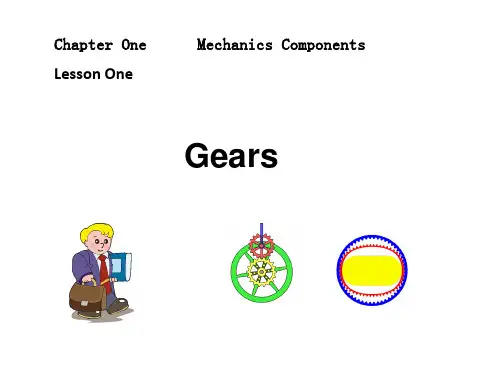
Helical gears can also be used to connect nonparallel, non-intersecting shafts at any angle to one another. Ninety degrees is the commonest angle at which such gears are used.
Chapter One Lesson One
Mechanics Components
Gears
Spur and helical gears.
A gear having tooth elements that are straight and parallel to its axis is known as a spur gear. A spur pair can be used to connect parallel shafts only. Parallel shafts, however, can also be connected by gears of another type, and a spur gear can be mated with a gear of a different type (Fig. 1-1).
The thrust problem can be overcome by cutting two sets of opposed helical teeth on the same blank. Depending on the method of manufacture, the gear may be of the continuous-tooth herringbone variety or a double-helical gear with a space between the two halves to permit the cutting tool to run out. Doublehelical gears are well suited for the efficient transmission of power at high speeds.
Chapter One Lesson One
Mechanics Components
Gears
Spur and helical gears.
A gear having tooth elements that are straight and parallel to its axis is known as a spur gear. A spur pair can be used to connect parallel shafts only. Parallel shafts, however, can also be connected by gears of another type, and a spur gear can be mated with a gear of a different type (Fig. 1-1).
The thrust problem can be overcome by cutting two sets of opposed helical teeth on the same blank. Depending on the method of manufacture, the gear may be of the continuous-tooth herringbone variety or a double-helical gear with a space between the two halves to permit the cutting tool to run out. Doublehelical gears are well suited for the efficient transmission of power at high speeds.
Unit-19-Hydraulic-Basic-Circuits-机电专业英语-图文课件
pneumatic [nju:'mæ tik] adj. 风动的, 气动的 decompression [͵di:kəm'preʃən] n. 降压, 减压, 释
放 regenerative [ri'dʒenəreitiv] adj. 再生的, 新生的 torque [tɔ:k] n. 转矩,力矩,扭矩 lubricator ['lu:brikeitə] n. 润滑剂, 加油器 modification [͵mɔdifi'keiʃən] n. 改装, 修订, 更改 customize ['kʌstəmaiz] v. 定制; 定做; 自定义 neutral ['nju:trəl] adj. 中立的, 中性的; 不确定的 n. 中
位 psi (pound per square inch) 气压单位(1 psi=6.89
kPa)
New Words & Expressions
cylinder ['silində] n. 气筒; 液压缸, 气缸 welder ['weldə] n. 焊工; 电焊机 parallel ['pærəlel] n. 平行, 平行线 solenoid ['səulinɔid] n. 螺线管 energize ['enədʒaiz] v. 给与…能量、电压, 使活跃 actuate ['æ ktjueit] v. 开动(机器), 驱动 compensate ['kɔmpenseit] v. 补偿, 赔偿 traverse ['trævə:s] v. 横越, 转动, 在轴上旋转 momentarily ['məumən͵terili] adv. 短暂地, 临时地 initiate [i'niʃieit] v. 开始; 创始
放 regenerative [ri'dʒenəreitiv] adj. 再生的, 新生的 torque [tɔ:k] n. 转矩,力矩,扭矩 lubricator ['lu:brikeitə] n. 润滑剂, 加油器 modification [͵mɔdifi'keiʃən] n. 改装, 修订, 更改 customize ['kʌstəmaiz] v. 定制; 定做; 自定义 neutral ['nju:trəl] adj. 中立的, 中性的; 不确定的 n. 中
位 psi (pound per square inch) 气压单位(1 psi=6.89
kPa)
New Words & Expressions
cylinder ['silində] n. 气筒; 液压缸, 气缸 welder ['weldə] n. 焊工; 电焊机 parallel ['pærəlel] n. 平行, 平行线 solenoid ['səulinɔid] n. 螺线管 energize ['enədʒaiz] v. 给与…能量、电压, 使活跃 actuate ['æ ktjueit] v. 开动(机器), 驱动 compensate ['kɔmpenseit] v. 补偿, 赔偿 traverse ['trævə:s] v. 横越, 转动, 在轴上旋转 momentarily ['məumən͵terili] adv. 短暂地, 临时地 initiate [i'niʃieit] v. 开始; 创始
机电工程英语课件
End
Topic
Above
汉
Next
Section II Text
• 1.Define craft process: • Carries on the craft analysis according to engineering drawing of the part, then designates the machine tool, the cutting tool and the clamp, confirms processing parameters such as craft route, working procedure and cutting depth and so on2. • 2. Calculate processing path size • According to the size of part drawing, the craft requirement and the programming convenience, we should determine a work-piece coordinate system and calculate the coordinate points of the cutting tool path in this coordinate system.
End Topic Above Next
Section I Words and Phrases
• work-piece coordinate system 工件坐标系 • dry run 空运行 • graph interactive automatic programming 图形交互式自 动编程 • processing parameter 工艺参数 • geometry modeling 几何造型 • post process 后处理
教学课件:《新核心高职行业英语——机电英语》
Part IV Task-driven Practice
Task Description The whole task is divided into three steps. Step 1 is about briefly introducing yourself, your unique strength and problems. Step 2 centers on talking about your major and related work skills and capabilities. Step 3 is to describe your future job you’re expecting and how to achieve it.
Part IV Task-driven Practice
Expressions used for giving a presentation. Read aloud and try to memorize & use some.
◆Getting people’s attention ① May I have your attention, please? ② Good morning/afternoon, everyone! I’m …from… ③ Ladies and gentlemen, attention please!
——Product Inspection & Certification
❖Unit 7 Have You Ever Heard of G-Marketing?
——Product Advertising & Marketing
❖Unit 8 How Do You Transport Your Goods?
Unit 1 机电专业英语 图文课件
Text & Translation
Mechanical design should be considered to be an opportunity to use innovative talents to envision a design of a product, to analyze the system and then make sound judgments on how the product is to be manufactured. It is important to understand the fundamentals of engineering rather than memorize mere facts and equations. There are no facts or equations which alone can be used to provide all the correct decisions required to produce a good design. On the other hand, any calculations made must be done with the utmost cle, if a decimal point is misplaced, an otherwise acceptable design may not function.
Text & Translation
People who perform the various functions of mechanical design are typically called designers, or design engineers. Mechanical design is basically a creative activity. However, in addition to being innovative, a design engineer must also have a solid background in the areas of mechanical drawing, kinematics, dynamics, materials engineering, strength of materials and manufacturing processes.