
高二外研版选修6 Module 1 Small Talk教案
Module 1 Small Talk Ⅰ. 模块教学目标Ⅱ.目标语言Ⅲ.教材分析与教材重组1. 教材分析本模块以Small Talk为话题,旨在通过教学,使学生对各种不同的闲聊话题、技巧、注意事项、社交方法、规则等加以了解并能够学会用small talk和别人进行交流。
学会使用非正式的日常用语;能正确运用“责任义务和无责任义务”的表达法;学会读、写电子邮件。
1.1 INTRODUCTION提供了四本权威词典对small talk的解释,让学生了解small talk的含义、small talk涉及的话题以及small talk 和serious talk的区别。
1.2 VOCABULARY AND READING是一篇介绍社交技巧的说明文。
文中介绍了交际活动中应注意的事项、社交技巧等。
1.3 FUNCTION 部分学习“责任义务和无责任义务”的表达法。
1.4 READING AND LISTENING部分要求学生朗读三段对话,选出对话发生的地点;根据对话内容回答问题;并通过听取对话录音回答问题、完成句子。
1.5 GRAMMAR学习并使用didn’t need to和needn’t have done结构。
1.6 READING AND WRITING 要求学生阅读并回复网友的电子邮件。
1.7 EVERYDAY ENGLISH 学习非正式交际用语中词汇的省略法。
1.8 SPEAKING 部分要求学生根据问题和提示,以small talk为话题展开小组活动并继续READING AND LISTENING中的对话。
1.9 CULTURAL CORNER部分介绍了英语国家“small talk”的一种较为成功的模式——AAA model.1.10 TASK部分要求学生在掌握small talk相关知识的基础上,收集课内外small talk中经常使用的表达并鼓励学生实现资源共享,编写一个供全班同学使用的小册子。
2. 教材重组2.1 将INTRODUCTION,EVERYDAY ENGLISH,SPEAKING部分整合为一节口语课。
2.2 将READING AND LISTENING和WORKBOOK中的Listening and speaking 部分整合为一节听力课。
2.3 将VOCABULARY AND READING和WORKBOOK中的V ocabulary部分整合为一节阅读课。
2.4 将CULTURAL CORNER, TASK与WORK-BOOK中的Reading部分整合为一节泛读课。
2.5 将FUNCTION,GRAMMAR和WORK-BOOK中的Grammar部分整合为一节语法课。
2.6 将READING AND WRITING 与WORKBOOK中的Speaking and writing部分整合为一节写作课。
3. 课型设计与课时分配1st Period Speaking2nd Period Listening3rd Period Reading4th Period Extensive Reading5th Period Grammar6th Period WritingⅣ.分课时教案The First Period SpeakingTeaching goals教学目标1. Target language目标语言a. 重点词汇和短语small talk, informal, conversation, unimportant, topic, leave outb. 交际用语(P8)Wonderful, aren’t they?Been here before?Language course?Staying long?Going anywhere nice?2. Ability goals能力目标Enable the students to know what small talk is and how to make small talk.3. Learning ability goals学能目标Help the students learn how to talk about small talk.Teaching important points教学重点Let the students learn to talk about small talk.Teaching difficult points教学难点How to make small talk.Teaching methods教学方法Cooperative learning and task’based activities.Teaching aids教具准备A computer and a projector.Teaching procedures & ways教学过程与方式Step I Lead-in and Warming UpT: Good morning/afternoon, everybody. Glad to meet you.Ss: Good morning/afternoon, Sir/Madam.T: Very glad to see you again. Welcome to continue you senior English study. After finishing the required courses, today we’ll begin the elective courses. But why choose the elective, can you tell me?S1: Yes. I’ve been good at English since the beginning. I feel interested in English. I’ve really learned a lot about both language and cultures. And I want to learn more.S2: Yes. I’ve decided to further my English study for future use. Though I’m not interested in it, I have to improve it. Because I prefer computer science and itis necessary for me to know more English.T: Great. Hope you all can make it. For further English study, you should workharder and try to practice more. By the way, do you find it interesting tocommunicate with others in English?S3: Yes. Very interesting. We can learn a lot from each other.T: Who do you often talk with?S3: I often talk with my deskmate. She speaks English very well. I enjoy talking with her.S4: Thank you. And I enjoy talking with you too.T: And what do you often talk about?S4: Usually about English study, math or physics problems, etc.S3: Sometimes clothes and sports.T: Do you find nervous when talking with your class-mates?S5: Of course not.T: Do you often make plans before your talking with someone?S6: No, never. We talk freely.S7: Sometimes just for fun....Step ⅡSpeakingTask 1: Talk about small talkT: Now here comes a question — Is the conversation between us serious?Ss: No.T: What kind of conversation do you think is serious then?S1: Conversations on politics.S2: Conversations on examinations, careers.T: We do often talk with each other every day. Well, what’s the difference? Do you think conversations can be classified as small or big, serious or free or anything else?S: It’s true that conversations are different in different occasions or events.T: Good. We do have different kinds of conversa-tions, formal or informal, serious or free, small or big, etc. Today we’ll talk about small talk. But what does small talk really mean? Now please read the explanations given in different famous English dictionaries on page 1. Answer the questions in Activity 1.S3: I think the definition given in the Longman Diction-ary sounds like a positive thing. Because it says small talk is polite friendly conversation about unimportant subjects.S4: The definitions given by Collins Cobuild English Language Dictionary and Oxford Advanced Learner’s Dictionary refer to places where small talk might take place: “at social occasions”and “usually at a social event”.S5: I think it is difficult for him to communicate and make friends with others. At the same time it shows that he lacks confidence.S6: I think it can be translated as “闲谈”or “聊天”.Task 2: Ask the students to answer the questions in Activity 2T: Now I think you have understood what small talk means. Small talk is a kind of informal conversa-tion about unimportant topics at social occasions. So it is not about serious subjects. Now let’s do Activity 2. In this Activity ten topics are given. Some of them are serious and some are suitable for small talk. Now prepare and then answer the following questions.S1: I think careers, examinations, politics are serious topics and the others can be small talk.T: That’s right. When people make small talk in different occasions, they can choose many topics including some of the given topics. In English-speaking countries people usually agree about the weather, so it is a safe topic for small talk. Sports news is a very common topic, too. Entertainment news, such as a celebrity who is in town, is another good topic. But personal affairs such as salaries or a recent divorce, religion or politics are not suitable topics for small talk in English. So when you are talking to a foreigner, you should choose proper topics. Or you may cause discomfort or embarrass-ment. Next question.S2: We often talk about film stars and sports stars because my friends and I are fond of seeing films and sports. For example, I like watching NBA games, especially games in which Yao Ming plays. After the games my friends and I will be together talking about the games and Yao’s performance.T: I also like NBA games and Yao Ming. He is considered to be a superstar. Thank you. OK. Next question?S3: You know my parents are very strict with me in my studies. So I cannot but talk about my studies and examinations with my parents. Even though I like music very much, I cannot talk about it with them. Every time I talk about music with them, they will scold me and tell me to spend time on my studies.T: I can understand you and your parents. But it is lucky that you can talk about it with your classmates or friends. You’ll soon have such a chance to talk about music. Till then, OK?S3: Thanks.T: Next question.S4: I am not good at English and I want to improve it and get good marks in English exams. But I don’t know what to do. So I want to talk about my English study with you.T: It is a big question. I can’t give you a perfect answer. But if you want to improve your English, first you must work hard at it and then try to find a good way that is suitable for you. For more details, we’ll talk about it later.S4: Thank you very much.T: You are welcome. The last question.S5: I never talk about politics. Because I don’t like it. In the news, the politicians often tell lies to the public for their own sake.S6: I never talk about cars. I don’t have a knowledge of cars. So I don’t know what to say when talking about it.T: It doesn’t matter. Everybody has his / her own interests, likes and dislikes. When we talk with others, try to find something in common.Task 3: DiscussionT: But do you know 80% of all conversations in English are small talk? Now let’s come to the Speaking part. Discuss the questions and give reasons for your answers in Activity 1.Sample answers:S1: Of course it is very important. Because small talk gets friendships started and ‘breaks the ice’ before important meetings and other events. I like collect ing stamps and I often go to the stamp market. If I want to pick up stamps or exchange stamps with others, small talk with other people seems necessary. I’ll try to get acquainted with them first and then make the deal. It makes things easier. What’s more, I have made a lot of friends from whom I can learn a lot about stamps. And I am a member of a stamp collecting society. So I think small talk is very important in my society.T: Stamp-collecting is a very rewarding hobby. And small talk seems beneficial to your hobby. Good. Next question.S2: I think it is as important as ‘real’ conversation. Sometimes small talk can lay a basic foundation for real conversation. When you show your concern, friendship, politeness in small talk, you can make good impressions on your listeners. And then you will get along well with them in the communication. So I think small talk is also important even though it is always about unimportant subjects.T: I agree. From what you have learnt in this module, would you say it was more or less important in English than in Chinese?S3: I think it is as important in English as in Chinese. As long as communication between each other exists, small talk is there. It is very important in daily life. However, every nation has its own customs and the standard of good manners, so when you are making small talk, especially in foreign countries, you should follow their customs and manners and try to find proper topics to talk about. Or you will cause some trouble.T: Excellent. This shows that there is much more to learn when we learn a language than just the vocabulary and the grammar of the language. We also have to learn the social behaviors in it.Step ⅢEveryday EnglishT: Now we know that small talk is informal conversa-tion with informal language. So we should use spoken English when making small talk. Most of the time the sentence is not complete as long as talkers can understand each other. Now please look at the sentences in EVERYDAY ENGLISH. Read and find the complete form of these sentences.Sample answers:Language course? (= Have you taken a language course? / Are you going to take a language course?)Staying long? (= Are you staying long?)Going anywhere nice? (= Are you going anywhere nice (for your holidays)?Lovely place. (= It is a lovely place. / What a lovely place it is.)Go there a lot. (= I go there a lot.)Never been there. (= I have never been there.)Step ⅣConversationT: From EVERYDAY ENGLISH we learned how to use the incomplete sentences in a conversation. Now, there’s a little time left. Let’s come to Activity 2 in SPEAKING. Please work in pairs and choose one of the short conversations in READING AND LISTENING Activity 1 to continue the small talk.Sample conversation 1:...A: But why not? I can’t understand.B: Because I was born and brought up in the plain. You know I have never seen mountains. I have only seen little hills. Every time I see high and thick mountains on TV or in films, I feel great and splendid.A: So interested in mountains?B: Yes. But not much. When I see mountains, I have a strong desire to get over.Do you know how I envy the mountaineers?A: But why?B: I think it can strengthen myself. If I reach the top of grand mountains, notonly will I get close to nature but also have a feeling of conquering. So wonderful, isn’t it? Maybe after many times of such experiences I will be able to manage life or work easily.A: I agree. But this is only in words. Take a try.B: I will if I have a chance.Sample conversation 2:…A: Now let’s get down to business.B: OK. For the goods that you will sell us, I would offer $60 per package.A: It is too low. If so, we will not be in pocket. I suggest $80. Please consider it.B: It’s impossible. This is not a fair deal.A: What about $75?B: No. $65.A: 70. It’s really a bargain.B: I can only give 68 at most. No more.A: That’s that.T: What a good negotiation. In the future maybe you will be successful businessmen. OK. Today we have learnt what small talk is and how to do small talk. And you must know the importance of small talk in communication. It can help us get along well with others.Step ⅤHomework1. Review what small talk is and try to find more information.2. Prepare a small talk English phrasebook for use.The Second Period ListeningTeaching goals 教学目标1. Target language目标语言a. 重点词汇和短语application, form, immigration, visa, impoliteb. 重点句子(P5)Pardon?Why not?2. Ability goals能力目标Enable the students to learn more about small talk.3. Learning ability goals学能目标Help the students to learn how to deal with language difficulties incommunication.Teaching important &difficult points教学重难点How to get some information useful from the listening materials.Teaching methods教学方法Listening and cooperative learning.Teaching aids教具准备A recorder.Teaching procedures & ways教学过程与方式Step ⅠRevision and Lead-inCheck the homework.T: We talked a lot about small talk. Now try to say some words about small talk.S: informal, unimportant, light, friendly, ordinary, etc.T: Have you prepared a phrasebook? What will you keep down in it? Today we’ll go on with the topic.Step ⅡListeningTask 1: Activities 1 and 2T: Now please open your books at page 5. Let’s come to READING AND LISTENING. Do Activities 1 and 2, please.Then check the answers.Sample answers to Activity 2:1. No. From the conversations, we know the speakers don’t know anything about the opposite side. In Conversation 1, they even couldn’t understand each other. In Conversation 2, they are employer and employee. In Conversation 3, the first speaker doesn’t know where the opposite side was born.2. Conversation 1 and Conversation3.3. I think the answers are too short. He should have given the reasons, not just the simple answers.Or: I think the answers are impolite. It is polite for people to give more information about themselves to employers.Task 2: ListeningAsk the students to read fast the questions to find out the listening points first, and then listen to the tape twice to answer the questions.T: Now, please listen carefully and pay much attention to the important points. You may make notes while listening.Then check the answers and explain some difficult listening points if necessary.Task 3: Listening and speaking in the WORKBOOKT: Please open your books at page 71. Now look at Activity 12. You are going to listen to a conversation between Hong, Marie and Peter, about their visits to the UK, USA and China. Listen and check the things they talk about for each country.Check the answers and explain some difficult listening points if necessary.Then go on with the next two activities.Step ⅢHomework1. Listen to the recording repeatedly and pay attention to the pronunciation.2. Prepare for the next period.The Third Period ReadingTeaching goals教学目标1. Target language目标语言a. 重点词汇和短语certain, confidently, embassy, excited, expect, favour, form, function, imagine, journey, lack, occasion, opinion, opportunity, positive, psychologist, reception, sentence, yawn, be nervous aboutb. 重点句子You needn’t worry about situations like these if you have good social skills. P2 Always remember ... you won’t impress people ... P32. Ability goals能力目标Enable the students to know more about social skills.3. Learning ability goals学能目标Help the students learn how to use the social skills in communication.Teaching important & difficult points教学重难点How to use the social skills in communication.Teaching methods教学方法Skimming and task-based activities.Teaching aids教具准备A recorder and a projector.Teaching procedures & ways教学过程与方式Step I Revision & Warming UpCheck the homework. Let the students say some-thing about small talk.Talk about the social skills with the students.T: As we know, as long as a person lives in society, he will communicate with others. If he wants to get along well with others, he must know something about social skills. Today we will learn an article about social skills. Before that let’s do Activity 1 on page 2.Then check the answers.Step ⅡReadingTask 1: SkimmingT: Now skim the passage and decide what kind of book it is from.S1: I think it is from a book which tells you what to do at social events. We can guess from the title “How Good Are Your Social Skills” and subtitles “Learn ho w to do small talk”, “Develop your listening skills” and “Learn the rules”.T: Good job. Before you read or buy a book, you should form a good habit of deciding whether it is worth reading or buying by reading the title and subtitles or preface. It is very important for you and can save you a lot of time and money.Task 2: ScanningT: Now please read the passage to get the general idea. While reading, divide thewhole passage into several parts and find out the main idea of each part.Sample answers:The general idea:S: This passage is about social skills. It tells us how to have a conversation and how to do small talk and when we go to a social occasion, we should pay attention to social rules in different countries.The main idea of each paragraph:Part 1(Paras. 1-2) Introduction to the body of the passage by asking questionsPart 2 (Para. 3) How to do small talkPart 3 (Paras. 4-6) Dos and don’ts while listeningPart 4 (Paras. 7-8) The social rulesTask 3: After-reading questionsT: Now we have known the general idea and the structure of the whole passage. Next read the passage again and answer the questions in Activity 3.Sample answers:1. Yes.2. Those who talk too much don’t give other people any chance of speaking. It shows that they are impolite. So usually people don’t like talking with those who talk too much.3. We should not look away from the person who’s talking to us.We should not change the subject that is being talked about.We should not finish other people’s sentences for them.4. It is polite and can encourage the other person.5. The quotation from Benjamin Disraeli tells us that one should find the subject that can interest the other and make it easy to go on with the conversation.Task 4: Comprehending questionsT: In order to understand the passage better, let’s answer more questions in Activity 5.Sample answers:1. No. Worrying about talking to people will make you feel unconfident.2. I could try to learn more about social rules of the country and find out dos and don’ts at a party. For example I must know what kind of gift I should take.3. For example, when a friend of my parents comes to my home for a visit, I will greet him / her by asking “How are you?” or “How do you do?”. Possibly I will tell him / her about my studies.4. I will enjoy the conversation by saying “对”,“是”,“啊”or “好的”or using body language, such as smiling, nodding, etc.5. The gestures such as nodding, smiling, applause, thumbs up are positive language.6. No. Every country has its own customs, culture and religion. So the people from different countries have different thinking ways. So it is impossible that social rules are completely the same in different countries.Task 5: DiscussionT: From the passage we have learnt something about social skills and some rules. To put them into practice, let’s have a discussion about the following situations in Activity 6 on page 4. Work in pairs please.Sample dialogues:1. S1: I think advance planning is very useful. I never paid attention to it before. That is, I didn’t do any advance planning before I went to a party. For example, I didn’t buy proper presents in advance. In a hurry, the present bought was sometimes unsuitable for the host. I seldom tried to know about other guests. Without advance preparations, sometimes I would get embarrassed.S2: I think listening skills are useful. Communica-tion is a two-way process. It is impolite to talk too much. If you want to continue the conversation smoothly, be a good listener. For example, when others are talking to you, you should show interest in the topic, from time to time ask for more information, always keep good eye contact, and use encouraging noises and gestures and so on.2. S3: I will go to university abroad after graduation. I will meet people from different countries. In order to contact with them very well, I must know about theircustoms and social rules. So at the beginning I will think of “safe”or low-risk topics to talk about. I believe soon I will make friends with them.S4: I think I should first choose a good topic or a low-risk opener. A good topic makes a good conversation.3. S5: I am good at keeping good eye contact with an attentive look. You know, eyes are windows of minds. From my eyes, the speaker knows that I am interested in what he is talking about. It is good manners, even in other countries.S6: I’m sorry to say that I am not good at what mentioned in the passage. I often look away from the person who is talking to me. I know it is a bad habit. I must get rid of it.4. S7: Sometimes I don’t know what proper topics to choose when I meet strangers. Most of the time I keep silent. The moment is a hard time to me. From this passage I know a little about how to do small talk. I believe later when I meet with the similar occasion, I can manage.S8: I should improve my social skills in many ways. For example, I used to talk about un-interesting things which made others feel embarrassed; for another, I used to sigh during the talk.5. S9: In everyday life, parents choose to talk about their children —their children’s life, studies, hobbies. Teachers get together to talk about their students —good or bad at some subjects or the results of examinations.S10: It is common that in China people like to know others’ ages, salaries while in the western countries it is bad manners to talk about these topics.Task 6: PracticeAsk the students to do Activity 4 in VOCABULARY on page 3 and Activities 4-5 in the WORKBOOK on pages 68 and 69. Then check the answers.Step ⅢSummaryT: Today we have learnt the passage about social skills which has much to do with our daily life. From the passage we know that social skills are very important when a person is in communication or having a conversation with others. We have also learnt some social rules and how to do small talk. It is necessary for us to learnsomething about social skills. As you know, we are now working hard to build a harmonious society. But how to construct a harmonious society if we don’t know how to behave in communicating with others. Especially, in 2008 the Olympic Games will be held in Beijing in our country. At that time how will we display our good manners to the whole world? So we must learn more about this inside or outside class.Step ⅣHomework1. Finish the rest of the exercises in VOCABULARY.2. Learn more about social skills.The Fourth Period Extensive ReadingTeaching goals教学目标1. Target language目标语言a. 重点词汇和短语visa, stare, sentence, polite, function, imagine, journey, opportunity, positive, psychologist, reception, circumstance, formula, prize, purpose, refund, get used to, in addition, social rulesb.重点句子(P9)By continuing with the AAA model, the conversation continues.You soon find you needn’t have worried and that you have made some new friends.2. Ablity goals能力目标Enable the students to learn about the AAA model and some more social rules.3. Learning ability goals学能目标Help the students learn how to make small talk using the AAA model.Teaching important & difficult points教学重难点How to make small talk using the AAA model.Teaching methods教学方法Task-based activities.Teaching aids教具准备A recorder, a projector and a computer.Teaching procedures & ways教学过程与方式Step ⅠRevision and Lead-inCheck the homework. Then talk about social rules.T: You have different sorts of relationships with different people that you know. You have different sorts of relationships with the people you live with, your family, your friends, workers and people you don’t know well. Then we have different social rules. This class we will read two passages about small talk and social rules in the UK from which we can learn more about social skills. Now please open your books at page 9. First look at the title “The AAA”. Without reading the pass age, can you guess the meaning? Or what do the three As stand for?Step ⅡReadingTask 1: Allow the students several minutes to read the passage fast. And then answer the following questionsShow the following.1. What does the AAA mean?2. How does the AAA model work?3. Is the AAA model a good idea while making small talk with someone you don’t know in China?Sample answers:1. AAA stands for answer, add and ask.2. When two strangers meet, they often use the AAA. From the example in the passage we know that the first person asks the second person a question, the second person answers. This is the first A (answer). Then the conversation begins. In order to show that he is interested in the conversation, the second person can add (the second A) something exact to the simple answer to the question. And then in order to continue their conversation, the second person can ask the partner the same question or quite another. This is the third A (ask). At first they may have difficulty, but they soon realize that the important thing is that they are saying something. By continuing with the AAA model, they continue the conversation to avoid an embarrassing silence. Maybe in the end they can find something they have in common. This is how theAAA model works.3. Of course. I think in whichever countries you are, people are eager to communicate with others. Most of the time a small talk is necessary. The AAA model is very useful in the conversation. There is no exception in China. When we meet someone we don’t know, we often start the conversation by asking a question, for example, where do you live? Or where is your hometown? In this way the conversation starts.Then ask the students to act out the conversation in the passage or make up their own.Task 2: ActSample dialogues:Dialogue 1:A: Do you live near here?B: Yes, I do. In an apartment on Brown Street. Do you live nearby too?A: No, I live in Bristol.B: I’m just visiting London.A: Have you ever lived here long?B: Not so long. I moved here three years ago. What’s the purpose of your visit to London?A: I’d like to know more about London.B: Why do you live in Bristol?A: I’m studying history there. Are you a student?B: Yes. And I know some people who are studying at Bristol. Do you know a girl called Helen Brown?A: Helen Brown!! Yes! She’s one of my best friends! How do you know her?B: She’s my cousin.A: What a coincidence.Dialogue 2:(Two students meet for the first time at the beginning of term.)A: Hello. What’s your name?B: Tom. In Class 2. Yours?A: John. That’s great. I’m in Class 2, too. Which school were you at last term?B: I was in No. 2 Junior High School. What about you?A: Wow! Really? Me, too. Which class?B: Class 7.A: So was my friend Mary. Do you know her?B: Sure. We were in the same class.A: Well, it’s getting late. I must leave. Nice to meet you. Bye-bye.B: Bye-bye.T: What a good situation! From your dialogues I know that you have learnt how to do small talk by using the AAA. Very good. Now let’s finish the Activities in TASK.Task 3: TaskAsk the students to work in small groups and prepare a small talk English phrasebook for use inside and outside the classroom.Activity 1:●asking the teacher for help and advice1. My I ask you a question?2. Excuse me, I have something unclear. May I ask you?3. I’ve no idea about what to do. Would you please give me some advice?4. What do you advise me to do next?5. May I have the honour to get some suggestions from you?●working in small groups1. Which topic should we talk about?2. Let’s talk about the first question, shall we?3. May I have your opinion?4. What about the first topic?5. We agree.6. You act as a servant, OK?7. I would like to begin the conversation with …。
高二外研版选修6Module1SmallTalk教案
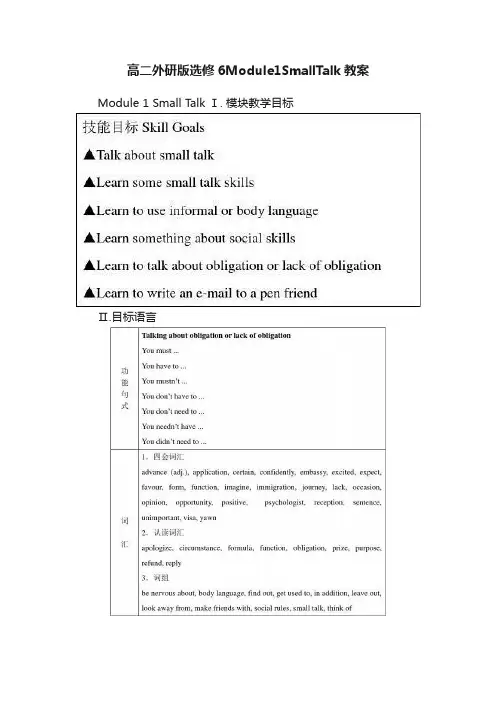
高二外研版选修6Module1SmallTalk教案Module 1 Small Talk Ⅰ. 模块教学目标Ⅱ.目标语言Ⅲ.教材分析与教材重组1. 教材分析本模块以Small Talk为话题,旨在通过教学,使学生对各种不同的闲聊话题、技巧、注意事项、社交方法、规则等加以了解并能够学会用small talk和别人进行交流。
学会使用非正式的日常用语;能正确运用“责任义务和无责任义务”的表达法;学会读、写电子邮件。
1.1 INTRODUCTION提供了四本权威词典对small talk的解释,让学生了解small talk的含义、small talk涉及的话题以及small talk 和serious talk的区别。
1.2 VOCABULARY AND READING是一篇介绍社交技巧的说明文。
文中介绍了交际活动中应注意的事项、社交技巧等。
1.3 FUNCTION 部分学习“责任义务和无责任义务”的表达法。
1.4 READING AND LISTENING部分要求学生朗读三段对话,选出对话发生的地点;根据对话内容回答问题;并通过听取对话录音回答问题、完成句子。
1.5 GRAMMAR学习并使用didn’t need to和needn’t have done结构。
1.6 READING AND WRITING 要求学生阅读并回复网友的电子邮件。
1.7 EVERYDAY ENGLISH 学习非正式交际用语中词汇的省略法。
1.8 SPEAKING 部分要求学生根据问题和提示,以small talk为话题展开小组活动并继续READING AND LISTENING中的对话。
1.9 CULTURAL CORNER部分介绍了英语国家“small talk”的一种较为成功的模式——AAA model.1.10 TASK部分要求学生在掌握small talk相关知识的基础上,收集课内外small talk中经常使用的表达并鼓励学生实现资源共享,编写一个供全班同学使用的小册子。
英语外研版选修6课时教案Module1SmallTalkTheFou.docx

Tlie Fourth Peiiod Extensive RendingTeaching goals 教学目标L Target language 目标语言a.重点词汇和短语visa, stare, sentence, polite, func tion, imagine, journey, opportunity, positive, psychologist, reception, circumstance, formula, prize, purpose, refund, get used to, in addition, social rulesb.重点句子(P9)By continuing with the AAA model, the conversation continues.You soon find you needn't have worried and that you have made some new friends-2.Ablity goals 能力目标Enable the students to learn about the AAA model and some more social rules.3.Learning ability goals 学能H 标Help the students learn how to make small talk using the AAA modelTeaching important & difficult points 教学重难点How to make small talk using the AAA model.Teaching methods 教学方法Task-based activities.Teaching aids教具准备A recorder, a projector and a computer.Teaching procedures & ways 教学过程与方式Step I Revision and Lead-inCheck the homework. Then talk about social rules.T: You have different sorts of relationships with different people that you know. You have different sorts of relationships with the people you live with, your family, your friends, workers and people you don^t know well. Then we have different social rules. This class we will read two passages about small talk and social rules in the UK from which we can learn more about social skills. Now please open your books at page 9. Firstlook at the title "The AAA'I Without reading the passage, can you guess the meaning? Or what do the three As stand for?Step II ReadingTask 1: Allow the students several minutes to read the passage fast. And then answer the following questionsShow the following.1.What does the AAA mean?2.How does the AAA model work?3.Is the AAA model a good idea while making small talk with someone you dorTt know in China?Sample answers:1.AAA stands for answer, add and ask.2.When two strangers meet, they often use the AAA. From the example in the passage we know that the first person asks the second person a question, the second person answers. This is the first A (answer). Then the conversation begins. In order to show that he is interested in the conversation, the second person can add (the second A) something exact to the simple answer to the question. And then in order to continue their conversation, the second person can ask the partner the same question or quite anothe匸This is the third A (ask). At first they may have difficulty, but they soon realize that the important thing is that they are saying something. By continuing w ith the AAA model, they continue the conversation to avoid an embarrassing silence. Maybe in the end they can find something they have in common. This is how the AAA model works.3.Of course. I think in whichever countries you are, people are eager to communicate with others. Most of the time a small talk is necessary. The AAA model is very useful in the conversation. There is no exception in China. When we meet someone we don^t know, we often start the conversation by asking a question, for example, where do you live? Or where is your hometown? In this way the conversation starts.Then ask the students to act out the conversation in the passage or make up their own.Task 2: ActSninple dialogues:Dialogue 1:A: Do you live near here?B: Ybs, I do. In an apartment on Brown Street. Do you live nearby too? A: No, I live in Bristol.B: Fm just visiting London.A: Have you ever lived here long?B: Not so long. I moved here three years ago. What/s the purpose of your visit to London?A: Fd like to know more about London.B: Why do you live in Bristol?A: Fm studying history there. Are you a student?B: Yes. And I know some people who are studying at Bristol. Do you know a girl called Helen Brown?A: Helen Brown!! Yes! She,s one of my best friends! How do you know her?B: She's my cousin.A: What a coincidence.Dialogue 2:(Two students meet for the first time at the beginning of term.)A: Hello. What,s your name?B: Tom. In Class 2. Yours?A: John. That5s great. Fm in Class 2, too. Which school were you at last term?B: I was in No. 2 Junior High School What about you?A: Wow! Really? Me, too. Which class?B: Class 7.A: So was my friend Mary. Do you know her?B: Sure. We were in the same class.A: Well, it's getting late. I must leave. Nice to meet you. Bye-bye.B: Bye-bye.T: What a good situation! From your dialogues I know that you have learnt how to do small talk by using the AAA・ Very good・ Now let^s finish the Activities in TASK.Task 3: TaskAsk the students to work in small groups and prepare a small talk English phrasebook for use inside and outside the classroom.Activity 1:•asking the teacher for help and advice1 • My I ask you a question?2.Excuse me, I have something unclea匸May I ask you?3.Fve no idea about what to do. Would you please give me some advice?4.What do you advise me to do next?5.May I have the honour to get some suggestions from you?•working in small groups1.Which topic should we talk about?2.Let's talk about the first question, shall we?3.May I have your opinion?4.What about the first topic?5.We agree.6.You act as a servant, OK?7.1would like to begin the conversation with •…•apologizing and explaining, for example, reasons for being late or not doing a task1 • Sorry, but my bike broke down on the way to school. So I was late..2.Terribly sorry to have kept you waiting for so long a time.3.1have to make an apology for my not having finished the task on time.4.Excuse me, but...5.1beg your pardon, but…Activity 2:•meeting an English-speaking forei gner in the street who needs help in finding his / her way1.Can I help you?2.Let me help you. Where do you want to go?3.Go down this street, at the second crossing turn right and you can see....4.The No.3 bus can take you there. / You can take the No. 3 bus to go there.5.It is about 20 km from here. You can take a taxi. There is no bus.6.Follow me. I can lead you to the place you want to go to.•meeting someone on a train or bus journey1 • How do you do?2.Where are you going?3.Glad to meet you.4.Fine, isn't it?5.It,s so crowded, isn^t it?•finding your way around a foreign city1.Excuse me. Whereas the nearest post office?2.Excuse me, can you tell me the way to the railway station?3.How can I get to...?4.1dorft know the way to...Activity 3:T: Maybe you have more useful expressions of everyday English. Share your work with each other and make a class book of useful expressions together after class. The book can be divided into several parts, for example, asking way, apologizing, greeting and etc. Add more of your ideas to the book whenever you find some.Step III Extensive ReadingTask 1: PairworkT: The AAA model is popular in English. And we know English people prefer to talk about weather when they meet. We may wonder about the question: why do they choose such a topic. Is it a low-risk opener or do they care more about weather? There are reallya lot more to learn. Next, we'll learn something new about the UK. Please turn to page 69 Activity 8. Look at the website homepage and the headings. Predict the advice that might be given in the passage How to Enjoy Your Visit to the UK.Ask the students to work in pairs and try to predict the advice for each part.Sample answers:SI: In the item of Food, I think the passage might tell us the table manners in the UK. For example, people should be quiet at table.S2: In Making conversations, we might know the way to make conversations. For example, how do people begin their dialogue? Or what should people choose to talk about in conversation ? And so on.S3: As for Greetings, I guess it might tell us how to greet someone in the UK. For example, when two people who don't know meet for the first time, what they will say.S4: Body language is very important when communica-ting. But, in different countries, body language is different. So I think it might teach us the typical ways in the UK. For example, Englishmen don't like to stand too close to each other when talking.S5: We have learnt something about advance planning for social events- So I think this part will tell us how to do advance planning or what kind of topics should be chosen. For example, when I visit a native family, I could buy a box of chocolate as a gift. Is it that?T: Now let's read the passage and match the headings in Activity 8 with the paragraphs.Then check the answers.Task 2: Reading comprehensionLet the students read aloud the passage again and then do Activities 10 and 11.Sample answers to Activity 11:1.If I am going to the UK. I need a visa. I have to go to the British Embassy, at least two months before the journey and fill in an application form. The staff may want me to interview me, which is quick and informal, so I will not be nervous.2.In the UK, many families only sit at the table together. Some families eat their meal while watching TV.3.It is polite. But people should try to avoid asking how old, how much money they earn and so on.4.People can talk about weather, family, home, job, hobby, garden, pet, history and study.5.1can take some photos of my family as a small gift.Task 3: PracticeT: Here's another passage about greetings and small talk. Please read it and do the exercises after it to choose the best answer for each question.Hand out the paper to the students and allow them several minutes to scan the passage and choose the best answers.Greetings and Small TalkIn most languages, a greeting is usually followed by “small talk” • Small talk means the little things we talk about at the start of a conversation. In English-speaking countries people often make small talk about the weather: “Nice day, isrTt it?” u Terrible weather, isrTt it?” But there is something special about small talk. It must be about something which both people have the same opinion about. The purpose of small talk is to let both people agree on something. This makes meeting people easier and more comfortable. People usually agree about the weather, so it is a safe topic for small talk. But people often disagree about religion or politics so these are not suitable topics for small talk in English. The topics for small talk also depend on where the conversation is tak ing place. At football matches, people make small talk about the game they are watching: u Great g ame, isn't it?” At bus stops, people may comment about the transport system: “The bus service is temble, isrft it?”Greetings and small talk are an important part of conversation in any language. The way people greet each other and the things they talk about, however, may be different from one language to another- This shows that there is much more to learn when we learn a language than just the vocabulary and the grammar of the language. We also have to learn the social behavior of the people who speak it.1.Small talk •A.is a kind of conversation with short wordsB.is a greeting when people meet each otherC.is to let people disagree about somethingD.is something we talk about to start a conversation2.The favorite topic of small talk in the UK is about ______ .A.the weatherB. politicsC. gamesD. languages3.The passage suggests that when we learn a language _____ •A.we should learn about the transport system of the countryB.we should only master the grammar and vocabularyC.we should know the culture about the countryD.we should know the importance of the language4.When we say u Great game, isn5t it? ”,we in fact _______ •A・ ask a question B. have a conversationC. greet each otherD. begin a small talk5.The passage mainly tells us that ______ •A.different language has different grammarB.Greeting and small talk are important parts in a conversationC・ When we learn a language, we must learn how to make small talk firstD・ In English-speaking countries we must talk about the weatherSample answers: 1-5 DACDBStep IV Summary and HomeworkT: That,s all for today. We have learnt in this period the AAA model when doing small talk in the first passage and some social rules in the UK in the second passage. Actually, we still have a lot to learn about social skills. And in life, there are always some people who dorf t have social skills at all. After class, please:1.Write a short passage explaining why some kids don,t have social skills.2.Review the passages again and try to keep down things you think are important.。
small talk教学设计
外研版选修6 Module 1 Small Talk教学设计一、Textbook analysis教材分析本节课是外研版选修6 Unit 1 Small Talk的Introduction与Reading部分。
这两部分介绍了Small Talk的定义和如何做好Small Talk的技巧。
通过本单元的学习,学生应了解英语中Small Talk的重要性以及如何做好Small Talk。
二、Teaching goals教学目标nguage goals知识目标1)Important words and phrases重点词汇和短语certain, confidently, embassy, excited, expect, favour, form, function, imagine, journey, lack, occasion, opinion, opportunity, positive, yawn, be nervous about 2)Important sentences重点句子You needn’t worry about situations like these if you have good social skills.Always remember… you won’t impress people…2.Ability goals技能目标Enable the studentys to know more about social skills.3.Emotion goals情感目标Help the students learn how to use the social skills in communication.三、Teaching important and difficult points教学重点与难点How to use the social skills in communication.四、Teaching methods教学方法Scanning, skimming, careful reading and task-based activities.五、Teaching aids教具A projector.六、Teaching procedures教学过程Step Ⅰ Lead-inT: Good morning, everyone!S: Good morning, teacher!T: Sit down, please! For this period, let’s look at the screen first.(Show a flash on the screen, in which two people are talking.)A: A nice day, isn’t it?B: Yes. The sun is bright, but not so hot.A: Mm. It’s quite a good day for outing. B ut I wonder if it will continue to the weekend.B: So do I. Weather changes so quickly.You see, it was raining yesterday.A: You said it. Oh, look! Here comes thebus!B: Yes, let’s get on.T: Now, let’s look at some questions on the screen.1.Where does the conversation take place?2.What’s the topic they talk about?3.Is the topic important or not important?4.Is the conversation serious or informal?Sample answers:1.At a bus stop.2.Weather.3.Not important.rmal and friendly.T: As for this kind of informal and friendly conversation about unimportant topics, we call it small talk.T: As we can see, the topic of small talk usually comes unimportant, but small talk itself is very important. It can help us to make it easy to develop new friendships, and can also “break the ice” before important meetings or other events.But not all people are good at doing small talk. It is difficult not only for English learners, but also for native speakers of English. Because making small talk means talking about everything, that means you should have a wide vocabulary in almost every topic. You may have good vocabulary in some topics, but as for some unfamiliar topics, your words will be limited. Therefore, some social skills for making small talk appear very important for us. So, in this period, we will learn some of the social skills.[设计说明]此部分一方面旨在引出Small Talk的定义,使学生明白什么是Small Talk;另一方面让学生明白Small Talk不仅是重要的,也是不容易做的,从而引出social skills在做Small Talk中的重要性,为本节课讲social skills打下铺垫。
高中英语Module 1 Small Talk (1)学案外研版选修6

高二年级第一学期英语学科教学案Book 6 Module1 Grammar过去分词专项练习Step1 自主学习过去分词两个显著的特点即:从时间上讲,表示动作已经完成;从语态上讲,表示被动的概念,但是如果是不及物动词用作过去分词形式,则只表示动作的完成,而没有被动意义。
如 fallen leaves 落叶 retired workers 退休工人。
过去分词主要起形容词或副词的作用,表示"被动、完成”的意义,在句中作状语、定语、补足语、表语等。
选择分词时,关键看分词与其逻辑主语的关系,若是其逻辑主语主动发出的动作,选用现在分词;若是被动动作,则选用过去分词。
过去分词用法总结如下:一、表语:1.The cup is broken. 2.The door remains locked.3.She looked disappointed.二、定语:要求学生必须掌握过去分词做定语的位置,告诉他们单个过去分词及由过去分词构成的复合形容词作定语时,通常置于被修饰词之前,但修饰代词时,需置于被修饰词之后,而过去分词短语作定语也要后置,即要放在被修饰词之后。
1. We needed much more qualified workers. ( 单个过去分词作定语)2. The girl dressed in white is my daughter. ( 过去分词短语作定语)3. Is there anything unsolved?There is nothing changed here since I left this town.(如果被修饰的词是由every/some/any/no+thing/body/one 所构成的复合代词或指示代词those 等时,即使是单个的过去分词作定语,也要放在被修饰词的后面)4. This is a state-owned factory.This is a newly built building.Advertising is a highly developed industry.(单个过去分词与名词或副词构成复合形容词时,放在其修饰的名词前作前置定语)三、宾语补足语:可以带过去分词作宾语补足语的动词有:1) see, hear, find ,feel, think等表示感觉和心理状态的动词He found his hometown greatly changed when he came back fromabroad.He once heard the song sung in German.Every thought the match lost.2) make, get, have, keep 等表示“致使”意义的动词:He’s going to have his hair cut.She had her foot injured in the fall.When you talk, you have to at least make yourself understood.Please keep us informed of the latest developments.( 请让我们了解最新的发展情况。
高中英语外研版高中选修6Module1SmallTalk-王成杰的公开课教案

Period 1 Vocabulary教学设计
by Wang Chengjie, Dongqi Bayi MiddleSchool
课题
B6M1Vocabulary
课型
词汇教学
主题语境
闲聊
教材分析
Analysis of Teaching Material
There are 86 new words and phrases in this module in total, more than any module the students have learned before. Of course, the students will find it very hard for them to learn . So we teachers should select different teaching materials according to the students’study levels instead of teaching all of them. Besides ,even in teaching the vocabulary , we‘ll do in different ways, for example, for some words,if the students know their meanings, that’s enough, while for some others, we should let them learn more, especially know how to use them.
核心素养聚焦:语言能力--感知注意
互动时间与模式:approximately 2 minutes; Individual work
高中英语 Module 1 Small Talk单元小结教学案 外研版选修6
1 Module 1 Small TalkSmall talk seems “small”, because it isgenerally thought to be informal and notserious . However, if you say the wrong thingon a certain occasion, you'll make both sidesawkward , for which you'll have to make anapology . As a consequence , it is necessary tobe aware of some basic social rules and do alittle advance planning.For example, if a friend who is not well off pays a visit to you, you can be hospitable to him, but never show off your riches during the conversation. Anyhow , you should be cautious about other people's feelings, even if he is an acquaintance .In addition , you should learn to be a good listener. While doing small talk, you shouldn't yawn, sigh , or look away from the person who is talking to you, trying to use positive body language .闲谈似乎是小事,因为人们一般认为闲谈不正式、不严肃。
外研版选修六module 1 small talk integrating skills 教案
Module 1 Small Talkintegrating skills教案●教学目标重点词汇的理解与语法的掌握。
●课标解读(1)熟记学案中所列出的单词和短语。
(2)通过学案中所给出的重点单词和重点短语的学习,让学生能够正确理解和使用这些单词和短语,能够运用这些词语造句。
(3)通过对语法的教学让学生能够理解并能够运用这些语法知识,能够区别运用didn't need to do和needn't have done。
●教学地位语法是学生感到比拟难以掌握的东西。
让学生正确理解和掌握语法知识是让学生学好英语的关键,所以应给学生创设一个语境,让学生理解该语法的应用,而不要让学生死记硬背语法条文,应从理解的根底上去运用这些语法。
●新课导入建议通过对学生作业的检查导入本堂新课。
●教学流程设计老师检查上堂课所布置的作业,检查学生对学案预习的情况。
⇒导入新课⇒让学生就“要点讲练〞(见学案第7页)进行讨论,让学生各自发表自己的见解,然后让各个讨论组派代表汇报各自讨论结果。
⇒让学生针对各自不同的意见展开讨论,然后老师给出详细正确答案。
⇒老师针对难点和重点词汇进行讲解,并补充学案中所遗漏的重点词汇,补充一些必要的练习。
自我评估(见学案第12页)。
⇐师生共同讨论“当堂双基达标〞并给出答案,并对难以理解的或有争议的地方给出详解。
⇐让学生完成“当堂双基达标〞(见学案第11页)。
⇐老师对语法局部给以点拨。
让学生掌握本单元语法知识。
⇐让学生讨论完成“语法精析〞局部(见学案第10页),并让各个讨论组发表各自见解。
布置作业。
让学生完成课本第6页1、2题和第7页3题,预习学案Period Ⅳ(见学案第12页)。
1.application n.申请,申请书;应用,运用So...you wrote in your application form that you're interested in mountains. (P5)所以……你在申请表中填写到你对山感兴趣。
高中英语 Module 1 Small Talk教案 外研版选修6
【课堂新坐标】(教师用书)2013-2014学年高中英语 Module 1 SmallTalk教案外研版选修6【美文阅读】无论在自己熟悉的场合还是在陌生的场合,和人闲聊是必不可少的一个交际方式。
那怎么样闲聊,闲聊的话题又该是什么,又仿佛是很多人感到棘手的问题。
本文就闲聊这个话题给了一些建议,我们一起看看吧!Making Small TalkThe ability to make small talk is highly valued. In fact, many English students are more interested in making effective small talk than knowing correct grammar structures. Small talk gets friendships started and “breaks the ice” before important business meetings and other events.Why is small talk difficult for some English learners?First of all, making small talk is not difficult only for English learners, but also for many native speakers of English. However, small talk can be especially difficult for some learners because making small talk means talking about almost anything and that means having a wide vocabulary that can cover most topics.How to improve small talk skills?Now that we understand the problem, the next step is to improve the situation. Here are some tips to improve small talk skills. Of course, making effective small talk means lots of practice, but keeping these tips in mind should improve overall conversational skills.·Do some researchSpend time on the Internet, reading magazines, or watching TV specials about the type of people you are going to meet. For example: If you are taking a class with students from other countries, take time after the first few days of class to do some research. They will appreciate your interest and your conversations will be much more interesting.·Use the Internet to gain specific vocabularyThis is related to doing research about other people. If you have a businessmeeting, or are meeting people who share a mon interest (a basketball team, a tour group interested in art,etc.), take advantage of the Internet to learn specific vocabulary. Almost all businesses and interest groups have glossaries(词汇表) on the Internet explaining the most important jargon(行话) related to their business or activity.·Find mon interestsOnce you have a subject that interests both of you, keep to it! You can do this in a number of ways: talking about travel, talking about the school or friend you have in mon, talking about the differences between your culture and the new culture.【诱思导学】1.In your opinion, what's small talk in China?________________________________________________________________________ 2.What topics do you often choose when you do small talk with others?________________________________________________________________________ 【答案】 1.Small talk means an informal conversation between friends, classmates, workmates, acquaintances and so on. 2.Sports, exams, food, fashion, weather, music, friendship, mood and so on.Period ⅠPreviewing(教师用书独具)●教学目标初步掌握本课文中的词汇,浅层次理解课文,了解相关的背景知识。
外研版选修六Module 1 Small Talk Reading How good are your social skills说课教案
Module 1 Small TalkReadingHow good are your social skills?教学设计本节课的内容是外研版(新标准)高中英语第六册Module 1 Small Talk中的第一篇课文:How good are your social skills? 接下来我将从教材、学情、教学方法和教学过程四个方面向大家介绍本节课的教学设计。
一、课标解读本节课响应素质教育的要求,主要采用了任务型语言教学模式,体现教师为主导,学生为主体的特点。
通过一系列任务的完成,提高学生用英语获取信息、处理信息、分析问题和解决问题的能力,特别注重提高学生用英语进行思维和表达的能力;同时,能根据话题要求与人交流、合作,共同完成任务;使用适当的语言形式进行描述和表达观点、态度和情感。
因此,在阅读教学中,教师应调整教学策略,利用阅读契机,提高学生整体英语水平和综合素养。
二、教材分析本节课的内容是高中教材选修六第一模块的Vocabulary and Reading 部分,本模块的话题是闲聊,教材通过对small talk的不同定义引出话题,然后通过设计不同交际情景来提高学生的社交技巧。
课文以不同方式呈现了词语和表达,训练学生学会运用文章提到的社交技巧组织会话。
本节课是模块的阅读课,文章脉络比较清晰,教师可在充分利用教材资源的基础上,结合学生的实际情况设计教学活动,引导学生通过阅读文章学会根据起始段落预测文章出处,帮助学生有效地掌握关键词汇,培养阅读技巧,学会使用文章中的技巧进行交流。
三、学情分析作为高二学生,经过几年的英语学习,已经具备了一定的词汇量和阅读理解能力,能够读懂本学段课标要求的文章。
但我们所面对的学生是普通生,总体英语水平不高,自主探究的能力也比较差。
在组织教学活动中,注意从简单的问题入手,逐步引导学生完成任务,使每个学生都能体验到成功的乐趣。
本节课话题与学生的日常生活关系比较紧密,学生可能会比较感兴趣。
高中英语Module 1 Small Talk学案外研版选修6
高二年级第一学期英语学科教学案BookⅤI Module 1 Small Talk-ReadingMade by LifengStep 1 学习目标1.理解课文。
2.掌握课文中的重要的单词,短语和句型/句式。
3.通过学习英语文化中的交际方式,了解不同国家的文化背景,提高跨文化理解能力。
Step 2难点突破How Good Are Your Social Skill?1. It helps if you do a little advance planning. 提前策划,会有帮助的。
句中do是及物动词,由它构成的短语动词还有: do one's assigned task 做指定的工作,do a series of business deals 做一连串的生意, did my duty at all times 随时随地履行义务,do a play on Broadway 在好莱坞制作一出戏,did Elizabeth I in the film 在影片中饰演伊丽莎白一世, doing the Southern voice装出南方人的腔,do any good,没有用,do equal justice to the opposing sides 给予反对人士公平的待遇,do honor to one's family 光耀门楣,do the best you can 尽最大的努力, do the bedrooms, did the dishes 洗碗, did her face 在脸部上妆, do a homework assignment 做家庭作业, do a mile in four minutes 以四分钟的时间走完一哩, do 15 countries of Western Europe in only a few days, 只花了几天的时间就参观了西欧十五个国家, do a relative out of an inheritance 骗取亲戚的遗产, do drugs,吸毒,2. Have some low-risk conversation openers ready. 准备一些低风险的开场白。