
人教版九年级英语Unit 5 教案
2. Ss try to made conversations using the information in 1b.
e.g. A:Your new shirt looks very nice. Is it made of cotton?
—Is this table made of wood?
—No, it isn’t. It’s made of glass.
—Is Butter made from meat?
—No. It’s made from milk.
II. Presentation
1.Show some pictures on the big screen. Try to learn the new words using “be made of” structure.
1) Where is the art and science fair?
_________________________
2) Do Nick and Marcus have to pay to go?
_________________________
3) What is the model plane made of?
What are these things usually made of? Match them with the materials. More than one answer is possible.
Check the answers with the Ss.
III. Listening
1.T: Tell Ss they will hear a conversation about some things and material. Listen and match the products with what they are made of and where they were made.
3. Play the recording again to check the answers.
Work on 2b:
1. Let Ss read the sentences below. Explain some main sentences for the Ss. Make sure they know what to do.
2. Let one student read the words in the box, Play the recording for the Ss to listen.
3. Ss try to listen and match the things with the material and here they were made.
e.g.
A: What did you see at the art and science fair?
B: I saw a model plane.
A: What is it made of?
B: It’s made of steel, glass, and plastic.
2. Let Ss make their own conversations.
—Yes,and it was made in Thailand.
What is the painting made from?
How is tea produced?
As far as I know,tea plants are grown on the sides of mountains.
People say that tea is good for both health and business!
Learn the new words: chopsticks, coin, fork, blouse, silver, glass, cotton, steel, grass, leaf
2. Ss discuss with their partner and try to learn the new words.
3. Practice their conversations in pairs.
VII. Role-play
1. Work on 2d
Read the conversation and complete the blanks.
1) Chinese _____________ tea both in the past and now.
2. Let Ss read the questions in 2b. Make sure they understand the meaning of each question.
Play the recording for the Ss to answer the questions. (If necessary, using the pause button.)
2.重点短语:be made of,be made in,be made from,as far as sb. know,be known for
3.重点句式:What are the shirts made of?
—This ring looks nice.Is it made of silver?
Cool.
7) What else does Susan show?
Ring.
8) Where was the ring made?
Thailand.
9) What will Susan do with the ring?
She give it to her friend.
IV. Pair work
_________________________
4) What is the painting made from?
__________________________
3. Play the recording again and mark true or false.
1) The art and science fair is just inside the science museum.
教学方法
小组交流学习法
教具准备
听力录音磁带
教
学
过
程
Ⅰ. Warming up
1. Present the sentence structure, using the pictures on the big screen:
—What’s the golden medal made of?
—It’s made of gold.
2) The fair is mainly about planes and paintings.
3) All the works at the fair were made by university students.
4) The model plane is very big.
5) The painting is made of wool and grass.
3. Give Ss five more minutes to remember the new words.
4. Work on 1a:
Let Ss read the things and materials in 1a. Discuss with their partners and match them with the materials. More than one answer is possible.
Cheap.
3) What are the shirts made of?
Cotton.
4) Where were they made?
America.
5) Where did Susan buy the chopsticks?
Korea.
6) How does Anita like the chopsticks?
二、过程与方法
进行听说练习,讲解本课的重点语法知识
三、情感态度与价值观
了解一些日常用品的制成材料,增加生活常识,养成良好的生活习惯;了解一些地方知名产品或传统艺术品的制作过程以及制作材料,培养学生的民族自豪感及爱国主义精神。
教学重难点
重点:
1.重点短语和句型
2.一般现在时态和一般过去时态的被动语态
难点:一般现在时态和一般过去时态的被动语态
4. Play the recording again. Let Ss answer the questions.
1) How much did Susan pay for the three shirts?
29 dollars.
2) What does Anita feel about the three shirts?
____ environmental protection
____ a model plane
____ a beautiful painting
____ grass and leaves
2. Play the recording for the Ss to listen and check the phrases.
B:No, it isn’t. It’s made of silk.
3. Let some pairs read out their conversations.
V. Listening
Pre-listening
fairadj.公平的;合理的;美丽的
fairn. an event at which people or
人教版九年级英语全册Unit5作文教学设计

在教学过程中,教师要关注学生的个体差异,因材施教,使每位学生都能在作文教学中获得成就感,提高英语综合素质。同时,教师要善于发现学生的优点,给予表扬和鼓励,激发学生的学习兴趣和自信心。通过本章节的教学,使学生在知识、技能、情感态度与价值观等方面得到全面提升。
ቤተ መጻሕፍቲ ባይዱ二、学情分析
九年级学生经过前两年的英语学习,已具备一定的词汇和语法基础,对英语作文的写作有了一定的了解和认识。但在实际写作过程中,仍存在以下问题:1.词汇量有限,难以表达丰富的思想;2.语法运用不够熟练,句子结构单一;3.缺乏逻辑思维能力,作文内容缺乏条理;4.部分学生对作文写作存在恐惧心理,缺乏自信。
2.提问学生:“Can you describe a person you admire? Why do you admire this person?”通过这个问题,让学生尝试用英语表达自己的想法,为新课的学习打下基础。
3.引导学生回顾已学的写作技巧,为新课的学习做好知识储备。
(二)讲授新知,500字
2.结合课堂所学,对同伴的作文进行互评。从词汇、语法、结构、内容等方面提出建议,促进相互学习,共同提高。
3.收集并整理有关人物的描写素材,如性格特点、外貌特征、兴趣爱好等,为下周的写作课做好准备。
4.自选一个话题,运用思维导图进行作文构思,并在课后完成一篇作文。要求运用本节课所学的写作技巧,提高作文质量。
2.各组选取一位代表进行汇报,分享本组的讨论成果。
3.鼓励学生相互提问、评论,激发思维碰撞,提高课堂氛围。
(四)课堂练习,500字
课堂练习环节旨在巩固所学知识,提高学生的写作能力。
1.布置一篇与本节课话题相关的作文,要求学生在规定时间内完成。
英语人教版九年级上册Unit5全单元教案
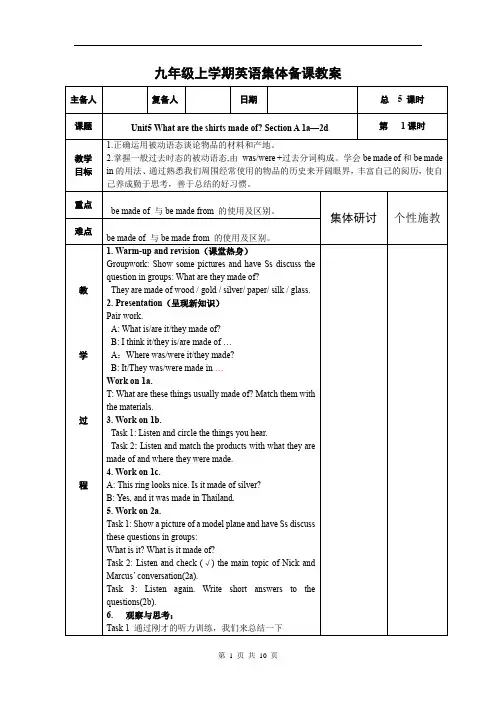
B: It/They was/were made in…
Work on 1a.
T: What are these things usually made of? Match them with the materials.
3.Work on 1b.
(2)Tea plants are grown on the sides of mountains......
10.小结。检测本课教学成果。
作
业
设
计
Homework:
介绍自己一样最感兴趣的物品,介绍制作者,何时制作的,有哪些材料做成,有何用途(be used for)等。
板
书
设
计
Section A1 (1a-2d)
Task 2:Listen and check (√) the main topic of Nick and Marcus’conversation(2a).
Task 3:Listen again. Write short answers to the questions(2b).
6.观察与思考:
Task1通过刚才的听力训练,我们来总结一下
Task2:Read the passage again and write what the words in bold refer to.
Task 3:仔细阅读文章,完成下列句子。
Kang Jian is a _____________ student from Shanghai.
People would buy a _______ in Japan, some beautiful ________ in France, or a ________ in Switzerland.
人教版九年级英语unit5作文教案
探索人教版九年级英语Unit 5作文教案的奥秘In the world of English education, the ninth-grade Unit 5 of the People's Education Press (PEP) textbook holds a pivotal position. This unit, rich in content and diverse in its approach, challenges students to delve into the depths of the language, while also encouraging them to express their thoughts and ideas creatively. The essay lessonwithin this unit presents a unique opportunity for students to flex their writing muscles and practice their compositional skills.The essay topic often revolves around a real-life scenario or a thought-provoking question, designed to spark the interest of the students and ignite their curiosity. The goal is not just to write a well-structured essay but also to instill in students the habit of critical thinking and independent analysis.Before diving into the essay writing, teachers often engage students in a brainstorming session, where they collect ideas and thoughts related to the topic. This activity helps students to organize their thoughts andidentify the main points they want to convey in their essays.The essay lesson typically begins with a carefulreading of the sample essay provided in the textbook. Teachers guide students through the essay, pointing out key features like the introduction, body paragraphs, and conclusion. They also discuss the language used, the choice of vocabulary, and the effectiveness of the sentence structure. This reading and discussion helps students to understand the basic structure and elements of a good essay. After the analysis of the sample essay, students are then given the opportunity to work on their own essays.They are encouraged to choose a topic that resonates with them and to express their opinions and ideas freely. Teachers provide guidance and feedback throughout thewriting process, helping students to shape their ideas into coherent and well-written essays.The revision and proofreading stage is also crucial. Students are taught to read their essays critically,looking for areas that need improvement. They are encouraged to revise their work, polishing the language,refining the ideas, and ensuring that their essays are free of grammatical errors and typos.The final step is the sharing and evaluation of the essays. Students are given the chance to read their essays aloud to the class, allowing their peers to provide feedback and suggestions. This sharing activity not only helps to build confidence but also encourages students to learn from each other's work.Throughout this entire process, teachers play a pivotal role. They act as guides, mentors, and critics, providing support and encouragement to students as they navigate the world of essay writing. They ensure that the students not only learn the mechanics of writing but also develop a passion for the subject and a love for the language.The essay lesson in Unit 5 of the PEP ninth-grade textbook is not just about writing an essay; it's about exploring ideas, developing critical thinking skills, and honing one's writing abilities. It's a journey that takes students deeper into the world of English, allowing them to express themselves freely and confidently.**人教版九年级英语Unit 5作文教案的深度探索**在英语教育领域中,人教版九年级英语Unit 5占据着举足轻重的地位。
Unit 5 第5课时 (Section B 2a-2e)(教学设计)-九年级英语全一册(人教版)
Read para.4 and finish the task
速读文章关键句子快速得到主旨大意。
设置每段大意匹配练习,加深对阅读文本的理解,以及进一步培养学生抓住关键信息的能力。
通过表格汇总有助于培养学生阅读能力,锻炼学生的思维能力。
效果评价
How:2a的读前活动让学生谈论中国传统文化艺术,2b活动要求学生先快速寻读(scanning),找到表格中的信息,即中文所提到的传统艺术形式和制作所需原料;2c活动指导学生关注文章细节,帮助他们加深对文章的理解;2d活动训练文章中出现的重要短语,特别是动词短语;2e活动是开放性的读后讨论。
教学
目标
2.Show some questions and letSspredicatethe answer according to the picture and title.
完成2a
Look at thepicture and title of this passage and make a prediction.
Unit5What are the shirts made of?第五课时教学设计)教材分析
What:此次授课内容为SectionB2a-2e的阅读板块,同时介绍中国最具特色的传统艺术孔明灯,剪纸和泥塑,包括他们的制作工艺,制作原料和象征意义等。
Why:通过语篇的综合性训练帮助学生,了解一些日常用品的制成材料,增加生活常识,养成良好的生活习惯;了解一些地方知名产品或传统艺术品的制作过程以及制作材料,培养学生的民族自豪感及爱国主义精神。
Exercises
(3minutes)
Ask Ss to finish the exercises on ppt.
人教版初中英语九年级全册unit5Whataretheshirtsmadeof优秀教学案例
(三)学生小组讨论
1.布置任务:分组讨论并完成一个关于环保的短剧,要求运用本节课所学知识。
2.学生分组,每组成员分工合作,共同完成任务。
3.引导学生围绕环保主题,运用所学语言知识进行角色扮演和对话练习。
4.给予学生必要的帮助和指导,确保他们能够顺利完成任务。
(四)反思与评价
1.组织学生进行课堂反思,引导学生总结所学知识和技能。
2.鼓励学生分享自己的学习心得和体会,培养他们的自我评价能力。
3.通过学生互评和教师评价,对学生的语言运用和合作能力进行综合评价。
4.关注学生的个体差异,给予不同水平的学生个性化的关注和指导,促进他们的全面发展。
四、教学内容与过程
(二)讲授新知
1.通过PPT展示一般现在时的被动语态结构,如“The shirts are made of cotton.”。
2.讲解一般疑问句及其回答,如“What are these shirts made of?”,“They are made of cotton.”。
3.举例说明衣物材质的多样性,如棉、丝、毛、合成纤维等,并引导学生进行实际操作,练习表达。
4.设计环保主题的短剧,让学生在角色扮演中运用所学知识,提高交际能力。
(二)问题导向
1.针对衣物材质和环保话题,设计一系列问题,引导学生进行思考和讨论。
2.通过提问,激发学生对环保问题的关注,培养学生独立思考和解决问题的能力。
3.引导学生从不同角度分析问题,如生产、消费和回收等,全面了解衣物材质对环境的影响。
针对本节课的内容,我设计了一系列实用的教学活动。首先,通过展示不同材质的衣物及其生产过程,让学生了解各种材料对环境的影响,从而引出本节课的主题。接着,采用任务型教学法,让学生分组讨论并完成一个关于环保的短剧,旨在培养他们的合作意识和创新精神。在课堂总结环节,组织学生进行反思,探讨如何在日常购物中践行环保理念,将学习成果运用到实际生活中。
人教版九年级英语全册Unit5Whataretheshirtsmadeof单元整体教学设计
3.听力:学生能够听懂并理解关于物品制作材料及环保话题的对话和短文,提高听力技巧和信息捕捉能力。
4.口语:学生能够就物品的制作材料进行交流,并能就环保话题展开讨论,提高口语表达能力和沟通技巧。
5.阅读与写作:学生能够阅读并理解关于物品制作及环保的文章,学会运用被动语态进行写作,提高阅读和写作能力。
3.引入一般现在时的被动语态,通过例句展示、讲解,让学生感知被动语态的结构,并学会在实际语境中运用。
4.教师选取一段关于物品制作材料的听力材料,引导学生边听边练习被动语态,提高听力理解能力。
(三)学生小组讨论
1.教师将学生分成小组,每组挑选一个物品,讨论并回答以下问题:“What is it made of? How is it made?”
2.语法方面:学生对一般现在时的被动语态掌握程度不一,部分学生可能在句子结构、时态运用上存在困难。
3.情感态度:学生对环保话题感兴趣,但可能缺乏实际生活中的实践经验,需要引导他们将所学知识运用到实际中。
4.学习策略:学生在合作学习、自主学习方面有待提高,需培养他们主动参与课堂、积极思考的习惯。
5.文化意识:学生对世界各国文化有一定了解,但需要进一步拓宽视野,增强跨文化交际能力。
4.观察日记:鼓励学生持续观察并记录一周内自己或家人在购物时选择环保材料的情况,如购买衣物、餐具等。要求学生思考并记录选择环保材料的原因和感受。
5.小组项目:小组合作设计一个环保宣传海报,内容包括环保口号、本节课学习的词汇和短语、被动语态的例句等。要求设计新颖,富有创意,能够吸引他人关注环保问题。
6.口语练习:学生与家长或朋友进行对话,讨论以下问题:“What is the most environmentally friendly material you know? Why?”并尝试使用一般现在时的被动语态进行回答。
人教版英语九年级全册Unit5 SectionA(Grammar Focus-4c)精品教案
Unit5 SectionA〔Grammar Focus-4c〕一、教学目标:1. 语言知识目标:1) 学习掌握以下词汇:boss, Germany, surface, material, traffic, postman, cap,glove2) 进展一步复习稳固学习Section A 局部所学的生词和词组。
3) 对询问物品的制作材料、生产地点、生产制作过程等语句进展归纳总结和探究学习。
4) 掌握被动语态的用法,并通过不同方式的练习,来熟练掌握被动语态。
2. 情感态度价值观目标:了解一些日常用品的制成材料,增加生活常识,养成良好的生活习惯;二、教学重难点1. 教学重点:1) 复习稳固Section A 局部所学的生词和词组,到达熟练运用的目标。
2) 被动语态的用法。
2. 教学难点:1) 探究学习询问物品的制作材料、生产地点、生产制作过程等句型。
2) 被动语态的用法。
三、教学过程Ⅰ. Warming- up and revision1. Have a dictation of the new words learned in the last class.2. Review some main phrases we learned in the last class. Check the homework. Ⅱ. Grammar Focus.1. 学生阅读Grammar Focus中的句子,然后做填空练习。
①你的衬衫是棉的吗?____ your shirts ____ ____ cotton?②是的,而且它们产于美国。
Yes. And they were _____ ___ the US.③飞机模型是由什么制成?______ the model plane ______ of ?④它是由旧木头和玻璃制成。
It’s made of _____ ______ and ______⑤茶产自中国哪里?_______ ____ tea ___________ in China?⑥茶产自很多不同的地区。
人教版九年级英语Unit 5 What are the shirts made of 全单元教案
Unit 5What are the shirts made of?Language Goal 【语言目标】Talk about what products are made of and where they weremadeKnowledge Goals 【知识目标】Key Words chopstick,coin,fork,blouse,silver,glass,cotton,steel,fair,grass,leaf(pl.leaves),produce,widely,process,product,France,local,avoid,handbag,mobile,everyday,boss,Germany,surface,material,traffic,postman,cap,glove,international,its,form,balloon,scissors,lively,heat,completeKey Phrases be known for,no matter,paper cuttingKey Sentences1.—Are your shirts made of cotton?—Yes,they are.And they were made in the US.2.—What's the model plane made of?—It's made of used wood and glass.3.—How is tea produced?—Tea plants are grown on the sides of mountains.When the leaves are ready,they are picked by hand and then aresent for processing.Key Grammar Learn to use the passive voice with present tense.Ability Goals 【能力目标】1.Develop listening,speaking,reading and writing skillsby using passive voice.2.Learn to talk about what things are made of and wherethey were made.Moral Goals 【情感目标】1.With the help of this unit's study,students can learn more about Chinese traditional culture and deepen the loveof our motherland.2.Know something about the world's manufacturing industry and see China's advantage and disadvantage in the world economic competition.Teaching Time【课时】Five periodsPeriod 1Section A(1a-2d)Period 2Section A(3a-4c)Period 3Section B(1a-1e)Period 4Section B(2a-2e)Period 5Section B(3a-3b) & Self Check本单元的话题是谈论日常生活用品是用什么材料制造的以及出产地是什么地方,要求学生学习并掌握一些日常生活用品的名称和制造的材料的基本词汇,同时在语言学习训练中接触并学习被动语态。
英语人教版九年级上册Unit5全单元教案
Read the sentences in Grammar Focus.Learn them by heart and translate the conversations with Ke Nan.
They are made ofwood / gold / silver/ paper/ silk/ glass.
2. Presentation(呈现新知识)
Pairwork.
A: What is/are it/they made of?
B: I think it/they is/are made of…
be made of和be made from都意为“由……做成”,be made of表示能看出来原材料,be made from则表示_____________.
练习:翻译句子
(1)桌子是由木头做成的。______________________________
(2)纸是由木头做成的。_________________________________
教
学
过
程
教
学
过
程
1. Warm-up and revision(课堂热身和复习)
(1)Pairwork两人一组讨论一下同学们的衣着服饰和学习用品。可以借鉴下面的对话:
A:What’s your pencil made of? B: It’s made of wood.
A: Where was it made? B: It was made in Shanghai.
二、熟练掌握被动语态用法,学会用被动语态表达自己喜欢的事物的认识和看法。
三、提倡学生使用国货,培养学生的爱国主义情怀。
人教版英语九年级全册-Unit 5 Section A 3a—3c教案
Unit 5What are the shirts made of?Section A 3a—3c一、教学目标1. 熟练掌握下列词汇和短语:product, France, local, avoid, handbag, mobile, everyday, no matter, avoid doing sth.2. 熟练掌握下掌握和运用下列句型:No matter what you may buy, you might think those products were made in those countries.He found it interesting that so many products in the local shops were made in China.He realized that Americans can hardly avoid buying products made in China.Kang Jian thinks it’s great that China is so good at making these everyday things.3. 读懂有关中国制造的产品的英文文章,并能够根据文段中的信息完成相应的阅读任务。
4. 能够谈论产品是由什么制造的以及它们在哪儿制造的。
5. 通过阅读有关在美国购物的文章,了解“中国制造”在世界的地位,增强民族自豪感。
二、教学重点及难点重点:1. 掌握本课时重点词汇、短语和句型表达。
2. 能够阅读有关“中国制造”的文章。
难点:能够运用一般现在时的被动语态谈论产品是由什么制造的以及它们在哪儿制造的。
三、教学准备教师:教学课件;多媒体设备学生:课前预习四、教学过程Step 1 Warming-upLook at some pictures and talk about the questions.【设计意图】利用图片来导入课堂,引出本节课中有关产品制造地的话题及学习相关词汇,为下文3a的阅读作好铺垫。