
译林版英语七年级下册教学教案Unit 7 Grammar
A. can: we are able to do sth now/ at present
could: we were able to do sth in the past
B. can/ could: sth is possible now/ at present
A: _______ brave he was! We should _________ from him.
B: I ______ with you. If you come across this kind of things.________ you be so brave likehim?
A: I think I _________ also do the same thing.
重点
To master the use of ‘can/ could’ and ‘may/ might’ correctly
难点
To identify and use the four modal verbs well enough
教学
准备
Multimedia;
教学设计详案
Teaching steps:
4. news, surprising, what, they, watching, are
5. strong, the, man, a, what, he, is!
6. weather, fine, what, it, is!
7.What beautiful flowers they are!
8. What an interesting book it is!
1. flowers, beautiful. how, are, the!
2. interesting, how, this, book, is!
3. nice, today, how, is!
4. news, surprising, how, the, is!
5. strong, the, man, how, is!
2. How wonderful!
What a wonderful program!
3. What a big fire!
How big the fire is!
4. What a brave young man!
How brave the young man is!
5. How dangerous the fire is!
课题
7B Unit 7 Abilities
Grammar
课时
1
课型
new
教
学
目
标
1.To recognize and understand how to use ‘can/ could’ to express ability/ possibility in the present and past
2.To recognize degrees of possibilities when using ‘may/ might’
9. What a nice day it is!
10. What surprising news they are watching!
11. What a strong man he is!
12. What fine weather it is!
II. Do the same things as the same way above.
12. How fine it is today!
Step 6 Practice
1. Talk about the pictures on page 85 Part C. Individuals give their answers.
1. What beautiful flowers!
How wonderful the flowers are!
Step 1 Revision
I. Revise the use of ‘can/ could’, get Ss to say sth about the two modal verbs.
II. Get Ss to talk about their own abilities at present and in the past.
6. today, fine, how it, is!
7.How beautiful the flowers are!
8.How interesting this book is!
9.How nice today is!
10. How surprising the news is!
11. How strong the man is!
I. Give Ss some words, get Ss to join them together.
1. flowers, beautiful,What, are, they!
2. interesting, what, an, book, is, it!
3. nice, a, day, what, today, is!
could: sth was possible in the past
C. can/ could: we can’t use them to talk about the chances that sth will certainly happen in the future.
Step 2 Practice
Ⅰ. PracticePart Al with the Ss together.
Ⅱ. Try to talk about the picturesindividually.(page83)
Ⅲ.HelpSs to find out they are great because they can do so many things in their daily life. Theyhave healthy bodies and minds. They can do so many things. So we should be grateful to ourparents for giving us so many things in the world.
2. Make more able Ss to give their own sentences in class.
Step 6 Production
Finish off the conversation in pairs.
A. Do you knoBiblioteka about Zhang Hua?
B: Yes, Of course. He helped his neighbour out of a fire.
B: _______ a brave boy you will be! We should try our best ______ others.
Step 7 Homework
1. Go over Integrated skills after class.
2. Make up some sentences using the simple future tense as written work.
A. What + a/ an + adj + sb/ sth(单数) +(S + V)!
What + + adj + sb/ sth(复数) +(S + V)!
What + + adj + sb/ sth(不可数名词) +(S + V)!
B. How + adj/ adv (+ S+ V)!
Step 5 Practice
2. It will be warm tomorrow so we________ wear short sleeves.
3. I _______ play games on my old computer, but the new one is much faster.
4. I forgot my key. I ________ open the door.
Ⅳ.Ss practice page 84 Part B individually.
Step 3 Production
Ss finish off the sentences using the modal verbs.
1. School finishes at 4 p.m. The bus leaves at 4:10 p.m. We _______ take the bus.
Step 4 Presentation
1. Arouse Ss’ interest in how to praise Zhang Hua with strong feelings in Chinese or English.
2. Lead into the new item: to use the Imperative Sentences to express strong feelings. Sum up Ss’ answers on the Bb.
作业设计
Do the workbook.
教学反思
Unit 7 Grammar 课时教案牛津译林版七年级英语下册
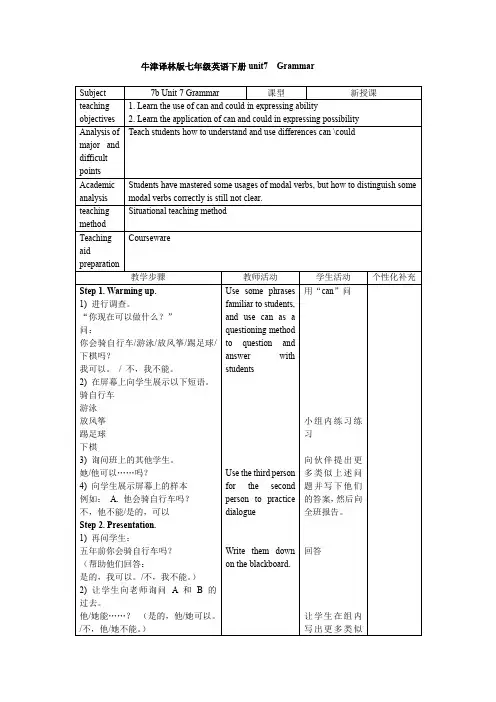
小组内练习练习
向伙伴提出更多类似上述问题并写下他们的答案,然后向全班报告。
回答
让学生在组内写出更多类似的句子
总结can与could的区别
报告自己自由谈论表格。成对。
理解
举例说明
回答这些句子并制作更多
完成单选练习
猜测
总结
Job design
Supplementary exercises
Synchronous Guidance
例如。桑迪现在可以划船了吗?
他去年能做到吗?
3)完成A2部分的对话。
5)说明:
我们可以使用am (is , are)能够替换can并且was (were)能够替换can。
eg.①麦克会唱20多首英文歌曲。
迈克能够……
②她四岁时会说英语。
她能够……
Step 4.ask
1)问学生
我可以借你的钢笔用下吗?
typography design
He can’t / cannot swim.…
Shecould ride a bike five years ago.
He couldn’t swim five years ago.
Can I borrow your pen ?
Can I open the window ?
Use some phrases familiar to students, and use can as a questioning method to question and answer with students
Use the third person for the second person to practice dialogue
牛津译林版七年级英语下册Unit7AbilitiesPeriod4Grammar教学设计

1.创设情境,引导学生通过观察、模仿、实践等方式,掌握语法知识。
2.利用多媒体教学资源,如图片、视频等,激发学生的学习兴趣,提高学习效果。
3.采用任务型教学法,设计丰富多样的课堂活动,如小组讨论、角色扮演、语法填空等,让学生在实践中掌握语法知识。
4.及时给予学生反馈,纠正错误,提高学生的语法准确性。
1.学生年龄特点:七年级学生正处于青春期,他们好奇心强,求知欲旺盛,但注意力容易分散。因此,教学活动应设计得生动有趣,以吸引学生的注意力。
2.英语水平:经过上半学期的学习,学生已具备一定的英语基础,能够进行简单的日常交流。但在语法知识方面,尤其是时态和情态动词的使用上,仍需加强练习和巩固。
3.学习兴趣:学生对英语学习充满热情,尤其对于能够表达自己能力和特长的内容感兴趣。因此,本节课的设计应紧密结合学生的兴趣,激发他们的学习动机。
4.语法讲解与练习:结合具体实例,以简洁明了的方式讲解语法规则。在讲解过程中,注意引导学生观察、总结规律,提高学生的语法意识。同时,设计针对性的练习,让学生及时巩固所学知识。
5.反馈与纠正:在教学过程中,教师应及时关注学生的学习反馈,针对学生的错误进行纠正,指导学生掌握正确的语法形式。同时,鼓励学生相互纠错,培养他们的合作意识和自主学习能力。
三、教学重难点和教学设想
(一)教学重点
1.一般现在时和现在进行时的正确运用,以及情态动词can的用法。
2.频率副词的使用,如always、usually、often、sometimes、never等。
3.能够运用所学语法知识进行句子构建和简单对话交流。
(二)教学难点
1.学生对一般现在时和现在进行时的区分,以及在实际语境中的正确运用。
牛津译林版七年级下册Unit 7《Abilities》(Grammar1)教学设计

牛津译林版七年级下册Unit 7《Abilities》(Grammar1)教学设计一. 教材分析《Abilities》是牛津译林版七年级下册Unit 7的一篇课文,主要讲述了一个关于孩子们在森林中迷路,最后在一位老人的帮助下找到回家的路的故事。
文章通过孩子们在解决问题过程中所表现出的不同能力和品质,引导学生学会欣赏他人的优点,培养合作意识。
本课的主要语言知识点是情态动词can的用法,以及一般现在时的被动语态。
二. 学情分析七年级的学生已经掌握了基本的英语语法和词汇,具备一定的听说读写能力。
但学生在情态动词和被动语态方面还存在一定的困难,因此需要在教学中给予学生充分的指导和练习。
此外,学生对于合作学习和小组讨论的活动形式较为熟悉,有助于课堂活动的开展。
三. 教学目标1.能够理解课文内容,把握情节发展。
2.学会使用情态动词can描述人的能力。
3.掌握一般现在时的被动语态结构。
4.培养合作意识和团队精神。
四. 教学重难点1.情态动词can的用法。
2.一般现在时的被动语态结构。
3.课文理解和文化背景知识的渗透。
五. 教学方法1.任务型教学法:通过完成各种任务,激发学生的学习兴趣,提高学生的参与度。
2.合作学习:分组讨论,培养学生的团队协作能力。
3.情境教学法:创设生活情境,让学生在实际语境中运用所学知识。
4.交际法:注重师生互动,生生互动,提高学生的口语表达能力。
六. 教学准备1.课文多媒体课件。
2.相关词汇和语法练习题。
3.小组讨论活动指南。
4.教学录音机和磁带。
七. 教学过程1.导入(5分钟)利用多媒体展示一幅森林图片,引导学生谈论森林中的事物,自然导入本课主题。
2.呈现(10分钟)播放课文动画视频,让学生初步感知课文内容。
随后展示课文图片,引导学生看图说话,概括故事情节。
3.操练(10分钟)分组进行角色扮演,让学生模拟故事情节,运用情态动词can和一般现在时的被动语态进行交流。
教师巡回指导,纠正发音和表达错误。
牛津译林版七年级下册Unit 7《Abilities》(grammar)教学设计
牛津译林版七年级下册Unit 7《Abilities》(grammar)教学设计一. 教材分析牛津译林版七年级下册Unit 7《Abilities》主要讲述了人们的能力和才能。
本单元的主题贴近学生的生活,易于激发学生的学习兴趣。
教材通过丰富的语境、生动的故事和实用的语言表达,帮助学生掌握一般现在时的被动语态、情态动词can 的用法以及描述人的能力和才能的表达方式。
二. 学情分析七年级的学生已经具备了一定的英语基础,对学习英语有较强的兴趣。
但部分学生在语言表达和听力方面还存在一定的困难。
因此,在教学过程中,需要关注学生的个体差异,调动学生的积极性,引导他们主动参与课堂活动。
三. 教学目标1.知识目标:–掌握一般现在时的被动语态结构“am/is/are done by sb.”;–学会使用情态动词can描述人的能力和才能;–学会用英语描述人的外貌、性格和兴趣爱好。
2.能力目标:–能够听懂、会说、会读、会写本课的生词和重点句子;–能够运用所学知识进行简单的日常交流。
3.情感目标:–培养学生对英语学习的兴趣;–培养学生关爱他人、了解他人的品质。
四. 教学重难点•一般现在时的被动语态结构;•情态动词can的用法;•描述人的能力和才能的表达方式。
•一般现在时的被动语态的运用;•情态动词can在不同语境中的用法;•准确描述人的外貌、性格和兴趣爱好。
五. 教学方法1.任务型教学法:通过完成各种任务,激发学生的学习兴趣,培养学生的实践能力;2.情境教学法:创设真实的语境,帮助学生在实际情境中学习和运用英语;3.合作学习法:引导学生分组讨论,培养学生的团队协作能力。
六. 教学准备1.教材:牛津译林版七年级下册Unit 7《Abilities》;2.多媒体课件:图片、视频、音频等教学资源;3.教学卡片:生词卡片、句子卡片等;4.板书:黑板、粉笔等。
七. 教学过程1.导入(5分钟)–利用图片引导学生谈论他们所知道的能力和才能;–询问学生想了解哪位同学的能力和才能,引出本课主题。
牛津译林版七年级英语下册7BUnit7grammar1说课稿
在学习本节课之前,学生可能已经接触过一些基本的英语语法知识,如一般现在时和一般过去时,但对于情态动词can的使用可能较为陌生。前置知识或技能方面,学生应具备基本的英语阅读和写作能力,以及一定的词汇量。可能存在的学习障碍包括:
1.对情态动词can的概念理解不清晰,难以区分其在不同语境中的用法。
3.创设真实的语言环境,让学生在模拟情景中运用情态动词can,增强其学习的实用性和紧迫感。
4.鼓励学生分享自己的学习心得,培养他们的自主学习能力和自信心。
5.设定明确的学习目标,让学生知道他们要达到什么样的水平,从而激发他们的内在驱动力。
三、教学方法与手段
(一)教学策略
本节课将主要采用以下教学方法:任务型教学法、情景教学法和合作学习法。任务型教学法能够将学习内容与学生的实际需求相结合,通过完成具体的任务来提高学生的语言能力;情景教学法能够提供真实的语言环境,让学生在特定的情境中自然地学习和使用目标语言;合作学习法则鼓励学生在小组中共同完成任务,促进学生之间的交流和合作。选择这些方法的理论依据在于它们能够激发学生的学习兴趣,增强学生的参与感和实践能力,同时也能够培养学生的自主学习能力和团队合作精神。
牛津译林版七年级英语下册7BUnit7grammar1说课稿
一、教材分析
(一)内容概述
本节课的教学内容为牛津译林版七年级英语下册7B Unit7 grammar1,主要围绕情态动词can的使用展开。本节课在整个课程体系中的位置承前启后,起到了巩固和拓展学生英语语法知识的作用。主要知识点如下:
1.情态动词can的基本用法,包括肯定句、否定句和疑问句。
四、教学过程设计
(一)导入新课
新课的导入方式将采用情境导入法,我会利用一个与学生生活紧密相关的情境来引入新课内容。例如,通过展示一个有趣的视频片段,内容可能是关于一群孩子在讨论他们能做什么和不能做什么。这样的视频能够迅速吸引学生的注意力,并激发他们的兴趣。随后,我会提出一些问题,如:“你们在视频中看到了什么?他们正在讨论什么?”通过这些问题引导学生思考,并自然过渡到情态动词can的使用上,为学习新课内容做好铺垫。
牛津译林版英语七年级下Unit7 Grammar公开课课件

Example: He can speak good English. When she was five, she could dance just a little.
Can, Could, May for Permission
We use can, could or may to ask for permission. Could sounds more polite than can. May is formal.
M: What _____ a wonderful man!
Summary
We learn
1. Words and phrases:
smoke, camera, X-ray, by the way, a good place to have fun, no problem 2. Useful expressions: What a beautiful flower (it How nice (the music is!)
Fill in the blanks with “can”, “could”.
1. ____ Can you speak Japanese?
Could you play the piano last year? 2. ______
3. ____ Can you cook?
Could you use a computer when you were three? 4. ______
(can/could/may表示许可,could表示的语气比can更有礼貌, may较正式。)
Example: May I come in?我可以进来吗? Could I put my coat here?我能把外套放在这儿吗? Can I borrow your book?我能借你的自行车吗?
译林版七年级英语下册Unit 7 Grammar教案
10. What surprising news they are watching!
11. What a strong man he is!
12. What fine weather it is!
II. Do the same things as the same way above.
2. How wonderful!
What a wonderful program!
3. What a big fire!
How big the fire is!
4. What a brave young man!
How brave the young man is!
5. How dangerous the fire is!
Step 4 Presentation
1. Arouse Ss’ interest in how to praise Zhang Hua with strong feelings in Chinese or English.
2. Lead into the new item: to use the Imperative Sentences to express strong feelings. Sum up Ss’ answers on the Bb.
2. Make more able Ss to give their own sentences in class.
Step 6 Production
Finish off the conversation in pairs.
A. Do you know about Zhang Hua?
B: Yes, Of course. He helped his neighbour out of a fire.
牛津译林版英语七下Unit 7《Abilities》(Grammar)教学设计2
牛津译林版英语七下Unit 7《Abilities》(Grammar)教学设计2一. 教材分析牛津译林版英语七下Unit 7《Abilities》主要讨论了日常生活中人们的能力和特长。
通过本单元的学习,学生将能够掌握如何描述一个人的能力、如何表达自己的观点和理由,以及如何给出建议等。
本节课的教学内容为Grammar部分,主要讲解一般现在时态的被动语态。
二. 学情分析七年级的学生已经掌握了基本的英语语法知识,对一般现在时态有所了解。
但部分学生可能对被动语态的运用还不够熟练,需要通过本节课的教学来进一步巩固。
此外,学生们的学习兴趣较高,乐于参与课堂活动,但部分学生可能在学习过程中容易产生紧张情绪,需要教师给予鼓励和关爱。
三. 教学目标1.知识目标:学生能够掌握一般现在时态的被动语态结构,理解其含义,并能够正确运用。
2.能力目标:学生能够通过pr work、group work等形式,提高口语表达能力和合作能力。
3.情感目标:培养学生热爱生活、积极向上的态度,增强自信心。
四. 教学重难点1.教学重点:一般现在时态的被动语态结构及其运用。
2.教学难点:一般现在时态的被动语态在实际语境中的运用。
五. 教学方法1.情境教学法:通过设定各种生活情境,让学生在实际语境中感知和运用一般现在时态的被动语态。
2.任务型教学法:通过完成各种任务,提高学生的口语表达能力和合作能力。
3.激励评价法:注重鼓励学生,激发学生的学习兴趣和自信心。
六. 教学准备1.教学PPT:制作含有动画、图片、例句等丰富的教学PPT,吸引学生的注意力。
2.练习题:准备一些关于一般现在时态被动语态的练习题,用于课堂巩固和课后作业。
3.教学道具:准备一些代表不同能力的物品,如篮球、足球等,用于情境教学。
七. 教学过程1.导入(5分钟)教师通过提问方式引导学生回顾一般现在时态的相关知识,如一般现在时的构成、用法等。
然后引入本节课的主题——一般现在时态的被动语态。
2019-2020年春牛津译林版英语七年级下册unit 7《abilities》grammar教案.doc
教案7B unit 7 Grammar 1the fifth periodAims: 1 Learn “can/could”to show one’s abilities.2 Learn “can/could”to show possibilities.3 Learn to change sentences with “can/ could”&“can’t /couldn’t”Type of lessons: NewTeaching tools: A computerTeaching ways: in pairs /groups of fourTeaching keys: Tense & sentence changesTeaching steps:Step1 Show aims and functions.Tell students what we should learn in class.Tell students to pay attention to “can, could”.Step2 presentationsShow presentations to the students.1 First ,show a model to students. (row a boat)2 Then,let students copy to make sentences.(ride a bike,play badminton, fly a kite, swim)3 Let students talk in pairs using their examples.Step3 Further practiseWhat can they do? / What couldn’t they do?1 Look at the table and talk about the people’s abilities.Pay attention to the past tense and present tense.(one by one )2 Talk with his partnerabout the table.Step4 Chang sentences.Qs:1 Can Simon …? Yes, he can. No, he can’t.2 Could Sandy …last year? Yes, she could.No, she couldn’t.Looking at slides 11 ,ask students to talk about them with each other. Step5 Presentations 2Learn “can/could”to show possibilities.1 Show pictures to show possibilities.2 Teach some new words.(racket, forget, snow,ski)3 Practise the new words in drills.Step6 Exercises Page 841 Read the sentences and fill in the blanks.2 Ask two students to write answers on the blackboard.3 Check the answers.4 Read the sentences.Step7 Talk in class.T alk in class------just to widen the students minds.Help them practise listening and speaking skills.Step8 Homework1 Revise some phrases.2 Learn to remember the functions of “can/could”.Handwriting on the blackboard:Thoughts of myself after teaching:*。
初中英语七年级下册(牛津译林版)Unit7Grammar优秀教学案例
五、案例亮点
1.情境创设丰富多样:本案例中,教师通过生活情境、故事情境和文化情境等多种方式创设情境,让学生在真实、有趣的环境中学习一般现在时,提高了学生的学习兴趣和积极性。
2.问题导向激发思考:教师在教学过程中提出一系列问题,引导学生思考和探索一般现在时的意义和用法,激发学生的问题意识,培养他们的思维能力。
1.学生通过观察和分析,发现一般现在时的构成和用法。
2.教师提出问题,引导学生思考一般现在时与其他时态的区别,如“When do we use the present simple tense?”等。
3.学生通过对比和讨论,深入理解一般现在时的意义和用法。
(三)小组合作
1.学生分组进行讨论,共同完成任务,如编写一段对话或故事,运用一般现在时进行交流。
3.小组合作促进互动:通过小组合作的方式,学生能够积极参与讨论和实践活动,促进学生之间的互动和交流,提高他们的合作能力和语言运用能力。
4.反思与评价促进行动:教师鼓励学生在课堂活动中进行自我反思和评价,以及互相评价和小组评价,帮助学生了解自己的学习过程和成果,促进学生的自我改进和成长。
5.教学内容与过程详细规划:本案例中,教师对教学内容进行了详细的规划和设计,包括导入新课、讲授新知、学生小组讨论、总结归纳和作业小结等环节,确保学生能够系统地学习和掌握一般现在时的知识和技能。
2.学生能够理解一般现在时的意义和用法,并能运用其进行简单的交流和写作。
3.学生能够掌握一般现在时的构成,即主语+动词(原形),并能正确运用助动词do、does、did进行提问和回答。
4.学生能够辨别一般现在时与其他时态的区别,如一般过去时和一般将来时。