
牛津初中英语 教学设计8A Unit5 Reading The story of Xi Wang
Teaching design――The story of Xi Wang This teaching design is made up of 6 parts, including analysis of teaching material, analysis of students, teaching objectives , teaching methods, teaching theories and procedures.Analysis of teaching materialThis article, the story of Xi Wang , is from the reading part of Unit 5, 8A, Fun with English. The topic, wild animals, accords with the cognitive ability and lives of students. This course requires that students read a passage about lives of giant pandas. By learning it, students can know the growing process of pandas and develop the awareness of protecting wild animals by exploring the dangers giant pandas face.Analysis of studentsThe target students are in level 4, they have certain reading ability. Their listening and speaking ability are enhanced in a certain degree. They have learning consciousness. With regard to the condition above, I will train their reading ability further and develop their comprehensive language skills by listening, reading, speaking and writing activities.Teaching objectivesStudents are able to(1) get to know some basic information of Xi Wang.(2) be familiar with and identify the new words and expressions: serious, none, mainly, be born, in the beginning, take action, look like, eat bamboo, live on, face serious problems, in the wild, in danger, right away.(3)improve reading ability by training skimming and scanning.(4) raise awareness of protecting wild animals by knowing the truth that many wild animals are in danger.Teaching methodsTask-based language teaching, communicative language teaching and the guided-discovery method.Teaching theories(1)Make students the real masters of the class and I act as a facilitator.(2)From easy to difficult, from shallow to deep, from simple to complicated. Teaching proceduresIt includes 4 steps: lead-in, pre-reading, while-reading, post-reading.Step 1 Lead-in (have a guess)Firstly, I will present students 3 sentences, they are the description of 3 animals. Then let students guess what animals they are.Secondly, ask students “What’s your favourite animals? Why?” I will ask some students to share their favourite animals with us.(Purpose: To lead in the topic and to arouse students’ interest by a guessing game) Step 2 Pre-readingActivity 1: important words and expressions learning1.In step1, students have shared their favourite animals, so I will ask them: “Do you know what’s my favourite animals” to arouse their interest. Then HaI will also give them a descriptive sentence to guess what it is――gaint panda.2.Show students a short paragraph of the reason why I like them and some basic information of gaint pandas. (These sentences contain important words and expressions)3.Have students finish B1 to consolidate the words and expressions.(Purpose: To deal with the difficult language points which may impede the understanding and to have students be prepared for the reading.)Activity 2: PredictingI’ll ask students “Can you predict the content of the article according to the title---The story of Xi Wang?”In this process, I’ll encourage students to think and speak out freely. (Purpose: To enable students to predict before reading and train the strategy of predicting)Step 3 While-readingListeningI will have students listen the article before reading. Before listening, I will ask them a question “How many pandas are there in the wild?”. Have them answer after listening. (To train their ability of listening with questions)Fast-reading (matching)I have divided the article into 4 parts and present the main idea of each part randomly.Have students read the article quickly and do the matching.( To improve ability of skimming)Careful-reading1.Fill-in-table activity. Have students read para1-3, discuss with partners to fill in the table.2.Have students read para4 to find the serious problems giant pandas face.3. Discussion:group workGive students a question “What can we do to protect wild animals?” Have them discuss in groups to put forward suggestions.(Purpose: To improve ability of scanning and to enhance their awareness of cooperation in pair and group work)Step 4 Post-reading1.Review: ask one students to lead the whole class to review what they have learned in this lesson.2.World Wildlife Protection DayHomework: have students surf in the internet to look for information of World Wildlife Protection Day. In the next lesson, share the information with the whole class.(Purpose: To train their ability of looking for information and have them aware the importance of wildlife protection in the process of surfing the Internet)。
八年级英语 Unit 5 Reading 最佳教案导学案教学设计

Para.2 what Eric has learnt in ChinaPara.3what Sarah plans to do when she returns home
Para.4what Sarah has learnt in a host family
Extended aim:Students can learn to use the reading strategy to find out the reference content of pronouns in the reading text.
Challenge aim:
Students can realize the meaning of the exchange visit.
学情分析
从认知水平看,八年级学生具有很强的感性认识基础,对一些具体的活动或学习内容很感兴趣,乐于探究,同时也具备了一定的表达能力;从知识储备看,学生对本国中学生活比较熟悉;从核心素养来说,通过阅读这篇文章,学生能够增强对外国学校生活的好奇。
教学目标
Basic aim:Students can learnto readthe exchange visit of the British students from Woodpark School.
Unit5 Reading教学设计
课 题
An exchange visit is educational and interesting!
课 型
新授课
年 级
八年级
学 科
英语
教材版本
牛津沪教版
学 校
沈阳版牛津英语八年级上册8achapter5waltdisneyreading公开课教案附..
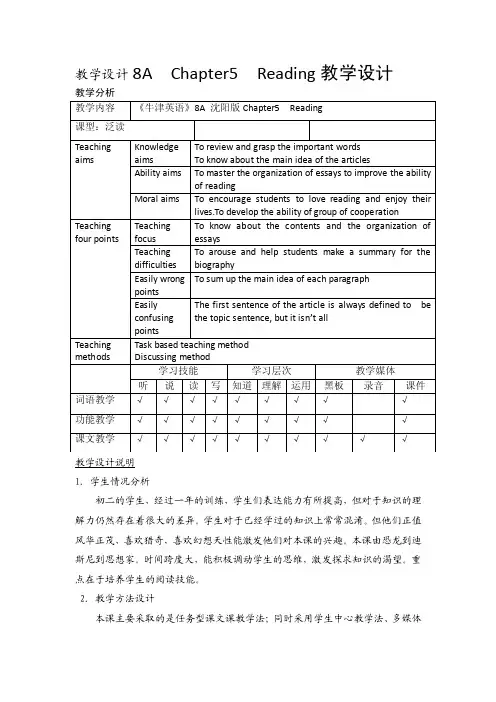
教学设计8A Chapter5 Reading教学设计教学分析教学设计说明1.学生情况分析初二的学生,经过一年的训练,学生们表达能力有所提高,但对于知识的理解力仍然存在着很大的差异。
学生对于已经学过的知识上常常混淆。
但他们正值风华正茂,喜欢猎奇,喜欢幻想天性能激发他们对本课的兴趣。
本课由恐龙到迪斯尼到思想家。
时间跨度大,能积极调动学生的思维,激发探求知识的渴望。
重点在于培养学生的阅读技能。
2.教学方法设计本课主要采取的是任务型课文课教学法;同时采用学生中心教学法、多媒体教学法、游戏法辅助进入各个环节,调节课堂气氛。
3.媒体设计a,需要PPT幻灯片,呈现故事图片以及直接、明晰地呈现生词,进行游戏,调动学生的就积极性。
同时设计不同层次的练习题通过多媒体得以展示,有效的辅助教学。
b. 同时使用黑板传统视觉媒体来呈现新语言知识点。
c. 对于课文内容,为了帮助学生学习准确的发音,需要采用录音机这样的听觉媒体。
4.教学时间本课是准备在45分钟之内完成。
课堂教学过程1.热身准备【时间】课前两分钟【教师活动】利用多媒体进行单词复习。
【学生活动】跟读。
【教学目的】吸引学生的注意力,为上课做准备。
”2.预习准备,启动教学【时间】第1—2分钟【教师活动】组织教学,利用屏幕呈现课题。
Chapter 5 Reading【学生活动】听教师介绍并通过教师展示理解所说内容,了解教师引出的任务。
【教学目的】教师导入教学内容,为任务的呈现做准备。
激活学生现有的知识和兴趣,准备学习新知识,完成新任务。
3.导入新语言项目【时间】第3—6分钟【教师活动】自述 we learnt some words yesterday , this time ,let’s review.通过幻灯片呈现复习内容。
【学生活动】利用快速抢答游戏教学来复习学过生词。
【教学目的】通过游戏法强化学生生词,通过不同层次的设计,分层次教学。
4.设疑启智,呈现新内容【时间】第7—10分钟【教师活动】在课件大屏幕上打出恐龙的图片,导入新课。
初中英语八年级上册(牛津译林版)Unit5Reading教学设计
(一)教学重难点
1.词汇和语法:本节课的重点词汇和语法结构是学生在理解和运用上的难点,如:adventure, explore, danger, risk等词汇的正确使用,以及文章中涉及的复杂语法结构。
2.阅读理解:学生对文章深层含义的理解,尤其是对探险过程中人物情感变化的把握,是教学的难点。
2.教师要关注学生的个体差异,适量布置作业,避免加重学生负担。
3.鼓励学生互相讨论、交流,共同完成作业,培养合作精神。
4.教师要及时批改作业,给予反馈,指导学生改进学习方法,提高作业质量。
五、作业布置
为了巩固本节课所学知识,提高学生的英语综合素质,特布置以下作业:
1.写作练习:请学生运用本节课所学的词汇和语法,编写一篇关于探险的小短文,要求内容丰富、结构清晰,不少于80词。
2.阅读理解练习:完成课后阅读理解练习题,要求学生运用所学阅读策略,准确理解文章内容,提高阅读能力。
3.口语练习:学生分组,每组选择一个探险话题,进行角色扮演,模拟探险过程中的对话。每组录制一段不少于2分钟的口语视频,要求发音准确、表达流畅。
4.教师针对文章内容提出问题,引导学生深入思考,提高阅读理解能力。
(三)学生小组讨论
1.学生分成小组,针对文章内容进行讨论,分享彼此的观点和心得。
2.教师设计小组讨论话题,如:“What is the most impressive part of the article?”,引导学生从不同角度分析文章,提高他们的思维品质。
7.情感教育:结合文章内容,引导学生认识到勇敢面对困难、关爱他人等价值观的重要性。
在教学过程中,教师要关注学生的个体差异,因材施教,使每个学生都能在原有基础上得到提高。同时,教师要善于运用多种教学方法和手段,激发学生的学习兴趣,帮助他们克服教学重难点,提高英语综合素质。
牛津译林版八年级英语上册8A Unit 5 Reading

Looks a white mouse
8 kg
/
over 35 kg
Food mother's milk
/
bamboo
time order
The growth of Xi Wang
--What problems may the giant pandas face if they live in the wild?
8A Unit 5 Reading The story of Xiwang
My dream is to take a color photo, but it is so difficult, who am I?
How much do you know about pandas?
Looks
01
They are/look...
2. Put up your report on your home page to make more people have a further understanding of protecting wild animals.
Loss of living areas
Diseases
problems
Predators
Less food
Underline the problems pandas face
1 difficult to have babies
Problems
2 die young 3 smaller bamboo forests
--China Daily
To symbolize(象征) her importance for the future of pandas, the two researchers have decided to name her Xi Wang.
牛津初中英语8A,Unit5Reading说课稿
牛津初中英语8A,Unit5Reading说课稿牛津初中英语8A, Unit5 Reading(1)说课稿Geetings and introduction:Good afteroon,everyone. I’m Yuan Xingchen. I’m an English teacher from Sihong No3 Middle School. I’m very pleased to have an opportunity to talk about some of my teaching ideas. My topic is made of five parts. It includes Teaching material analysis, Teaching methods ,Study methods ,Teaching procedures and blackboard design..一.Teaching material analysis.1. Lesson type and contents.Today I’m going to talk about the reading part of Unit5, Oxford English 8A. I’ll finish the part in two lessons. This is the first period.2. Status and functionThis lesson is a reading passage. It plays a very important role in the English teaching of this unit. By studying this lesson, Ss can improve their readingability. The Ss should receive some moral education. At the same time, we should get the Ss to learn some words and some expressions about protecting wild animals.3. Teaching aims and demands.①Knowledge objects:a.) To get the students to understand the article.b.) Help the Ss remember the flowing new words and phrases. Eg:nature, wildlife,shelter,government, endangered, tourists, all year round,provide sth for sb, etc.②Ability objects:a). To develop the ability to infer the general meaning from title and context.b) To improve the students’ability to skim text for overall meaning and scanfor details③Moral objects:a) Arouse their interest in learning English.b) Enable the Ss the love our earth and the nature.c) Be aware of the importance of protecting our environment and take actions to protect wildlife.4.Teaching important points:①To understand the passage.②To enable the Ss to master the new word s and the phrases.③To develop the ability to infer the general meaning from title and context.5.Teaching difficult points.a) To use the words to express their ideas.b) To reinforce Ss’ability to skim text for overall meaning and scan for detail6. Teaching aidsIn this lesson, the multi-media will be used to make the class lively andimprove my teaching result.二.Teaching methodsAs we know, the main instructional aim of learning English in middle school isto cultivate Ss’s basic ability of listening, speaking, reading, writing andtheir good sense of the English language. So in this lesson, I’ll mainly useAudio-video method, the Communicative Method and Task-based Method. That is to say, I’ll let the Ss to get a better understanding of the key structu re of the text. I’ll give the Ss some tasks and arrange some activities三.Study methods①Teach the Ss how to be successful language learners.②Teach Ss how to develop the reading skills—skim and scan.③Get the Ss to form good learning habits.四.Teaching proceduresI’ll finish this lesson in seven steps.Step1. Listen to a songFirstly, I’ll ask the students to enjoy a beautiful song by Gan Ping, A RealStory. And then tell the students to talk about it. This step is used to arouseSs’interest and curiosity in the lesson.Step2. Look and discussIn this step, I’ll show the students some picures of many kinds of birds. Letthe Ss ask and answer with the learned expressions. Then I’ll present the map ofZha Long nature reserve and the pictures of red crowned cranes. Some of the new words in the passage will be presented. This step is used to review the learned knowledge and present new words. It’s also important to form a better English learning surrounding for the Ss.Step3. Fast and further reading.After pres enting the new words, I’ll present the article. FirstI’ll show the Sstwo questions and let them read the article and find the answers quickly.ThenI’ll present the Ss some more questions and get the Ss to read the text furtherto find the details.For th e rest of the new words, I’ll train the Ss to infer according to thecontext or the structrure of the words. This step is the most important. It’sused to train the students’ability to skim text for overall meaning and scanfor details. In this step, the rest of the new words should be taught.Step4. Read and match.I’ll show the Ss the next slide. On it there are paragraph orders on the rightand the main ideas on the left. I’ll ask the Ss to read the article again andmatch the paragraphs and the main ide as. In this step, I’ll train the studentsto summarize the main idea of each paragraph.Step5. Listen and fill.I’m going to get the Ss to listen to recording in this step. Remind them to pay attention to the pronunciation of the new words. Then I’ll show an exercise and let them fill in the blanks.In this step, I want to train the studentsprounounce and spell the new words correctly.Step 6. Retell the text.In the seventh step, I’ll give some hints in each paragraphand let the Ss prepare for a while. Then ask some students to retell the paraghrphs one by one. My design purpose is to check the production.Step7. Homework.I think revision is so important that Ss should speak English as much as they can in class or after class. It’s necessary for the Ss to do some extensive exercises after class to consolidate the knowledge they learned. 五.Blackboard design.Unit5 ReadingZhanglongA special placecomfortable→comfortablyThis area provedes food and shelter for wildlifeeasy →easlilyprovide sth.for sb.to ur →touristThis area provides wildlife with food and shelter.active →activelyprovide sb with sth.important→importanceIt is one of the world’s most important wetlands.…………。
八年级英语上册 Chapter 5 Reading教案 牛津沈阳版
Chapter 5Lesson: ReadingGrade: 8A Chapter 5Time: 20 minClass presentationⅠ. Status and function:The topic of this chapter is about finding and understanding information, especiallyfrom encyclopaedias. The part I will conduct is Reading Part, which contains threeshort articles from a children’s encyclopaedia. It is closely related to thechapter’s topic. By reading the three articles, students can get information ondinosaurs, Disney Walt and Diogenes. In this way, they are able to handle the usefulexpressions, master the vocabulary, and base for the Using English part.Ⅱ. Analysis of the students:According to the students’ interest and ability about this reading in Grade 8, theycan easily handle the words and get information from it. So I think the most importantstep is to enable the students to make up sentences and retell the articles withthe words and phrases.The students may have different opinions about Diogenes’ thought on how to be happy.So they need to discuss and present their own ideas.Ⅲ. Teaching aims and demands1. Knowledge objects : Words and expressions.2. Ability objects : a. Using the new vocabulary to retell the article.b. Showing the students’ ideas with the expression.c. Writing an article about one of the topics.3. Moral objects : Be kind to others, be kind to yourself.Ⅳ. Teaching key and difficult points1. Teaching key : a. Use of vocabulary.b. Understanding of reading.2. Difficult point : Further prehension about related topics.Ⅴ. Teaching aids:Multi-media.Ⅵ. Teaching methods:a. Task-based teaching methodb. Environmental teaching method.Ⅶ. Teaching procedureStep 1 : Warm-up (3 min)a. Review former closely knowledge.b. Watch a DVD to arouse the s tudents’ attractions.Step 2 : Presentation (7 min)a. Display the new words with pictures.b. Match the new words and the right pictures.Step 3 : Reading (10 min)a. Listen to the reading and get the main idea.b. Skimming reading: Read the articles quickly and answer some questions.c. Scanning reading: Read separately to gain some more details. Step 4 : Practice (5 min)Fill in the blanks of summary with vocabulary.Step 5 : Group-work (11 min)a. Discussion in groups: Different ways to be happy.b. Expression: The results from their discussion.c. Writing: A short article of being happy.Step 6 : Conclusion (3min)Retell the main idea and express their opinions about the three articles.Step 7 : Homework (1 min)a. Search for a similar article from encylopaedias.b. Use “dinosaur”, “Diogenes”, “Disney Walt” to make a story.Ⅷ. Blackboard designChapter 5 ReadingDinosaurs Disney Walt Diogenesexist amusement Greeceharmless create jarfootprint cartoon kneel byleave behind character fountainⅨ. RethinkingTo face the Oxford English, students should be masters from activities. We should pay more attention to practice students’ survival English. From municating between teachers and students, students’ ability of language using and creation spirit can get further development. So I design my class in this way to improve the students’ prehensive ability.。
牛津初中英语教学设计8AUnit5ReadingThestoryofXiWang
The story of Xi WangTeaching design――This teaching design is made up of 6 parts, including analysis of teaching material, analysis of students, teaching objectives , teaching methods, teaching theories and procedures.Analysis of teaching materialThis article, the story of Xi Wang , is from the reading part of Unit 5, 8A, Funwith English. The topic, wild animals, accords with the cognitive ability and lives of students. This course requires that students read a passage about lives of giant pandas. By learning it, students can know the growing process of pandas and develop the awareness of protecting wild animals by exploring the dangers giant pandas face. Analysis of studentsThe target students are in level 4, they have certain reading ability. Their listening and speaking ability are enhanced i n a certain degree. They have learning consciousness. W ith regard to the condition above, I will train their reading ability further and develop their comprehensive language skills by listening, reading, speaking and writing activities.Teaching objectivesStudents are able to(1) get to know some basic information of Xi Wang.(2) be familiar with and identify the new words and expressions: serious, none, mainly, be born, in the beginning, take action, look like, eat bamboo, live on, face serious problems, in the wild, in danger, right away.(3)improve reading ability by training skimming and scanning.(4) raise awareness of protecting wild animals by knowing the truth that many wild animals are in danger.Teaching methodsTask-based language teaching, communicative language teaching and the guided-discovery method.Teaching theories(1)Make students the real masters of the class and I act as a facilitator.(2)From easy to difficult, from shallow to deep, from simple to complicated.Teaching proceduresIt includes 4 steps: lead-in, pre-reading, while-reading, post-reading.Step 1 Lead-in (have a guess)Firstly, I will present students 3 sentences, they are the description of 3 animals.Then let students guess what animals they are.Secondly, ask students “What’s your favourite animals Why” I will ask some students to share their favourite animals with us.’ interest by a guessing game)(Purpose: To lead in the topic and to arouse studentsStep 2 Pre-readingActivity 1: important words and expressions learning1.In step1, students have shared their favourite animals, so I will ask them: “know what’s my favourite animals” to arouse their interest.Then HaI will also givethem a descriptive sentence to guess what it is――gaint panda.2.Show students a short paragraph of the reason why I like them and some basicinformation of gaint pandas. (These sentences contain important words andexpressions)3.Have students finish B1 to consolidate the words and expressions.(Purpose: To deal with the difficult language points which may impede theunderstanding and to have students be prepared for the reading.)Activity 2: PredictingI’ll ask students “Can you predict the content of the article according to thetitle---The story of Xi Wang”In this process, I’ll encourage students to think andspeak out freely. (Purpose: To enable students to predict before reading and train thestrategy of predicting)Step 3 While-readingListeningI will have students listen the article before reading. Before listening, I will ask them a question “How many pandas are there in the wild”. Have them answer after listening. (To train their ability of listening with questions)Fast-reading (matching)I have divided the article into 4 parts and present the main idea of each part randomly.Have students read the article quickly and do the matching.( To improve ability of skimming)Careful-reading1.Fill-in-table activity. Have students read para1-3, discuss with partners to fill in the table.2.Have students read para4 to find the serious problems giant pandas face.3. Discussion:group workGive students a question “What can we do to protect wild animals” Have them discuss in groups to put forward suggestions.(Purpose: To improve ability of scanning and to enhance their awareness of cooperation in pair and group work)Step 4 Post-reading1.Review: ask one students to lead the whole class to review what they have learned in this lesson.2.World Wildlife Protection DayHomework: have students surf in the internet to look for information of World Wildlife Protection Day. In the next lesson, share the information with the whole class.(Purpose: To train their ability of looking for information and have them aware the importance of wildlife protection in the process of surfing the Internet)。
牛津初中八年级8A Unit5教案(Reading)
8A Unit 5 Birdwatchers教案ReadingPresentation (Reading A)1 Before Ss look at this page, review vocabulary of wildlife and conversation previously taught.2 Write the title ‘Zhalong—A special place’ on the board. Ask Ss what they know about it. Ask where do you think it is? What kind of animals live there? Etc. . Encourage any contributions.3 Encourage Ss to visit some of the websites providing information about Zhalong before the lesson.4 Ask pairs of Ss to exchange information and opinions about the different materials they are studying.5 Ask more able Ss to look for names and descriptions of birds. Have a class feedback using Ss’ research skills.6 Read the title and explain the context. Ask questions about why Ss think that Zhalong is a special place.7 Ask Ss to skim the text quickly,focusing on key words and main points only. Set a strict time limit and tell them in advance that they only have 8 minutes, for example, to read the text. Then ask volunteers to each read a paragraph to the class.9 Ask Ss to write a caption for each paragraph.Presentation (Reading B)1 Ask students to do Part B1 as a quiz.2 Divide the class into groups of six. Choose a group to start the competition. Ask what does ‘endangered’ mean? Set a time limit for each group to answer.3 In pairs, Ss read and complete the conversation. Invite some of them to read it in front of the class.Presentation (Reading C)1 Divide the class into teams of 4-5 students. Do Part C1 as a quiz. Set a time limit.2 Ask students to correct the false sentences.3 Encourage discussions about why a sentence is wrong in order to develop Ss’ deductive skills.Language points (Part A)A nature reserve, in north-east China, one of the world’s most important wetlands, wildlife, provide sth. for sb. ,different kinds of, all year round, for a short stay, there are many fish, catch them for food, the rare red-crowned cranes, change the wetlands to make more space for farms, less and less space for wildlife, have enough space, the Chinese government, protect these endangered birds, a lot tourists, members of our Birdwatching Club, study the different kinds of birds, the changes in their numbers, a bird count, the importance of wetlands Language points (Part B)Areas of land with wet ground, areas of land for farming, a place to live or stay, in a dangerous state, a large number of, people who are traveling, be important forLanguage points (Part C)Find food easily, in other parts of the world, have enough space to live, the ideal home for many plants, fish and birdsHomework1 Learn the language points by heart.2 一课三练P.56-573 Preview the V ocabulary Part.。
8A Unit5 阅读教学设计
巧设“任务”,提升英语阅读能力8A Unit5 Reading教学设计【教学内容】牛津初中英语8A Unit4 Reading【理论基础】《英语课程保准》明确指出:“基础教育阶段英语课程的总体目标是培养学生的综合语言运用能力。
”即培养学生用英语做事的能力。
要培养学生的这种能力,就应该给学生以任务,使他们在完成任务的过程中体验和实践,通过交流、互助和合作完成任务。
新课标在进行听、说、读、写综合训练的同时,侧重培养阅读能力。
阅读能力是学习能力的核心,在各种形式的阅读理解中获取资料和信息,这是学生学习与发展的主要途径。
阅读的目的, 不仅是要欣赏,更重要的是获取信息,并利用信息解决问题。
为了实现这一目标,教师必须首先转变自己的角色,改革课堂教学方式,以学生为主体,发展学生的学习策略和自主学习能力,倡导任务型阅读教学模式。
在阅读教学中,可以不断巧妙设计多种任务,在任务活动中更多的使用语言,学习和掌握最基本的语言知识和语言技能,使学生“在做中学”(learning by doing),培养学生观察、思维、记忆、想象和创新这种用英语做事的能力,从而达到整体阅读素质的提升。
【教材分析】关于“Wild animals”是青少年很感兴趣的一个话题,而Reading部分是一个单元的核心部分,这篇文章通过描述大熊猫的成长过程,面临的危险以及我们人类应当采取必要的保护措施,让学生意识到生态环境对人类和动物的重要性。
既然是一节阅读课,它的学习目标就是要培养提升学生的阅读能力,同时还包括语法、词汇、知识点的掌握与英语的综合运用等任务。
在教学的过程中,巧用多媒体教学的优越性,结合课文,来激发学生的兴趣,调动学生参与的积极性,让学生在轻松愉快的气氛中获取知识,陶冶情操,以达到教学效果的最优化。
【教学策略】利用学生感兴趣的话题,借助于具有大容量、快节奏、形象性、直观性等诸多优势先进的教学手段,创设情景,激发兴趣,采用任务型教学,环环相扣,层层深入。
牛津译林版八年级英语上册unit5 Reading课时 教案
牛津译林版八年级英语上册教案教案背景 1.面向学生:中学 2.学科:英语3.课时:14.学生课前准备:1)学习生词,预习课文,了解文章大意2)提出预习中出现的问题教学课题8A Unit5 Wild animals Reading教材分析本课来自牛津初中英语8A第5单元。
这一单元主要围绕野生动物开展多种教学任务,材料内容符合学生生活实际,符合学生对野生动物的认知能力,具有很强的教育意义。
本节课是本单元的Reading部分,主要围绕大熊猫的成长过程展开话题讨论。
通过学习,让学生了解大熊猫的成长过程以及目前他们可能遇到的危机,让学生了解动物是人类的朋友,保护动物也就是保护人类自己,最后讨论保护野生动物的措施,为后面的学习打下伏笔。
教学目标 1.知识目标理解并运用本课时的四会单词理解并掌握描述大熊猫外貌特征、它们所面临的危险以及采取保护措施的词组和句型2.能力目标能根据上下文猜测词汇在上下文中的意思,从而理解文章内容能通过阅读了解名叫“希望”的大熊猫的成长过程、面临的危险以及所采取的保护措施3.情感目标通过了解大熊猫的信息,我们要善待大熊猫。
动物是我们的朋友,我们要尽力保护它们。
教学重难点理解文章大意,掌握语言授课类型新授讲授方法Task-based teaching methord教具准备PPT 学生提前互动准备动物特征纸条、学生对人类要说的话奖励物品(小熊猫)教学过程及时间主要教学内容教学方法应用Part OnePre-reading1. A guessing game Good morning, boys and girls. Nice to meet you.Last class we have learnt many names of animals.Do you remember them?Good. Let’s play a guessing game,ok?I will ask one student to say sth about his favouriteanimal. The others please guess what it is.(Good. Let’s clap our hands for them)(Congratulations to you )学生回答Yes请四位学生描述他最喜欢的动物的特征,其他人猜动物名称。