
【精品】译林版四年级下册英语 教案 说课稿 Unit 3 My day Story time
英语(四年级下册)Unit 3 My dayStory timeTeaching contents 教学内容Story timeTeaching aims and learning objectives 教学目标1. 能听懂、会读、会说:usually, go to school, in the morning, in the afternoon, gohome, homework, watch TV, in the evening, have lunch, play football, have dinner, go to bed, at night。
2. 能听懂、会读、会说日常用语:When do you ...? I ... at …3. 能正确地理解并朗读故事内容,在图片和语言提示下复述故事。
Focus of the lesson and predicted area of difficulty 教学重点和难点教学重点:1. 短语和句型的教学。
2. 用正确的语音语调朗读故事。
3. 在图片和语言提示下复述故事。
教学难点:对于短语和句型的掌握;复述故事。
Teaching procedures 教学过程Step 1 Greeting & Warm up1. GreetingT: Hello, boys and girls.S: Hello, Vivian.T: Hi, …, how are you today?S1: I’m fine. / I’m good. / …T: Do you like playing games?S: Yes, we do.2. Play a gameT: Let’s play a game. OK?S: OK!T: Good. Here we go. Ready? Go.(如果你和我一样,请站起来大声说Me too. )【设计意图:通过游戏营造轻松愉悦的课堂气氛,同时渗透今天教学的重点句型,为后面的教学做铺垫。
】Step 2 Presentation1. My DayT: Well, boys and girls. I have a clock. What time is it now?S: Six thirty.T: That’s right. I usually get up at 6:30.(教学usually)(同法问余下钟面,说自己的日常活动,遇生词和词组渗透教学)2. Let’s tell the timeT: Look at the timetable. This is my day. Can you tell the time now?S: Yes.T: What time is it?S1: Six.T: What about this one?S2: Seven ten.(总结本节课说钟面的规律,同桌讨论说一说。
)T: Let’s tell th e time together.S: (tell the time with the teacher)【设计意图:通过教师说钟面时间,学生说钟面时间,自然教授时间的说法规则,同桌再说一说,加以巩固,为后面的故事教学降低难度。
】Step 3 Story time1. Look and sayT: Look at the picture. Who’s the boy?S1: Mike.T: Yes, today we are going to learn a story about him. And here is a question for you. The story is about Mike’s .(PPT出示人物图片,教师带领学生说说人物并引入故事)2. Watch and chooseT: (PPT播放课文动画) The story is about Mike’s .S: The story is about Mike’s .(day)【设计意图:帮助学生整体感知课文, 整理课文要素。
】3. Read and matchT: Open your books, read the first paragraph and then try to match the time to the daily activities.(学生自读第一段,试着连线。
)T: You may say it like this, “I … at …”(check the answers)4. Read and fill in the blanks.T: Next, read the second paragraph and fill in the blanks. You may discuss in pairs. (学生自读第二段,试着填表。
)T: You may say it like this, “At …, I …”(check the answers)5. Read and say.T: Then, read the third paragraph and say the sentences.(学生自读第三段,填句子并说一说。
)6. Fill in the table and retell Mike’s d ay.(梳理时间和日常活动,教学in the morning,in the afternoon和in the evening,区分evening和night。
)7. Read and imitate(听录音,跟读课文,鼓励学生模仿录音中的语音语调)【设计意图:通过精读课文句子,模仿语音语调,理解文中人物的心理与情感变化。
】Step 4 Consolidation1. Let’s dub.(三人一小组,为Mike配音。
)2. Act the story.T: You really did a good job in this story time. It’s Show time for you. Can you act the story? Prepare it in groups of three. Then come to the blackboard to act it out.(选择你最喜欢的一个时间段表演,记住台词并加上动作)【设计意图:表演课文可以帮助学生复习、巩固课文,学生带着头饰,将故事内容进行脱稿表演是提高学生语言能力和学习兴趣的最佳方式。
】3. Discussion.T: You acted the story very well. What do you think of Mike’s day? Please discuss in groups of four and try to judge.(四人一组,根据提示判断)4. Talk about your day.T: Mike’s day is reasonable. What about your day? Please talk about your day in groups of four.(学生小组谈论自己的作息安排)T: Excellent, boys and girls. Wonderful jobs you did today. I can see you can play, read and act!S: Yeah!【设计意图:对合理作息做出自己的判断,这对学生提出了更高的要求,期待学生通过讨论、交流、合作,将这节课所学内容以自己的方式演绎出来。
学生有话可说,有话想说,课堂气氛再次升至高点。
】Homework 家庭作业1. Introduce Mike’s day.介绍Mike的一天。
2. Write a diary about your day. 写一篇日记记录你的一天。
3. Preview (预习) Fun time.Teaching aids 教学准备(含板书设计)教学准备:人物卡片、多媒体课件。
板书设计:Unit 3 My day说课Pre-reading 阅读前在阅读前阶段,设计了两个层次递进的活动。
首先,利用游戏调动课堂气氛,同时引入本节课的主要话题;其次,通过时间的问答,复习数词并新授课文中所涉及的时间表达法,为后面的教学做铺垫。
这样的设计意图在于:1. 创设整体情境;2. 激发学习兴趣和积极性;3. 导入相关话题;4. 渗透句型教学,为后文的学习做好铺垫。
While-reading 阅读中阅读前的热身后,学习进入重要的主体部分——阅读中阶段。
本阶段中,我设计了以下6个前后相连的活动:1. Watch and answer学生带着问题观看卡通动画,了解故事整体信息。
2. Read and match了解大意后,学生分段精读,第一段落,进行细节信息的匹配。
3. Read and fill in the blanks针对第二段落,填表。
4. Read and say针对第三段落,完成句子,说一说。
5. Summarize在上面三个活动的基础上,总结归纳,梳理时间和日常活动。
6. Read and imitate听录音跟读,强调模仿,归纳语调规则,旨在培养正确优美的语音语调。
显而易见,从对文本进行整体感知,到通过设计不同形式的活动分步解读文本,重在对学生进行文本阅读策略和技能的指导,引导学生关注文本细节,学会把握关键信息。
Post-reading阅读后阅读后阶段,通常认为是语言输出阶段。
考虑到四年级学生爱说、爱表演的特点,我设计了以下三个活动:1. Let’s dub三人小组,分段配音。
2. Act the story学生围绕课本表演。
3. Discussion学生小组讨论,说说Mike一天的作息安排是否合理。
这样的设计意图在于:1. 针对不同层面的学生,设计不同的输出方式,以巩固对文本的学习。
2. 创设平台,学生自由交流讨论,表达自己的见解,学会合作与分享。
精品教案译林版四年级英语下册Unit3 My day
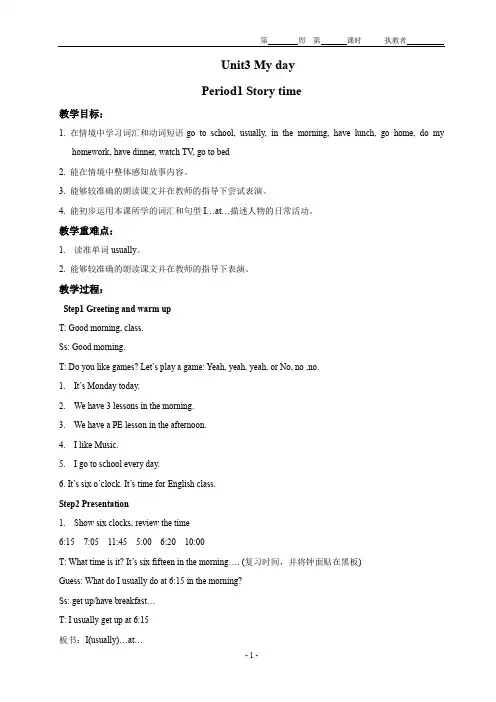
Unit3 My dayPeriod1 Story time教学目标:1. 在情境中学习词汇和动词短语go to school, usually, in the morning, have lunch, go home, do myhomework, have dinner, watch TV, go to bed2. 能在情境中整体感知故事内容。
3. 能够较准确的朗读课文并在教师的指导下尝试表演。
4. 能初步运用本课所学的词汇和句型I…at…描述人物的日常活动。
教学重难点:1.读准单词usually。
2. 能够较准确的朗读课文并在教师的指导下表演。
教学过程:Step1 Greeting and warm upT: Good morning, class.Ss: Good morning.T: Do you like games? Let’s play a game: Yeah, yeah, yeah, or No, no ,no.1.It’s Monday today.2.We have 3 lessons in the morning.3.We have a PE lesson in the afternoon.4.I like Music.5.I go to school every day.6. It’s six o’clock. It’s time for English class.Step2 Presentation1.Show six clocks, review the time6:15 7:05 11:45 5:00 6:20 10:00T: What time is it? It’s six fifteen in the morning…. (复习时间,并将钟面贴在黑板)Guess: What do I usually do at 6:15 in the morning?Ss: get up/have breakfast…T: I usually get up at 6:15板书:I(usually)…at…Teach: usuallyWhen do you get up? Ss: I get up at…2.In the same way to teach:go to school at 7:05have lunch at 11:45go home at 5:00have dinner at 6:20go to bed at 10:003. T: I do different things at different time.(Chant)I get up at six fifteen.I go to school at seven o five.I have lunch at eleven fifteen .I go home at five.I have dinner at six twentyI go to bed at ten.So this is my day.揭题:Unit 3 My day4. Talk in groups. Make a new chant, say something about your day.Step3 Story timeT: We’re having an English lesson and we’re talking about our days. Mike is talking about his day too. Let’s listen to Mike, try to find out Mike’s activities in the morning.(Part1)Ss listen and then choose the pictures.1.Listen again and match(再听一遍介绍,出现三个钟面,将Mike的活动与时间配对)2.T: What else does Mike do in the morning?Ss: have lessonsT: Yes. And how many lessons does he have in the morning.Ss: Four.T: So Mike has four lessons in the morning.3.Listen and read Part 1.(Part2)1.T: How many lessons does Mike have in the afternoon? And what else does Mike do in the afternoon? Let’s listen again, and try to answer.Q1. How many lessons does Mike have in the afternoon?Q2. What else does Mike do in the afternoon?Teach: go home do my homeworkIn the afternoon: have lessons/play football/go2.Listen and read Part 2(Part3)1.Read Part3 by selves, try to fill in the blanks.2. Talk in groups: When does Mike do these things? Say like this:…at…3. Listen and read Part3Step4Consolidation1.Read in three.2.Act as Mike, choose one part and talk about your activity.()Step5Homework1.Listen and read the story, try to recite it.Describe your day to your family, then write it down.板书设计:Unit 3 My dayI (usually) …at…In the morning/ afternoon / evening/ at nighthave lunch go home have dinner go to bedPeriod2 Vocabulary & Fun time教学目标:1. 能听懂会说:When do you ...? I...at…并能在情境中熟练的运用。
四年级下册英语说课稿-Unit3 My day 译林版
四年级下册英语说课稿-Unit3 My day 译林版一、教材分析教材内容本篇教材《My day》介绍了一天中的各种活动,包括早上和晚上起床、吃早餐和晚餐、上学和放学等内容。
同时也教授了一些英语表达,如:get up, have breakfast/dinner, go to school, come back等。
教材特点本单元主要介绍一些日常生活中的活动,内容比较基础,易于学生们掌握。
同时,在学习过程中,结合许多生活场景和图片,可以更好地帮助学生们理解和记忆。
教材目标1.掌握本单元中涉及的单词和短语,如:get up, have breakfast/dinner,go to school, come back等;2.能够使用正确的语境表达一天中的各种活动;3.能够初步掌握一些英语句型和语法规则,如:一般现在时。
二、教学设计教学目标1.让学生们通过学习一天中的活动,能够在日常生活中使用英语简单对话;2.培养学生的口语表达能力;3.培养学生的学习兴趣和英语学习习惯。
教学内容1.单词和短语:get up, have breakfast/dinner, go to school, come back 等;2.一般现在时的使用;3.口语表达练习;教学步骤第一步:导入通过介绍几种日常活动场景,如:早上起床、吃早餐等,引导学生们学习本单元内容,并同时学习使用相关的英语表达。
第二步:学习单词和短语通过对单词和短语的介绍,让学生们了解相关词汇的含义,并进行一些口语表达练习。
第三步:学习语法介绍一般现在时的概念和使用方法,并进行相应的例句练习。
同时,让学生们了解和掌握一些常用谓语动词的用法。
第四步:学习用法在学习语法的基础上,引导学生们学习句型的使用方法,并进行相应的口语表达练习。
第五步:巩固与拓展让学生们运用所学的知识,进行日常生活中相关的英语口语表达练习。
同时,为了更好地拓展知识面,也可以介绍一些相关文化和背景知识。
译林英语四下说课稿Unit 3 My day 第一课时
译林英语四下说课稿:Unit 3 My day 第一课时教学目标1.能够听懂、会说日常活动词汇,如 get up、have breakfast、go to school 等。
2.能够用一句简单的英语句子介绍自己的日常活动。
3.能够听懂、会说一些英语问候语,如 Good morning、How are you? 等。
4.培养学生的听说能力和自信心,提高英语口语出现的频率。
教学重点1.日常活动词汇的学习。
2.简单的英语句子的构成和应用。
3.英语问候语的运用。
教学难点1.学生英语口语能力和自信心的培养。
2.英语句子的基本结构和语序。
教学过程一、导入(5分钟)老师和学生互相问候,鼓励学生用英语回答,如:•Good morning, class!(早上好,同学们!)•How are you?(你们好吗?)•I’m fine, thank you.(我很好,谢谢。
)•What day is it today?(今天是星期几?)二、新授课内容(30分钟)1. 单词学习介绍一些日常活动的基本词汇,有图片可以用图片帮助学生理解。
•get up(起床)•have breakfast(吃早饭)•brush teeth(刷牙)•take a shower(洗澡)•get dressed(穿衣服)•go to school(去学校)•have lunch(吃午饭)•do homework(做作业)•watch TV(看电视)•go to bed(上床睡觉)2. 句子构成介绍简单的英语句子的构成和语序,如:•My name is Tom. (我的名字是汤姆。
)•I am a student. (我是一名学生。
)•I get up at six in the morning. (我早上六点起床。
)•I go to school by bus. (我坐车去学校。
)•I have lunch at twelve noon. (我中午十二点吃午饭。
译林版四年级英语下册教案Unit 3 My day_教案3
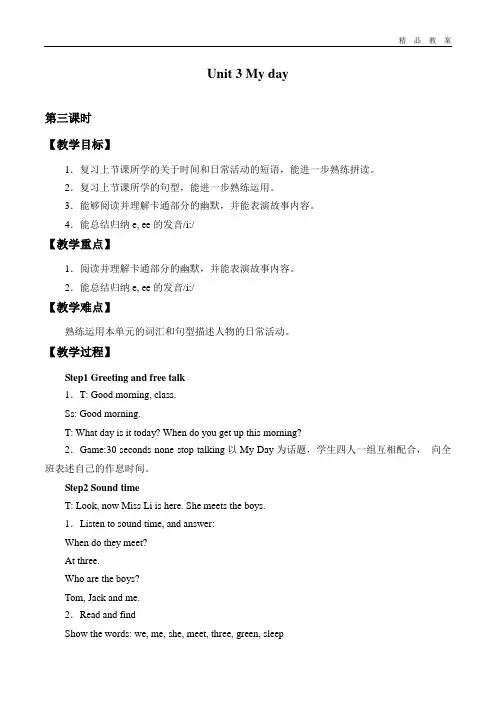
Unit 3 My day第三课时【教学目标】1.复习上节课所学的关于时间和日常活动的短语,能进一步熟练拼读。
2.复习上节课所学的句型,能进一步熟练运用。
3.能够阅读并理解卡通部分的幽默,并能表演故事内容。
4.能总结归纳e, ee的发音/i:/【教学重点】1.阅读并理解卡通部分的幽默,并能表演故事内容。
2.能总结归纳e, ee的发音/i:/【教学难点】熟练运用本单元的词汇和句型描述人物的日常活动。
【教学过程】Step1 Greeting and free talk1.T: Good morning, class.Ss: Good morning.T: What day is it today? When do you get up this morning?2.Game:30 seconds none stop talking以My Day为话题,学生四人一组互相配合,向全班表述自己的作息时间。
Step2 Sound timeT: Look, now Miss Li is here. She meets the boys.1.Listen to sound time, and answer:When do they meet?At three.Who are the boys?Tom, Jack and me.2.Read and findShow the words: we, me, she, meet, three, green, sleepThe letter “e” and “ee” have the same pronunciation /i: /3.Work in groups, and find some words and write down.4.Try to read: be, bee, sweep, feet, need, free, week, beef, sheep5.Ticking time: I know the sound of “e” and “ee”.Step3 Cartoon timeT: From the song, what do you think about Peter?Ss: He’s a good boy.T: Yes. He gets up at six thirty every day. And he goes to school at seven thirty every. He has good habits. I think you have good habits too, right? And so is Bobby.1.(Show a picture of Bobby on book.)Bobby gets up at six every day. Do you know when does Bobby have dinner every day? Guess.Ss: At five/six…?2.T: Yes, he has dinner at six every day. Does he have dinner at six today? What happened?Where is Bobby? A.In the desert(在沙漠里)B.At homeLet’s watch the cartoon and choose the correct one.3.T: What can they see over there? And does Bobby eat it at last? Read the story and answer.Ss: They see a big cake over there.T: There’s a nice cake in the desert. But Bobby cannot eat it. Because it’s a dream! Bobby is sleeping and he is very hungry. So he makes a dream.4.Good! Well, boys and gi rls, let’s learn the story together.Ss: Listen and repeat.T: 指导朗读。
四年级下册英语教案 Unit 3 My day 第1课时 译林版
四年级下册英语教案 Unit 3 My day 第1课时译林版教学目标:1. 让学生能够听懂、会说、会读本课时主要单词:morning, afternoon, evening, night。
2. 让学生能够听懂、会说、会读本课时主要句型:What time is it?It's ...3. 培养学生运用所学单词和句型进行日常交流的能力。
4. 培养学生的观察能力、思维能力和合作精神。
教学内容:1. 单词:morning, afternoon, evening, night。
2. 句型:What time is it? It's ...教学重点与难点:1. 教学重点:掌握本课时主要单词和句型,能够运用所学知识进行日常交流。
2. 教学难点:正确运用所学单词和句型进行情景对话。
教具与学具准备:1. 教具:多媒体课件、录音机、磁带、单词卡片、时钟模型。
2. 学具:英语课本、练习本、彩色笔。
教学过程:1. 导入:通过唱英文歌曲《Hello, how are you?》来营造英语学习氛围,激发学生学习兴趣。
2. 新课内容呈现:利用多媒体课件展示本课时主要单词和句型,引导学生跟读并模仿。
3. 情景创设:创设不同时间段的生活场景,让学生运用所学单词和句型进行角色扮演,如早晨、下午、晚上等。
4. 小组合作:学生分组进行练习,互相纠正发音,巩固所学知识。
5. 游戏环节:设计“猜时间”游戏,让学生在游戏中运用所学句型,提高口语表达能力。
6. 总结与反馈:教师对本课时所学内容进行总结,学生进行反馈,检查学习效果。
板书设计:1. Unit 3 My day2. 主要单词:morning, afternoon, evening, night3. 主要句型:What time is it? It's ...作业设计:1. 听力作业:听课文录音,跟读并模仿。
2. 口语作业:与同学进行情景对话,运用所学单词和句型。
四年级下册英语说课稿-Unit 3 My day Period 3-译林版三起

四年级下册英语说课稿-Unit 3 My day Period 3-译林版三起一、教材分析《译林版三起》四年级下册英语Unit 3的主要内容是让学生学会询问和描述自己每天的活动。
本课时为Period 3,主要教学目标为学生能够用所学的句型来询问和描述别人的每天活动,并能听懂日常活动的表述。
具体的教学内容包括以下方面:1.词汇get up, eat breakfast, go to school, have English class, have math class, have PE class, have music class, have art class, go home, do homework, watch TV, go to bed2.句型•What do you do at 7:30?•I eat breakfast at 7:30.•What class do you have at 9:00?•I have English class at 9:00.二、教学目标1.知识目标学生能够听懂和说出目标句型。
学生能够掌握并使用本课所学的词汇。
2.能力目标学生能够用所学的句型询问和描述别人的每天活动。
学生能够通过听力训练有效提升自己的听力水平。
3.情感目标培养学生热爱学习英语的兴趣。
通过本课的学习使学生体验到用英语交流的乐趣。
三、教学重点和难点1.教学重点使学生熟练掌握目标句型。
培养学生用所学的句型询问和描述别人的每天活动的能力。
2.教学难点让学生能听懂日常活动的表述。
培养学生发散思维和口语表达能力。
四、教学过程1.导入环节通过投影展示今日日程表,介绍今天的教学内容。
2.语言输入环节通过教师展示图片和对话,引出目标句型和词汇。
3.语言训练环节运用板书上的单词和目标句型,进行语言训练,在口头和书面表达上进行训练,让学生全面掌握所学内容。
4.语言输出环节分组进行小组活动,让学生运用所学的句型描述和询问别人的日常活动,每组表现一定要有评价和改进。
四年级下册英语说课稿-Unit 3 My day 课时2 译林三起
四年级下册英语说课稿-Unit 3 My day 课时2 译林三起一、教学目标1.学生能够听懂、会说和读出本课的四会单词及短语;2.学生能够正确理解并使用第三人称单数形式的动词;3.学生能够以正确的方式表达自己在一天中的不同活动;4.学生能够用英文简单描述自己的一天。
二、教学重点1.学生能够正确理解并使用第三人称单数形式的动词;2.学生能够以正确的方式表达自己在一天中的不同活动;三、教学难点1.学生能够用英文简单描述自己的一天。
四、教学内容1. 教学过程(1) Warm-up•Greet students and introduce yourself.(2) Presentation•Show a picture of a clock and ask students to tell you the time.•Introduce the new vocabulary for this lesson: wake up, get up, have breakfast, go to school, have lunch, go home, have dinner, go to bed.•Use realia to help students understand the meaning of the new vocabulary.(3) Practice•Ask students to listen to the teacher as they read a sample schedule of one student’s day.•Have students repeat the schedule after the teacher.•Then, ask students to write and share their own schedules with a partner.(4) Production•Have students create a poster or a comic strip of their own daily routines using the vocabulary and sentence structure learned in class.•Encourage them to include the correct use of third-person singular verbs in their sentences.(5) Review•Review the new vocabulary and sentence structures.2. 教学重点(1) Third-person singular verbsMake sure students understand the use of third-person singular verbs in English, and encourage them to use these verbs correctly when talking about daily routines.(2) Daily RoutinesHelp students develop their ability to talk about their own daily routines in English and provide them with opportunities to practice using the vocabulary and sentence structures learned in class.3. 教学方法(1) Communicative Language TeachingEncourage students to practice communicating in English by providing them with opportunities to interact with each other in pairs or small groups.(2) Total Physical ResponseUse physical actions and movements to help students remember and understand the meaning of new vocabulary words.4. 教学建议(1) Use RealiaBring in real objects or pictures to help students understand the meaning of new vocabulary words.(2) Model Correct UsageModel the correct pronunciation and usage of the new vocabulary and sentence structures for students to imitate.(3) Provide FeedbackProvide students with feedback on their pronunciation and grammar usage to help them improve their English language skills.五、教学评估•Monitor students’ participation during group activities•Check for understanding during individual and whole-class practice •Assess students’ speaking and writing skills during production activities六、教学后记This lesson on daily routines provides students with a solid foundation for talking about their own daily lives in English. With practice, students will become more confident in using third-person singular verbs and the vocabulary words learned in class.。
四年级下册英语说课稿-Unit 3 My day 课时4 译林三起
四年级英语课程说课稿单元: Unit 3 My day课时4教材版本:译林三起教师姓名:XXX一、课程背景本篇课程为四年级下册英语教育的课程设计,旨在通过学习“Unit 3 My day”中的第四课时,帮助学生扩展英语词汇并掌握英语时间表达的基础规则。
同时,通过运用语言、图片、声音及互动等技术手段,提高学生的听、说、读、写的能力提高。
二、教学目标1.能够认识并阅读文本中的新词汇,并了解其基本用法。
2.能够理解并熟练表达天气状况。
3.能够编写简单的日程计划并表达详细的时间。
4.能够更好地理解“时间”的概念,知道如何组织日常生活。
5.通过课程的掌握,提高学生对英语的兴趣。
三、教学重点1.本节课将重点教授天气描述的表达方法,包括相关词汇及用法。
2.引导学生通过图片对天气状况进行预测,提高其语言思维能力。
3.通过实例引导学生复述日常生活中的事件,并表达时间。
四、教学过程Step 1: 钟面与日期表达•引导学生阅读文本内容,并重点介绍钟面及日期的表达方法。
•设置对比页,让学生查看中文时间和英文时间表达形式的差异。
Step 2: 天气咨询•向学生展示天气图片并介绍相关天气词汇。
•要求学生练习用英语描述天气,并让同学对其进行评价。
•以此引导学生进一步掌握天气表达方法。
Step 3: 群体讨论•分组让学生通过图片进行讨论天气情况,引导学生对天气状态做出预测。
•要求学生在小组内讨论出具有代表性的天气情况,帮助学生理解并掌握天气描述方法。
Step 4: 复述日程•带领学生从文本中寻找具有代表性的日常安排,让学生进行复述。
•通过显式示范,引导学生掌握对时间的表达方式,如“早上/中午/下午/晚上”等。
Step 5: 时间对数字看齐•提供学生常用的时间词汇和日子词汇,并帮助学生了解时分秒、分秒和秒的表达方式。
•让学生对数字进行尝试,并深入理解数字与时间的关系。
五、教学反思本节课带领学生熟练掌握计算时间的方法、基本天气和时间表达方法,进一步提高学生对英语掌握的兴趣。
Unit3Myday(教案)译林版英语四年级下册(1)
Talk about the students’day.
在情境教学中,理解词汇和句型,达成目标3和4
文本理解中达成目标4.
通过这一环节,帮助学生复习本课的重点以及难点内容,更有效地达成整体目标。
开放式延伸
1.熟练朗读Story time,并能用自己的话说说Mike一天的活动;
5、通过Mike和教师一天的活动描述,尝试描述自己一天的学习生活,熟练运用句型I usually …at…及时间和活动的表达。
制定依据
1.教材分析
本课时的教学主要任务是story time,展示了本单元的短语和套用这些短语的句子,是本节课的学习重点。在教学时要复习数字,时间的表达方法,结合日常的活动复习已学的动词短语,拓展新的动词词组,进而形成句子,让学生学会用Iusually…at…描述自己的一天。
2、Read and finish the timetable;
(1)Please open your books, read the text and then underline the time, like this(做一个示范:at seven),then finish the timetable of Mike’s.
Unit 3 My day
教学目标
1、通过对游戏活动,复习数字及时间表达,从而能熟练地表达时间;
2、通过游戏活动,归纳所学活动类短语,从而熟练地表达一天的活动;
3、通过教师相关活动的呈现,学习新句型I usually…at…的表达,理解When do you …?
4、通过对文本的朗读、理解,了解Mike一天的活动,熟练朗读课文,进一步熟悉句型I…at…;
(2)11:15 Iusuallyhave lunchat11:15
译林版(三起)四年级下册英语教案:Unit3Myday
译林版(三起)四年级下册英语教案:Unit3 My day一、教学目标1. 知识与技能:(1)能够正确听、说、认读词汇“morning, afternoon, evening, dinner, watch TV”。
(2)能够正确听、说、认读句型“What do you do in the morning/afternoon/evening? I in themorning/afternoon/evening”。
2. 过程与方法:(1)通过图片、情景创设等方式,培养学生英语听说能力。
(2)通过小组合作、角色扮演等活动,提高学生的英语实际运用能力。
3. 情感态度与价值观:(2)培养学生关爱家人,关心同伴,学会与人分享。
二、教学内容1. 词汇:morning, afternoon, evening, dinner, watch TV2. 句型:What do you do in the morning/afternoon/evening?I in the morning/afternoon/evening3. 对话:能够熟练运用本课所学词汇和句型进行交流,描述自己在不同时间段的活动。
三、教学重点与难点1. 教学重点:(1)正确听、说、认读词汇“morning, afternoon, evening, dinner, watch TV”。
(2)正确听、说、认读句型“What do you do in themorning/afternoon/evening? I in themorning/afternoon/evening”。
2. 教学难点:(1)正确运用词汇和句型描述自己在不同时间段的活动。
(2)理解并运用时间状语“in themorning/afte rnoon/evening”。
四、教具与学具准备1. 教具:多媒体课件、图片、卡片、时钟模型2. 学具:课本、练习册、笔五、教学过程1. 导入:通过唱英文歌曲《Good Morning to You》导入新课,激发学生学习兴趣。