
【金榜学案】九年级英语全册 Unit 15 We’re trying to save the m
九年级英语教案:Unit15 We’re trying to save the manatees

九年级英语教案:Unit15 We’re trying to savethe manateesUnit 15 We’re trying to save the manatees!Ⅰ. Teaching Aims and Demands1. Knowledge Objects(1) Key Vocabularymanatee, cheetah, chimpanzee, kangaroo, polar-bear, gentle, furry, enormous, playful, noisy, aggressive, spotted(2) Target LanguageI am like this animal because I am strong and intelligent. I like water, and I like to eat vegetables.You’re like an elephant.No.You’re like a manatee.Yes.2. Ability Objects(1)Train students’ listening ability.(2)Train students’ communicative competence.3. Moral ObjectLove all kinds of animals because they are our friends.Ⅱ. Teaching Key PointTarget LanguageⅢ. Teaching Difficult Points1.How to train students’ listening ability.2.How to train students’ communicative competence.Ⅳ. Teaching Methods1. Didactic to learn the new vocabulary.2. Listening-and-answering activity to helpstudents go through with the listening material.3. Groupwork to make every student work in class,Ⅴ. Teaching Aids1. A tape recorder2. The blackboard3. A projectorⅥ. Teaching ProceduresStep I RevisionNow let’s review five different verb tenses. Can you name the five tenses? Please look at the screen.Show the names of the five tenses on the screen by a projector along with a sample sentence for each.present progressive:You’re reading these sent ences.present: We use our books every day.past with used to: He used to live in the countryside.passive voice: Our classroom is found at the end of the hall.present perfect: We have already finished Unit 14. We haven’t finished Unit15 yet.Invite a student to read the verbs in these sentences. Then get other students to briefly explain what each tense is used for.Present progressive describes things that are happening right now.Present describes things that happen all the time or usually happen.The past with used to describes things that were a certain way in the past, but have changed now.The passive voice describes things that we don’t know who did, or we don’t care who performed the action.The present perfect describes recent events.Get students to think of two or three more sample sentences using each type of verb. Have several students read their sentences.Step Ⅱ 1aThis activity introduces the key vocabulary.Look at the signs on each animal’s picture and read the words to the class. Get students to repeat the name of each animal.African elephants, chimpanzees, kangaroos, manatees, cheetahs, polar bears. If necessary, read the words and ask students to repeat them again. Then have students read the words by themselves.Make sure students can read the words correctly and fluently.Read the directions to the class. Point to the list of words in the box. Read the words and let students repeat them. Then get different students to explain what they think each word means in their own words. For example, A gentle animal is quiet and not dangerous. A fury animal is covered with soft hair. Ask some students to explain any words students may not understand.An enormous animal is very great.A playful animal is full of fun.An aggressive animal is fond of quarrels and quick-tempered.A spotted animal is marked with spots.Let students begin filling in the answers on theirown. When they work, walk around the classroom checkingtheir progress and answering any questions they mayhave. After students have finished using all the words from the box, let the students write some other words in theblanks below some of the pictures.Check the answers with the whole class.Let students say the words they wrote under each heading.AnswersPossible answersmanatee: gentle, shychimpanzees: noisyelephants: enormous, graykangaroos: playfulcheetahs: spotted, fastpolar bears: aggressive, furryStep Ⅲ 1bThis activity gives students practice in understanding the target language in spoken conversation.Go through the instructions with the class. Look back at the list of words in Activity 1a. You will hear Ginny and Victor talk about the animals in the picture in Activity1a. Now please listen to the recording carefully and circle the words on the list that they use to describe the animals.Play the recording the first time. This time students only listen. Play the recording a second time. Now listen to the recording again and circle the words you hear on the recording.Check the answers.AnswersThese words should be circled:aggressive, gentle, shy, furry, gray, fast, spottedTapeseriptBoy:Hey, Ginny, What’s that big, furry animal in the pond?Girl:It’s a polar bear, Victor.They’re kind of aggressive.Boy: Are they? They looks like really love water.Girl: Uh-huh.Boy: And what do you call those big, gray things in the water?Girl:They’re called manatees.Boy: What?Girl: Manatees.They’re very gentle and very shy.Boy: Oh. And how about the yellow and black spotted animals in that cage?Girl:They’re cheetahs. The cheetah is the fastest animal on earth.Step Ⅳ 1cThis activity provides oral practice using the target language.Go through the instructions with the whole class.Look at the sample conversation in the box and get three students to read it aloud to the class.SA: I am like this animal because I am strong and intelligent. I like water, and I like to eat vegetables.SB:You’re like an elephant.SA: No.SC:You’re like a manatee.SA: Yes!Tell students to think of an animal that is the same as them in some ways. Take a few minutes to write down a statement.Say, You can write a sentence or two that describes how you are similar to the animal you choose.Don’t say the name of the animal.A few minutes later, let student read their statements to the class and see how quickly the other students can guess what animal the students is talking about.Statement 1S1:I am like this animal because I am playful and funny.Ss:You’re like a polar bear.S1: No.Ss:You’re like a kangaroo.S1: Yes!Statement 2S2: I am like this animal because I run very fast. I like to wear colorful clothes.Ss:You’re a kangaroo.S2: No.Ss:You’re like a cheetah.S2: Yes!Notelike—(here prep.)in the manner ofStep Ⅴ SummaryIn this class, we’ve learned some important words such as manatee, kangaroo, Po ;; ar bear, gentle, furry, enormous, playful, noisy, aggressive, spotted.We’ve also learned the target language I am like this animal because I am strong and intelligent. I like water, and I like to eatvegetables. You are like an elephant. No.You’re like a manatee. Yes!Step Ⅵ Homework1. Get students to write down some statements and read them to their partners.Let the partners guess what animals they are talking about.2. Review the new words in the box inActivity 1a.。
最新-九年级英语上册 Unit 15《We’re trying to save

Revision of Unit 15 We’re trying to save the manatees!复习内容:Revision of Unit15复习目标: 1、复习巩固第十五单元相关知识点。
2、培养学生的辩论及交流协作的能力。
学会正确处理人与自然的关系。
复习重点: Describe the animals correctly.复习难点:Train students’ communicative competence环节一:引入目标,内容概述T: Today we’ll have a revision of Unit 15. First of all, let’s…环节二:自主复习,合作探究I. Words: 1.weigh→n.________ 2.suit→adj.________ 3.push→(反义词)v._________4.expression→v.________ 5.society→adj.________6. truth→adj._______→adv._______7.proud→n._________________ 8 . build →过去式/过去分词_______ 9.行星________ 10.社团;社会 _________ 11.模型__________Ⅱ. Phrases: 1. 反对(做)某事___________________ 2.强烈要求某人做某事_____________________3.适合于 ______________ 4.关心,关怀____________ 5. 由…制成_____________ 6. 空闲时间________7.玩具模型__________ 8.塑料袋____________ 9. 出差____________ 10. 以…为骄傲______________11. 供给某人某物__________ 12. 濒危动物__________13. 听说__________14. 不同意某人__________Ⅲ. Grammar Focus.1、各种时态的混用。
九年级英语全册 Unit 15 We’re trying to save the manatees单

第十七页,共23页。
Things Julia would never do
* Fill in the chart.
House parts Things made from
The walls
old glass bottles
The fence
used soda cans
The roof
discarded tiles
A: I agree with you.
第八页,共23页。
Fill in the chart.
Zoos are terrible places
Zoos are important places
*Animals are kept in tiny
cages
* Zoos are living textbook.
Joe Winterbourne loves the clothes his mother made for him. At school, everyone calls him Mr. Recycle. His hat is made from_th_e_b_o_tt_om__o_f_th_e_p_e_tr_ol drum_. H__is_b_a_g_c_om__es_f_r_om__r_ed__tr_ou_s_e_rs_w_h_i_ch__is_t_oo__sh_o_r_t f_o_r_him.
Follow the three R’s: REUSE, REFUSE, and RECYCLE.
REUSE You don’t need new bags every time you go to the store. Reuse the old ones---and you had better use cloth bags, not plastic ones.
九年级英语全册 Unit 15 We’re trying to save the manatees period 1教案 人教新目标版
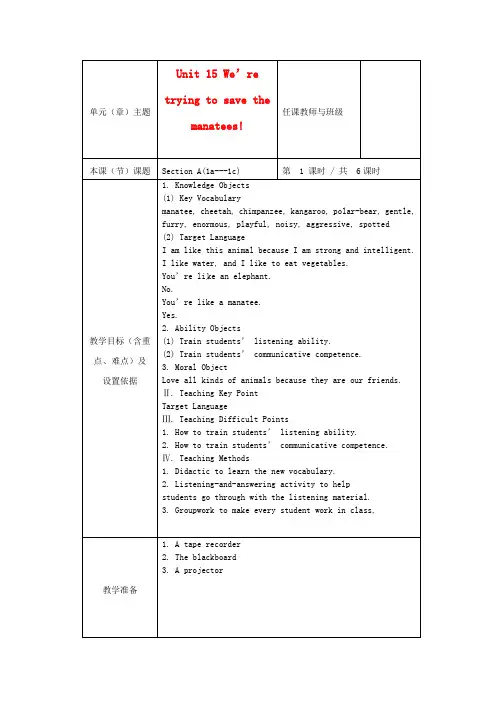
Unit 15 We’re trying to save the manatees!
任课教师与班级
本课(节)课题
Section A(1a---1c)
第1课时/共6课时
教学目标(含重点、难点)及
设置依据
1. Knowledge Objects
(1) Key Vocabulary
manatee, cheetah, chimpanzee, kangaroo, polar-bear, gentle, furry, enormous, playful, noisy, aggressive, spotted
The passive voice describes things that we don’t know who did, or we don’t care who performed the action.
The present perfect describes recent events.
Get students to think of two or three more sample sentences using each type of verb. Have several students read their sentences.
present: Weuseour books every day.
past with used to: Heused tolive in the countryside.
passive voice: Our classroomis foundat the end of the hall.
present perfect: WehavealreadyfinishedUnit 14. Wehav en’t finishedUnit15 yet.
九年级英语全册 Unit 15 We’re trying to save the manatees(

Unit 15 We’re trying to save the manat ees!第五课时 Selfcheck 复习课课型一.翻译下列动词并正确选择填空support_______;endangered__________;recycle_________;wear______;pulldown________1. Why are you________ a coat? It’s not very suitable for this hot weather.2. Our school s occer team needs more__________. They aren’t doing very well.3. Pandas are__________ animals. There aren’t many of them left.4. It’s important to_________ paper to save the trees.5. That apartment block is old and dangerous. It should be___________.二.用所给词的适当形式填空.1. Have you collected waste paper for (recycle)?2. The flowers must (take) good care of.3. She’s a very (usual) woman, she made trash recycled.4. Many old buildings (pull) down.5. He gave lots of money to the (child) Hospital.6. The dress (make) of silk.7. Don’t forget (return) the book to the library.8. He’s so tired, he should stop (walk).9. I often see him (search) the Internet.10. He’s so tired, he should stop (walk).三、根据汉语提示,完成下列句子。
九年级英语全册Unit 15 We’re trying to save the manatees-Section B 1-课件 人教新目标版

The polluted water makes the fish and animals die.
Many factories pour waste water into rivers.
What should we do to save the planet?
turn off the lights when you leave a room
not ridding in cars ridding a bike recycling paper
Things Julia will do in the future
∨
Things Julia and Jack talk about turn off the light turning off the shower stopping using paper napkins talking your own bags when shopping
recycle books and papers
Things Julia and Jack talk about ∨_turn off the light ∨_turning off the shower
_stopping using paper napkins ∨_talking your own bags when shopping ∨_not ridding in cars ∨_ridding a bike _recycling paper
plant trees
turn off the showers while you are washing your hair
save water
take your own bags when shopping
【全效学习】九年级英语全册 Unit 15 We’re trying to save the manatees(第二课时)Section A 3a-4阅读
Unit 15 We’re trying t o save the manatees!第二课时 Section A 3a-4 阅读课课型一. 背记本课单词1.适合的;适宜的a,2.极小的;微小的a.3.厌恶的;憎恶的a.4.笼子n.5.表达方式n.6.教育;培养v.7.关心;关怀(词组)8.强烈要求;竭力主张v.二.背记翻译本课词组1. write to sb.2. be against building a new zoo3. in our town4. terrible places to live5. be suitable for6. in tiny cages7. can hardly move at all8. a good way to live9. be surprised to find hardly anyone10. many endangered animals11. help to educate the public about caring for the anima l12. care for13. take care of14. agree with sb.15. disagree with sb.三.适当的词填空1. I am writing to say that I am against ________(build) a new zoo in our town.2. Zoos are terrible places _______(live) for animals.3. I have never _______(see) one I liked or one that was ________(suit) f or animalsto live in4. The animals are kept in tiny cages and can ________(hard) move at all.5. I visited our zoo yesterday and I was very surprised to find hardly _______(someone)there.四.3a 填空Dear Editor,I am writing to say that I am against 1)________(build) a new zoo in our town. Zoos are terrible places for animals 2)_______(live). I've visited a lot of 3)__ _____(zoo) in my life, and I have never 4)________(see) one I liked or one that was 5)________(suit) for animals to live in. Just last week, I 6)_______(visit) a zoo and couldn't believe what I saw. The animals are kept in tiny cages and can7)________(hard) move at all. And 8)_______(it) are only given food 9)__ ______(one)a day. Is this a good way for animals to live? I 10)_______( think) so.。
九年级英语全册《Unit 15 We’re trying to save the
We really shouldn’t use
I know. I stopped
paper napkins, you know. using them last year.
Thank you for listening!
plant trees
turn off the showers while you are washing your hair
save water
take your own bags when shopping
don’t use paper towels or napkins
stop ridding in cars
• recycle books and papers
பைடு நூலகம்
Things Julia and Jack talk about ∨_turn off the light ∨_turning off the shower
_stopping using paper napkins ∨_talking your own bags when shopping ∨_not ridding in cars ∨_ridding a bike _recycling paper
新目标 九年级 Unit 15
•Unit 15 •We’re trying to save the manatees! •Section B Period 1
Look at our earth!
We throw trash everywhere.
We humans cut too many trees.
The polluted water makes the fish and animals die.