
四年级英语下册Unit7AttherestaurantLesson6教学指导北师大版(三起)
《Unit 7 At the restaurant》第六课教学指导•Uncle Booky's storytimeStudent Book page 12•Tell the children that they are going to listen to a story.•Play the tape, ask the children to listen to the story with their books closed.•Have the children open their books, and look at the pictures.•Ask them to look for familiar words in the story.•Have children read the story silently, encourage them to try to guess the meaning of unfamiliar words.•It doesn't matter if they don't know the words. The requirement for this part is to understand the story.2.Spelling gameUse the following game to review some of this Unit's core vocabulary words and their correct spellings.•Ask the children to tell you the English name for a place where people go when they want to eat out. Elicit the word restaurant.•Write the word on the board. Now spell the word aloud as you point to each letter in turn (r-e-s-t-a-u-r-a-n-t).•Ask the children to look in their books and find a word beginning with each letter. For example:•After you have elicited a word, write it in its correct place on the board. Then spell the word aloud for the children, pointing to each letter as you do so.•You can extend this game by eliciting another core vocabulary word from this Unit and repeating the procedure.第六课1.Uncle Booky讲故事学生用书第12页•告诉学生将要听一个故事。
•放录音,让学生合上书听故事。
•让学生打开书,翻到故事这一页,让他们看图。
•让学生在故事中寻找熟悉的词语。
•学生默读故事,鼓励他们猜测生词的意思。
•这一部分的重点在于让学生整体理解故事内容,因此不对生词作要求。
2.拼词游戏这个游戏的目的是复习本单元的核心词汇以及词汇的拼写。
•让学生说出人们外出吃饭的地方的英文名称,引导学生说出单词 restaurant。
•把单词写在黑板上。
依次指着每个字母拼出这个单词(r-e-s-t-a-u-r-a-n-t)。
•让学生在书里找出以每个字母开头的单词。
•每说出一个单词,写在黑板恰当的位置上。
然后指着每个字母,给学生拼读出单词。
•可以另外选择一个本单元的核心词汇,用同样的方法继续游戏。
3.BingoThis is a vocabulary drill in the form of a game.•Have each child draw a Bingo gameboard (3×3 boxes), and take outtheir small cards for this Unit.•Tell the children to put nine cards onto the box of their game board.•Tell the class that you will call out a word. The children must findthe correct card in their set.(Make sure that you call out the words in a random order.)The children then turn over the card and say the word aloud.•Have the children call out “Bingo!”each time they have turned over a full column down their Bingo boards. Continue until all the cards have been turned over.•At the end of the game, review all the vocabularies in a class drill.4.Snap!This game reviews new vocabulary introduced in this Unit. It is best played in pairs.•Ask the children to take out their small flashcards for this Unit.•See previous unit, for the rules and procedure.5.Self-assessmentStudent Book page 13In self-assessment children need to assess themselves by their own so that they can have an idea of what they have achieved. Children can do this part by their own after class or the teacher can choose to assess the children within class time.•Ask the children to look at the pictures in the first activity. Ask if they know all of these food. Say, “I like vegetables.”“I don't like noodles.”Have children to work in pairs to talk about their preference of food with the help of the pictures. If necessary ask a confident pair to give one more example. At the end of the activity ask several pairs to check how well they could finish it.•In the second acti vity children need to finish the sentences. Say, “We are going to write out what we said just now.” Draw the children's attentionto the sentences under the pictures. Tell them to finish the sentences.The children can read out their sentences and check in pairs.6.My notes and teacher's notesStudent Book page 13•This activity helps children have a look at what they have done in this Unit. Ask them to assess themselves according to the items in My Notes individually. Explain to them that the stars here only indicate how well they have done in their learning and the stars should not be changed to scores.•The teacher should evaluate the children positively in the part of Teacher's Notes. The purpose is to have children realize that they are making progress and to help them build up a sense of achievement and confidence. Stickers provided at the end of the Teacher's Resouce Book can be used here.7.Set homeworkStudent Book page 12Tellthe children to read the story again with their parents.3.Bingo这是一个练习词汇的游戏。
•让学生画一个3×3个方格的Bingo游戏板,并拿出本单元的小卡片。
•让学生在游戏板上摆出9张卡片。
•告诉学生教师将每次读一个单词,学生要在自己的游戏板上找到正确的卡片(注意顺序一定要随机),翻过来,并大声读单词。
•当学生完成一整行或是一整列的时候喊Bingo!继续游戏直到所有的卡片都被翻过来。
•在游戏的最后,全班复习所有的单词。
4.Snap!用这个游戏复习本单元学过的词汇。
(北师大三起)四年级英语下册教案Unit7Attherestaurant
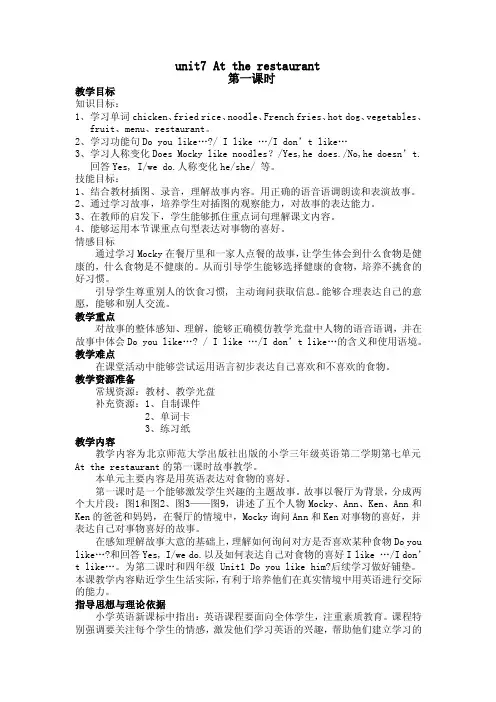
unit7 At the restaurant第一课时教学目标知识目标:1、学习单词chicken、fried rice、noodle、French fries、hot dog、vegetables、 fruit、menu、restaurant。
2、学习功能句Do you like…?/ I like …/I don’t like…3、学习人称变化Does Mocky like noodles?/Yes,he does./No,he doesn’t.回答Yes, I/we do.人称变化he/she/ 等。
技能目标:1、结合教材插图、录音,理解故事内容。
用正确的语音语调朗读和表演故事。
2、通过学习故事,培养学生对插图的观察能力,对故事的表达能力。
3、在教师的启发下,学生能够抓住重点词句理解课文内容。
4、能够运用本节课重点句型表达对事物的喜好。
情感目标通过学习Mocky在餐厅里和一家人点餐的故事,让学生体会到什么食物是健康的,什么食物是不健康的。
从而引导学生能够选择健康的食物,培养不挑食的好习惯。
引导学生尊重别人的饮食习惯, 主动询问获取信息。
能够合理表达自己的意愿,能够和别人交流。
教学重点对故事的整体感知、理解,能够正确模仿教学光盘中人物的语音语调,并在故事中体会Do you like…? / I like …/I don’t like…的含义和使用语境。
教学难点在课堂活动中能够尝试运用语言初步表达自己喜欢和不喜欢的食物。
教学资源准备常规资源:教材、教学光盘补充资源:1、自制课件2、单词卡3、练习纸教学内容教学内容为北京师范大学出版社出版的小学三年级英语第二学期第七单元At the restaurant的第一课时故事教学。
本单元主要内容是用英语表达对食物的喜好。
第一课时是一个能够激发学生兴趣的主题故事。
故事以餐厅为背景,分成两个大片段:图1和图2、图3——图9,讲述了五个人物Mocky、Ann、Ken、Ann和Ken的爸爸和妈妈,在餐厅的情境中,Mocky询问Ann和Ken对事物的喜好,并表达自己对事物喜好的故事。
北师大版英语四下《Unit7 At the restaurant》教学设计
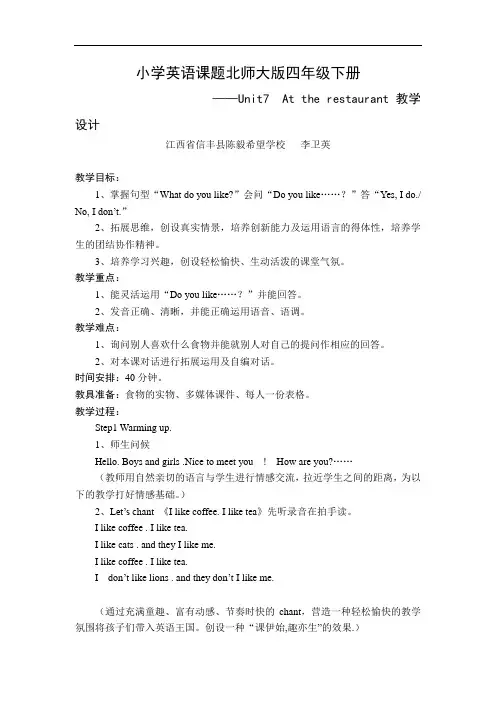
小学英语课题北师大版四年级下册——Unit7 At the restaurant 教学设计江西省信丰县陈毅希望学校李卫英教学目标:1、掌握句型“What do you like?”会问“Do you like……?”答“Yes, I do./ No, I don’t.”2、拓展思维,创设真实情景,培养创新能力及运用语言的得体性,培养学生的团结协作精神。
3、培养学习兴趣,创设轻松愉快、生动活泼的课堂气氛。
教学重点:1、能灵活运用“Do you like……?”并能回答。
2、发音正确、清晰,并能正确运用语音、语调。
教学难点:1、询问别人喜欢什么食物并能就别人对自己的提问作相应的回答。
2、对本课对话进行拓展运用及自编对话。
时间安排:40分钟。
教具准备:食物的实物、多媒体课件、每人一份表格。
教学过程:Step1 Warming up.1、师生问候Hello. Boys and girls .Nice to meet you ! How are you?……(教师用自然亲切的语言与学生进行情感交流,拉近学生之间的距离,为以下的教学打好情感基础。
)2、L et’s ch ant 《I like coffee. I like tea》先听录音在拍手读。
I like coffee . I like tea.I like cats . and they I like me.I like coffee . I like tea.I don’t like lions . and they don’t I like me.(通过充满童趣、富有动感、节奏时快的chant,营造一种轻松愉快的教学氛围将孩子们带入英语王国。
创设一种“课伊始,趣亦生”的效果.)Step 2 Presentation1、课件显示图片,借助图片复习下列单词。
food fruit vegetable chicken a restauranthot dog French fries fried rice noodles a corn①Read the cards②闪读课件在个大转盘里出示图片,图片的速度很快,在学生眼前一闪,让学生马上说出单词,看谁的单词记得最熟,谁反应最快。
2023年北师大版四年级英语下册Unit7AttherestaurantLesson2教案

Lesson 2教学内容:1.Structures:I like (chicken).I don’t like (corn).Ken likes (fruit).Vocabulary:Core: food, fruit, vegetables, chicken, a hot dog, French fries, noodles, fried rice,a hamburger, a corn, a restaurant, a menu教学目标:正确掌握不同人称的表示方法。
教学重点:第三人称的表示方法。
教学难点:like在不人称后的用法。
教具准备:本单元的教学卡片教学过程:1.复习:(1)复习本单元的教学卡片。
拿起restaurant的卡片,提问:“What’s this?”引导学生回答:“It’s a restaurant.”(2)用同样的方法复习menu, hot dog.(3)拿出vegetables的卡片。
问:“What are these?”引导学生回答:“They are vegetables.”(4)拿出fruit的教学卡片,让学生说出正确的名称。
2.学单词学生用书第4页(1)让学生将书翻到第4页,看该页上部的图。
把这一页给学生展示。
依次指每一幅图,引导学生说出已学过的单词。
(2)指着hamburger的卡片。
示范朗读该词并让学生跟读。
(3)用同样的方法学习fried rice, hot dog, corn.(4)再放一遍录音,每个单词后停顿,让学生跟读。
3.听一听学生用书第4页(1)让学生看第4页下方的图片。
指着Ken的图片提问:“Who’s this?”引导学生回答:“It’s Ken.”(2)指着同一幅图片中碗里的水果,提问:“What’s this?”引导学生说出来词fruit.(3)用同样的方法完成其他图片。
(4)告诉学生根据听到的录音找出相对应的图片。
(5)放录音,每句话后停顿,让学生指出相对应的图片,确保每个学生都能做对。
【北师大版】四年级英语下册:Unit 7 At the Restaurant 第一课教案及反思
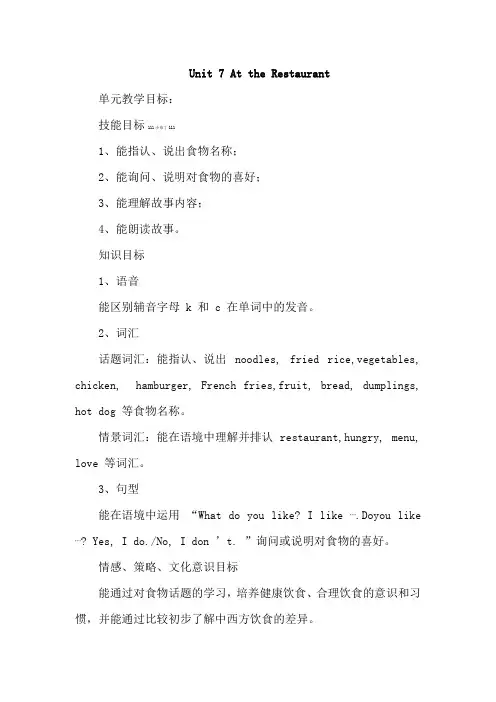
Unit 7 At the Restaurant单元教学目标:技能目标111小布丁1111、能指认、说出食物名称;2、能询问、说明对食物的喜好;3、能理解故事内容;4、能朗读故事。
知识目标1、语音能区别辅音字母 k 和 c 在单词中的发音。
2、词汇话题词汇:能指认、说出noodles, fried rice,vegetables, chicken, hamburger, French fries,fruit, bread, dumplings, hot dog 等食物名称。
情景词汇:能在语境中理解并排认 restaurant,hungry, menu, love 等词汇。
3、句型能在语境中运用“What do you like? I like ⋯.Doyou like ⋯? Yes, I do./No, I don ’t. ”询问或说明对食物的喜好。
情感、策略、文化意识目标能通过对食物话题的学习,培养健康饮食、合理饮食的意识和习惯,并能通过比较初步了解中西方饮食的差异。
单元内容分析本单元话题是食物,属于《标准( 2011 年版)》中“饮食”的话题项目。
三年级教材中的“ Fruits ”和“Vegetables ”等单元都属于该话题,而且说明个人喜好的句型“ I like beans. ”以及noodles 等相关词汇在前面的学习中也已渗透。
教师可以结合这些相关内容,引导学生学习新语言。
在语境中学习和使用“ What do you like? I like/I don’t like ⋯.Do you like ⋯? Yes, I do./No,I don’t. ”询问和回答对食物的喜好是本单元主要语言学习内容。
以上主要句型都是在 Mocky 和Ken一家人到餐馆就餐,相互询问喜欢什么食物的过程中自然呈现。
Mocky 想知道Ken和Ann喜欢什么食物,于是引出了“What do you like? I like ⋯,”句型。
四下师大英语Unit 7 At the restaurant Lesson 6 教案备课

Unit 7 At the Restaurant Lesson 6教案教学目标:1、能说明自己是否喜欢某食物;2、能指认食物的图片,抄写单词;3、能区别辅音字母k和c在单词中的不同发音;4、能阅读Uncle Booky’s Storytime小故事,了解故事大意。
教学重点:1、复习本单元核心句型和词汇;2、复习本单元所学字母发音。
教学难点:回顾、评价本单元学习过程与效果。
教具准备:配套教学光盘,教学卡片。
教学建议:Get Ready(1)播放录音,让学生演唱本单元的歌谣和歌曲。
(2)游戏:让一个学生通过动作模仿或表演喜欢某种食物,其他的学生猜这位学生喜欢什么食物。
S1: Do you like chicken?Talk about the following food.(1)让学生看插图,指一指、说一说这些食物的名称。
然后相互说一说各自喜欢什么食物。
(2)可以让学生说一说本单元还出现了哪些食物,复习相应的词汇。
(3)让学生说一说这些食物哪些属于中餐、哪些属于西餐。
(4)指插图下面的句子,让学生选择词汇补全句子。
(5)让学生读一读他们写出的句子。
Look at the pictures and complete the sentences.(1)让学生看图片,说一说都有哪些食物。
(2)让学生读一读图片下面的句子,独立补全句子。
(3)让学生读一读写出的句子。
Group the words.(1)让学生独立读一读语音单词,并注意区别阴影部分字母的发音。
(2)让学生看阴影标出的字母,根据字母的发音把单词写到相应的方框里。
(3)让学生读一读每个框里的单词,全班一起核对答案。
(4)让学生说一说是否还知道其他含有字母k和c的单词,并说出字母k 和c在单词中分别发什么音。
Self-assessment(1)让学生说一说本单元主要学习了哪些内容。
(2)根据单元主要内容,让学生说一说他们是否能在不同情景中询问、猜测和说明彼此对食物的喜好。
北师大版(三起)四下Unit7Attherestaurantword教案

北师大版三年级英语下册Unit7 At the restaurant教案各位老师,大家好!以下是我修改的北师大版小学英语三年级下第七单元At the restaurant北师大版小学英语三年级下第七单元At the restaurant第三课时对话教学指导思想与理论依据:《新课标》倡导以“主动、探究、合作”为主要特征的学习方式,倡导学生的积极参与,让学生在学习的过程中建构知识,提高语言的能力,通过感知、体验、实践、参与和合作等活动方式,完成任务,实现目标。
教学背景分析:1、备教材:本节课的教学内容是北师大版小学英语三年级下第七单元At the restaurant 第三课时,主要教学内容包括Talk together、Listen and number和Read, Trace, and Copy三个板块,Talk together中重点语句是Do you like ….?Yes, I do.\ No, I don’t.I like… I don’t like…. 拓展语句是What do you want to eat? 和I will have some fried rice. Listen and number是让学生听句子给图片标顺序。
检查学生对句子和对单词的听力理解。
Read, Trace, and Copy检查学生对单词的书写,和句子在不同情景的运用。
在学习了本单元的故事和重点句型结构Do you like ….后,学习此对话,学生能够在语境中理解对话的意义,并通过初步朗读、表演对话的形式强化对话的应用,再通过Listen and number的操练与巩固,学生能在教师设置的相似情景中,初步简单使用对话进行交际。
所以,结合对教材的分析,我认为第三课时应属于一节操练巩固课。
2.备学生:A.学生情况分析:三年级的学生,正处在从低年级向高年级过渡阶段,整体特点较活跃,思维活泼富有表现力。
但是,学生在课堂学习中依赖心理还较强,所以,教师在教学实施过程中,应处理好“主导与主体”的关系。
小学英语北师大版四年级下册Unit 7 At the Restaurant公开课优质课教案比赛讲课获奖教案
小学英语北师大版四年级下册Unit 7 At the Restaurant《Lesson 1 What do you like?》公开课优质课教案比赛讲课获奖教案1教学目标知识与技能。
能听,会说,拼读词汇:noodles, chicken, vegetable, bread,fruit.会认读hamburger, French fri es, fried rice。
能用句型“what do you like ?”“I like.....”来询问别人喜欢什么及表达自己的喜好。
能听懂并理解课文内容,根据掌握的文本信息完成各种课堂活动预设。
结合实际,能用已有的知识储备,写简短的句子或对话表达情感。
2.学习策略利用小组合作学习的方式,培养合作意识,引导学生积极与他人合作交流共同完成学习任务。
鼓励学生结合实际,对所学的内容进行归纳和运用。
学会在学习中获取关键信息的能力。
3.情感态度培养学生学习英语的兴趣和积极参与小组活动,养成乐观开朗善于表达的性格。
养成健康饮食,合理搭配食物的好习惯。
渗透热爱家乡,当地的特色食物也是一种文化的传承方式。
2学情分析四年级学生仍处在直观形象思维阶段,活泼好动,对课堂中的游戏和竞赛等活动兴趣浓厚。
有强烈的好奇心和和求知欲。
之前他们已有一年多的英语学习基础,积累了一定词汇和简单交流的能力。
喜欢与他人交流合作。
因此,教师在课堂里要积极调动学生已有的知识储备,创设各种活动。
提供语言使用的平台来培养学生用英语表达交流的能力。
3重点难点能在实际中指认食物单词及运用“what do you like ?”“I like.....”来询问别人喜好和表达自己的喜好。
4教学过程教学活动1【导入】过程Step1 Warming-up and lead-in (5mins)Greetings.T:hello,boys and girls .Each group has a menu and some food cards., if you do well. you can get some cards on it.sing s song: I like fruitT:boys and girls, please stand up and clap your hands.I like bananas, I like apples, I like oranges....。
【最新】北师大版四年级英语下册Unit7AttherestaurantLesson1教案
Unit 7 At the restaurantLesson 1教学内容:1、Structures (New)What food do you like?I like (chicken).Do you like (fruit)?Yes, I do. / No, I don’t.2、VocabularyCore: a restaurant, a menu, food, fruit, vegetables, chicken, a hot dog, French fries, a hamburger, fried rice, noodles, a cornContextual: Here’s the restaurant.教学目标:掌握询问对方喜欢什么食品的句型。
教学重点:(1)掌握句型的正确运用。
(2)熟练读出单词。
教学难点:(1)like的正确理解。
(2)个别单词的发音及意思。
教具准备:1、学生卡片2、准备本单元的教学卡片教学过程:1.情景引入(1)问学生,他们是否有最喜欢的餐厅。
问他们通常会点什么菜。
试着引导学生说出“鸡肉”和“蔬菜”,把汉字写在黑板上。
(2)指着“鸡肉”说:“这个词对应的英语是chicken”,并写在旁边。
给学生示范,让学生跟读。
(3)用同样的方法学习vegetables。
(4)给学生解释“food”的意思,把单词写在黑板上,示范朗读,让学生跟读。
(5)展示本单元的教学卡片。
拿出教学卡片restaurant。
给学生示范朗读,让学生重复。
(6)用同样的方法学习单词menu, fruit, fried rice, corn, noodles, hot dog。
2.示范句型(1)在黑板上写出句子What food do you like?指着每个单词给学生示范朗读这个问句。
解释句子的意思让学生跟读。
(2)呈现I like(hot dogs)和I don’t like (chicken).(3)呈现问句Do you like (fruit)?和回答Yes, I do. No, I don’t.(4)用同样的方法呈现其余的句型。
外研版(三起)-英语-四年级下册-【推荐】Unit 7 At the Restaurant 教案
《At the restautant》第三课时
反思:本节课主要采用对话式教学,活动的设计围绕着知识目标、技能目标和情感目标而定,注重主体框架句型的操练与扩展。
尤其注意引导学生多听说突破音难、多在情景中交际运用对话突破语言运用。
因为是四年级的学生,我比较注重语言实践能力的培养,拓展应用环节主要落实技能目标的语用能力。
从学生掌握情况看主体句型对话及回答,操练方式及参与面较多,总体上掌握不错,词汇能够正确拼读,会区别使用句型。
但是在联系生活实际的拓展练习时效果不是很好。
我的预设不够充分,应该设计更为丰富的有针对性的活动让更多人在这个环节参与课堂。
北师大版-英语-四年级下册-4B Unit 7 At the restaurant 第五课教学指导
《Unit 7 At the restaurant》第五课教学指导Preparation•You will need flashcards for this Unit.1.Review•Review the flashcards for this Unit. Hold up the flashcard for restaurant. Elicit the correct word from the children.•Re peat the procedure for other flashcards.2.Read and checkStudent Book page 10•Have the children open their books at page 10. Show your copy of the page. Explain that you will read the questions and answers together. Tell the children that only one answer is correct for each question.•Point to the first picture. Ask the children what Ken is eating. Elicit the word,chicken. Read the first question aloud. Have the children repeat the question as they touch each word in their books.•Repeat the procedure for the first answer. Then ask the children if the answer is correct. The children should say, “Yes.”• Now read the second answer. Again, ask if the answer is correct. The children should say, “No.”• Have the children check (√) the box next to the correct answer.• Repeat the procedure for the other questions and answers.第五课教具准备:•本单元的教学卡片1.复习•用教学卡片复习本单元的单词。