
外研版七年级英语下册Module 4 Unit 1教案
Module 4 Life in the future
Unit 1 Everyone will study at home.
一、教学目标:
【语言知识目标】
1) 掌握本单元所学单词和短语:chalk, ruler, carry, change, everything, in the future, life, will, maybe, ask, by, be able to, not...any more...
2) 能听懂谈论未来的简单对话,能判断未来事实。
【情感态度目标】
通过对未来美好的憧憬,培养学生积极乐观的精神。
二、教学重难点
1. 教学重点:以谈论将来生活为中心,介绍并询问有关将来生活的信息。
2. 教学难点:一般将来时will 的陈述句,否定句,一般疑问句及回答。
三、教学过程
Step 1 Warming up
Give some pictures and videos about the schools in the future to students. Let t hem watch it.
Step 2 Work in pairs.
Look at the picture of Activity 1 and use the words in the box to help you describe it. Step 3 Listening
Listen and choose Lingling’s answers to the questions.
carry change everything future life need will
1. Will our life be different in the future? Yes, it will. / No, it won’t.
2. Will our school change? Yes, they will. / No, they won’t.
3. Will everything be different? Yes, it will. / No, it won’t.
4. Will students need computers at school? Yes, they will. / No, they won’t.
5. Will they carry lots of books to school? Yes, they will. / No, they won’t. Step 4 Listen and read.
able any more free level maybe need question telephone Betty: We’ll always (1) _____ teachers because computers will never be (2) _____ to check the students’ (3) ______ and answer th eir (4) _____ by (5) _____or Internet. Will students need to go to school (6) _____? Yes, (7) _____ they will, because school is good fun, but everyone will have lots of (8) ______ time.
Step6 Work in pairs.
Ask and answer the questions.
1. Will schools be different in the future?
2. Will students use books in the future?
Step7 Work in pairs.
Talk about what your school will be like in ten years.
— We will study at home and only go to school for sports and games.
— Well, this is good, but I’ll miss my teachers and friends.
Step8 Language Points
1. In 20 year’s time, maybe there won’t be any schools.
句中的“in +一段时间”表示“一段时间之后”,常用于将来时。
可以用how soon 来提问。
e.g.—How soon will you be back? 你多久回来?
—In a week. 一周之后。
2. They can ask their teachers questions by Internet, telephone or email.
句中的“by”表示方式,意思是“用……,靠……,通过……”。
e.g.1)Send it by air mail. 用航空邮件寄吧。
2)They want to travel by train. 他们想乘火车旅行。
puter won’t be able to do that.
be able to的意思是“能够,会,胜任”,相当于can,与can 相比,be able to可以用于更多的时态中。
e.g. 1) I’m able to swim. = I can swim. 我会游泳。
2) He was able to write when he’s three. = He could write when he’s three.
他三岁就会写字了。
4. Teachers won’t use chalk on a blackboard and students won’t use pen and paper, or erasers anymore!
not ... any more的意思是“不再”。
e.g.1)He isn’t a child any more. 他不再是小孩子了。
2) I won’t do that any more. 我再也不那样做了。
Step9 Homework
Review and recite the important points of Unit 1.
教学反思。
Module4Unit1教案2023-2024学年外研版七年级英语下册

一、导入新课(用时5分钟)
同学们,今天我们将要学习的是《Module 4 Unit 1 How much is it?"》这一章节。在开始之前,我想先问大家一个问题:“你们在日常生活中是否遇到过购物时需要询问价格的情况?”(举例说明)这个问题与我们将要学习的内容密切相关。通过这个问题,我希望能够引起大家的兴趣和好奇心,让我们一同探索如何用英语表达价格和进行购物交际的奥秘。
2.购物场景的交际用语:如何在购物场景中熟练运用所学交际用语,如"I'd like...","How much is it?","I can afford..."
难点:
1.价格的表达方式:学生对于不同货币的表达和换算可能存在困难。
2.购物场景的交际用语:学生在实际运用中可能不知道如何正确开口,或者对于一些表达不够自信。
3. They are twelve euros.
2.填空题:
a. The shirt is ______.
b. I'd like ______ apples, please.
c. How much is ______?
3.对话填空:
a. A: How much is this book?
B: ______.
本节课的核心素养目标主要聚焦于语言能力、文化意识、思维品质和学习策略四个方面。
1.语言能力:通过本节课的学习,学生能够准确地表达价格,并在购物场景中熟练运用所学交际用语,提高其在实际生活中的语言运用能力。
2.文化意识:通过学习购物场景中的交际用语,学生能够了解并体会不同文化背景下的购物习惯和交际方式,提高其对文化差异的敏感性和理解能力。
七年级英语下册 Module 4 Unit 1 Everyone will study at home教案 (新版)外研版
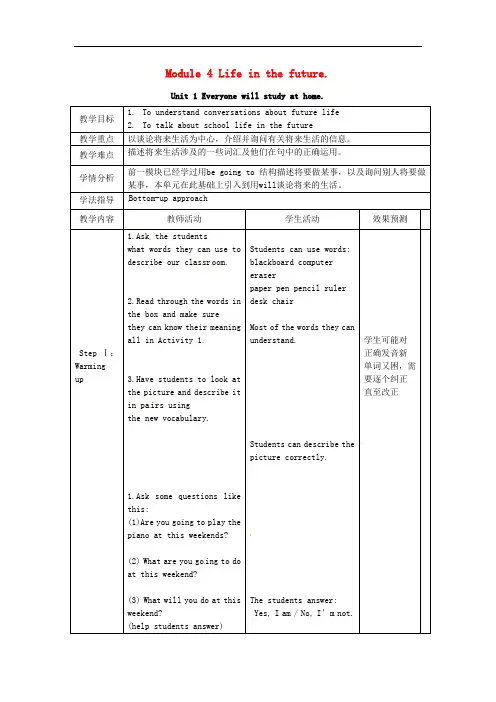
8.play the recording again and ask students to check the correct boxes.
paper pen pencil ruler desk chair
Most of the words they can understand.
Students can describe the picture correctly.
The students answer:
Yes, I am / No, I’m not.
(1)Are you going to play the piano at this weekends?
(2) What are you go ing to do at this weekend?
(3) What will you do at this weekend?
(help students answer)
I’m going to do
my homework
…….
I will do my homework
at is weekend.
Students practise
the struc ture like this:
I w ill play football
this afternoon……
Students look at the questions and elicit the answer
教学内容
教师活动
新外研版七年级下册英语 Module 4 Unit 1 教案(教学设计)
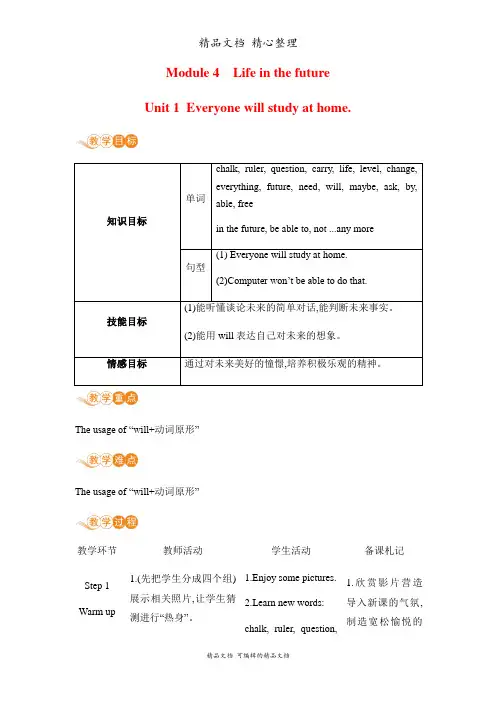
Module 4Life in the future Unit 1 Everyone will study at home.chalk, ruler, question, carry, life, level, change,The usage of “will+动词原形”The usage of “will+动词原形”教学环节教师活动学生活动备课札记Step 1Warm up1.(先把学生分成四个组)展示相关照片,让学生猜测进行“热身”。
1.Enjoy some pictures.2.Learn new words:chalk, ruler, question,1.欣赏影片营造导入新课的气氛,制造宽松愉悦的2.利用多媒体呈现单词:chalk, ruler, question, carry, life, level, change, everything, future, in the future, need, will, maybe, ask, by, able, be able to, more, not ...any more, free。
Show sentences and ask: What is he going to do?3.Show activity 1 by showing some pictures.T:Look at these pictures. What is it?Teach something else in the same way. carry, life, level,change, everything,future, in the future,need, will, maybe, ask,by, able, be able to,more, not ...any more,free。
3.Learn importantsentences.环境。
2.分组活动,设计培养学生小组合作学习,让学生合作并相互帮助学习,形成团体合作及竞争意识。
外研版英语七年级下册Module 4 Life in the future Unit 1表格式教案
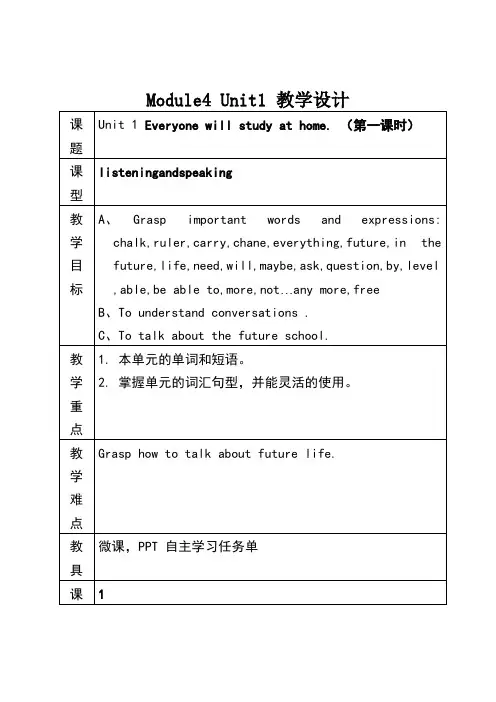
A; 抄写本课单词,短语5遍在作业本上。
B,C :Read and translate the conversaion。
B,C: Do some exersice。
板书Leabharlann 设计Module4 Life in the future
Unit1Everyone will study at home.
5.Ask the students to read the conversation silently.
Step6 Finish part 3
1. Read the conversation by themselves .
2. Complete the table.
3. Check the answer
3. Explain some important sentences and the students keep notes.
Step5Listen and read.
1. Ask the students to read the questions on the blackboard carefully.
2.Make a conversation with their partner, and show out.
3.Wtire their conversations on the exercise books.
Step4 Finish part 1
1.Work in pairs.Look at the picture anddescribeit. Use the words in the box to help you.
A.重点短语:
1.in the future
外研版英语七年级下册Module 4 Life in the future Unit 1教案

Module 4 Lifein the futureUnit 1 Everyone will study at home.1.教学目标1.To master the new words and expressions.2. Learn to talk about life in the future.2.学情分析学生上个模块已经学习过“be going to”结构的一般将来时,但没有系统学习过“will do sth”结构的一般将来时3.重点难点1.重点:To learn the grammar knowledge of Future Simple Tense (will+V.).难点:To cultivate the ability of expressing opinions by using Future Simple Tense (will+V.).2.Target language:(1) --- What will life be like in the future?---Everyone will study at home.4. 教学活动Step 1. Leading inThe teacher takes a picture of the classroom,then Ss discuss the classroom .Step 2. V ocabulary1.Game: Find new words.(让学生圈出新单词)2.(Activity 1) Look at the picture and describe it. Use the words in the box.Show a picture of a classroom in the future to Ss and talk about it.E.g. T: Look at the picture ,do you like this classroom?S: Yes,I do.T:Do you like this classroom or our classroom more?S: I like this classroom because it is more beautiful ... .Step 3. Listen and read1. (Activity 2) Listen and choose Lingling’s answers to the questions.2. Listen and check(√) the students’ideas about the future.3 .Listen again and complete the sentences.4 .(Activity 3)Watch a cartoon first. Read the conversation after the recording and play it in different roles. ( Group competition)学生跟读音频一遍后,接着进行小组之间的分角色朗读比赛。
外研版七年级下册Module 4 Life in the future Unit 1教案

Unit 1 Everyone will study at home一、Teaching materials:Unit 1 Everyone will study at home. (Module 4 Life in the future)二、Targets for this period:To understand conversations about future schoolsTo process information of future life in the listening materialTo talk about the prospect of one’s own life.三、Key points:Key vocabulary—cable TV, calculator, cell phone, chalk, Internet, satellite, everyone, no oneKey structures--will + do四、Teaching methods:Interactive approach五、Teaching aidsTape recorder, computer六、Teaching arrangements:Step One Lead-in1. Introduce “everyone, no one” by using a few examples that are true.2. Remind the students that “everyone” and “no one” take a thir d person singularverb.3. Ask the students to make sentences by using everyone and no one.e.g. Everyone is a girl. (肯定)Everyone isn’t a girl. = Not everyone is a girl. (部分否定)No one is a girl. (完全否定)Step Two Pre-Listening1. Memory game: show the new words to the students.2. Let the students talk about the things which the teacher shows to them like this“I use a computer to send emails”3. Ask the students to make a survey “What do you use to study?”, then report theresult to the whole class.Handout:Make a survey: What do you use to study?The things we have: computer, calculator, ruler, TV set, dictionary…Step Three Listening and introducing1. Read through the sentences in the chart in Activity 4 and make sure that theyunderstand the sentences.2. Ask the students to listen to the dialogue and finish the exercises in Activity 4.3. Collect the answers from the class.4. Introduce the structures: a. will+do b. will not do=won’t do c. Will…do..?5. Ask the students to practice the structures.Step Four Discussing and listening1. Ask the students to have a discussion about:Will there be teachers in the future?Will students read books in the future?Will teachers use a blackboard and chalk in the future?2. Ask the students to listen to the dialogue and finish the exercises in Activity 6.3.Collect the answers from the class, having one student ask and another studentanswer each question.Step Five To read aloud the conversationStep Six Pair working1. Ask the students to think about : If you meet an alien, what will you do?2. Pair them to discuss their ideas.3. Ask the students to say out their ideas individually.4. Listen to a song Que Sera Sera, fill in the missing words of the song, then pointout the theme of the song is “Everyone wants to know what they will be in the future.”Homework:Talk about: What will you be in the future?1.Will you be rich/famous? Why?2.Will you have a happy/interesting life?3.What will your home be like in the future?。
英语外研标准版七下教案4 Module 4 Unit 1
Module 4 Life in the future.Unit 1 Everyone will study at home.教案4 Teaching target: To learn the new wordsStudents will go…Will students go…?Yes, they will./No, they won’t.Teaching points: will + verbTeaching difficulty: find the differences between be going to and will+ verb Teaching method: Five –step Teaching Method and Task—based Method. Teaching aids : computer, tape—recorder, blackboardTeaching plan:Step 1.To learn the new wordsRead these words:blackboard calculator computercable TV chalk Emailradio ruler dictionarycell phone Internet satellite TVpaper pen pencilStep 2. Which words can you use to describe your classroom?I use a pen and a dictionary to study English.I don’t use a calculator to study EnglishStep 3Everyone will study at home.They will use the Internet.They will send their homework to the teacher by email.Students will talk to their teacher on their computers.Everyone will have a computer on their desk.I think students will use computers.They will read books.The teachers won’t write on a blackboard. Step 4 PracticeWork in pairs and answer the questions.—What are you looking forward to?—What are you going to do?—Why are you going to do it?Choose the best answers to the questions. Step 5. They will use the Internet.They won’t use….Will they use…?Yes, they will./ No, they won’t.Step6. Homework.。
外研版七年级英语下册教学设计Module 4 Unit 1 第1课时教案
Module 4 Life in the future模块分析本模块以未来生活为话题。
第一单元主要谈论未来的学校,内容主要以对话的形式呈现,要求学生用目标词汇比较自己所在教室与未来教室的异同,学会使用will来描述自己想象中的未来学校和未来教室。
第二单元内容主要以语篇的形式呈现,以学生作文的方式描述了未来生活中环境、气候、旅行和假期等方面的变化。
关于对未来生活的描述每个人的想象都不同,因此这一话题很容易激发学生对课本内容的讨论。
既有利于学生更好地运用课本知识,又能达到提高学生的综合语言运用能力的目的。
Period 1 Unit 1 Everyone will study at home.(1-3, 7-8) 第一课时是听说课,重点在于训练学生使用一般将来时will来介绍未来教室和未来学校的口语表达。
教学目标1. 词汇:chalk, ruler, carry, change, everything, future, in the future, life, need, will, maybe, ask,question, by, level, able, be able to, not…any more, free2. 句型:(1) Everyone will…(2) —Will students…? —Yes, they will. / No, they won’t.3. 能听懂谈论未来的简短对话并判断未来事实,能用will表达自己对未来的想象;4. 了解未来生活会带给我们的变化,让学生有危机感;并通过对美好未来的憧憬,培养乐观向上的精神。
教学重难点【教学重点】学会准确使用一般将来时的基本句型“will + do”描述未来的学校生活。
【教学难点】在对未来的事实或对将来进行预测时能正确使用的一般将来时,使语法知识的学习融入生活实践中。
教学过程Step 1. Warm-up1. Show some pictures of daily activities. Say what they are going to do this weekend.2. Learn the new expressions.(设计意图:通过复习上一模块有关一般将来时be going to的提问与回答,引出本模块一般将来时的另一种表达:will,从而激发学生学习兴趣。
外研版英语七年级下册MModule 4 Life in the future Unit 1 教案
Module 4 Unit 1 Everyone will study at home.一、Lead in—What are you going to do this weekend?—I am going to ….Students do an Ask and Answer practice using the above 2 sentences.(In order to describe our weekend plan, let’s learn another form of simple future tense, so let’s learn the new lesson: Module 4 Unit 1 Everyone will study at home. Let’s see the goals of this lesson, after this lesson; you need to master the 2 points. )二、learn the words1.To read the words after the teacher: chalk, ruler, carry, change,everything, future, life, need, etc2.To give 1 minute to recite the words3.To finish the following exercise(1).There is a r____ and an eraser in her pencil bag.(2). What will you want to be in the f_____?(3). He is a____ to speak English.(4). M____ he can’t understand me.(5). If you don’t understand, you can a___ me.三、learn the dialogue1. To translate the following questions (to make the next stepeasier)(1). Will schools be different?A. Yes, they will.B. No, they won’t.(2). Who will check students’level?A. ParentsB. Teachers(3). Will students have a lot of homework to do?A. Yes, they will.B. No, they won’t.2. To listen to the dialogue and finish the questionsKey: A B B3. To read in groups4.To show in groups5.To show as a whole class6.To translate the following phrases在未来……20年内在家交朋友能(做……)不再……通过络……空闲时间7.To play a game --- PresentsStudents who answer the questions right can only do half of the homework!(1). He wants to be a doctor ___ ___ _____.(在将来)(2). The class will begin in 2 minutes.(划线提问)____ ____ will the class begin?(3). When I am on summer holiday, I have a lot of ____ ____.(空闲时间)(4). I want to ____ _____ with Dai Qiwen, because she is so kind. (交朋友)(5). Lily is can to/ able to ride a bike.(6). Now, we can ask teachers questions by Internet / at Internet.四、Grammar1. To observe the following sentences and summarize the sturctures of the simple future tense with “will”(1) Everyone will study at home.(2) Students will use computers and get information on the Internet.(3). Computers won't be able to do that.Affirmative sentence :主语+ will + do + 其他Negative sentence:主语+ will +not+ do + 其他2. To make sentences with “I will/ won’t ”For example: I will go over my lessons.She will go to date with her friends.3.To observe the following sentences and summarize thegeneral questions’sturctures of the simple future tense with “will”(1) Will students have a lot of homework? No, they won’t.(2) Will students study at home? Yes, they will.General question: Will + 主语+ do +其他?Yes, sb. will. / No, sb. won’t.4.To make sentences with “Will sb. do ……For example: Will you have a rest at this weekend?Yes, I will. No, I won’t.5.To have an oral practice—What will you do this weekend? —I will ……—Will you ……—Yes / No, ……三、Make a summaryWords: chalk, ruler, carry, change, everything, future, life, need, will, maybe, question, by, level etcGrammar: Everyone will study at home.Will everyone study at home?Yes, they will./ No,they won’t.四、Test1. The panda ____ a baby in a few weeks.A. will haveB. has hadC. hadD. is going to be2. We don’t have food. I ___ and buy some.A. goB. wentC. will goD. was going3. She can’t speak English. But she ____ speak Chinese.A. is able toB. able toC. is able4. ---___ will the class begin? --- In 10 minutes.A. How oftenB. How soonC. How long。
外研版七年级英语下册 Module 4 Unit 1教案 (2)
Module4 Unit1教案教学目标1.语言知识目标:掌握下列单词: chalk, ruler, question, carry, life, level, change, everything, future, in the future, need, will,maybe, ask, by, able, be able to, more, not ...any more, free2. 语言技能目标:1)能听懂谈论未来的简单对话,能判断未来事实。
2)能用will表达自己对未来的想象。
3. 情感目标:通过对未来美好的憧憬,培养积极乐观的精神。
教材分析本模块以学校为题材,要求学生想象未来学校的样子,通过对未来学校的描述,学习和掌握时态——一般将来时。
本模块的主要语法是一般将来时,教学重点是通过对未来学校的想象和描述,重点学习本模块中出现的重点词汇、短语、固定搭配和句型。
课前准备一段有关于未来学习视频,让学生观看。
围绕未来学校和未来生活这一话题展开听说读写的全面训练,使学生熟悉一般将来时并逐步开始这个时态。
教学过程Step 1:Warming upGive a video about the schools in the future to students. Let them watch it.Step 2:Read the words and expressions for today.Step 3:Listen and choose Lingling’s answers to the questions.Listen carefully and fill in the blanks using “will” or “won’t”.1. Our life be different in the future.2. Everything be different.3. Students use computers at school.4. They need lots of books to school.Step 4:General listening: Listen and answer the question. Will students have a lot of homework to do?Step 5:Careful listening:1.Listen to the part of Daming’s opinion and answer the questions.2.Listen to the part of Betty’s opinion and answer the questions.Step 6 : Reading.Listen and read the Activity 3. And then check (√) the students’ ideas about the future in the box of the Activity 3.Step7:Role-playRead the dialogue in different roles.Step8:Discussion.Work in groups. Imagine and discuss what yourschool will be like in ten years.Step13:Homework1.Write down your imagination about school in the future.2.Recite new words and dialogue.。