
英语文体学教程_教案
2. From the beginning of the 1930 to the end of the 1950s stylistics was developing slowly and was only confined to the European continent. During this period, the Russian formalists, the Prague School and the French structuralists all contributed to the development of stylistics.
The development of stylistics 1. Modern stylistics got its development in the 19th and 20th centuries from rhetoric and from the interpretation of literature. The first book on stylistics was written by a French scholar Charles Bally, student of F. D. Saussure in 1902, was considered a landmark of modern stylistics. Later, Spitzer, a German scholar began to analyze literary works form a stylistic point of view, and was often considered as the ―father of literary stylistics.
3. From the end of 1950s to the present time, modern stylistics reached its prosperity. This can be further divided into roughly four periods: a. From the end of the 1950s to the end of the 1960s, formal stylistics prevailed. b. The second period is the 1970s, in which functional stylistics predominated. c. In the 1980s, discourse stylistics flourished. d. In the 1990s, the socio-historical/ socio-cultural stylistics or contextualized stylistics developed quickly.
Stylistics
is the study of varieties of language whose properties position that language in context. For example, the language of advertising, politics, religion, individual authors, etc., or the language of a period in time, all belong in a particular situation.
Chapter 1 I. Definition of stylistics ―The study of that variation in language which is dependent on the situation in which the language is used. Although stylistics sometimes includes investigation of spoken language, it usually refers to the study of written language, including literary texts. Stylistics is concerned with the choices that are available to a writer and the reasons why particular forms and expressions are used rather than others.‖ (Longman Dictionary of Language Teaching & Applied Linguistics)
Widdowson provides a more informative definition: ―By stylistics, I mean the study of literary discourse frotake the view that what distinguishes stylistics from literary criticism on the one hand and linguistics on the other is that it is essentially a means of linking the two‖
G. Leech defines style as the study of the use of language in literature, a meeting-ground of linguistics and literary study.
In short, stylistics is defined as the study of discourse or text on the basis of modern linguistic theories.
Stylistics
also attempts to establish principles capable of explaining the particular choices made by individuals and social groups in their use of language, such as socialisation, the production and reception of meaning, critical discourse analysis and literary criticism.
英语文体学教案LecturefiveDeepstructuredeviation
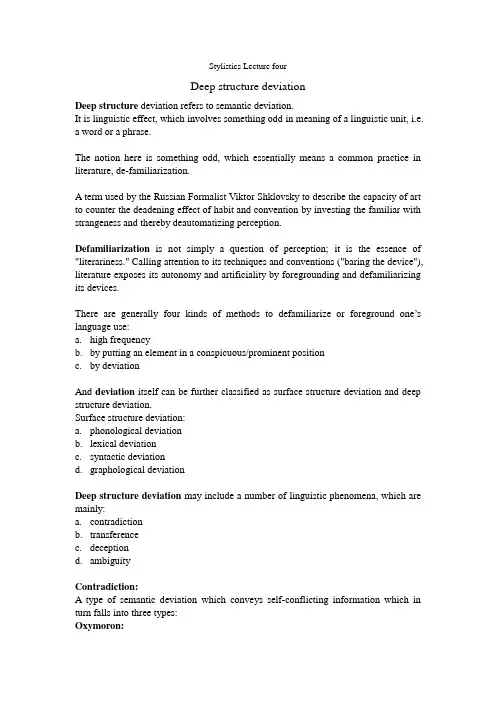
Stylistics Lecture fourDeep structure deviationDeep structure deviation refers to semantic deviation.It is linguistic effect, which involves something odd in meaning of a linguistic unit, i.e.a word or a phrase.The notion here is something odd, which essentially means a common practice in literature, de-familiarization.A term used by the Russian Formalist Viktor Shklovsky to describe the capacity of art to counter the deadening effect of habit and convention by investing the familiar with strangeness and thereby deautomatizing perception.Defamiliarization is not simply a question of perception; it is the essence of "literariness." Calling attention to its techniques and conventions ("baring the device"), literature exposes its autonomy and artificiality by foregrounding and defamiliarizing its devices.There are generally four kinds of methods to defamiliarize or foreground one’s language use:a.high frequencyb.by putting an element in a conspicuous/prominent positionc.by deviationAnd deviation itself can be further classified as surface structure deviation and deep structure deviation.Surface structure deviation:a.phonological deviationb.lexical deviationc.syntactic deviationd.graphological deviationDeep structure deviation may include a number of linguistic phenomena, which are mainly:a.contradictionb.transferencec.deceptiond.ambiguityContradiction:A type of semantic deviation which conveys self-conflicting information which in turn falls into three types:Oxymoron:Oxymoron refers to the yoking together of two expressions that are not compatible in the normal sense, so that in combination they have no conceivable literal reference in reality.E.g. p62Bitter –sweet memory proud humility orderly chaos rich povertyParadox:a statement which is absurd because it self-evidently false, a seemingly contradictory statement that nonetheless may be true.e.g. p62-63It is the semantic deviation occurring over a sentence rather than a phrase, or between a modifier and a modified.Transference: originally a psychological term which refers to the practice of redirecting a feeling or a wish that has been kept subconsciously to a new object.As a literary practice it refers to the use of language which leads people’s comprehension to the figurative plane.Transference essentially speaking is the diversion of the feeling and wish from one normal object to something else. synaesthesiaSynecdoche: the figure of speech that uses a part to refer to the whole, or to use a particular thing of a kind to refer to the whole species or kind or vice versa. (p64, 65)Metonymy: a type of transference, which involves substitution of an attribute of a certain thing for the whole rather than the substitution relationship between the part and the whole. In recent development of linguistics and the theory of metonymy, synecdoche and metonymy has been merged. Metonymy then covers not only the substitution of the attribute for the thing, or the substitution of one thing for another thing that is near by, or the substitution of one thing for another between which there is a container and content relationship.(adjacency/contiguity(mainly physical and spatial)is the base for metonymy and metonymic thinking)japan china morocco kritzer东坡肉佛跳墙耳农211学校Metaphor: metaphor is the most important type of transference in literature. It is alsothe defining nature of literature. For after all, literature is symbolic.The way of talking about one thing by means of or in terms of another thing on the basis of a certain similarity between these two.Similarity is t he foundation of metaphor. The similarity in between connects the cognition of these two things.Five kinds of metaphors. (p68-69)Metaphor and metonymy are also important ways of thinking. They extend man’s power of thinking and enlarge the domain of human knowledge. They also lead forward man’s quest for knowledge.Metaphor and metonymy are also most important mechanisms by which language develop.Think tank/ brain trust/ brain storm/ blood bank/ head hunter brain drain/ th ce promiscuousDeception:Deception is not really the use of language to deceive but to achieve a better effect of communicating.Overstatement /hyperboleUnderstatement1)Litotes: p73A figure of speech consisting of an understatement in which an affirmative is expressed by negating its opposite, as in This is no small problem.2)Meiosis:p74Rhetorical understatement.3)Irony: p75Ambiguity: p77。
英语文体学教案
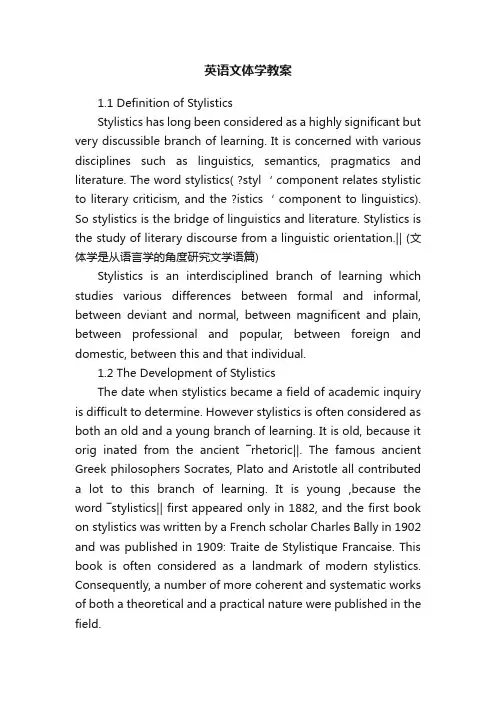
英语文体学教案1.1 Definition of StylisticsStylistics has long been considered as a highly significant but very discussible branch of learning. It is concerned with various disciplines such as linguistics, semantics, pragmatics and literature. The word stylistics( ?styl‘ component relates stylistic to literary criticism, and the ?istics‘ component to linguistics). So stylistics is the bridge of linguistics and literature. Stylistics is the st udy of literary discourse from a linguistic orientation.‖ (文体学是从语言学的角度研究文学语篇)Stylistics is an interdisciplined branch of learning which studies various differences between formal and informal, between deviant and normal, between magnificent and plain, between professional and popular, between foreign and domestic, between this and that individual.1.2 The Development of StylisticsThe date when stylistics became a field of academic inquiry is difficult to determine. However stylistics is often considered as both an old and a young branch of learning. It is old, because it orig inated from the ancient ―rhetoric‖. The famous ancient Greek philosophers Socrates, Plato and Aristotle all contributed a lot to this branch of learning. It is young ,because the word ―stylistics‖ first appeared only in 1882, and the first book on stylistics was written by a French scholar Charles Bally in 1902 and was published in 1909: Traite de Stylistique Francaise. This book is often considered as a landmark of modern stylistics. Consequently, a number of more coherent and systematic works of both a theoretical and a practical nature were published in the field.The subject of study in Bally’s time was oral discourse. Bally considered that apart from the denotative meaning expressed by the speaker4, there was usually an “overtone” which indicated different “feelings”, and the task of stylistics was to find out the linguistic devices indicating these feelings.Later , the German scholar L.Spitzer(1887-1960), began to analyze literary works from a stylistic point of view, and therefore, Spitzer if often consider4ed as the “father of literary stylistics”.From the beginning of the 1930s to the end of the 1950s stylistics was developing slowly and was only confined to the European continent. From the end of the 1950s to the present time, modern stylistics has reached its prosperity.1.3 Definitions of StyleSo style is an integral part of meaning. It gives us additional information about the speaker‘s/writer‘s regional and social origin, education, his relationship with the his/her reader, his feelings, emotions or attitudes. Without a sense of style we cannot arrive at a better understanding of an utterance 1).Written---spoken in terms of channel2)The Differences between Formal and Informal Language 3)modern----archaic in terms of time4)normal----deviated in terms of degree of novelty5). common---professional in terms of technique(专业)1.What‘s stylistics?2.What does stylistics study?3.Say something about the development of stylistics.4.Give examples to explain ―Proper words in proper places makes the true definition of a style.‖5.What does style study?6.Give example to illustrate the differences between spoken-- written,formal–informal, modern–archaic, norm—deviated, common---professional.第二章1. Definition of meanings of meaningAccording to Leech (1974 English linguists), meanings of meaning can be broken into seven kinds:1).Denotative meaningIt refers to literal meaning, refers to diction meaning.(super meaning) 词的概念意义。
英语文体学教案Lecturefo...
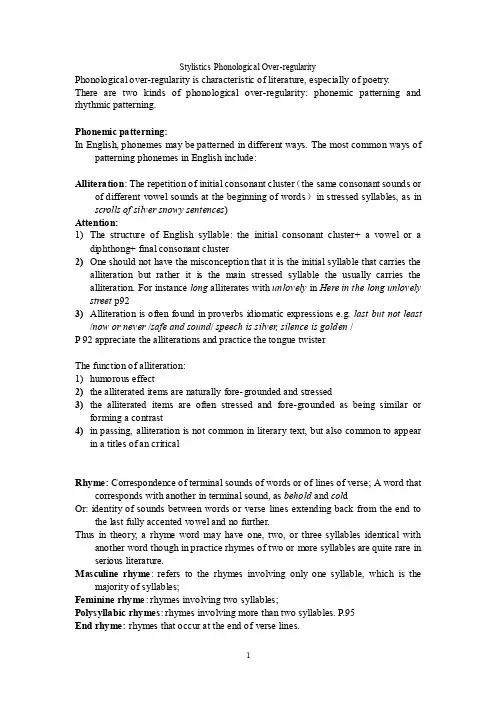
Stylistics Phonological Over-regularityPhonological over-regularity is characteristic of literature, especially of poetry. There are two kinds of phonological over-regularity: phonemic patterning and rhythmic patterning.Phonemic patterning:In English, phonemes may be patterned in different ways. The most common ways of patterning phonemes in English include:Alliteration: The repetition of initial consonant cluster(the same consonant sounds or of different vowel sounds at the beginning of words)in stressed syllables, as in scrolls of silver snowy sentences)Attention:1)The structure of English syllable: the initial consonant cluster+ a vowel or adiphthong+ final consonant cluster2)One should not have the misconception that it is the initial syllable that carries thealliteration but rather it is the main stressed syllable the usually carries the alliteration. For instance long alliterates with unlovely in Here in the long unlovely street p923)Alliteration is often found in proverbs idiomatic expressions e.g. last but not least/now or never /safe and sound/ speech is silver, silence is golden /P 92 appreciate the alliterations and practice the tongue twisterThe function of alliteration:1)humorous effect2)the alliterated items are naturally fore-grounded and stressed3)the alliterated items are often stressed and fore-grounded as being similar orforming a contrast4)in passing, alliteration is not common in literary text, but also common to appearin a titles of an criticalRhyme: Correspondence of terminal sounds of words or of lines of verse; A word that corresponds with another in terminal sound, as behold and col dOr: identity of sounds between words or verse lines extending back from the end to the last fully accented vowel and no further.Thus in theory, a rhyme word may have one, two, or three syllables identical with another word though in practice rhymes of two or more syllables are quite rare in serious literature.Masculine rhyme: refers to the rhymes involving only one syllable, which is the majority of syllables;Feminine rhyme: rhymes involving two syllables;Polysyllabic rhymes: rhymes involving more than two syllables. P.95End rhyme: rhymes that occur at the end of verse lines.Internal rhyme: a rhyme that occurs within a verse line.Half rhyme: a rhyme which is formed either by repeating the vowel or the diphthong or the final consonant clusters.p.96Pararhyme: such rhymes refer to the case in which the poet repeats the initial consonant clusters as well as the final consonant clusters of the concerned words.P. 96Rhyme scheme: the pattern of the rhymes in poem is called rhyme scheme.The functions of rhyme:1.The most common function of rhyme is to make the text better organized and givethe text some musical effect.2.Rhymes can also be used to bind lines, which are closely associated in content. So rhyme is not a phonological decoration but has its some literary effects of its own. Assonance: [类音, 类韵, 准押韵,半谐音; 或押辅音韵,e.g. killed/cold] The repetition of identical or similar vowel sounds, especially in stressed syllables, with changes in the intervening consonants, as in the phrase tilting at windmills.Or e.g. sonnet /porridge. P101 tree—>leaves—>seed—>earthAssonance can occur not only at the end of lines but also within the lines.The function of assonance:1)Assonance not only contributes to the musical quality of the literary text but alsoto its meaning.2)Most assonances function to unite sentences, ideas, and words that are associated.that areConsonance:[和音] The repetition of consonants or of a consonant pattern, especially at the ends of words, as in blank and think or strong and string. Consonance may be used to achieve various effects, especially1)Musical, euphonious effect2)Make the rhymed parts of the text better organized.Onomatopoeia:The formation or use of words such as buzz or murmur that imitate the sounds associated with the objects or actions they refer to.Strange Meeting ~Wilfred OwenIt seemed that out of battle I escapedDown some profound dull tunnel, long since scooped Through granites which titanic wars had groined.Y et also there encumbered sleepers groaned,Too fast in thought or death to be bestirred.Then, as I probed them, one sprang up, and staredWith piteous recognition in fixed eyes,Lifting distressful hands, as if to bless.And by his smile, I knew that sullen hall,-By his dead smile I knew we stood in Hell.With a thousand pains that vision's face was grained;Y et no blood reached there from the upper ground,And no guns thumped, or down the flues made moan. "Strange friend," I said, "here is no cause to mourn." "None," said that other, "save the undone years,The hopelessness. Whatever hope is yours,Was my life also, I went hunting wildAfter the wildest beauty in the world,Which lies not calm in eyes, or braided hair,But mocks the steady running of the hour,And if it grieves, grieves richlier than here.For by my glee might many men have laughed,And of my weeping something had been left,Which must die now I mean the truth untold,The pity of war, the pity war distilled.Now men will go content with what we spoiled,Or, discontent, boil bloody, and be spilled.They will be swift with swiftness of the tigress.None will break ranks, though nations trek from progress. Courage was mine, and I had mystery,Wisdom was mine, and I had mastery:To miss the march of this retreating worldInto vain citadels that are not walled.Then, when much blood had clogged their chariot-wheels, I would go up and wash them from sweet wells,Even with truths that lie too deep for taint.I would have poured my spirit without stintBut not through wounds; not on the cess of war. Foreheads of men have bled where no wounds were.I am the enemy you killed, my friend.I knew you in this dark: for so you frownedY esterday through me as you jabbed and killed.I parried; but my hands were loath and cold.。
英语文体学教案LectureThreeThreeViewsofStyle
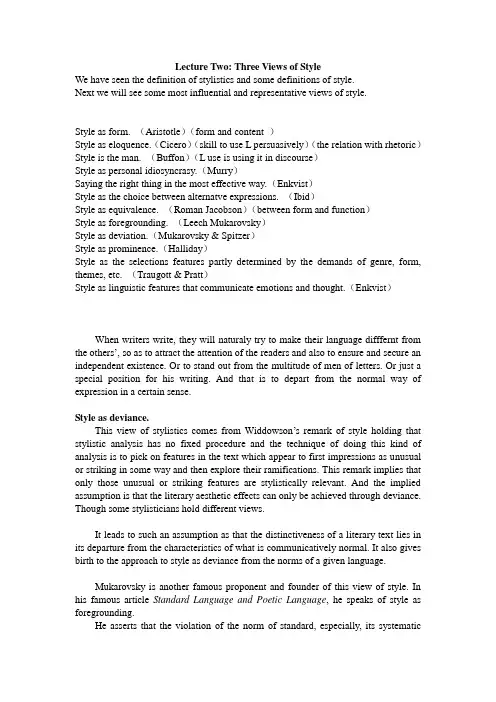
Lecture Two: Three Views of StyleWe have seen the definition of stylistics and some definitions of style.Next we will see some most influential and representative views of style.Style as form. (Aristotle)(form and content )Style as eloquence.(Cicero)(skill to use L persuasively)(the relation with rhetoric)Style is the man. (Buffon)(L use is using it in discourse)Style as personal idiosyncrasy.(Murry)Saying the right thing in the most effective way.(Enkvist)Style as the choice between alternatve expressions. (Ibid)Style as equivalence. (Roman Jacobson)(between form and function)Style as foregrounding. (Leech Mukarovsky)Style as deviation.(Mukarovsky & Spitzer)Style as prominence.(Halliday)Style as the selections features partly determined by the demands of genre, form, themes, etc. (Traugott & Pratt)Style as linguistic features that communicate emotions and thought.(Enkvist)When writers write, they will naturaly try to make their language difffernt from the others’, so as to attract the attention of the readers and also to ensure and secure an independent existence. Or to stand out from the multitude of men of letters. Or just a special position for his writing. And that is to depart from the normal way of expression in a certain sense.Style as deviance.This view of stylistics comes from Widdowson’s remark of style holding that stylistic analysis has no fixed procedure and the technique of doing this kind of analysis is to pick on features in the text which appear to first impressions as unusual or striking in some way and then explore their ramifications. This remark implies that only those unusual or striking features are stylistically relevant. And the implied assumption is that the literary aesthetic effects can only be achieved through deviance. Though some stylisticians hold different views.It leads to such an assumption as that the distinctiveness of a literary text lies in its departure from the characteristics of what is communicatively normal. It also gives birth to the approach to style as deviance from the norms of a given language.Mukarovsky is another famous proponent and founder of this view of style. In his famous article Standard Language and Poetic Language, he speaks of style as foregrounding.He asserts that the violation of the norm of standard, especially, its systematicviolation, is what makes possible the poetic utilization of language; without this possibility there would be no poetry. According to Mukarovsky normal use of language “automatizes”language to such an extent that the users no longer see its expressive or aesthetic power; poetry must de-automatize or foreground language by breaking the rules of everyday language. P13Such as the expression “a grief ago”“a presidency ago”“Mr. Smarter”“Mr. Bumble””The advantage of this approach to style is that it helps us keep in mind the there is a difference between everyday language and the language of literature.The disadvantages are that:a.It is difficult to define the norm from which the style of a text deviates.Bloch considers the basis of norm to e statistical, that is, to determinestyle by counting or resorting to the frequency distributions of linguisticfeatures as they differ from that of the language as a whole.b.It tends to lead the readers and stylisticians to value only the language ofthe grammatically highly deviant authors and under value those authorsthat do not deviate or do not deviate so much from the norms of language.And generally speaking, it tends to lead underestimation of thenon-deviant language both within literature and without.Style as choice.Style results from a tendency of speaker or writer to consistently choose certain structures over others available in the language.The difference between L and style is that L is the sum total of the structures available to the speaker, while style concerns the characteristic choices by a certain writer either consistently or in a given text or context.To say that style is choice of words is not the same thing as saying that it is always a conscious choice, though of course if the writer always chooses his word scrutinously the effect of his way of using L will be all the more obvious as a style. Then that is pick his way forward among words, and it is hard to imagine how much literary work can there be by now. The stock of literature of we human kind no doubt will be greatly diminished. But most, almost all poets, and some writers, and all writers at certain points in their writing do write that way, that is, they a kind of choose scrutinously and seem to pick their way forward among the forest of words.E.g. we Chinese posts have a tradition of refining words. 吟得一字安,捻断数茎须。
英语文体学课程教学大纲

英语文体学课程教学大纲课程英文名称:English Stylistics课程编号:0400810 学分:2 学时:32一、课程教学对象本课程教学对象为英语专业三年级的学生。
二、课程性质及教学目的《英语文体学》属于专业选修课,它是在综合分析英语语言现象的基础上进而对语言功能进行应用性透析的过程。
它对充分理解语言、欣赏语言具有理论指导作用。
解决“何为”与“为何”两个基本问题,无疑是英语专业高年级学生主攻的重要内容。
三、对先修知识的要求学生在学习本课之前,应先英语专业一、二年级所有基础课。
四、课程的主要内容、基本要求和学时分配建议(总学时数: 32 )基本要求:A级=掌握B级=理解C级=了解建议使用教材及参考书本课程建议使用教材:王守元.《英语文体要略》,山东大学出版社,2000。
参考书目:[1]. Leech, Geoffrey. 1969. A Linguistic Guide to English Poetry. London: Longman.[2] Crystal, David and Davy, Derek. 1969. Investigating English Style. London:Longman.[3] Traugott, Elizabeth and Pratt, Mary. 1980. Linguistics for Students ofLiterature. New York and London: Harcourt Brace Jovanovich.[4] Widdowson, H. G. !992. Practical Linguistics. Oxford University Press.5] Leech. Geoffrey & Short. Michael H. Style in Fiction. Beijing: Foreign Language Teaching and Research Press.[6].秦秀白.《文体学概论》长沙:湖南教育出版社,1986。
“英语文体学”课程教学大纲

“英语文体学”课程教学大纲一、课程基本信息开课单位:翻译学院课程名称:英语文体学课程编号:224118英文名称:English Stylistics课程类型:专业拓展课总学时:36 理论学时:34 实验学时:2学分:2开设专业:翻译专业;商务英语专业先修课程:英语语言学;英美文学二、课程任务目标(一)课程任务本课程是面向英语专业、翻译专业和商务英语专业开设的一门专业任选课,属于专业理论与及其应用类课程,一般在四年级开设。
本课程的任务是使学生在了解文体学的相关理论以及文体分析的方法和步骤的基础上,学会在语言学理论的指导下分析文学和非文学语篇的文体特征及其文体功能,从而提高其分析、欣赏和批评文学和非文学语篇的能力。
(二)课程目标在学完本课程之后,学生能够:1.掌握文体学的基本原理与文体分析的方法和步骤;2.从文学和非文学语篇中识别相关文体特征,并分析其文体功能;3.了解语言学理论与文体分析之间的关系,提高研究意识,学习研究性学习方法;4.提高借助语言学理论分析问题和解决问题的能力,尤其是分析、欣赏和批评文学和非文学语篇的能力。
三、教学内容和要求Chapter 1 Introduction本章是整个课程的导入部分,目的是让学生了解文体学的定义及其产生背景和过程、理论假设以及文体学研究的目标和文体分析的基本步骤,并了解文体学的基本特征。
具体内容如下:Defining stylistics;Naissance of stylistics as an interdisciplinary field of study;Two important assumptions of stylistics;Goals, components and procedure of stylistic inquiry;Nature of stylistic analysis。
Chapter 2 On style本章在介绍文体学界的三种典型文体观的基础上,列举文体的分类特征,讨论多种英语变体的基本特征,并分析文体的正式程度及其语言表现形式。
文体学的教案,
■Course: English Stylistics■Time: Sep.6-30■Course material: English Stylistics: A New Course Book《新编英语文体学教程》董启明编著外语教学与研究出版社■Teaching procedure: Part OneTheoretical Preliminaries(理论预备) and Major Varieties(主要变体)of EnglishChapter 1 Style and Stylistics1.1Introduction1.What is Language? And in which aspects of language does stylistics focus on?A. Language is the primary object of the study of linguistics, and linguists construct theories of language in general or of particular languages from differing points of view. The discussion of the concepts of style should focus on some essential aspects of language on which most linguists agree.B. Language is viewed as a system of different types of linguistic organization such as phonology, syntax and lexicon. The English language consists of its pattern of sounds, sets of grammatical rules and a large body of vocabulary.C. Language is also a social phenomenon, or institution, whereby people communicate and interact with each other. A language of a particular society is part of the society’s culture. Language activities operate within social activities. The language of a participant in a social activity reflects his social characteristics (such as his status, ethnic group, age and sex). It also reflects his awareness of the various factors of a social situation in which he finds himself. He should adjust his language in accordance with the medium of communication (speech or writing), the setting (private or public), the relationship with the addressee (in terms of the degree of intimacy or social distance), and the purpose (to inform, to persuade, etc.).2. Varieties 变体of Language(variety=style)A. Varieties in relation to regions---- British/American EnglishB. Varieties in relation to media----Spoken English/Written EnglishC. Varieties in relation to attitude----degrees of formality/politeness/ impersonality/accessibilityD. Varieties in relation to social factors----Women’s English/Black English/Taboo and EuphemismE. Varieties in relation to social Genre----The English of Conversation / Public speaking/ News reporting/Advertising/Literary English (The Novel/Poetry)/ Science and Technology/Legal Documents3. Varieties analysis theory----Stylistics (文体学)★Essence of stylistics : Appropriate use of language is considered the key to effective communication.e.g. How to suck an egg? (Example and Analysis: Page 3)★Analysis : The difference lies in the fact that the young student used some big and formal words, such as perforation(齿孔,hole) ,apex(顶点,最高点top),aperture(小孔,缝隙,opening), inhaling (吸气)discharged(流出), which made her utterance difficult to understand, especially by an old woman without much education,while the old woman used informal words, such as gal, hole, end and suck. As a result, her utterance is easy to understand.★Note: Different styles should be used on different occasions, and the key to the effective use of language is “appropriateness”, and the key to effective communication is the ability to use language appropriately, otherwise we cannot achieve our purpose of communication.1.2 Definitions of Style/Stylistics/Text1. TextDefinition: A TEXT is any passage, spoken or written, of whatever length, that forms a unified whole. It may be the product of a single speaker/writer (e.g. a sign, a letter, a news report, a statue, a novel), or that of several speakers (e.g. a piece of conversation, a debate).For example,Two boys stood near a jeweller’s shop. They saw a man break the shop window and steal all the watches. They ran after him, because they took him for a thief.Analysis:A text is realized by a sequence of language units, whether they are sentences or not. The connection among parts of a text is achieved by various cohesive devices, and by semantic and pragmatic implication. In the text you may notice the following modifications, which serve as 1) grammatical cohesive devices:(a) the use of the definite article on second mention, e.g.a shop---- the shop a man---- the man(b) the substitution of pronouns for nouns. e.g.two boys---- they(c) the use of conjunction. e.g.They ran after him, because…2) the lexical cohesion in the text is realized by the collocation of the words that are in some way or other typically associated with one another, e.g. steal all the watches; took him for a thief2.StyleDefinition—Manners indicating prominent linguistic features, devices or patterns, most (at least) frequently occur in a particular text of a particular variety of language.Analysis:①Manners (appropriateness) [Study Aims]indicating prominent②a) linguistic features (phonological /lexical /syntactic /grammatical/semantic features),b) devices (device markers) orc) Patterns(文体/语体常规“型式”)[Study Scope]③most (or least) frequently occur (words/sentencespercentage) [Study Approach]in a particular④text(语篇、篇章、文本) of a particular⑤variety of language. [Study Material]2.StylisticsDefinition----Stylistics is a branch of linguistics which studies style in a scientific way concerning the manners/linguistic features of different varieties of language at different levels.A branch of linguistics which studies style in a scientific and systematic way [StudyApproach] concerning the manners/linguistic features [Study Aims] of different varieties of language [Study Scopes] at different levels [Study Scopes].1.4 The Development of Stylistics《文心雕龙·刘勰》摘录《说文》云:“体,总十二属也,从骨。
英语文体学教程(第二版)
英语文体学教程(第二版)英语文体学是一门研究英语语言在不同语境中表达意义的语言学分支。
它探讨了英语在不同文体类型(如叙述、说明、议论文体等)中的结构、功能、演变和变异。
本教程作为第二版,对英语文体学的理论和实践进行了全面更新和深化,旨在帮助读者更好地理解和应用英语文体学知识。
一、英语文体学的定义和重要性英语文体学关注英语在各种文本中的使用,包括口头和书面表达。
它研究不同文体的特征、语言特点和交际目的,以及这些因素如何影响语篇的理解和解释。
通过了解各种文体的语言特征和规律,我们可以更好地理解和分析英语语篇,提高我们的语言运用能力。
二、本书的结构和内容本书分为十章,涵盖了英语文体学的各个方面。
第一章是导论,介绍了英语文体学的概念、研究范围和方法。
第二章至第九章分别对不同文体的特征、功能、演变和变异进行了深入探讨,包括叙述文体、说明文体、议论文体、描述文体、正式文体、非正式文体、口语文体和文学文体等。
第十章是应用和实践,通过案例分析,帮助读者将所学知识应用到实际语言运用中。
三、学习资源和方法建议本书不仅提供了丰富的理论知识和研究案例,还提供了许多实践机会,帮助读者更好地理解和应用英语文体学。
建议读者在阅读过程中,结合自己的语言运用实践,多思考、多分析、多比较,逐步提高自己的语言运用能力和理解水平。
四、结论《英语文体学教程(第二版)》是一本全面、深入、实用的英语文体学教程,适合英语专业学生、教师和研究人员阅读参考。
通过学习本书,读者可以更好地理解和应用英语文体学知识,提高自己的语言运用能力。
同时,本书也为英语学习者提供了一个系统地学习和掌握英语各种文体的机会,有助于提高他们的英语水平和跨文化交际能力。
文体学第二三章教案
Chapter 2 Procedure of Stylistic AnalysisChapter 3 Stylistic Functions of Linguistic ItemsI.Procedure of Stylistic Analysis----3 steps1.Linguistic description2.Textual analysis(语篇分析)3.Contextual factors analysis(语境分析)II.Linguistic Description and Stylistic Functions of Linguistic Items1.Linguistic descriptionA.What does linguistic description refer to?Linguistics description refers to the exploration and classification of linguistic features of a given text.B.Linguistic feature s—in 5 categories, i.e. phonology, graphology, lexis/leksəs/(词汇),syntax/grammar, and semantics.C.Consistency and relative frequency—linguistic features in 5 categories analyzed in stylisticway.Note: Generally speaking, when we say that a text has certain linguistic features, we mean that these features recur (反复出现) or prevail(盛行)in the text. That is to say, frequencies of certain linguistic features should be calculated, the stylistic functions of which would be helpful for us to analyze a text.2. A checklist of linguistic description and their stylistic functionsA.The phonological category and their stylistic functionsk'tæmətə] )超过八音步以上的诗行也有,但很少见。
新编英语文体学教程
新编英语文体学教程摘要:一、引言1.英语文体学的重要性2.新编英语文体学教程的目的和特点二、英语文体学的基本概念1.文体与文体学2.英语文体学的分支和研究方法三、英语文体学的主要内容1.语篇分析2.语义分析3.语法分析4.修辞分析四、英语文体学的实际应用1.写作技巧的提升2.阅读理解的提高3.口语表达的优化4.翻译质量的保证五、英语文体学的教学方法1.理论教学与实践相结合2.教师引导与学生自主学习相结合3.课程设置与实际需求相结合六、结论1.新编英语文体学教程对英语学习者的帮助2.对未来英语文体学发展的展望正文:在新编英语文体学教程中,我们旨在介绍英语文体学的基本概念、主要内容和实际应用,以及教学方法。
英语文体学是研究英语表达形式的学科,它关注英语在不同语境下的使用,以及如何使用英语来达到特定的交际目的。
英语文体学包含许多分支,如语篇分析、语义分析、语法分析和修辞分析。
这些分支相互关联,共同构成了英语文体学的理论体系。
语篇分析主要研究篇章的结构和组织,以及篇章在不同语境下的功能。
语义分析则关注词汇和句子的意义,以及如何在不同语境下进行合适的表达。
语法分析涉及句子结构和成分之间的关系,以及如何在不同语境下使用合适的语法手段。
修辞分析则强调如何在英语表达中运用各种修辞手法,以增强表达效果和吸引力。
英语文体学的实际应用广泛,包括写作、阅读理解、口语表达和翻译等方面。
通过学习英语文体学,学习者可以提升自己的写作技巧,使文章更具表达力和说服力。
同时,英语文体学也有助于提高阅读理解的准确性和速度,使学习者能够更好地理解文章的深层含义。
在口语表达方面,英语文体学可以帮助学习者优化自己的语言表达,使之更加得体、自然。
此外,英语文体学还能提高翻译质量,使翻译作品更符合原文的文体特点。
在英语文体学的教学方法上,我们主张理论教学与实践相结合,以培养学习者的实际应用能力。
教师应引导学习者进行自主学习,培养他们独立分析和解决问题的能力。