
词汇学论文(英文的)
一。
The Development of English VocabularyThere are about one million English words in all. English is also an international language in this society. You can see English words almost every where, even in non-English-spoken countries.How does English come into being? Why it has so many vocabularies? In the following passage, I will give you a general picture about these two questions. The English people are of a mixed blood. The early inhabitants of the island we now call England were Britons, but in fact all the races were the invaders came from Europe. Nobody knows very much about Britain before the Romans came during the first century BC, but there had been at least three invasions before that. The first of these was by a dark-haired Mediterranean race called the Iberians. The other two were by Celtic tribes: one is Gaels, whose descendants are the modern Scots and Irish; another is the Britons, who gave their name to the whole island of Britain. These were the people whom the Romans conquered. The Romans gave the Britons a good deal of their civilization. Then at the beginning of the fifth century Britain was invaded by three tribes from the northern Europe: the Angles, the Saxons, and the Jutes. These three tribes merged into one people, and the three dialects they spoke naturally grew into a single language, the English language.But at first, the English word made up of only a small part of native words and some borrowed words. The native words were the core words of English. According to a kind of classification of language, English is classified as a Teutonic language, which is a Germanic language. To be more exact, English belongs to the low West Germanic branch of the Indo-European family. Because of the complex history of Briton, the language of English is of a mixed character. On one hand, it shares with West Germanic languages many common words and similar grammatical structures. On the other hand, more than half of the English vocabulary is derived from Latin and French. Besides, English has accepted words from other languages of the world in the course of its historical development.The history of English language is divided into three periods:1. the old English period ( from 450AD to 1150 AD )2. the middle English period ( from 1150AD to 1500AD )3. the modern English period ( from 1500AD up to now )As I mentioned above, in fact, that there is also a period we can call it thepre-old English period, which includes the Celts, the Scottish and Irish races and culture, and also Welsh race and culture were brought by the Celts. Then the Romans brought Latin alphabet and civilization to this land. After these two were the formation of the Anglo-Saxons people, which is the original English race and language.Old English consists mainly about the native language of Anglo-Saxons people. The period from 450AD to 1150AD is known as the old English period, and it isalso been called Anglo-Saxons period. It is described as the period of full inflections, since during most of this period the case endings of the noun, the adjective, and the conjugation of the verb were not weakened. Also during this period, when the Norman Conquest in 1066AD brought French to England, and much of the English vocabulary was replaced by words borrowed from French and Latin.Old English is a synthetic language. (There are two classes of languages in the world: synthetic and analytic. A synthetic language is one which shows the relation of words in a sentence largely by means of inflections. An analytic language is one which indicates the relation of words in a sentence by means of word order, prepositions or auxiliary verbs, rather than by inflections.) Old English nouns and adjectives have four cases: the nominative case, the genitive case, the dative case and the accusative case. Apart from these four cases, Latin nouns have the ablative and locative cases.Middle English period is from 1150AD to 1500AD. During this period the inflections which had begun to break down towards the end of the old English period, became greatly reduced, and it is known as the period of leveled inflections. The Norman Conquer was the cause of this change. The change of this period had a great effect on both grammar and vocabulary. In grammar English has changed from a highly inflected language to an analytic language. In this period many old English words were lost, but thousands of words borrowed from French and Latin appeared in the English vocabulary. French influence on the English vocabulary is much more direct and observable. The number of French words that came into English was very numerous. More than half of the English vocabulary is derived from Latin.Modern English period is from 1500 to the present. A large part of the original inflectional system has disappeared, and it is known as the period of lost inflections. We may divide this period into two parts: the early Modern English period and the Late Modern English period.The early modern English period extends from 1500AD to 1700AD. The chief influence of this time was the great humanistic movement of the Renaissance. In this period the study of the Latin and Greek classics was stressed, so the influence of Latin and Greek on English was great.The late modern English period started after 1700AD. The eighteenth century in England was a time of stabilizing and purifying the English language. The publication in 1755AD of A Dictionary of the English Language edited by Samuel Johnson was a typical example of consolidating and purifying the English language in this period. He set a standard for using English words in spelling, meaning and usage. In the eighteenth century French greatly influenced English. The number of French words in the period from 1650AD to 1800AD increased rapidly. Such as: ballet, cartoon, champagne, cohesion, dentist, patrol, publicity, routing, etc.Meanwhile the territorial expansion of the English empire in this period resulted in the expansion of the English vocabulary. Thus, there are many words flow into English vocabulary, which includes American Indian words, Mexican words, Peru words, Brazil words, India and African words.The nineteenth and twentieth centuries are a period of rapid expansion for the English vocabulary in the history of the English language. In this period many changes have taken place. Especially the great development of science and technology is reflected in the English vocabulary.Besides, the great changes in industry, in political and social lives, in sports and amusements all have contributed a great deal to the English vocabulary. Since the Second World War the English vocabulary has been affected powerfully by social, political, economic, especially scientific and technical changes. The English vocabulary not only changes, but also changes quickly in this period. Thousands of new words are added, existing words acquire new meaning and old words die out.Till now, the English vocabulary is still changing, some words come out and some die out. In a word, as society is constantly in a state of development, so is language. Society depends on language for its existence. As society develops new objects are created that require the invention of new words and expressions. Therefore, the changing of English vocabulary is an endless changing process.Bibliography:陆国强,published in 1999,Modern English Lexicology (new edition)Adams, Valerie, published in1982,An Introduction to Modern English Word-formation戴炜栋,published in 2002,A New Concise Course on Linguistics for Students of English朱永涛,published in 1997,The Society and Culture of Major English-speaking Countries林承璋,published in 1987,An Introduction to English Lexicology也可以写广告中的词汇特点:The Lexical Features of Advertisement on NewspaperNewspapers are generally the cheapest way to reach a mess audiences,and the timing is fast.Adverments make an important part on English Newspaper.We live in a world of advertising.Advertising provides a valuable service to society and its members,because it defines for consumers the meaning and the role of products,services and institutions.Newspaper advertisements’ main text use words for the spread of vector,and must must be simple eye-catching,because of the layout of resources.To some extent,thenewspaper advertisements content mainly rely on language toexpress.Advertising language ,playing a role of communication and persuasion,has developed its own features.Naturally,advertisements in English have become an important means of communicatingideas,demoinstrating a variety of linguistic features of its own.The present study discusses some lexical features of English advertisement texts.ⅠChoose the simple wordsAdvertiment language must be easily understood terms so that readers can get information as soon as possible.In advertising,simple words can win the consumers by their exact,effective expression an d a kind of closeness.E.g.①Take time.Any time.Continuous using two “time” can make the language simple and clear.②Once tasted,always loved.The article should be clearly and concisly understood in order to arouse the interest of customers on food which make them mouth-watering.③My goodness!My Guinness!Common language facilitate people to memory and speak,this reproduce the scene of people driking the Guinness beer which is full of praise.ⅡFrequent Employment of Simple VerbsSimple verbs are frequently employed in English advertisements, which is an obvious wording characteristics of English advertising texts.Verbs are the most important part of language.It is a prominent feature in adervertising english that verbs are regularly used for the ultimate goal of advertising ,which is to enable consumers to buy their goods.So in terms of the using of words,dynamic and strong word will produce a better feeling effects.Verbs can be used to “touch”the consumer's heart.In this way,they will have impules to buy the goods.E.g.①Drink Coca-Cola.②I want you to sponsor a Rice Paddy Baby.③For incredible speed and accuracy, try the Minolta 7000, the world’s first body-integral auto-focus SLR.In the above examples, “try”,”sponsor” and “drink”are to fulfill the “get action” requirement seem more euphemistic and even more attractive.④Get noticed. Get results.⑤Feel the Hyatt Touch.⑥Send today for your free sample, and try the new flavor.After reading the above ads, we feel encouraged to take buying action or make repeated purchases. The active voice doesn’t force people to take the passive action while it makes people feel that they do something of their own accord. Ⅲ. Adjectives⑴It is hard for us to think of any really persuasive message without the use of descriptive and vivid adjectives. Copywriters like to use a large number of adjectives not only to describe the quality and features of the products or services, but to a great extent to praise and beautify them.E.g.For people who care about their bodies, Dairy Farm brings fresh skimmed milk. With almost no fat, it keeps your body fit inside and outside, fresh skimmed milk. Fresh Dairy Farm.The adjective “fresh” in Example appears three times to emphasize how fresh the product is, making its quality particularly attra ctive. And the adjective “fit” points out the remarkable function of the product.⑵The copywriter tends to select the superlative or comparative forms of adjectives that carry positive meanings so as to make a comparison and stress the wonderful qualities of the advertised product. E.g.①Using Dove, I do feel 20 years younger.“Younger” just emphasizes the magic power of the product.②Discover the season’s newest splendor.The word “newest” , which is an advertisement of a kind of perfume, means “fashionable to the highest degree”.Of course, the advertisers must make sure that the advertised goods or services are actually the best in the same category.Sometimes people do not know how superb the goods or the services are in quality. Anyhow, people tend to believe what is said in advertisements.Ⅳ.New Words Constantly AppearIn order to attract people’s attention, copywriters like to create some new words which are more active. The new words are mainly used for truthfulness, humor or emphasis in English advertising texts. E.g.①Surefit Shoe Ltd.“Surefit” is a new word which makes consurms thing of a sentence”Surely to fit your feet”.That means the shoes are fot for your feet.②Give a Timex to all, and to all a good time.The well-known watch brand “Timex” is a variation of “Time + Excellent”, wh ich persuasively shows the merit of the watch brand. Thus, brand names get and retain a unique image.Ⅴ.PronousPronouns of the first and second person: we, I and you outnumber the other pronouns in advertisements. It is because that you, we and I help create a friend-like intimate atmosphere to move and persuade the audience. The audience will easily accept a product, a service or an idea as if a good friend recommended them.Sometimes,we use infinitive pronouns,such asall,everyone,none,nothing and so on in order to feflect the extraordinarycharacteristics of a particular commodity or it has been spending and receiving most of people.E.g.Our finest time.It is about a well-known red wine.A pair of lover drink together at romantic atmosphere.Ⅵ.Compound wordsA compound word is often a noun or an adjective made up of two or more words which are frequently used to express more information in limited space. Especially,compound adjectives are often seen in advertisements.E.g.Kodak Single-use-came ras take pictures where you wouldn’t normally take your camera.It used the compound word skillfully and describe the capability and function of the product incisively and vividly.Now we have briefly discussed the six wording characteristics of English advertisements. We have got to know that simple verbs and concise adjectives are very important words in English advertising, and that new words which are attractively used to stress the new and special qualities or functions of the advertised products. Language in advertising presents us with a colorful, interesting and wonderful world in order to serve the purpose of attracting advertising readers. Of course, besides the above features discussed in this study, there is much more for further study in advertising language.Email:********************。
2012 英语词汇学论文 英文版
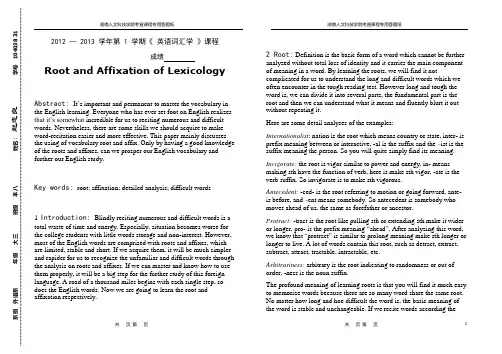
成绩Root and Affixation of LexicologyAbstract: It’s important and permanent to master the vocabulary in the English learning. Everyone who has ever set foot on English realizes that it’s somewhat incredible for us to reciting numerous and difficult words. Nevertheless, there are some skills we should acquire to make word-recitation easier and more effective. This paper mainly discusses the using of vocabulary root and affix. Only by having a good knowledge of the roots and affixes, can we prosper our English vocabulary and further our English study.Key words: root; affixation; detailed analysis; difficult words1Introduction: Blindly reciting numerous and difficult words is a total waste of time and energy. Especially, situation becomes worse for the college students with little words storage and non-interest. However, most of the English words are comprised with roots and affixes, which are limited, stable and short. If we acquire them, it will be much simpler and rapider for us to recognize the unfamiliar and difficult words through the analysis on roots and affixes. If we can master and know how to use them properly, it will be a big step for the further study of this foreign language. A road of a thousand miles begins with each single step, so does the English words. Now we are going to learn the root and affixation respectively.Definition is the basic form of a word which cannot be further analyzed without total loss of identity and it carries the main component of meaning in a word. By learning the roots, we will find it not complicated for us to understand the long and difficult words which we often encounter in the tough reading test. However long and tough the word is, we can divide it into several parts, the fundamental part is the root and then we can understand what it means and fluently blurt it out without repeating it.Here are some detail analyses of the examples:Internationalist: nation is the root which means country or state, inter- is prefix meaning between or interactive, -al is the suffix and the –ist is the suffix meaning the person. So you will quite simply find its meaning. Invigorate: the root is vigor similar to power and energy, in- means making sth have the function of verb, here is make sth vigor, -ate is the verb suffix. So invigorate is to make sth vigorous.Antecedent: -ced- is the root referring to motion or going forward, ante- is before, and –ent means somebody. So antecedent is somebody who moves ahead of us, the same as forefather or ancestor.Protract: -tract is the root like pulling sth or extending sth make it wider or longer, pro- is the prefix meaning “ahead”. After analyzing this word, we know that “protract” is similar to prolong meaning make sth longer or longer to live. A lot of words contain this root, such as detract, extract, subtract, attract, tractable, intractable, etc.Arbitrariness: arbitrary is the root indicating to randomness or out of order, -ness is the noun suffix.The profound meaning of learning roots is that you will find it much easy to memorize words because there are so many word share the same root. No matter how long and hoe difficult the word is, the basic meaning of the word is stable and unchangeable. If we recite words according theag=do,act: agent agency agenda aggrandizeagri,agro,agrfield: agriculture agricorporation agrimotor agrinomy cred=believe,trust: credible credibility incredible credulous credit creditable discredit accredit creditor creed credentialsdoc=teach: doctor doctoral doctorate doctrine doctrinal doctrinaire documentflat=blow: Inflate inflation inflationary inflatable inflator deflate deflation deflationary hospit=guest: hospital hospitalize hospitality inhospitable inhospitalityinsul=island: peninsula peninsular insular insularism insularity insulation insulatorit=go: exit initial initiate initiation initiative transit transitor transition vid,vis=see: visible visual visage vision visionary visor vista visa visit advise advice revise3 Affixation:Affixes are linguistic fragments that are attached to words or word elements to modify meaning or change function. According to the distribution of them in formation, affixes can be divided into prefixation and suffixation.Prefixation is the formation of new word by adding prefixes to bases. Prefixes do not generally change the word-class of the base but only modify its meaning. Root is included in the base.Suffixation is the formation of new words by adding suffixes to the base. Suffixes have only a small semantic role, their primary function being to Here are some detail analyses of the prefixation and suffixation respectively:non- : meaning not, a productive affix expressing the idea that a person or thing does not have qualities and characters referred to, as innon-classical, non-smoker, non-violence, non-president, non-virtue,and so on.de- : meaning reversing the action or depriving of, a productive affix, as in decentralize, demystify, dehumanize, deforestation; fixed to nouns to form verbs, a characters absent from most prefix as in device, defeather, debug.mal- : meaning badly or bad, added to verbs, participles, adjectives, ang abstract nouns, e.g. maltreat, malformed, malnourished, malodorous, malpractice, and maladministration.post- : meaning after, productive with nouns and adjectives, e.g.post-election, post-independence, post-structuralism, post-settlement, post-arrival.They are prefixes, let’s move to suffixes.-ship: meaning occupation and position, e.g. ambassadorship, governorship, authorship; also meaning skill and ability as in craftsmanship, sportsmanship; also meaning relation, e.g. acquaintanceship, partnership, friendship.-ant: meaning occupations and participation, e.g. assistant, contestant, informant, applicant; also referring to an object or substance, e.g. coolant, pollutant, decongestant.-ation, -ition, -tion, -sion, -ion: meaning process of or state of or product of, e.g. realization, imagination, addition, protection, commission, decision, operation, motivation.-able, -ible Adjective:worth, abilitysolvable, incredible-ate Verb: cause tobegraduate, ameliorate, amputate, colligatebene- good, well,gentlebenefactor, beneficial, benevolent,benediction, beneficiary, benefit-ess female actress, goddess, poetesshetero- other, different heterodox, heterogeneous, heterosexual, heterodynehyper- over, above hyperactive, hypertensive, hyperbolic, hypersensitive, hyperventilate, hyperkineticinfra- beneath infrared, infrastructuremega- great, million megaphone, megaton, megaflop, megalomaniac, megabyte, megalopolismicro- small, millionth microscope, microfilm, microcard, microwave, micrometer, microvoltsemi- half, partial semifinal, semiconscious, semiannual, semimonthly, semicircletri- three tripod, triangle, trinity, trilateral-y marked by,havinghungry, angry, smeary, tearybut they can be divided into several parts through the analysis of the rootsand affixation, which are stable and short. After you are quite familiarwith them, it will be hyper-effective for you to memorize the words,which can save you a lot of energy and time, and can do a greatcontribution into your English study. Since then, you will more like thisforeign language.5 Some long and difficult words for you to analyzeTelecommunication /e.g. Telecommunications developments enable thesending of messages via television, radio, and very shortly, electronicmail to bombard people with multitudes of messages.Transcendentalist /e.g. Ralph Waldo Emerson and other transcendentalistphilosophers thought schooling and rigorous book learning put unnaturalrestraints on children.Differentiation /e.g. A rather similar process of differentiation has led toprofessional geologists coming together nationally within one or twospecific societies, whereas the amateurs have tended either to remain inlocal societies or to come together nationally in a different way.Hydroelectric /e.g. Hydroelectric power and flood control and irrigationare possible without building monster dams.Dispassionate /e.g. Social science is that branch of intellectual enquirywhich seeks to study humans and their endeavors in the same reasoned,orderly, systematic, and dispassionate manner that natural scientists usefor the study of natural phenomena.Conclusion:Above is what I want to mainly express in this paper,however, there are still much deserving t o be learnt in this field. It’sundeniable that words play an important role in our foreign languageessential for us to learn word formation, especially for the students of English major. It’s the most useful and practical way for us to broaden English vocabulary.Reference:[1] 张维友. 英语词汇学教程[M]. 华中师范大学出版社2004.[2] 蒋争. 英语词汇的奥秘[M]. 中国国际广播出版社1999.[3] 林承章. 英语词汇引论[M]. 武汉大学出版社1997.。
词汇学论文模板

题目:Semantic Analysis of English Words学期2011/2012学年第一学期科目英语词汇学班级学号姓名摘要语言教学领域的变革从来没有停止过,而在近年变革中,其中最主要的一个变化是人们研究的焦点已经从教师的教转移到学生的学。
因此,学生自主学习能力的培养越来越受到外语教育界的重视。
同时,国家教育部提出了“优化学习方式,提高自主学习能力”的基本理念。
这样,传统的课堂教学正面临着一次巨大的挑战,并逐步被以“学习者为中心”的教学模式所取代。
不少人误认为“学生自主学习”就是“孤立地学习”或“没有教师的自学”,而有时候,学生自主能力被认为是完全独立于教师、其他学生和被认可的教学大纲,而实际并非如此。
完全的独立并不是自主能力,而是自闭。
本文首先分析了大学生英语自主学习的现状和必要性。
传统的教学方法,缺乏关注学生的情感需要导致了目前我国大学阶段的英语教学整体效率较低,成为大学英语教学的最大障碍。
接下来回顾了自主学习定义、自主学习的“最近发展区”理论、认知建构主义学习理论和罗杰斯的人本主义学习理论等。
最后根据大学生英语自主学习的现状和以自主学习的理论为基础,探讨了培养大学英语自主学习的方法,培养学生自主性的关键是要转换教师角色,创造一个宽松积极的学习氛围和进行系统的英语学习策略训练。
通过本文的研究,我们知道什么是学习动机,以及如何提高学生的学习动机。
我们要改变传统的教学理念,转换师生角色,提高学生的英语水平。
关键词:自主学习;角色转换;策略训练;大学英语I.IntroductionEver since its birth in the 1980s, the concept of learner autonomy has long been a hot topic in the field of linguistics both at home and abroad. Substantial research on learner autonomy has hence been carried out and turned out to be fruitful. It is generally accepted that language learning requires the active involvement of learners. Language can only be learned and not be taught. The focus of classroom activities has been shifting from teacher-centered to learner-centered. The goal of language teaching is to help learners to become independent from their teachers in their learning and use of language. “Although there has always been the Chinese idea of zi xue (self-teaching),the idea is different from the concept of learner autonomy and is only peripheral in the Chinese educational culture.”(Bai & Jing,P52)Learning how to learn is more important than being taught something from the superior vantage point of teachers. (Cao, P39)Furthermore, recent research in psychology, sociology and linguistics, has shedlight on language teaching, learning and the roles of learners in the language learning process. The learner-centered approach, constructivism, humanism and social cognition all support and emphasize a learner’s central place in the classroom. (Qin Shen, P9-P11)Personal construct theory holds that individual learners bring their own systems of constructs to bear on learning tasks. When learning is a matter of adding information to an existing construct, it is likely to be relatively unproblematic. When new knowledge contradicts existing construct systems, learning is likely to be more difficult and resistance may be encountered. Both in therapy and in education, resistance is overcome by helping individuals to become more aware of their existing personal construct systems and gradually to assume control of their psychological processes. In education, this means helping learners to become more aware of their assumptions about learning and to assume control of their own learning processes. Humanistic approach emphasizes the importance of inner world of the learners and affective factors in learning process. Teachers should pay attention to and respect learners with decision-making power. Learner autonomy used to be considered as a concept only suitable for Western countries, but it is now regarded as an unquestionable goal and a prerequisite for lifelong learning also in China.Over the last few decades, English teaching in China has made remarkable progress. Many educational reforms have been undertaken, new frontier language learning theories have been introduced and much research on teaching has been carried out. V arious innovative teaching methods have been explored. Even new technology like computer and the Internet has been introduced into the teaching process. The achievement of these reforms cannot be denied. Y et many problems still exist and much room for improvement remains, especially in the field of lea rner’s learning. Therefore, learner autonomy catches the eye of many researchers.However, teacher-centered approaches and spoon-fed methods have been prevalent for a long time in China’s EFL context.Teachers are regarded as authority, knowledge-givers and error correctors, while students tend to limit their work to what is taught in class. As a result, many learners are accustomed to depending on teacher’s feeding. Without teacher’s timely and adequate help, students will feel disoriented, lose confidence and fail to pinpoint their goals in learning. So there is a need for a shift in English language studies from focusing on how to teach language to how to learn it, with a consequent change of perspective from the teacher to the learner.Global changes in the availability of information indicate that there is no longer a fixed body of knowledge that can be transmitted to learners. It is no longer possible toteach all students all they need to know. Learning is a lifelong endeavor. Only when learners are able to know their situation, their learning strength, weakness and avail themselves of each learning opportunity rather than simply react to various stimuli from the teacher can they be confident enough to involve into their learning and eventually become successful language learners. The situation calls for the urgent need of fostering learner autonomy in college English teaching.II.Current Situation of English Learning and Necessity of Learner Autonomy1. Current Situation of English LearningCollege English teaching in China is still focusing on teacher’s teaching rather than student’s learning. It ignores student’s individua l variables and thus produces passive learners. Recently, with the boom in curriculum reform, more and more teachers have begun to accept new educational concepts and try new teaching methods, but influenced by traditional educational theory and exam-oriented education, China’s education reform still has a long way to go. Some existing problems need to be addressed.1.1 Teacher-Centered Classroom TeachingTeacher-centered classroom teaching is a traditional teaching style in which teaching is carried out by the teacher who is the focus of the classroom, and students only listen to him or her.In China’s EFL context, teacher-centered approaches and spoon-fed methods have been prevalent for a long time. Teachers are regarded as authority, knowledge-givers and error correctors, while students tend to limit their work to what is taught in class. Classes are usually driven by “teacher-talk”and depend heavily on textbooks. Instruction in the classroom is based on the misconception that there is a fixed body of knowledge that students must know. There is little or no room for student-initiated questions, independent thought or interaction between students. Teachers often tend to focus on teaching the target language by carefully designed steps. As a result, many le arners are accustomed to depending on teacher’s feeding. Without teacher’s timely and adequate help, students will feel disoriented, lose confidence and fail to pinpoint their goals in learning. Such situation is getting worse and worse with the expansion of college school enrolment, too many students in a class and inadequate teaching staff, who find it hard to take every student’s need into consideration.This teaching style focuses on knowledge delivery, instead of language skill training. It prevents learners from exploring their learning potentiality anddeveloping the abilities to manage their learning effectively. So there is a needfor a shift in English language studies from focusing on how to teach languageto how to learn it, with a consequent change of perspective from the teacher tothe learner.(Mo Liqun and Liu Jian, P11-P13)1.2 Exam-Oriented Language LearningSince the time we learn English, the exam-oriented system has made a lot of students feel not much interest in English. Teachers cannot escape from this notorious system either, because we have to complete the textbook within a term, and simultaneously, devote everything in the classroom to equipping students with necessary skills to get a high score in tests. Moreover, a high score in exams is considered to indicate that both teachers and students are “good”, and the prestige of parents and schools relies heavily on student’s performance. The focus of failure and extrinsic motivation sends the wrong message to students and parents. Many educators and psychologists believe that competition and comparison should not be the basis for accountability, because it puts all the emphasis on high-test scores instead of self-motivated learning for intrinsic interest and improvement. This exam-oriented language teaching decouples self-directed learning from assessments, destabilizes student’s feeling of personal responsibility and suppressed their motivations and learning at school.III.IV.…VI. Conclusion“Give a man a fish, you will feed him a day; teach the man to fish, and you will feed him for a lifetime.”Obviously, this argument shows the importance of learner autonomy.According to the paper, we can see that the current college English teaching system in China is that college English teaching is still focusing on teacher rather than students’learning. It ignores students’individual variables and thus produces passive learner. So it is important for us to shift the roles of teachers and students. And thetraditional classroom teaching should be replaced by the “learner-centered”teaching style. And the traditional exam in the field of language teaching and learning, English teachers must improve their teaching methodology and lay stress on learner’s learning in order to guide them to learn autonomously instead of learning in a passive way.According to current situation of English learning in college, teachers should shift their roles, create a relaxing and positive learning atmosphere in which students can actively involve into their language learning process, help students learn how to learn English effectively through strategy training. Only by doing this, students can finally move towards learner autonomy. In addition, English classes should be arranged in accordance with the law of human memory. In many colleges and universities, there are four or five English lessons a week. During English classes, there is no extra time to review the learning contents before. Consequently, English lesions should be added more lessons for practice. Only when students put English into practice, they can master English completely. It is suggested more English classes to learn it would be more effective.For teachers’aspect, in autonomous learning environment, the role of teachers should be identified newly. According to the current situation of the college English teaching, teachers are expected to play more various roles: guide, promoter, assessor and psychological coordinator etc. school and teachers should offer more conditions which can develop students’ faculty in autonomous learning process.It is also suggested that organization of English corner should be considered in college English teaching and learning plan. Colleges and universities should think over a complete and suitable teaching and learning system for college English. And the teaching and learning plan for college English should be more systematical, scheming and well-designed.However, language learning is a lifelong endeavor. Fostering learner autonomy in college is our long-term pedagogical goal. The author hopes this research may make contribution to the future study in this field. This paper is merely an attempt in this field and there id enormous untouched room left. With the development of science and learners. They can meet the demands for higher and higher levels of competence of English in work. And it is expected that more research will be done to accelerate students’ autonomous learning.This study is still limited, as we have only skimmed the surface of the subject called learner autonomy, and all my discussions about the ways of fostering learner autonomy in China are made only on theoretical level. But it will do great help toimprove English teaching.References[1] Bai, Shuqin and Jing, Jiangbo. Promoting EFL Learner Autonomy in China: From Theory toPractice [J]. Teaching English in China. 2003(03).[2] Benson, P. Teaching and Researching Autonomy in Language Learning [M]. Beijing: ForeignLanguage Teaching and Research Press, 2005.[3] Benson, P. and V oller, P. Autonomy and Independence in Language Learning [M]. London:Longman, 1997.[4] Candy, P. C. Self-direction for Lifelong learning [M]. San Francisco: Jossey-Bass, 1991.[5] Cao, Rongping. Respecting Individual Differences and Promoting Learner Autonomy in China’sForeign Language Teaching[J]. Teaching English in China. 2003(02).[6] Crabbe, D. Fostering autonomy from within the classroom: the teacher’s responsibility[J].System, 1993(04).[7] Dickinson, L.Self-instruction in Language Learning [M]. Cambridge: Cambridge UniversityPress, 1987.[8] Gardner, D. and Miller, L. Establishing Self-access: from Theory to Practic e [M]. Shanghai:Shanghai Foreign Language Education Press, 2002.[9] Gardner, R. Social Psychology and Second Language Learning: The Role of Attitude andMotivation [M]. London: Edward Arnold, 1985.[10] Little, D. Taking Control: Autonomy in Language Learning[M]. Hong Kong: Hong KongUniversity Press, 1996.[11] 何沂, 张利华.A New Role for Teachers in Autonomous Learning Contexts[J].内蒙古师范大学学报(哲学社会科学版), 2004(06).[12] 莫群俐,刘坚.非英语专业大学生的英语学习动机与激发策略[J].湖南工程学院学报(社会科学版),2003(01).[13] 秦琛.英语教学中多种激励方式的探讨[J].成都航空职业技术学院学报,2001(02).[14] 束定芳,庄智象.现代外语教学—理论、实践与方法[M].上海:上海外语教育出版社,1996.[15] 杨建萍.大学生学习动机的培养与激发[J].交通高教研究,2001(03).[16] 张秋玲.浅论情绪激励法在英语教学中的应用[J].嘉应大学学报,1995(04)。
英语词汇学论文---词义的变化
英语词汇学论文---词义的变化The Causes of Changes in Word Meaning Abstract:Key words: historical; social; psychological; linguistic; semanticDo you know when Juliet tells Romeo, “I am too fond”, she is not claiming she likes Romeo too much? She means “I am too foolish” Do you know when Horatio says to Hamlet, “Season your admiration for a while…”, he is not telling Hamlet “to increase his respect( the current meaning of admiration) for something”?In fact, he means “ to moderate his astonishment.”Don?t be surprised, because, as Quirk asserts, almost every word we use today has slightly different meaning from the one is had a century ago; and a century ago it had a slight different meaning from the one it had a century before that. When a word loses its old meaning and comes to refer to something altogether different, the result is a change of word meaning.As nonnative English learners, learning the causes of changes in word meaning can help us deepen the understanding of the meaning of lexicology, vocabulary, semantic field and culture background. By learning this, we can use vocabulary in a more precise way and avoid mistake or embarrassment when communicating with native speakers.The causes of changes in word meaning can be divided into linguistic cause and extra-linguistic cause. Extra-linguistic cause can also divide into historical cause, social cause and psychology cause.Linguistic causeChange of meaning is frequently brought about by two tendencies in a linguistic system: towards ellipsis and towardsanalogy. Some linguists think foreign influence should subordinate linguistic cause.Ellipsis occurs when a phrase is shortened to one word which retains the meaning of the whole, so it often occurs in habitual collocations, such as adjective + noun or attributive noun + noun. Private, daily, duplicate are all adjectives, but they are used as nouns. Private means a soldier of the lowest rank, daily means daily newspaper, and duplicate means duplicate copy. Under such circumstances, whatever is left, whether a noun or an adjective, is all used as a noun assuming the original meaning. Naturally, the association became so close that the first element could alone carry the meaning of the whole phrase.Besides, there is a change of grammatical function as well, as when adjectives assumethe roles of nouns. Unlike the above examples, whose sense of one word has been transferred to another simple because the two occur together habitually, in some cases, it is the second or “headword”of the phrase that remains. For example, (stream) engine, (coal) gas and (light) bulb.The analogical tendency means new meanings developed in one part of speech are passed on to other parts of speech from the same lexical bas e. Fortuitous formerly denoted …happening by chance?, …accidental?, and later took on the meaning …fortunate?probably by analogy because the two words look similar in shape. Another interesting example is fruition, originally from a Latin word fruitio meaning enjoyment. But now, its meaning is given as “fulfillment of (plans, desired results, aims, etc.),”possibly from connection with the word fruit.Foreign influencesA particularly important cause of change of meaning inwords has been the influence of foreign words. For example, the native word stool originally meant any kind of seat for one person, and could even be used for a king?s seat. It got its humble meaning because the French word chair was adopted to denote a more comfortable piece of furniture. Other example is dream. Dream meant “joy” in OE; it gets its modern sense from the related Scandinavian word draumr.Historical causeIt often happens that though a word retains its original form, its meaning has changed because the object which it denotes has changed. This is the historical cause of semantic change.The well-known semanticist Ullmann notes, “It often happens that language is more conservative than civilization, material as well as moral. Objects, institutions, ideas, scientific concepts change in the course of time; yet in many cases the name is retained and thus helps to ensure a sense of tradition and continuity.”(Ullmann 1997:198)Indeed, it often happens that a word is retained for a name though the meaning has changed because the referent has changed. Take pen for example, it donated …feather?, which was used in the West as pen in old times. Now, the time when …feather? served as pen is long gone, and people are using hall-point pens and fountain pens, yet the name is still kept. This change has also occurred to computer, which designated a …person who computes? in the past. At present, when we talk about computer, people, people would think of an …electronic machine? rather than a person.There are also many scientific concepts which have retained their original forms, although their meanings have changed as a result of new scientific discoveries and increased knowledge. Forinstance, before Copernicus, the sun was thought to be …the luminous celestial body that in the Plolemaic system is one of the seven planets revolving around the earth? and this meaning is retained in “The sun rises and sets.”The Copernician theory tried to change the historical point of view and now everyone knows that the sun is a …star around which the earth a nd other planets revolve…?Social causeWe are going to discuss social cause of the changes of words?meanings in five aspects.A. Social developmentChange in word meaning resulting from a constant verbal traffic between common word and various technical words is referred to as social cause of semantic change. (Ullmann 1997:199-200) As a result, some technical words have lost their specialized meanings and have come to be used in more general senses, which connect with electricity, physics, chemistry, medicine, mathematics, etc. For instance, feedback means “response” in common use, as in “The teacher likes to have feedback from his students.”Dimension: as a common word, it means “extent in a particular aspect”, as in “This problem has a new dimension.”B. Social environmentBig events in society will change the meaning of some words. The simple words cold and hot have changed their meanings in the field of politics, as in “cold war” and “hot war”. In England, Abdication can mean King Edward VIII abdicated for marrying a divorced American woman, Ms Simpson. In these cases, nonnative speakers should try to memorize.C. Social classVillain means bad people, but its original meaning is villager.Because the aristocrat looks down upon the low social status villagers, the meaning of villain changed. It is a kind of degeneration of meaning. More examples are clown, boor, knave, and churl. Thus, if a word has something to do with low social status, it will have derogatory sense, vice versa.D National sentimentNational sentiment influences the meaning of word deeply. In English, some bad things will have connection with other nations. For instance, to take French leave means leaving without saying goodbye. Italian hand means interfere. Spanish athlete means a person who says nonsense.The most obvious nation, to which English shows great prejudice, is Netherlands, because these two countries always fought each other in 17century. Dutch act means commit suicide. Dutch comfort means comfort of no help. Dutch widow means prostitute. Dutch uncle means strict critic. Dutch treat means a party that you should pay for yourself. Dutch bargain means a deal made when you are drunk. I amDutched means I am cheated. Double Dutch means words that are rather baffling. I’m a Dutch man if …E. SexismThere are some words with sexism in English, but the number is minor. For example, “Man is a rational animal; men are born equal.”The man in there refers to human being. Recent years, thanks to feminist movement, more and more words are created to refer to women, such as businessperson, draftsperson, poetess, heroine, spokeswoman etc.Psychological causePsychological cause is also constantly at work in bringing about changes in word meaning. Psychological factors play abasic part in meaning change, which leads to the elevation or degradation of word meanings. It takes three forms: euphemism, grandiloquence and cynicism.A.EuphemismPeople change word-meaning owing to various psychological motives: love, respect, courtesy, suspicion, pessimism, irony, contempt, hatred, etc. People tend to use mild, agreeable language when speaking of an unpleasant or embarrassing fact and taboo subjects.Death and things related to death are one of the most common objects of euphemism. “To pass away,”“to brea the one?s last,”“to cease to think,”“to fall asleep,”“to kick the bucket,”“to be no more,”“to go west,” all refer to death.Toilet is another example. Rest room, lounge, convenience, comfort station and powder room are just some of its euphemism. Pregnant can be said “big,”“big with child,”“expectant,”“heavy with child,”“laden,”“anticipating,”“in the family way,”and “in an interesting condition.”B.GrandiloquenceGrandiloquence refers to the use of long, important-sounding words for effect. The desire to upgrade or raise the social status of a position, occupation, or institution by changing its common name to one felt to confer greater dignity or importance is another psychological factor in the change of word meaning.In American English, there are so many words of grandiloquence used in unpopular jobs. Garbage collector is sanitation engineer, servant is domestic engineer, mortician is funeral director and gardener is landscape architect.In a sense, grandiloquence is a form of euphemism, too. So some linguists consider grandiloquence subordinate the Euphemism.C.CynicismCynicism is the desire to sneer and to be sarcastic. For instance, the word pious may mean “hypocritically virtuous” in addition to its primary meaning, “having, showing deep devotion to religion.” The present meaning of sanctimonious is “pretending to be very holy or pious”, while it once meant “devout, holy or sacred”. Fanatic, a Latin synonym for enthusiastic, means “unreasonably enthusiastic, almost approaching to madness.”ConclusionChange in word meaning is commonplace and fundamental in a living language, for it is one of the simplest and most convenient ways of meeting peoples? need for new manes to refer to new things, ideas, processes, etc. Broadly speaking, change of meaning refers to the alteration of the meaning of existing words, as well as the addiction of new meaning to established words.The causes of semantic change are historical, social, psychological or purely linguistic. As nonnative English learners, we need to pay more attention to the changes of word meanings, for we are not familiar with their own history, their culture background and psychological situation. Only by learning these causes can we get a better understanding of lexicology, vocabulary, semantic field and context. Only by learning these causes can we know which words should be used and which words should be avoided, so that we can express our meaning more specific in communication with others.Bibliography:Jackson Howard (2000), Words, Meaning and V ocabulary, Trowbridge: The Cromwell PressJavier E Diaz Verd (2004), Lexicography, Semantics and Lexicology in English Historical Linguistics, Netherlands: Rodopi 汪榕培(2000),《英语词汇学研究》,上海:上海外语教育出版社汪榕培& 卢晓娟(2006),《英语词汇学教程》,上海:上海外语教育出版社杨艳华& 张树凡(2007),《现代英语词汇学》,:冶金工业出版社张维友(1997),《英语词汇学教程》,武汉:华中师范大学出版社张韵斐(2012),《现代英语词汇学概论》,北京:北京师范大学出版社。
词汇学期末论文
A brief introduction of the major differences between British English and American EnglishAbstractThis article describes some of the main differences in the English of British and American speakers. Differences in the way that the same language is spok en in different places are called varieties or dialects. These varieties may be regional or national. For example, we can hear different forms of English in various regions of the UK, or in different parts of the English-speaking world. There are numerous varieties of English, such as Indian English, Australian English, and West African English. But for historical reasons, British English and American English are the two most influential varieties and it is the differences between these two that we will discuss here.Key Words:British English,American English,differences,varieties,dialects,IntroductionAmerican and British English are dialects of English which have a recognised standard form and are equally acceptable in Academic English as long as the style and register used are appropriately formal. There are no significant differences in the academic form of other varieties of English.These tend to resemble either the American or British form. For example, Australian English generally uses the same spelling as British English. Those people who complain about the difficulties of learning German, don't know how lucky they really are - they only have one language to master. Admittedly, there are regional differences of dialect in German-speaking countries, but the non-native speaker who has learned Hochdeutsch (high or standard German) should have no problems in making himself understood by citizens of Germany, Austria or Switzerland. The difficulty for the nonnative learner of English on the other hand is that there is no standard English form. He is confronted with two English dialects to learn: British English and American English (leaving aside Australian, Indian, South AfricanEnglish etc.) And despite the many cross-cultural influences, it seems that the vocabularies, spellings and pronunciations of these two dialects are diverging year by year.To be consistent in his use of English and, more importantly, to be understood , the nonnative speaker needs to know which words have distinct meanings and pronunciations depending on whether they are used by a Briton or an American. This is necessary not only for sake of communication, but also to avoid embarrassment. For example, if a Londoner tells a resident of New Y ork that she has left her child's dummy in the pram and its nappy in the boot, she will merely be greeted with a look of bewilderment. If the New Y orker then tells the London woman that she has nice pants, he may well wonder why she doesn't seem to take his remark as a compliment.What follows are brief examples of the major areas of difference between the two languages:Spelling differencesThe most noticeable difference in the academic context is in spelling. Where there are differences between British English (BE) and American English (AE) spelling, it can be said that American English has the more economical and phonetic spelling. Unnecessary letters are left out andIn general, both American and British spelling are acceptable, but it is important to be consistent, at least with the use of the same word - theatre or theater, but not both - and in your choice of ize or ise endings as in criticize or criticise, plagiarize or plagiarise. The Cambridge International Dictionary of English gives British, American and Australian English spelling. American spelling tends to reflect pronunciation and British spelling tends to reflect grammatical or historical implications as well.However, there may be advantages in using British spelling in certain situations. For instance, two forms: programme and program exist in British English. The former can be a noun referring to television programmes or programmes of events (plans, conferences, a theatre programme etc.). The latter can be a noun referring to computerprograms. Both forms can be verbs, but there is no spelling distinction between them except in the infinitive form (as in She learned how to program the computer to calculate the value of the pound against the Euro at twelve hourly intervals) and the present tense. If you wish to make reference to both meanings in your writing, then British English makes a useful reference (meaning) distinction between the two, while American English has only one form program to refer to both.An obvious example is the omission in AE of the letter u in words such as color, neighbor, honor etc. Compare also the AE words traveling, jewelry and program with their BE counterparts travelling, jewellery and programme. However, this rule does not always apply. For example, you would expect skilful to be the AE spelling and skillful the BE spelling, but unfortunately you would be wrong!Pronunciation differencesThere are a number of easy-to-hear differences in the way that English is pronounced by British and American speakers. Here we will look at the following areas: stress, some vowel sounds, and vowels followed by an 'r'.British and American speakers have different stress patterns in their speech when they say certain words with two or more syllables. For example:word BritishEnglishAmerican Englishballet/b le/ /b le/debris/debri/ /d bri/The same differences can be heard in words like gourmet, chalet, garage, parquet, and paté. In words with several syllables like secretary, American speakers emphasize the ending more than British speakers, so that the word seems to have an extra syllable:word BritishEnglishAmerican Englishsecretary/sekr tri/ /sekr teri/territory/ter tri/ /ter t ri/There are of course great regional differences in pronunciation within both countries, but the following is a list of words which are pronounced differently by most Americans and most British. The difference in lies either in using different vowel sounds or by stressing the word in a different place.Vocabulary differencesAs a percentage of the total English vocabulary the number of words which are used only in one or the other country is very small, but the problem for learners of English is that these words are among the most common in the language. There are many words that are used almost exclusively by Americans which are understood by most Britons, and vice versa. But there are others which can cause difficulty. For example, most Britons know that Americans call biscuits cookies and flats apartments, but not so many know what an alumnus or a fender is. Similarly, Americans know that what they call their yard is called a garden in Britain and that trucks are lorries, but common British English words like plimsolls or off-licence may mean nothing to them.Grammar differencesBritish English and American English grammar are mostly in agreement; there are however some interesting variations. For example there are differences in certain verb forms. In AE the past tense of fit is fit; in BE it is fitted. Americans say I've gotten to know her well; Britons I've got to know her well. In BE the present perfect tense is used for situations in which AE would typically use the past simple. For exampleusing the words just or already, Britons would be more likely to say: I've just seen him or I've already done it whereas in AE it would be common to hear I just saw him or I already did it.As another example, Americans are much more likely to be technically correct in the agreement of collective noun and verb form than Britons. So in standard AE it would be: The team is playing well this season whereas in BE it is common and acceptable to say The team are playing well. Similar differences can be seen in the use of words like government, committee etc.: The government is .. (AE), The government are .. (BE).American English accepts the use of the simple past tense with just, already and yet (Did you see him yet?/He just went out?/Did you go there already?) while British English requires the use of the present perfect (Have you seen him yet?/He has just gone out/Have you been there already?) In Academic English, the British form is preferable as the American form tends to be perceived as informal (rather than inaccurate).Particle differences - Clinton met with the representatives of the Daughters of the Revolution / Clinton met the representatives - are not significant, though British markers may 'correct' the with as it seems informal.American English can make what British English considers to be uncountable nouns plural, for example technologies. When this occurs with formal, technical vocabulary in a specific context - the new technologies - British English, over time, tends to adopt the same form.Semantics differencesThere are two important types of difference in the meanings of words in the two varieties:1 The same object may have a completely different name2 The same word is used in both varieties, but it mayhave a completely different meaning.Type 1: same object, different namesSome of the biggest differences are in the words used for basic everyday things, such as common foods, household equipment, and the parts of a car. For example:British word American wordmobile phone cellphonepetrol gastap faucetcooker stovedustbin garbage canaubergine eggplantsweets candybonnet (on a car) hoodboot (on a car) trunkwindscreen windshieldType 2: same word, different meaningsDifferences of this type can be very confusing, even for people whose first language is English. The Macmillan English Dictionary provides over 25 special usage notes that deal with these American/British 'false friends'.word British meaning American meaningfootba ll a game played all over the world,with a round ball that the players kick(but do not throw). Americanspeakers call this game soccer.a game played in the US, with anegg-shaped ball that the players canthrow or kick. British speakers callthis game American football.chips long thin pieces of potato, fried and eaten hot. American speakers callthese fries or French fries. thin flat pieces of potato, fried and eaten cold. Also called potato chips. British speakers call these crisps.vest a piece of underwear that you wearunder a shirt. American speakers callthis an undershirt.a piece of clothing with buttons on thefront and no sleeves that men oftenwear over their shirt as part of a suit.British speakers call this a waistcoat.Usage differencesThere are countless other small and interesting differences between AE and BE, which come under the heading of usage. Take the useful expression used in AE through, meaning up to and including. E.g., The exhibition is showing March through June. The equivalent expression in BE is from March to June, but this is ambiguous. Does the exhibition close at the end of May or the end of June? To avoid any misunderstanding, it is necessary to say something like The exhibition is showing from March to the end of June.As another example: for Americans the number billion has 9 zeros (a thousand million); for most Britons it has 12 zeros (a million million). Zero itself is a much more common word in AE than in BE, where nought is more widespread. Americans say the number 453 as four hundred fifty three, whereas in Britain it would be said four hundred and fifty three.ConclusionAmerican and British English will be two major varities of one language bacause of the similarities of the basic word stock,the basic grammer and the basic phonetic system, and because of rapid development of modern science, technology, mass media, and constant cultural and economic exchanges between these two nations.Bibliography1 Practical English Usage, M. Swan (1995) , Oxford University Press2 The Right Word at the Right Time (A guide to the English language and how to use it) (1985) Readers Digest3 Doreen du Boulay, Sussex Language Institute 1998-2001.4 British and American English,by Don R. McCreary5 British English and American English,陈福生,厦门大学外文系6 An Introdyction To English Lexicology, 林承璋,刘世平著,武汉大学出版社7语音学教程,林焘,王理嘉著,1992年11月,北京大学出版社8语音学与音系学入门,[英]克拉克,[英]亚洛坡著,史宝辉导读,2000年08月,外语教学与研究出版社9英国英语和美国英语的词汇差异现象,孟宪友,广东农工商职业技术学院学报,2003,第1期。
《英语词汇学教程》论文(中文版)

《英语词汇学教程》论文(中文版)篇一:词汇学中文版第一章词汇与词汇学的基本概念词汇学学习之初,有必要去澄清一些关于词和词汇的基本概念。
词语word是一个难以捉摸的概念,需要在开始就认真关注。
发音和意义之间的关系,声音和形式之间的关系,词语和词汇之间的关系。
另外,我们将注意一些关于词汇分类的共识的规则,并且在本章一定程度上研究每类词语。
1.1一个词是什么?词语是什么?多年来已经引起了语言学家的关注。
争议较大。
尽管已经提出了很多的定义,没有一个是最好的。
学者们仍然没有在词语的定义上达成一致。
当我们谈起一个词语,我们倾向于根据视觉条件来思考。
在这个角度,一个词可以被定义为平印在或者写在纸上的字母的有意义的集合。
当根据口语定义的时候,词被看成是一个发音或发音的集合,是由人的发音器官自由的发出的。
根据语义学家的意见,一个词是一个意义单位。
语法学家,则认为一个词是在句中起作用的自由形式。
等等。
总结起来,词语的定义包含以下几点:(1)一个最小的自由形态(2)一个发音的集合体(3)一个意义单位(4)能独自影响句子的形式因此,我们能说“词语是语言最小的自由形式,拥有固定的声音和意义以及句法作用。
”词语可以是简单词或者合成词,然而全部必须服从这些标准。
Man 和fine是简单词,但是他们都有读音,意义和句法意义。
每个都能单独出现在句子中。
自然他们都是词。
也有像是misfortune和management 这样的复合词,他们都是多音节词,可以用来作主语,宾语和预示性词语。
尽管misfortune可以被进一步分为mis和fortune,前者不能作为词单独使用。
相似的,management可以被分成manage和ment,但是后者不能自由使用。
Blackmail能被分为black和mail,而且都能作为独立的句子单位使用,然而词的意思绝对不是两个部分的组合。
Black是颜色,针对white,mail指示“被邮局运送的东西”,然而当它们放在一起,组合形式意味着“强迫,利用不光彩的秘密要人送钱或行动作为答复。
词汇学论文On-the-Three-Major-Processes-of-English-Word-formation

On the Three Major Processes of English Word formation赖惠珊,英D,NO.12 Various ways of forming words can be classified on the basis of frequency of usage, into major of minor processes. The major processes are three.a. Derivation or Affixation (about 17.5%)b. Compounding (about 27%)c. Conversion (about 10.5%)The minor processes are eight.a. Initialism and acronym首字母缩写(about 9%)b. Blending (about 6%)c. Clipping (about 2%)d. Words from proper names (about 2%)e. Back formation (about 1%)f. Reduplication (about 0.5%)构成重叠g. Analogy (about 4%)h. Others ( about 3%)One of the three major processes——Affixation or derivation is generally defined as a word formation process by which new words are created by adding a prefix, or suffix, or both, to the base. To be more exact, derivation may be defined as a process of forming new words by the addition of a word element, such as prefix, suffix or combining form, to an already existing word. Prefixes do not generally change the word-class of the stem but only modify its meaning. However, there is an insignificant number of class-changing prefixes. Non-class-changing prefixes such as natural-unnatural, like-dislike, fair- unfair. Class-changing prefixes such as force-enforce, danger-endanger, enslave, enlarge, enrich and empower and so on.In some reference books, prefixes and suffixes are classified according to their source, but this does not seem to help from a practical point of view. It seems more helpful to classify the most important productive prefixes bu their meaning into the following ten categories:1)Reversative or privative.For example,de- : decentralize, deforest, deregulatedis- :disconnect,, disheartenun- : unpack, un-wrap, unzip2) "negative" prefixes (a(n)-, dis- , in-, non-, un-)For example,a- (an-) –: anarchy, amoraldis- : disloyal, dislike, disjointin- (im-,il-, ir-) : infamous, illegal, impossible, irregularnon- : nonessential, non-smoker, non-stop, non-scienceun- : unwise, unhappy, unease4) "prefixes of degree or size (arch-, co-, hyper-, mini- ,out-, over-, sub-, super-, sur, ultra-, under-,)5) prefixes of attitude (anti-, contra, counter-, pro-)6) "locative" prefixes (fore-, inter-, sub-, super-, trans-);7) prefixes of time and order (ex-, fore-,pre-, post-, re-);8) "number" prefixes (uni-/mono-, bi-/di-, tri-, …multi-/poly-);9) Conversion prefixes (a, be-, en- )10) Miscellaneous category (auto-, extra-, neo-, paleo-, pan-, proto-, tele-, vice)Suffixation is the formation of a new word by adding a suffix or a combining form to the base, and usually changing the word-class of the base. Since suffixes usually change the word from one part of speech to another, it is convenient to classify them not only according to theword-class of the word they form as 1)noun-forming suffixes,2)adjective-forming suffixes, 3) adverb suffixes 4) verb suffixes, but also according to the kind of base to which they are typically added. Take some examples, a de-verbal suffix: -able or-er is one that is typically added to verb; a de-adjectival suffix: -ize is added to an adjective : ade-nominal suffix like -hood is added to a noun.1)noun-forming suffixesnoun-forming suffixes may be subdivided into the following five kinds. Denominal nouns(concrete or abstract)Deverbal nounsDe-adjectival nounsNoun and adjective suffixes2)adjective-forming suffixesFor example,-able, -ible, movable, comfortable, applicable, visible, responsible,etc.-al, natural, additional, educational,etc.-ant, -ent, distant, important, excellent,etc.3)adverb suffixesFor example,-ly, possibly, swiftly, simply,etc.-ward, -wards, downward, inwards, upward,etc.-wise, otherwise, clockwise, lengthwise,etc.4) verb suffixesFor example,-ize, ise, modernize, mechanize, democratize, organize,etc.-en, quicken, weaken, soften, harden,etc.Compounding is the process of conjoining two or more free morphemes to form a new word. Compounds are written in various ways. For example, a.conjoined: honeymoon, airmail,etc.b.hyphenated: air-conditioning, above mentioned,etc.c.open: air force, air raid, reading material,etc. Conversion is a word-formation whereby a word of a certainword-class is shifted into a word of another without the addition of an affix. It is also called zero derivation. What’s more, conversion also called functional shift, and derivation by zero suffix. Conversion is a result of the almost entire loss of inflection in ModernEnglish;productive.There are three major types of conversion.1)Noun-verb conversionToday the large number of words formed by conversion is constituted bu verbs from nouns.2)Verb-noun conversionNouns converted from verbs are not as numerous as verbs converted from nouns,because the English speaking people are inclined to employ derivation by means of de-verbal suffixes.3)Adjective noun conversionThe conversion of adjective into noun is complete conversion when the converted from takes on all the features of a noun.Multiple conversion, which enables a word to function as a member of several word classes. Take some examples, The second round was exciting.(n); Any round plate will do.(adj); Some drivers round the comers too rapidly.(V) The above examples tell us a very important fact: because word order is more fixed in Modern English than ever before, functional shift within sentence structures are possible without causing any confusion in intelligibility.。
英语词汇学论文
英语词汇学论文词汇使我们在英语学习过程中的最大障碍,。
然而,英语构词法能够帮助我们很好的辨别并正确理解英语,同时也可以在短时间内增加我们的词汇量,就是我们学习英语的有力武器。
本学期上了词汇学,学到了一些以前学不到的东西。
总体的感觉就就是“原来英语中的词汇也像中文一样博大精深,而且很活,有很多学问”。
在语言的发展过程当中,词汇也就是起着举足轻重的作用。
在教学实践中,有相当多的教师与学生对词汇的教学认识就是片面的,认为学生只要记住单词的发与拼写及词义就足够了。
于就是,许多学生就只会机械地背诵课本后词汇表中每个英语单词与与之相对应的汉语解释。
而当她们要把这些词汇运用到写作与口语中的时候,结果却就是错误百出。
究其原因,就在于教师的教学方法使学生认为:词汇就是静止的单个词语的总与,只要掌握单个的词语就足够了。
其实这种认识就是有局限性的,谈不上就是真正的掌握。
其结果就就是遣词造句时的生搬硬套,逐字逐句的别扭翻译。
事实上,词语就是有生命的,就是活动的,而不就是孤立的。
“词与词在很多方面都就是相联系的,这也就是掌握词汇并将其储存在记忆中的方式”。
因此, 教师在词汇教学中除了教会学生单词的发音及其词意外,还应注重核心词汇的教学与词语搭配的教学。
这两个方面虽然同属于词汇教学的范畴,但却就是紧密相连,缺一不可的。
只有把这两方面的内容真正搞清楚了,才能准确无误地运用各类词汇。
语言中单个词的语法归类称为该词的词性。
英语词汇可以通过自身形态的变化引起自身词性的变化,这就使得英语的构词法有着灵活性与多样性的优势。
例如:英语的名词通过添加词缀可以变成动词或形容词;动词通过添加词缀也可以变成名词或就是形容词等。
英语构词法中词汇的变化大部分都就是通过词汇本身形态的变化而产生的。
英语的这一特性使英语具有强大的派生能力,许多的词都就是由其它词通过词形的变化派生而来的。
其中在英语词汇中变化最多的就是英语的动词、名词与形容词。
比如:通过对动词形态的改变,动词就会产生人称、时态、语态、情态以及非谓语(不定式、分词)的词性变化;也会产生词类的变化。
词汇学(论文)
姓名:丁君怡学号:2012125112 班级:英语1213 课程:英语词汇学引论英语词素的类型摘要:词素也叫语素,是语言中最小的而又具有意义的单元。
不同的分类方法可以将理据分为不同的类型。
依据语素能否单独出现的特性,语素大体上可分为两大类,分别为:自由词素,黏着词素。
依据词素的词汇的和语法的关系,词素可化分为词汇词素,语法词素。
关键字:词素,词素,分类,不同依据,不同类型一、依据词素能否单独出现自由词素自由词素是可以单独出现并能独立成词的词素。
也就是说,一个自由词素自身就是一个具有一定意义的单词。
比如,单词boy, girl, table, nation, faith等都是自由词素,因为他们单独出现时就表示一个单词,并具有意义,分别表示男孩,女孩,桌子,民族,忠诚。
像homework, airsick, and takeoff 这样的单词,home, work, air, sick, take, off都能单独出现并独自成词,它们拥有一个以上的自由词素,被称为复合词。
黏着词素黏着词素是不能作为一个词而单独出现的词素,也就是当它单独出现时,不能表示一个单词。
因此,他们不能单独出现,必须跟至少一个其他语素共同出现,这样的语素叫做粘着语素。
黏着词素大多是词缀。
例如:-s in dogs, -al in national, and dis- in disclose等,他们都不能单独出现,必须与其他词素一起出现。
一个英语单词可以拥有一个或多个黏着词素。
比如,单词unfaithful中-un与-ful ,都是黏着词素。
值得注意的是单词contain 与receive 都不仅仅只有一个黏着词素。
因为con, tain, re, ceive 都不能单独出现并独立成词。
二、依据词素词汇的和语法的关系词汇词素词汇词素是用来构成新的单词的词素。
可以构成复合词。
比如单词blackbird就是在black和bird这两个词汇词素的基础上创造的。
英语词汇学理据论文
Lexical motivation and implications for language learning and teaching IntroductionMost English words are conventional, arbitrary symbols. There is no connection between the word form and its meaning. Some English words are motivated symbols. What is motivation?Motivation means relation between the form of the word and the original fact or reality. More specifically, if there is a relationship between phonic (sound) form of a word/lexeme and an object/fact of extra-lingual reality, or between a new word and the original word, we speak of motivated words. There are four principal types of motivation: Onomatopoeic motivated, syntactically motivated, semantically motivated and etymologically motivated.1)Onomatopoeic motivation means defining the principle of motivation by sound.The sounds of such words as cuckoo, ding-dong, swish, buzz, seem to beappropriate to their senses. Some of these onomatopoeic terms have certainelements in common. For Example, the sounds / sn / may express three types of experiences: "breath-noise (sniff, snuff, snore, snort), "quick separation ormovement" (snip, snap, snatch), and "creeping" (snake, snail, sneak, snoop).Another interesting feature of onomatopoeic patterns is that they often work by vowel alternation. By substituting one vowel for another one can express different noises: snip - snap, sniff - snuff, flip - flap - flop. It should be noted that many onomatopoeic forms are based on alternations of not vowels but of initialconsonants: higgledy-piggledy, helter-skelter, namby-pamby, roly-poly, etc.2)Syntactic motivation means that by analyzing the formation of the word, one cangain the meaning of it. Apparently, words which have syntactic motivation are almost derivative or compound words. So, syntactic motivation, namely, thesyntactic relations between the two bases of compounds, account for a large part of self-explaining compounds. A possible sub classification of compound nouns could be made by the part of speech of each base. 'Daydreaming' and 'sightseeing' are compound nouns from 'N+V-ing'. And others such as teacher, worker, leader, and singer, etc --- these derivative words are not non-motivation. They all consist of a verb and –er. These words mean people who do these actions. And from the affix of the derivation words, we can often infer their meaning. Take collapse for example. It is made up of col (which means doing things together) and lapse(which means falling down), so the word means falling down together. And then we can imagine it into subside or cave in. But we can not take this regulation for granted. Eggplant has no egg in side; pineapple has neither pine nor apple; and there’s no ham in hamburger at all. Some abrogative words have allegoricsignificance, so their motivation is unobvious. For example, night-cap means the wine drunk before sleep instead of the cap used for sleep.3)Semantic motivation means that motivation is based on semantic factors. It is akind of mental association. When we speak of the bonnet or the hood of a car, of a coat of paint, or of potatoes cooked in their jackets, these expressions aremotivated by the similarity between the garments and the objects referred to. In the same way, when we say the cloth for the clergy, silk for a Q. C., or "town and gown" for "town and university", there is semantic motivation due to the fact that the garments in question are closely associated with the persons they designate.Both types of expression are figurative: the former are metaphorical, based onsome similarity between the two elements, the latter are metonymic, founded on some external connection.1. MetaphorMetaphor is a figure of speech containing an implied comparison, in which a word or phrase ordinarily and primarily used of one thing is applied to another, as in "He has a heart of stone.", "The curtain of night has fallen."2. MetonymyMetonymy is the device in which we name something by one of its attributes, as in crown for king, the turf for horse-racing, the White House for the President.3. SynecdocheSynecdoche means using a part for a whole, an individual for a class, a material for a thing or the reverse of any of these - for example, bread for food, the army for a soldier, copper for penny.4. AnalogyAnalogy is a process whereby words are created in imitation of other words.It is illustrated by motorcade and aquacade, created on the model of cavalcade;cashomatic coined after automatic; flash-forward after flash-back; earthrise after sunrise; without-it after with-it.4) Etymological motivation means that the meanings of words can be explained with reference to etymological information. Very often, the history of the word can explain why a form has acquired a particular meaning. Like human beings, the word also has history. History helps to understand and to memorize words. In 1880, Charles Stewart Parnell attempted to break the shackles of landlords living outside of Ireland, he initiated that the tenant occupying the land but can not afford to pay rent should be punished. Then in Russia within the Earl of Erne the land, since the tenant can not afford to pay rent, they asked Earl to lower rent, however, the butler Charles Cunningham Boycott refused. In retaliation, the tenant not only refused to harvest their crops and arable land, but also detained Boycott’s food and letters. They humiliated him threatened his life. Their disposal has become very famous as a result; the newspaper will use Boycott to replace any non-violent resistance approach. Today, boycott means “to refuse to buy, use or take part in something as a way of protesting”.E.g. China porcelain or ceramic ware (originally imported from China)Japan a hard varnish (brought from Japan)Braille from the creator Louis BrailleWalkman from a trade markMotivation’s history and rela tion with cultureEnglish has a long history, the development of English witness changes and developments in British history. Etymologically if you explore the rationale of a word,it is not difficult to find words provided a rich cultural connotations. Each nation has its own unique language and cultural heritage, including the national psychology, religious culture, way of thinking, ethical concepts, historical facts and so on.1 An alien cultural integrationFor example, in English means that sheep, mutton, cream is from Old English. The British have suffered Norman invasion, after three hundred years, the British aristocracy and upper classes mostly francophone, English is spoken by inferior peoples and peasant. Norman's cultural superiority and social status to the British left a lot Normandy vocabulary. Now English has a high proportion of French presence, and today no one can change them.2 the role of historical figuresSuch as August, this word comes from the ancient Roman emperor Julius Caesar’s first name, whose full name is Julius Caesar Augustus Caesar. Also July is also derived from the name of Julius Caesar Julius Caesar, which is Caesar's birth month, people named after him to commemorate his achievements. Some inventor, scientist's name is also used as a synonym for a particular area. Amp comes from the French scientist Ampere, ohm from the German physicist Ohm and so on.3 Some vocabulary words from the title of masterpiece, the meaning of the word is relevant with the books. Like utopia from "Utopia" this book, odyssey from Homer’s "Odyssey".Loss of motivationThere may be two factors which lead to loss of motivation. One is a change in the morphological structure of a word. The other is the change of meaning. When the gap between original and transferred meaning becomes too wide, motivation is lost and two senses will be felt to belong to two separate word.Lexical motivation’s implications for language learning and teachingAnyway, motivation (and lack of motivation) is a language universal, that is a linguistic phenomenon that characterizes all languages without exception, no matter whether they are genetically related and structurally close or not. It is vitally important to study lexical motivation in typological perspective, because it not only makes it possible to classify tongues according to the degree and type and subtypes of motivation, but also gives insights into the nature of the word, into the human brain that verbalizes attributes of an object to name this object. A contrastive research into lexical motivation contributes to comprehension why some attributes are lexicalized more often than others, and why some attributes are never lexicalized at all. In the final analysis, it contributes to the cognitive science aimed at ascertaining how information is acquired, processed and stored by the human mind. Based on heuristic,associative and practical principles,this theory can be applied into vocabulary teaching,and make vocabulary teaching various,effective and economic.Vocabulary is one of the most important and basis unit for language constitution.An English learner’s language proficiency largely depends on his mastery of vocabulary.It is allimportant task in consideration that how to activate students’ knowledge in memory,spread their plentiful association,and deepen their comprehension.Reference1 汪榕培;卢晓娟. 英语词汇学教程.上海:上海外国语出版社20052 王艾录;司富珍. 语言理据研究[M].北京:中国社会科学出版社,2002.3 黄慧平. 福建商业高等专科学校学报.2007。
词汇学论文
My view on English LexicologySince I have learning English, I never focus on English Lexicology. Actually, I have no idea on English Lexicology. But now I realize that English Lexicology is one of the core courses for English majors. I must say that English Lexicology is extensive and profound.So what is Lexicology? Lexicology is increasingly associated with not only the structure and meaning of words but also their development including their origin, history, change, their use and learning, and lexicography. In short, lexicology deals with the issues that go to the meaning and structure of words and other areas of lexical development. In other words, it’s the nature and features of words. In my opinion, words compose of vocabulary; vocabulary composes of lexicology; lexicology composes of culture.As we all know, language and letters is a part of culture and it is a shout cut to touch culture. So does Lexicology. If you have a better known on lexicology, you will have a clear brain on the origin, the history, and the development of a country.After learning English Lexicology, English is classified into the Indo-European family. It has 3 periods, Old English(450-1100), Middle English(1100-1500) and Modern English(1500-now). Generally speaking, the great size and mixed character of the English vocabulary are attributed to 3 components: native words, loan words and neologisms. I have learning Japanese for 2 month, I found its structure is similar to English. To my surprise, only about 20 percent of words are probably descended from Old English. Of the estimated one million English words, most were borrowed from other languages. English has borrowed words from more than 350 languages around the world. The major contributors include French, Latin, Greek, etc. Latin had been a language of great power for at least a thousand years before it declined and lost ground to English. The influence of Latin on the English language has been profound and is reflected in the great number of words borrowed from Latin in a variety of spheres. The Latin influence on English is seen in four periods: the Germanic periods, the Old English period, the Middle English period and the Modern English period. Renaissance, as a historic incident in this period, exerted great influence on the development of the English vocabulary. According to the course book Lexicology(2011), 66 Chinese words have been borrowed into English. Indeed, English has a history as rich as its vocabulary.The status of the English language as the lingua franca in the world is beyond doubt. A better word to describe the development of the English language can probably be “glocalization”, the blending of “globalization” and “localization”, which is already in good use in financial and social sciences.However, all the signs today suggest that English is the global language. Why we learn English? Just for tests? No! Because we are members of the world. Although our English maybe is not very good, but never mind, we must continue to learn and to challenge. English will never out of date. So we should keep up with the world.According to D.Graddol “ But the closer one examines the historical causes and current trends, the more it becomes apparent that the future of English will be more complex, more demanding of understanding and more challenging for the position of native-speaking countries than has hitherto been supposed. In one word, its dominance in the linguistic world guaranteed.。