
消化系统 英文版.ppt
The digestive system is responsible for breaking down food, absorbing nutrients from the food, and ridding the body of waste products from the food. It is roughly nine meters long and begins at the mouth and ends at the anus.
Kids have 20 teeth, but by the time they are fully grown, they should have 32 teeth (some people do have less!).
The esophagus is the second step to digestion and closely follows the oral cavity – once swallowing has initiated.
The digestive system consists of the: the alimentary tract mouth, pharynx , esophagus, stomach, small and large intestines, rectum and anus the accessory organs salivary glands, liver, gall bladder and pancreas
The stomach is divided into the fundic, cardiac, body, and pyloric regions. The stomach has three layers of muscle: an outer longitudinal layer, a middle circular layer, and an inner oblique layer. The inner lining consists of four layers: the serosa, the muscularis, the submucosa, and the mucosa. The mucosa is densely packed with gastric glands, which contain cells that produce digestive enzymes, hydrochloric acid, and mucus. The stomach is a multi-functional organ, it stores food, breaks it down and then empties it into the small intestineh, or oral cavity, is the first part of the digestive tract. It is adapted to receive food by ingestion, break it into small particles by mastication, and mix it with saliva. The lips, cheeks, and palate form the boundaries. The oral cavity contains the teeth and tongue and receives the secretions from the salivary glands.
The small intestine consists of three sections. duodenum, jejunum and ileum which attaches to the first portion of the large intestine.
Function digestion, and absorption . The small intestine finishes the process of digestion, absorbs the nutrients, and passes the residue on to the large intestine.
The liver, gallbladder, and pancreas are accessory organs of the digestive system that are closely associated with the small intestine.
The large intestine is made up of three portions: the ascending, transverse and descending colon. It is the portion of the digestive system most responsible for absorption of water from the indigestible residue of food. The ileocecal valve of the ileum (small intestine) passes material into the large intestine at the cecum. Material passes through the ascending, transverse, descending and sigmoid portions of the colon, and finally into the rectum. From the rectum and anus, the waste is expelled from the body.
Kids have 20 teeth, but by the time they are fully grown, they should have 32 teeth (some people do have less!).
The esophagus is the second step to digestion and closely follows the oral cavity – once swallowing has initiated.
The digestive system consists of the: the alimentary tract mouth, pharynx , esophagus, stomach, small and large intestines, rectum and anus the accessory organs salivary glands, liver, gall bladder and pancreas
The stomach is divided into the fundic, cardiac, body, and pyloric regions. The stomach has three layers of muscle: an outer longitudinal layer, a middle circular layer, and an inner oblique layer. The inner lining consists of four layers: the serosa, the muscularis, the submucosa, and the mucosa. The mucosa is densely packed with gastric glands, which contain cells that produce digestive enzymes, hydrochloric acid, and mucus. The stomach is a multi-functional organ, it stores food, breaks it down and then empties it into the small intestineh, or oral cavity, is the first part of the digestive tract. It is adapted to receive food by ingestion, break it into small particles by mastication, and mix it with saliva. The lips, cheeks, and palate form the boundaries. The oral cavity contains the teeth and tongue and receives the secretions from the salivary glands.
The small intestine consists of three sections. duodenum, jejunum and ileum which attaches to the first portion of the large intestine.
Function digestion, and absorption . The small intestine finishes the process of digestion, absorbs the nutrients, and passes the residue on to the large intestine.
The liver, gallbladder, and pancreas are accessory organs of the digestive system that are closely associated with the small intestine.
The large intestine is made up of three portions: the ascending, transverse and descending colon. It is the portion of the digestive system most responsible for absorption of water from the indigestible residue of food. The ileocecal valve of the ileum (small intestine) passes material into the large intestine at the cecum. Material passes through the ascending, transverse, descending and sigmoid portions of the colon, and finally into the rectum. From the rectum and anus, the waste is expelled from the body.
合集下载
医学消化系统课件:Maladies du tube digestif_1
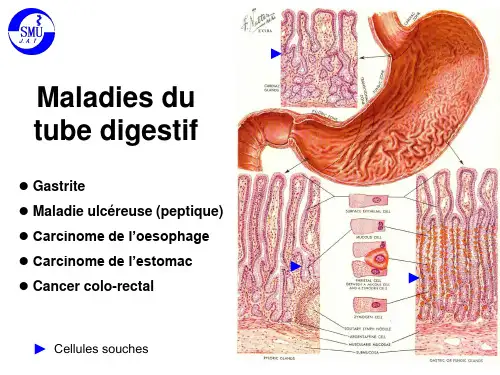
Gastrite chronique
Une atteinte inflammatoire chronique de la muqueuse associé avec l’atrophie et la métaplasie.
Autoimmune Hp
Les étiologies les plus fréquentes :
Métaplasie intestinale
Metaplasia of small intestinal type
Métaplasie intestinale complet
Metaplasia of colonic type
Métaplasie intestinale
Type I stained blue (sialomucins+)
L’infiltrat inflammatoire principalment lymphoplasmocytaire L’atrophie de la muqueuse
Légère: infiltrat lymphoplasmocytaire dans une parti de chorion superficielle (anciennement: gastrite chronique superficielle) Avancé: infiltrat lymphocytaire atteint toute l’épaisseur de la chorion avec fréquentment l’atrophie de la muqueuse (anciennement: gastrite chronique atrophique)
● L’infection chronique par l’Helicobacter pylori (Hp).
关于消化系统的英文PPT幻灯片
Mouth Pharynx Esophagus Stomach Small intestine Large intestine Liver Gallbladder Pancreas
Accessory organs of the digestive system
3
4
The oral cavity
The teeth The tongue The palate
The colon has 3 divisions : the ascending colon, the transverse colon, the sigmoid colon. As fluid waste from the small intestine pass through various sections of the colon ,water is reabsorbed into body.
•The tongue manipulates food in the mouth during
mastication and deglutition.
•The palate the hard plate and the soft plate (the uvula
hanging from the soft plate)
Chewing and swallowing
•The teeth are used to cut ,tear and crush food into smaller
pieces. Each tooth consists of pulp, cementum and enamel.The teeth are classified incisors , cuspids and molars.
双语医学课件-消化系统TheDigestive

胃溃疡
病因
胃酸和蛋白酶的消化是形成胃溃 疡的主要因素,长期不良饮食习 惯、精神压力大、药物刺激等也
可能导致胃溃疡。
症状
上腹疼痛、饱胀、反酸、嗳气等 是胃溃疡的常见症状,严重时可
出现出血、穿孔等并发症。
治疗
药物治疗是胃溃疡的主要治疗方 法,同时需要改善饮食习惯和生
活方式。
肠道疾病
肠易激综合征
一种功能性肠病,表现为 腹痛、腹胀、排便习惯改 变等症状,但无器质性病 变。
胃
通过胃酸和消化酶进一步分解 食物,并与消化液混合形成食 糜。
大肠
包括盲肠、结肠和直肠,主要 负责吸收水分和形成粪便。
消化系统的生理作用
01
02
03
分泌消化液
口腔、胃和小肠等器官分 泌消化液,如唾液、胃酸、 胆汁和胰液,以帮助分解 食物。
蠕动运动
消化道的肌肉通过蠕动运 动推动食物向下移动,促 进食物的消化和吸收。
调节消化
神经系统和激素对消化系 统进行调节,控制消化液 的分泌、胃肠的蠕动以及 吸收过程。
02
消化系统的结构
口腔
口腔是消化系统的起始部分,主 要功能是咀嚼食物,为后续的消
化做准备。
口腔内有牙齿、舌、唾液腺等结 构,共同完成咀嚼和吞咽的动作。
口腔还是呼吸系统的入口,具有 感受味道的功能。
食管
食管是连接口腔和胃 的管道,主要功能是 输送食物进入胃。
避免久坐
长时间久坐会影响肠道蠕动,增加消化系统疾病的风险,应尽量避免 长时间保持同一姿势。
运动前的热身和运动后的放松
进行适当的热身和放松活动,有助于预防运动损伤和促进身体恢复。
感谢您的观看
THANKS
chapter 13 消化系统
Among many causes of esophagus cancer, heavy alcohol consumption is a typical one. In Western nations, a majority of esophageal squamous cell carcinomas result from chronic alcohol abuse. Longterm heavy drinking irritates the lining of the esophagus, leading to inflammation (6_e_so_p_h_ag_it_is_____ ) that eventually may cause malignant changes in the cells.
Ascites 腹水 Gastrointestinal bleeding Abdominal mass 腹部肿块
Gastrointestinal bleeding
Hematemesis
Vomiting of blood Cf. hemoptysis Usu. indicating upper GI bleeding 呕血
squamous cell su
peristalsis
Esophagus cancer
Another ring of muscle, the 5_lo_w_er_e_s_op_h_a_ge_a_l _sp_h_in_ct_e_r , sits at the junction where your esophagus and stomach connect. It opens to allow food into your stomach and then clamps shut so that corrosive stomach acids and digestive enzymes don't back up into the esophagus.
Ascites 腹水 Gastrointestinal bleeding Abdominal mass 腹部肿块
Gastrointestinal bleeding
Hematemesis
Vomiting of blood Cf. hemoptysis Usu. indicating upper GI bleeding 呕血
squamous cell su
peristalsis
Esophagus cancer
Another ring of muscle, the 5_lo_w_er_e_s_op_h_a_ge_a_l _sp_h_in_ct_e_r , sits at the junction where your esophagus and stomach connect. It opens to allow food into your stomach and then clamps shut so that corrosive stomach acids and digestive enzymes don't back up into the esophagus.
消化系统的英文PPT演示课件
9
10
• The small intestine is the region of the gut where nearly all of the chemical digestion of the nutrition components of food take place.
• It divided into 3 sections:1)the duodenum 2)the jejunum 3)the ileum
8
The stomach
It is composed of an upper portion called fundus,a middle section known as the body and a lower portion, called the antrum.
The cardiac sphincter relaxes and contracts to move food from the esophagus into the stomach ,whereas the pyloric sphincter allows food to leave the stomach when it sufficiently digested.
5
6
7
• The pharynx or throat ,is a passageway for food from the mouth to the esophagus and as a passway for air from nose to the windpipe.
As the stomach fills ,the rugae unfolded, exposing the digestive glands and stimulating them to secret digestive enzymes and hydrochloric acid. These substances help transform food present to a semifluid substance.
10
• The small intestine is the region of the gut where nearly all of the chemical digestion of the nutrition components of food take place.
• It divided into 3 sections:1)the duodenum 2)the jejunum 3)the ileum
8
The stomach
It is composed of an upper portion called fundus,a middle section known as the body and a lower portion, called the antrum.
The cardiac sphincter relaxes and contracts to move food from the esophagus into the stomach ,whereas the pyloric sphincter allows food to leave the stomach when it sufficiently digested.
5
6
7
• The pharynx or throat ,is a passageway for food from the mouth to the esophagus and as a passway for air from nose to the windpipe.
As the stomach fills ,the rugae unfolded, exposing the digestive glands and stimulating them to secret digestive enzymes and hydrochloric acid. These substances help transform food present to a semifluid substance.
双语医学课件-消化系统The Digestive

食物经过食道进入胃,胃酸和 消化酶开始对食物进行进一步 消化。
食物经过胃的消化后进入小肠, 小肠是主要的消化器官,通过 分泌多种消化酶对食物进行消 化。
大肠主要吸收水分和形成粪便, 同时也有一定的消化功能。
营养的吸收
小肠是主要的营养吸收器官,吸收食 物中的水、无机盐、维生素和氨基酸 等营养物质。
营养物质被吸收后通过血液运输到全 身各处,供细胞代谢和维持生理功能。
消化系统的基本功能
摄入食物
口腔、食道和胃等器官负责摄 入和运输食物,确保身体获得
足够的能量和营养物质。
分解食物
唾液、胃酸和消化酶等物质将 食物分解为小分子物质,如氨 基酸、单糖和脂肪酸等。
吸收营养
小肠通过绒毛吸收氨基酸、单糖 和脂肪酸等营养物质,并将其输 送到血液中,供身体细胞使用。
排泄废物
大肠主要吸收水分和盐,并形 成粪便,通过肛门排出体外。
治疗
针对不同病因进行治疗,包括药物治疗、生活方式调整和手术治疗等。
其他消化系统疾病
胆囊炎和胆结石
胆囊炎常表现为右上腹疼痛,胆结石可无症状或引起胆绞痛。
胰腺炎
由于胰酶消化胰腺组织引起,临床表现为腹痛、恶心、呕吐等症状。
消化道肿瘤
包括食管癌、胃癌、结直肠癌等,早期症状不明显,晚期可能出现 消化道出血、肠梗阻等症状。
05 双语医学词汇
中英文消化系统专业词汇对照
中文:食管 英文:Esophagus
中文:胃
中英文消化系统专业词汇对照
英文:Stomach 中文:小肠
英文:Small intestine
中英文消化系统专业词汇对照
中文:大肠 英文:Large intestine 中文:肝脏
双语医学课件2-消化系统The Digestive System
1. 功能上可分为三部分:十二指肠, 空肠和回肠
Small Intestine 小肠 Divided into 3 segments: the duodenum, jejunum, and ileum 2. 腹膜是包裹在腹部器官和骨盆腔 上的一层浆膜 The peritoneum is the serous membrane surrounding the organs of abdomen and pelvic cavity.
Cardiovascular System: Major Vessels
1. renal artery 肾动脉 2.vertebral artery 脊椎动脉 3. subclavian artery 锁骨下动脉 4. aorta 主动脉 5. coronary artery 冠状动脉 6. celiac artery 腹腔动脉 7. superior mesenteric artery 肠系膜上动脉 8. lumbar artery 腰动脉 9. inferior mesenteric artery 肠系膜下动脉 10. gonadal artery 生殖腺动脉
Intrinsic nerves (内神经)
The submucosal plexus (Meissner plexus) What are the three nerve plexuses?
黏膜下层神经丛 (即迈斯纳exus (Auerbach plexus)
1.Three pairs of salivary glands
1 liter of saliva per day salivation 唾液分泌
1.Three pairs of salivary glands
1 liter of saliva per day salivation 唾液分泌
关于消化系统的英文PPT优秀课件
11
The large intestine is divided into 4 parts :cecum, colon,sigmoid colon,and rectum.
The cecum is connected to the small intestine by the ileocecal valve.
5
6
7
• The pharynx or throat ,is a long muscular tube that serves
as a passageway for food from the mouth to the esophagus and as a passway for air from nose to the windpipe.
9
10
• The small intestine is the region of the gut where nearly all of the chemical digestion of the nutrition components of food take place.
• It divided into 3 sections:1)the duodenum 2)the jejunum 3)the ileum
• The esophagus is a long muscular tube extending from the
pharynx to the stomach .Food is propelled by rhythmic contractions of muscles in the wall of the esophagus. This process is called peallowing
The large intestine is divided into 4 parts :cecum, colon,sigmoid colon,and rectum.
The cecum is connected to the small intestine by the ileocecal valve.
5
6
7
• The pharynx or throat ,is a long muscular tube that serves
as a passageway for food from the mouth to the esophagus and as a passway for air from nose to the windpipe.
9
10
• The small intestine is the region of the gut where nearly all of the chemical digestion of the nutrition components of food take place.
• It divided into 3 sections:1)the duodenum 2)the jejunum 3)the ileum
• The esophagus is a long muscular tube extending from the
pharynx to the stomach .Food is propelled by rhythmic contractions of muscles in the wall of the esophagus. This process is called peallowing
消化系统 英文版 ppt
-
1
The digestive system is responsible for breaking down food, absorbing nutrients from the food, and ridding the body of waste products from the food. It is roughly nine meters long and begins at the mouth and ends at the anus.
-
4
The stomach is divided into the fundic, cardiac, body, and pyloric regions. The stomach has three layers of muscle: an outer longitudinal layer, a middle circular layer, and an inner oblique layer. The inner lining consists of four layers: the serosa, the muscularis, the submucosa, and the mucosa. The mucosa is densely packed with gastric glands, which contain cells that produce digestive enzymes, hydrochloric acid, and mucus. The stomach is a multi-functional organ, it stores food, breaks it down and then empties it into the small intestine.
1
The digestive system is responsible for breaking down food, absorbing nutrients from the food, and ridding the body of waste products from the food. It is roughly nine meters long and begins at the mouth and ends at the anus.
-
4
The stomach is divided into the fundic, cardiac, body, and pyloric regions. The stomach has three layers of muscle: an outer longitudinal layer, a middle circular layer, and an inner oblique layer. The inner lining consists of four layers: the serosa, the muscularis, the submucosa, and the mucosa. The mucosa is densely packed with gastric glands, which contain cells that produce digestive enzymes, hydrochloric acid, and mucus. The stomach is a multi-functional organ, it stores food, breaks it down and then empties it into the small intestine.
Gastrointestinal System(消化系统)影像学教学课件英文版
(3). This type of examination should be done by appointment,usually scheduled on the morning.
Chapter 10
(4). It requires preliminary preparation of the patient’s gastrointestinal tract fasting stomach on the day of examination and empty colon by cleaning enema for colon examination.
Chapter 10
However, generally only the stomach with the gastro-esophageal junction and the duodenum, part of the jejunum are investigated in detai1, complete examination of the esophagus and small bowel are usually performed only in cases with special pertinent problems and should be ordered separately .For examination of the colon barium enema is the best choice.
Esophagus
Section 2
2. Esophagus
(1). Basic tissue layers of the gut are ① mucosa ② submucosa ③ advenfitia ④ muscularis extemal
Chapter 10
(4). It requires preliminary preparation of the patient’s gastrointestinal tract fasting stomach on the day of examination and empty colon by cleaning enema for colon examination.
Chapter 10
However, generally only the stomach with the gastro-esophageal junction and the duodenum, part of the jejunum are investigated in detai1, complete examination of the esophagus and small bowel are usually performed only in cases with special pertinent problems and should be ordered separately .For examination of the colon barium enema is the best choice.
Esophagus
Section 2
2. Esophagus
(1). Basic tissue layers of the gut are ① mucosa ② submucosa ③ advenfitia ④ muscularis extemal