
人教版英语七年级上册 Unit 2 Section B 教案
1 Unit 2 This is my sister.
Section B(1a-1d)
Teaching
Aims
1.语言能力:掌握单词son, daughter, cousin, grandpa, grandma, mom, dad,
uncle,aunt等,通过家谱图了解家族成员的关系并用英语单词介绍家庭成员。
2.文化意识:了解中英家庭构成差异,增强家族意识,传承传统家风。
3.思维品质:能根据所给内容或所给条件进行改编或创编。
4.学习能力:了解家族成员的关系并使用目标语言介绍家庭成员。
Teaching
Difficulties
了解家族成员的关系并使用目标语言介绍家庭成员。
Teaching
Aids
A tape recorder; CAI or multimedia courseware
Teaching Procedures Tips
Step 1 Lead in
➢ The T can play a video about introducing family members to help
Ss review the target language they have learned and more involved
in the following activities.
➢ Then the T can encourage Ss to describe a family tree. During the
process, the T can also pre-teach some new words and expressions.
Ss are encouraged to practice using these target language.
Step 2 Presentation & Practice
2 ➢ 1a
This activity is to help Ss use the target language to complete a
family tree. Have Ss learn the different terms that are commonly
used for each family member. Write on the board:
Grandfather/Grandpa
Grandmother/Grandma
Mother/Mom
Father/Dad
Explain that “grandpa,grandma, mom, dad” are less formal.
Ss do the in 1a individually and the T can check answers in class.
The T can ask Ss to read these words in chorus to check their
pronunciation.
Answers:
mom, aunt, son, sister, cousin
➢ 1b
The activity is to give Ss practice recognizing the target language.
The T can use Answer Poll to check Ss’ answers:
Find out how many Ss obtained the correct answers in an activity by
taking a poll. List the possible answers on the board (but do not tell Ss
the correct answers). Then ask Ss to raise their hands for each item
they checked. In this way, you can count how many Ss checked each
item. Finally, tell Ss the correct answers. How many were correct?How
many were wrong?
Answers:
aunt; uncle; cousin; friends; grandpa, grandma.
➢ 1c
3 This activity is to provide guided listening and speaking practice
with the target language. The T can guide Ss to use picture clues.
Before listening , the T can ask Ss to look at the pictures in 1c and
discuss the following questions:
How many people are in the pictures?
Who are they?
Where are they?
What are they doing?
...
In this way, Ss are better prepared to answer listening
comprehension questions.
Answers: picture 1
➢ 1d
The activity is to provide Ss with speaking practice using the target
language. Ask Ss to draw their families and friends. Then Ss work
in pairs to introduce the people in their pictures. The T can
observe and offer help to Ss in need. Ss should pay attention to the
accuracy of Ss’ speaking.
Step 3 Language points
➢ aunt 指父母那一辈除母亲之外的所有女性长辈,相当于汉语中的“姑母;姨母;伯母;婶母;舅母”。前面有不定冠词修饰时,应用an。注意:a+读音以辅音音素开头的词;an+读音以元音音素开头的词。
➢ uncle 指父母那一辈除父亲之外的所有男性长辈,相当于汉语中的“舅父;叔父;伯父;姑父;姨父”。前面有不定冠词修饰时,应用an。
4 ➢ aunt与uncle与人名连用的时候, 书写与汉语习惯相反,
要将称呼写在人名前, 且首字母要大写。
➢ cousin是名词, 意为“堂兄(弟、姊、妹);表兄(弟、姊、妹)”,表示与自己同辈的男性亲属或女性亲属,其复数形式为cousins。
Step 4 Summary & Homework
The
homework
can vary
with the
specific
conditions. ➢ Summary The T can encourage Ss to summarize the key points of
this class to help Ss consolidate the knowledge.
➢ Homework:
Preview the passage in Section B 2b.
Do the exercises in students’ book.
Teaching
Reflection The design of activities before listening(Activities1a and 1b) is very
important. The purpose is to activate the memory in students' brain, recall
the learned words, phrases and sentence patterns, and pave the way for
listening activities. At the same time, students' response process is also to
learn and consolidate language knowledge in application.
Unit 2 This is my sister.
Section B(2a-2c)
Teaching
Aims
1. 语言能力:能够读懂介绍家庭成员的文章,并分辨出英文名字及家庭成员之间的关系。
2.文化意识:了解家庭成员的称谓,学会书面或口头向他人介绍家庭成员,促进家庭意识的养成。
3.思维品质:能提取、整理、概括语篇的关键信息、主要内容。
4.学习能力:能整理、归纳所学内容,把握重点和难点。
5 Teaching
Difficulties
阅读文章,找出文章的关键信息。
Teaching
Aids
A tape recorder ,CAI or multimedia courseware
Teaching Procedures Tips
Step 1 Lead in
➢ The T can present the family pictures appearing in this unit and
elicit the people’s names from Ss . Ss can be encouraged to say out
more names in this unit. The T can also encourage Ss to review what
the differences between Chinese names and English names.
Step 2 Presentation & Reading
➢ 2a
The activity is to provide writing practice with the target language.
Before Ss look for the answers in the unit, ask them to try to do the
activity from memory first. Ss often read material or listen to
conversations, but they do not necessarily try to remember what they
have heard or read.
Answers:
Male: Tom Bob Jack Paul Jiang Tao Alan
Eric John Bill Dale
Female: Cindy Li Lan Jenny Linda Mary Sally
Unit 1 Section B(2a-2c)教案2022-2023学年人教版英语七年级上册
七上英语
Lesson period: 5 _月_日 Lesson type: New
Unit1 My name's Gina
Section B 2a–2c
Teaching aims
1. Expressions and writings of names in different cultures.
2. Grasp the knowledge in 2b
Leading in (1')
My name is…, my first name is…, and my last name is …. Can you tell me your
first name and last name? Let’s look at our learning aims:
Learning aims(1')
1. To master the format of Chinese and Western names
2. To master how to introduce yourself and your friends’ name and phone number.
Guide One(3')
1. Read and translate the sentences in the pictures in 2a.
2. Read the title, finish the task in 2a.
Self-Check One(2')
1. Choose students to read and translate the dialogues.
2. Exchange answers. If you have any problems, you can ask your partners(Page96)
(Students teach students )
【精选】人教版七年级上册英语Unit2第二单元优秀教案
【精选】⼈教版七年级上册英语Unit2第⼆单元优秀教案
Unit 2 This is my sister.
第⼀课时Section A(1a-1c)
【学习⽬标】1.重点单词:sister,mother,father,parent,brother,grandmother,grandfather,grandparent,family,those,who,these
2.重点短语:my parents,my brothers
3.重点句式:
That's my family.
Those are my parents.
—Who's she?
—She is my sister.
【学习重点】1.学会说家庭成员的称谓
2.学会谈论家庭成员
3.能听懂有关介绍家庭成员的谈话
4.学会指⽰代词this,that,these,those的⽤法
【学习难点】1.名词复数的正确使⽤
2.学会介绍家⼈
【⾃主学习】
⼀、预习课本P7新单词并背诵,完成下⾯的汉译英。1.姐妹__________ 2.妈妈__________
3.爸爸__________ 4.⽗亲或母亲__________
5.兄弟__________ 6.奶奶或姥姥__________
7.爷爷或姥爷__________
8.祖⽗或祖母__________
9.家庭____________ 10.那些____________
11.这些____________ 12.谁____________
⼆、认真预习1a,1b,1c,找出下列短语和句型。1.我的⽗母亲________________
2.我的兄弟们________________
3.那是我的家庭。________________
4.这些是我的⽗母亲。________________
5.—她是谁?—她是我妹妹。_________________________________________________________________ 【课堂导学】
新人教版七年级英语上册(2021年秋使用)全册教案
公众号:惟微小筑
2021年新人教版七年级||英语上册全册教案
Unit 1 My name is Gina.
1.Topic话 题:
Making new friends
2.功能目标:
1 )Introduce yourself使学生学会用英语介绍自己 .
2 )Greet people使学生学会用英语和别人打招呼 .
3 )Ask for and give telephone numbers 询问和给出 号码
3.文化目标:
1 )让学生初步体会用英语和别人交流的感受 ,培养学生学习英语的兴趣 .
2 )通过对英文名字的介绍 ,比照中西方表达名字的不同 ,了解中西方文化的差异 .
3 )通过对西方一些成功人士英文名字的介绍 ,使学生了解成功是由不懈的努力和艰苦的奋斗得来的 .
4 )通过介绍英文名字的由来 ,使学生产生对西方文化的好奇及兴趣 .
4.认知目标:
1 )词 汇:
clock, hello, hi, and, question, answer, look, first name, last name
2) 语法工程:一般现在时be的用法
以特殊疑问词what开头的问句
形容词性物主代词my, your, his, her
What ,s =What is I ,m =I am My name ,s =My name is
3) Language goals语言目标:
What ,s your name?
My name is Gina.
I ,m Gina. Nice to meet you.
What ,s your telephone number? It ,s….
Period one
I.教材分析:这是课本的第|一局部 ,题目是My mane is Gina. 有很多学生第|一次学习接触英语 ,为了调动他们的积极性 ,不产畏难情绪 ,尽量简单的处理教材 .
2021秋七年级英语上册人教版 Unit 2 Section A 1a-2d 教案
This is my sister.
Section A 单词 sister n. 姐;妹 mother n. 母亲;妈妈
father n. 父亲;爸爸 parent n. 父(母)亲
brother n. 兄;弟 grandmother n. (外)祖母;奶奶;外婆;姥姥
grandfather n. (外)祖父;爷爷;外公;姥爷
grandparent n. 祖父(母);外祖父(母)
family n. 家;家庭 those pron. 那些
who pron. 谁;什么人 these pron. 这些
they pron. 他(她、它)们 well interj. 嗯;好吧
have v. 经受;经历 day n. 一天;一日;白天
bye interj. (=goodbye)再见
短语 my family我的家庭 have a good day过得愉快
句型 1. —Who’s she? 她是谁?
—She’s my sister. 她是我的姐姐(妹妹)。
2. This is my friend Jane. 这是我的朋友,简。
3. That’s my family. 那是我的家人们。
4. Have a good day!(表示祝愿)过得愉快!
5. —Are those your parents? 那些是你的父母吗?
—Yes, they are. 是的,他们是。
Section B 单词 son n. 儿子 grandpa n. (外)祖父;爷爷;外公;姥爷
dad n. 爸爸 mom n. (=mum)妈妈
picture n. 照片;图画 aunt n. 姑母;姨母;伯母;婶母;舅母
girl n. 女孩 grandma n. (外)祖母;奶奶;外婆;姥姥
人教版英语七年级上册 Unit2 单元教材分析

Unit2 单元教材分析
本单元包括 Section A,Section B 和Self Check。本单元的标题为This is my
sister.围绕介绍家庭成员开展听说读写教学活动,中心话题是介绍家人和亲属,学生的学习活动是在真实的生活场景中展开的,并把“名词的单、复数形式”这一语法主线贯穿其中。 教学内容为语法的学习和使用提供了必要的感性材料,同时也体现了语法项目与交际情景自然结合的特点。
本单元的重点教学项目是介绍家人、亲属和一般名词的单、复数形式。
难点是区分名词的单、复数形式与be动词、指示代词(this、that、these、those)之间的关系。
单元教学设想
思路一:本单元的词汇主要是家庭成员,所以进行词汇教学时,就以人物为主,让学生将单词和家庭成员进行结合,一方面容易记住,另一方面增加了学习兴趣。在教 father,mother,son,daughter 等名称的单词时,用my/your/his/her来反复操练,既可以巩固单词,又可以让学生练习形容词性物主代词的用法,达到“温故而知新”。
思路二:英语课程改革的重点强调课程从学生的学习兴趣、生活经验和认知水平出发,倡导体验、实践、参与、合作与交流的学习方式和任务型的教学途径,发展学生的综合语言运用能力。因此笔者设计了六个非常生活化的场景,并把这些场景像故事情节一样展开。设置场景的目的是为任务的下达创造条件。学生在解决任务的过程中,经历了为用而学,用中学,学了就用等环节,使英语学习的过程成为培养学生实际语言运用能力的过程,真正体现“以人为本”及“学以致用”的原则。六个场景的设置为中心话题的展开找到了线索,使本单元的内容浑然一体。
思路三:本单元共分为四课时:
第一课时(Section A la—2c)
第二课时(Section A 2d—3c)
第三课时(Section B la—2c)
第四课时(Section B 3a—Self Check)
人教版七年级英语上册教案Unit 2 What time do you go to school1第一课时
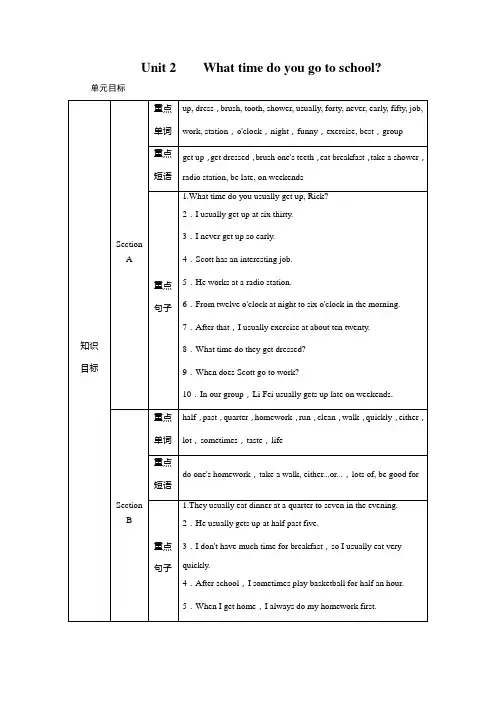
Unit 2 What time do you go to school?
单元目标
知识
目标 Section
A 重点
单词 up, dress,brush, tooth, shower, usually, forty, never, early, fifty, job,
work, station,o'clock,night,funny,exercise, best,group
重点
短语 get up,get dressed,brush one's teeth,eat breakfast,take a shower,radio station, be late, on weekends
重点
句子 1.What time do you usually get up, Rick?
2.I usually get up at six thirty.
3.I never get up so early.
4.Scott has an interesting job.
5.He works at a radio station.
6.From twelve o'clock at night to six o'clock in the morning.
7.After that,I usually exercise at about ten twenty.
8.What time do they get dressed?
9.When does Scott go to work?
10.In our group,Li Fei usually gets up late on weekends.
Section
B 重点
单词 half,past,quarter,homework,run,clean,walk,quickly,either,lot,sometimes,taste,life
重点
短语 do one's homework,take a walk, either...or...,lots of, be good for
七年级英语上册Unit1 Topic2 SectionB教学设计 最新仁爱版
Unit1MakingNewFriends
Topic2Whereareyoufrom?SectionB
Ⅰ.Materialanalysis
本节课是在SectionA的基础上拓展学习新知识,主要活动是1a和2a。通过看、听、
说,复习询问姓名、国籍的表达方式,并进一步学习对第三人称基本信息的询问“Whoisshe/he?”,“She/Heis…”,“Whereisshe/hefrom?”此外,学生还会了解到英美国家
在姓名表达方式上与中国的不同,老师将利用图片和师生互动展开教学,最后,通过学
唱英文歌巩固本课的询问国籍表达及国家名称。
Ⅱ.Teachingaims1.Knowledgeaims
能够掌握并应用新学习的单词:look;
能够正确使用be动词am,isare的一般现在时在不同情况下形式上的不同变化;
能够正确使用人称代词:she,he;
能够用英语熟练表达询问姓名、国籍的方式:Whoisshe/he?She/Heis….Whereisshe/hefrom?She/Heisfrom…Isshe/hefrom…?Yes,she/heis./No,she/heisn’t.
能够正确运用特殊疑问词where,who引导的特殊疑问句。2.Skillaims
能听懂有关询问姓名、国籍等基本情况的简单对话或叙述;
能运用图文就表示询问姓名、国籍等基本情况的话题进行简单的交流;
能正确地朗读对话,并能注意语音语调;
能正确使用英文句子的书写格式和单词的大写规则。3.Emotionalaims
能够与同学积极合作,参与课堂活动,大胆实践,培养友好互助的精神;
能有兴趣用所学的功能句进行口头对话;
使学生乐于接触并了解异国文化。Ⅲ.Thekeypointsanddifficultpoints
1.Keypoints
正确使用表示询问姓名、国籍等的表达方法;
正确使用人称代词:she,he
掌握be动词am,is,are的一般现在时在不同情况下形式上的不同变化;
英语人教版(2024)版七年级初一上册Starter Unit1 Section B 教案 01
Starter Unit 1
Period 2 Section B How do you start a conversation?
一、教材分析
What: 本课时语篇主要围绕如何开始一段对话这个话题进行读写任务的练习。Conversation 1是两个初次见面的同学开展的对话。对话中,两人主要交流了彼此的名字,拼写当时及友好问候。Conversation 2是两个认识的同学的对话,包含对彼此近况的询问及礼貌地告别。
Why: 本课时语篇通过不同情境语境可以帮助学生了解与不同的人打招呼的基本交际礼仪,了解并掌握如何询问别人的姓名,如何介绍自己及如何礼貌地告别。
How: 本课时先通过一个小测试使同学进一步加强对于开始一段对话的表达,在第一篇语篇中通过对话向同学们介绍了如何礼貌地询问别人名字的方式,如“May I have your name?”“How do you
spell your name?”,向对方释放善意的表达,如“You can call me...”“Nice to meet you”等。在第二篇语篇中向同学们介绍了如何询问别人近况及对应答的表达,如“How are you?I’m fine, thank you.
And you?”以及结束对话的礼貌问答,如“Goodbye.”“Bye.”接着通过对对话的读写练习,加深同学们对所学对话内容的掌握。
二、教学内容
1. 本课时的重点单词,短语和句子。
2. 区分熟人和陌生人之间的问候语,在正确语境中开展对话。
4. 锻炼学生抓取信息的能力。
三、教学目标
【知识与技能】
1. 掌握以下重点单词及短语:
start、conversation、spell、bell、
2. 掌握下列句型:
May I have your name?How do you spell your name?How are you?I’m fine, thanks. That’s the bell.
最新七年级上册英语教案人教版免费(8篇)
最新七年级上册英语教案人教版免费(8篇)
七年级上册英语教案人教版免费【篇1】
Unit 1 Topic 3 How old are you ?
Section D
学习目标
1.学习以短文形式谈论姓名、年龄、学校、班级和电话号码等个人信息
2.能读懂短文并能从简单的名片中获得信息
3.能向大家做自我介绍
学习重点
以短文形式谈论姓名、年龄、学校、班级和电话号码
学习难点
第一人称和第三人称的转变
学习过程
(一)导入
(二)自学指导
1、预习课本P23 Part 1 ,复习书上的六个音标
2、预习课本P23 Part 2 ,分别找出Jane 和 Huang Hua 的个人信息 3、预习P23 Part 3 ,根据所给信息把空补充完整
4、背诵课本P24 Part 4a 4b
(三)问题导学 再看课本P22 Part 2 ,回答问题。
Where is Jane from ?__________________________
How old is she ?___________________________
What class is she in ? _____________________
Where is Huang Hua from ? _______________
What’s his English name ? _____________________
Are they in the same class ? ______________
(四)典题训练
(五)精讲点拨
1、They are not in the same class ,but they good friends.
他们不在同一个班,但是他们是好朋友。
解析:same 意思是“相同的”,前面一定要用定冠词“the”,后面接单数名词。
人教版七年级上册英语教案:Unit 1 My name's Gina. Section B2
本文由一线教师精心整理/word可编辑
1 / 2 Section B 3a-Self Check
一、教学目标:
1. 语言知识目标:
1) 复习英文中姓与名的表达方式,熟练掌握英文中姓在后,名在前。
2) 能正确叙述别人的电话号码,别人姓氏及名字。
3) 能辨别英文中的姓氏与名字,了解中英文中姓名之间的区别。
4)了解并掌握一些常用的电话号码,并知道在什么情况下会打此电话。
4)能根据信息卡提供的信息,描述他人的电话号码及姓氏及名字等内容。
5)能制作自己的信息卡,并能简单地描述自己的电话号码力。
2. 情感态度价值观目标:
1) 能积极主动提供并获取个人信息资料(如:名字、电话号码)
2) 能对所获取的信息进行初步的整理和总结。
3) 能积极动手、动脑,培养自己的想象力和创造力。
4)掌握一些紧急求助电话,提高自我保护意识。
二、教学重难点
1. 教学重点:
1) 能根据信息卡提供的信息,描述他人的电话号码及姓氏及名字等内容。
2) 能制作自己的信息卡,并能简单地描述自己的电话号码力。
3) 通过读与写的训练,提高学生们综合运用英语的能力,培养学生们学习英语的兴趣,并在学习中体会到学习英语的乐趣。
2. 教学难点:
1) 根据信息卡提供的信息,描述他人的电话号码及姓氏及名字等内容。
2) 制作自己的信息卡,并能简单地描述自己的电话号码力。
三、教学过程
Ⅰ. Warming- up and revision
1. Daily greetings to the students.
T: Good morning, everyone. My name is Peter. My telephone number is … What’s your name, please?