
高中英语 Unit 3 Section I Warming Up Reading Pre r
Unit3 Traveljournal单元规则与Period1 WarmingupandReading
Unit3 Traveljournal单元规则与Period1
WarmingupandReading
Unit3 Traveljournal
单元规则
本单元的中心话题是旅游,通过旅游日记的方式描述旅行见闻。具体涉及旅游所需的准备工作,以及选择安排旅游时间、景点、路线、交通工具等。语言技能和语言知识等都是围绕旅游这一中心话题展开的。
为了围绕中心话题开展听、说、读、写活动,本单元安排了八个部分:“热身”“读前”“阅读”“理解”“语言学习”“语言运用”“小结”和“学习建议”。
“热身”部分让学讨论乘公交车、乘火车、乘船和乘飞机四种不同交通方式的优、缺点,并填入表格中。然后让学生想象自己计划选一个地方去度假,并就度假事宜编一段对话。与同学讨论六个问题,使学生了解旅游的必要手段和必备的费用。目的是培养学生利用网络等资源查阅信息的能力,教师可借此帮助学生掌握一些关于旅游方面的词汇和相关知识,同时提出的六个问题都涉及现在进行时表示将来的用法,为本单元其余部分的学习作好了铺垫。
“读前”部分提出了两个问题:沿河居住的人怎样利用河流?世界上有许多大河,如果你只能沿着其中一条河旅游,你会选哪一条?它们不仅与单元主题有关,而且与下一部分的阅读材料内容紧密联系,从而导出了话题,并为阅读作好准备。
“阅读”部分是joURNEyDoNTHEEoNG的部分THEDREAANDTHEPLAN,王坤用人称讲述了他和王薇梦想沿湄公河骑自行车旅行,并为之作准备的过程。主要目的是通过阅读培养学生略读、跳读、根据上下文猜测词义等阅读技巧,并使学生了解湄公河的地理风貌,丰富他们的地理知识。
“理解”部分提供了五个练习。通过问答题的形式、用自己的话解释句子。让学生填写表格列举在课文中王薇和王坤对旅行的相同和不同态度并说明自己的看法、想象自己就是王坤和王薇并利用某一段落的信息编对话以及比较并解释句子的意义,加深学生对课文内容、细节以及重点句子的进一步理解。
人教版选修七Unit 3 Under the sea教案及说课稿

Unit 3 Under the sea
I.教学内容分析
本单元的中心话题是海底世界。听说读写活动主要围绕海底的动植物、奇异景观和有关大海的神话绽开的。
Warming Up局部通过探讨海底生物和理解海底世界的途径导入本单元话题。
Pre-reading局部通过探讨图片导入课文并介绍故事背景。
Reading局部讲解并描述了一个虎鲸助人捕鲸、救人脱险的故事。课文中采纳了大量的动作描写,并运用了大量的-ing形式。
Comprehending局部由三个练习题组成,旨在逐步加深学生对课文的理解。
Learning about Language局部突出了本单元词汇和语法的学习与训练。本单元的语法是-ing形式的被动语态。
Using Language局部包括阅读和写作两局部。课文通过对海的世界奇观妙境的描写,为学生树立了景物描写的典范。写作局部要求学生仿照课文描写景物。本局部中,形容词的依次和复合形容词的构成也是学生应理解的内容。
Summing Up局部要求学生对本单元的内容、词语和构造进展总结,有助于学生
Learning Tip 局部介绍了合成形容词的构词法,并指导学生在写作中主动利用构词规则组词。
II.教学重点和难点
1. 教学重点
(1) 本单元的生词和短语;
(2) 驾驭运用-ing 形式的被动式;
(3) 学会在对话和写作中表达责怪、埋怨以及要求赔偿。
2. 教学难点
(1) 帮住学生更多地理解海洋生物,培育学生敬重海洋、爱惜海洋生物的道德品质;
(2) 学会仿照课文描写景物;
(3) 学会复述故事。
III.教学安排
本单元建议分五课时:
第一课时:Warming up, Pre-reading, Reading & Comprehending
第二课时:Learning about Language
第三课时:Reading and discussing (Using Language)
高中英语-unit-3-Life-In-the-Future-全单元教案

⾼中英语-unit-3-Life-In-the-Future-全单元教案
⾼⼆上学期第三次教案设计⼈:Unit 3 Life In the Future
Period 1 & 2 Warming Up & Pre-reading, Reading
Teaching Goals:
1.To illustrate Ss’ imagination of future life.
2.To arouse Ss to pay more attention to the problems that probably appeared in the
future life.
3.To make Ss know the difference of life between the past, present and future. Teaching Procedures:
Step 1 Leading-in
Purpose: To talk about past and future changes of life.
1. Group work
Let Ss discuss the questions in groups of four.
(1)How do you usually get to school?
(2)Where do you live, in a city or in the countryside?
(3)Where would you like to live in the future?
(4)Do you live in a flat or a house?
(5)Do you have a room of you won? Can you describe the room in the picture?
(6)What kind of housing would you like to have in the future?
高中英语(人教版必修5)教师用书:Unit 5 Section_Ⅰ Warming Up - Reading — Pre-reading (含答案)

Section_ⅠWarming Up & Reading — Prereading
Now many hospitals suggest that we use the letters DR ABC to remember what to
do when dealing with an emergency. Do you know what they stand for?Now read the
following passage to get the answer.
The most important thing to keep in mind when dealing with an emergency (紧急情况) is to stay calm. By staying calm we will be able to think what to do and
make better decisions.
Many hospitals suggest that we use the letters DR ABC to remember what to do
when we have to think fast. D stands for danger. We should first of all make sure
that the accident scene is no longer dangerous. If we were to get hurt trying to
save someone, we would not be able to help. R is for response. We can do a lot of
good by simply asking “Are you all right?” If the person can answer, we know
人教新课标高中英语必修二Unit4Wildlifeprotection习题(3)
Unit 4Wildlife protection
Section I Warming Up,Pre-reading,
Reading & Comprehending
课后篇巩固探究
一、用方框内所给短语的适当形式填空 die out pay attention to protect…from burst into laughter do harm to have an
effect on in danger in relief succeed in in peace
1 .Think of the movies,books,teachers,and friends that you most deeply.
答案:have an effect on
2 .Many animals have because of much killing and hunting.
答案:died out
3 .Do you think that work without rest will your health?
答案:do harm to
4 .We all when we saw the funny performance.
答案:burst into laughter
5 .The doctor told the parents that their son was injured badly,and was still .
答案:in danger
6 .We should take measures to the lake pollution.
答案:protect;from
7 .You are to your work because you are wise and hardworking.答案:response
答案:succeed in
8 .People won' t you when they still have a lot of ideas of their own crying for
人教版高中英语选修8教师用书:Unit 2 Section_Ⅰ Warming Up - Reading — Pre-reading(含答案)
.
.
Section_ⅠWarming Up & Reading — Prereading
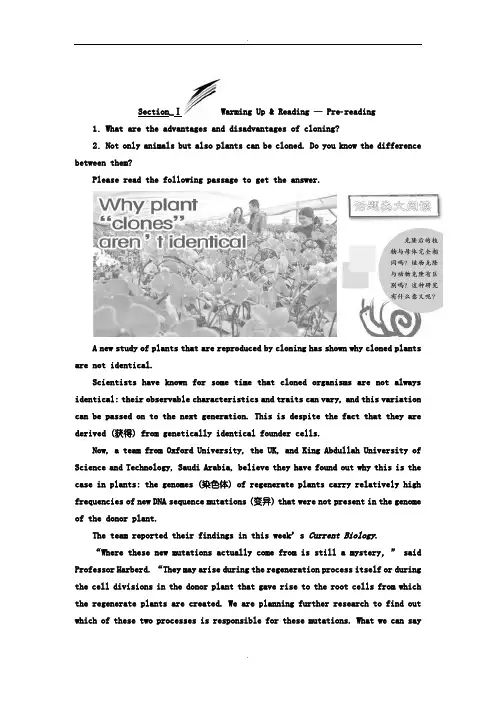
1.What are the advantages and disadvantages of cloning?
2.Not only animals but also plants can be cloned. Do you know the difference
between them?
Please read the following passage to get the answer.
A new study of plants that are reproduced by cloning has shown why cloned plants
are not identical.
Scientists have known for some time that cloned organisms are not always
identical: their observable characteristics and traits can vary, and this variation
can be passed on to the next generation. This is despite the fact that they are
derived (获得) from genetically identical founder cells.
Now, a team from Oxford University, the UK, and King Abdullah University of
Science and Technology, Saudi Arabia, believe they have found out why this is the
case in plants: the genomes (染色体) of regenerate plants carry relatively high
人教新课标高中英语必修三Unit 1 Festivals around the world全章教案
人教新课标高中英语必修三Unit 1 Festivals around the world全章教案
I.教学内容分析
本单元的中心话题是“节日”,主要讲述了不同地区不同种类的节日。
Warming Up部分设计了小组活动,通过图表填写让学生区分中国的传统节日与别国节日的异同,目的在于激活学生已有的节日背景知识,引出主题,为以后几堂课学习热身。
Pre-reading 通过几个问题,调动学生已有的知识和经验,激发学生想了解更多节日的好奇心,让他们主动参与到主题教学活动中,为下面学习阅读文章作铺垫。
Reading 部分先简要介绍了一下早期各种节日的起源以及存在的原因,然后又分别介绍了几种世界各地的节日,依次的顺序是亡灵节、纪念名人的节日、丰收节、春天的节日等。
Comprehending 由四个部分组成。第一、三、四部分通过表格形式,第二部分通过让学生回答问题的方式,鼓励学生积极思考,加深对课文的理解。
Learning about Language 部分主要突出了本单元的语法项目——情态动词的用法。这些情态动词主要有:can,could,may,might,will,would,shall,should,must,can’t 等的用法。
Using Language 部分中包括了听、说、读、写几个部分的内容。学生可通过对Trinidad
Carnival、情人节等一些节日的学习,分析问题,锻炼自己的思维能力。阅读后的习题及讨论不仅帮助学生理解文章的主旨大意,更重要的是让学生寻找解决问题的方法。
Learning Tip 部分主要建议学生搜集各种资料,查询与世界各地节日有关的信息,了解各种节日的来源与内涵。
II.教学重点和难点
1. 教学重点 (1) 本单元的生词和短语;
(2) 掌握一些情态动词的基本用法;
(3) 了解有关节日和民俗,掌握有关词汇,如custom,religious等 。
人教版高中英语必修3人教版必修三Unit1Festivals around the world教案Period 1 Warming up and Reading
探索尚未知道的东西
Unit 1 Festivals around the world
单元要览
类别 课程标准要求掌握的项目
话题 Festivals; how festivals begin; how to celebrate festivals
词汇 beauty n. 美; 美人 award n. 奖; 奖品 vt. 授予
harvest n. & vt. & vi. 收获; 收割 rooster n. 雄鸡; 公鸡
celebration n. 庆祝; 祝贺 admire vt. 赞美; 钦佩; 羡慕
starve vt. & vi. (使)饿死; 饿得要死 energetic adj. 充满活力的; 积极的
origin n. 起源; 由来; 起因 custom n. 习惯; 风俗
religious adj. 虔诚的; 宗教上的 clothing n. 衣服
ancestor n. 祖先; 祖宗 worldwide adj. 遍及全世界的
feast n. 节日; 盛宴 permission n. 许可; 允许
belief n. 信任; 信心; 信仰 fool n. 愚人 vt. 愚弄 vi. 干傻事
trick n. 诡计; 恶作剧; 窍门 apologize vi. 道歉; 辩白
arrival n. 到来; 到达; 到达者 drown vt. & vi. 溺死; 淹死
gain vt. 得到; 获得 obvious adj. 明显的; 显而易见的
independence n. 独立; 自主 remind vt. 提醒; 使想起
gather vt. , vi. & n. 集合; 聚集 weep n. 哭 vi. 哭泣; 流泪
agriculture n. 农业; 农艺; 农学 forgive vt. 原谅; 饶恕
短语 take place发生 turn up出现; 到场
高中英语(必修1)课后强化作业:unit 3 section 1 word版含答案
Unit 3 Travel journal
SectionⅠ Warming Up & Reading
Ⅰ.单词拼写
1.The salesman ________(说服)us to buy his product.
2.She is a ________(毕业生)student in literature.
3.They________(终于)realized that the whole thing was a joke.
4.They have planned a tight________(日程表)of travel.
5.He has the ability to________(组织).
6.The workers are ________(决定) to finish the job on time.
7.It is one day's________(旅程) to get to the seaside.
8.There were perhaps ten________(一步) between me and the bear.
答案:
1.persuaded 译文:那个推销员说服了我们买他的产品。
2.graduate 译文:她是个念文学的毕业生。
3.finally 译文:他们终于意识到整个事情是场玩笑。
4.schedule 译文:他们安排了一个紧凑的旅行日程。
5.organize 译文:他很有组织才能。
6.determined 译文:工人们决心按时完成这项工作。
7.journey 译文:到海滨是一天的行程。
8.paces 译文:在我和熊之间相距大约有十步。
Ⅱ.完成句子
1.Many people living in cities would actually ____________(更喜欢) live in the
countryside.(prefer)
2.In school, we always arrange all kinds of activities ________ ________(按时间表).(schedule)
人教版高中英语选修7教师用书:Unit 1 Section_Ⅰ Warming Up - Reading — Pre-reading(含答案)
.
.
Section_ⅠWarming Up & Reading — Prereading
Do you know Wilma Rudolph who is deaf and dumb? And what did she do to try to
get over the difficulties? Please read the following passage to get the answers.
They called her “the Black Pearl”, “the Black Gazelle” and “the fastest
woman in the world”. In 1960, Wilma Rudolph became the first American woman to
win three gold medals in one Olympics. She was an extraordinary American athlete.
She also did a lot to help young athletes succeed.
Wilma Rudolph was born in 1940, in Saint Bethlehem, Tennessee. She was born
too early and only weighed two kilograms. She had many illnesses when she was very
young, including pneumonia and scarlet fever. She also had polio, which damaged
her left leg. When she was six years old, she began to wear metal leg braces (支架) because she could not use that leg.