
2011年专八口语考试真题第一部分英译汉答案
TASK ONE: English to Chinese
Speech by the director of the Frankford book fair at the 4th china international cultural
industries fair
Distinguished Guests, ladies and gentleman, I am extremely honored to be here today
for the opening of the 4th international cultural industries fair in Shenzhen, the largest fair of
this kind in China, I further praise the aspiration of the people’s republic of china to improve
the international marketing and promotion of Chinese culture .All around the world people
are interested in getting to know China better. They are not only curious about the economic
and political aspects of the Asian giant, but also its culture. The cultural industries fair in
Shenzhen is an international platform for culture in all its mini aspects. Digital media are just
as much at home here as print products dance folk art calligraphy and literature. For the first
time this year, an entire hall has been dedicated to international exhibitors, emphasizing the
increased importance china places on international context. The topic I would like to focus
on today is how to market culture internationally which is exactly what the Frankford book
fair has been doing ever since our establishment 60 years ago after the second world war .
The Frankford book fair is unique because there is no other place in the world that brings
together so many international publishers, writers, critics and other publishing professionals.
More than 7000 exhibiters from over 100 countries around the world present their products
at our fair; approximately 180 thousand trade visitors come to the fair from every corner of
the world. Each year, the fair invites a country as its guest of honor. Several weeks before the
fair, the media in Germany begin to focus on the guest of honor. Numerous independent
events draw attention to this country’s literature and culture. Events range from the
discussions of literature politics and history, to theater, dance, films and concerts. The
success story of the Frankford book fair clearly proves that culture and commerce can go
hand in hand. On this note I would like to wish you all a very successful time during the
international cultural industries fair in Shenzhen
尊敬的各位贵宾,尊敬的各位来宾: 我很高兴今天来参加第四届中国(深圳)国
际文化产业博览交易会——这个中国最大的文化产业博览会的开幕式。祝贺中国文化
在国际市场营销与推广方面取得成就。世界关注中国,希望更多了解中国的愿望不仅
体现在经济和政治领域,还体现在文化领域。深圳文博会为文化产业搭建了一个国际
性的平台,在这里文化涵盖了各个方面,从数字媒体、印刷产品到舞蹈、民间艺术、
书法以及文学等。深圳文博会今年还首次为国际参展商设立了专门的展厅,充分体现
了中国对国际合作的重视。今天我的发言主要将围绕“如何开展文化的国际营销”展开。
因为这也正是法兰克福书展在二战后,约60年前的“重生”以后一直以来的工作。此次
书展是独一无二的,因为世界上没有一个地方能像法兰克福书展这样吸引着全世界的
出版人、作家、评论家以及出版界的各种专业人士。此次书展聚集了来自100多个国
家的7000多家参展商来展示他们的产品。约180000位来自世界各地的专业人士每年
参加法兰克福书展。在书展开幕的数周之前,德国的媒体就已经开始聚焦主宾国了。
众多的各种文化活动将吸引人们关注主宾国的文学与文化。从以文学、政治、历史为
主题的研讨会,到戏剧、舞蹈演出、电影和音乐会。还经常有关于主宾国的专业会议
和国民大学课程。法兰克福书展成功的历史充分证明了,文化与贸易可以紧密的结合
在一起。从这个意义上,我祝愿深圳文博会取得圆满成功,祝愿大家在文博会上取得
业绩。我很期待2009年法兰克福书展上中国主宾国的展示!
2011年专八真题 部分解析
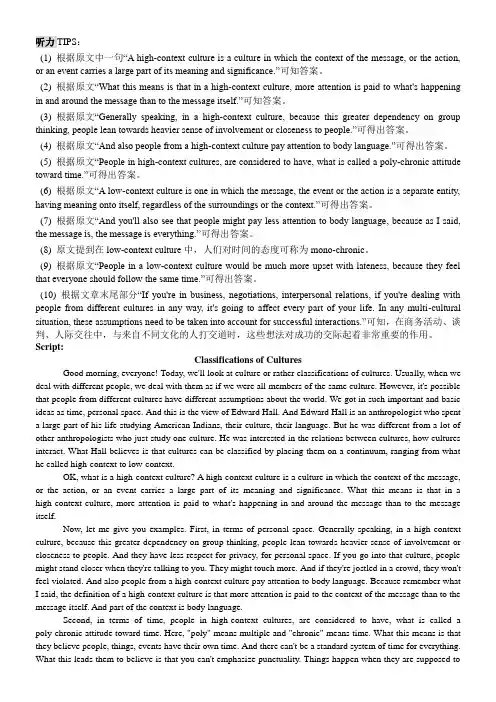
听力TIPS:(1) 根据原文中一句“A high-context culture is a culture in which the context of the message, or the action, or an event carries a large part of its meaning and significance.”可知答案。
(2) 根据原文“What this means is that in a high-context culture, more attention is paid to what's happening in and around the message than to the message itself.”可知答案。
(3) 根据原文“Generally speaking, in a high-context culture, because this greater dependency on group thinking, people lean towards heavier sense of involvement or closene ss to people.”可得出答案。
(4) 根据原文“And also people from a high-context culture pay attention to body language.”可得出答案。
(5) 根据原文“People in high-context cultures, are considered to have, what is called a poly-chronic attitude toward time.”可得出答案。
(6) 根据原文“A low-context culture is one in which the message, the event or the action is a separate entity, having meaning onto itself, regardless of the surroundings or the context.”可得出答案。
2011年3月5日专八 (TEM8) 真题+答案+听力材料[完整版]
![2011年3月5日专八 (TEM8) 真题+答案+听力材料[完整版]](https://360docs-1393072327.cos.ap-beijing.myqcloud.com/af2d82493b3567ec102d8a79.webp)
TEST FOR ENGLISH MAJORS (2011)-GRADE EIGHT-TIME LIMIT: 195 MIN PART I LISTENING COMPREHENSION (35 MIN) SECTION A MINI-LECTUREIn this section you will hear a mini-lecture. You will hear the lecture ONCE ONLY While listening, take notes on the important points. Your notes will not be marked, but you will need them to complete a gap-filling task after the mini-lecture. When the lecture is over, you will be given two minutes to check your notes, and another ten minutes to complete the gap-filling task on ANSWER SHEET ONE. Use the blank sheet for note-taking.Complete the gap-filling task. Some of the gaps below may require maximum of THREE words. Make sure the word(s) you fill in is (are) both grammatically & semantically acceptable. You may refer to our notes.Classifications of CulturesAccording to Edward Hall, different cultures result in different ideas about the world. Hall is an anthropologist. He is interested in relations between cultures.I.High-context cultureA. feature—context: more important than the message—meaning (1) ________________i.e. more attention paid to (2) ________ than to the message itselfB. examples—personal spacepreference for (3) ___________less respect for privacy/personal spaceattention to (4) ________concept of time—belief in (5) _________ interpretation of time—no concern for punctuality—no control overtimeII.Low-context cultureA.feature—message: separate from context—meaning (6) __________B.examples—personal space—desire/respect for individuality/privacy—less attention to body language—more concern for (7) ________—attitude toward time—concept of time: (8) ___________—dislike of (9) _____________—time seen as commodityIII.ConclusionAwareness of different cultural assumptions—relevance in work and lifee.g. business, negotiation, etc.—(10) ___________ in successful communicationSECTION B INTERVIEWIn this section you will hear everything ONCE ONLY. Listen carefully and then answer the questions that follow. Mark the correct answer to each question on your coloured answer sheet.Questions 1 to 5 are based on an interview. At the end of the interview you will be given 10 seconds to answer each of the following five questions. Now listen to the interview.1. According to Dr. Harley, what makes language learning more difficult after a certain age?A.Differences between two languages.B.Dealing capacity to learn syntax.C. Lack of time available.D. Absence of motivation.2. What does the example of Czech speakers show?A. It‘s natural for language learners to make errors.B. Differences between languages cause difficulty.C. There exist differences between English and Czech.D. Difficulty stems from either differences or similarity.3. Which of the following methods does NOT advocate speaking?A. The traditional method.B. The audiolingual method.C. The immersion method.D. The direct method.4. Which hypothesis deals with the role of language knowledge in the learning process?A. The acquisition and learning distinction hypothesis.B. The comprehensible input hypothesis.C. The monitor hypothesis.D. The active filter hypothesis.5. Which of the following topics is NOT discussed during the interview?A. Causes of language learning difficulties.B. Differences between mother tongue and a second language.C. Theoretical conceptualization of second language learning.D. Pedagogical implementation of second language teaching.SECTION C NEWS BROADCASTIn this section you will hear everything ONCE ONLY. Listen carefully and then answer the questions that follow. Mark the best answer to each question on ANSWER SHEET TWO.Question 6 is based on the following news. At the end of the news item, you will be given 10 seconds to answer the question. Now listen to the news.6. Which of the following statements is INCORRECT?A. Greyhound is Britain's largest bus and train operator.B. Currently Greyhound routes in Britain are limited.C. The coach starts from London every hour.D. Passengers are offered a variety of services.Questions 7 and 8 are based on the following news. At the end of the news item, you will be given 20 seconds to answer the questions. Now listen to the news.7. What does the news item say about the fires in Greece?A. Fires only occurred near the Greek capital.B. Fires near the capital caused casualties.C. Fires near the capital were the biggest.D. Fires near the capital were soon under control.8. According to the news, what measure did authorities take to fight the fires?A. Residents were asked to vacate their homes.B. Troops were brought in to help the firefighter.C. Air operations and water drops continued overnight.D. Another six fire engines joined the firefighting operation.Questions 9 and 10 are based on the following news. At the end of the news item, you will be given 20 seconds to answer the questions. Now listen to the news.9. Which of the following is NOT mentioned as a cause of the current decline in the Mexican economy?A. Fewer job opportunities in Mexico.B. Strong ties with the U.S. economy.C. Decline in tourism.D. Decline in tax revenues.10. Drop in remittances from abroad is mainly due to _______A. declining oil production.B. the outbreak of the H1N1 flu.C. the declining GDP in Mexico.D. the economic downturn in the U.S.PART II READING COMPREHENSION (30 MIN) In this section there are four reading passages followed by a total of 20 multiple-choice questions. Read the passages and then mark your answers on your coloured answer sheet.TEXT AWhenever we could, Joan and I took refuge in the streets of Gibraltar. The Englishman's home is his castle because he has not much choice. There is nowhere to sit in the streets of England, not even,after twilight, in the public gardens. The climate, very often, odes not even permit him to walk outside. Naturally, he stays indoors and creates a cocoon of comfort. That was the way we lived in Leeds.These southern people, on the other hand, look outwards. The Gibraltarian home is, typically, a small and crowded apartment up several flights of dark and dirty stairs. In it, one, two or even three old people share a few ill0lit rooms with the young family. Once he has eaten, changed his clothes, embraced his wife, kissed his children and his parents, there is nothing to keep the southern man at home. He hurries out, taking even his breakfast coffee at his local bar. He comes home late for his afternoon meal after an appetitive hour at his café. He sleeps for an hour, dresses, goes out again and stays out until late at night. His wife does not miss him, for she is out, too – at the market in the morning and in the afternoon sitting with other mothers, baby-minding in the sun.The usual Gibraltarian home has no sitting-room, living-room or lounge. The parlour of our working-class houses would be an intolerable waste of space. Easy-chairs, sofas and such-like furniture are unknown. There are no bookshelves, because there are no books. Talking and drinking , as well as eating, are done on hard chairs round the dining-table, between a sideboard decorated with the best glasses and an inevitable display cabinet full of family treasures, photographs and souvenirs. The elaborate chandelier over this table proclaims it as the hub of the household and of the family. ,Hearth and home' makes very little sense in Gibraltar. One's home is one's town or village, and one's health is the sunshine.Our northern towns are dormitories with cubicles, by comparison. When we congregate – in the churches it used to be, now in the cinema, say, impersonally, or at public meetings, formally – we are scarcely ever man to man. Only in our pubs can you find the truly gregarious and communal spirit surviving, and in England even the pubs are divided along class lines.Along this Mediterranean coast, home is only a refuge and a retreat. The people live together in the open air – in the street, market-place. Down here, there is a far stronger feeling of community than we had ever known. In crowded and circumscribed Gibraltar, with its complicated inter-marriages, its identity of interest, its surviving sense of siege, one can see and feel an integrated society.To live in a tiny town with all the organization of a state, with Viceroy (总督), Premier, Parliament, Press and Pentagon, all in miniature, all within arm's reach, is an intensive course in civics. In such an environment, nothing can be hidden, for better or for worse. One's successes are seen and recognized; one' failures are immediately exposed. Social consciousness is at its strongest, with the result that there is a constant and firm pressure towards good social behavior, towards courtesy and kindness. Gibraltar, with all its faults, is the friendliest and most tolerant of places. Straight from the cynical anonymity of a big city, we luxuriated in its happy personalism. We look back on it, like all its exiled sons and daughters, with true affection.11. Which of the following best explains the differences in ways of living between the English and the Gibraltarians?A. The family structure.B. Religious belief.C. The climateD. Eating habit.12. The italicized part in the third paragraph implies that _______A. English working-class homes are similar to Gibraltarian ones.B. English working-class homes have spacious sitting-rooms.C. English working-class homes waste a lot of space.D. the English working-class parlour is intolerable in Gibraltar.13. We learn from the description of the Gibraltarian home that it is _______A. modern.B. luxurious.C. stark.D. simple.14. There is a much stronger sense of ________ among the Gibraltarians.A. togethernessB. survivalC. identityD. leisure15. According to the passage, people in Gibraltar tend to be will-behaved because of the following EXCEPT ________.A. the entirety of the state structure.B. constant pressure from the state.C. the small size of the town.D. transparency of occurrences.TEXT BFor office innovator s, the unrealized dream of the ―paperless‖ office is a classic example of high-tech hubris (傲慢). Today's office drone is drowning in more paper than ever before.But after decades of hype, American offices may finally be losing their paper obsession. The demand for paper used to outstrip the growth of the US economy, but the past two or three years have seen a marked slowdown in sales – despite a healthy economic scene.Analysts attribute the decline to such factors as advances in digital databases and communication systems. Escaping our craving for paper, however, will be anything but an easy affair.―Old habits are hard to break.‖ says Merilyn Dunn, a communications supplies director. ―There are some functions that paper serves where a screen display doesn't work. Those functions are both its strength and its weakness.‖In the early to mid-'90s, a booming economy and improved desktop printers helped boost paper sales by 6 to 7 percent each year. The convenience of desktop printing allowed office workers to indulge in printing anything and everything at very little effort or cost.But now, the growth rate of paper sales in the United States is flattening by about half a percent each year. Between 2004 and 2005, Ms. Dunn says, plain white office paper will see less than a 4 percent growth rate, despite the strong overall economy. A primary reason for the change, says Dunn, is that for the first time ever, some 47 percent of the workforce entered the job market after computers had already been introduced to offices.―We're finally seeing a reduction in the amount of paper being used per worker in the workplace.‖ says John Maine, vice president of a pulp and paper economic consulting firm. ―More information is being transmitted electronically, and more and more people are comfortable with the information residing only in electronic form without printing multiple backups.‖In addition, Mr. Maine points to the lackluster employment market for white-collar workers – the primary driver of office paper consumption – for the shift in paper usage.The real paradigm shift may be in the way paper is used. Since the advent of advanced and reliable office-network systems, data storage has moved away from paper archives. The secretarial art of ―filing‖ is disappearing from job descriptions. Much of today's data may never leave its original digital format.The changing attitudes toward paper have finally caught the attention of paper companies, says Richard Harper, a researcher at Microsoft. ―All of a sudden, the paper industry has started thinking,‗We need to learn more about the behavioural aspects of paper use,'― he says. ―They had never asked, they'd just assumed that 70 million sheets would be bought per year as a literal function of economic growth.‖To reduce paper use, some companies are working to combine digital and paper capabilities. For example, Xerox Corp. is developing electronic paper: thin digital displays that respond to a stylus, like a pen on paper. Notations can be erased or saved digitally.Another idea, intelligent paper, comes from Anoto Group. It would allow notations made with a stylus on a page printed with a special magnetic ink to simultaneously appear on a computer screen.Even with such technological advances, the improved capabilities of digital storage continue to act against ―paperlessness,‖ argues Paul Saffo, a technology forecaster. In his prophetic and metaphorical 1989 essay, ―The Electronic Pinata (彩罐),‖ he suggests that the increasing amounts of electronic data necessarily require more paper.The information industry today is like a huge electronic pinata, composed of a thin paper crust surrounding an electronic core,‖ Mr. Saffo wrote. The growing paper crust ―is most noticeable, but the hidden electronic core that produces the crust is far larger – and growing more rapidly. The result is that we are becoming paperless, but we hardly notice at all.‖In the same way that digital innovations have increased paper consumption, Saffo says, so has video conferencing – with its promise of fewer in-person meetings – boosting business travel.―That's one of the great ironies of the information age,‖ Saffo says. ―It's just common sense that the more you talk to someone by phone or computer, it inevitably leads to a face-to-face meeting. The best thing for the aviation industry was the Internet.‖16. What function does the second sentence in the first paragraph serve?A. It further explains high-tech hubris.B. It confirms the effect of high-tech hubris.C. It offers a cause for high-tech hubris.D. It offers a contrast to high-tech hubris.17. Which of the following is NOT a reason for the slowdown in paper sales?A. Workforce with better computer skills.B. Slow growth of the US economy.C. Changing patterns in paper use.D. Changing employment trends.18. The two innovations by Xerox Corp. and Anoto Group feature _______.A. integrated use of paper and digital form.B. a shift from paper to digital form.C. the use of computer screen.D. a new style of writing.19. What does the author mean by ―irony of the information age‖?A. The dream of the ―paperless‖ office will be realized.B. People usually prefer to have face-to-face meetings.C. More digital data use leads to greater paper use.D. Some people are opposed to video-conferencing.20. What is the author's attitude towards ―paperlessness‖?A. He reviews the situation from different perspectives.B. He agrees with some of the people quoted in the passage.C. He has a preference for digital innovations.D. He thinks airlines benefit most from the digital age.TEXT CWhen George Orwell wrote in 1941 that England was ―the most class-ridden country under the sun‖, he was only partly right. Societies have always had their hierarchie s, with some group perched at the top. In the Indian state of Bihar the Ranveer Sena, an upper-caste private army, even killed to stay there.By that measure class in Britain hardly seems entrenched (根深蒂固的). But in another way Orwell was right, and continues to be. As a new YouGov poll shows, Britons are surprisingly alert to class – both their own and that of others. And they still think class is sticky. According to the poll, 48% of people aged 30 or over say they expect to end up better off than their parents. But only 28% expect to end up in a different class. More than two-thirds think neither they nor their children will leave the class they were born into.What does this thing that people cannot escape consist of these days? And what do people look at when decoding which class someone belongs to? The most useful identifying markers, according to the poll, are occupation, address, accent and income, in that order. The fact that income comes fourth is revealing: though some of the habits and attitudes that class used to define are more widely spread than they were, class still indicates something less blunt than mere wealth.Occupation is the most trusted guide to class, but changes in the labour market have made that harder to read than when Orwell was writing. Manual workers have shrunk along with farming and heavy industry as a proportion of the workforce, while the number of people in white-collar jobs has surged. Despite this striking change, when they were asked to place themselves in a class, Brits in 2006 huddled in much the same categories as they did when they were asked in 1949. So, jobs, which were once a fairly reliable guide to class, have become misleading.A survey conducted earlier this year by Expertian shows how this convergence on similar types of work has blurred class boundaries. Expertian asked people in a number of different jobs to place themselves in the working class or the middle class. Secretaries, waiters and journalists were significantly more likely to think themselves middle-class than accountants, computer programmers or civil servants. Many new white-collar jobs offer no more autonomy or better prospects than old blue-collar ones. Yet despite the muddle over what the markers of class are these days, 71% of those polled by YouGov still said they found it very or fairly easy to figure out which class others belong to.In addition to changes in the labour market, two other things have smudged the borders on the class map. First, since 1945 Britain has received large numbers of immigrants who do not fit easily into existing notions of class and may have their own pyramids to scramble up. The flow of new arrivals has increased since the late 1990s, multiplying this effect.Second, barriers to fame have been lowered, Britain's fast-growing ranks of celebrities –like David Beckham and his wife Victoria – form a kind of parallel aristocracy open to talent, or at least to those who are uninhibited enough to meet the requests of television producers. This too has made definitions more complicated.But many Brits, given the choice, still prefer to identify with the class they were born into rather than that which their jobs or income would suggest. This often entails pretending to be more humble than is actually the case: 22% of white-collar workers told YouGov that they consider themselves working class. Likewise, the Expertian survey found that one in ten adults who call themselves working class are among the richest asset-owners, and that over half a million households which earn more than $191,000 a year say they are working class. Pretending to be grander than income and occupation suggest is rarer, though it happens too.If class no longer describes a clear social, economic or even political status, is it worth paying any attention to? Possibly, yes. It is still in most cases closely correlated with educational attainment and career expectations.21. Why does the author say ―…Orwell was right, and continues to be‖ (Paragr aph Two)?A. Because there was stronger class consciousness in India.B. Because more people hoped to end up in a higher class.C. Because people expect to gain more wealth than their parents.D. Because Britons are still conscious of their class status.22. ―…class still indicates something less blunt than mere wealth‖ (Paragraph Three) means that____.A. class is still defined by its own habits and attitudes.B. class would refer to something more subtle than money.C. people from different classes may have the same habits or attitudes.D. income is unimportant in determining which class one belongs to.23. Which of the following statements is INCORRECT?A. White-collar workers would place themselves in a different class.B. People with different jobs may place themselves in the same class.C. Occupation and class are no longer related with each other.D. Changes in the workforce have made it difficult to define class.24. Which of the following is NOT a cause to blur class distinction?A. Notions of class by immigrants.B. Changing trends of employment.C. Fewer types of work.D. Easy access to fame.25. When some successful white-collar workers choose to stay in the working class, it implies that they are _______.A. showing modesty.B. showing self-respect.C. expressing boastfulness.D. making an understatement.TEXT DThe train was whirling onward with such dignity of motion that a glance from the window seemed simply to prove that plains of Texas were pouring eastward. Vast flats of green grass, dull-hued spaces of mesquite and cactus, little groups of frame houses, woods of light and tender trees, all were sweeping into the east, sweeping over the horizon, a precipice.A newly married pair had boarded this coach at San Antonio. The man's face was reddened from many days in the wind and sun, and a direct result of his new black clothes was that his brick-coloured hands were constantly performing in a most conscious fashion. From time to time he looked down respectfully at his attire. He sat with a hand on each knee, like a man waiting in a barber's shop. The glances he devoted to other passengers were furtive and shy.The bride was not pretty, nor was she very young. She wore a dress of blue cashmere, with small reservations of velvet here and there, and with steel buttons abounding. She continually twisted her head to regard her puff sleeves, very stiff, and high. They embarrassed her. It was quite apparent that she had cooked, and that she expected to cook, dutifully. The blushes caused by the careless scrutiny of some passengers as she had entered the car were strange to see upon this plain, under-class countenance, which was drawn in placid, almost emotionless lines.They were e vidently very happy. ―Ever been in a parlor-car before?‖ he asked, smiling with delight.―No.‖ she answered: ―I never was. It's fine, ain't it?‖―Great! And then after a while we'll go forward to the dinner, and get a big lay-out. Fresh meal in the world. Charge a dollar.‖―Oh, do they?‖ cried the bride. ―Change a dollar? Why, that's too much – for us –ain't it, Jack?‖ ―Nor this trip, anyhow.‖ he answered bravely. ―We're going to go the whole thing.‖Later he explained to her about the trains. ―You se e, it's a thousand miles from one end of Texas to the other' and this runs right across it, and never stops but four times.‖ He had the pride of an owner. He pointed out to her the dazzling fittings of the coach; and in truth her eyes opened wider and she contemplated the sea-green figured velvet, the shining brass, silver, and glass, the wood that gleamed as darkly brilliant as the surface of a pool of oil. At one end a bronze figure sturdily held a support for a separated chamber, and at convenient places on the ceiling were frescos in olive and silver.To the minds of the pair, their surroundings reflected the glory of their marriage that morning in San Antonio; this was the environment of their new estate; and the man's face in particular beamed with an elation that made him appear ridiculous to the Negro porter. This individual at times surveyed them from afar with an amused and superior grin. On other occasions he bullied them with skill in ways that did not make it exactly plain to them that they were being bullied. He subtly used all the manners of the most unconquerable kind of snobbery. He oppressed them. But of this oppression they had small knowledge, and they speedily forgot that infrequently a number of travelers coveredthem with stares of derisive enjoyment. Historically there was supposed to be something infinitely humorous in their situation.―We are due in Yellow Sky at 3:42.‖ he said, looking tenderly into her eyes.―Oh, are we?‖ she said, as if she had not been aware of it. To evince (表现出) surprise at her husband's statement was part of her wifely amiability. She took from a pocket a little silver watch; and as she held it before her, and stared at it with a frown of attention, the new husband's face shone.―I bought it in San Anton' from a friend of mine,‖ he told her gleefully.―It's seventeen minutes past twelve.‖ she said, looking up at him with a kind of shy and clumsy coquetry (调情;卖俏). A passenger, nothing this play, grew excessively sardonic, and winked at himself in one of the numerous mirrors.At last they went to the dining-car. Two rows of Negro waiters, in glowing white suits, surveyed their entrance with the interest, and also the equanimity (平静), of men who had been forewarned. The pair fell to the lot of a waiter who happened to feel pleasure in steering them through their meal. He viewed them with the manner of a fatherly pilot, his countenance radiant with benevolence. The patronage, entwined with the ordinary deference, was not plain to them. And yet, as they returned to their coach, they showed in their faces a sense of escape.26. The description of the couple's clothes and behaviour at the beginning of the passage seems to indicate that they had a sense of _______.A. secrecy.B. elation.C. superiority.D. awkwardness.27. Which of the following adjectives best depicts the interior of the coach?A. Modern.B. Luxurious.C. Practical.D. Complex.28. Which of the following best describes the attitude of other people on the train to couple?A. They regarded the couple as an object of fun.B. They expressed indifference towards the couple.C. They were very curious about the couple.D. They showed friendliness towards the couple.29. Which of the following contains a metaphor?A. … li ke a man waiting in a barber's shop.B. … his countenance radiant with benevolence.C. … sweeping over the horizon, a precipice.D. … as darkly brilliant as the surface of a pool of oil.30. We can infer from the last paragraph that in the dining-carA. the waiters were snobbish.B. the couple felt ill at ease.C. the service was satisfactory.D. the couple enjoyed their dinner.PART ⅢGENERAL KNOWLEDGE (10 MIN) There are ten multiple-choice questions in this section. Choose the best answers to each question. Mark your answers on your colored answer sheet.31. The northernmost part of Great Britain is ________.A. Northern Ireland.B. Scotland.C. England.D. Wales.32. It is generally agreed that ________ were the first Europeans to reach Australia's shores.A. the FrenchB. the GermansC. the BritishD. the Dutch33. Which country is known as the Land of Maple Leaf?A. Canada.B. New Zealand.C. Great Britain.D. The United States of America.34. Who wrote the famous pamphlet, The Common Sense, before the American Revolution?A. Thomas Jefferson.B. Thomas Paine.C. John Adams.D. Benjamin Franklin.35. Virginia Woolf was an important female ________ in the 20 -century England.A. poetB. biographerC. playwrightD. novelist36. _____ refers to a long narrative poem that records the adventures of a hero in a nation's history.A. Ballad.B. Romance.C. Epic.D. Elegy.37. Which of the following best explores American myth in the 20 century?A. The Great Gatsby.B. The Sun Also Rises.C. The Sound and the Fury.D. Beyond the Horizon.38. ________ is defined as the study of the relationship between language and mind.A. Semantics.B. Pragmatics.C. Cognitive linguisticsD. Sociolinguistics39. A vowel is different from a consonant in English because of ________.A. absence of obstruction.B. presence of obstruction.C. manner of articulation.D. Place of articulation.。
2011年3月5日专八 (TEM8) 真题+答案+听力材料[完整版]
TEST FOR ENGLISH MAJORS (2011)-GRADE EIGHT-TIME LIMIT: 195 MIN PART I LISTENING COMPREHENSION (35 MIN) SECTION A MINI-LECTUREIn this section you will hear a mini-lecture. You will hear the lecture ONCE ONLY While listening, take notes on the important points. Your notes will not be marked, but you will need them to complete a gap-filling task after the mini-lecture. When the lecture is over, you will be given two minutes to check your notes, and another ten minutes to complete the gap-filling task on ANSWER SHEET ONE. Use the blank sheet for note-taking.Complete the gap-filling task. Some of the gaps below may require maximum of THREE words. Make sure the word(s) you fill in is (are) both grammatically & semantically acceptable. You may refer to our notes.Classifications of CulturesAccording to Edward Hall, different cultures result in different ideas about the world. Hall is an anthropologist. He is interested in relations between cultures.I.High-context cultureA. feature—context: more important than the message—meaning (1) ________________i.e. more attention paid to (2) ________ than to the message itselfB. examples—personal spacepreference for (3) ___________less respect for privacy/personal spaceattention to (4) ________concept of time—belief in (5) _________ interpretation of time—no concern for punctuality—no control overtimeII.Low-context cultureA.feature—message: separate from context—meaning (6) __________B.examples—personal space—desire/respect for individuality/privacy—less attention to body language—more concern for (7) ________—attitude toward time—concept of time: (8) ___________—dislike of (9) _____________—time seen as commodityIII.ConclusionAwareness of different cultural assumptions—relevance in work and lifee.g. business, negotiation, etc.—(10) ___________ in successful communicationSECTION B INTERVIEWIn this section you will hear everything ONCE ONLY. Listen carefully and then answer the questions that follow. Mark the correct answer to each question on your coloured answer sheet.Questions 1 to 5 are based on an interview. At the end of the interview you will be given 10 seconds to answer each of the following five questions. Now listen to the interview.1. According to Dr. Harley, what makes language learning more difficult after a certain age?A.Differences between two languages.B.Dealing capacity to learn syntax.C. Lack of time available.D. Absence of motivation.2. What does the example of Czech speakers show?A. It‘s natural for language learners to make errors.B. Differences between languages cause difficulty.C. There exist differences between English and Czech.D. Difficulty stems from either differences or similarity.3. Which of the following methods does NOT advocate speaking?A. The traditional method.B. The audiolingual method.C. The immersion method.D. The direct method.4. Which hypothesis deals with the role of language knowledge in the learning process?A. The acquisition and learning distinction hypothesis.B. The comprehensible input hypothesis.C. The monitor hypothesis.D. The active filter hypothesis.5. Which of the following topics is NOT discussed during the interview?A. Causes of language learning difficulties.B. Differences between mother tongue and a second language.C. Theoretical conceptualization of second language learning.D. Pedagogical implementation of second language teaching.SECTION C NEWS BROADCASTIn this section you will hear everything ONCE ONLY. Listen carefully and then answer the questions that follow. Mark the best answer to each question on ANSWER SHEET TWO.Question 6 is based on the following news. At the end of the news item, you will be given 10 seconds to answer the question. Now listen to the news.6. Which of the following statements is INCORRECT?A. Greyhound is Britain's largest bus and train operator.B. Currently Greyhound routes in Britain are limited.C. The coach starts from London every hour.D. Passengers are offered a variety of services.Questions 7 and 8 are based on the following news. At the end of the news item, you will be given 20 seconds to answer the questions. Now listen to the news.7. What does the news item say about the fires in Greece?A. Fires only occurred near the Greek capital.B. Fires near the capital caused casualties.C. Fires near the capital were the biggest.D. Fires near the capital were soon under control.8. According to the news, what measure did authorities take to fight the fires?A. Residents were asked to vacate their homes.B. Troops were brought in to help the firefighter.C. Air operations and water drops continued overnight.D. Another six fire engines joined the firefighting operation.Questions 9 and 10 are based on the following news. At the end of the news item, you will be given 20 seconds to answer the questions. Now listen to the news.9. Which of the following is NOT mentioned as a cause of the current decline in the Mexican economy?A. Fewer job opportunities in Mexico.B. Strong ties with the U.S. economy.C. Decline in tourism.D. Decline in tax revenues.10. Drop in remittances from abroad is mainly due to _______A. declining oil production.B. the outbreak of the H1N1 flu.C. the declining GDP in Mexico.D. the economic downturn in the U.S.PART II READING COMPREHENSION (30 MIN) In this section there are four reading passages followed by a total of 20 multiple-choice questions. Read the passages and then mark your answers on your coloured answer sheet.TEXT AWhenever we could, Joan and I took refuge in the streets of Gibraltar. The Englishman's home is his castle because he has not much choice. There is nowhere to sit in the streets of England, not even,after twilight, in the public gardens. The climate, very often, odes not even permit him to walk outside. Naturally, he stays indoors and creates a cocoon of comfort. That was the way we lived in Leeds.These southern people, on the other hand, look outwards. The Gibraltarian home is, typically, a small and crowded apartment up several flights of dark and dirty stairs. In it, one, two or even three old people share a few ill0lit rooms with the young family. Once he has eaten, changed his clothes, embraced his wife, kissed his children and his parents, there is nothing to keep the southern man at home. He hurries out, taking even his breakfast coffee at his local bar. He comes home late for his afternoon meal after an appetitive hour at his café. He sleeps for an hour, dresses, goes out again and stays out until late at night. His wife does not miss him, for she is out, too – at the market in the morning and in the afternoon sitting with other mothers, baby-minding in the sun.The usual Gibraltarian home has no sitting-room, living-room or lounge. The parlour of our working-class houses would be an intolerable waste of space. Easy-chairs, sofas and such-like furniture are unknown. There are no bookshelves, because there are no books. Talking and drinking , as well as eating, are done on hard chairs round the dining-table, between a sideboard decorated with the best glasses and an inevitable display cabinet full of family treasures, photographs and souvenirs. The elaborate chandelier over this table proclaims it as the hub of the household and of the family. ,Hearth and home' makes very little sense in Gibraltar. One's home is one's town or village, and one's health is the sunshine.Our northern towns are dormitories with cubicles, by comparison. When we congregate – in the churches it used to be, now in the cinema, say, impersonally, or at public meetings, formally – we are scarcely ever man to man. Only in our pubs can you find the truly gregarious and communal spirit surviving, and in England even the pubs are divided along class lines.Along this Mediterranean coast, home is only a refuge and a retreat. The people live together in the open air – in the street, market-place. Down here, there is a far stronger feeling of community than we had ever known. In crowded and circumscribed Gibraltar, with its complicated inter-marriages, its identity of interest, its surviving sense of siege, one can see and feel an integrated society.To live in a tiny town with all the organization of a state, with Viceroy (总督), Premier, Parliament, Press and Pentagon, all in miniature, all within arm's reach, is an intensive course in civics. In such an environment, nothing can be hidden, for better or for worse. One's successes are seen and recognized; one' failures are immediately exposed. Social consciousness is at its strongest, with the result that there is a constant and firm pressure towards good social behavior, towards courtesy and kindness. Gibraltar, with all its faults, is the friendliest and most tolerant of places. Straight from the cynical anonymity of a big city, we luxuriated in its happy personalism. We look back on it, like all its exiled sons and daughters, with true affection.11. Which of the following best explains the differences in ways of living between the English and the Gibraltarians?A. The family structure.B. Religious belief.C. The climateD. Eating habit.12. The italicized part in the third paragraph implies that _______A. English working-class homes are similar to Gibraltarian ones.B. English working-class homes have spacious sitting-rooms.C. English working-class homes waste a lot of space.D. the English working-class parlour is intolerable in Gibraltar.13. We learn from the description of the Gibraltarian home that it is _______A. modern.B. luxurious.C. stark.D. simple.14. There is a much stronger sense of ________ among the Gibraltarians.A. togethernessB. survivalC. identityD. leisure15. According to the passage, people in Gibraltar tend to be will-behaved because of the following EXCEPT ________.A. the entirety of the state structure.B. constant pressure from the state.C. the small size of the town.D. transparency of occurrences.TEXT BFor office innovator s, the unrealized dream of the ―paperless‖ office is a classic example of high-tech hubris (傲慢). Today's office drone is drowning in more paper than ever before.But after decades of hype, American offices may finally be losing their paper obsession. The demand for paper used to outstrip the growth of the US economy, but the past two or three years have seen a marked slowdown in sales – despite a healthy economic scene.Analysts attribute the decline to such factors as advances in digital databases and communication systems. Escaping our craving for paper, however, will be anything but an easy affair.―Old habits are hard to break.‖ says Merilyn Dunn, a communications supplies director. ―There are some functions that paper serves where a screen display doesn't work. Those functions are both its strength and its weakness.‖In the early to mid-'90s, a booming economy and improved desktop printers helped boost paper sales by 6 to 7 percent each year. The convenience of desktop printing allowed office workers to indulge in printing anything and everything at very little effort or cost.But now, the growth rate of paper sales in the United States is flattening by about half a percent each year. Between 2004 and 2005, Ms. Dunn says, plain white office paper will see less than a 4 percent growth rate, despite the strong overall economy. A primary reason for the change, says Dunn, is that for the first time ever, some 47 percent of the workforce entered the job market after computers had already been introduced to offices.―We're finally seeing a reduction in the amount of paper being used per worker in the workplace.‖ says John Maine, vice president of a pulp and paper economic consulting firm. ―More information is being transmitted electronically, and more and more people are comfortable with the information residing only in electronic form without printing multiple backups.‖In addition, Mr. Maine points to the lackluster employment market for white-collar workers – the primary driver of office paper consumption – for the shift in paper usage.The real paradigm shift may be in the way paper is used. Since the advent of advanced and reliable office-network systems, data storage has moved away from paper archives. The secretarial art of ―filing‖ is disappearing from job descriptions. Much of today's data may never leave its original digital format.The changing attitudes toward paper have finally caught the attention of paper companies, says Richard Harper, a researcher at Microsoft. ―All of a sudden, the paper industry has started thinking,‗We need to learn more about the behavioural aspects of paper use,'― he says. ―They had never asked, they'd just assumed that 70 million sheets would be bought per year as a literal function of economic growth.‖To reduce paper use, some companies are working to combine digital and paper capabilities. For example, Xerox Corp. is developing electronic paper: thin digital displays that respond to a stylus, like a pen on paper. Notations can be erased or saved digitally.Another idea, intelligent paper, comes from Anoto Group. It would allow notations made with a stylus on a page printed with a special magnetic ink to simultaneously appear on a computer screen.Even with such technological advances, the improved capabilities of digital storage continue to act against ―paperlessness,‖ argues Paul Saffo, a technology forecaster. In his prophetic and metaphorical 1989 essay, ―The Electronic Pinata (彩罐),‖ he suggests that the increasing amounts of electronic data necessarily require more paper.The information industry today is like a huge electronic pinata, composed of a thin paper crust surrounding an electronic core,‖ Mr. Saffo wrote. The growing paper crust ―is most noticeable, but the hidden electronic core that produces the crust is far larger – and growing more rapidly. The result is that we are becoming paperless, but we hardly notice at all.‖In the same way that digital innovations have increased paper consumption, Saffo says, so has video conferencing – with its promise of fewer in-person meetings – boosting business travel.―That's one of the great ironies of the information age,‖ Saffo says. ―It's just common sense that the more you talk to someone by phone or computer, it inevitably leads to a face-to-face meeting. The best thing for the aviation industry was the Internet.‖16. What function does the second sentence in the first paragraph serve?A. It further explains high-tech hubris.B. It confirms the effect of high-tech hubris.C. It offers a cause for high-tech hubris.D. It offers a contrast to high-tech hubris.17. Which of the following is NOT a reason for the slowdown in paper sales?A. Workforce with better computer skills.B. Slow growth of the US economy.C. Changing patterns in paper use.D. Changing employment trends.18. The two innovations by Xerox Corp. and Anoto Group feature _______.A. integrated use of paper and digital form.B. a shift from paper to digital form.C. the use of computer screen.D. a new style of writing.19. What does the author mean by ―irony of the information age‖?A. The dream of the ―paperless‖ office will be realized.B. People usually prefer to have face-to-face meetings.C. More digital data use leads to greater paper use.D. Some people are opposed to video-conferencing.20. What is the author's attitude towards ―paperlessness‖?A. He reviews the situation from different perspectives.B. He agrees with some of the people quoted in the passage.C. He has a preference for digital innovations.D. He thinks airlines benefit most from the digital age.TEXT CWhen George Orwell wrote in 1941 that England was ―the most class-ridden country under the sun‖, he was only partly right. Societies have always had their hierarchie s, with some group perched at the top. In the Indian state of Bihar the Ranveer Sena, an upper-caste private army, even killed to stay there.By that measure class in Britain hardly seems entrenched (根深蒂固的). But in another way Orwell was right, and continues to be. As a new YouGov poll shows, Britons are surprisingly alert to class – both their own and that of others. And they still think class is sticky. According to the poll, 48% of people aged 30 or over say they expect to end up better off than their parents. But only 28% expect to end up in a different class. More than two-thirds think neither they nor their children will leave the class they were born into.What does this thing that people cannot escape consist of these days? And what do people look at when decoding which class someone belongs to? The most useful identifying markers, according to the poll, are occupation, address, accent and income, in that order. The fact that income comes fourth is revealing: though some of the habits and attitudes that class used to define are more widely spread than they were, class still indicates something less blunt than mere wealth.Occupation is the most trusted guide to class, but changes in the labour market have made that harder to read than when Orwell was writing. Manual workers have shrunk along with farming and heavy industry as a proportion of the workforce, while the number of people in white-collar jobs has surged. Despite this striking change, when they were asked to place themselves in a class, Brits in 2006 huddled in much the same categories as they did when they were asked in 1949. So, jobs, which were once a fairly reliable guide to class, have become misleading.A survey conducted earlier this year by Expertian shows how this convergence on similar types of work has blurred class boundaries. Expertian asked people in a number of different jobs to place themselves in the working class or the middle class. Secretaries, waiters and journalists were significantly more likely to think themselves middle-class than accountants, computer programmers or civil servants. Many new white-collar jobs offer no more autonomy or better prospects than old blue-collar ones. Yet despite the muddle over what the markers of class are these days, 71% of those polled by YouGov still said they found it very or fairly easy to figure out which class others belong to.In addition to changes in the labour market, two other things have smudged the borders on the class map. First, since 1945 Britain has received large numbers of immigrants who do not fit easily into existing notions of class and may have their own pyramids to scramble up. The flow of new arrivals has increased since the late 1990s, multiplying this effect.Second, barriers to fame have been lowered, Britain's fast-growing ranks of celebrities –like David Beckham and his wife Victoria – form a kind of parallel aristocracy open to talent, or at least to those who are uninhibited enough to meet the requests of television producers. This too has made definitions more complicated.But many Brits, given the choice, still prefer to identify with the class they were born into rather than that which their jobs or income would suggest. This often entails pretending to be more humble than is actually the case: 22% of white-collar workers told YouGov that they consider themselves working class. Likewise, the Expertian survey found that one in ten adults who call themselves working class are among the richest asset-owners, and that over half a million households which earn more than $191,000 a year say they are working class. Pretending to be grander than income and occupation suggest is rarer, though it happens too.If class no longer describes a clear social, economic or even political status, is it worth paying any attention to? Possibly, yes. It is still in most cases closely correlated with educational attainment and career expectations.21. Why does the author say ―…Orwell was right, and continues to be‖ (Paragr aph Two)?A. Because there was stronger class consciousness in India.B. Because more people hoped to end up in a higher class.C. Because people expect to gain more wealth than their parents.D. Because Britons are still conscious of their class status.22. ―…class still indicates something less blunt than mere wealth‖ (Paragraph Three) means that____.A. class is still defined by its own habits and attitudes.B. class would refer to something more subtle than money.C. people from different classes may have the same habits or attitudes.D. income is unimportant in determining which class one belongs to.23. Which of the following statements is INCORRECT?A. White-collar workers would place themselves in a different class.B. People with different jobs may place themselves in the same class.C. Occupation and class are no longer related with each other.D. Changes in the workforce have made it difficult to define class.24. Which of the following is NOT a cause to blur class distinction?A. Notions of class by immigrants.B. Changing trends of employment.C. Fewer types of work.D. Easy access to fame.25. When some successful white-collar workers choose to stay in the working class, it implies that they are _______.A. showing modesty.B. showing self-respect.C. expressing boastfulness.D. making an understatement.TEXT DThe train was whirling onward with such dignity of motion that a glance from the window seemed simply to prove that plains of Texas were pouring eastward. Vast flats of green grass, dull-hued spaces of mesquite and cactus, little groups of frame houses, woods of light and tender trees, all were sweeping into the east, sweeping over the horizon, a precipice.A newly married pair had boarded this coach at San Antonio. The man's face was reddened from many days in the wind and sun, and a direct result of his new black clothes was that his brick-coloured hands were constantly performing in a most conscious fashion. From time to time he looked down respectfully at his attire. He sat with a hand on each knee, like a man waiting in a barber's shop. The glances he devoted to other passengers were furtive and shy.The bride was not pretty, nor was she very young. She wore a dress of blue cashmere, with small reservations of velvet here and there, and with steel buttons abounding. She continually twisted her head to regard her puff sleeves, very stiff, and high. They embarrassed her. It was quite apparent that she had cooked, and that she expected to cook, dutifully. The blushes caused by the careless scrutiny of some passengers as she had entered the car were strange to see upon this plain, under-class countenance, which was drawn in placid, almost emotionless lines.They were e vidently very happy. ―Ever been in a parlor-car before?‖ he asked, smiling with delight.―No.‖ she answered: ―I never was. It's fine, ain't it?‖―Great! And then after a while we'll go forward to the dinner, and get a big lay-out. Fresh meal in the world. Charge a dollar.‖―Oh, do they?‖ cried the bride. ―Change a dollar? Why, that's too much – for us –ain't it, Jack?‖ ―Nor this trip, anyhow.‖ he answered bravely. ―We're going to go the whole thing.‖Later he explained to her about the trains. ―You se e, it's a thousand miles from one end of Texas to the other' and this runs right across it, and never stops but four times.‖ He had the pride of an owner. He pointed out to her the dazzling fittings of the coach; and in truth her eyes opened wider and she contemplated the sea-green figured velvet, the shining brass, silver, and glass, the wood that gleamed as darkly brilliant as the surface of a pool of oil. At one end a bronze figure sturdily held a support for a separated chamber, and at convenient places on the ceiling were frescos in olive and silver.To the minds of the pair, their surroundings reflected the glory of their marriage that morning in San Antonio; this was the environment of their new estate; and the man's face in particular beamed with an elation that made him appear ridiculous to the Negro porter. This individual at times surveyed them from afar with an amused and superior grin. On other occasions he bullied them with skill in ways that did not make it exactly plain to them that they were being bullied. He subtly used all the manners of the most unconquerable kind of snobbery. He oppressed them. But of this oppression they had small knowledge, and they speedily forgot that infrequently a number of travelers coveredthem with stares of derisive enjoyment. Historically there was supposed to be something infinitely humorous in their situation.―We are due in Yellow Sky at 3:42.‖ he said, looking tenderly into her eyes.―Oh, are we?‖ she said, as if she had not been aware of it. To evince (表现出) surprise at her husband's statement was part of her wifely amiability. She took from a pocket a little silver watch; and as she held it before her, and stared at it with a frown of attention, the new husband's face shone.―I bought it in San Anton' from a friend of mine,‖ he told her gleefully.―It's seventeen minutes past twelve.‖ she said, looking up at him with a kind of shy and clumsy coquetry (调情;卖俏). A passenger, nothing this play, grew excessively sardonic, and winked at himself in one of the numerous mirrors.At last they went to the dining-car. Two rows of Negro waiters, in glowing white suits, surveyed their entrance with the interest, and also the equanimity (平静), of men who had been forewarned. The pair fell to the lot of a waiter who happened to feel pleasure in steering them through their meal. He viewed them with the manner of a fatherly pilot, his countenance radiant with benevolence. The patronage, entwined with the ordinary deference, was not plain to them. And yet, as they returned to their coach, they showed in their faces a sense of escape.26. The description of the couple's clothes and behaviour at the beginning of the passage seems to indicate that they had a sense of _______.A. secrecy.B. elation.C. superiority.D. awkwardness.27. Which of the following adjectives best depicts the interior of the coach?A. Modern.B. Luxurious.C. Practical.D. Complex.28. Which of the following best describes the attitude of other people on the train to couple?A. They regarded the couple as an object of fun.B. They expressed indifference towards the couple.C. They were very curious about the couple.D. They showed friendliness towards the couple.29. Which of the following contains a metaphor?A. … li ke a man waiting in a barber's shop.B. … his countenance radiant with benevolence.C. … sweeping over the horizon, a precipice.D. … as darkly brilliant as the surface of a pool of oil.30. We can infer from the last paragraph that in the dining-carA. the waiters were snobbish.B. the couple felt ill at ease.C. the service was satisfactory.D. the couple enjoyed their dinner.PART ⅢGENERAL KNOWLEDGE (10 MIN) There are ten multiple-choice questions in this section. Choose the best answers to each question. Mark your answers on your colored answer sheet.31. The northernmost part of Great Britain is ________.A. Northern Ireland.B. Scotland.C. England.D. Wales.32. It is generally agreed that ________ were the first Europeans to reach Australia's shores.A. the FrenchB. the GermansC. the BritishD. the Dutch33. Which country is known as the Land of Maple Leaf?A. Canada.B. New Zealand.C. Great Britain.D. The United States of America.34. Who wrote the famous pamphlet, The Common Sense, before the American Revolution?A. Thomas Jefferson.B. Thomas Paine.C. John Adams.D. Benjamin Franklin.35. Virginia Woolf was an important female ________ in the 20 -century England.A. poetB. biographerC. playwrightD. novelist36. _____ refers to a long narrative poem that records the adventures of a hero in a nation's history.A. Ballad.B. Romance.C. Epic.D. Elegy.37. Which of the following best explores American myth in the 20 century?A. The Great Gatsby.B. The Sun Also Rises.C. The Sound and the Fury.D. Beyond the Horizon.38. ________ is defined as the study of the relationship between language and mind.A. Semantics.B. Pragmatics.C. Cognitive linguisticsD. Sociolinguistics39. A vowel is different from a consonant in English because of ________.A. absence of obstruction.B. presence of obstruction.C. manner of articulation.D. Place of articulation.。
2011年专八真题及参考答案!
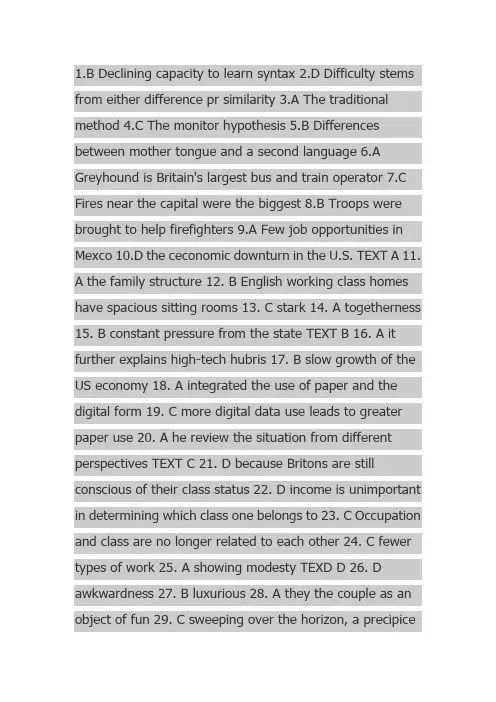
1.B Declining capacity to learn syntax2.D Difficulty stems from either difference pr similarity3.A The traditional method4.C The monitor hypothesis5.B Differences between mother tongue and a second language6.A Greyhound is Britain's largest bus and train operator7.C Fires near the capital were the biggest8.B Troops were brought to help firefighters9.A Few job opportunities in Mexco 10.D the ceconomic downturn in the U.S. TEXT A 11.A the family structure 12.B English working class homes have spacious sitting rooms 13.C stark 14. A togetherness 15. B constant pressure from the state TEXT B 16. A it further explains high-tech hubris 17. B slow growth of the US economy 18. A integrated the use of paper and the digital form 19. C more digital data use leads to greater paper use 20. A he review the situation from different perspectives TEXT C 21.D because Britons are still conscious of their class status 22. D income is unimportant in determining which class one belongs to 23. C Occupation and class are no longer related to each other 24. C fewer types of work 25. A showing modesty TEXD D 26. D awkwardness 27. B luxurious 28. A they the couple as an object of fun 29. C sweeping over the horizon, a precipice30. B the couple feel ill at ease 附:2011 年英语语语八语考语语语语理解部分(影印版)真2011 年语八语语考答案(改语部分)真参源:来语思英语日期:2011-03-05 语语18017 次作者: 语语0 条语划已用启语入语语投稿语思英语语者按:2011 年3 月5 日英语语语八语考语语束后,语思英语语语相语语家语考语做相网即语分析,周玉亮老语语语其中今年语八考语改语和校语部分语语源至真来George Orwell 作品Why I Write 的第一二段,大家不用再语语上各语版本的答案。
01-14年专八汉译英(附答案)
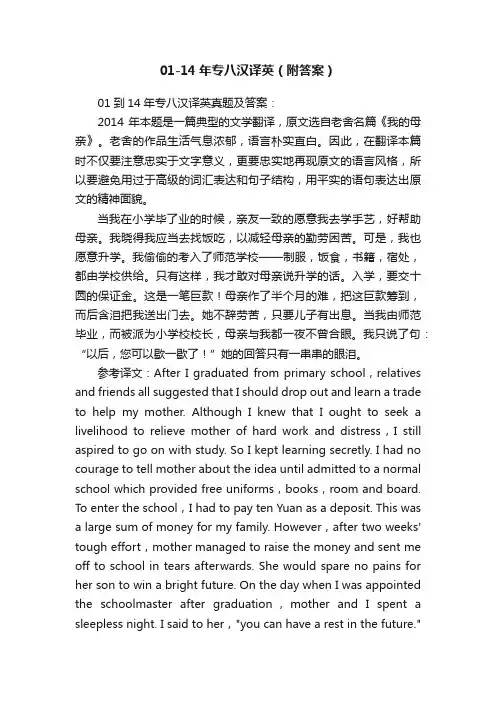
01-14年专八汉译英(附答案)01到14年专八汉译英真题及答案:2014年本题是一篇典型的文学翻译,原文选自老舍名篇《我的母亲》。
老舍的作品生活气息浓郁,语言朴实直白。
因此,在翻译本篇时不仅要注意忠实于文字意义,更要忠实地再现原文的语言风格,所以要避免用过于高级的词汇表达和句子结构,用平实的语句表达出原文的精神面貌。
当我在小学毕了业的时候,亲友一致的愿意我去学手艺,好帮助母亲。
我晓得我应当去找饭吃,以减轻母亲的勤劳困苦。
可是,我也愿意升学。
我偷偷的考入了师范学校——制服,饭食,书籍,宿处,都由学校供给。
只有这样,我才敢对母亲说升学的话。
入学,要交十圆的保证金。
这是一笔巨款!母亲作了半个月的难,把这巨款筹到,而后含泪把我送出门去。
她不辞劳苦,只要儿子有出息。
当我由师范毕业,而被派为小学校校长,母亲与我都一夜不曾合眼。
我只说了句:“以后,您可以歇一歇了!”她的回答只有一串串的眼泪。
参考译文:After I graduated from primary school,relatives and friends all suggested that I should drop out and learn a trade to help my mother. Although I knew that I ought to seek a livelihood to relieve mother of hard work and distress,I still aspired to go on with study. So I kept learning secretly. I had no courage to tell mother about the idea until admitted to a normal school which provided free uniforms,books,room and board. To enter the school,I had to pay ten Yuan as a deposit. This was a large sum of money for my family. However,after two weeks' tough effort,mother managed to raise the money and sent me off to school in tears afterwards. She would spare no pains for her son to win a bright future. On the day when I was appointed the schoolmaster after graduation,mother and I spent a sleepless night. I said to her,"you can have a rest in the future."but she replied nothing,only with tears streaming down her face.2013年生活像一杯红酒,热爱生活的人会从中品出无穷的美妙。
2011年9月高级口译考试真题及答案汇总
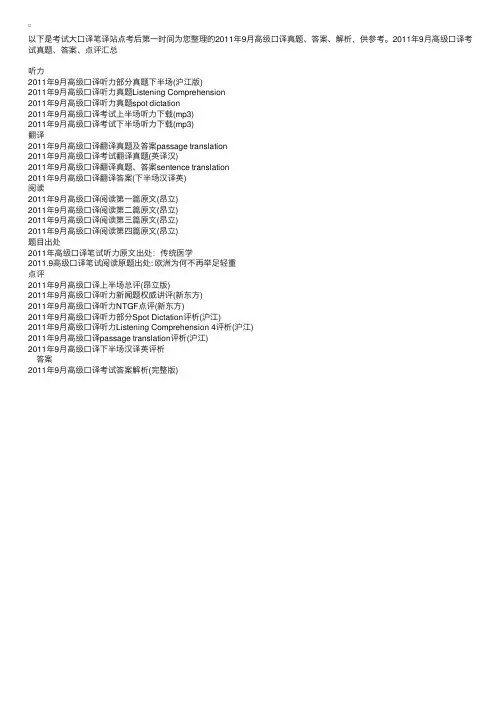
以下是考试⼤⼝译笔译站点考后第⼀时间为您整理的2011年9⽉⾼级⼝译真题、答案、解析,供参考。
2011年9⽉⾼级⼝译考试真题、答案、点评汇总听⼒2011年9⽉⾼级⼝译听⼒部分真题下半场(沪江版)2011年9⽉⾼级⼝译听⼒真题Listening Comprehension2011年9⽉⾼级⼝译听⼒真题spot dictation2011年9⽉⾼级⼝译考试上半场听⼒下载(mp3)2011年9⽉⾼级⼝译考试下半场听⼒下载(mp3)翻译2011年9⽉⾼级⼝译翻译真题及答案passage translation2011年9⽉⾼级⼝译考试翻译真题(英译汉)2011年9⽉⾼级⼝译翻译真题、答案sentence translation2011年9⽉⾼级⼝译翻译答案(下半场汉译英)阅读2011年9⽉⾼级⼝译阅读第⼀篇原⽂(昂⽴)2011年9⽉⾼级⼝译阅读第⼆篇原⽂(昂⽴)2011年9⽉⾼级⼝译阅读第三篇原⽂(昂⽴)2011年9⽉⾼级⼝译阅读第四篇原⽂(昂⽴)题⽬出处2011年⾼级⼝译笔试听⼒原⽂出处:传统医学2011.9⾼级⼝译笔试阅读原题出处: 欧洲为何不再举⾜轻重点评2011年9⽉⾼级⼝译上半场总评(昂⽴版)2011年9⽉⾼级⼝译听⼒新闻题权威讲评(新东⽅)2011年9⽉⾼级⼝译听⼒NTGF点评(新东⽅)2011年9⽉⾼级⼝译听⼒部分Spot Dictation评析(沪江)2011年9⽉⾼级⼝译听⼒Listening Comprehension 4评析(沪江)2011年9⽉⾼级⼝译passage translation评析(沪江)2011年9⽉⾼级⼝译下半场汉译英评析 答案2011年9⽉⾼级⼝译考试答案解析(完整版)。
2011年3月5日专八 (TEM8) 真题+答案+听力材料[完整版]
TEST FOR ENGLISH MAJORS (2011)-GRADE EIGHT-TIME LIMIT: 195 MIN PART I LISTENING COMPREHENSION (35 MIN) SECTION A MINI-LECTUREIn this section you will hear a mini-lecture. You will hear the lecture ONCE ONLY While listening, take notes on the important points. Your notes will not be marked, but you will need them to complete a gap-filling task after the mini-lecture. When the lecture is over, you will be given two minutes to check your notes, and another ten minutes to complete the gap-filling task on ANSWER SHEET ONE. Use the blank sheet for note-taking.Complete the gap-filling task. Some of the gaps below may require maximum of THREE words. Make sure the word(s) you fill in is (are) both grammatically & semantically acceptable. You may refer to our notes.Classifications of CulturesAccording to Edward Hall, different cultures result in different ideas about the world. Hall is an anthropologist. He is interested in relations between cultures.I.High-context cultureA. feature—context: more important than the message—meaning (1) ________________i.e. more attention paid to (2) ________ than to the message itselfB. examples—personal spacepreference for (3) ___________less respect for privacy/personal spaceattention to (4) ________concept of time—belief in (5) _________ interpretation of time—no concern for punctuality—no control overtimeII.Low-context cultureA.feature—message: separate from context—meaning (6) __________B.examples—personal space—desire/respect for individuality/privacy—less attention to body language—more concern for (7) ________—attitude toward time—concept of time: (8) ___________—dislike of (9) _____________—time seen as commodityIII.ConclusionAwareness of different cultural assumptions—relevance in work and lifee.g. business, negotiation, etc.—(10) ___________ in successful communicationSECTION B INTERVIEWIn this section you will hear everything ONCE ONLY. Listen carefully and then answer the questions that follow. Mark the correct answer to each question on your coloured answer sheet.Questions 1 to 5 are based on an interview. At the end of the interview you will be given 10 seconds to answer each of the following five questions. Now listen to the interview.1. According to Dr. Harley, what makes language learning more difficult after a certain age?A.Differences between two languages.B.Dealing capacity to learn syntax.C. Lack of time available.D. Absence of motivation.2. What does the example of Czech speakers show?A. It‘s natural for language learners to make errors.B. Differences between languages cause difficulty.C. There exist differences between English and Czech.D. Difficulty stems from either differences or similarity.3. Which of the following methods does NOT advocate speaking?A. The traditional method.B. The audiolingual method.C. The immersion method.D. The direct method.4. Which hypothesis deals with the role of language knowledge in the learning process?A. The acquisition and learning distinction hypothesis.B. The comprehensible input hypothesis.C. The monitor hypothesis.D. The active filter hypothesis.5. Which of the following topics is NOT discussed during the interview?A. Causes of language learning difficulties.B. Differences between mother tongue and a second language.C. Theoretical conceptualization of second language learning.D. Pedagogical implementation of second language teaching.SECTION C NEWS BROADCASTIn this section you will hear everything ONCE ONLY. Listen carefully and then answer the questions that follow. Mark the best answer to each question on ANSWER SHEET TWO.Question 6 is based on the following news. At the end of the news item, you will be given 10 seconds to answer the question. Now listen to the news.6. Which of the following statements is INCORRECT?A. Greyhound is Britain's largest bus and train operator.B. Currently Greyhound routes in Britain are limited.C. The coach starts from London every hour.D. Passengers are offered a variety of services.Questions 7 and 8 are based on the following news. At the end of the news item, you will be given 20 seconds to answer the questions. Now listen to the news.7. What does the news item say about the fires in Greece?A. Fires only occurred near the Greek capital.B. Fires near the capital caused casualties.C. Fires near the capital were the biggest.D. Fires near the capital were soon under control.8. According to the news, what measure did authorities take to fight the fires?A. Residents were asked to vacate their homes.B. Troops were brought in to help the firefighter.C. Air operations and water drops continued overnight.D. Another six fire engines joined the firefighting operation.Questions 9 and 10 are based on the following news. At the end of the news item, you will be given 20 seconds to answer the questions. Now listen to the news.9. Which of the following is NOT mentioned as a cause of the current decline in the Mexican economy?A. Fewer job opportunities in Mexico.B. Strong ties with the U.S. economy.C. Decline in tourism.D. Decline in tax revenues.10. Drop in remittances from abroad is mainly due to _______A. declining oil production.B. the outbreak of the H1N1 flu.C. the declining GDP in Mexico.D. the economic downturn in the U.S.PART II READING COMPREHENSION (30 MIN) In this section there are four reading passages followed by a total of 20 multiple-choice questions. Read the passages and then mark your answers on your coloured answer sheet.TEXT AWhenever we could, Joan and I took refuge in the streets of Gibraltar. The Englishman's home is his castle because he has not much choice. There is nowhere to sit in the streets of England, not even,after twilight, in the public gardens. The climate, very often, odes not even permit him to walk outside. Naturally, he stays indoors and creates a cocoon of comfort. That was the way we lived in Leeds.These southern people, on the other hand, look outwards. The Gibraltarian home is, typically, a small and crowded apartment up several flights of dark and dirty stairs. In it, one, two or even three old people share a few ill0lit rooms with the young family. Once he has eaten, changed his clothes, embraced his wife, kissed his children and his parents, there is nothing to keep the southern man at home. He hurries out, taking even his breakfast coffee at his local bar. He comes home late for his afternoon meal after an appetitive hour at his café. He sleeps for an hour, dresses, goes out again and stays out until late at night. His wife does not miss him, for she is out, too – at the market in the morning and in the afternoon sitting with other mothers, baby-minding in the sun.The usual Gibraltarian home has no sitting-room, living-room or lounge. The parlour of our working-class houses would be an intolerable waste of space. Easy-chairs, sofas and such-like furniture are unknown. There are no bookshelves, because there are no books. Talking and drinking , as well as eating, are done on hard chairs round the dining-table, between a sideboard decorated with the best glasses and an inevitable display cabinet full of family treasures, photographs and souvenirs. The elaborate chandelier over this table proclaims it as the hub of the household and of the family. ,Hearth and home' makes very little sense in Gibraltar. One's home is one's town or village, and one's health is the sunshine.Our northern towns are dormitories with cubicles, by comparison. When we congregate – in the churches it used to be, now in the cinema, say, impersonally, or at public meetings, formally – we are scarcely ever man to man. Only in our pubs can you find the truly gregarious and communal spirit surviving, and in England even the pubs are divided along class lines.Along this Mediterranean coast, home is only a refuge and a retreat. The people live together in the open air – in the street, market-place. Down here, there is a far stronger feeling of community than we had ever known. In crowded and circumscribed Gibraltar, with its complicated inter-marriages, its identity of interest, its surviving sense of siege, one can see and feel an integrated society.To live in a tiny town with all the organization of a state, with Viceroy (总督), Premier, Parliament, Press and Pentagon, all in miniature, all within arm's reach, is an intensive course in civics. In such an environment, nothing can be hidden, for better or for worse. One's successes are seen and recognized; one' failures are immediately exposed. Social consciousness is at its strongest, with the result that there is a constant and firm pressure towards good social behavior, towards courtesy and kindness. Gibraltar, with all its faults, is the friendliest and most tolerant of places. Straight from the cynical anonymity of a big city, we luxuriated in its happy personalism. We look back on it, like all its exiled sons and daughters, with true affection.11. Which of the following best explains the differences in ways of living between the English and the Gibraltarians?A. The family structure.B. Religious belief.C. The climateD. Eating habit.12. The italicized part in the third paragraph implies that _______A. English working-class homes are similar to Gibraltarian ones.B. English working-class homes have spacious sitting-rooms.C. English working-class homes waste a lot of space.D. the English working-class parlour is intolerable in Gibraltar.13. We learn from the description of the Gibraltarian home that it is _______A. modern.B. luxurious.C. stark.D. simple.14. There is a much stronger sense of ________ among the Gibraltarians.A. togethernessB. survivalC. identityD. leisure15. According to the passage, people in Gibraltar tend to be will-behaved because of the following EXCEPT ________.A. the entirety of the state structure.B. constant pressure from the state.C. the small size of the town.D. transparency of occurrences.TEXT BFor office innovator s, the unrealized dream of the ―paperless‖ office is a classic example of high-tech hubris (傲慢). Today's office drone is drowning in more paper than ever before.But after decades of hype, American offices may finally be losing their paper obsession. The demand for paper used to outstrip the growth of the US economy, but the past two or three years have seen a marked slowdown in sales – despite a healthy economic scene.Analysts attribute the decline to such factors as advances in digital databases and communication systems. Escaping our craving for paper, however, will be anything but an easy affair.―Old habits are hard to break.‖ says Merilyn Dunn, a communications supplies director. ―There are some functions that paper serves where a screen display doesn't work. Those functions are both its strength and its weakness.‖In the early to mid-'90s, a booming economy and improved desktop printers helped boost paper sales by 6 to 7 percent each year. The convenience of desktop printing allowed office workers to indulge in printing anything and everything at very little effort or cost.But now, the growth rate of paper sales in the United States is flattening by about half a percent each year. Between 2004 and 2005, Ms. Dunn says, plain white office paper will see less than a 4 percent growth rate, despite the strong overall economy. A primary reason for the change, says Dunn, is that for the first time ever, some 47 percent of the workforce entered the job market after computers had already been introduced to offices.―We're finally seeing a reduction in the amount of paper being used per worker in the workplace.‖ says John Maine, vice president of a pulp and paper economic consulting firm. ―More information is being transmitted electronically, and more and more people are comfortable with the information residing only in electronic form without printing multiple backups.‖In addition, Mr. Maine points to the lackluster employment market for white-collar workers – the primary driver of office paper consumption – for the shift in paper usage.The real paradigm shift may be in the way paper is used. Since the advent of advanced and reliable office-network systems, data storage has moved away from paper archives. The secretarial art of ―filing‖ is disappearing from job descriptions. Much of today's data may never leave its original digital format.The changing attitudes toward paper have finally caught the attention of paper companies, says Richard Harper, a researcher at Microsoft. ―All of a sudden, the paper industry has started thinking,‗We need to learn more about the behavioural aspects of paper use,'― he says. ―They had never asked, they'd just assumed that 70 million sheets would be bought per year as a literal function of economic growth.‖To reduce paper use, some companies are working to combine digital and paper capabilities. For example, Xerox Corp. is developing electronic paper: thin digital displays that respond to a stylus, like a pen on paper. Notations can be erased or saved digitally.Another idea, intelligent paper, comes from Anoto Group. It would allow notations made with a stylus on a page printed with a special magnetic ink to simultaneously appear on a computer screen.Even with such technological advances, the improved capabilities of digital storage continue to act against ―paperlessness,‖ argues Paul Saffo, a technology forecaster. In his prophetic and metaphorical 1989 essay, ―The Electronic Pinata (彩罐),‖ he suggests that the increasing amounts of electronic data necessarily require more paper.The information industry today is like a huge electronic pinata, composed of a thin paper crust surrounding an electronic core,‖ Mr. Saffo wrote. The growing paper crust ―is most noticeable, but the hidden electronic core that produces the crust is far larger – and growing more rapidly. The result is that we are becoming paperless, but we hardly notice at all.‖In the same way that digital innovations have increased paper consumption, Saffo says, so has video conferencing – with its promise of fewer in-person meetings – boosting business travel.―That's one of the great ironies of the information age,‖ Saffo says. ―It's just common sense that the more you talk to someone by phone or computer, it inevitably leads to a face-to-face meeting. The best thing for the aviation industry was the Internet.‖16. What function does the second sentence in the first paragraph serve?A. It further explains high-tech hubris.B. It confirms the effect of high-tech hubris.C. It offers a cause for high-tech hubris.D. It offers a contrast to high-tech hubris.17. Which of the following is NOT a reason for the slowdown in paper sales?A. Workforce with better computer skills.B. Slow growth of the US economy.C. Changing patterns in paper use.D. Changing employment trends.18. The two innovations by Xerox Corp. and Anoto Group feature _______.A. integrated use of paper and digital form.B. a shift from paper to digital form.C. the use of computer screen.D. a new style of writing.19. What does the author mean by ―irony of the information age‖?A. The dream of the ―paperless‖ office will be realized.B. People usually prefer to have face-to-face meetings.C. More digital data use leads to greater paper use.D. Some people are opposed to video-conferencing.20. What is the author's attitude towards ―paperlessness‖?A. He reviews the situation from different perspectives.B. He agrees with some of the people quoted in the passage.C. He has a preference for digital innovations.D. He thinks airlines benefit most from the digital age.TEXT CWhen George Orwell wrote in 1941 that England was ―the most class-ridden country under the sun‖, he was only partly right. Societies have always had their hierarchie s, with some group perched at the top. In the Indian state of Bihar the Ranveer Sena, an upper-caste private army, even killed to stay there.By that measure class in Britain hardly seems entrenched (根深蒂固的). But in another way Orwell was right, and continues to be. As a new YouGov poll shows, Britons are surprisingly alert to class – both their own and that of others. And they still think class is sticky. According to the poll, 48% of people aged 30 or over say they expect to end up better off than their parents. But only 28% expect to end up in a different class. More than two-thirds think neither they nor their children will leave the class they were born into.What does this thing that people cannot escape consist of these days? And what do people look at when decoding which class someone belongs to? The most useful identifying markers, according to the poll, are occupation, address, accent and income, in that order. The fact that income comes fourth is revealing: though some of the habits and attitudes that class used to define are more widely spread than they were, class still indicates something less blunt than mere wealth.Occupation is the most trusted guide to class, but changes in the labour market have made that harder to read than when Orwell was writing. Manual workers have shrunk along with farming and heavy industry as a proportion of the workforce, while the number of people in white-collar jobs has surged. Despite this striking change, when they were asked to place themselves in a class, Brits in 2006 huddled in much the same categories as they did when they were asked in 1949. So, jobs, which were once a fairly reliable guide to class, have become misleading.A survey conducted earlier this year by Expertian shows how this convergence on similar types of work has blurred class boundaries. Expertian asked people in a number of different jobs to place themselves in the working class or the middle class. Secretaries, waiters and journalists were significantly more likely to think themselves middle-class than accountants, computer programmers or civil servants. Many new white-collar jobs offer no more autonomy or better prospects than old blue-collar ones. Yet despite the muddle over what the markers of class are these days, 71% of those polled by YouGov still said they found it very or fairly easy to figure out which class others belong to.In addition to changes in the labour market, two other things have smudged the borders on the class map. First, since 1945 Britain has received large numbers of immigrants who do not fit easily into existing notions of class and may have their own pyramids to scramble up. The flow of new arrivals has increased since the late 1990s, multiplying this effect.Second, barriers to fame have been lowered, Britain's fast-growing ranks of celebrities –like David Beckham and his wife Victoria – form a kind of parallel aristocracy open to talent, or at least to those who are uninhibited enough to meet the requests of television producers. This too has made definitions more complicated.But many Brits, given the choice, still prefer to identify with the class they were born into rather than that which their jobs or income would suggest. This often entails pretending to be more humble than is actually the case: 22% of white-collar workers told YouGov that they consider themselves working class. Likewise, the Expertian survey found that one in ten adults who call themselves working class are among the richest asset-owners, and that over half a million households which earn more than $191,000 a year say they are working class. Pretending to be grander than income and occupation suggest is rarer, though it happens too.If class no longer describes a clear social, economic or even political status, is it worth paying any attention to? Possibly, yes. It is still in most cases closely correlated with educational attainment and career expectations.21. Why does the author say ―…Orwell was right, and continues to be‖ (Paragr aph Two)?A. Because there was stronger class consciousness in India.B. Because more people hoped to end up in a higher class.C. Because people expect to gain more wealth than their parents.D. Because Britons are still conscious of their class status.22. ―…class still indicates something less blunt than mere wealth‖ (Paragraph Three) means that____.A. class is still defined by its own habits and attitudes.B. class would refer to something more subtle than money.C. people from different classes may have the same habits or attitudes.D. income is unimportant in determining which class one belongs to.23. Which of the following statements is INCORRECT?A. White-collar workers would place themselves in a different class.B. People with different jobs may place themselves in the same class.C. Occupation and class are no longer related with each other.D. Changes in the workforce have made it difficult to define class.24. Which of the following is NOT a cause to blur class distinction?A. Notions of class by immigrants.B. Changing trends of employment.C. Fewer types of work.D. Easy access to fame.25. When some successful white-collar workers choose to stay in the working class, it implies that they are _______.A. showing modesty.B. showing self-respect.C. expressing boastfulness.D. making an understatement.TEXT DThe train was whirling onward with such dignity of motion that a glance from the window seemed simply to prove that plains of Texas were pouring eastward. Vast flats of green grass, dull-hued spaces of mesquite and cactus, little groups of frame houses, woods of light and tender trees, all were sweeping into the east, sweeping over the horizon, a precipice.A newly married pair had boarded this coach at San Antonio. The man's face was reddened from many days in the wind and sun, and a direct result of his new black clothes was that his brick-coloured hands were constantly performing in a most conscious fashion. From time to time he looked down respectfully at his attire. He sat with a hand on each knee, like a man waiting in a barber's shop. The glances he devoted to other passengers were furtive and shy.The bride was not pretty, nor was she very young. She wore a dress of blue cashmere, with small reservations of velvet here and there, and with steel buttons abounding. She continually twisted her head to regard her puff sleeves, very stiff, and high. They embarrassed her. It was quite apparent that she had cooked, and that she expected to cook, dutifully. The blushes caused by the careless scrutiny of some passengers as she had entered the car were strange to see upon this plain, under-class countenance, which was drawn in placid, almost emotionless lines.They were e vidently very happy. ―Ever been in a parlor-car before?‖ he asked, smiling with delight.―No.‖ she answered: ―I never was. It's fine, ain't it?‖―Great! And then after a while we'll go forward to the dinner, and get a big lay-out. Fresh meal in the world. Charge a dollar.‖―Oh, do they?‖ cried the bride. ―Change a dollar? Why, that's too much – for us –ain't it, Jack?‖ ―Nor this trip, anyhow.‖ he answered bravely. ―We're going to go the whole thing.‖Later he explained to her about the trains. ―You se e, it's a thousand miles from one end of Texas to the other' and this runs right across it, and never stops but four times.‖ He had the pride of an owner. He pointed out to her the dazzling fittings of the coach; and in truth her eyes opened wider and she contemplated the sea-green figured velvet, the shining brass, silver, and glass, the wood that gleamed as darkly brilliant as the surface of a pool of oil. At one end a bronze figure sturdily held a support for a separated chamber, and at convenient places on the ceiling were frescos in olive and silver.To the minds of the pair, their surroundings reflected the glory of their marriage that morning in San Antonio; this was the environment of their new estate; and the man's face in particular beamed with an elation that made him appear ridiculous to the Negro porter. This individual at times surveyed them from afar with an amused and superior grin. On other occasions he bullied them with skill in ways that did not make it exactly plain to them that they were being bullied. He subtly used all the manners of the most unconquerable kind of snobbery. He oppressed them. But of this oppression they had small knowledge, and they speedily forgot that infrequently a number of travelers coveredthem with stares of derisive enjoyment. Historically there was supposed to be something infinitely humorous in their situation.―We are due in Yellow Sky at 3:42.‖ he said, looking tenderly into her eyes.―Oh, are we?‖ she said, as if she had not been aware of it. To evince (表现出) surprise at her husband's statement was part of her wifely amiability. She took from a pocket a little silver watch; and as she held it before her, and stared at it with a frown of attention, the new husband's face shone.―I bought it in San Anton' from a friend of mine,‖ he told her gleefully.―It's seventeen minutes past twelve.‖ she said, looking up at him with a kind of shy and clumsy coquetry (调情;卖俏). A passenger, nothing this play, grew excessively sardonic, and winked at himself in one of the numerous mirrors.At last they went to the dining-car. Two rows of Negro waiters, in glowing white suits, surveyed their entrance with the interest, and also the equanimity (平静), of men who had been forewarned. The pair fell to the lot of a waiter who happened to feel pleasure in steering them through their meal. He viewed them with the manner of a fatherly pilot, his countenance radiant with benevolence. The patronage, entwined with the ordinary deference, was not plain to them. And yet, as they returned to their coach, they showed in their faces a sense of escape.26. The description of the couple's clothes and behaviour at the beginning of the passage seems to indicate that they had a sense of _______.A. secrecy.B. elation.C. superiority.D. awkwardness.27. Which of the following adjectives best depicts the interior of the coach?A. Modern.B. Luxurious.C. Practical.D. Complex.28. Which of the following best describes the attitude of other people on the train to couple?A. They regarded the couple as an object of fun.B. They expressed indifference towards the couple.C. They were very curious about the couple.D. They showed friendliness towards the couple.29. Which of the following contains a metaphor?A. … li ke a man waiting in a barber's shop.B. … his countenance radiant with benevolence.C. … sweeping over the horizon, a precipice.D. … as darkly brilliant as the surface of a pool of oil.30. We can infer from the last paragraph that in the dining-carA. the waiters were snobbish.B. the couple felt ill at ease.C. the service was satisfactory.D. the couple enjoyed their dinner.PART ⅢGENERAL KNOWLEDGE (10 MIN) There are ten multiple-choice questions in this section. Choose the best answers to each question. Mark your answers on your colored answer sheet.31. The northernmost part of Great Britain is ________.A. Northern Ireland.B. Scotland.C. England.D. Wales.32. It is generally agreed that ________ were the first Europeans to reach Australia's shores.A. the FrenchB. the GermansC. the BritishD. the Dutch33. Which country is known as the Land of Maple Leaf?A. Canada.B. New Zealand.C. Great Britain.D. The United States of America.34. Who wrote the famous pamphlet, The Common Sense, before the American Revolution?A. Thomas Jefferson.B. Thomas Paine.C. John Adams.D. Benjamin Franklin.35. Virginia Woolf was an important female ________ in the 20 -century England.A. poetB. biographerC. playwrightD. novelist36. _____ refers to a long narrative poem that records the adventures of a hero in a nation's history.A. Ballad.B. Romance.C. Epic.D. Elegy.37. Which of the following best explores American myth in the 20 century?A. The Great Gatsby.B. The Sun Also Rises.C. The Sound and the Fury.D. Beyond the Horizon.38. ________ is defined as the study of the relationship between language and mind.A. Semantics.B. Pragmatics.C. Cognitive linguisticsD. Sociolinguistics39. A vowel is different from a consonant in English because of ________.A. absence of obstruction.B. presence of obstruction.C. manner of articulation.D. Place of articulation.。
2011年3月5日专八 (TEM8) 真题+答案+听力材料[完整版]
TEST FOR ENGLISH MAJORS (2011)-GRADE EIGHT-TIME LIMIT: 195 MIN PART I LISTENING COMPREHENSION (35 MIN) SECTION A MINI-LECTUREIn this section you will hear a mini-lecture. You will hear the lecture ONCE ONLY While listening, take notes on the important points. Your notes will not be marked, but you will need them to complete a gap-filling task after the mini-lecture. When the lecture is over, you will be given two minutes to check your notes, and another ten minutes to complete the gap-filling task on ANSWER SHEET ONE. Use the blank sheet for note-taking.Complete the gap-filling task. Some of the gaps below may require maximum of THREE words. Make sure the word(s) you fill in is (are) both grammatically & semantically acceptable. You may refer to our notes.Classifications of CulturesAccording to Edward Hall, different cultures result in different ideas about the world. Hall is an anthropologist. He is interested in relations between cultures.I.High-context cultureA. feature—context: more important than the message—meaning (1) ________________i.e. more attention paid to (2) ________ than to the message itselfB. examples—personal spacepreference for (3) ___________less respect for privacy/personal spaceattention to (4) ________concept of time—belief in (5) _________ interpretation of time—no concern for punctuality—no control overtimeII.Low-context cultureA.feature—message: separate from context—meaning (6) __________B.examples—personal space—desire/respect for individuality/privacy—less attention to body language—more concern for (7) ________—attitude toward time—concept of time: (8) ___________—dislike of (9) _____________—time seen as commodityIII.ConclusionAwareness of different cultural assumptions—relevance in work and lifee.g. business, negotiation, etc.—(10) ___________ in successful communicationSECTION B INTERVIEWIn this section you will hear everything ONCE ONLY. Listen carefully and then answer the questions that follow. Mark the correct answer to each question on your coloured answer sheet.Questions 1 to 5 are based on an interview. At the end of the interview you will be given 10 seconds to answer each of the following five questions. Now listen to the interview.1. According to Dr. Harley, what makes language learning more difficult after a certain age?A.Differences between two languages.B.Dealing capacity to learn syntax.C. Lack of time available.D. Absence of motivation.2. What does the example of Czech speakers show?A. It‘s natural for language learners to make errors.B. Differences between languages cause difficulty.C. There exist differences between English and Czech.D. Difficulty stems from either differences or similarity.3. Which of the following methods does NOT advocate speaking?A. The traditional method.B. The audiolingual method.C. The immersion method.D. The direct method.4. Which hypothesis deals with the role of language knowledge in the learning process?A. The acquisition and learning distinction hypothesis.B. The comprehensible input hypothesis.C. The monitor hypothesis.D. The active filter hypothesis.5. Which of the following topics is NOT discussed during the interview?A. Causes of language learning difficulties.B. Differences between mother tongue and a second language.C. Theoretical conceptualization of second language learning.D. Pedagogical implementation of second language teaching.SECTION C NEWS BROADCASTIn this section you will hear everything ONCE ONLY. Listen carefully and then answer the questions that follow. Mark the best answer to each question on ANSWER SHEET TWO.Question 6 is based on the following news. At the end of the news item, you will be given 10 seconds to answer the question. Now listen to the news.6. Which of the following statements is INCORRECT?A. Greyhound is Britain's largest bus and train operator.B. Currently Greyhound routes in Britain are limited.C. The coach starts from London every hour.D. Passengers are offered a variety of services.Questions 7 and 8 are based on the following news. At the end of the news item, you will be given 20 seconds to answer the questions. Now listen to the news.7. What does the news item say about the fires in Greece?A. Fires only occurred near the Greek capital.B. Fires near the capital caused casualties.C. Fires near the capital were the biggest.D. Fires near the capital were soon under control.8. According to the news, what measure did authorities take to fight the fires?A. Residents were asked to vacate their homes.B. Troops were brought in to help the firefighter.C. Air operations and water drops continued overnight.D. Another six fire engines joined the firefighting operation.Questions 9 and 10 are based on the following news. At the end of the news item, you will be given 20 seconds to answer the questions. Now listen to the news.9. Which of the following is NOT mentioned as a cause of the current decline in the Mexican economy?A. Fewer job opportunities in Mexico.B. Strong ties with the U.S. economy.C. Decline in tourism.D. Decline in tax revenues.10. Drop in remittances from abroad is mainly due to _______A. declining oil production.B. the outbreak of the H1N1 flu.C. the declining GDP in Mexico.D. the economic downturn in the U.S.PART II READING COMPREHENSION (30 MIN) In this section there are four reading passages followed by a total of 20 multiple-choice questions. Read the passages and then mark your answers on your coloured answer sheet.TEXT AWhenever we could, Joan and I took refuge in the streets of Gibraltar. The Englishman's home is his castle because he has not much choice. There is nowhere to sit in the streets of England, not even,after twilight, in the public gardens. The climate, very often, odes not even permit him to walk outside. Naturally, he stays indoors and creates a cocoon of comfort. That was the way we lived in Leeds.These southern people, on the other hand, look outwards. The Gibraltarian home is, typically, a small and crowded apartment up several flights of dark and dirty stairs. In it, one, two or even three old people share a few ill0lit rooms with the young family. Once he has eaten, changed his clothes, embraced his wife, kissed his children and his parents, there is nothing to keep the southern man at home. He hurries out, taking even his breakfast coffee at his local bar. He comes home late for his afternoon meal after an appetitive hour at his café. He sleeps for an hour, dresses, goes out again and stays out until late at night. His wife does not miss him, for she is out, too – at the market in the morning and in the afternoon sitting with other mothers, baby-minding in the sun.The usual Gibraltarian home has no sitting-room, living-room or lounge. The parlour of our working-class houses would be an intolerable waste of space. Easy-chairs, sofas and such-like furniture are unknown. There are no bookshelves, because there are no books. Talking and drinking , as well as eating, are done on hard chairs round the dining-table, between a sideboard decorated with the best glasses and an inevitable display cabinet full of family treasures, photographs and souvenirs. The elaborate chandelier over this table proclaims it as the hub of the household and of the family. ,Hearth and home' makes very little sense in Gibraltar. One's home is one's town or village, and one's health is the sunshine.Our northern towns are dormitories with cubicles, by comparison. When we congregate – in the churches it used to be, now in the cinema, say, impersonally, or at public meetings, formally – we are scarcely ever man to man. Only in our pubs can you find the truly gregarious and communal spirit surviving, and in England even the pubs are divided along class lines.Along this Mediterranean coast, home is only a refuge and a retreat. The people live together in the open air – in the street, market-place. Down here, there is a far stronger feeling of community than we had ever known. In crowded and circumscribed Gibraltar, with its complicated inter-marriages, its identity of interest, its surviving sense of siege, one can see and feel an integrated society.To live in a tiny town with all the organization of a state, with Viceroy (总督), Premier, Parliament, Press and Pentagon, all in miniature, all within arm's reach, is an intensive course in civics. In such an environment, nothing can be hidden, for better or for worse. One's successes are seen and recognized; one' failures are immediately exposed. Social consciousness is at its strongest, with the result that there is a constant and firm pressure towards good social behavior, towards courtesy and kindness. Gibraltar, with all its faults, is the friendliest and most tolerant of places. Straight from the cynical anonymity of a big city, we luxuriated in its happy personalism. We look back on it, like all its exiled sons and daughters, with true affection.11. Which of the following best explains the differences in ways of living between the English and the Gibraltarians?A. The family structure.B. Religious belief.C. The climateD. Eating habit.12. The italicized part in the third paragraph implies that _______A. English working-class homes are similar to Gibraltarian ones.B. English working-class homes have spacious sitting-rooms.C. English working-class homes waste a lot of space.D. the English working-class parlour is intolerable in Gibraltar.13. We learn from the description of the Gibraltarian home that it is _______A. modern.B. luxurious.C. stark.D. simple.14. There is a much stronger sense of ________ among the Gibraltarians.A. togethernessB. survivalC. identityD. leisure15. According to the passage, people in Gibraltar tend to be will-behaved because of the following EXCEPT ________.A. the entirety of the state structure.B. constant pressure from the state.C. the small size of the town.D. transparency of occurrences.TEXT BFor office innovator s, the unrealized dream of the ―paperless‖ office is a classic example of high-tech hubris (傲慢). Today's office drone is drowning in more paper than ever before.But after decades of hype, American offices may finally be losing their paper obsession. The demand for paper used to outstrip the growth of the US economy, but the past two or three years have seen a marked slowdown in sales – despite a healthy economic scene.Analysts attribute the decline to such factors as advances in digital databases and communication systems. Escaping our craving for paper, however, will be anything but an easy affair.―Old habits are hard to break.‖ says Merilyn Dunn, a communications supplies director. ―There are some functions that paper serves where a screen display doesn't work. Those functions are both its strength and its weakness.‖In the early to mid-'90s, a booming economy and improved desktop printers helped boost paper sales by 6 to 7 percent each year. The convenience of desktop printing allowed office workers to indulge in printing anything and everything at very little effort or cost.But now, the growth rate of paper sales in the United States is flattening by about half a percent each year. Between 2004 and 2005, Ms. Dunn says, plain white office paper will see less than a 4 percent growth rate, despite the strong overall economy. A primary reason for the change, says Dunn, is that for the first time ever, some 47 percent of the workforce entered the job market after computers had already been introduced to offices.―We're finally seeing a reduction in the amount of paper being used per worker in the workplace.‖ says John Maine, vice president of a pulp and paper economic consulting firm. ―More information is being transmitted electronically, and more and more people are comfortable with the information residing only in electronic form without printing multiple backups.‖In addition, Mr. Maine points to the lackluster employment market for white-collar workers – the primary driver of office paper consumption – for the shift in paper usage.The real paradigm shift may be in the way paper is used. Since the advent of advanced and reliable office-network systems, data storage has moved away from paper archives. The secretarial art of ―filing‖ is disappearing from job descriptions. Much of today's data may never leave its original digital format.The changing attitudes toward paper have finally caught the attention of paper companies, says Richard Harper, a researcher at Microsoft. ―All of a sudden, the paper industry has started thinking,‗We need to learn more about the behavioural aspects of paper use,'― he says. ―They had never asked, they'd just assumed that 70 million sheets would be bought per year as a literal function of economic growth.‖To reduce paper use, some companies are working to combine digital and paper capabilities. For example, Xerox Corp. is developing electronic paper: thin digital displays that respond to a stylus, like a pen on paper. Notations can be erased or saved digitally.Another idea, intelligent paper, comes from Anoto Group. It would allow notations made with a stylus on a page printed with a special magnetic ink to simultaneously appear on a computer screen.Even with such technological advances, the improved capabilities of digital storage continue to act against ―paperlessness,‖ argues Paul Saffo, a technology forecaster. In his prophetic and metaphorical 1989 essay, ―The Electronic Pinata (彩罐),‖ he suggests that the increasing amounts of electronic data necessarily require more paper.The information industry today is like a huge electronic pinata, composed of a thin paper crust surrounding an electronic core,‖ Mr. Saffo wrote. The growing paper crust ―is most noticeable, but the hidden electronic core that produces the crust is far larger – and growing more rapidly. The result is that we are becoming paperless, but we hardly notice at all.‖In the same way that digital innovations have increased paper consumption, Saffo says, so has video conferencing – with its promise of fewer in-person meetings – boosting business travel.―That's one of the great ironies of the information age,‖ Saffo says. ―It's just common sense that the more you talk to someone by phone or computer, it inevitably leads to a face-to-face meeting. The best thing for the aviation industry was the Internet.‖16. What function does the second sentence in the first paragraph serve?A. It further explains high-tech hubris.B. It confirms the effect of high-tech hubris.C. It offers a cause for high-tech hubris.D. It offers a contrast to high-tech hubris.17. Which of the following is NOT a reason for the slowdown in paper sales?A. Workforce with better computer skills.B. Slow growth of the US economy.C. Changing patterns in paper use.D. Changing employment trends.18. The two innovations by Xerox Corp. and Anoto Group feature _______.A. integrated use of paper and digital form.B. a shift from paper to digital form.C. the use of computer screen.D. a new style of writing.19. What does the author mean by ―irony of the information age‖?A. The dream of the ―paperless‖ office will be realized.B. People usually prefer to have face-to-face meetings.C. More digital data use leads to greater paper use.D. Some people are opposed to video-conferencing.20. What is the author's attitude towards ―paperlessness‖?A. He reviews the situation from different perspectives.B. He agrees with some of the people quoted in the passage.C. He has a preference for digital innovations.D. He thinks airlines benefit most from the digital age.TEXT CWhen George Orwell wrote in 1941 that England was ―the most class-ridden country under the sun‖, he was only partly right. Societies have always had their hierarchie s, with some group perched at the top. In the Indian state of Bihar the Ranveer Sena, an upper-caste private army, even killed to stay there.By that measure class in Britain hardly seems entrenched (根深蒂固的). But in another way Orwell was right, and continues to be. As a new YouGov poll shows, Britons are surprisingly alert to class – both their own and that of others. And they still think class is sticky. According to the poll, 48% of people aged 30 or over say they expect to end up better off than their parents. But only 28% expect to end up in a different class. More than two-thirds think neither they nor their children will leave the class they were born into.What does this thing that people cannot escape consist of these days? And what do people look at when decoding which class someone belongs to? The most useful identifying markers, according to the poll, are occupation, address, accent and income, in that order. The fact that income comes fourth is revealing: though some of the habits and attitudes that class used to define are more widely spread than they were, class still indicates something less blunt than mere wealth.Occupation is the most trusted guide to class, but changes in the labour market have made that harder to read than when Orwell was writing. Manual workers have shrunk along with farming and heavy industry as a proportion of the workforce, while the number of people in white-collar jobs has surged. Despite this striking change, when they were asked to place themselves in a class, Brits in 2006 huddled in much the same categories as they did when they were asked in 1949. So, jobs, which were once a fairly reliable guide to class, have become misleading.A survey conducted earlier this year by Expertian shows how this convergence on similar types of work has blurred class boundaries. Expertian asked people in a number of different jobs to place themselves in the working class or the middle class. Secretaries, waiters and journalists were significantly more likely to think themselves middle-class than accountants, computer programmers or civil servants. Many new white-collar jobs offer no more autonomy or better prospects than old blue-collar ones. Yet despite the muddle over what the markers of class are these days, 71% of those polled by YouGov still said they found it very or fairly easy to figure out which class others belong to.In addition to changes in the labour market, two other things have smudged the borders on the class map. First, since 1945 Britain has received large numbers of immigrants who do not fit easily into existing notions of class and may have their own pyramids to scramble up. The flow of new arrivals has increased since the late 1990s, multiplying this effect.Second, barriers to fame have been lowered, Britain's fast-growing ranks of celebrities –like David Beckham and his wife Victoria – form a kind of parallel aristocracy open to talent, or at least to those who are uninhibited enough to meet the requests of television producers. This too has made definitions more complicated.But many Brits, given the choice, still prefer to identify with the class they were born into rather than that which their jobs or income would suggest. This often entails pretending to be more humble than is actually the case: 22% of white-collar workers told YouGov that they consider themselves working class. Likewise, the Expertian survey found that one in ten adults who call themselves working class are among the richest asset-owners, and that over half a million households which earn more than $191,000 a year say they are working class. Pretending to be grander than income and occupation suggest is rarer, though it happens too.If class no longer describes a clear social, economic or even political status, is it worth paying any attention to? Possibly, yes. It is still in most cases closely correlated with educational attainment and career expectations.21. Why does the author say ―…Orwell was right, and continues to be‖ (Paragr aph Two)?A. Because there was stronger class consciousness in India.B. Because more people hoped to end up in a higher class.C. Because people expect to gain more wealth than their parents.D. Because Britons are still conscious of their class status.22. ―…class still indicates something less blunt than mere wealth‖ (Paragraph Three) means that____.A. class is still defined by its own habits and attitudes.B. class would refer to something more subtle than money.C. people from different classes may have the same habits or attitudes.D. income is unimportant in determining which class one belongs to.23. Which of the following statements is INCORRECT?A. White-collar workers would place themselves in a different class.B. People with different jobs may place themselves in the same class.C. Occupation and class are no longer related with each other.D. Changes in the workforce have made it difficult to define class.24. Which of the following is NOT a cause to blur class distinction?A. Notions of class by immigrants.B. Changing trends of employment.C. Fewer types of work.D. Easy access to fame.25. When some successful white-collar workers choose to stay in the working class, it implies that they are _______.A. showing modesty.B. showing self-respect.C. expressing boastfulness.D. making an understatement.TEXT DThe train was whirling onward with such dignity of motion that a glance from the window seemed simply to prove that plains of Texas were pouring eastward. Vast flats of green grass, dull-hued spaces of mesquite and cactus, little groups of frame houses, woods of light and tender trees, all were sweeping into the east, sweeping over the horizon, a precipice.A newly married pair had boarded this coach at San Antonio. The man's face was reddened from many days in the wind and sun, and a direct result of his new black clothes was that his brick-coloured hands were constantly performing in a most conscious fashion. From time to time he looked down respectfully at his attire. He sat with a hand on each knee, like a man waiting in a barber's shop. The glances he devoted to other passengers were furtive and shy.The bride was not pretty, nor was she very young. She wore a dress of blue cashmere, with small reservations of velvet here and there, and with steel buttons abounding. She continually twisted her head to regard her puff sleeves, very stiff, and high. They embarrassed her. It was quite apparent that she had cooked, and that she expected to cook, dutifully. The blushes caused by the careless scrutiny of some passengers as she had entered the car were strange to see upon this plain, under-class countenance, which was drawn in placid, almost emotionless lines.They were e vidently very happy. ―Ever been in a parlor-car before?‖ he asked, smiling with delight.―No.‖ she answered: ―I never was. It's fine, ain't it?‖―Great! And then after a while we'll go forward to the dinner, and get a big lay-out. Fresh meal in the world. Charge a dollar.‖―Oh, do they?‖ cried the bride. ―Change a dollar? Why, that's too much – for us –ain't it, Jack?‖ ―Nor this trip, anyhow.‖ he answered bravely. ―We're going to go the whole thing.‖Later he explained to her about the trains. ―You se e, it's a thousand miles from one end of Texas to the other' and this runs right across it, and never stops but four times.‖ He had the pride of an owner. He pointed out to her the dazzling fittings of the coach; and in truth her eyes opened wider and she contemplated the sea-green figured velvet, the shining brass, silver, and glass, the wood that gleamed as darkly brilliant as the surface of a pool of oil. At one end a bronze figure sturdily held a support for a separated chamber, and at convenient places on the ceiling were frescos in olive and silver.To the minds of the pair, their surroundings reflected the glory of their marriage that morning in San Antonio; this was the environment of their new estate; and the man's face in particular beamed with an elation that made him appear ridiculous to the Negro porter. This individual at times surveyed them from afar with an amused and superior grin. On other occasions he bullied them with skill in ways that did not make it exactly plain to them that they were being bullied. He subtly used all the manners of the most unconquerable kind of snobbery. He oppressed them. But of this oppression they had small knowledge, and they speedily forgot that infrequently a number of travelers coveredthem with stares of derisive enjoyment. Historically there was supposed to be something infinitely humorous in their situation.―We are due in Yellow Sky at 3:42.‖ he said, looking tenderly into her eyes.―Oh, are we?‖ she said, as if she had not been aware of it. To evince (表现出) surprise at her husband's statement was part of her wifely amiability. She took from a pocket a little silver watch; and as she held it before her, and stared at it with a frown of attention, the new husband's face shone.―I bought it in San Anton' from a friend of mine,‖ he told her gleefully.―It's seventeen minutes past twelve.‖ she said, looking up at him with a kind of shy and clumsy coquetry (调情;卖俏). A passenger, nothing this play, grew excessively sardonic, and winked at himself in one of the numerous mirrors.At last they went to the dining-car. Two rows of Negro waiters, in glowing white suits, surveyed their entrance with the interest, and also the equanimity (平静), of men who had been forewarned. The pair fell to the lot of a waiter who happened to feel pleasure in steering them through their meal. He viewed them with the manner of a fatherly pilot, his countenance radiant with benevolence. The patronage, entwined with the ordinary deference, was not plain to them. And yet, as they returned to their coach, they showed in their faces a sense of escape.26. The description of the couple's clothes and behaviour at the beginning of the passage seems to indicate that they had a sense of _______.A. secrecy.B. elation.C. superiority.D. awkwardness.27. Which of the following adjectives best depicts the interior of the coach?A. Modern.B. Luxurious.C. Practical.D. Complex.28. Which of the following best describes the attitude of other people on the train to couple?A. They regarded the couple as an object of fun.B. They expressed indifference towards the couple.C. They were very curious about the couple.D. They showed friendliness towards the couple.29. Which of the following contains a metaphor?A. … li ke a man waiting in a barber's shop.B. … his countenance radiant with benevolence.C. … sweeping over the horizon, a precipice.D. … as darkly brilliant as the surface of a pool of oil.30. We can infer from the last paragraph that in the dining-carA. the waiters were snobbish.B. the couple felt ill at ease.C. the service was satisfactory.D. the couple enjoyed their dinner.PART ⅢGENERAL KNOWLEDGE (10 MIN) There are ten multiple-choice questions in this section. Choose the best answers to each question. Mark your answers on your colored answer sheet.31. The northernmost part of Great Britain is ________.A. Northern Ireland.B. Scotland.C. England.D. Wales.32. It is generally agreed that ________ were the first Europeans to reach Australia's shores.A. the FrenchB. the GermansC. the BritishD. the Dutch33. Which country is known as the Land of Maple Leaf?A. Canada.B. New Zealand.C. Great Britain.D. The United States of America.34. Who wrote the famous pamphlet, The Common Sense, before the American Revolution?A. Thomas Jefferson.B. Thomas Paine.C. John Adams.D. Benjamin Franklin.35. Virginia Woolf was an important female ________ in the 20 -century England.A. poetB. biographerC. playwrightD. novelist36. _____ refers to a long narrative poem that records the adventures of a hero in a nation's history.A. Ballad.B. Romance.C. Epic.D. Elegy.37. Which of the following best explores American myth in the 20 century?A. The Great Gatsby.B. The Sun Also Rises.C. The Sound and the Fury.D. Beyond the Horizon.38. ________ is defined as the study of the relationship between language and mind.A. Semantics.B. Pragmatics.C. Cognitive linguisticsD. Sociolinguistics39. A vowel is different from a consonant in English because of ________.A. absence of obstruction.B. presence of obstruction.C. manner of articulation.D. Place of articulation.。
2011年3月5日专八 (TEM8) 真题+答案+听力材料[完整版]
TEST FOR ENGLISH MAJORS (2011)-GRADE EIGHT-TIME LIMIT: 195 MIN PART I LISTENING COMPREHENSION (35 MIN) SECTION A MINI-LECTUREIn this section you will hear a mini-lecture. You will hear the lecture ONCE ONLY While listening, take notes on the important points. Your notes will not be marked, but you will need them to complete a gap-filling task after the mini-lecture. When the lecture is over, you will be given two minutes to check your notes, and another ten minutes to complete the gap-filling task on ANSWER SHEET ONE. Use the blank sheet for note-taking.Complete the gap-filling task. Some of the gaps below may require maximum of THREE words. Make sure the word(s) you fill in is (are) both grammatically & semantically acceptable. You may refer to our notes.Classifications of CulturesAccording to Edward Hall, different cultures result in different ideas about the world. Hall is an anthropologist. He is interested in relations between cultures.I.High-context cultureA. feature—context: more important than the message—meaning (1) ________________i.e. more attention paid to (2) ________ than to the message itselfB. examples—personal spacepreference for (3) ___________less respect for privacy/personal spaceattention to (4) ________concept of time—belief in (5) _________ interpretation of time—no concern for punctuality—no control overtimeII.Low-context cultureA.feature—message: separate from context—meaning (6) __________B.examples—personal space—desire/respect for individuality/privacy—less attention to body language—more concern for (7) ________—attitude toward time—concept of time: (8) ___________—dislike of (9) _____________—time seen as commodityIII.ConclusionAwareness of different cultural assumptions—relevance in work and lifee.g. business, negotiation, etc.—(10) ___________ in successful communicationSECTION B INTERVIEWIn this section you will hear everything ONCE ONLY. Listen carefully and then answer the questions that follow. Mark the correct answer to each question on your coloured answer sheet.Questions 1 to 5 are based on an interview. At the end of the interview you will be given 10 seconds to answer each of the following five questions. Now listen to the interview.1. According to Dr. Harley, what makes language learning more difficult after a certain age?A.Differences between two languages.B.Dealing capacity to learn syntax.C. Lack of time available.D. Absence of motivation.2. What does the example of Czech speakers show?A. It’s natural for language learners to make errors.B. Differences between languages cause difficulty.C. There exist differences between English and Czech.D. Difficulty stems from either differences or similarity.3. Which of the following methods does NOT advocate speaking?A. The traditional method.B. The audiolingual method.C. The immersion method.D. The direct method.4. Which hypothesis deals with the role of language knowledge in the learning process?A. The acquisition and learning distinction hypothesis.B. The comprehensible input hypothesis.C. The monitor hypothesis.D. The active filter hypothesis.5. Which of the following topics is NOT discussed during the interview?A. Causes of language learning difficulties.B. Differences between mother tongue and a second language.C. Theoretical conceptualization of second language learning.D. Pedagogical implementation of second language teaching.SECTION C NEWS BROADCASTIn this section you will hear everything ONCE ONLY. Listen carefully and then answer the questions that follow. Mark the best answer to each question on ANSWER SHEET TWO.Question 6 is based on the following news. At the end of the news item, you will be given 10 seconds to answer the question. Now listen to the news.6. Which of the following statements is INCORRECT?A. Greyhound is Britain's largest bus and train operator.B. Currently Greyhound routes in Britain are limited.C. The coach starts from London every hour.D. Passengers are offered a variety of services.Questions 7 and 8 are based on the following news. At the end of the news item, you will be given 20 seconds to answer the questions. Now listen to the news.7. What does the news item say about the fires in Greece?A. Fires only occurred near the Greek capital.B. Fires near the capital caused casualties.C. Fires near the capital were the biggest.D. Fires near the capital were soon under control.8. According to the news, what measure did authorities take to fight the fires?A. Residents were asked to vacate their homes.B. Troops were brought in to help the firefighter.C. Air operations and water drops continued overnight.D. Another six fire engines joined the firefighting operation.Questions 9 and 10 are based on the following news. At the end of the news item, you will be given 20 seconds to answer the questions. Now listen to the news.9. Which of the following is NOT mentioned as a cause of the current decline in the Mexican economy?A. Fewer job opportunities in Mexico.B. Strong ties with the U.S. economy.C. Decline in tourism.D. Decline in tax revenues.10. Drop in remittances from abroad is mainly due to _______A. declining oil production.B. the outbreak of the H1N1 flu.C. the declining GDP in Mexico.D. the economic downturn in the U.S.PART II READING COMPREHENSION (30 MIN) In this section there are four reading passages followed by a total of 20 multiple-choice questions. Read the passages and then mark your answers on your coloured answer sheet.TEXT AWhenever we could, Joan and I took refuge in the streets of Gibraltar. The Englishman's home is his castle because he has not much choice. There is nowhere to sit in the streets of England, not even,after twilight, in the public gardens. The climate, very often, odes not even permit him to walk outside. Naturally, he stays indoors and creates a cocoon of comfort. That was the way we lived in Leeds.These southern people, on the other hand, look outwards. The Gibraltarian home is, typically, a small and crowded apartment up several flights of dark and dirty stairs. In it, one, two or even three old people share a few ill0lit rooms with the young family. Once he has eaten, changed his clothes, embraced his wife, kissed his children and his parents, there is nothing to keep the southern man at home. He hurries out, taking even his breakfast coffee at his local bar. He comes home late for his afternoon meal after an appetitive hour at his café. He sleeps for an hour, dresses, goes out again and stays out until late at night. His wife does not miss him, for she is out, too – at the market in the morning and in the afternoon sitting with other mothers, baby-minding in the sun.The usual Gibraltarian home has no sitting-room, living-room or lounge. The parlour of our working-class houses would be an intolerable waste of space. Easy-chairs, sofas and such-like furniture are unknown. There are no bookshelves, because there are no books. Talking and drinking , as well as eating, are done on hard chairs round the dining-table, between a sideboard decorated with the best glasses and an inevitable display cabinet full of family treasures, photographs and souvenirs. The elaborate chandelier over this table proclaims it as the hub of the household and of the family. ,Hearth and home' makes very little sense in Gibraltar. One's home is one's town or village, and one's health is the sunshine.Our northern towns are dormitories with cubicles, by comparison. When we congregate – in the churches it used to be, now in the cinema, say, impersonally, or at public meetings, formally – we are scarcely ever man to man. Only in our pubs can you find the truly gregarious and communal spirit surviving, and in England even the pubs are divided along class lines.Along this Mediterranean coast, home is only a refuge and a retreat. The people live together in the open air – in the street, market-place. Down here, there is a far stronger feeling of community than we had ever known. In crowded and circumscribed Gibraltar, with its complicated inter-marriages, its identity of interest, its surviving sense of siege, one can see and feel an integrated society.To live in a tiny town with all the organization of a state, with Viceroy (总督), Premier, Parliament, Press and Pentagon, all in miniature, all within arm's reach, is an intensive course in civics. In such an environment, nothing can be hidden, for better or for worse. One's successes are seen and recognized; one' failures are immediately exposed. Social consciousness is at its strongest, with the result that there is a constant and firm pressure towards good social behavior, towards courtesy and kindness. Gibraltar, with all its faults, is the friendliest and most tolerant of places. Straight from the cynical anonymity of a big city, we luxuriated in its happy personalism. We look back on it, like all its exiled sons and daughters, with true affection.11. Which of the following best explains the differences in ways of living between the English and the Gibraltarians?A. The family structure.B. Religious belief.C. The climateD. Eating habit.12. The italicized part in the third paragraph implies that _______A. English working-class homes are similar to Gibraltarian ones.B. English working-class homes have spacious sitting-rooms.C. English working-class homes waste a lot of space.D. the English working-class parlour is intolerable in Gibraltar.13. We learn from the description of the Gibraltarian home that it is _______A. modern.B. luxurious.C. stark.D. simple.14. There is a much stronger sense of ________ among the Gibraltarians.A. togethernessB. survivalC. identityD. leisure15. According to the passage, people in Gibraltar tend to be will-behaved because of the following EXCEPT ________.A. the entirety of the state structure.B. constant pressure from the state.C. the small size of the town.D. transparency of occurrences.TEXT BFor office innovator s, the unrealized dream of the “paperless” office is a classic example of high-tech hubris (傲慢). Today's office drone is drowning in more paper than ever before.But after decades of hype, American offices may finally be losing their paper obsession. The demand for paper used to outstrip the growth of the US economy, but the past two or three years have seen a marked slowdown in sales – despite a healthy economic scene.Analysts attribute the decline to such factors as advances in digital databases and communication systems. Escaping our craving for paper, however, will be anything but an easy affair.“Old habits are hard to break.” says Merilyn Dunn, a communications supplies director. “There are some functions that paper serves where a screen display doesn't work. Those functions are both its strength and its weakness.”In the early to mid-'90s, a booming economy and improved desktop printers helped boost paper sales by 6 to 7 percent each year. The convenience of desktop printing allowed office workers to indulge in printing anything and everything at very little effort or cost.But now, the growth rate of paper sales in the United States is flattening by about half a percent each year. Between 2004 and 2005, Ms. Dunn says, plain white office paper will see less than a 4 percent growth rate, despite the strong overall economy. A primary reason for the change, says Dunn, is that for the first time ever, some 47 percent of the workforce entered the job market after computers had already been introduced to offices.“We're finally seeing a reduction in the amount of paper being used per worker in the workplace.” says John Maine, vice president of a pulp and paper economic consulting firm. “More information is being transmitted electronically, and more and more people are comfortable with the information residing only in electronic form without printing multiple backups.”In addition, Mr. Maine points to the lackluster employment market for white-collar workers – the primary driver of office paper consumption – for the shift in paper usage.The real paradigm shift may be in the way paper is used. Since the advent of advanced and reliable office-network systems, data storage has moved away from paper archives. The secretarial art of “filing” is disappearing from job descriptions. Much of today's data may never leave its original digital format.The changing attitudes toward paper have finally caught the attention of paper companies, says Richard Harper, a researcher at Microsoft. “All of a sudden, the paper industry has started thinking,‘We need to learn more about the behavioural aspects of paper use,'“ he says. “They had never asked, they'd just assumed that 70 million sheets would be bought per year as a literal function of economic growth.”To reduce paper use, some companies are working to combine digital and paper capabilities. For example, Xerox Corp. is developing electronic paper: thin digital displays that respond to a stylus, like a pen on paper. Notations can be erased or saved digitally.Another idea, intelligent paper, comes from Anoto Group. It would allow notations made with a stylus on a page printed with a special magnetic ink to simultaneously appear on a computer screen.Even with such technological advances, the improved capabilities of digital storage continue to act against “paperlessness,” argues Paul Saffo, a technology forecaster. In his prophetic and metaphorical 1989 essay, “The Electronic Pinata (彩罐),” he suggests that the increasing amounts of electronic data necessarily require more paper.The information industry today is like a huge electronic pinata, composed of a thin paper crust surrounding an electronic core,” Mr. Saffo wrote. The growing paper crust “is most noticeable, but the hidden electronic core that produces the crust is far larger – and growing more rapidly. The result is that we are becoming paperless, but we hardly notice at all.”In the same way that digital innovations have increased paper consumption, Saffo says, so has video conferencing – with its promise of fewer in-person meetings – boosting business travel.“That's one of the great ironies of the information age,” Saffo says. “It's just common sense that the more you talk to someone by phone or computer, it inevitably leads to a face-to-face meeting. The best thing for the aviation industry was the Internet.”16. What function does the second sentence in the first paragraph serve?A. It further explains high-tech hubris.B. It confirms the effect of high-tech hubris.C. It offers a cause for high-tech hubris.D. It offers a contrast to high-tech hubris.17. Which of the following is NOT a reason for the slowdown in paper sales?A. Workforce with better computer skills.B. Slow growth of the US economy.C. Changing patterns in paper use.D. Changing employment trends.18. The two innovations by Xerox Corp. and Anoto Group feature _______.A. integrated use of paper and digital form.B. a shift from paper to digital form.C. the use of computer screen.D. a new style of writing.19. What does the author mean by “irony of the information age”?A. The dream of the “paperless” office will be realized.B. People usually prefer to have face-to-face meetings.C. More digital data use leads to greater paper use.D. Some people are opposed to video-conferencing.20. What is the author's attitude towards “paperlessness”?A. He reviews the situation from different perspectives.B. He agrees with some of the people quoted in the passage.C. He has a preference for digital innovations.D. He thinks airlines benefit most from the digital age.TEXT CWhen George Orwell wrote in 1941 that England was “the most class-ridden country under the sun”, he was only partly right. Societies have always had their hierarchie s, with some group perched at the top. In the Indian state of Bihar the Ranveer Sena, an upper-caste private army, even killed to stay there.By that measure class in Britain hardly seems entrenched (根深蒂固的). But in another way Orwell was right, and continues to be. As a new YouGov poll shows, Britons are surprisingly alert to class – both their own and that of others. And they still think class is sticky. According to the poll, 48% of people aged 30 or over say they expect to end up better off than their parents. But only 28% expect to end up in a different class. More than two-thirds think neither they nor their children will leave the class they were born into.What does this thing that people cannot escape consist of these days? And what do people look at when decoding which class someone belongs to? The most useful identifying markers, according to the poll, are occupation, address, accent and income, in that order. The fact that income comes fourth is revealing: though some of the habits and attitudes that class used to define are more widely spread than they were, class still indicates something less blunt than mere wealth.Occupation is the most trusted guide to class, but changes in the labour market have made that harder to read than when Orwell was writing. Manual workers have shrunk along with farming and heavy industry as a proportion of the workforce, while the number of people in white-collar jobs has surged. Despite this striking change, when they were asked to place themselves in a class, Brits in 2006 huddled in much the same categories as they did when they were asked in 1949. So, jobs, which were once a fairly reliable guide to class, have become misleading.A survey conducted earlier this year by Expertian shows how this convergence on similar types of work has blurred class boundaries. Expertian asked people in a number of different jobs to place themselves in the working class or the middle class. Secretaries, waiters and journalists were significantly more likely to think themselves middle-class than accountants, computer programmers or civil servants. Many new white-collar jobs offer no more autonomy or better prospects than old blue-collar ones. Yet despite the muddle over what the markers of class are these days, 71% of those polled by YouGov still said they found it very or fairly easy to figure out which class others belong to.In addition to changes in the labour market, two other things have smudged the borders on the class map. First, since 1945 Britain has received large numbers of immigrants who do not fit easily into existing notions of class and may have their own pyramids to scramble up. The flow of new arrivals has increased since the late 1990s, multiplying this effect.Second, barriers to fame have been lowered, Britain's fast-growing ranks of celebrities –like David Beckham and his wife Victoria – form a kind of parallel aristocracy open to talent, or at least to those who are uninhibited enough to meet the requests of television producers. This too has made definitions more complicated.But many Brits, given the choice, still prefer to identify with the class they were born into rather than that which their jobs or income would suggest. This often entails pretending to be more humble than is actually the case: 22% of white-collar workers told YouGov that they consider themselves working class. Likewise, the Expertian survey found that one in ten adults who call themselves working class are among the richest asset-owners, and that over half a million households which earn more than $191,000 a year say they are working class. Pretending to be grander than income and occupation suggest is rarer, though it happens too.If class no longer describes a clear social, economic or even political status, is it worth paying any attention to? Possibly, yes. It is still in most cases closely correlated with educational attainment and career expectations.21. Why does the author say “…Orwell was right, and continues to be” (Paragr aph Two)?A. Because there was stronger class consciousness in India.B. Because more people hoped to end up in a higher class.C. Because people expect to gain more wealth than their parents.D. Because Britons are still conscious of their class status.22. “…class still indicates something less blunt than mere wealth” (Paragraph Three) means that____.A. class is still defined by its own habits and attitudes.B. class would refer to something more subtle than money.C. people from different classes may have the same habits or attitudes.D. income is unimportant in determining which class one belongs to.23. Which of the following statements is INCORRECT?A. White-collar workers would place themselves in a different class.B. People with different jobs may place themselves in the same class.C. Occupation and class are no longer related with each other.D. Changes in the workforce have made it difficult to define class.24. Which of the following is NOT a cause to blur class distinction?A. Notions of class by immigrants.B. Changing trends of employment.C. Fewer types of work.D. Easy access to fame.25. When some successful white-collar workers choose to stay in the working class, it implies that they are _______.A. showing modesty.B. showing self-respect.C. expressing boastfulness.D. making an understatement.TEXT DThe train was whirling onward with such dignity of motion that a glance from the window seemed simply to prove that plains of Texas were pouring eastward. Vast flats of green grass, dull-hued spaces of mesquite and cactus, little groups of frame houses, woods of light and tender trees, all were sweeping into the east, sweeping over the horizon, a precipice.A newly married pair had boarded this coach at San Antonio. The man's face was reddened from many days in the wind and sun, and a direct result of his new black clothes was that his brick-coloured hands were constantly performing in a most conscious fashion. From time to time he looked down respectfully at his attire. He sat with a hand on each knee, like a man waiting in a barber's shop. The glances he devoted to other passengers were furtive and shy.The bride was not pretty, nor was she very young. She wore a dress of blue cashmere, with small reservations of velvet here and there, and with steel buttons abounding. She continually twisted her head to regard her puff sleeves, very stiff, and high. They embarrassed her. It was quite apparent that she had cooked, and that she expected to cook, dutifully. The blushes caused by the careless scrutiny of some passengers as she had entered the car were strange to see upon this plain, under-class countenance, which was drawn in placid, almost emotionless lines.They were e vidently very happy. “Ever been in a parlor-car before?” he asked, smiling with delight.“No.” she answered: “I never was. It's fine, ain't it?”“Great! And then after a while we'll go forward to the dinner, and get a big lay-out. Fresh meal in the world. Charge a dollar.”“Oh, do they?” cried the bride. “Change a dollar? Why, that's too much – for us –ain't it, Jack?”“Nor this trip, anyhow.” he answered bravely. “We're going to go the whole thing.”Later he explained to her about the trains. “You se e, it's a thousand miles from one end of Texas to the other' and this runs right across it, and never stops but four times.” He had the pride of an owner. He pointed out to her the dazzling fittings of the coach; and in truth her eyes opened wider and she contemplated the sea-green figured velvet, the shining brass, silver, and glass, the wood that gleamed as darkly brilliant as the surface of a pool of oil. At one end a bronze figure sturdily held a support for a separated chamber, and at convenient places on the ceiling were frescos in olive and silver.To the minds of the pair, their surroundings reflected the glory of their marriage that morning in San Antonio; this was the environment of their new estate; and the man's face in particular beamed with an elation that made him appear ridiculous to the Negro porter. This individual at times surveyed them from afar with an amused and superior grin. On other occasions he bullied them with skill in ways that did not make it exactly plain to them that they were being bullied. He subtly used all the manners of the most unconquerable kind of snobbery. He oppressed them. But of this oppression they had small knowledge, and they speedily forgot that infrequently a number of travelers coveredthem with stares of derisive enjoyment. Historically there was supposed to be something infinitely humorous in their situation.“We are due in Yellow Sky at 3:42.” he said, looking tenderly into her eyes.“Oh, are we?” she said, as if she had not been aware of it. To evince (表现出) surprise at her husband's statement was part of her wifely amiability. She took from a pocket a little silver watch; and as she held it before her, and stared at it with a frown of attention, the new husband's face shone.“I bought it in San Anton' from a friend of mine,” he told her gleefully.“It's seventeen minutes past twelve.” she said, looking up at him with a kind of shy and clumsy coquetry (调情;卖俏). A passenger, nothing this play, grew excessively sardonic, and winked at himself in one of the numerous mirrors.At last they went to the dining-car. Two rows of Negro waiters, in glowing white suits, surveyed their entrance with the interest, and also the equanimity (平静), of men who had been forewarned. The pair fell to the lot of a waiter who happened to feel pleasure in steering them through their meal. He viewed them with the manner of a fatherly pilot, his countenance radiant with benevolence. The patronage, entwined with the ordinary deference, was not plain to them. And yet, as they returned to their coach, they showed in their faces a sense of escape.26. The description of the couple's clothes and behaviour at the beginning of the passage seems to indicate that they had a sense of _______.A. secrecy.B. elation.C. superiority.D. awkwardness.27. Which of the following adjectives best depicts the interior of the coach?A. Modern.B. Luxurious.C. Practical.D. Complex.28. Which of the following best describes the attitude of other people on the train to couple?A. They regarded the couple as an object of fun.B. They expressed indifference towards the couple.C. They were very curious about the couple.D. They showed friendliness towards the couple.29. Which of the following contains a metaphor?A. … li ke a man waiting in a barber's shop.B. … his countenance radiant with benevolence.C. … sweeping over the horizon, a precipice.D. … as darkly brilliant as the surface of a pool of oil.30. We can infer from the last paragraph that in the dining-carA. the waiters were snobbish.B. the couple felt ill at ease.C. the service was satisfactory.D. the couple enjoyed their dinner.PART ⅢGENERAL KNOWLEDGE (10 MIN) There are ten multiple-choice questions in this section. Choose the best answers to each question. Mark your answers on your colored answer sheet.31. The northernmost part of Great Britain is ________.A. Northern Ireland.B. Scotland.C. England.D. Wales.32. It is generally agreed that ________ were the first Europeans to reach Australia's shores.A. the FrenchB. the GermansC. the BritishD. the Dutch33. Which country is known as the Land of Maple Leaf?A. Canada.B. New Zealand.C. Great Britain.D. The United States of America.34. Who wrote the famous pamphlet, The Common Sense, before the American Revolution?A. Thomas Jefferson.B. Thomas Paine.C. John Adams.D. Benjamin Franklin.35. Virginia Woolf was an important female ________ in the 20 -century England.A. poetB. biographerC. playwrightD. novelist36. _____ refers to a long narrative poem that records the adventures of a hero in a nation's history.A. Ballad.B. Romance.C. Epic.D. Elegy.37. Which of the following best explores American myth in the 20 century?A. The Great Gatsby.B. The Sun Also Rises.C. The Sound and the Fury.D. Beyond the Horizon.38. ________ is defined as the study of the relationship between language and mind.A. Semantics.B. Pragmatics.C. Cognitive linguisticsD. Sociolinguistics39. A vowel is different from a consonant in English because of ________.A. absence of obstruction.B. presence of obstruction.C. manner of articulation.D. Place of articulation.。
1997-2011年英语专八翻译真题及答案
1997年:English to ChineseOpera is expensive: that much is inevitable. But expensive things are inevitably the province(范围)of the rich unless we abdicate(退位、放弃)society’s power of choice. We can choose to make opera and other expensive forms of culture, accessible(易接近的,可达到的)to those who cannot individually pay for it. The question is: why should we? No body denies the imperatives(必要的)of food, shelter, defence, health and education. But even in a prehistoric cave, man-kind stretched out a hand of not just to eat, drink or fight, but also to draw. The impulse(冲动)towards culture, the desire to express and explore the world through imagination and representation(表述、陈述)is fundamental. In Europe, this desire has found fulfillment(完成、成就)in the masterpieces of our music, art, literature and theatre. These masterpieces are the touchstones(标准、试金石)for all our efforts; they are the touchstones for the possibilities to which human thought and imagination may aspire(立志、追求目标、渴望); they carry the most profound (深厚的、深刻的)messages that can be sent from one human to another.欣赏歌剧是一种奢侈:你必须为此支付昂贵的票价。