
牛津译林版初中英语七年级下册 Unit4 Finding your way 知识点总结及单元综合测试
牛津译林版初中英语七年级下册
Unit 4 Finding your way
知识点总结
一. 重点词组
1.follow me 跟着我 2. go down 下去
3.be afraid 害怕 4.have to 必须
5.go on a trip去旅行
6. north of Sunshine Middle School 在阳光中学的北面
7.Go straight on 径直往前走 8. lie down all day long整天躺着
9. walk along the road 沿着路走 10. the kings of the animal world 动物之王
11. turn left 向左拐 12. make beautiful sounds 发出美妙的声音
13. make people laugh 使人们大笑 14. eat the leaves from trees 吃树上的树叶
15. walk past the house 经过房子 16. cross the bridge 过桥
17. traffic lights 红绿灯 18. the way to my home 去我家的路
19. at Exit A 在A出口处
20. prepare plenty of food and drinks 准备足够的食物和饮料
二、 重要句型
1, I think we have to go up again.我想我们不得不再上去。
Have to意为“必须,不得不”,否定形式为don't(doesn't)have to,疑问形式为“Do (does)…have to…?”。如:
We have to finish the work before having supper.
I don't have to practice the piano on Sunday.
2. Sunshine Zoo is north of Sunshine Middle School.
阳光动物园在阳光中学的北面。
“A+be +方位词+of +B”结构用于描述A地在B地的某个方向。如:
The park is west of my home.公园在我家的西边。
注意:此种结构中方位词前不加the,而在“in/on/to the +方位词+ of”中,却要加the。如:
China is in the east of Asia.中国在亚洲东部。
3. They like to eat bamboo and lie down all day long.它们喜欢吃竹子,整天躺着。
( 1 )lie为不及物动词,意思是“平躺”、“位于”、“说谎”。例如:
After supper he likes lying on his chair.
Taiwan lies in the southeast of China.
We don't like a person who often lies.
注意:lie的现在分词是lying。
1
2) all day long的意思是“整天”,亦可以说成all day around。类似的还有all year
long/ around(全年)。例如: 类似的还有all year long/around(全年)。例如:
It's not too hot or cold in Kunming all year long.
4. Go straight on, and you'll find the Panda House.
一直往前走,你就将看到熊猫馆。
(l)go on表示“继续(说/做)下去”。常用结构为:go on doing继续做(未做完的事,中间无间断),go on to do接着做(做完某事,接着干另外一件事)。如:
Go on writing,please.请继续写下去。
We have finished Unit 5. Let's go on to learn Unit 6.
我们已经学完了第5单元,让我们继续学习第6单元。
(2) straight用作副词,意为“径直;直接地”。如:
They stood straight.他们站得笔直。
Walk straight on and you'll see the traffic lights.一直走你将看到红绿灯。
5.Walk along the road.沿着这条路走。
(1) along用作介词,意为“沿着;顺着”,相当于down 。如:
The train station is along that road, on the left.
(2) along用作副词,意为“向前”,常与表示运动的动词go,come,move等连用,表示向前移动。如:
Come straight along here.直接到这儿来。
6. Remember that they're dangerous.记住它们是危险的。
(1) remember动词,意为“记得、记住”,反义词是forget。后面可接名词和代词或从句。如:
Do you remember her?你还记得她吗?
Did the girl remember your name?那个女孩还记得你的名字吗?
(2)remember to do sth意为“记得去做某事”,该事没做:remember doing sth意为“记得曾做过某事”,该事已做了。如:
Remember to turn off the lights when you leave.
I remember telling you about this.
7. Cross the bridge, and you'll see the elephants.过桥,你就会看到大象。
1)本句属于“祈使句+ and +简单句”的句型。它可以转成含有if条件状语从句的复合句。
本句 = If you cross the bridge, you'll see the elephants.如:
Work hard,and you will pass the exam. = If you work d,you'll pass the
exam.如果你努力学习,你就会考试及格。
2) cross作动词,意为“越过;穿过;渡过”。如:
It's dangerous to cross the street when the traffic can go.
3) cross用作动词,还可意为“使交叉;使相交”。如:
2
The street crosses the railroad tracks.这条街道与铁轨相交。
8.The sign is over the bench.指示牌在长椅的上面。
(1) above用作介词,意为“在??之上”。如:
The temperature will stay above zero in the daytime.
( 2) above用作副词,意为“在上方”。如:
Her bedroom is just above.她的卧室就在上面。 9. Take the second turning on the right.在第二个拐角处右拐。
本句中的“take + the十序数词+ turning on the left/ right”意为“在第??个拐弯处向左/右拐”,其同义结构为“turn left/right + at + the +序数词+
turning”。如:
Walk/Go along the street, take the second turning on the left.
= Walk along the street, turn left at the second turning.
沿着这条街往前走,在第二个拐弯处向左拐。
10. My parents will prepare plenty of food and drinks for us.
我的父母将为我们准备足够的食品和饮料。
(1) prepare作动词,意为“准备;预备”。常用短语有:prepare for sth为??做好准备;prepare sth(for sb)(为某人)准备某事;prepare to
do sth 准备做某事;prepare sth准备(好)??。如:
We must prepare the room for the meeting.
我们必须为会议准备好房间。
(2) plenty作名词,意为“丰富,大量,充分”,它是不可数名词,只用于肯定句中。如:
-Would you like some more? –再来点儿吗?
--No,thanks. I have had plenty.
一谢谢,不要了,足够了。
[拓展]
plenty of意为“大量,足够”,前面没有不定冠词,它既可修饰可数名词,也可修饰不可数名词。如;
There's plenty of time/money.有充足的钱。
There are plenty of books.有充足的书。
11.Follow me,Eddie.跟着我,埃迪。
follow及物动词,意为“跟随”,其后可以接表人或事物的名词或代词作宾语。
The robot follows Mr Green all也e time.这个机器人一直跟着格林先生。
Tom follows his mother all day long.汤姆整天跟着他妈妈。
拓展:follow的形容词是following,意为“下述的,下列的”。
Which of the following sentences is right? 下列哪个句子是正确的
12.Is it far away from our school?它离我们学校近吗?
be far away from?意为“离??很远”:其中away可以省略。
3
His home is far away from school,他的家离学校很远。
My home is not far away from the zoo.我家离动物园不远。
13. How will we get there?我们将怎样到达那儿?
牛津译林版英语七下初中Unit4Findingyourway单元练习

敬请各位同仁批评指正
金戈铁骑制作
初中英语译林牛津版七年级下册Unit4 Finding your way单元练习
一、听力(听力)(共20小题;共20分)
听力部分(20分)
Ⅰ.听句子,选出句子中所包含的信息(5分)
1. A. tree B. trip C. travel
2. A. excited B. exciting C. expensive
3. A. 428 B. 728 C. 782
4. A. bell B. bike C. believe
5. A. They are taking a plane to Lanzhou.
B. They are going on a trip to Lanzhou by train.
C. They will take a plane to Lanzhou.
II.听对话和问题,选择正确答案(5分)
6. How far is Jack's home from the centre of the city?
A. 20 minutes by bus.
B. 40 minutes by underground.
C. 40 minutes by bus.
7. When does the train leave?
A. At 5:30. B. At 4:30. C. At 6:30.
8. How much is the car?
A. 3,000 yuan. B. 30,000 yuan. C. 300 yuan.
9. Where is the man going?
A. B. C.
10. What does the man like?
A. B. C.
Ⅲ.听长对话和问题,选择正确答案(5分)
11. What is the woman doing now?
A. Making a phone call. B. Giving a lesson. C. Asking the way. 敬请各位同仁批评指正
译林牛津七年级下册英语unit4知识点总结
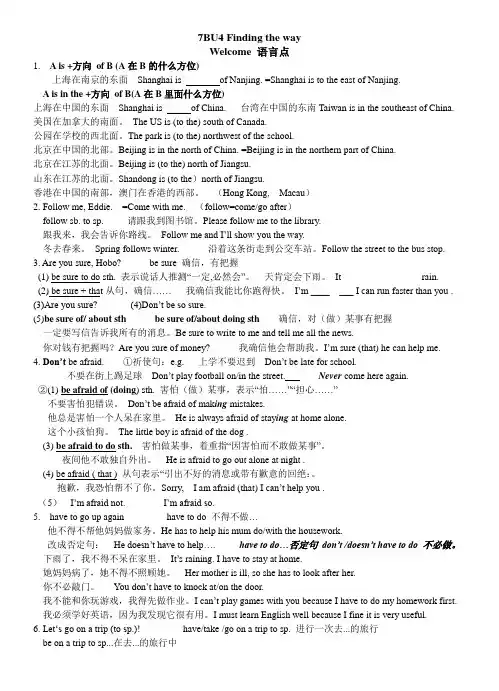
7BU4 Finding the way
Welcome 语言点
1. A is +方向 of B (A在B的什么方位)
上海在南京的东面 Shanghai is of Nanjing. =Shanghai is to the east of Nanjing.
A is in the +方向 of B(A在B里面什么方位)
上海在中国的东面 Shanghai is of China. 台湾在中国的东南Taiwan is in the southeast of China.
美国在加拿大的南面。 The US is (to the) south of Canada.
公园在学校的西北面。The park is (to the) northwest of the school.
北京在中国的北部。Beijing is in the north of China. =Beijing is in the northern part of China.
北京在江苏的北面。Beijing is (to the) north of Jiangsu.
山东在江苏的北面。Shandong is (to the)north of Jiangsu.
香港在中国的南部,澳门在香港的西部。 (Hong Kong, Macau)
2. Follow me, Eddie. =Come with me. (follow=come/go after)
follow sb. to sp. 请跟我到图书馆。Please follow me to the library.
跟我来,我会告诉你路线。 Follow me and I’ll show you the way.
冬去春来。 Spring follows winter. 沿着这条街走到公交车站。Follow the street to the bus stop.
【优选整合】牛津译林版七年级下册英语 Unit4 Finding your way-Task 测试

初中数学、数学试卷、初中数学试题、数学学案、数学初中教案、初中数学练习题、数学课件、期末考试数学、数学知识难点分析
初中数学、数学试卷、初中数学试题、数学学案、数学初中教案、初中数学练习题、数学课件、期末考试数学、数学知识难点分析 Task (单元任务)
一、要遵守交通规则首先要了解交通规则,你认识下列交通标志吗?请你选择下列路标相对应的英文释义。
1. ________ 2. _______ 3. ________ 4. ________ 5. ________
6. ________ 7. _______ 8. ________ 9. ________ 10. ________
A. Yield(让车) ahead. F. No left turn.
B. School: children cross the road. G. No entrance.
C. No U-turn. H. Only bike allowed (被允许)on this road.
D. No Parking. I. No stopping.
E. NO pedestrians (行人)allowed here. J. Road curves (弯路)left.
二、根据汉语提示和句意写单词,完成句子。
1. My school _________ (begin) at 7:30 am. and finishes at 5 pm.
2. We have _____________ (plenty of ) time to play games with you.
3. -- There are a lot of buses, cars and bikes in the street.
-- Yes, the ___________ is very busy at this time.
牛津译林英语7B Unit4课本知识整理

1
Unit 4 Finding your way
Warm up
一、重点单词
1. follow vt. 跟随;仿效
2. path n. 小路,小径
3. again adv. 再一次,又
4. afraid v. 害怕
二、重点词组
1. be afraid of.../be afraid to do 害怕.../害怕去做...
2. go down 向下走
go up 向上走
3. have to 必须,不得不
三、重点句型
1. Are you sure, Hobo? 你确定吗,霍波?
2. Come with me. 跟我来。
3. show you friends how to get to your home. 向你的朋友展示如何到你家
Welcome to the unit
一、重点单词
1. north n./adj./adv. 北,北方
2. west n./adj./adv. 西,西方
3. south n./adj./adv. 南,南方
4. east n./adj./adv. 东,东方
5. north-west n. 西北
6. north-east n. 东北
7. south-west n. 西南
8. south-east n. 东南
9. trip n. 旅行,旅游
10. kilometer =(km) n. 千米,公里= kilometer
11. instruction[ɪn'strʌkʃ(ə)n] n. 指令;指示(instructions 复数形式意为说明,说明书)
二、重点词组
1. go on a trip to sp. = take a trip to sp. 去某地旅游
2. be north/south/west/east of =be in the north/south/west/east of... 在…的北/南/西/东面
3. bus stop 公交站
牛津译林版英语七下_Unit 4 单元测试能力提升卷(解析版)

班级 姓名 学号 分数
Unit 4 Finding your way 单元测试 (B卷·能力提升)
(时间:60分钟,满分:100分)
一、单项选择(本题共10小题,每小题1.5分,共15分。)
1.What’s the name ________ the dog?
A.at B.in C.on D.of
2.This is ________ orange. ________ orange is green.
A./,/ B.a, The C.an, The D.an, a
3.Kitty goes to a dancing lesson ________ every Tuesday afternoon.
A./ B.in C.on D.at
4.—Excuse me, where is the meeting room?
—________. I will take you there.
A.That’s right B.This way, please C.In your dreams D.It doesn’t matter
5.Which of the following underlined parts has a different sound from the others?
A.leaf B.read C.team D.great
6.People built the Great Wall ________ bricks and stones.
A.in B.on C.use D.with
7.Bob is ________ SPCA officer and he wears ________ uniform at work.
A.a; an B.an; a C.an; an D.a; a
牛津译林版七年级英语下册7BUnit4Findingyourway单元测试卷(含答案)
⽜津译林版七年级英语下册7BUnit4Findingyourway单元
测试卷(含答案)
7B Unit4单元测试卷
⼀、单项选择1. ─You've dropped "s" in the word "across".
─Oh,letter "s" should be doubled.
A. a; a
B. an; a
C. an; the
D. the; the
2.Look at the__________words on the blackboard and_________me to read them.
A. following;following
B.follow;following
C. follow;follow
D.following;follow
3.Elephants ______Cute. Their large ears ______ open fans.
A. look;look
B. look like;look
C. look;look like
D.look like;look like
4. Walk ______ the road and turn left _______ Park Road,you will find the shop _____ your left.
A. down, into, on
B. along, to, in
C. straight, into, on
D. on, into, in
5. We are happy ____you ____ a farewell party for our friends from Beijing.
A. invite, to
B. to invite, join
C. inviting, to
D. to invite, to
6. Tom, follow this morning.
A. me home
B. me to home
C. have homeD. I to home
牛津译林版英语 七年级下册 Unit 4 Finding your way Welcome to
Unit 4
Comic strip and welcome to the unit
Teaching Aims:
1. Introduce the location and traffic topic.
2. Talk about visit and traffic mode
3. Distinguish directions.
一、初“练”找问题
1. Show some pictures to learn some words about different directions.
trip path north south east west
2. Then read aloud the new words.
follow vt. 跟随,效仿
path n. 小路,小径
north n., adj. &adv. 北,北方
west n., adj. &adv. 西,西方
south n., adj. &adv. 南,南方
east n., adj. &adv. 东,东方
trip n. 旅行,旅游
kilometre=km n. 千米,公里
have to 不得不,必须
二、精“讲”寻规律
Step2. Practise
1. Practise in pairs like this to talk about where the place is.
牛津译林版七年级英语下册7B Unit4单元测试卷(附答案)
7 B Unit4 Finding your way单元过关自测题
第一部分:听力测试(15分)
I. 听力。
A)听对话回答问题,听两遍。
( )1.How can the woman get to the post office?
A. B. C.
( )2. Which animal can help people?
A. B.
C.
( )3. How will Kate go to Beijing?
A. B.
C.
( )4. What is Simon playing?
A. B.
C.
( )5. What time is it now?
A.14: 00 B. 6:00 C. 20:00
( )6. How many blue pens are there?
A. One B. Four C. Three
( )7. What can the woman see?
A. Some books B. A box C. Some bananas
( )8. Where are the two speakers?
A. At school B. In the library C. In a bookshop
( )9. Where is Mary?
A. In the classroom B. In the Teachers’ office C. At home
( )10. What’s the new teacher like?
牛津译林版七年级下册Unit 4《Finding your way》练习题4
Unit 4 Finding your way习题
一、 选择题
1. The man is driving ______ his office.
A. on B. along C. towards D. pass
2. Go ______ down the road ______you see the tall building.
A. straight; until B. /; or C. along; and D. to; until
3. I’m sure grandpa will be very happy ______ us.
A. see B. seeing C. to see D. to seeing
4. Mr. Huston is looking forward ______ Beijing.
A. visiting B. to visiting C. to visit D. visit
5. I’m still hungry. Would you please give me ______ cake?
A. other B. the others C. another D. the another
6. ______ the hospital, turn right when you come to the first crossing.
A. Get B. Arrive C. To get D. To get to
7. He came into the supermarket from the ____, and went out from the ___ without buying
anything.
A. entrance; entrance B. entrance; exit C. exit; entrance D. exit; exit
译林牛津七年级英语下 Unit4 Finding your way 提优复习卷(含答案)
最新Word
7B Unit4 Finding your way提优复习卷
一、单项选择(每小题1分,满分15分)
1._______ cute the little panda is! It looks like its mother.
A What B. Why C. How D. If
2. The shirt is too small. Would you please show me_______, Madam?
A. the other one B. another one C. one another D. other one
3. We would like you _______ and we look forward _______ you.
A. to come; to see B come, to seeing C. come; to see D. to come; to seeing
4. The nearest hotel is 500 metres_______.
A far B. far from C. away D. far away from
5. You can find the cinema_______ the end of the street.
A on B. in C. at D. to
6. I think I _________ do my homework now.
A. have to B. maybe C. don’t have to D. mustn’t
7. Don’t _________ afraid. Give me, he a ring when you need some ____________.