
船舶签证规则对比
船舶签证制度的历史划分(1952-2017)

2016年11月,全国人大常委会第二十四次会议对《海上交通安全法》进行了修正,同月交通运输部海事局下发了《关于实施国内航行海船进出港报告制度有关事项的通知》,2017 年 3月交通运输部海事局下发了《关于实施内河航行船舶进出港报告制度有关事项的通知》,从规范层面,正式取消了国内航行的海船、内河船的进出港签证制度。
存在了半个多世纪的船舶签证制度, 如何寻求一个无限接近客观公正的评判,是一个巨大而艰难的课题。
对一项制度的评判首先应当了解其历史发展阶段,而不能只看一个时间点。
船舶签证制度自1952 年至今,历经三次存废六个不同的发展阶段,实施了半个多世纪。
它从行政许可逐步演变成监管制度,其功能也从单一的适航性审查逐步集聚港航规费征收、违章监管、宣传服务等多位功能。
船舶签证制度的历史渊源依据现有史料,船舶签证制度可以追溯到战国时期楚怀王赐给儿子鄂君启的舟、车铜质符节,该符节称为“鄂君启节”,其目的是方便鄂君启在楚国域内免税从事水路经商活动,该免税通行凭证,用铭文错金详细规定了车船数目、行程期限、运载物类等,它是中国历史上最早的行船通行凭证。
至唐代,诞生了中国历史上海事管理机构的雏形——“市舶使”,行使船舶检查之责。
宋代(公元971年),正式设立专职海事管理机构——市舶司,船舶始发港市舶司签发的“公据”或“公屏”,其内容与今天的《船舶签证簿》中的内容有较多相似之处。
明代由于实行海禁,市舶司职责发生转变,主要是辨勘合、禁通番、征私货和平交易四个方面。
清代由海关统一掌管,民国初年由航政局对国内船舶查验签证。
船舶签证制度的历史划分(1952-2017)DOI:10.16831/ki.issn1673-2278.2019.09.027The historical partition of ship visa scheme77中国海事海事博览Maritime Browse变革年代:初创到短暂废止(1952-1958)新中国成立后,在立法层面对海事进行规范始于1952年。
船舶海事签证办法

船舶海事签证办法第一条为促进水上运输事业的发展,保护当事人的合法权益,规范海事签证工作特制定本办法。
第二条本办法适用于船舶申办的海事签证工作。
第三条中华人民共和国港务监督局是海事签证的主管机关。
各地港务监督(含港航监督)机构是海事签证的承办机关。
第四条签证机关在受理船方申办海事签证时,可对下列海事文书予以签证。
(一)海事声明、延伸海事声明;(二)海事报告;(三)与船舶有关的其他海事文书。
第五条本办法中有关用语的含义:(一)“海事签证”是指签证机关应船方申请办理海事签证时,对在第四条所列文书的内容进行初步核查,签注“准予备查”以证明船方确向签证机关申报过有关海事的公证性行为。
(二)"海事声明"是指船长就船舶遭遇恶劣天气或意外事故引起或可能引起的船舶、货物损害或灭失情况,在船舶抵港后递交的声明。
(三)“延伸海事声明”是指海事声明提出后,在合理时间内递交的更为具体、详细的补充声明。
(四)“海事报告”是指船舶发生事故后,向签证机关递交并要求办理签证的书面报告。
第六条船舶申办海事签证,应遵守下列规定:(一)海事声明应在船舶抵第一到达港24小时内递交当地签证机关,在港停留时间不足24小时的,应在船舶抵港后立即递交当地签证机关。
(二)船舶抵港前已发生或可能引起船舶或货物受到损害的,必须在开舱卸货前,将申报文书递交给签证机关或先行将其内容用电报、电传等形式通知签证机关。
(三)申报文书一式不得少于三份(其中一份为正本,其余为副本,并分别加盖正、副本章)。
(四)申报第四条所列文书时,应同时附送有关的船舶法定文件摘录或其影印件,如航海日志、轮机日志、车钟记录、海图等。
(五)申报文书必须使用中文或英文。
(六)船长必须在其所申报文书和附件上签字和加盖船章,并应有不少于两个见证人的签字。
第七条申报文书主要内容应包括:(一)船舶名称、国籍、船籍港、船舶登记号、所有人和经营人名称。
(二)船舶的主要技术资料,出发港和目的港,客货情况。
船舶管理3.国内法规

(1)同3000GT及以上船舶 (2)连续航行时间不超过8小时可再减 免二副
未满500GT
船长1人 值班驾驶员2人 水手3人
(1)连续航行时间不超过24小时可减免 水手1人 (2)连续航行时间不超过8小时可再减 免值班驾驶员1人
3.5海船船员值班规则中的相关内容
海船船员值班规则(都要求) 制定《值班规则》的目的 加强海船船员值班管理 防止船员疲劳操作 保障海上人命与财产安全、保护海洋环境 制定《值班规则》的法律依据 《值班规则》是根据《中华人民共和国海上交通安全 法》、《中华人民共和国海洋环境保护法》、 STCW78/95公约、国际电信联盟的《无线电规则》的 要求制定的。
3.4船舶最低安全配员规则
最低安全配员(都要求) 自1998.05.01起施行, 目的是为确保船舶在航行和停泊时配有足以保证船舶安全的船员, 以保障水上人命、财产的安全,防止水域环境污染。 适用范围: 所有航行国际航线的中国籍机动船舶; 200总吨或750kW以上航行中国国内沿海航线的中国籍机动船舶; 50总吨或36.8kW以上航行国内内河航线的中国籍机动船; 《最低安全配员原则》和监督检查的规定也适用于500总吨及以上 航行中国管辖水域的外国籍船舶,航行中国管辖水域的外国籍船舶 应持有船旗国政府签发的《船舶最低安全配员证书》或等效文件; 军事、公安、渔业和体育运动船舶不适用本规则。
第二章 国际公约
船艺教研室
3船舶与船员安全管理的国内法规
3.1海上交通安全法(新的正在修订之中) 适用的水域:我国沿海水域。“沿海水域”是指我国 沿海的港口、内水和领海以及国家管辖的一切其他海 域。 适用对象:在沿海水域航行、停泊和作业的一切船舶 、设施和人员以及船舶、设施的所有人、经营人(没有 代理人)。“船舶”是指各类排水或非排水船、筏、水 上飞机、潜水器和移动式平台。“设施”是指水上水 下各种固定或浮动建筑、装置和固定平台。 主管机关:中华人民共和国海事局。而以渔业为主渔 港水域内,国家渔政渔港监督管理机构。
中华人民共和国船舶签证管理规则(英文版)

Rules of the People's Republic of China on the Administration of Vessel VisasChapter I General ProvisionsArticle 1 The present Rules are formulated according to the Law of the People's Republic of China on the Safety of Maritime Transport and the Regulation of the People's Republic of China on the Safety of Inland River Transport for the purpose of regulating the conducts relating to vessel visas and safeguarding the security of water transport.Article 2 The present Rules shall apply to the issuance of vessel visas to the domestic vessels navigating within the waters of the People's Republic of China.The present Rules do not apply to the military vessels, fishing vessels, and sports vessels. However, when the aforesaid vessels are engaged in profitable transportation, they shall apply for a vessel visa according to the provisions of the present Rules.The term "vessel visa" as herein used in the present Rules refers to the administrative licensing act whereby the maritime affairs administrative organs examine vessels and vessel operators upon their application and issue a permit to those that satisfy the conditions for a vessel visa.Article 3 The Maritime Safety Administration (MSA ) of the People's Republic of China shall take charge of the administration of vessel visa all through the whole country, and the maritime affairs administrative organs at various levels are specifically responsible for the administration of the vessel visas within their respective jurisdictions.The administration of vessel visas shall meet the principle of efficiency and facilitating people.Chapter II V essel VisasSection 1 General ProvisionsArticle 5 One shall apply to the maritime affairs organ for a vessel visa under any of the following circumstances unless it is otherwise differently provided for in the present Rules:1. sailing from within a port to without the port;2. sailing from without a port to within the port;3. necessary to sail out of an in-port berth so as to sail within the port as so required by operations;4. necessary to sail into an in-port berth so as to sail within the port as so required by operations;5. sailing out of a vessel fixing plant or station or out-of-port operating site or on-sea operating platform;6. sailing into a vessel fixing plant or station or out-of-port operating site or on-sea operating platform;The vessel visas as described in Items 1, 3 and 5 of the preceding paragraph are referred to in general as departure visas, which the applicant shall have obtained within 24 hours prior to the vessel sets sail, while the vessel visas as described in Items 2, 4 and 6 of the preceding paragraph are referred to in general as arrival visas, which the applicant shall have obtained within 24 hours after the vessel arrives. Where a report has already been made to the maritime affairs administrative organ of the place of arrival about the vessel within 24 hours before the vessel arrives, the arrival visa and departure visa may be issued concurrently.Article 6 A vessel visa shall be issued upon the request of the vessel or the business operator thereof. In the case of a towed vessel, its application for issuing a visa shall be filed by the towed 中华法律学习网w w w .1000f l .n e tvessel or the operator thereof, or be filed by the towing vessel or the operator thereof on its behalf. The applicant may entrust someone else to apply for a vessel visa.Article 7 The vessel for which an application for departure visa is filed shall be in a state of sea-worthiness or tow-worthiness.A vessel or the operator thereof who applies for a vessel visa for the first time shall submit to the maritime affairs administrative organ the following materials:1. vessel visa book;2. electronic card of vessel information (for the applicable vessel );3. certificate of vessel nationality;4. certificate of vessel inspection;5. minimum safety manning certificate;6. seaman's competence certificate;7. certificate on prevention of oil pollution (for the applicable vessels );8. duplicate of the vessel safety management certificate and the certificate on compliance with the corporate security management system (for the applicable vessels );9. vessel safety inspection records;10. certification on payment of or exemption from vessel port fees;11. bill of declaration for the approved carriage of hazardous goods by vessel (for the applicable vessel );12. captain's pre-departure announcement and vehicle safe loading records (for the applicable vessel );13. application form for convoy (for the applicable vessel ); and14. vessel operation license.Where the information about the certificates as listed in Items 3 through 8 in the second paragraph has been recorded in the book of vessel visas of the maritime affairs administrative organ or been saved in the vessel electronic information card, such certificates may be exempted from submission.The vessel operation certificate as mentioned in Item 14 of the second paragraph has to be submitted only for the visa application for the old transporting vessels engaged in domestic transportation. The issuer of vessel operation certificates shall provide the corresponding information of the vessel operation certificate to the maritime affairs administrative organ.Article 8 A vessel or vessel operator shall report truthful information when submitting application materials to the maritime affairs administrative organ, and shall be responsible for the truthfulness of such information.A vessel or vessel operator may apply for a vessel visa by means of fax, email, electronic data interchange (EDI ), etc., and may also report its arrival at the port by means of cable, telex, fax, mobile phone message, email, electronic data interchange (EDI ), etc., and make corresponding records in the log book.The report shall include the name, type, scale, total tonnage, draught, passenger or freight on board, the place to berth, etc.Article 9 The maritime affairs administrative organ shall check if the application materials for a vessel visa are complete, whether they meet the requirements for application, whether there is any obvious sign of alteration or falsification, and whether they are submitted within the valid term, etc. 中华法律学习网w w w .1000f l .n e tWhere the maritime affairs administrative organ is doubtful about the genuineness of the application materials or receives any relevant exposure for offence, it shall assign people to make an onsite investigation.Article 10 After receiving an application for vessel visa, the maritime affairs administrative organ shall process it according to the relevant provisions of the Procedural Provisions on the Implementation of Transport Administrative License.The maritime affairs administrative organ shall process the applications for a single voyage visa on the spot. The visa officer shall remark in the vessel visa book whether the visa is approved, the number and date of the maritime administrative enforcement certificate, and the special seal for vessel visa shall be affixed. Where the application for vessel is disapproved, the reasons for disapproval shall be stated in the vessel visa book.Article 11 Where any of the following circumstances occurs, an application shall be filed for a new departure visa:1. the captain or any of the seamen performing the corresponding duties changes;2. any material change occurs to the structure of the vessel or any of the important equipment relating to the safety of voyage;3. the area or line of voyage changes;4. the vessel has failed to depart within 48 hours after the departure visa was issued.Article 12 Where a vessel is not able to apply for a vessel visa according to the prescribed procedures due to such emergency as disaster relief, salvation, etc., it shall report to the maritime affairs administrative organ prior to its departure and shall make up the vessel visa within 24 hours after completing the task.Article 13 Where a vessel enters into or sails past a port temporarily due to reasons like sheltering from wind, waiting for the tide, or replenishment, etc., it shall be exempted from vessel visa, except:1. the captain or any of the seamen performing the corresponding duties changes;2. to embark or disembark passengers; or3. to load or unload goods.Article 14 Where a barge-tug fleet finds it necessary to add or release any vessel halfway, the vessels added or released shall apply for a vessel visa, while other vessels in the fleet do not have to apply for a vessel visa.Section II Special ProvisionsArticle 15 A vessel may apply for a short-term fix-term vessel visa instead of a voyage vessel visa if it is:1. a vessel that sails within a fixed water area; or2. a vessel that sails along a fixed route.A vessel that sails within a fixed water area shall file an application to any of the maritime affairs administrative organs that has jurisdiction over the fixed water area, and a vessel that sails along a fixed route shall file a separate application to the maritime affairs administrative organ of the place where the port of departure and port of destination of the route is situated.Article 16 A vessel may apply to the maritime affairs administrative organ directly affiliated to the Ministry of Communications of the place where the hail port is situated or to the maritime affairs administrative organ affiliated to the provincial department of communications for an annual fixed-term vessel visa instead of a voyage vessel visa if it: 中华法律学习网w w w .1000f l .n e t1. is a vessel with good faith in safety;2. has been equipped with and uses an automatic identification system as required;3. has submitted as required a report of arrivals and departures of the previous year during the prescribed term of visa; and4. has entered into an agreement on the payment of port fees with a relevant financial institution.Article 17 To apply for a fix-term vessel visa, one shall submit certification materials to prove that it meets the requirements as described in Article 15 or 16 in addition to the materials as provided for in Article 7 of the present Rules.Article 18 The maritime affairs administrative organ shall finalize the processing of the application for a short-term fixed-term vessel visa within 7 work days of accepting an application, and shall finalize the processing of the application for an annual fixed-term vessel visa. Where it approves an application for a fixed-term vessel visa, it shall remark in the vessel visa book the valid term of the visas, the area of voyage or the route.The valid term of a short-term fixed-term vessel visa shall not be any longer than 3 months. An annual fixed-term vessel visa shall be effective countrywide, and shall be valid for a term of 12 months.A passenger vessel and a vessel that carries hazardous goods can only apply for a short-term fixed-term vessel visa whose valid term is not longer than a month.Article 19 Where a vessel sails beyond the valid term of the fixed-term vessel visa or the approved area of voyage or route, or any other content as approved in the visa changes, it shall apply for a voyage vessel visa according to the provisions of Section I of the present Chapter.Article 20 A vessel which has obtained a fixed-term vessel visa shall, when carrying out any of the activities as provided for in Article 5 of the present Rules, report to the maritime affairs administrative organ about itself according to the ways and contents as provided for in paragraphs 2 and 3 of Article 8 of the present Rules.Chapter III Vessel Visa BooksArticle 21 A vessel visa book is a documentation used for the exclusive purpose of vessel visas as well as a proof for recording the visas that the vessel has applied for. No entity or individual other than the maritime affairs administrative organ may detain or capture any vessel visa book, nor may it or he make any remark in the vessel visa book.The format and contents of the vessel visa books and the specimens of the vessel visa seals shall be exclusively provided for by the Maritime Safety Administration of the People's Republic of China.Article 22 The issuance, change or make-up issuance of vessel visa books shall be conducted upon the application of the vessels or operators thereof filed to the maritime affairs administrative organ.Where a vessel applies for a vessel visa book for the first time and applies for a new vessel visa book subsequent to the change in the owner, operator or name of the vessel, it shall apply to the maritime affairs administrative organ of the hail port.A vessel whose vessel visa book is missing or lost shall apply to the maritime affairs administrative organ of the hail port for making it up. When applying for making up a vessel visa book, it shall submit a photocopy of its recent vessel visa application form as approved by the maritime affairs administrative organ. 中华法律学习网w w w .1000f l .n e tWhere a vessel visa book is used up or cannot be used any more due to defiling, it may apply to the maritime affairs administrative organ of the hail port or place where the visa was issued to change one. When applying for changing one, it shall return the original vessel visa book.Article 23 Where the requirements of the present Rules are met, the maritime affairs administrative organ shall issue, change or make up a vessel visa book on the spot.When issuing, changing or making up a vessel visa book, the maritime affairs administrative organ shall record the general information of the vessel in the vessel visa book, and shall affix the seal of the maritime affairs administrative organ to it. Where the vessel visa book is changed by the maritime affairs administrative organ of a place other than the hail port, the change of vessel visa book shall be reported to the maritime affairs administrative organ of the hail port in writing. Article 24 A vessel may request the maritime affairs administrative organ of the hail port or the place of visa to record the information of the vessel certificates and seaman certificates in the vessel visa book, and shall submit the corresponding certificates when filing the request.If the request meets the relevant requirements, the maritime affairs administrative organ shall record down in the vessel visa book the relevant information about the vessel certificates and seaman certificates, and write down the number and date of the maritime law enforcement certificate and affix the seal of the maritime affairs administrative organ.Article 25 A vessel visa book shall be used continuously, kept intact and may not miss any page or unlawfully altered. A vessel visa book shall be kept on the vessel for two years after it is used up.Where a vessel is discarded as useless or is lost or the owner or operator of the vessel changes or the name of the vessel changes, the vessel shall hand its visa book back to the maritime affairs administrative organ of the hail port for write-off.Article 26 No vessel may falsify, change, or lease any vessel visa book or use any other vessel's visa book or obtain a vessel visa book by fraudulent means.Chapter IV Supervision, Inspection, and Legal LiabilitiesArticle 27 Maritime affairs administrative organs shall strengthen their supervision and inspection to the vessel visas. The relevant entities and individuals shall offer assistance and show cooperation in the supervision and inspections carried out by the maritime affairs administrative organs, and shall not refuse, impede or obstruct the process of supervision and inspection.Article 28 Where a maritime affairs administrative organ finds that any vessel has failed to obtain a vessel visa according to the relevant provisions, it shall order it to obtain one, and may order it to accept investigation and punishment at a designated place. If the vessel refuses to make correction, it may adopt such measures as prohibiting its sailing into or out of the port or order it to stop voyage, etc.Article 29 Where a vessel is found not to meet the conditions for issuing a fixed-term vessel visa any more, it shall be demanded to apply for a voyage visa according to Section I, Chapter II of the present Rules, and a notice shall be circulated to the maritime affairs administrative organ that approved the fixed-term vessel visa to cancel the fixed-term visa of the vessel in question. Article 30 Where a vessel is found to have obtained its visa by unfair means before it departed from the port, the maritime affairs administrative organ shall revoke the vessel visa and record down in the vessel visa book the reasons and the date of revocation, and shall affix its seal. If the vessel has already departed from the port, the maritime affairs administrative organ shall make an investigation so as to impose a punishment upon it or notify the maritime affairs 中华法律学习网w w w .1000f l .n e tadministrative organ of the next stop of the vessel to investigate and punish it.Article 31 A maritime affairs administrative organ shall, in the process of supervision and inspection, record in the vessel visa book and inform the maritime affairs administrative organ of the hail port if:1. the vessel is given a maritime administrative punishment;2. the vessel has incurred a water traffic accident or pollution accident; or3. the vessel is prohibited from departing from the port.The maritime affairs administrative organ of the hail port shall record down the aforesaid information it has received and offer assistance in investigation and punishment.Article 32 Where a vessel shall be given an administrative punishment due to violation of the provisions on vessel visa, it shall be punished according to the rules of the Ministry of Communications on maritime administrative punishment.Article 33 Any functionary of any maritime affairs administrative organ who abuses his power, practices favoritism or neglects his duties shall be given an administrative sanction by the entity where he works or the next higher organ. If any crime has been constituted, he shall be delivered to the judicial organ for criminal liabilities.Chapter V Supplementary ProvisionsArticle 34 The term "vessel with good faith in safety" as used in the present Rules refers to a vessel which meets the following requirements and is regarded by the Maritime Safety Administration of the People's Republic of China as a vessel with good faith in safety:1. it is found to have a good record in the recent vessel safety inspection or in the supervision and inspection of the country of port during a period of twelve months, and has no serious defect;2. it has obtained a SMC for two years or more and has not been imposed a track-up inspection or additional inspection during the recent three years;3. it has not incurred any safety accident or pollution accident during the recent three years;4. it has not been given any maritime administrative punishment during the recent three years; and5. it is a vessel not as old as 12 years, and it has not been held up in the vessel safety inspections or the supervision and inspections of the country of port during the recent three years; or, if the vessel is twelve years old or older, it has not been held up in the vessel safety inspections or the supervision and inspections of the country of port during the recent five years.Article 35 A maritime affairs administrative organ shall gradually establish and perfect its platform of basic data for the management of vessels and seamen in the issuance of vessel visas so as to facilitate the applications for visas by vessels or vessel operators and their report for departing from or arrival at the port.Article 36 Where the Ministry of Communications has promulgated any special provision on the visa of special vessels such as high-speed vessels and roll-on vessel, such special provisions shall prevail.Article 37 The present Rules shall become effective as of October 1, 2007, and the Rules of the People's Republic of China on Vessel Visas (Order No. 3 [1993] of the Ministry of Communications as issued by the Ministry of Communications on May 17, 1993 shall be repealed concurrently. 中华法律学习网w w w .1000f l .n e t。
中华人民共和国船舶进出渔港签证办法

中华人民共和国船舶进出渔港签证办法文章属性•【制定机关】农业部(已撤销)•【公布日期】1990.01.26•【文号】农业部令1990年第11号•【施行日期】1990.01.26•【效力等级】部门规章•【时效性】失效•【主题分类】水运正文*注:本篇法规已被《中华人民共和国农业部令--规章和规范性文件清理结果(第39号)》(发布日期:1997年12月25日实施日期:1997年12月25日)修改中华人民共和国船舶进出渔港签证办法(农业部令1990年第11号1990年1月26日)第一章总则第一条为维护渔港正常秩序,保障渔港设施、船舶及人命、财产的安全,防止污染渔港水域环境,加强进出渔港船舶的监督管理,根据《中华人民共和国海上交通安全法》、《中华人民共和国海洋环境保护法》及《中华人民共和国渔港水域交通安全管理条例》,特制定本办法。
第二条凡进出渔港(含综合性港口内的渔业港区、水域、锚地)的中国籍船舶均需办理进出港签证。
第三条下列船舶可免于签证:(一)在执行公务时的军事、公安、边防、海关、海监、渔政船等国家公务船;(二)体育运动船;(三)经渔港监督机关批准免予签证的其他船舶。
第四条外国籍船舶,港、澳地区船舶(含港、澳流动渔船)及台湾省渔船,进出渔港应遵守我国现行有关规定,并应向渔港监督机关报告。
第五条中华人民共和国渔港监督机构负责船舶进出渔港签证工作。
第二章签证办法第六条船舶进港后至出港前,应向渔港监督机关办理进出港签证手续,并接受安全检查。
签证工作一般实行进出港一次签证。
渔业船舶若临时改变作业性质,出港时仍需办理出港签证。
第七条目前尚无渔港监督机构或人员的渔港,在设置机构前可委托当地适当部门代为签证,签证业务受授权的渔港监督机构领导。
第八条在海上连续作业时间不超过24小时的渔船,可定期向所在地或就近渔港的渔港监督机关或其派出机构办理签证,并接受安全检查。
第九条凡需在渔港内装卸货物的船舶,须填写《船舶进(出)港报告单》(附表一、二)一式两份(一份存签证机关,一份存本船)。
3.7船舶签证ok
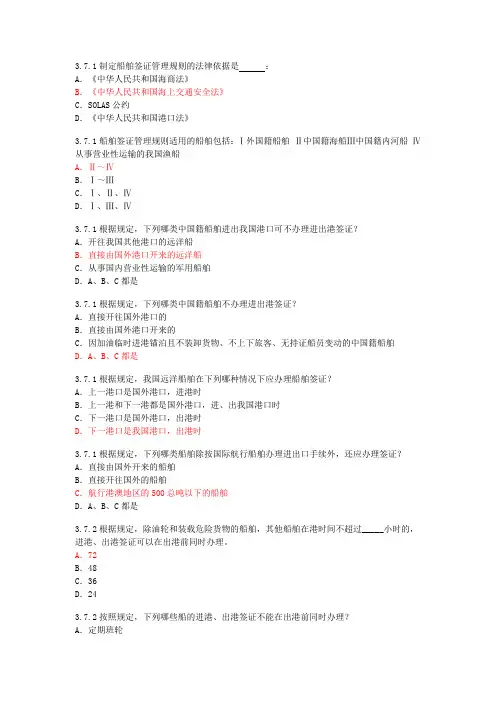
3.7.1制定船舶签证管理规则的法律依据是:A.《中华人民共和国海商法》B.《中华人民共和国海上交通安全法》C.SOLAS公约D.《中华人民共和国港口法》3.7.1船舶签证管理规则适用的船舶包括:Ⅰ外国籍船舶Ⅱ中国籍海船Ⅲ中国籍内河船Ⅳ从事营业性运输的我国渔船A.Ⅱ~ⅣB.Ⅰ~ⅢC.Ⅰ、Ⅱ、ⅣD.Ⅰ、Ⅲ、Ⅳ3.7.1根据规定,下列哪类中国籍船舶进出我国港口可不办理进出港签证?A.开往我国其他港口的远洋船B.直接由国外港口开来的远洋船C.从事国内营业性运输的军用船舶D.A、B、C都是3.7.1根据规定,下列哪类中国籍船舶不办理进出港签证?A.直接开往国外港口的B.直接由国外港口开来的C.因加油临时进港锚泊且不装卸货物、不上下旅客、无持证船员变动的中国籍船舶D.A、B、C都是3.7.1根据规定,我国远洋船舶在下列哪种情况下应办理船舶签证?A.上一港口是国外港口,进港时B.上一港和下一港都是国外港口,进、出我国港口时C.下一港口是国外港口,出港时D.下一港口是我国港口,出港时3.7.1根据规定,下列哪类船舶除按国际航行船舶办理进出口手续外,还应办理签证?A.直接由国外开来的船舶B.直接开往国外的船舶C.航行港澳地区的500总吨以下的船舶D.A、B、C都是3.7.2根据规定,除油轮和装载危险货物的船舶,其他船舶在港时间不超过_____小时的,进港、出港签证可以在出港前同时办理。
A.72B.48C.36D.243.7.2按照规定,下列哪些船的进港、出港签证不能在出港前同时办理?A.定期班轮B.油轮和装运危险货物的船舶C.高速客船D.A、B、C都是3.7.2按照规定,在港停泊时间不超过72小时的油轮和装运危险货物的船舶应如何办理签证手续?A.进出港签证可同时办理B.进港后立即办理进港签证,出港时仍需办理出港签证C.按危险品船舶管理办法执行D.根据具体情况决定3.7.2《船舶签证管理规则》规定,办理出港签证后36小时内未能出港的船舶:A.可不再办理出港签证B.要重新办理出港签证C.应接受检查D.以上都不对3.7.2《船舶签证管理规则》规定,办理出口签证后___ 小时内未能出港的船舶应重新办理签证?A.72B.36C.24D.483.7.2根据规定,已经签证的船舶出港前出现下列哪种情况时应重新办理签证?Ⅰ大副变动Ⅱ轮机长变动Ⅲ目的港改变Ⅳ办理出港签证后24小时内未能出港A.Ⅰ~ⅣB.Ⅰ~ⅢC.Ⅱ~ⅣD.Ⅱ、Ⅲ3.7.2根据规定,已经签证的船舶,出港前出现下列哪种情况时应重新办理签证?Ⅰ大管轮变动Ⅱ船长变动Ⅲ船舶用途改变Ⅳ办理出港签证后24小时内未能出港A.Ⅰ~ⅣB.Ⅰ~ⅢC.Ⅱ~ⅣD.Ⅱ、Ⅲ3.7.2根据规定,已经签证的船舶,出港前出现下列哪种情况时应重新办理签证?Ⅰ船舶主机损坏Ⅱ船舶结构和技术条件变化Ⅲ船舶用途改变Ⅳ办理出港签证后36小时内未能出港A.Ⅰ~ⅢB.Ⅰ~ⅣC.Ⅱ~ⅣD.Ⅱ、Ⅲ3.7.2根据船舶签证管理规则,在没有旅客上下、持证船员变动、货物装卸的前提下,中国籍船舶遇有下列哪些情况可不办理进、出港签证?A.因避风、侯潮、补给等原因临时进港抛锚B.航经港区水域C.因避风、侯潮、补给等原因临时进港靠泊D.A和B正确3.7.2根据规定,如因避风等原因临时进港锚泊时,应具备下列哪些条件才可以不办理进、出港签证?A.不装卸货物、不上下旅客B.三副变动C.普通船员变动D.A和C是3.7.2根据规定,如因避风等原因临时进港锚泊时,下列哪种船舶不应办理进、出港签证?A.外国籍船B.干部船员变动的中国籍船C.装卸货物的中国籍船D.上下旅客的中国籍船3.7.2船舶办理出港签证应具备下列哪些条件?Ⅰ无违反国家法律的行为Ⅱ配备足以保证航行安全的船员Ⅲ持有危险货物申报单Ⅳ载客货符合要求A.Ⅰ~ⅢB.Ⅰ~ⅣC.Ⅱ~ⅣD.Ⅲ Ⅳ3.7.2在下列哪些情况下船舶可以办理出港签证?Ⅰ已缴纳港务费Ⅱ船舶处于适航状态Ⅲ持有危险货物申报单Ⅳ缺少一名服务员A.Ⅰ~ⅢB.Ⅰ、Ⅲ、ⅣC.Ⅱ~ⅣD.Ⅰ~Ⅳ3.7.2根据规定,下列哪些情况导致船舶不符合办理出港签证的条件?Ⅰ不具有有效的卫生证书Ⅱ规定的载重线被浸没Ⅲ船舶安全检查存在缺陷但已纠正并复查合格Ⅳ无装载危险货物监装证明A.Ⅰ~ⅣB.Ⅰ、Ⅲ、ⅣC.Ⅱ、ⅣD.Ⅰ~Ⅲ3.7.2根据规定,船舶办理签证时不需交验的资料是:A.船舶技术证书B.船员适任证书C.船舶安全检查记录D.危险货物申报单及装载清单*3.7.2按照规定,船舶办理进、出港签证时应交验下列哪些资料?Ⅰ船员适任证书Ⅱ有效的保险文书Ⅲ船舶安全检查记录簿Ⅳ装载危险货物的船舶,应持有危险货物申报单和装载清单A.Ⅰ~ⅣB.Ⅰ、Ⅱ、ⅣC.Ⅰ、Ⅲ、ⅣD.Ⅰ~Ⅲ3.7.2船舶办理进、出港签证的程序是:Ⅰ填写船舶签证簿Ⅱ填写船舶签证报告单Ⅲ交验所需的资料Ⅳ由船长通过代理向海事局办理A.Ⅰ、ⅣB.Ⅱ~ⅣC.Ⅰ、Ⅲ、ⅣD.Ⅰ~Ⅲ3.7.3下列有关船舶签证簿的叙述正确的是:Ⅰ 船舶可向所在港申领签证簿Ⅱ 签证簿是船舶航行必备的文书Ⅲ 任何单位、个人不得扣留签证簿Ⅳ 使用完毕后,应送海事局注销,并由船舶或其所有人保留三年A.Ⅰ~ⅣB.Ⅱ、ⅣC.Ⅰ~ⅢD.Ⅰ、Ⅲ、Ⅳ3.7.3下列有关《船舶签证簿》的叙述哪些正确?Ⅰ 船舶应向船籍港海事局申领Ⅱ签证簿必须加盖海事局印章方为有效Ⅲ 如果船舶同时使用二本,海事局有权没收其中的一本Ⅳ 换发新签证簿时,原签证簿内的记载仍然有效A.Ⅰ~ⅣB.Ⅱ、ⅣC.Ⅰ~ⅢD.Ⅰ、Ⅱ、Ⅳ3.7.3根据规定,国内航行船舶申领签证簿时应校验:Ⅰ 船舶登记证书Ⅱ船舶国籍证书Ⅲ 船舶检验证书簿或航行安全证书Ⅳ 最低安全配员证书A.Ⅰ~ⅢB.Ⅱ、ⅣC.Ⅰ~ⅣD.Ⅰ、Ⅲ、Ⅳ3.7.3根据规定,船舶签证簿在下列哪些情况下应申请换发?Ⅰ船名改变时Ⅱ船舶所有人改变时Ⅲ船员配备改变时Ⅳ船舶航区改变时A.Ⅰ、ⅡB.Ⅰ、Ⅱ、ⅣC.Ⅲ、Ⅳ D.Ⅰ~Ⅳ。
中华人民共和国海船船员适任考试和发证规则(简称11规则)
(十四)在液化气船上服务的船长、驾驶员、轮机长、轮机员、值班水手、值班机工、高级值班水手、高级值班机工及其他对液化气船货物相关操作承担直接责任的船员,应当持有液化气船货物操作高级培训合格证;
(十五)在客船上服务的所有船员,应当持有客船船员特殊培训合格证;
(三)持有适任证书者申请培训合格证书再有效的,原则上应向适任证书签发机关提出申请,未持有适任证书者申请培训合格证书再有效的,原则上应向船员服务单位所在地海事机构提出请。
《海船船员培训合格证书申请表》样式,详见附件2。
四、申请培训合格证书的污损、遗失补办者,应当向培训合格证书原签发机关提出申请;申请培训合格证书的个人信息变更发证者,可按以下优先顺序向相应海事管理机构提出申请:
第二条 本办法适用于为取得《中华人民共和国海船船员培训合格证书》(以下简称为“培训合格证书”)而进行的考试以及培训合格证书、其他缔约国培训合格证书承认签证的签发与管理。
第三条 在中国籍海船上任职的船员应当持有符合《中华人民共和国船员条例》和我国缔结或加入的有关国际公约所要求的有效培训合格证书。
第四条中华人民共和国海事局负责统一管理培训合格证书考试和签发工作。
附件1:
中华人民共和国海事局文件
海船员〔2012〕170号
关于印发《中华人民共和国海船船员培训合格证书签发管理办法》的通知
各有关单位:
为提高海船船员的基本素质和专业技能,保障海上人命和财产安全,保护海洋环境,促进海上保安,根据《中华人民共和国船员条例》、《中华人民共和国船员培训管理规则》、《中华人民共和国海船船员适任考试和发证规则》以及我国缔结或加入的有关国际公约规定,现将《中华人民共和国海船船员培训合格证书签发管理办法》(以下简称《办法》)印发你们,请遵照执行。为更好地实施《办法》,现将有关事项通知如下:
中华人民共和国船舶签证管理规则
中华人民共和国船舶签证管理规则第一章总则第一条为规范船舶签证行为,保障水上交通安全,依据《中华人民共和国海上交通安全法》和《中华人民共和国内河交通安全管理条例》,制定本规则。
第二条国内航行船舶在中华人民共和国管辖水域内办理船舶签证,适用本规则。
本规则不适用于军事船舶、渔船、体育运动船舶。
但是前述船舶从事营业性运输时,应当按照本规则办理船舶签证。
本规则所称船舶签证,是指海事管理机构根据船舶或者其经营人的申请,经依法审查,对符合船舶签证条件的,准予其航行的行政许可行为。
第三条中华人民共和国海事局主管全国的船舶签证管理工作。
各级海事管理机构具体负责本辖区内的船舶签证管理工作。
第四条船舶签证管理工作应当符合高效、便民的原则。
第二章船舶签证第一节一般规定第五条除本规则另有规定外,船舶有下列情形之一的,应当向海事管理机构申请航次船舶签证:(一)由港内驶出港外;(二)由港外驶入港内;(三)因作业需要在港内航行驶出港内泊位;(四)因作业需要在港内航行驶入港内泊位;(五)驶出船舶修造(厂)点、港外作业点、海上作业平台;(六)驶入船舶修造(厂)点、港外作业点、海上作业平台。
本条第一款第(一)、(三)、(五)项船舶签证统称出港签证,申请人应当在船舶开航前24小时内办理。
本条第一款第(二)、(四)、(六)项船舶签证统称进港签证,申请人应当在船舶抵达后24小时内办理。
船舶抵达前24小时内已经向拟抵达地海事管理机构报告船舶情况的,进港签证可以与出港签证合并办理。
第六条船舶签证应当由船舶或者其经营人申请办理。
被拖船可由被拖船或者其经营人申请,也可由拖船或者其经营人代为申请。
申请人可以委托代理人办理船舶签证。
第七条申请办理出港签证的船舶,应当处于适航或者适拖状态。
船舶或者其经营人申请办理航次船舶签证,应当向海事管理机构提交以下材料:(一)船舶签证簿;(二)船舶电子信息卡(适用的船舶);(三)船舶国籍证书;(四)船舶检验证书;(五)船舶最低安全配员证书;(六)船员适任证书;(七)防止油污证书(适用的船舶);(八)船舶安全管理证书和公司安全管理体系符合证明副本(适用的船舶);(九)船舶安全检查记录簿;(十)船舶港务费缴纳或者免于缴纳证明;(十一)经批准的船舶载运危险货物申报单(适用的船舶);(十二)船长开航前声明和车辆安全装载记录(适用的船舶);(十三)护航申请书(适用的船舶);(十四)船舶营运证。
中华人民共和国船舶进出内河港口签证管理规则
中华人民共和国船舶进出内河港口签证管理规则【发文字号】中华人民共和国交通部令第27号【发布部门】交通部(已撤销)【公布日期】1991.03.27【实施日期】1991.07.01【时效性】失效【效力级别】部门规章中华人民共和国船舶进出内河港口签证管理规则(1991年3月27日交通部令第27号)第一条根据《中华人民共和国内河交通安全管理条例》,制定本规则。
第二条进出中华人民共和国内河各港口的中国籍船舶,应当按照本规则的规定,办理船舶进出港口签证,但下列船舶可免办签证:(一)军用船舶、公安船舶;(二)体育运动船艇;(三)经县级以上港航监督机关批准免办签证的其他非营业性船舶。
军用船舶、公安船舶、渔船从事营业性运输时,应按本规则的规定办理进出港口签证。
第三条船舶进出港口签证工作,由各级港航监督机关及其设置的签证站(点)负责。
签证工作实行“谁签证、谁负责”的原则。
第四条船舶进出港口,一般应在出港时一次办理进出港口签证。
船舶因修理、待命、封存或者其他原因暂不能够确定出港时间的;应在抵港后24小时内办理进港签证,出港时再办理出港签证。
装载危险货物的船舶进港和出港均需办理签证。
第五条船舶在未设置签证站(点)的港口始发,应在开航后途经的第一个设有签证站(点)的港口办理签证。
第六条船队进口港口,由拖轮统一办理签证。
第七条船队在始发港签证时,已详细注明在中途港停靠或者加、解作业的船舶,在中途港可免办签证。
第八条在中途港被加、解的船舶,除本规则第七条规定情况外,必须单独办理进出港口签证。
无人驳船的签证由无人驳船基地或者其在港口的代理人负责申办。
第九条已办理出港签证尚未离港或者办理定期签证后尚未到期的船舶,遇有下列情况之一,必须及时向港航监督机关报告并重新办理签证;(一)船长、轮机长、驾驶员、轮机员变更;(二)船舶技术条件发生变化;(三)船舶证书过期或者记载内容改变;(四)改变航线或者用途;(五)改装载危险货物或改变大批货种;(六)办理出港签证后24小时内未能出港。
船舶各种证书介绍及检验审核要求
船舶各种证书介绍及检验审核要求本文是一位船长总结的关于船舶证书的管理,供大家参考,不当之处还望指正。
主要以五星红旗国际航行船舶为例。
一、船舶国籍证书Certificate of Vessel’s Nationality在我国取得所有权的船舶,由我国海事局签发“中华人民共和国船舶国籍证书”;在国外登记、悬挂他国国旗的船舶则拥有“REGISTRY CERTIFICATE”登记证书。
1、证书有效期:五年。
2、只要船舶所有人不变更、不改挂他国国旗,该证书在其标定的有效期内有效。
3、注意:船舶所有人及其地址、船舶经营及其地址要与船舶安全管理证书(SMC)、公司的符合证明(DOC)、入籍证书等其它证书上的名称、地址一致,尤其是公司上市和(或)改名后,要及时更改所有证书、资料(防油污计划、系固手册等)中的船舶所有人名称及其地址。
否则,给以后各种检查留下了“缺陷”。
二、船体入级证书 (CCH) Classification for Hull1、临时证书(有效期五个月);正式证书(有效期五年)。
2、法定检验分为:(1)年度检验(证书周年日前后三个月内实施)。
(2)期间检验(有效期中间的前后半年内实施)。
可替代一次年度检验。
(3)换证检验(证书到期之前实施,以便发新证书)。
(4)加强检验(特检)(每五年实施一次,结合厂坞修进行)。
(5)临时检验(损坏检验)(船体结构和或重大机电设备损坏时实施检验,核准该船是否适航和或进行怎样的修理才能适航)。
3、注意:要将船级社检验报告FORM PHC 与该证书钉在一起作为支持件。
三、轮机入级证书(CCM) Classification Certificate for Machinery1、证书有效期:临时证书(有效期五个月);正式证书(有效期五年)。
2、法定检验:(1)年度检验(证书周年日前后三个月内实施)。
(2)期间检验(有效期中间的前后半年内实施)。
可替代一次年度检验。
(3)换证检验(证书到期之前实施,以便发新证书)。