
沪教牛津版四年级上册英语课件 Unit 10 Around my home
四年级上册英语一课一练-module 3 unit 2 exercise 4 牛津上海版(一起)
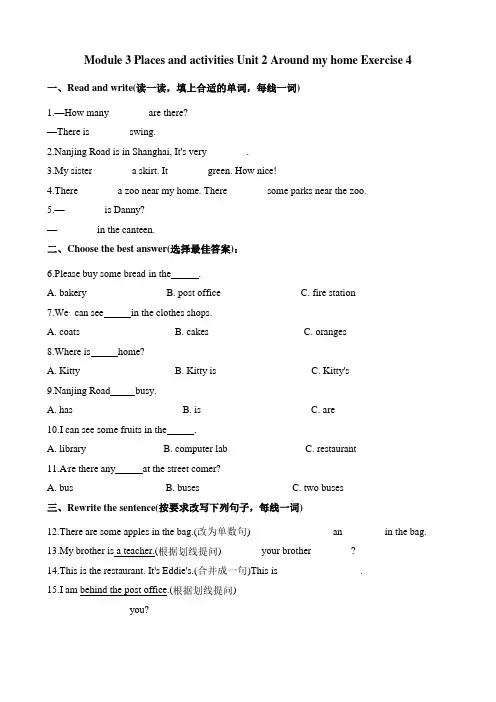
Module 3 Places and activities Unit 2 Around my home Exercise 4
一、Read and write(读一读,填上合适的单词,每线一词)
1.—How many________are there?
—There is________swing.
2.Nanjing Road is in Shanghai, It's very________.
3.My sister________a skirt. It________green. How nice!
4.There________a zoo near my home. There________some parks near the zoo.
5.—________is Danny?
—________in the canteen.
二、Choose the best answer(选择最佳答案):
6.Please buy some bread in the
.
A. bakery B. post office C. fire station
7.We can see in the clothes shops.
A. coats B. cakes C. oranges
8.Where is home?
A. Kitty B. Kitty is C. Kitty's
牛津英语四年级上册Unit10 Around my home教案
1 / 16
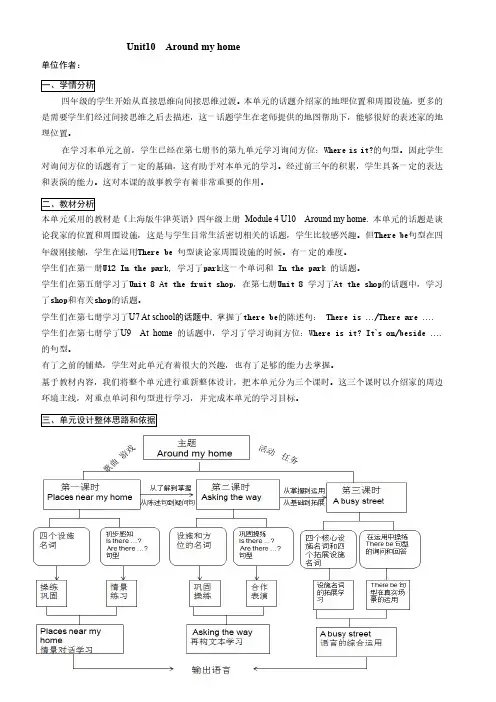
Unit10 Around my home
单位作者: 一、学情分析 四年级的学生开始从直接思维向间接思维过渡。本单元的话题介绍家的地理位置和周围设施,更多的
是需要学生们经过间接思维之后去描述,这一话题学生在老师提供的地图帮助下,能够很好的表述家的地
理位置。
在学习本单元之前,学生已经在第七册书的第九单元学习询问方位:Where is it?的句型。因此学生
对询问方位的话题有了一定的基础,这有助于对本单元的学习。经过前三年的积累,学生具备一定的表达
和表演的能力。这对本课的故事教学有着非常重要的作用。 二、教材分析 本单元采用的教材是《上海版牛津英语》四年级上册 Module 4 U10 Around my home. 本单元的话题是谈
论我家的位置和周围设施,这是与学生日常生活密切相关的话题,学生比较感兴趣。但There be句型在四
年级刚接触,学生在运用There be 句型谈论家周围设施的时候。有一定的难度。
学生们在第一册U12 In the park, 学习了park这一个单词和 In the park 的话题。
学生们在第五册学习了Unit 8 At the fruit shop,在第七册Unit 8 学习了At the shop的话题中,学习
了shop和有关shop的话题。
学生们在第七册学习了U7 At school的话题中, 掌握了there be的陈述句: There is …/There are ….
学生们在第七册学了U9 At home 的话题中,学习了学习询问方位:Where is it? It’s on/beside ….
的句型。
有了之前的铺垫,学生对此单元有着很大的兴趣,也有了足够的能力去掌握。
基于教材内容,我们将整个单元进行重新整体设计,把本单元分为三个课时。这三个课时以介绍家的周边
环境主线,对重点单词和句型进行学习,并完成本单元的学习目标。 三、单元设计整体思路和依据 2 / 16 四、单元教学安排(课时、内容) 本单元共分三课时:第一课时Place near my home,第二课时Asking the way ,第三课时 A busy street 。
牛津深圳版小学英语五年级上册unit 9 around the city 教案(共3课时)
Unit 9 Around the city
教案
一、学情分析
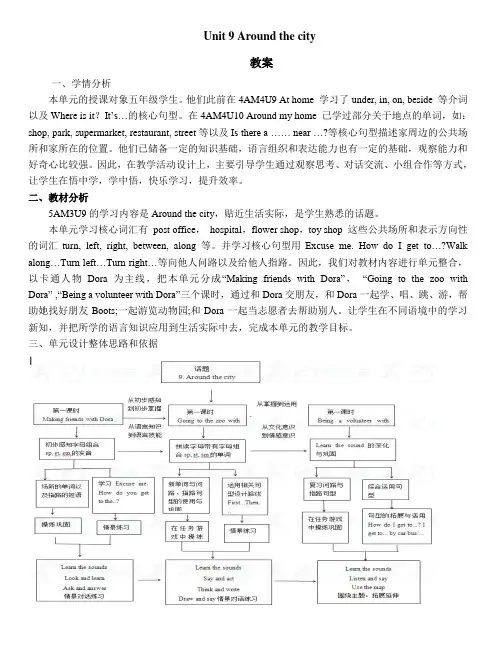
本单元的授课对象五年级学生。他们此前在4AM4U9 At home 学习了under, in, on, beside 等介词以及Where is it?It’s…的核心句型。在4AM4U10 Around my home 已学过部分关于地点的单词,如:shop, park, supermarket, restaurant, street等以及Is there a …… near …?等核心句型描述家周边的公共场所和家所在的位置。他们已储备一定的知识基础,语言组织和表达能力也有一定的基础,观察能力和好奇心比较强。因此,在教学活动设计上,主要引导学生通过观察思考、对话交流、小组合作等方式,让学生在悟中学,学中悟,快乐学习,提升效率。
二、教材分析
5AM3U9的学习内容是Around the city,贴近生活实际,是学生熟悉的话题。
本单元学习核心词汇有 post office, hospital,flower shop,toy shop 这些公共场所和表示方向性的词汇turn, left, right, between, along 等。并学习核心句型用Excuse me. How do I get to…?Walk
along…Turn left…Turn right…等向他人问路以及给他人指路。因此,我们对教材内容进行单元整合,以卡通人物Dora 为主线,把本单元分成“Making friends with Dora”, “Going to the zoo with
Dora” ,“Being a volunteer with Dora”三个课时,通过和Dora交朋友,和Dora一起学、唱、跳、游,帮助她找好朋友Boots;一起游览动物园;和Dora一起当志愿者去帮助别人。让学生在不同语境中的学习新知,并把所学的语言知识应用到生活实际中去,完成本单元的教学目标。
沪教版五年级上册英语Unit 9 Around the city讲义(教师版)

Unit 9 Around the city
一、重点词汇及拓展
1. post office n. 邮局
词汇拓展:postcard 明信片 postman 邮递员
e.g. There is a post office near my home. 在我家附近有一个邮局。
2. quite adv. 相当 十分
词汇拓展:very 非常 易混淆:quiet 安静的
e.g. It’s quite far from here. 那个地方离这非常远。
3. along prep. 沿着
e.g. Walk along the street. 沿着街道走。
4. turn v. 转向,转弯
词汇拓展:turn on 打开 turn off 关掉
e.g. Turn left at the Spring Street. 在春天街道左转。
5. left n. 左边 adj. 左边的
词汇拓展:on the left 在左边
e.g. There is a TV on the left. 电视在房间的左边。
6. straight adj&adv 直的,笔直地
词汇拓展:curly 卷曲的
e.g. Walk straight and you will see the supermarket. 直走然后你就会看到超市。
7. right n. 右边 adj. 右边的, 正确的
词汇拓展:on the right 在右边
e.g. On the right of the room, there is a hospital. 在房间的右边有一个医院。
8. between prep. 在两者之间
词汇拓展:among 在三者及以上之间 between ...and... 在......之间
e.g. The flower shop is between the post office and the cinema. 花店在邮局和电影院之间。
牛津沪教版四上英语Unit 10 Around my home 教案
小学英语 四年级上册 牛津沪教版
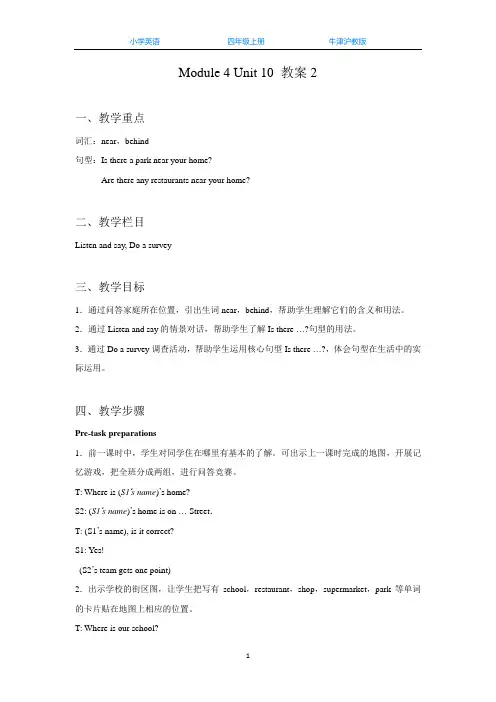
1 Module 4 Unit 10 教案2
一、教学重点
词汇:near,behind
句型:Is there a park near your home?
Are there any restaurants near your home?
二、教学栏目
Listen and say, Do a survey
三、教学目标
1.通过问答家庭所在位置,引出生词near,behind,帮助学生理解它们的含义和用法。
2.通过Listen and say的情景对话,帮助学生了解Is there …?句型的用法。
3.通过Do a survey调查活动,帮助学生运用核心句型Is there …?,体会句型在生活中的实际运用。
四、教学步骤
Pre-task preparations
1.前一课时中,学生对同学住在哪里有基本的了解。可出示上一课时完成的地图,开展记忆游戏,把全班分成两组,进行问答竞赛。
T: Where is (S1’s name)’s home?
S2: (S1’s name)’s home is on … Street.
T: (S1’s name), is it correct?
S1: Yes!
(S2’s team gets one point)
2.出示学校的街区图,让学生把写有school,restaurant,shop,supermarket,park等单词的卡片贴在地图上相应的位置。
T: Where is our school? 小学英语 四年级上册 牛津沪教版
1 S1: Our school is on … Street.
T: (point to … Street) Please put the word “school” on … Street.
四年级上册英语一课一练Module 3 Unit 2 Exercise 5 牛津上海版

第1页/共9页 牛津上海版(试用本)2019-2019学年小学英语四年级上册Module 3 Places and activities Unit 2
Around my home Exercise 5
一、Read and write(正确抄写下列单词、词组和句子)
1.正确抄写下列单词、词组和句子,抄写句子时注意大小写和标点符号。
(1)Nanjing behind clothes next to show you the way our pleasure
(2)What's in front of the street? There are some shops.
二、Read and write(读一读,填上合适的单词完成句子,每线一词):
2.I can see a bottle of milk on the________(桌子).
3.On Nanjing Road, you can see many________(旅馆)and________(餐馆).
4.We can buy some________(postcard)in the post office.
三、Read and write(用所给单词的适当形式填空,每线一词)
5.There________(be) some water. There________(be) some biscuits.
6.—What________in the cinema?
—There are many________(boy).
7.—Can________(you) father________(dive) ?—Yes.
8.This is________(I) friend. He________(have) a long rope.
沪教牛津版四年级英语上册 Module 4 The world around Unit 11达标检测卷【名校试卷+详细解答】
沪教牛津版四年级英语上册 Module 4 The world around Unit 11达标检测卷
时间:40分钟 满分:100分+10分
题号 一 二 三 四 五 六 七 八 九 十 十一 十二 十三 口语 总分
得分
听力部分 (40分)
一、听录音,给下列图片排序。(5分)
二、听录音,选出你所听到的句子。(5分)
( )1. A. I can draw a circle. B. I can draw a triangle.
( )2. A. We're at home. B. We're at school.
( )3. A. My biscuit is a star. B. My biscuit is a circle.
( )4. A. I like the star. B. I like the square.
( )5. A. We can't see any rectangles. B. We can see some rectangles.
三、听录音,判断下列图片正(T)误(F)。(10分)
四、听录音,选择正确的答案。(10分)
( )1. What shape is Peter's biscuit?
A. It's a square. B. It's a triangle.
( )2. What shape is Kitty's biscuit?
A. It's a rectangle. B. It's a star.
( )3. What shape is the plate?
A. It's a square. B. It's a circle.
( )4. How many biscuits are there on the plate?
A. There is one biscuit. B. There are nine biscuits.
上海版牛津小学(新教材)英语目录
一年级上册
Module 1 Getting to know you
Unit 1 Greetings
Unit 2 My classmates
Unit 3 My face
Module 2 Me, my family and friends
Unit 1 My abilities
Unit 2 My family
Unit 3 My friends
Module 3 Places and activities
Unit 1 In the classroom
Unit 2 In the fruit shop
Unit 3 In the restaurant
Module 4 The natural world
Unit 1 On the farm
Unit 2 In the zoo
Unit 3 In the park
一年级下册
Module 1 Using my five senses
Unit 1 Look and see
Unit 2 Listen and hear
Unit 3 Taste and smell Module 2 My favourite things
Unit 1 Toys I like
Unit 2 Food I like
Unit 3 Drinks I like
Module 3 Things around us Unit 1 Seasons
Unit 2 Weather
Unit 3 Clothes
Module 4 Things we do
Unit 1 Activities Unit 2 New Year's Day
Unit 3 Story time
二年级上册
Module 1 Getting to know you
Unit 1 Hello
Unit 2 I’m Danny Unit 3 A new classmate
Module 2 Me, my family and friends
沪教牛津版五年级英语(下)Unit 9达标检测卷
沪教牛津版五年级英语(下)Unit 9达标检测卷
时间:40分钟 满分:100分+10分
题号 一 二 三 四 五 六 七 八 九 十 十一 十二 口语 总分
得分
听力部分 (30分)
一、听录音,选出你所听到的单词。(5分)
( )1. A. ear B. bear C. ill
( )2. A. right B. wrong C. long
( )3. A. parent B. party C. present
( )4. A. rest B. best C. fast
( )5. A. keep B. king C. cold
二、听录音,根据你所听到的内容给下列图片排序。(5分)
( ) ( ) ( )
( ) ( )
三、听录音,判断下列句子与所听内容是(T)否(F)相符。(10分) ( )1. Thank you, Lisa. But I can't eat candy. I have a toothache.
( )2. I'm going to see my uncle because he is ill.
( )3. Watch TV and you'll feel happy soon.
( )4. I want to travel around the world in the future.
( )5. Mrs Liu has a bad cold and she can't dance.
四、听录音,选词填空。(10分)
Lisa is sick. She 1. ________. She also 2. ________. She goes to see the
深圳沪教牛津版(2024版新教材)七年级英语上册期末总复习语法填空100题(含答案)
第1页 共6页 2024版新教材 深圳沪教牛津版七年级英语上册期末总复习 语法填空100题 第01篇 阅读下面短文,在空白处填入一个适当的单词或括号内单词的正确形式。 Friends are actually around us Jack is 1 14-year-old boy. He lives in New York. Last autumn, he visited an old people’s home. There he 2 (meet) an old woman named Hildegard. Jack introduced himself to her, 3 she said nothing. The workers there said that she had no family in New York and didn’t talk to anyone at the old people’s home. Jack can speak German. Hildegard’s name sounds like a German name, 4 he said it in German. Hearing that, Hildegard’s face lighted up. They started 5 (talk). She opened up and told Jack her life story 6 (happy). They became good friends. After that visit, 7 Jack has time, he and his family visit Hildegard. She is now a part of 8 (them) family. Not long ago, Jack and his family celebrated (庆祝) Hildegard’s 94th birthday at the old people’s home. “I don’t have 9 (most) visitors and I have no family members left. What they do for me is very 10 (nicely) and heart-warming,” said Hildegard. 第02篇 阅读下面短文,在空白处填入一个适当的单词或括号内单词的正确形式。 Long long ago, an old man lived by himself. He was good at fishing. One day, when he was fishing near a river, a boy came and said, “Can you give me 1 fishing rod (钓鱼竿) in your hands?” The old man 2 (look) up at him and said, “I can give you a full basket of fish. ” But the boy shook 3 (he) head. The old man was 4 (surprise) and asked, “ 5 do you want the fishing rod instead of the fish?” “You know it doesn’t take long 6 (finish) eating all the fish in a basket. But if you give me the fishing rod, I 7 go fishing by myself and I won’t be afraid of not having any fish to eat. ” You may think that the boy is smart. But it is wrong. As he doesn’t 8 (know) how to fish, he doesn’t have any fish to eat, either. It is useless to only have a fishing rod. Fishing skills are more important than the fishing rod. 第2页 共6页 Many people think that 9 they have “a fishing rod” in their daily lives, they will no longer fear the wind and rain. In fact, they will make the same mistake like the boy 10 the story. 第03篇 阅读下面短文,在空白处填入一个适当的单词或括号内单词的正确形式。 Falling leaves and cold wind show the coming of another season. This year, Lidong starts 1 November 7th. It is a Chinese word for one of the 24 solar terms. To celebrate Lidong, people have many colorful 2 (activity) that light up the cold days. One of the most popular customs (习俗) is to have 3 big meal. Eating well helps people have energy to spend the cold 4 (snow) days in winter, and prepare for the coming spring. In the north, people enjoy 5 (have) dumplings. The Chinese word for dumpling-jiaozi has a similar pronunciation (发音) to the word “change” jiao. It 6 (mean) celebrating the change of autumn to winter. While in the south, people 7 (usual) eat chicken, duck and fish. According to history, Lidong was also a time for people 8 (keep) vegetables. In the past, there 9 (be) not many fresh vegetables to eat in winter. Therefore, around Lidong some people in the north began to keep vegetables like cabbages 10 green onions. However, most people buy fresh vegetables in the supermarket today. 第04篇 阅读下面短文,在空白处填入一个适当的单词或括号内单词的正确形式。 Guyu, or Grain Rain, is the 1 (six) solar term in the traditional Chinese calendar. It is also the last solar term of the spring, starts on April 19 and 2 (end) on May 4. The name of Guyu is 3 the Chinese saying “rain produces hundreds of grains (雨生百谷)”. 4 (it) name shows the relationship between weather and farming during the period. The period sees warmer weather and an increase in 5 (rain) days. It creates a wonderful environment for 6 (plant) and animals. For farmers, it’s the best time for them 7 (work) their land. Grain Rain is also 8 solar term that shows rich traditional Chinese cultural feature. In Chinese myth (神话) before 2500 BC, Cang Jie created a set of characters (文字) for better record-keeping. We do not know if Cang Jie really created the characters, 9 Grain Rain day has become a day to honor Cang Jie and the invention (发明) of the Chinese language. 第3页 共6页 The United Nations (联合国) set April 20 as the yearly UN Chinese Language Day. It happens right with Grain Rain day, which 10 (usual) falls between April 19 and 2. 第05篇 阅读下面短文,在空白处填入一个适当的单词或括号内单词的正确形式。 Chris is 12 years old. He 1 (live) in a village in England. The school in his village is very 2 (beauty) and is not far from his home, so Chris often goes to school 3 bike. Chris usually gets up at about 7:00 in the morning. It is not early. So he has a quick breakfast. He leaves home at about 7:50. It takes 4 (he) 10 minutes to go to school. He gets to school at about 8 o’clock. School starts at 8:10. Chris would like 5 (have) different classes at school. His favorite subject is math. He thinks numbers are 6 (interest). Chris has 7 dream (梦想 ). He hopes to go to London 8 he likes big cities. “I 9 (take) the subway in the future. It must be a lot of fun.” he says. Can his dream come true? “Sure, 10 can,” says Chris. 第06篇 阅读下面短文,在空白处填入一个适当的单词或括号内单词的正确形式。 I couldn’t wait to go to Europe (欧洲) to see some cities I 1 (real) wanted to visit. It was great 2 I could choose (选择) what I enjoyed doing in each city. The train trip was fast and the views (风景) of the countryside were 3 (interest). Now I was in Salzburg (萨尔茨堡), Austria (奥地利). The quiet hills of Austria are great places to relax (放松). We saw the movie The Sound of Music. Mozart, the famous musician (音乐家), was born in Austria. I listened to some of 4 classical (古典的) music. The train ride to Amsterdam (阿姆斯特丹) was a long one. Amsterdam is a fun city, full of 5 (friend) locals (当地人) and many tourists. I spent the whole day 6 (visit) the art museums there. The museum about the famous Dutch artist Van Gogh is filled with history and beautiful art. I took a boat ride and saw local people in traditional dresses. I even tasted some delicious Dutch cheese. Copenhagen (哥本哈根), Denmark, is one of the safest 7 (place) in the world. I spent a busy and nice day at the Tivoli Amusement Park. It is a huge park which even has concerts (音乐会) and 8 (dance) shows. Hans Christian Andersen (安徒生), a famous writer of 9 (child) books, was born in this city. I found a lovely bookshop and bought two of his fairy tale books, The Little Mermaid and The Ugly Duckling. 10 an interesting trip it is! I love it. 第07篇 阅读下面短文,在空白处填入一个适当的单词或括号内单词的正确形式。 Different people have different hobbies. Some like listening to music, some enjoy playing