
三年级下英语教案Unit 6 What time is it_译林版(三起)
3.能正确地理解并朗读对话内容,在教师的引导和帮助下尝试复述课文内容。
4能初步运用本课所学的词汇和日常交际用语谈论时间。
Adjustment or Reflection
Step 1 Free talk and motivation
1. Free talk
T: Hello,boys and girls.
S: Hello.
T: How are you today?
S: Fine, thanks.
2.Brain storm
T: What time is it?
Ss: It’s…
T: Yes. / No. It’s time for….(做动作)
T: Who wants to show us your clock? (让学生拿出自己设计的钟面)
S1: What time is it?
Ss: It’s….
Ss show their clocks(小组合作游戏)
What time is it?
S1: It’s eleven o’clock. T: No.
S2: It’s twelve o’clock.
T: Yes.It’s time for lunch. Now you can play this game in groups.
Ss: (小组内开展活动)
2.教师出示一个钟面,钟面朝着老师,老师拨完时间,让学生猜测
课时
Period
第一课时
教学内容
Teaching
Contents
Unit 6 What time is it?
Story time
教学目标Teaching Aims
1.能初步感知、体验单词wake up, mum, o’clock, breakfast, dinner, class, bed, OK, eleven, twelve.,并理解单词的意思;
2.学生能初步听懂、会说、会读单词these, here’s=here is,能初步听懂并会说句型What are these?能理解cartoon time的幽默之处。
教学难点Teaching Difficult Points
学生能熟练地谈论整点时间,培养学生珍惜时间,热爱生活的良好品德。
教学准备Teaching Preparation
教学准备Teaching Preparation
学情分析
Students Analysis
教具准备
Teaching Aids
教学光盘、课件、图片等
课前自主预习
Independent Preview Before Class
听录音,跟读课文,理解课文大意。
教学过程
Teaching Procedures
T:Can you count from one to twelve?
Show a long hand and a short hand.What’sthis?
Ss: It’s a clock.
T: Can you tell me the time quickly ?
(快速出示钟面时间,学生抢答)
3. Review Part A
引导学生在习得课文语句的基础上进行对话创编:
T:Now. Look at the clock . (在实物钟上拨一个时间)
What time is it?
Ss: It’s…o’clock.
It’s time for….
Practise in pairs.
学生在小组内开展对话练习与创编。
N
(分层)作业设计Homework
修改或反思
Adjustment or Reflection
Step 1.Greeting and warm up
1. Greetings.
T:It’s time for class.Hello, boys and girls.
S: Hello,...
T: Nice to see you.
S: Nice to see you, too.
Fun Time& Cartoon Time
教学目标Teaching Aims
1.在第一课时基础上,能进一步建立单词class, bed, OK, eleven, twelve, wake up, mum, o’clock, breakfast, dinner,的音、行、义的联系。
2.能理解句型What time is it? It’s…o’clock.It’s time for….的含义,并能应用到实际中进行描述。
T:NowI’m Liu Tao’s mum and you’re Liu Tao. Let’s act.
Ss act in roles.
4.同样的方法教授P2-P3
5.出示P4,让学生自己尝试说对话。
T: Look at this picture, what time is it?
What are Liu Tao and his Mum saying?
Step 2.Presentation and practice .
1. T:Ihave a clock here. What time is it? (反复,然后带读)
Oh, it’s four. We can also say“It’s four o’clock”. (带读)
2. T: Look at these three clocks.
Discuss in two, and try to say.
Show‘beБайду номын сангаас’, learn‘time for bed’
6. Read and act in roles
7. Try to retell the story.
Step 4 Consolidation
Make a new dialogue.
(出示图2)What time is it?
T: Now ,look at this picture. Who’s he?
Ss:He’s Liu Tao.
1.Watch the cartoon初步感知课文
T: Let’s watch the cartoon and try to choose a title about the story.
A. Liu Tao’s Day B. Liu Tao’s weekend
3.T: Last lesson, we learned the numbers. Can you count from one to ten?
Ss: Yes! (Ss count from one to ten, PPT show the numbers at the same time.)
T: Please look and guess what number is missing?
3.学生能初步听懂、会说、会读单词these, here’s=here is,能初步听懂并会说句型What are these?能理解cartoon time的幽默之处。
教学重点Teaching Key Points
1.能理解句型What time is it? It’s…o’clock.It’s time for….的含义,并能应用到实际中进行描述。
Step 3. Learn to say .
教师出示自己一天的主要作息时间表,引导学生谈论时间和相应活动
T: Look at tha clock.What time is it?(时间拨到7点)
Ss:It’s seven o’clock.
T: Yes, it’s time for breakfast.
学情分析
Students Analysis
教具准备
Teaching Aids
图片、课件
课前自主预习
Independent Preview Before Class
预习Cartoon time,尝试朗读故事并理解意思。完成Fun time手工制作。
教学过程
Teaching Procedures
修改或反思
Unit 6 What time is it?
A: What time is it?
B: It’s…o’clock.
It’s time for…
教后反思
Teaching Reflection After Class
课时
Period
第二课时
教学内容
Teaching
Contents
Unit 6 What time is it?
2. T: This is Liu Tao’s Day. Can you help to finish Liu Tao’s timetable?
Listen to the dialogues and find out the time
Name
Clock time
Time for
Liu Tao
3. Read after the tape and try to complete the activities
教学重点Teaching Key Points
能正确地理解并朗读对话内容,在教师的引导和帮助下尝试复述课文内容。
教学难点Teaching Difficult Points
能在情境中感知如何问询时间,能初步听懂、会说、会读句型日常交际用语:What time is it? It’s…o’clock.It’s time for….及Hurry up.
T: What time is it?
2013译林版小学英语三下Unit_6_What_time_is_it教案i
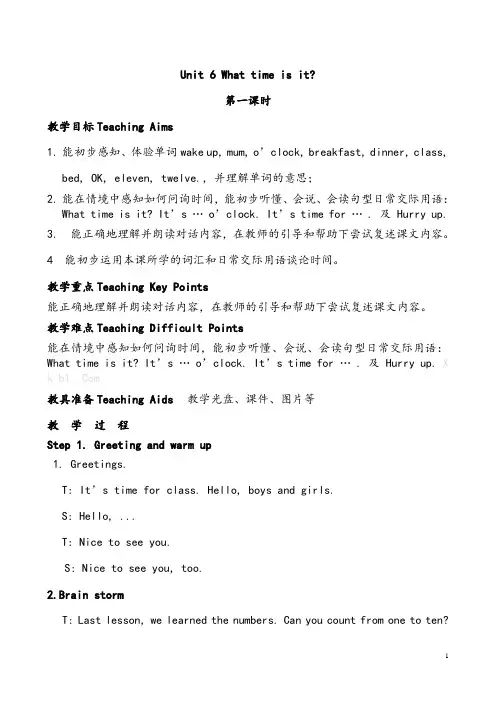
Unit 6 What time is it?第一课时教学目标Teaching Aims1.能初步感知、体验单词wake up, mum, o’clock, breakfast, dinner, class, bed,OK, eleven, twelve.,并理解单词的意思;2.能在情境中感知如何问询时间,能初步听懂、会说、会读句型日常交际用语:What time is it? It’s … o’clock. It’s time for … . 及Hurry up.3. 能正确地理解并朗读对话内容,在教师的引导和帮助下尝试复述课文内容。
4 能初步运用本课所学的词汇和日常交际用语谈论时间。
教学重点Teaching Key Points能正确地理解并朗读对话内容,在教师的引导和帮助下尝试复述课文内容。
教学难点Teaching Difficult Points能在情境中感知如何问询时间,能初步听懂、会说、会读句型日常交际用语:What time is it? It’s … o’clock. It’s time for … . 及Hurry up. X k b1. Com教具准备Teaching Aids教学光盘、课件、图片等教学过程Step 1. Greeting and warm up1. Greetings.T: It’s time for class. Hello, boys and girls.S: Hello, ...T: Nice to see you.S: Nice to see you, too.2.Brain stormT: Last lesson, we learned the numbers. Can you count from one to ten?Ss: Yes! (Ss count from one to ten, PPT show the numbers at the same time.)T: Please look and guess what number is missing?Ss: Eleven, twelve. (Teach ‘eleven, twelve’)3.T: Do you know what it is?Yes, it’ s a clock.It can tell us the time.Today, we will talk about the time. (Teach: time)Step 2.Presentation and practice .1. T: I have a clock here. What time is it? (反复,然后带读)Oh, it’s one. We can also say “It’s one o’clock”. (带读)2. T: Look at these three clocks.Can you talk about the time like this?Please ask and answer in pairs.3. T: What’s the time?Ss:It’s ten o’clock.T:It’s time for class. (重点教句型)We can do different things at different time.Step 3. Learn to say .教师出示Liu Tao's timetable,引导学生谈论时间和相应活动T: Look at tha clock. What time is it?(时间拨到7点)Ss:It’s seven o’clock.T: Yes, it’s time for breakfast.T: What time is it?Ss: It’s twelve o’clock.T: Yes. It’s time for lunch.T: And look, is it twelve o’clock?Ss: No, it isn’t. It’s six o’clock.T: Yes, it’s time for dinner. This is my day.T: Now ,look at this picture. Who’s he?Ss: He’s Liu Tao.1.Watch the cartoon 初步感知课文T: Let’s watch the cartoon and try to choose a title about the story.A. Liu Tao’s DayB. Liu Tao’s weekend2. T: This is Liu Tao’s Day. Can you help to finish Liu Tao’s timetable?Listen to the dialogues and find out the time3. Read after the tape and try to complete the activities出示课文P1 Listen and complete: Wake up, Taotao.(板书Wake up)引导学生填空____ _____ is it, Mum?It’s seven ______ .It’s time ______ breakfast. (新授breakfast ) T:Now I’m Liu Tao’s mum and you’re Liu Tao. Let’s act.Ss act in roles.4.同样的方法教授P2-P35. 出示P4,让学生自己尝试说对话。
三年级下册英语说课教案-unit6 What time is it 译林版
What time is it?说课稿一、说教学内容本课的教学主要是6个词组和1个句型,并结合四年级学生英语学习的特点,在原有教材的基础上融入了Let’s go to the _________.句型的简单教学,也是教材重组的一个课型。
词组:music class, P.E.class, English class, breakfast, lunch, dinner.句型:What time is it?并作出相应的回答:It’s ____ o’clock. It’s time for _________.二、对教学内容及学生的分析对于时间的表达方式,教材在编排上还是第一次面向全体学生,所以这个学习内容对学生来说有一定的新鲜感。
而从难易程度上来讲,本课的教学设计基本上符合四年级学生英语学习的特点,大部分学生是能接受的。
本课在设计时将时间与事件及地点相结合,呈现给了学生一个个短小的事件体系。
将简单的时间表达进行了深入的挖掘,让学生在本课学习上不感到单调。
同时,也给予了不同的学生不同的学习起点,并提出了不同的要求。
三、教学目标:新课程英语标准指出,基础教育阶段英语课程的总体目标是培养学生的综合语言运用能力。
而综合语言运用能力又以学生语言技能、语言知识、情感态度、学习策略和文化意识五个方面的综合素养为基础。
基于以上认识,对教学内容的分析与教材的特点,我将教学目标确定为:1、知识目标:(1)能听、说、认、读6个词组及句型,并能用正确的方式进行时间的表达;(2)能认读句型:What time is it?并作出相应的回答:It’s ____ o’clock. It’s time for _________.2、技能目标:能做替换练习,并结合实际情境中运用句型It’s ____ o’clock. It’s time for _________.3、情感目标:通过对时间表达的学习,潜移默化地教导学生要珍惜时间、合理安排时间。
三年级下册英语说课稿-Unit 6 What time is it 课时3|译林版(三起)
三年级下册英语说课稿-Unit 6 What time is it 课时3|译林版(三起)一、教学目标•知识目标:能够听懂、会说并正确运用询问时间的日常用语,并进一步学习并掌握数字0-20的发音和书写形式。
•能力目标:能够听懂和模仿老师的表达,并能够简单地用英语进行交流。
•情感目标:培养学生对英语学习的兴趣,同时增强他们的自信心和参与意识。
二、教学内容Unit 6 What time is it 课时3,包括以下三个部分的内容:1.听课文录音,跟读和模仿老师的表达。
2.数字0-20的发音和书写形式。
3.情境问答练习,巩固和运用所学知识。
三、教学重点和难点•教学重点:数字0-20的发音和书写形式,以及询问时间的日常用语。
•教学难点:数字13-20的发音和书写形式,需要特别注意发音和书写的细节。
四、教学方法本节课采用多种有效的教学方法:1.听说链接法:通过听课文录音、跟读和模仿老师的表达,有效地提高学生的听说能力。
2.演示法:老师进行数字0-20的发音和书写形式的演示,帮助学生掌握数字的正确发音和书写方法。
3.问答法:通过情境问答练习,有效地提高学生的运用能力,并培养他们的思考和表达能力。
五、教学准备•PPT课件、黑板、粉笔、录音机等。
六、教学过程Step 1. Warm-up1.打招呼,问候学生,并复习前两节课所学的内容,如数字0-10的发音和书写形式等。
Step 2. Presentation1.放映Unit 6 What time is it 课时3的课文录音,让学生跟读和模仿老师的表达,以此提高他们的听说能力。
2.进一步学习数字0-20的发音和书写形式。
老师进行数字的发音和书写演示,学生跟读和复写书写形式,并进行集体纠错。
3.教师板书数字0-20的发音和书写形式,帮助学生记忆与掌握。
Step 3. Practice1.根据Unit 6 What time is it 课时3中提供的情境问答内容,带领学生进行问答练习。
译林版三年级下册英语-Unit6 What time is it (Story time)教案
Period 1 教学内容TeachingContentsUnit6 What time is it?(Story time)教学目标Teaching Aims1. 能听懂、会读、会说词语:wake up, mum, o’clock, breakfast, dinner2. 能听懂、会读、会说句型:What time is it? It’s … o’clock. It’s time for… Hurry up.3. 能正确地理解并朗读课文内容,并尝试带有情感的体验、表演对话。
4. 能尝试运用What time is it? It’s … o’clock. It’s time for…等句型向别人谈论时间及相关时间内所做的事。
教学重点Teaching Key Points1. 能听懂、会读、会说词语:wake up, mum, o’clock, breakfast, dinner2. 能听懂、会读、会说句型:What time is it? It’s … o’clock. It’s time for… Hurry up.3. 能正确地理解并朗读课文内容,并尝试带有情感的体验、表演对话。
教学难点Teaching Difficult Points1. 能正确地理解并朗读课文内容,并尝试带有情感的体验、表演对话。
2. 能尝试运用What time is it? It’s … o’clock. It’s time for…等句型与别人谈论时间及相关时间内所做的事。
教具准备Teaching Aid s相关课件,图片,生词卡等单元分析The analysis of new unit本节课中要求新授的句型What time is it?It’s ...o'clock. It’s time for ….以及数字eleven, twelve。
在Unit 5单元中已经出现并略有涉及数字1-10以及“It’s time for…”这个句子的使用。
三年级下册英语教案 Unit6 What time is it 第一课时 译林版
三年级下册英语教案 Unit6 What time is it 第一课时译林版一、教学目标1. 知识与技能:使学生能够正确运用句型What time is it?It’s ...o’clock.来询问和回答时间,并能用Let’s ...的结构提出建议。
2. 过程与方法:通过图片、游戏等多种形式,让学生在真实语境中感知、理解和运用英语。
3. 情感态度与价值观:培养学生珍惜时间、规律作息的良好习惯,激发学生学习英语的兴趣。
二、教学内容1. 词汇:o’clock, time, class, break, lunch, do morning exercises, play football, eat dinner等。
2. 句型:What time is it? It’s ...o’clock. Let’s ...3. 功能:询问和回答时间,提出建议。
三、教学重点与难点1. 教学重点:句型What time is it? It’s ...o’clock. Let’s ...2. 教学难点:正确运用词汇和句型进行时间询问和回答,以及提出建议。
四、教具与学具准备1. 教具:课件、图片、时钟模型、单词卡片等。
2. 学具:学生自备时钟模型或图片。
五、教学过程1. 热身(5分钟)a. 跟唱歌曲“What time is it?”b. 老师出示时钟模型,引导学生认识时间。
2. 新课导入(10分钟)a. 老师出示一张作息时间表,引导学生用英语描述。
b. 学生分组讨论,用英语描述自己的作息时间。
3. 新课呈现(15分钟)a. 老师呈现一张图片,引导学生用句型What time is it?It’s ...o’clock.进行问答。
b. 学生分组练习,用句型询问和回答时间。
4. 语言实践(15分钟)a. 学生分成小组,用句型Let’s ...提出建议,安排一天的活动。
b. 各小组展示成果,全班分享。
5. 巩固拓展(10分钟)a. 老师出示一些图片,学生用所学句型进行问答。
译林版小学英语三年级下册Unit6 What time is it Period 3精品教案

Period 3 教学内容TeachingContentsUnit6 What time is it?Cartoon time, Sound time 教学目标Teaching Aims1.能够理解、有感情地朗读并能表演卡通内容。
2.能够掌握字母t的正确发音并理解、会读语音部分句子, 能结合旧单词尝试拼读新单词。
3.能够熟练在情景中综合运用句型谈论时间以及相应时间内适合做的事情。
教学重点Teaching Key Points1.学生能够理解,有感情地朗读并能表演卡通内容。
2.学生能够掌握字母t的正确发音。
教学难点Teaching Difficult Points1、能够熟练在情景中综合运用句型谈论时间以及相应时间内适合做的事情。
2.能听懂、会说、发音准确的读出字母“t”在单词中的读音,并且能够拓展单词,并用拓展的单词试着组成一句话。
教具准备Teaching Aid s教学课件课前自主预习Independent Preview Before Class1.听读Cartoon time,理解意思并尝试用适当的语气读出来。
2.听读Sound time ,理解意思并想一想还有哪些词中有/t/的发音。
3.想一想,在2034年你和自己的孩子会发生哪些故事。
你能在对话中用到哪些句子。
教学过程Teaching Procedures修改或反思Adjustment or ReflectionStep1.Warming up1.Travel to Time Wonderland.T: Hello, boys and girls. We‟ll travel to Time Wonderland today. Are you ready? S: Yes!T: (Cl ick)Look! The train is coming. Don‟t be late. Hurry up!2.Play a gameT: The first station is Game Park. Let‟s join them and play!(看到钟先生招手说Hi,看到图片或英文大声朗读。
译林英语三下教案Unit 6 What time is it 第三课时
译林英语三下教案Unit 6 What time is it 第三课时Unit 6 What time is itThird periodTeaching objectives:1. Learn to say the time on the hour, to the quarter past and ten to the hour.2. Understand the question and answer patterns of What time is it? It’s ...3. Develop students’ listening and speaking abilities.Key points and difficult points:Key points: Speaking and listening practice on telling time.Difficult points:To use the correct sentence structures and vocabulary to tell time.Teaching procedures:Step 1: Warm-up1. Greet the students and ask them to talk about the time they usually wake up, have breakfast, and start classes.2. Lead the students to know that time is an essential part of daily life.Step 2: Presentation1. Ask students to look at the clock on the board and say what time it is. (The teacher should set the clock to different times so that all of the students can have a chance to practice.)2. Show the expressions of telling time to students:It is ... o’clock.It is a quarter past ...It is ten to ...3. Encourage students to repeat the expressions and write them down in their notebooks.Step 3: Practice1. Play a listening game with the students. Read out different times and ask the students to repeat what they hear. (For example, the teacher says, “It’s four o’clock,” and the students repeat it after the teacher.)2. Divide the class into pairs and ask them to practice asking and answering, using the sentence pattern: What time is it? It’s ...3. The teacher walks around the room, listening and observing students, providing help when needed.Step 4: Consolidation1. In groups of three, ask the students to take turns to ask and answer questions about the time using the sentence pattern: What time is it? It’s ...2. Encourage the students to express their own ideas, use sentence patterns correctly and use different time expressions.Step 5: Assessment1. Test the students’ understanding of time by asking them to draw what they usually do at specific times of the day (such as waking up, having breakfast, and going to school).2. The teacher asks for volunteers to share their drawings with the class, explaining what they do at those times.3. The teacher evaluates how well the students have grasped the concept of time and the ability to use the sentence patterns and vocabulary to tell time.Step 6: HomeworkAsk students to practice telling the time with their parents, siblings or friends at home, and make a chart of daily activities based on the time of the day.Teaching reflection:This lesson focuses on learning to tell the time in English, including understanding the basic sentence structures and time expressions. It is necessary and practical for students, as they can use it in their daily life. The teaching plan uses various teaching methods to provide interactive and engaging activities to enhance the students' listening and speaking ability. It encourages the students to participate in the class and to practice inpairs and groups, which help to build their confidence in using English. Finally, the assessment helps to evaluate the students' comprehension of the materials learned in the class, and provide the opportunity for them to apply those materials in a real-life scenario.。
(最新原创)译林 三年级下(3B) Unit 6 What time is it 单元教案
Unit 6 What time is it?第一课时(总第______课时)Teaching contents教学内容:Story timeTeaching aims and learning objectives教学目标:1.能听懂,会说,会读句型What time is it? It’s…o’clock. It’s time for…2.能听懂,会运用日常用语 Hurry up! Wake up.3.能听懂,会说,会读单词breakfast, lunch, dinner, eleven, twelve。
4.能让学生学会合理安排时间。
5.能正确地理解、掌握对话内容,并能朗读、表演对话。
Focus of the lesson教学重点:1.能听懂,会说,会读单词breakfast, lunch, dinner, eleven, twelve;熟练运用句型“What time is it? /It’s …o’clock. It’s time for…”。
2.能正确地理解、掌握对话内容,并能朗读、表演对话。
Predicted area of difficulty教学难点:单词breakfast、twelve、dinner的读音Teaching aids教具准备:单词卡片,多媒体,实物Teaching procedures教学过程:Step 1: Warming up1. Greeting.2. Free talk.T: How old are you?Ss: I’m…3. Game: Say the next number. (Review the numbers from one to ten.)Step 2: Presentation and practice1. 教师出示11与12两张数字卡片,教学新单词:eleven, twelve,o’clock,与句型:What time is it? /It’s …o’clock.。
译林小学英语三年级下册Unit 6 What time is it?
译林小学英语三年级下册Unit 6 What time is it?Story time(第一课时)教学设计一、案例背景:1.教材分析:译林小学英语三年级下册第六单元,本单元的主要语言功能项目是“询问时间”,词汇部分在第五单元学习数词1-10 的基础上,引入了11、12 的学习以及一日三餐的英语单词。
主要教学内容为简单的祈使句和询问时间的特殊疑问句及答语。
在教学中,应尽量创设真实、自然的情景,并借助游戏、实物、多媒体等辅助教学,增强学习的趣味性。
2.学情分析:三年级下学期的学生已经具备了一定的英语学习能力,积累了一定的语言知识。
时间对于他们来说是熟悉的事物,孩子们渴望通过本课的学习获得更多的英语知识以丰富自己的交际内容,提高自身的交际能力。
针对低年级学生活泼好动,部分学生会注意力不集中这种情况,我采用趣味教学并运用我研究的个人课题“小组合作形式的有效性探究”。
把学生分成若干小组,组内相互帮助,组间相互竞争,多为学生创设学习语言的环境,尽最大努力吸引学生的注意力以便更有效地激发他们的学习兴趣,提高学习效率。
二、教学内容:译林小学英语3BUnit6 What time is it? (Story time)三、教学目标:1.知识目标:(1)能听懂、会说、会读以下日常交际用语:Wake up. Hurry up.What time is it? It’s…o’clock.It’s time for…并熟练地运用于他人进行日常交流。
(2)能听、说、读、写单词class, morning,time, bed,lunch和OK.(3)能准确听、说、读英语单词breakfast,lunch,eleven,twelve和dinner。
2.技能目标:能运用日常交际用语与他人讨论时间。
3.情感目标:与他人交际过程中敢于开口,表达中不怕出错误。
四、教学重点、难点:1.能听懂、会说、会读日常交际用语:Wake up. Hurry up. What time is it? It’s…It’s time for…并且熟练地运用于他人进行日常交流。
译林版(三起)三年级下册英语优质教案:Unit 6 What time is it?第4课时
英语(三年级下册)Unit 6 What time is it?Sound time & Rhyme time & Checkout timeTeaching contents 教学内容Sound time & Rhyme time & Checkout timeTeaching aims and learning objectives 教学目标1. 了解字母t在单词中发[t]的音,熟读小诗,体验韵律感,并能举一反三找出更多含有字母t且发[t]的单词。
2. 学生能用正确的语音语调阅读chant。
3. 学生能综合运用本单元所学知识在真实的情景中进行交流。
Focus of the lesson and predicted area of difficulty 教学重点和难点学生能综合运用本单元所学知识在真实的情景中进行交流。
Teaching procedures 教学过程Step 1 Game timeListen and guess: What’s the time for?播放打铃、吃饭、打呼的声音【设计意图:以游戏的形式导入有利于唤起学生旧知。
播放闹钟的声音激发学生兴趣,引入新知。
】Step 2 Sound time & Rhyme time & Checkout timeT: Mr T has a big castle, do you want to have a look? But before you get to the castle, you should finish three tasks.Sound school(1) Can you find the friends for Mr T?(2) Can you find more friends for Mr T?(3) Mr T is so happy, and here is a chant about him. Can you find the words thatcontain the letter “t” and pronounce [t].(4) Work in pairs: Say the chant.Eddie’s home(1) Can you say something about the picture?(2) What time is it? Where is Eddie? If you were mum, what will you say?(3) Be mum and wake up Eddie.Time Town(1) Listen and draw.(2) Ask and answer in pairs.Mr T’s castle(1) Checkout time.(2) Work in pairs.It’s time for fun!(1) Enjoy a song.(2) Make your own songs.(3) Proverb: Time is money.【设计意图:将综合板块像故事一样的串在一起更显趣味性,每个板块既有说的环节,又有唱的环节,形式多样,丰富多彩,学生能在做中学。