
人教版七下英语全册导学案
人教版七下英语全册导学案
Unit 1 Friends
一、重点短语
1. look like 看起来像
2. a little bit 一点点
3. be interested in 对...感兴趣
4. much more than 不仅仅
5. get to know 了解
6. make friends with 与...交朋友
7. be different from 与...不同
8. as long as 只要
9. listen to 听
10. pay attention to 注意
二、重点句型
1. What does she look like? 她看起来什么样?
2. What do you think of her? 你认为她怎么样?
3. Do you want to be friends with her? 你想和她交朋友吗? 4. How do you get on with your classmates? 你和你的同学相处得怎么样?
5. I think she is friendly and outgoing. 我认为她友好并且外向。
6. I’m not very outgoing, but I’m very kind. 我不太外向,但是我很善良。
7. As long as she is friendly, I’m happy to make friends with her. 只要她友好,我很高兴和她交朋友。
8. He is different from me, but he gets on well with his classmates. 他和我不同,但是他和他的同学相处得很好。
9. I pay attention to my friends’ feelings because I think it’s important.
我关注我的朋友的感受,因为我认为这很重要。
三、词汇运用
1. 根据句意和首字母提示填入适当的词
1) My cousin looks like her father, but she is a l_________ like her
mother.
2) He is very friendly and o_________. He has many friends.
3) My sister is very k________ to everyone and she gets on well with
her classmates.
4) She is not very o________, but she is very easygoing.
5) Nick is different from his brother. He is more i________ in music. 2. 选择合适的词填入空格
1) My friend is very _________ (outgoing, interested) in basketball and
he plays it every day.
2) Lucy pays a lot of attention to her _________ (families, friends)
because she cares about them.
3) My grandfather is very _________ (kind, similar) to all his
grandchildren and he loves us very much.
4) She is a little bit _________ (friendly, different) from others, but she
also has many friends.
5) If you want to _________(get to know, make friends) with someone,
you need to be friendly and kind.
Unit 2 Festivals
一、重点短语
1. at the beginning of 在...开始时
2. send sb. sth. 向某人送去…
3. in the west 在西方
4. unlike sb./sth. 不同于
5. look like 看起来像
6. wear costumes 穿着服装
7. on the 15th day of the 1st lunar month 农历正月十五 8. be similar to 与...相似
9. make dumplings 包饺子
10. have fun 玩得开心
二、重点句型
1. What do people do on Mid-Autumn Festival? 中秋节的时候人们做什么?
2. Are there any differences among different countries? 不同国家有什么不同之处?
3. What do you think of the festival? 你觉得这个节日怎么样?
4. In China, people often eat moon cakes during Mid-Autumn Festival.
在中国,中秋节的时候人们常吃月饼。
5. Halloween is a festival that is unlike Mid-Autumn Festival. 万圣节是一个不同于中秋节的节日。
6. People in the west wear costumes and go trick-or-treating during
Halloween. 西方人在万圣节时穿着服装,去“不给糖就捣蛋”。
7. Unlike Mid-Autumn Festival, Christmas is celebrated on the 25th of
December. 与中秋节不同,圣诞节在12月25日庆祝。
8. What are you going to do on Children’s Day? 你们在儿童节的时候要做什么呢? 9. On the 15th day of the 1st lunar month, Chinese people often make
dumplings to celebrate. 农历正月十五的时候,中国人通常包饺子来庆祝。
三、词汇运用
1. 根据句意和首字母提示填入适当的词
1) Mid-Autumn Festival is c__________ in the middle of the autumn.
2) People in the west like eating c___________ during Halloween.
3) Children like wearing c_________ and going trick-or-treating on
Halloween.
4) Easter is a f__________ celebrated in many countries around the
world.
5) On New Year’s Day, people often wear new clothes and have
f_________.
2. 选择合适的词填入空格
1) Chinese New Year is a festival that is s_________ (different, similar)
to Spring Festival.
2) I often send my friends cards and gifts on their b________ (birthday,
Christmas).
3) During Lantern Festival, people often eat y_________ (yuanxiao,
dumplings) and enjoy the lantern shows. 4) In the west, people often wear c___________ (costumes, clothes) and
go trick-or-treating on Halloween.
5) On National Day, people all over China have f_________ (fun,
friends) and celebrate the holiday together.
Unit 3 Travel
一、重点短语
1. have a good time 玩得开心
2. go shopping 去购物
3. take photos 拍照
4. go sightseeing 去观光
5. visit museums 参观博物馆
6. climb mountains 爬山
7. swim in the sea 在海里游泳
8. ride a bike 骑自行车
9. see wildlife 观赏野生动物
10. stay in a hotel 住在旅馆
二、重点句型
1. What do you usually do on holiday? 你假期通常做什么? 2. Where do you want to go on vacation? 你想去哪里度假?
3. I usually go sightseeing and take photos when I travel. 我旅行的时候通常去观光和拍照。
4. Many people like climbing mountains and swimming in the sea during
vacation. 很多人喜欢度假时爬山和在海里游泳。
5. Where are you going for your holiday? 你假期去哪里了?
6. I want to visit museums and see wildlife during my vacation. 我想在假期时参观博物馆和观赏野生动物。
7. I always have a good time when I travel. 我旅行时总是玩得很开心。
8. How was your trip to Beijing? 你去北京的旅行怎么样?
9. I had a great time in Beijing. 我在北京玩得很开心。
三、词汇运用
1. 根据句意和首字母提示填入适当的词
1) When I travel, I usually take a lot of p________ because I like to keep
memories.
2) In summer, many people like to swim in the s________ to cool off.
人教版七年级英语下册导学案-Unit 4 Don't eat in class
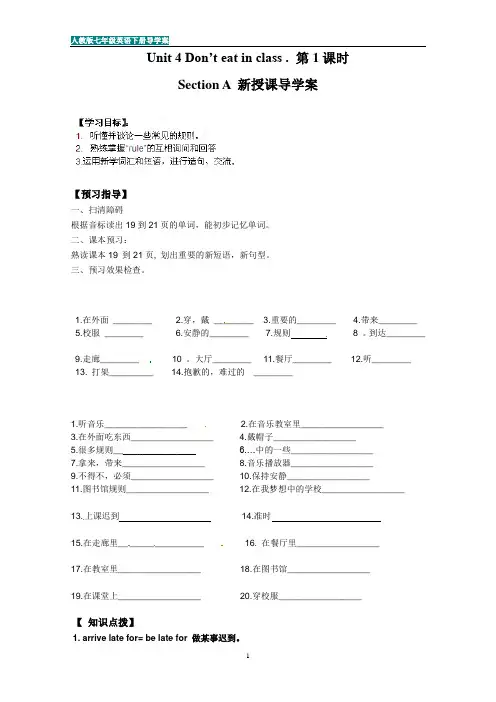
1 Unit 4 Don’t eat in class . 第1课时 Section A 新授课导学案
【预习指导】
一、扫清障碍
根据音标读出19到21页的单词,能初步记忆单词。
二、课本预习:
熟读课本19 到21页, 划出重要的新短语,新句型。
三、预习效果检查。
1.在外面 ________ 2.穿,戴 ________ 3.重要的________ 4.带来________
5.校服 ________ 6.安静的________ 7.规则 8 。到达________
9.走廊________ 10 。大厅________ 11.餐厅________ 12.听________
13. 打架_________ 14.抱歉的,难过的 ________
1.听音乐_________________ 2.在音乐教室里_________________
3.在外面吃东西_________________ 4.戴帽子_________________
5.很多规则_________________ 6.…中的一些_________________
7.拿来,带来_________________ 8.音乐播放器_________________
9.不得不,必须_________________ 10.保持安静_________________
11.图书馆规则_________________ 12.在我梦想中的学校_________________
13.上课迟到 14.准时
15.在走廊里_________________ 16. 在餐厅里_________________
(人教版)七年级下册英语导学案:Unit 10 I’d like some noodles

Unit 10 I’d like some noodles.
Period 1
Section A(1a~2c)
自主学习课前诊断
温故知新
两人一组回顾所学过的食品名称,并且分别归类。
Food: _______________________
Drink: _______________________
Countable noun: _______________________
Uncountable noun: _______________________
Countable and uncountable noun: _______________________
二.设问导读
Ⅰ. Pairwork.
Talk about your needs in pairs:
I’d like some …
Ⅱ. Ask and answer.
If you go to a noodle house, what will you say? For example:
A: Hello, I’d like some noodles.
B: What kind of noodles would you like?
A: Beef and tomato noodles, please.
B: What size bowl of noodles would you like?
A: I’d like a small / medium / large bowl of noodles.
三.自学检测
Practice the dialogue and listen to 1b, 2a and 2b.
互动学习问题解决
special n. ______________special adj._________________
1.___________________ is steak.
星期四的特色菜是牛排。
人教版七年级英语下册同步导学案unit12 period2 sectiona2d--3c
Unit 12 What did you do last weekend?Period 2 Section A 2d-3c
【课型】对话表演和语法课
学习目标
1.通过2d的对话表演,领会一般过去时在具体语境中的运用并熟练掌握目标语言:I worked as a guide
at the Natural History Museum.I told the visitors about them and their living habits.I stayed
up late to watch the soccer game.
2.通过语法表格,能更深入地理解一般过去时态的特殊疑问句的变化规律。
3.3a(关注语言形式),3b(关注语言意义)和3c(关注口头交际)的逐级训练,能熟练地正确地运用过去时态的各种不同句式。
学习过程
【自主学习】
一、预习交流
(1)根据Grammar Focus,归纳Section A部分语法重点。
(2)自学2d,勾画出重点和疑惑。
二、英汉互译
(1)自然历史博物馆 (2)生活习性
(3)担当;工作是 (4)tell...about...
(5)kind of tired
(6)stay up late
【新课导入】
Step 1:Lead-in
1.Greetings
教师和学生互动交流周末怎么样,做了什么。根据实际情况可用不同的活动短语,用得越多越好。
T:How was your weekend?
S:It was great.
T:What did you do?
S:I fed some sheep.
...
2.两两对话。
Look at the pictures and talk about the weekend.
A:How was your weekend?
B:It was great /OK /not bad/not very good...
人教版七年级英语下册Unit3How do you get to schoolSection A 1a—1c导学案
第1页/共12页 Unit 3 How do you get to school ?
学习目标
1.学会谈论交通工具和距离||。
2.学会合理安排行程||,并合理选用交通工具||。
重点难点
1.学习并掌握how /how far /how long 引导的特殊疑问句.
2.掌握乘坐交通工具的表示方法和相应的句型
3.掌握并熟练运用句型:It takes /will take/took sb some time to do sth .
Period One (Section A 1a—1c)
学习目标
1.谈论如何到达某地||。
2.学会用how 来问路||。
3.熟记本节课的单词和短语||。
重点难点
学习how对交通方式提问的特殊疑问句及答语||。
导学过程
一、课前预习:翻译下列短语
1.去上校 _____________ 2.乘坐火车 ______________ 3.乘坐公共汽车____________
4.乘地铁 _____________ 5.骑自行车______________6. 步行___________ _____
7.八十三________________ 8.一百____________ 9.七十___________ _______
10.你怎么到达学校?________________________________________________________
二、自主学习、合作探究
(一)自主学习
1.朗读1a短语||,完成1a.
2.练习对话:
---How do you get to school ? ---I get to school…/ I take the … to school.
---How does he / she get to school ?
---He / She gets to school … / He /She takes the …to school.
新人教版七年级英语下册unit6导学案
1
Unit 6 I`m watching TV.
Section A 1a—2c(听说课)
编写:唐晓静 审核:冯贵容 挂科领导:_____________ 使用者:____________
教师寄语::Doing is better than saying.与其挂在嘴上,不如落实在行动上。
学习目标:
1. 掌握本节课的重点单词和短语
2. 掌握本节课的重点句型:(1)What are you doing ?I’m watching TV. (2)Do you want
to play tennis ? That sounds good.(3)Is Nancy doing her homework?——No,she isn’t.She is writing a letter. (4)What are they talking about ?
重点、难点:现在进行时态.(be +doing)
学习过程:
Step1、 感知
(一) 了解话题
1、预习并翻译下列短语。
(1)做家庭作业_____________ (2)看电视________________( 3)吃晚饭 __________(4)在电话上交谈________________ (5)打扫房间_________________(6)清洗餐具______(7)听唱片________________ (8) 读报纸 (9)用电脑
(10)做汤 (11)锻炼
2.(1)认真观察1a中的图片,将活动与图片搭配,小组讨论并核对答案。
(2) 将1a中的现在分词所对应的原型写下来。
(二) 初听材料 1.听对话,完成1b,小组讨论核对答案.
(人教版)七年级下册英语导学案:Unit1 学案1 三课时
一、课题:Unit 1 Unit1 Can you play the guitar ?
二、学习目标:
1、知识目标:能够识记并运用本单元重点词汇和短语(详见单词表),以及重点句型(详见课本第3页Grammar Foucus)。
语法:(1)情态动词can的肯定句、否定句、一般疑问句、肯定回答、否定回答、特殊疑问句。
(2)谈论意愿的句型:
——What club do you want to join?
——We want to join the chess club.
2、能力目标:能够谈论自己的喜好和意愿;能够为自己成立的各种俱乐部制作海报;会写招聘广告。
3、情感目标:通过实践让学生体验学习的乐趣,并能勇于展示自己的才能,通过小组活动谈论彼此的特长与爱好,使学生能相互学习,培养团队精神。
三、学习过程
Section A
The First Period Section A(1a-1c)
【学习目标】
1.词汇:课本121页P1-P3重点词汇
2.句型:熟练掌握Grammar Focus中的句型
【重点难点】
情态动词的肯定句、否定句、一般疑问句、肯定回答、否定回答、特殊疑问句
【预习自学】
Ⅰ、预习课文,进行汉译英。
1.跳舞 _____________
2.游泳 _____________
3.唱歌 _____________
4.画画 ____________
5.下国际象棋 _____________
6.说英语 ________________
7.弹吉他 _________________
8.想要做某事 ___________________
9.参加音乐俱乐部 _____________________
10. 讲故事
Ⅱ、翻译句子
1.你会游泳吗?___________________
不,我不会。__________________
(完整版)人教版英语七年级下册英语U1导学案(知识点解析)
七年级下 Unit 1 Can you play the guitar? (Section A 1a-1c )
目标疑难点分析
1. play the guitar 弹吉他 play chess 下国际象棋
1) play +the + 乐器 play + 球、棋、牌 play the piano 弹钢琴 play soccer 踢足球 play the drums 击鼓
play basketball 打篮球 play the violin 拉小提琴 play cards 打牌 eg. Victor can play ___ piano. He can join the music club.
But he cant play___soccer, he can’tjoin the sports club. ( 冠词 )
2) play with sb. 与某人玩 play with sth. 玩某物
eg. 不要玩火。 Don’tplay with fire.
Please don’t___your pencil in class. A.play B.played C.played with D.play with
3) play 常用短语:
play games 玩游戏 play computer games 玩电脑游戏 play a joke on sb, 开某人玩笑 play a part in 在 .中间起作用
play for 为 播放 play against 抗衡,迎战 2. sing Vt. Vi 唱歌 dance Vi 跳舞 3. speak English 讲英语 speak , say , talk , tell 的差别
speak Vt. 说某种语言 Speak + 语言 我会讲很多中文。 I can speak much
七年级英语人教版下册导学案 Unit 5 Why do you like pandas
Unit 5 Why do you like pandas?
第一课时Section A(1a-2c)
【教师寄语】A friend in need is a friend indeed. 患难朋友才是真朋友。
【Free talk】Talk about the animals you like, and why do you like them?
【Learning tasks】
1. 学会本节单词、短语和句型。
2. 学会描述动物,并能表达对某种动物的好恶。
【Importance and difficulties】
句型:1 .Why do you like…? Because they are …
2. Let’s do…
【学习过程】
一、超前预习
Ⅰ.预习section A 1a—2c,写出下列单词。
1. 熊猫 2. 老虎 3. 大象 4. 狮子 5. 长颈鹿
6.动物 7.动物园 8.可爱的 9.懒散的 10.聪明的
11.美丽的 12.吓人的;恐怖的 13.种类
Ⅱ.译出下列短语
1.最喜欢的动物 2. 相当恐怖 3. 稍微,有点
4. 南非 5.来自
Ⅲ. 试着翻译下列句子。
1)Let's see the lions.
(1)—Why do you want to see the lions?
—Because they're interesting.
2019-2020年人教版英语七年级下册Unit 6 I’m watching TV全单元导学案+
2019-2020学年人教版英语七年级下册
全单元导学案+练习题
Unit 6 I’m watching TV.
语法部分
安全警示:活动课上注意安全。
教学内容:P112、P113
课前对话:谈论人们的活动。
教学目标:1、掌握现在进行时的用法。
2、(1)学会动词变现在分词。
(2)掌握现在进行时的构成。
3、能区分现在进行时和一般现在时。
复习旧知:
1、I usually get up at 7:00 in the moring.(否定句)
2、She does homework every day .(一般疑问句)
3、They walk to school.(对画线部分提问)
4、我的姐姐每天都帮我打扫房间。
预习导学:
一、 看书112页,学习现在进行时。
现在进行时表示:1、
2、
二、 现在进行进构成:
三、其中动词需要变成现在分词形式。动词现在分词变化规则:
类别 构成方法 例子
三、 现在进行时变换形式:
1、 变一般疑问句: 回答:
2、 变否定句:
3、 提问:
四、 与现在进行时连用的词和短语:
预习检测:
一、写出下列词的现在分词形式:
Go ask look listen
take make write get
初中英语人教版七年级下册第一单元第一学时导学案
班级__________ 姓名________________
英语导学案
七年级下 Unit1 Can you play the guitar?
Period One(第一课时):Section A 1a — 1c ______________
Part 1: 【课前预习与回顾】
Ⅰ. 词汇学习(课本P120单词表Unit1 P1)
1. 三个名词(按英文中文的顺序)
____________ ________ ____________ ________ ____________ ________
2. 四个动词(同上) ____________ ________
____________ ________ ____________ ________ ____________ ________
3. 两个动词名词兼类词 ____________ ________ ____________ ________
4. 两个动词词组 __________________ ________ __________________ ________
Ⅱ. 完成课本P.1,1a
Ⅲ. 复习:want to do sth. 仿照例子完成下列词组或句子:
e.g. want to play basketball want to __________________ (打乒乓球)
______________________ (想要打网球) ______________________ (想要踢足球)
e.g. I want to eat apples. I want to __________________ .(吃橘子)
____________________________ .(我想要买一支钢笔)