
翻译的基本理论复习题
一、翻译的基本理论复习题(一)列举至少三种翻译标准(中、西均可),并指出是由谁提出的。
中国的:严复,信雅达三字标准; 林语堂:忠实,通顺,美的标准傅雷,神似;茅盾:意境论;钱钟书:化境秀明:韵味说外国的:泰特勒的三原则(1.译文应完全复写出原作的思想2.译文的风格和笔调应与原文的性质相同3.译文应和原作同样流畅)费道罗夫的等值论:等值即译文和原文等值,表现在读者看了原文和译文之后,其感受的等值性。
奈达的等效理论奈达从社会语言学和语言交际功能观点,提出“最接近的,自然的等效翻译”概念,认为翻译必须以接受者服务为中心,要根据不同接受者的要求对译文作相应调整。
(二)翻译的主要方法有_直译_和_意译_。
“直译”就是忠实的再现原作思想容,并尽量保存原作语言形式的表现方法。
原文如在形、义上与译语全同或是基本相同的可以直译,原语中的比喻或形象能为译语读者所接受的有时也可以采用直译。
“意译”是忠实传达原作思想容而放弃原作形式。
多强调译文的效果,不求表层次形式对应,只求语言在深层次中的对应。
不是主观臆断,是以不背离原文为限度,注意翻译时对原文结构的调整,用规的译语表达。
(三)列举你所掌握的翻译技巧。
技巧是翻译的具体策略,在直译和意译两大类翻译方法之下,具体的翻译技巧有分切、转换、转移、还原、阐释、融合、引申、反转、替代、拆离、增补、省略、重复、重组、移植等。
再概括起来,可以归结为增、减、移、换四大策略。
(四)列举中、西翻译史上著名翻译家至少十位。
傅雷,季羡林,草婴,鲁迅,绛,朱生豪,谷若,诺思,查普曼,费洛里欧,何兰德,阿瑟伟利,弗兰茨库恩,玄奘、义净、徐寿、善兰、元益、卞之琳、叶水夫、黄龙、茅盾;乔叟、西塞罗、哲罗姆、阿尔弗雷德国王、波伊提乌、诺思(五)谈谈翻译的困难(至少两点)。
首先理解的困难。
汉语和英语都是很发达的语言,以表达丰富细致著称,要理解的准确必须处处细致。
Eg:in the seventh heaven不可按表面译为“升天”本意是“非常高兴”:翻译方法的选择是另一困难。
直译和意译的选择,翻译腔的消除,容与形式的统一都需要熟练的技巧。
(六)中、西语言的主要差异是:语言差异:汉语属于汉藏语系,是表意文字,句子有语调,有形态变化。
英语属于印欧语言,是拼音文字,单词有声调,没有严格意义的形态变化。
汉语语音的一大特点是音节匀称,成双成对。
于是双音节化和四音节化成了现代汉语的主要节奏倾向。
句子差异:由于中西方思惟方式不同,英汉两种语言的词的结合表现为两种性质不同的序列。
英语是开放式序列,在词的组合中,核心词一般居于首位,其限定成分可以随想随加。
而汉语是闭合式序列,在词的组合中,核心词一般位于尾部,限定修饰成分在先,说到核心词,序列便闭合。
(七)一个合格的译者应具备哪些素质?1.扎实的语言功底。
~是保证译文质量的根本。
译者应具有扎实的汉英语言基本功,较强的驾驭两种语言的能力,能正确理解原文,熟练运用本族语的写作能力。
2.丰富的文化知识。
译者应有广博的知识,对各学科有所了解。
除专业知识外,应注意各学科相互渗透,尤其是文学翻译要增强修养。
3.理论与技巧修养。
译者应掌握基本翻译理论和方法,善于灵活运用各种翻译技巧。
4.专业修养。
文章翻译,译者应熟悉所译文本所涉及的专业容。
文学翻译的专业是审美,需要较好的文学功底,懂得艺术规律,运用艺术性语言译出有文学味的作品。
(八)中国大规模的翻译活动是什么时候开始的?我国历史上出现的最早的、具有较大规模的文字翻译活动是佛经翻译。
(九)文学翻译和非文学翻译有什么主要不同点?文学翻译的专业是审美。
需要有较好的文学功底,懂得艺术规律,运用艺术性语言译出有文学味的作品。
(十)翻译为什么要讲究修辞?1.翻译的质量依赖于修辞的质量:翻译中的表达问题,实际上也就是修辞问题,因为修辞就是讲究语言的运用技巧和艺术,如何斟酌词语,锻词造句。
而译者建构译文,表达的完美,译出精品,完美依靠修辞。
2.译文之“神”源于词语之锤炼。
(十一)翻译是忠实主要还是通顺重要?或者两者都重要,为什么?两者都重要,忠实即信守原作的思想容和语言形式。
思想容通常指作品中所叙述的事实,说明的事理,描写的景物以及作者在叙述说明和描写过程中所反映的思想、观点、立场和所流露的感情等。
通顺指译文语言通俗易懂,符合译语规。
忠实和通顺是相辅相成的。
忠实而年通顺,读者看不懂,也就谈不上忠实;通顺而不忠实,脱离原作的容与风格,通顺也就失去了作用,使译文成为杜撰甚至乱译。
(十二)翻译的过程是什么?翻译的过程就是译者从特定的翻译动机出发所进行的解读原作、建构译作的全部活动,这个过程包括理解、表达和修改三个步骤。
这三个步骤是相互循环联系的。
理解要求译者根据一定的语境阅读全文,分析出袁文中的语言意义、言语意义和言语动机,以及各种修辞信息和语境信息。
表达时理解的深化和体现,是将译者对原作的理解通过语言组织的形式呈现出来。
修改是对理解和表达质量的全面检查,是对译文错误的纠正和改进,也会上塑造翻译精品的保证。
(十三)你认为语境在翻译重要吗?为什么?语境是指语言使用和意义生成的环境,分为宏观语境和微观语境。
翻译时既要善于从宏观上运用整体思维方式,对语言运用做整体把握,整体分析,体现出一种语境通关的思想,又注意从微观的角度分析词语的运用,行文及表现的手法,才能保证译文的成功。
(十四)翻译的灵活性体现在哪些方面?灵活的技巧是指技巧的运用在于圆活。
在语法上注重语义结构,词语涵丰富,文句结构流洒自如,词语和句法组织重意合不重形合,句子的语法成分和语法意义也都不显在形态上,而是隐含在语言的总体结构中。
(十五)翻译时需要注意原文中文化因素的传达吗?为什么?异域文化适应本土文化打上文化印记。
地域不同,要求语言表达者采用不同的语言表达方式与之适应,分布在不同地域的人,语言特点不同,在语音上,词汇上语法上都会形成一些差别。
这种差别要求在语言环境表达中做出适当的调整,互相适应。
(十六)四字格的翻译要注意什么?汉语的四字格历经锤炼,言简意赅,常常是已合法的佳作。
翻译转换是,应注意两种语言在这方面的特色。
(十七)翻译理论和翻译实践是什么关系?我们目前所说的翻译理论是通过翻译实践活动经验的总结而提炼出来的,主要用来检验翻译作品,检查翻译活动的效果,而不是用来指导翻译实践。
由于翻译理论是从描写和分析译品中总结出来的,因此理论亦可反过来用于指导对译品的批评与赏析。
翻译理论与翻译实践之间存在着很大的“过节”。
不容置疑,大凡理论总是具有一定难度,一般不如经验直观,与实践的“现实”联系也不紧密,对实践中出现的问题更不可能提供简单快捷的答案。
在许多情况下,由于翻译函和性质不断被重新界定,理论非但没象设想和预期的那样对实践发挥指导作用,反倒使实践变得混乱不堪,亦难以用来评估实践的效果,甚至使实践陷于无所适从的境地。
虽然如此,理论的作用及重要性仍不容抹杀。
(十八)翻译有不必要考虑读者吗?为什么?(十九)翻译是理解重要还是表达重要?为什么?(二十)翻译是传达容重要还是保留风格重要?为什么?(二十一)理解原文,指的是理解原文中的什么?首先解析原作有组织的言语系统,依其文序感知其字,词,句,段,章,篇,进而通晓文章独具的体式和风貌,即把握结构,辨明语体,识别文体,揣摩技法,贯通文气,品味风格,监审文风,欣赏气质,然后提取全文涵的信息,即抓住事料,概括意旨,体会情感,进入境界。
其次要跨越译者与作者的距离,双方只能以文字载体为中介来实现两个心灵的理解转换和情感交流。
再次是跨越译者与社会的距离。
文章文学是作者在一定时代背景下写出的,纵向产生一定的社会影响,读者当时阅读,或隔代阅读,其历史价值和现实意义必有所不同。
一、翻译定义:1. 培基——翻译是用一种语言把另一种语言所表达的思维容准确而完整地重新表达出来的语言活动。
3. 宓庆——翻译的实质是语际的意义转换。
4. 王克非——翻译是将一种语言文字所蕴含的意思用另一种语言文字表达出来的文化活动。
5. 泰特勒——好的翻译应该是把原作的长处完全地移注到另一种语言,以使译入语所属国家的本地人能明白地领悟、强烈地感受,如同使用原作语言的人所领悟、所感受的一样。
6. 费道罗夫——翻译就是用一种语言把另一种语言在容与形式不可分割的统一中所业已表达出来的东西准确而完全地表达出来。
7. 卡特福德——翻译的定义也可以这样说:把一种语言(Source Language)中的篇章材料用另一种语言(Target Language)中的篇章材料来加以代替。
8. 奈达——翻译就是在译入语中再现与原语信息最切近的自然对等物,首先就意义而言,其次就是文体而言。
9. 巴尔胡达罗夫——翻译是把一种语言的语言产物在保持容方面(也就是意义)不变的情况下改变为另一种语言的语言产物的过程。
纽马克——通常(虽然不能说总是如此),翻译就是把一个文本的意义按作者所想的方式移译入另一种文字(语言)。
10. “Translation is the expression in one language (or target language译入语) of what has been expressed in another language (source language 原语), preserving semantic and stylistic equivalences.” --- Dubois11. “Translating consists in reproducing in the receptor language the closest natural equivalent of the source language message, first in terms of meaning and secondly in terms of style.” ---Eugene Nida12. “Translation is a craft consisting in the attempt to replace a written message and/or statement in one language by the same message and/or statement in another language.” --- Peter Newmark 13.Translation or translating is a municative activity or dynamic process in which the translator makes great effort to thoroughly prehend a written message or text in the source language and works very hard to achieve an adequate or an almost identical reproduction in the target language version of the written source language message or text.二、翻译标准1. 翻译的标准概括为言简意赅的四个字:“忠实(faithfulness)、通顺(smoothness)”。
翻译理论考试试题

翻译理论考试试题一、选择题(每题 2 分,共 20 分)1、严复提出的“信、达、雅”翻译标准中,“雅”指的是()A 忠实原文内容B 通顺流畅C 语言优美D 保持原文风格2、下列哪种翻译方法强调保留原文的语言形式和结构?()A 直译B 意译C 音译D 加注3、功能对等理论的提出者是()A 奈达B 严复C 泰特勒D 纽马克4、翻译中,当源语和目的语在文化背景上存在巨大差异时,常采用的策略是()A 归化B 异化C 解释D 省略5、“异化”翻译策略的目的是()A 使译文更符合目的语读者的习惯B 保留源语文化特色C 增强译文的可读性D 便于目的语读者理解6、以下哪项不是翻译的基本技巧?()A 增译B 减译C 改译D 乱译7、机器翻译与人工翻译相比,其主要优势在于()A 翻译质量高B 速度快C 能处理复杂语境D 更具创造性8、翻译“Love me, love my dog”,下列哪个译文最恰当?()A 爱我,爱我的狗B 爱屋及乌C 喜欢我,喜欢我的狗D 爱我就爱我的狗9、在商务翻译中,最重要的原则是()A 准确性B 简洁性C 专业性D 灵活性10、翻译诗词时,常常需要考虑的因素是()A 韵律和节奏B 词汇的选择C 语法结构D 以上都是二、简答题(每题 10 分,共 30 分)1、请简述直译和意译的区别,并举例说明。
直译是指在翻译过程中,既保持原文的内容,也尽可能保留原文的形式和结构。
例如,将“paper tiger”直译为“纸老虎”。
意译则更注重传达原文的意思,而不拘泥于原文的形式和结构。
比如,“It rains cats and dogs”意译为“倾盆大雨”,而不是直译为“下猫和狗”。
2、谈谈你对翻译中文化因素的理解,以及如何处理文化差异。
在翻译中,文化因素至关重要。
不同的语言往往承载着各自独特的文化内涵。
比如,一些习语、典故、宗教信仰等在不同文化中可能有不同的理解和象征意义。
处理文化差异时,可以采用归化和异化的策略。
翻译知识试题及答案解析

翻译知识试题及答案解析一、选择题1. 翻译理论中的“直译”和“意译”分别指的是什么?A. 直接翻译和间接翻译B. 逐字翻译和随文翻译C. 逐句翻译和整体翻译D. 逐词翻译和自由翻译答案:B解析:直译指的是尽可能保持原文的字面意思,而意译则是根据目标语言的表达习惯来传达原文的意思。
2. 在翻译过程中,如何处理专有名词?A. 直接音译B. 根据目标语言习惯进行翻译C. 保持原文不变D. 以上都是答案:D解析:处理专有名词时,可以根据具体情况选择音译、意译或者保持原文不变,没有固定的规则。
二、填空题3. 翻译中的“信、达、雅”原则是由________提出的。
答案:严复解析:严复是中国近代翻译理论的奠基人,他提出的“信、达、雅”原则强调翻译要忠实原文、通顺易懂、文雅得体。
4. 在翻译文学作品时,译者需要考虑的一个重要因素是________。
答案:文化差异解析:文学作品中往往蕴含丰富的文化内涵,译者在翻译时需要充分考虑文化差异,以确保译文能够传达原作的文化内涵和艺术魅力。
三、简答题5. 简述翻译中“忠实性”的重要性。
答案:忠实性是指翻译时要尽可能保持原文的意思和风格。
忠实性是翻译的基本原则之一,它确保了翻译作品的准确性和可靠性。
在翻译过程中,译者需要忠实于原文的内容、风格和作者的意图,同时也要考虑到目标语言的表达习惯,做到既忠实又通顺。
四、论述题6. 论述翻译中如何处理语言的模糊性和多义性。
答案:语言的模糊性和多义性是翻译中的常见问题。
处理这些问题时,译者首先需要准确理解原文的意图和上下文,然后根据目标语言的表达习惯和文化背景,选择最合适的译文。
在必要时,译者可以采用注释、脚注或者附加解释的方式来帮助读者理解。
此外,译者还应该具备一定的语言敏感性和文化素养,以便更好地处理语言的模糊性和多义性。
五、翻译实践题7. 将以下中文句子翻译成英文,并简要说明翻译策略。
中文句子:他的话让人深思。
英文翻译:His words are thought-provoking.翻译策略:在翻译这句话时,采用了意译的方法。
大学生翻译考试题及答案
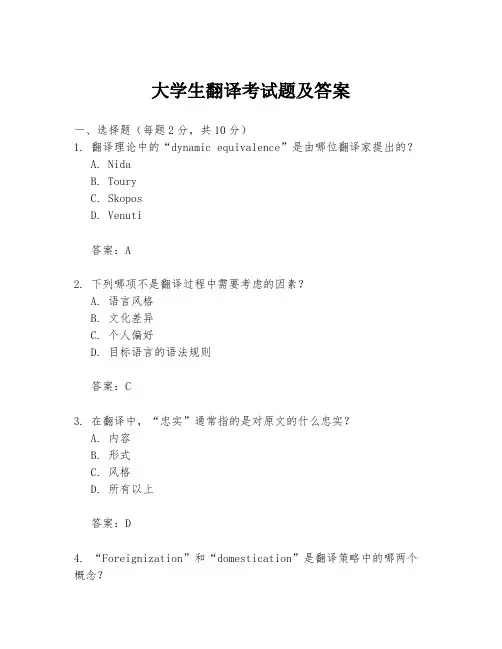
大学生翻译考试题及答案一、选择题(每题2分,共10分)1. 翻译理论中的“dynamic equivalence”是由哪位翻译家提出的?A. NidaB. TouryC. SkoposD. Venuti答案:A2. 下列哪项不是翻译过程中需要考虑的因素?A. 语言风格B. 文化差异C. 个人偏好D. 目标语言的语法规则答案:C3. 在翻译中,“忠实”通常指的是对原文的什么忠实?A. 内容B. 形式C. 风格D. 所有以上答案:D4. “Foreignization”和“domestication”是翻译策略中的哪两个概念?A. 文化适应B. 语言转换C. 读者导向D. 作者导向答案:A5. 下列哪个不是翻译技巧?A. 直译B. 意译C. 机器翻译D. 归化答案:C二、填空题(每题2分,共10分)6. 翻译活动通常包括三个步骤:理解、_________、表达。
答案:转换7. 在翻译中,处理专有名词时,通常采用_________的策略。
答案:音译或保留原文8. 翻译的标准之一是“信、达、雅”,其中“雅”指的是译文的_________。
答案:文采或风格9. 翻译理论中的“功能主义”是由德国翻译学者_________提出的。
答案:Katharina Reiss10. 在翻译实践中,处理习语和谚语时,可以采用_________的方法。
答案:文化补偿三、简答题(每题10分,共20分)11. 简述翻译中的“直译”与“意译”的区别。
答案:直译是指尽可能忠实于原文的字面意思,逐字逐句地翻译,保持原文的结构和词汇。
意译则更注重传达原文的意图、情感和语境,允许译者在不改变原文意思的前提下,根据目标语言的习惯进行适当的调整和改写。
12. 描述翻译中的“归化”策略,并给出一个例子。
答案:归化是一种翻译策略,它将原文中的文化元素转换为目标语言文化中的对应元素,使译文更易于目标语言读者的理解和接受。
例如,将中文的“龙”翻译为英文的“dragon”时,可能需要解释其在中国文化中的吉祥含义,因为“dragon”在西方文化中通常带有负面含义。
翻译理论与实践试题及答案

翻译理论与实践试题一、选择题(在四个选项中选择一个正确答案):20%1. 中国古代佛经翻译家------提出了“既须求真,又须喻俗”的翻译思想。
A. 鸠摩罗什B. 玄奘C.安世高D。
释道安2. 严复说的“一名之立,旬月踟躇”是指---------------------。
A. 翻译一部书要化一个月时间作准备B 翻译一个术语往往要考虑很久C.只有化苦功才能翻译成一部名著D.书名的翻译颇费思量3..下列四句,----句的表述是不正确的。
A. 鲁迅提出过“宁信而不顺”的翻译观点。
B. 马建忠主张“善译”的翻译标准。
C. 钱钟书认为文学翻译的最高标准是“化”。
D. 傅雷认为文学翻译的最高境界是“形似”。
4.下列四位翻译家中,英译《红楼梦》的是------。
A. 林语堂B. 杨宪益C. 杨必D. 鲁迅5.英国语言学家M.A.K.Halliday提出的构成语境三要素中,fields of discourse指---------------------------。
A. 交际内容B. 交际方式C. 交际风格D. 交际地点6. 多用被动语态是----------的一个比较明显的语法特点。
A. 广告英语B. 科技英语C. 新闻英语D. 法律英语7. “意译”是指译文从意义出发,要求将原文的意义正确表达出来,不必拘泥于------的形式。
A.词句B. 词句和比喻C. 各种修辞手段D. 词、句、以及各种修辞手段8.. ------翻译了莎士比亚的全部戏剧作品。
A. 朱生豪B. 卞之琳C. 梁实秋D. 林语堂9. fast, firm, secure三个同义词中,firm的正规程度介于前后两者之间,由此可以判定,它最有可能源自------。
A. 法语B. 拉丁语C.盎格鲁-撒克逊语D. 德语10. 下列四种“语体”中,--------的语言最为正规。
A. 广告英语B. 法律英语C. 新闻英语D. 科技英语二、问答题:30%1. 为什么严复要在他的翻译标准中加上一个“雅”字?你认为现在我们应该怎样理解这个“雅”字?2、.我们可以通过观察哪几种“语域标志”来区别英语语言的正规程度?请举例说明其中两种。
翻译理论的习题及答案

翻译理论的习题及答案(共3页)--本页仅作为文档封面,使用时请直接删除即可----内页可以根据需求调整合适字体及大小--关于翻译理论的习题选择题1、直译保存了原作____,因而能达到与原文近似的效果。
A内容 B思想 C风格 D手法2、死译只注意保存原文____,对原文使用的词语,句子结构,比喻以及其他修辞手法,尽量原封不动地照搬过来。
A 形式 B风格 C 意义 D 内容3、译文中若出现译语词不搭配的现象,就会产生_____。
A 翻译调 B翻译病 C 翻译症 D翻译腔4、克服翻译症的方法之一是弄清_____与内容的关系。
A 形式 B风格 C意义 D表面5、从实用翻译理论的角度来看,译文不但要保存原作的思想风格,而且必须符合译语习惯,即提高____。
A随意性 B传意性 C相似性 D可接受性6、有的动物可通过动作,如蜜蜂的舞蹈,来传递某种信息,这属于_____。
A自然信息 B动物信息 C 非语言信息 D语言信息7、交流思想通过语言进行,因而语言是交流思想的___A物质 B工具 C媒介 D手段8、有人认为翻译外国小说等文学作品。
三分靠____,七分靠____。
A外语,汉语 B汉语,外语 C外语,外语 D汉语,汉语9、翻译症的主要特征是____。
A文从句顺 B流畅易懂 C声情并茂 D文笔拙劣10、不可以的情况有___A没有对等词 B内容和形式必须兼顾的情况 C词外含义 D A,B and C1-5 DACAD 6-10 BCBAD简答题1、结合具体事例你谈谈对“英语重形合,汉语重意合”这句话的理解。
形合指句子内部的链接或句子间的连接采用句法手段或词汇手段,意合指句子内部的链接或句子间的连接采用语义手段。
印欧语言重形合,语句各成分的相互结合常用适当的链接词语或各种语言链接手段,以表示其结构关系。
汉语重意合,句子各成分之间或句子之间的结合多依靠语义的贯通,少用连接语,所以句法结构形式短小精悍。
2、有人认为翻译的总体发展趋势是由归化逐步趋向与异化,你是否赞同这个观点归化与异化作为翻译两种主要的翻译方法,一直是翻译界研究和争论的焦点之一。
翻译理论练习题

翻译理论练习题西方译论简介西塞罗:“我不是作为解释员而是作为演说家进行翻译的,不是字当句对,而是保留语言的总的风格和力量。
”泰特勒的“翻译三原则”: 1) 译文应完全传达原作的思想; 2)译文的风格与笔调应与原作属于同一性质;3)译文应具有原作的流畅性。
费道罗夫的等值翻译思想: 1)与原文作用相符(表达方面的等值); 2) 译者所选用的语言材料的等值(语言和文体的等值)奈达的翻译思想:所谓翻译,是指用一种语言中的语言符号解释另一种语言中的语言符号;是指从语义和文体风格上采用最接近而又最自然的同义语再现原文的信息。
他主张把翻译的重点放在译文读者的反应上。
他认为判断译作是否翻译得正确,必须以译文的服务对象为衡量标准。
“衡量翻译质量的标准,不仅仅在于所译的词语能否被理解,句子是否合乎语法规范,而在于整个译文使读者产生什么样的反应。
”英国翻译理论家:纽马克(Peter Newmark)他提出真正的翻译应该充分体现作者的意图。
译者应忠实于原文读者和译文,并根据原文所使用的语言种类来确定原文读者群的特点,从而确定给予目的语读者多少注意力。
西方翻译理译理论练习题1. It is _______ that wrote Essay on the Principles of Translation in 1790.A. F. TylerB. Charles R. TaberC. Saint JeromeD. Eugene A. Nida2. According to The Art of Translation by Theodore Savory, faced with a passage in its original language, a translator must ask himself some questions except: A. What does the author say? B. What does he mean? C. How does he say it? D. Why does he say it? 3. The Art of Translation is written by _______. A. Theodore Savory B. George Steiner C. Eugene A. Nida D. Charles R. Taber4. Several thousand years ago, _______ did not think it necessary to translate word for word, and he preserved the general style and force of the language. A. Cicero B. Saint Jerome C. John SteinbeckD. Theodore Savory5. All of the following ideas are Cicero’s, except ________. A.It wasn’t necessary to translate word for word.B.He preserved the general style and force of the language.C.It wasn’t his duty to count out words to the re ader like coins, but rather ti pay them out by weight as it were.D.He aimed at translating sense, not words.6. A. F. Tytler thought the principles of translation included all the following except _______. A. the translation should give a complete transcript of the ideas of the original work. B. It is necessary to translate word for word. C. The style and manner of writing should be of the same character with that of the original. D. The translation should have all the ease of original composition.7. “______” is the idea of Saint Jerome. A.It isn’t necessary to translate word for word. B.I have always aimed at translating sense, not words. C.The translation should have all the ease of original composition. D.The style and manner of writing should be of the same character with that of the original.8. ________ is correct. A.Saint Jerome said that he had always aimed at translating sense, not words. B.Saint Jerome said that it was necessary to translate word for word. C.Saint Jerome said that it wasn’t his duty to count out words to the reader like coins, but rather to pay them out by weight as it were. D.ASaint Jerome said that he preserved the general style and force of the language when he was translating.9. ________ describes a good translation to be, that, in which the merit of the original work is so completely transfused into another language, as to be as distinctly apprehended, and as strongly felt, by a native of the country to which that language belongs, as it is by those who speak the language of the original work. A. Cicero B. Saint Jerome C. A. F. Tylter D. Charles R. Taber 10. 句法上下文是指——————。
《翻译理论与实践(笔译)》期末复习辅导 - 萧山电大
浙江广播电视大学英语专业(开放专科)《英语翻译基础》期末复习一、考试题型和模拟题1. 选择题:10题,每题2分,共20分。
范围主要包括翻译标准,直译与意译问题,翻译的定义,文化与翻译的问题。
2. 问答题:1题,共10分。
范围主要包括直译与意译问题,翻译的标准,以及翻译与文化的关系等等。
3.改译句子:10题,共30分。
3. 段落翻译(英译汉):2段,共40分。
一、选择题(在四个选项中选择一个正确答案):1. 明朝末年的翻译家徐光启主要从事--- ---的翻译。
A. 佛教经典B. 文学作品C. 科技著作D. 哲学著作2. 《马氏文通》的作者马建忠提出了“--- ---”的翻译观点。
A. 善译B. 化境C. 神似D. 信、达、雅3. 出版后即风靡海内的《巴黎茶花女遗事》是-- ----的译作。
A.严复 B. 林纾C. 林语堂D. 梁实秋4.“意译”是指译文从意义出发,要求将原文的意义正确表达出来,不必拘泥于-- ----的形式。
A. 词句B. 词句和比喻C. 各种修辞手段D. 词、句、以及各种修辞手段5. 翻译是一种()的交际活动。
A.跨语言,跨文化,跨社会 B. 跨语言C.跨语言,跨社会 D. 跨语言,跨社会6. 翻译的理想单位是:__________。
()A.篇章 B. 句子 C.词语 D. 单词7.下列四个语言特点中,---- --不是广告英语的特点。
A. 多祈使句B. 多后置定语C. 多新词汇D. 多常用词汇8. 鲁迅曾提出过“------- --------”的翻译观点。
A. 宁顺而不信B. 宁信而不顺C. 与其信而不顺,不如顺而不信D. 忠实、通顺、得体9.“Do you see any green in my eye?”可以翻译为:__ _____。
A. 你从我的眼睛里看到绿颜色吗?B. 你以为我是好欺骗的吗?C. 你从我的眼睛里看到嫉妒的感觉吗?D. 你以为我在嫉妒你吗?10. “Last night I heard him driving his pigs to market.” 意思为( )。
英语翻译复习题 100
英语翻译100题1热烈欢迎世界各地客商来此进一步加强合作,建立和发展贸易。
1 Customers from various countries and regions are warmly welcome to establish and develop business contacts.2 她从来没想到他是个不诚实的人。
2 It never occurred to her that he was a dishonest man.3 南京发生过许多重大的历史事件。
3 Nanjing witnessed many great historic events.4 到去年年底,我部已同有关省市签订了100余艘中小船舶的建造合同和协议。
4 By the end of last year, contracts and agreements were signed with some provinces and cities for the construction of more than 100 medium-and small-sized vessels.5 我们事业从胜利走向胜利。
5 We have won one victory after another for our cause.6 乡镇企业的繁荣是我国农村改革的必然产物。
6 The prosperity of township enterprises is the inevitable outcome of the economic reform in the rural areas.7 他做实验时心不在焉,几乎引起化学药物爆炸。
7 His absent-mindedness during the experiments nearly caused an explosion of the chemical.8 这一证书课程分在三年中学完。
英语翻译复习题
翻译复习题1.那意味着大量的工作和责任(mean)2.做出了承诺,你就要兑现(fulfill)3.我们对蚂蚁研究得越多,就越觉得他们像人类。
(the…the…) 4.一般来说,女士爱逛商店买新衣服。
(in general )5.尽管不太流利,她的英语足以应付这项工作。
(adequate )6.出了一处拼写错误,他的答卷完美无缺。
(perfect )7.他尽管很同情,却无能为力。
(while )8.讨论这样的问题简直是浪费时间。
(waste )9.Jane总是学着妈妈的样子做事。
(model oneself after )10.没有什么能阻止我实现自己的抱负。
(ambition )11.他没有做出一个明确的解释。
(explanation )12.Mart发现学习英语挺有意义。
(rewarding )13.你是怎样高效率完成任务的?(effectively)14.这个科学家经过艰苦努力,取得了成功。
(attain )15.无论花多少钱,他也要把自己的汽车修好。
(no matter how) 16.年轻人应当尊敬老年人。
(respect )17.学生在空白处记笔记。
(margin)18.有志者事竟成。
(will)19.刻苦努力是通向成功的必由之路。
(way to)20.这些东西哪个杂货店都有。
(available)1.That means a lot of work and responsibility.2.Once you make a promise, you must fulfill it.3.The more we study ants, the more they seem to be like ourselves.4.In general, women enjoy going shopping for new clothes.5.Although his English is not fluent, it is adequate to handle the work.6.His paper is perfect except for a spelling mistake.7.While he sympathizes, he can’t really do very much to help.8.It is a waste of time discussing such questions.9.Jane always models herself after her mother in whatever she does.10.Nothing can prevent me from carrying out my ambition.11.She failed to make a clear explanation.12.Mary found it rewarding learning English.13.How did you fulfill the task effectively?14.After working hard, the scientist attained success.15.No matter how much money it cost, he would have his car repaired.16.Yong people should respect the old.17.Students take notes in the margin.18.Where there is a will, there a way.19.Hard work is the way to the end of the rainbow.20.Such articles are available in any drugstore.1.They failed to convince the directors that their proposals would work.2.Hearing the news, he felt extremely sad.3.Don’t remind me of that awful day----I made such a fool of myself!4.She is going to India on a special assignment for her newspaper.5.Human beings are much more intelligent than animals.6.The police have blocked off the road where the bomb was found.7.If he’s not here in five minutes, we’ll assume that he isn’t coming.8.The teacher made me responsible keeping the class in order while she went out.9.Why are you being so critical of everything I do?10.Her performance was adequate, though hardly exciting.11.His parents hoped the course would broaden his horizons.12.The result was the best that could be expected under that circumstances.13.The company should be able to fulfill our requirements.14.There are no simple solutions to the problem of unemployment.15.He took the lead, and maintained it until the end of the race.16.The difficulty of putting our ideas into practice challenged us to find new methods.17.There was nothing special about the film----it was only average.18.There was universal agreement as to who should become the new chairman.19.She was brought up to believe that money is the most important thing in life.20.You shouldn’t miss the opportunity to see the play----it’s rarely put on.21.That’s indeed a crucial point. I am in entire agreement with you.22.I had to restrain myself from telling him what I thought of his proposals.23.The school has only been open for six months, so it’s hard to evaluate its success.24.They awoke to the danger of the situation too late to do anything about it.25.I am afraid that the company was not capable of handling such a large order.26.It seemed unlikely to me, but she seemed absolutely positive about it.27.He completed the book with a chapter on the practical applications of his theory.28.He failed to set a new record, but it was a good attempt.29.In the past few years the company has concentrated on improving its efficiency.30.She has at last achieved her lifetime ambition of setting up a school.31.So many new ideas! It’s all rather too much for me to absorb all at once.32.I don’t think we should devote any more time to this question.33.Teaching can be a rewarding career.34.Just a minute! Don’t you think it a very full schedule?35.The fall in prices will be beneficial to small business.阅读练习Passage OneDuring the Christmas shopping rush in London, the interesting story was reported of a tramp who, apparently though no fault of his own, found himself locked in a well-known chain store late on Christmas Eve. No doubt the store was crowded with last-minute Christmas shoppers and the staff were dead beat and longing to get home. Probably all the proper security checks were made before the store was locked and they left to enjoy the three-day holiday untroubled by customers desperate to get last-minute Christmas presents.However ridiculous that may be, our tramp found himself alone in the store and decided to make the best of it. There was food, drink, bedding and camping equipment, of which he made good use. There must also have been television sets and radios. Though it was not reported if he took advantage of these facilities, when the shop reopened he was discovered in bed with a large number of empty bottles beside him. He seems to have been a man of good humor as indeed tramps very commonly are.Everyone else was enjoying Christmas. So he saw no good reason why he should not do the same. He yielded himself cheerfully, and was taken by the police. Perhaps he had had a better Christmas than usual. He was sent to prison for seven days. The judge awarded no compensation to the chain store for the food and drink our tramp had consumed. They had, in his opinion, already received valuable free publicity from the story revealed in the newspaper and on television. Perhaps the judge had had a good Christmas, too.1.The tramp was locked in the store __________.A)for 7 daysB)on purposeC)by accidentD)for security reasons2.It can be inferred from the passage that the underlined phrase “dead beat”in paragraph 1means ______________.A)angryB)exhaustedC)forgetfulD)careless3.Which of the following was uncertain about the tramp after he was locked in the store?A)He watched TVB)He was well fedC)He had a sound sleepD)He had a good drink4.When the tramp was arrested, he ____________.A)was drunkB)felt he deserved itC)made no resistanceD)felt himself wronged5.The judge didn’t award compensation to the chain store because ___________.A)the store was responsible for what happenedB)the report of the event benefited the store a lotC)the tramp had stolen nothing of valueD)the tramp was pennilessPassage TwoOnline distance learning is an instructional system which connects learners with educational resources. Students work on their own at home, at work, or at school and communicate with faculty and other students by means of e-mail, electronic meetings, videoconferencing, chat rooms, instant messaging and other forms of computer-based communication. There are both advantages and disadvantages to online distance learning.There are many benefits to using online distance learning environments. Online education is available all the time, anywhere and to all people. However, there are weaknesses for some learners. The online learner only has the written text and no other face-to-face hints. This may confuse the learner and cause misunderstanding. While distance learning allows for an openness, it is also difficult because it is done by e-mail messages and writing, and therefore may take more time than face-to-face learning. Sometimes the messages can be overwhelming for many online students.Universities, colleges and schools use online distance learning environments. These are important for students who may be unable to attend classes for various reasons like illnesses or busy everyday schedules. Some learners just want to further their studies at home. They enjoy the convenience of home learning as they take regular programs or enrichment classes.Online courses keep learners very occupied at all hours of the day. There are a great many messages and other online resources to read and respond to. Most learners have regular jobs or attend regular school classes on ground as well. However, the benefits are clear. Online distance learning is becoming very popular. Some online classes have become a profitable business as they replace regular traditional means of learning.6.Which of the following is TRUE of the passage about online distance learning?A)It has more disadvantages than advantagesB)It is a learning form based on internetC)It is not available for some studentsD)It has only enrichment classes7.Sometimes online distance learning can be a problem because _______.A)learners can’t afford itB)learners get too many hintsC)it involves excessive writingD)it is not available at the weekend8.One of the good aspects of online distance learning is _____________.A)speedB)convenienceC)easy operationD)variety of instruction9.What kind of students may NOT like online distance learning?A)Those busy with their schedulesB)Those in need of further educationC)Those unable to attend regular classesD)Those in favor of face-to-face teaching10.With regular means of learning, the learners have to study ________.A)at schoolB)on their ownC)at all hours of the dayD)by means of reading and writingPassage 3Invented at the turn of the century, radio ( the transmission of electric signals without wires connecting the points of transmission and reception) became widespread throughout North America and Europe by the 1930s. The early radio was large and cumbersome but over the years the radio has become increasingly smaller and more portable. People now listen to the radio in their cars or carry a walkman when going from one place to another. Radio is perhaps the most convenient of all the media. The influence of the radio began to decline in the 1950s with the advent of television. But many people still consider radio superior in quality when it comes to analytical news programs.On July 1, 1941, the FCC granted broadcasters permission to use commercial to help pay costs. NBC and the Columbia Broadcasting System (CBS) soon began regular commercial broadcasts in New York City.The United States’ entry into World War Two in December 1941 delayed the commercial growth of TV, but broadcasting continued. In fact, CBS was one of the most notable of the early shows that same month----a documentary on Japan’s attack on Pearl Harbor.The manufacture of commercial TV equipment, however, ended almost entirely in 1942. But technical improvements in the laboratory continued at a more rapid pace because government officials thought television might have military uses. During the war, engineers developed new types of phosphors for TV picture tubes that greatly improved brightness and contrast. Clearer glass tubes helped to increase picture clarity.After World War Two ended in 1945, television stations sprang up throughout the United States. The year 1951 saw the first coast-to-coast telecast. A TV boom was underway.But the TV image still differed from the scene being telecast in one significant aspect: the image lacked color. Since the late 1930s, researchers had experimented extensively with color-TV systems. In December 1953, the FCC pave the way for color broadcasting by establishing a standard, and in 1954 color sets went on sale in the United States.1.The radio was invented at the turn of last century, it soon became widespread throughout_________.A)South America and North EuropeB)North Latin America and South EuropeC)North America and EuropeD)South Latin America and East Europe2.Nowadays radio has become ________________.A)increasingly smaller and more portableB)increasingly heavy and inconvenientC)more expensive and less convenientD)bigger and cheaper3.The broadcasters asked the FCC to ______________.A)allow them to make ads in their programsB)allow them to use commercial to help pay costsC)allow them to use non-commercial adsD)allow them to use different frequencies4.During WWII, CBS was famous for one of the early shows which is __________.A) a documentaryB) a music comedyC) a news reportD) a feature story5.During the war, engineers developed new types of phosphors for TV picture tubes that greatlyimproved _____________.A)brightness and contrastB)darknessC)rotation and colorD)sizePassage 4It is hard to predict how science is going to turn out, and if it is really good science it is impossible to predict. If the things to be found are actually new, they are by definition unknown in advance. You cannot make choices in this matter. You either have science or you don’t, and if you have it you are obliged to accept the surprising and disturbing pieces of information along with the neat and promptly useful bits.The only solid piece of scientific truth about which I feel totally confident is that we are profoundly ignorant about nature. Indeed, I regard this as the major discovery of the past hundred years of biology. It is, in its way, an illumination piece of news. It would have amazed the brightest minds of the 18th century Enlightenment to be told by any of us how little we know and how bewildering seems the way ahead. It is this sudden confrontation with the depth and scope of ignorance that represents the most significant contribution of the 20th century science to the human intellect. In earlier times, we either pretended to understand how things worked or ignored the problem, or simply made up stories to fill the gaps. Now that we have begun exploring in earnest, we are getting glimpses of how huge the questions are and how far from being answered. Because of this, we depressed. It is not so bad being ignorant if you are totally ignorant; the hard thing is knowing in some detail the reality of ignorance, the worst spots and here and there the not-so-bad spots, but no true light at the end of the tunnel nor even any tunnels that can yet be trusted.But we are making a beginning and there ought to be some satisfaction. There are probably no questions we can think up that can’t be answered, sooner or later, including even the matter of consciousness. To be sure, there may well be questions we can’t think up ever and therefore limits to the reach of human intellect, but that is another matter. Within our limits, we should be able towork our way through to all our answers if we keep at it long enough and pay attention.1.According to the author, really good science _______.A)would surprise the brightest minds of the 18th century EnlightenmentB)will produce results which cannot be foreseenC)will help people to make the right choice in advanceD)will bring about disturbing results2.It can be inferred from the passage that scientists of the 18th century ______.A)thought that they knew a great deal and could solve most problems of scienceB)were afraid of facing up to the realities of scientific researchC)knew that they were ignorant and wanted to know more about natureD)did more harm than good in promoting man’s understanding of nature3.Which of the following statements is NOT true of scientists in earlier times?A)They invented false theories to explain things they didn’t understandB)They falsely claimed to know all about natureC)They did not believe in results from scientific observationD)They paid little attention to the problems they didn’t understand.4.What is the author’s attitude towards science?A)He is depressed because of the ignorance of scientistsB)He is doubtful because of the enormous difficulties confronting itC)He is confident though he is aware of the enormous difficulties confronting it.D)He is delighted because of the illuminating scientific findings.5.The author believes that __________.A)man can find solutions to whatever questions concerning nature he can think upB)man cannot solve all the problems he can think up because of the limits of humanintellectC)sooner or later man can think up all the questions concerning nature and answer themD)questions concerning consciousness are outside the scope of scientific research完形填空复习题1.Many students find the experience of attending university lectures to be a confusing and frustrating experience. The lecturer speaks for one or two hours, perhaps illustrating the talk with slides, (1) _________ up important information on the blackboard, distributing reading material and giving out (2) ________. The new student sees the other students continuously writing on notebooks and wonders what to write. Very often the student leaves the lecture (3)________ notes which do not catch the main points and become hard even for the students to understand.Most institutions provide courses which assist new students to develop the skills they need to be (4) ________ listeners and note-takers. If these are unavailable, there are many useful study-skills guides which enable learners to practice these skills (5) ________. In all cases it is important to (6)______ the problem before actually starting your studies.It is important to acknowledge that most students have difficulty in acquiring the language skills (7) _______ in college study. One way of overcoming these difficulties is to attend the language and study-skills classes which most institutions provide throughout the (8) _______ year. Another basic (9) ________ is to find a study partner (10) _______ it is possible to identify difficulties, exchange ideas and provide support.1. A) writes B) writing C) written D) wrote2. A) assignments B) information C) content D) definition3. A) without B) with C) on D) except4. A) effective B) passive C) relative D) expressive5. A) independently B) repeatedly C) logically D) generally6. A) evaluate B) acquaint C) tackle D) formulate7. A) to require B) required C) requiring D) are required8. A) average B) ordinary C) normal D) academic9. A) statement B) strategy C) situation D) suggestion10. A) in that B) for which C) with whom D) such as2.Disasters can strike people quickly and without warning. It can force you run away from (1) _____ you live and just confine you (2) ______ your home.(3)_____, it threatens your life and property. However, there are still some effective measures people can (4) ______ to cope with disasters. First of all, gathering as much information as possible. It enables you to get will prepared (5) ______ a disaster both psychologically and in material. It usually (6) ______ a disaster guide that provides appropriate approaches to a safe place and some emergency telephone numbers. Secondly, a supplies kit is a necessity. According to experts, the supplies should (7) ______ your needs for at least three days. It may include water, food, clothing, first id kit and emergency tools (8) ______. The last but not the least, one should keep calm when facing a disaster. (9) ______ everyone reacts differently to disastrous situations, keeping calm is one of the most important things one needs to do. Don’t forget to do something positive that will help you gain a greater sense of self-control and try to save your life and property.(10) _______ with the above mentioned facilities, you’ll deal with disasters in a better way.1. A) where B) which C) what D) when2. A) at B) to C) from D) in3. A) However B) For C) Moreover D) Despite4. A) do B) work C) fulfill D) take5. A) before B) after C) in D) at6. A) makes up B) consists of C) constitutes D) comprises of7. A) be B) have C) meet D) do8. A) too B) also C) either D) as well9. A) Although B) Despite C) Actually D) Furthermore10. A) Owned B) Armed C) Had D) Grasped3.It is interesting how NASA chose their astronauts for landing them on the moon. They chose men (1) ______ the age of twenty and thirty-five. There were about fifty of them. Many were old air pilots. (2) ______ were scientists with two or three degrees. The health and physical condition of the pilots was, of course, very necessary. (3) ______ those in very good health and physical condition were chosen. While being trained to be astronauts, they went through many (4) _____. They studied the star and the moon, and they also studied geology, the science of rocks. They were all (5) ______ to fly in helicopters. These helicopters landed (6) ______ down to give them some experience of the way the spaceship would (7) ______ land on the moon. They learnt all the technical details of the spaceships and rockets. They visited the scientists and engineers who (8)______ them. They visited the factories where they were built. They learnt how every part of a spaceship and its instruments work. They also learnt every detail of ground-control (9) ______. In a word, to be chosen as an astronaut, one must be in good health, (10) ______ in science and good at piloting.1. A) at B) between C) of D) on2. A) None B) Few C) Others D) They3. A) As B) Only C) If D) Or4. A) jobs B) places C) courses D) ways5. A)showed B) trained C) told D) let6. A) straight B) straightly C) indirectly D) directly7. A) possibly B) likely C) actually D) really8. A) drew B) produced C) designed D) made9. A) house B) stop C) system D) station10. A) well-done B) well-fed C) well-known D) well-informed4.The Red Cross is (1)______ international organization which cares for people who are in need of help. A man in Paris hospital (2) ______ needs blood, a woman in Mexico who is (3) ______ in an earthquake, and a family in India that lose their home in a storm may all be (4) ______ by the Red Cross.The Red Cross exists in almost every country around the world. All of these agencies share a common goal of trying to help people (5) ______ need.The idea of forming an organization (6) ______ the sick and wounded during a war started with Jean Henri Dunant. In 1859, he observed how people were suffering on a battlefield (7)______ Italy. He wanted to help all the wounded people (8)______ which side they were fighting for. The most important result of his work was an international treaty (9)______ the Geneva Convention. It protects prisoners of war, the sick and wounded, and other citizens during a war.The American Red Cross was set up by Clara Barton in 1881. Today the Red Cross in the United States provides a number of services for the public, such as helping people in need, (10)______ first aid, demonstrating water safety and artificial respiration, and providing blood.1. A) a B) the C) an D) /2. A) who B) that C) which D) where3.A) injuring B) injured C) injury D) injure4. A) aiding B) aid C) to aid D) aided5. A) in B) under C) with D) by6.A) helping B) helped C) to help D) helps7. A) in B) at C) on D) with8.A) regarding B) regardless of C) in regard to D) as regards9. A) called B) calling C) calls D) to call10.A) taught B) teaching C) teaches D) teach5.A land free from destruction, plus wealth, natural resources, and labor supply----all these were important factors in helping England to become the center for the Industrial Revolution. (1) ______ they were not enough. Something (2) ______ was needed to start the industrial process. That “something special” was men---- creative individuals who could invent machines, find new sources of power, and establish business organizations to reshape society.The men who (3)______ the machines of the Industrial Revolution (4) ______ from many backgrounds and many occupations. Many of them were (5)______ inventors than scientists. A man who is a pure scientist is primarily interested in doing his research accurately. He is not necessarily working (6) ______ that his findings can be used.An inventor or one interested in applied science is (7)______ trying to make something that has an actual use. He may try to solve a problem by using the theories (8)______ science or by experimenting through correct and error. Regardless of his method, he is working to obtain a specific result: the construction of a harvesting machine, the burning of a light bulb, or one of many other objectives.Most of the people who (9)______ the machines of the Industrial Revolution were inventors, not trained scientists. A few were both scientists and inventors. Even those who had little or no training in science might not have made their inventions (10)______ a ground work had not been laid by scientists years before.1. A) But B) And C) Besides D) Even2. A) else B) near C) extra D) similar3. A) employed B) created C) operated D) controlled4. A) came B) arrived C) stemmed D) appeared5. A) less B) better C) more D) worse6.A) now B) and C) all D) so7. A) seldom B) sometimes C) usually D) never8. A) of B) with C) to D) as9. A) proposed B) developed C) supplied D) offered10. A) as B) if C) because D) while11。
翻译理论与实践(笔译)期末复习及答案
浙江广播电视大学英语专业(开放本科)《翻译理论与实践》期末复习题型:一、选择题(每小题2分,共20分)二、翻译句子。
(每小题3分,共30分)三、篇章翻译(每小题40分,共40分)四、案例分析题(每小题10分,共10分)一、选择题(每小题2分,共20分)1.美国语言学家罗曼.雅各布森把翻译分成__________。
A. 语内翻译B. 语际翻译C. 符际翻译D. 以上选项都正确2. 下面哪个选项是错误的_________。
A. dry goods:纺织品B.white goods:白色的货物C.white wine:白葡萄酒D.toilet water:花露水3. “This is a special offer and is not subject to our usual discounts” 请问下面哪个译文最合适________。
A. 这是特殊报盘,不以我方通常折扣为条件。
B. 这是特惠报盘,我方通常折扣不适应于此盘。
C. 此系特惠报盘,不另加我方通常折扣。
D. 这是特殊报盘,不局限于我们通常折扣。
4.下面哪句话的描述是错误的________。
A.美国著名翻译理论家奈达提出了“动态对等”原则。
B.“动态对等”原则是指,运用交际理论和信息论的原理,将焦点从传统的译文与原文两个文本的比较转移到两个过程的比较,使人们注意到影响信息接收的各种语言和文化因素。
C.奈达曾将“动态对等”的提法改成了“功能对等”原则。
D.翻译求的是“形式对等”,而非”动态对等”。
5._________提出了“美化之艺术,创优似竞赛”的翻译理念。
A.尤金.奈达B.泰特勒C.许渊冲D.鲁迅6. 下面哪个配对是错误的_____。
A.赤脚医生:barefoot doctor B.纸老虎:paper tigerC.to show one’s cards:摊牌D.大海捞针:look for a needle in seaD B C D C D7.哪句话的描述是正确的______。