
book7-unit2语言点
• feel/have sympathy for sb
• 4.Improve one’s social position
【原句】Also she felt her home wasn't elegant enough for someone like Larry who wanted to improve his social position. 还有对于像拉里这样很 想提高社会地位的人来说,她的家也不够高雅
desire v. 希望得到;想要 n. 渴望,欲望
渴望做某事:_d_e_s_i_re__t_o_d__o_=____; _h_a_v_e__a_d_e__s_ir_e_t_o__d_o__s_th____
渴望得到某物:de_s_i_r_e_s_t_h_=__h_a_v_e__a_d__e_s_ir_e__fo_r__s_th___
look on her face
Para 7-8
1.weep (wept, wept) with anger in her armchair
2.before he was to leave 3.期望房子焕然一新
4.fall (fell, fallen) off a ladder 5.紧紧抱住某人 6.the rest of the day 在那天余下的时间里
desire + that sb. (should) do sth. 1) 这个残疾人渴望成功。(三种翻译)
T_h_e__d_is_a_b__le_d__m_a_n__d_e_s_ir_e_d__to__s_u_c_c_e_e_d_._____
T_h_e__d_i_s_a_b_le_d__m_a_n__h_a_d__a_d_e_s_i_re__f_o_r _s_u_c_c_e_s_s_. T_h__e_d_i_s_a_b_le_d__m_a_n__d_e_s_i_re_d__t_h_a_t _h_e_s_u_c_c_e_ed. 2) He desired that _h__e__ ___re_s_i_g_n__ (辞职)
keep sb from doing • 4.sense of failure • 5.there was no risk to …
You cannot have women falling in love with machines. have sb. doing sth. 允许,容忍 我不能允许你这样浪费时间
• 1.答应帮忙 • 2.一堆书 • 3.惊奇地看着 • 4.对…感到惊讶
• 5.as a favour/favor
PPaarara55
Para 6 • 1.accompany sb to sp
• 2.a list of items
• 3.be rude to sb • 4.immediately change his attitude • 5.by the amused and surprised
he felt more than just the desire to please her. • 5.free her and disappear from sight
more than twenty years. more than+数词, “多于, 超过”。 What he wants is more than money. more than + n “不仅仅,不止” He is more than scared of cats . more than + adj / adv “很 / 非常” more A than B 与其说B, 不如说A 他与其说是病了,倒不如说他是受了惊吓 He is more scared than ill.
the rest of one’s life 余生
Para 9
• 1.strike (struck, struck/stricken) eight • 2.fold one’s arms around sb • 3.bend his face close to hers • 4.declare that he ..the next day and that
Unit 2 Robots
Language focus in Reading
• 1.experiment with • 2.be absent (from)
PPaarraa1-22
• 3.persuade sb that…/to do sth
• 4.alarmed
• alarming adj=frightening
I cannot have you wasting time like this.
as soon as possible.
Para 10
• be impressed by sb • whisper to sb • a sweet victory • envy-envied-envied
Para 12
• 1.be pleased with • 2.protect a human being from harm • 3.prevent sb from doin • stop sb from doing
famous university 2 years later. 【模仿2】对于像他的哥哥那样想成为一名大作家的
人来说,John觉得自己还不够聪明。 John felt he himself is not clever enough for someone like his brother who wants to be a famous writer.
• 5.more like a human than a machine.
• 6.facial expression
Para 3-4
• 1.feel embarrassed • 2.it was disturbing 令人安的 and
frightening that he looked so human. • 3.it was ridiculous可笑的 to be offered sympathy by a robot
北师大版七年级下册英语unit2知识点 语法点(含答案)
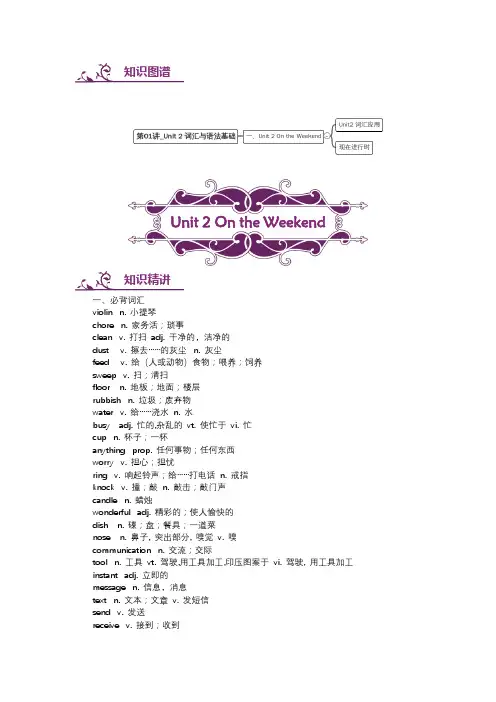
知识图谱Unit 2 On the Weekend知识精讲一、必背词汇violin n. 小提琴chore n. 家务活;琐事clean v. 打扫adj. 干净的,洁净的dust v. 擦去……的灰尘 n. 灰尘feed v. 给(人或动物)食物;喂养;饲养sweep v. 扫;清扫floor n. 地板;地面;楼层rubbish n. 垃圾;废弃物water v. 给……浇水n. 水busy adj. 忙的,杂乱的vt. 使忙于vi. 忙cup n. 杯子;一杯anything prop. 任何事物;任何东西worry v. 担心;担忧ring v. 响起铃声;给……打电话n. 戒指knock v. 撞;敲n. 敲击;敲门声candle n. 蜡烛wonderful adj. 精彩的;使人愉快的dish n. 碟;盘;餐具;一道菜nose n. 鼻子, 突出部分, 嗅觉v. 嗅communication n. 交流;交际tool n. 工具vt. 驾驶,用工具加工,印压图案于vi. 驾驶, 用工具加工instant adj. 立即的message n. 信息,消息text n. 文本;文章v. 发短信send v. 发送receive v. 接到;收到while n. 一会儿conj. 在……期间slow adj. 慢的adv. 慢慢地vt.& vi. 放慢,减速just adv. 只是;正好;刚才website n. 网站bank n. 银行;河岸museum n. 博物馆police n. 警察部门;警方station n. 站,所,局;火车站;电视台post n. 邮政;职位v. 邮寄;张贴;发布office n. 办公室,职务,事务train n. 火车underground n. 地铁way n. 路线;路;方法excuse v. 原谅n. 借口;理由cross v. 穿越,越过,横过street n. 大街;街道road n. 路,道路,公路corner n. 角;街角miss v. 错过;想念opposite prep. 与……相对adj. 对面的;across prep. 从一边到另一边;横过square n. 广场gym n. 体育馆;健身房二、重点词汇1. busy adjective /ˈbɪzi/If you are busy, you are working hard, or giving your attention to a particular thing.忙碌的;忙于……的;专注的1). Mum was busy in the kitchen.妈妈在厨房里忙活呢。
七年级unit2重要知识点总结

七年级unit2重要知识点总结七年级Unit2主要学习了一些基础的英语知识,重点在于词汇和语法的学习,这对于英语的基础打牢非常有帮助。
在这篇文章中,我们将总结Unit2中最重要的知识点,为大家提供更加系统化的学习方式。
1. 单词及词组Unit2中涉及到的单词相对较多,覆盖了生活中的很多方面。
每个人的记词方式不同,但我们可以将单词分为以下几类:国家名称、颜色名称、日期表示、星期表示、物品名称、食品名称、动物名称、身体部位、时刻表示等。
相信大家平时在学习的时候已经很好地掌握了这些单词,但是要想更好地记住它们,我们建议大家可以将这些单词分类并逐个记忆。
此外,Unit2还涉及到了一些常用的英语短语和句型。
比如,“have a great time”表示“度过美好时光”,“What do you think of…”表示“你认为…怎么样”,“How much/many…”表示“多少钱/多少个”等。
这些短语和句型经常会在口语和写作中出现,我们需要掌握它们的用法和搭配。
2. 代词和人称代词代词的作用是用来替代名词,可以减少重复,使句子更简洁明了。
在Unit2中,我们主要学习了三种代词:主格代词、宾格代词和物主代词。
主格代词在句子中作主语,比如“I am a student.”(我是一个学生)。
宾格代词在句子中作宾语,比如“She likes me.”(她喜欢我)。
物主代词用来表示所属关系,比如“My book is red.”(我的书是红色的)。
此外,我们还学习了人称代词。
人称代词分为第一人称、第二人称和第三人称,分别表示说话人、听话人和其他人。
在口语和写作中,正确使用人称代词非常重要,可以使语言更加准确流畅。
3. 时态和动词结构时态是描述事件发生时间的一个重要概念,它包括一般现在时、一般过去时和一般将来时等。
在Unit2中,我们需要掌握这三种时态的用法和句型。
动词结构是指动词在句子中的使用方式,包括动词不定式、动名词等。
高中英语 外研版选修第二册unit2语言知识点总结
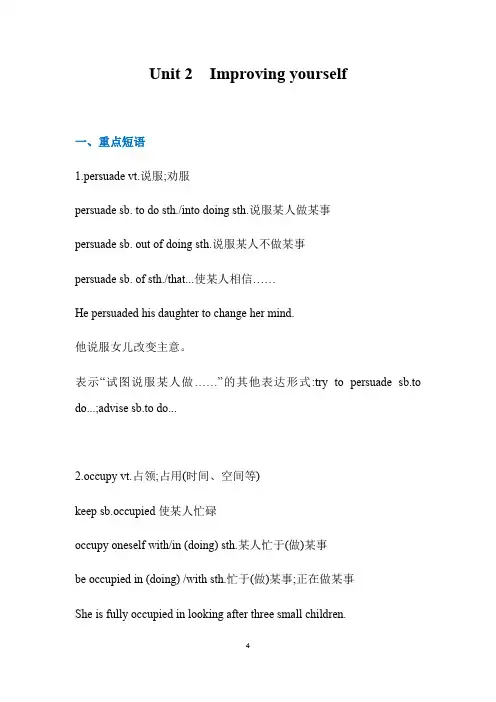
Unit 2 Improving yourself一、重点短语1.persuade vt.说服;劝服persuade sb. to do sth./into doing sth.说服某人做某事persuade sb. out of doing sth.说服某人不做某事persuade sb. of sth./that...使某人相信……He persuaded his daughter to change her mind.他说服女儿改变主意。
表示“试图说服某人做……”的其他表达形式:try to persuade sb.to do...;advise sb.to do...2.occupy vt.占领;占用(时间、空间等)keep sb.occupied使某人忙碌occupy oneself with/in (doing) sth.某人忙于(做)某事be occupied in (doing) /with sth.忙于(做)某事;正在做某事She is fully occupied in looking after three small children.=She is fully occupied with three small children.她忙于照料三个小孩。
3.pick up 捡起;拾起pick off摘下来pick out挑选,选出;辨认出;领会,理解4.constantly adv.持续不断地;经常地constant temperature恒温constant friend忠实的朋友He is constant to his purpose.他始终抱定目标。
She is a constant friend;you can rely on her.她是一位忠实的朋友,你可以依赖她。
5.embarrassed adj.窘迫的;尴尬的;害羞的embarrass sb.with sth./by doing sth.以……难住某人或使某人窘迫be embarrassed at/about such a request这样的请求使某人为难be embarrassed to do sth.因做了某事感到不好意思be embarrassed by sb.’s praise因为某人的表扬而感到窘迫embarrassing adj.使人害羞的/难堪的/惭愧的embarrassment n.害羞;困窘;难堪;困境不要问隐私让他们觉得不好意思。
Book 6 Unit 2 Poems语言知识点
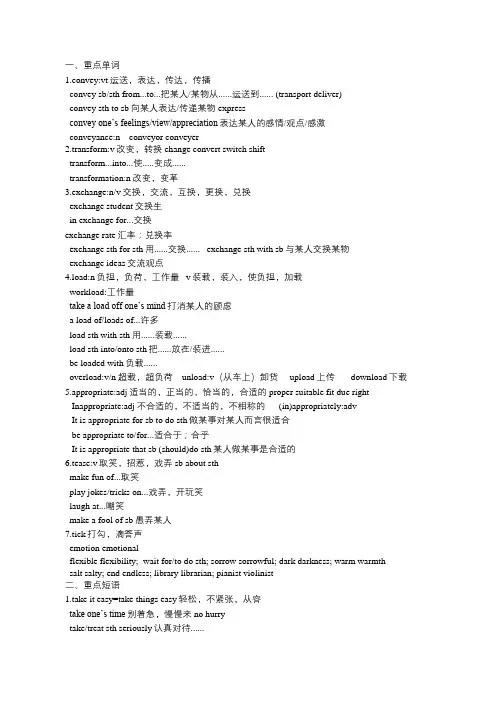
一、重点单词1.convey:vt运送,表达,传达,传播convey sb/sth from...to...把某人/某物从......运送到...... (transport deliver)convey sth to sb向某人表达/传递某物expressconvey one’s feelings/view/appreciation表达某人的感情/观点/感激conveyance:n conveyor conveyer2.transform:v改变,转换change convert switch shifttransform...into...使.....变成......transformation:n改变,变革3.exchange:n/v交换,交流,互换,更换,兑换exchange student交换生in exchange for...交换exchange rate汇率;兑换率exchange sth for sth用......交换...... exchange sth with sb与某人交换某物exchange ideas交流观点4.load:n负担,负荷,工作量 v装载,装入,使负担,加载workload:工作量take a load off one’s mind打消某人的顾虑a load of/loads of...许多load sth with sth用......装载......load sth into/onto sth把......放在/装进......be loaded with负载......overload:v/n超载,超负荷 unload:v(从车上)卸货 upload上传 download下载5.appropriate:adj适当的,正当的,恰当的,合适的proper suitable fit due rightInappropriate:adj不合适的,不适当的,不相称的 (in)appropriately:advIt is appropriate for sb to do sth做某事对某人而言很适合be appropriate to/for...适合于;合乎It is appropriate that sb (should)do sth某人做某事是合适的6.tease:v取笑,招惹,戏弄 sb about sthmake fun of...取笑play jokes/tricks on...戏弄,开玩笑laugh at...嘲笑make a fool of sb愚弄某人7.tick打勾,滴答声emotion emotionalflexible flexibility; wait for/to do sth; sorrow sorrowful; dark darkness; warm warmthsalt salty; end endless; library librarian; pianist violinist二、重点短语1.take it easy=take things easy轻松,不紧张,从容take one’s time别着急,慢慢来no hurrytake/treat sth seriously认真对待......take sth for granted认为.....理所当然, take it for granted that...take/accept/regard/look upon/think/treat/recognize/work/consider...as...2.sb run out of sth用完,用尽;从.....跑出去Sth run out被用完(time money food) My time is running out recently.Sb give out.用尽,精疲力尽 give out分发,发出,公布,发表Sb use up sth用完,耗尽3.let out释放,放走;发出(叫喊声等);泄露;加宽;加出租let alone sth更不用说,更谈不上let sb/sth alone对某人/某物放任不管;置之不理 leave alone不打扰,不干涉,不管,不顾 let down把......放下来,使(某人)失望/情绪低沉let in允许进入,容许,许可let go of sb/sth let sb/sth go放开,释放4.try out测试(性能),试验try on试穿try to do sth尽力做某事,努力做某事try doing sth尝试做某事try one’s fortune碰运气have a try尝试,努力三、重点句型1.the reason for sth......的原因The reason why/for which... is that...: reason在定语从句中做状语The reason that/which...is that...:reason在定语从句中做主、宾语for the reason因为这个原因2.with/there be+宾语+doing sthwith/there be+宾语+donewith/there be+宾语+to dowith/there be+宾语+n/adj/adv/介短。
牛津译林英语7A Unit2知识点
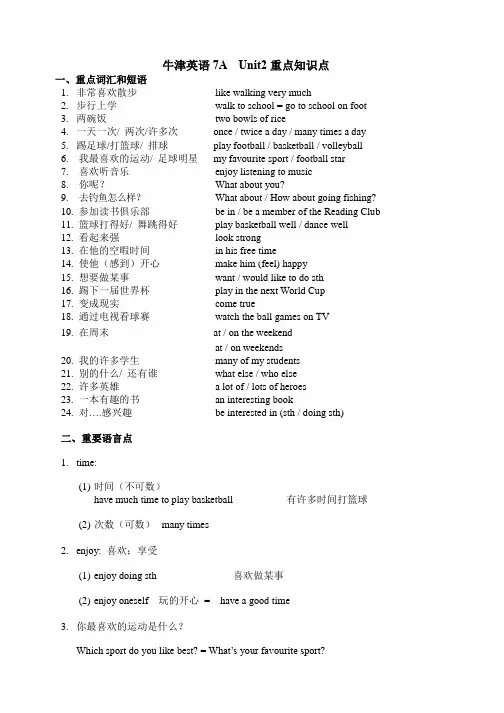
牛津英语7A Unit2重点知识点一、重点词汇和短语1.非常喜欢散步like walking very much2.步行上学walk to school = go to school on foot3.两碗饭two bowls of rice4.一天一次/ 两次/许多次once / twice a day / many times a day5.踢足球/打篮球/ 排球play football / basketball / volleyball6.我最喜欢的运动/足球明星my favourite sport / football star7.喜欢听音乐enjoy listening to music8.你呢?What about you?9.去钓鱼怎么样?What about / How about going fishing?10.参加读书俱乐部be in / be a member of the Reading Club11.篮球打得好/舞跳得好play basketball well / dance well12.看起来强look strong13.在他的空暇时间in his free time14.使他(感到)开心make him (feel) happy15.想要做某事want / would like to do sth16.踢下一届世界杯play in the next World Cup17.变成现实come true18.通过电视看球赛watch the ball games on TV19.在周末at / on the weekendat / on weekends20.我的许多学生many of my students21.别的什么/还有谁what else / who else22.许多英雄 a lot of / lots of heroes23.一本有趣的书an interesting book24.对….感兴趣be interested in (sth / doing sth)二、重要语言点1.time:(1)时间(不可数)have much time to play basketball 有许多时间打篮球(2)次数(可数)many times2.enjoy: 喜欢;享受(1)enjoy doing sth 喜欢做某事(2)enjoy oneself玩的开心= have a good time3.你最喜欢的运动是什么?Which sport do you like best? = What’s your favourite sport?4.make:(1)制作make a kite 制作风筝(2)使某人….make sb happy 使某人高兴5.want = would like 想要…want / would like sth / to do sth 想做某事6.hope: v.希望(1)hope to do sthEg. I hope to go to Beijing.我希望去北京。
七上英语unit2笔记
七上英语unit2笔记Unit 2 of the seventh grade English curriculum covers the theme of "Our World". In this unit, students will expandtheir understanding of different aspects of our world, including geography, weather, and culture. Here are some key points to note:1. Geography: Students will learn about different geographical features such as mountains, rivers, and deserts. They will also study continents and countries, and practice using locational vocabulary to describe specific places.2. Weather: In this unit, students will explore different weather patterns and seasons. They will learn vocabulary related to weather conditions and will be able to describe different types of weather. Additionally, they will learn about different activities that people do based on different weather conditions.3. Culture: Students will gain an understanding of different cultures around the world. They will learn about traditional clothing, food, and customs of different countries. They will also explore cultural diversity and how it contributes to a richer global community.4. Comparisons: Throughout the unit, students will be encouraged to make comparisons between their own culture and others. They will learn how to express similarities and differences between different cultures, and will be able to discuss their own traditions and customs.5. Reading and Writing: Students will read texts about different countries and cultures, and will practice summarizing and retelling the main points. They will also learn how to write short paragraphs describing different geographical features or weather conditions.It's important to note that the specific content and activities covered in Unit 2 may vary depending on thecurriculum and textbook used in your school. Make sure to follow the guidance of your teacher and consult the appropriate resources for more detailed information.。
人教版七年级上册英语Starter Unit 2知识点梳理及语法讲义-2024-2025学年人教版七
七年级上册英语Starter Unit 2知识点与语法精讲精练词汇梳理(一)完成单词梳理:名词:1. map地图 2. cup 杯子 3. ruler 尺;直尺4. pen 笔;钢笔5. orange 橙子6. jacket 夹克衫;短上衣7. key 钥匙8. quilt 被子;床罩动词:1. is 是(单数) 2. spell 用字母拼;拼写代词:1. this 这;这个 2. it 它 3. that 那;那个介词:1. in (表示使用语言、材料等)用;以感叹词:1. please (用于客气地请求或吩咐)请不定冠词:1. a 、an (用于单数可数名词前,表示未曾提到的)一(人、事、物)兼类词:1. what (pron/adj)什么 2. English (n)英语(adj)英格兰的;英语的缩略词:1. NBA (美国)全国篮球协会 2. P 停车场;停车位 3. kg 千克;公斤(二) 词汇变形小结:1. this (pron. 这;这个) — that (对应词:那;那个)2. is (v. 是,用于第三人称单数) — am (v. 用于第一人称I) — are (v. 用于第二人称you)3. map (n.地图) — maps (复数)4. cup (n.杯子) — cups (复数)5. ruler (n. 直尺) — rulers (复数)6. pen (n.钢笔) — pens (复数)7. orange (n.橙子) — oranges (复数)8. jacket (n.夹克衫) — jackets (复数)7. key (n.钥匙) — keys (复数)(三) 短语攻关:in English 用英语an orange 一个橙子this key 这把钥匙 this is 这是…… spell it 拼写它 that map 那幅地图1. What’s this in English?这用英语怎么说? 【用法详解】(1)what 是特殊疑问词,引导特殊疑问句,意为“ 什么 ”,What’s 是 What is 的缩写形式。
PEPBook7Unit2 第6课时
PEP Book 7 Unit 2 Ways to go to schoolB Let’s check Let’s wrap it upC story timeBy Tao Meiling From Hengjie Primary School Ⅰ Teaching content and analysis:本节课是PEP教材六年级上册Unit 2 Ways to go to school第六课时。
教学涉及内容较多较杂,有Let’s check ,有Let’s wrap it up,凸显练习,注重理解。
还有story time,完整情节,实践运用。
为了更好地完成本课时教学,从单元整体教学着眼,从教学细微处入手,以单元复习为主线,组织多种任务活动,巧妙串联起所有教学知识点,有的放矢地开展学习和活动。
让Let’s check Let’s wrap it up成为学生单元学习的提升突破口,让story time成为学生单元学习的亮点延伸拓展,一举两得。
Ⅱ Teaching aims:nguage aims:①能够听、说、读、写短语:on foot、 by bike、 by bus、 by train等。
②能够听说、认读和理解第2单元主要句型,并在真实情境中加以运用。
③能在真实情景中理解come go 表达的意思。
④能听懂,理解 story time 的意思。
2.Ability aims:①能够询问别人出行的方法。
②培养学生的选择去不同地方的出行方式的能力。
3.Emotional aims:培养学生积极运用所学语言进行表达、交流和表演的能力。
Ⅲ The important and difficult points:1.The important points:①能够听、说、读、写短语:on foot、 by bike、 by bus、 by train等。
②能够听说、认读和理解第2单元主要句型,并在真实情境中加以运用。
外研版(三起)-英语-六年级下册--外研版三起Module7Unit2教材同步讲解
外研版(三起)-英语-六年级下册--外研版三起Module7Unit2教材同步讲解Unit 2:She couldn't see or hear.(第⼆单元:她看不到也听不到。
)(教材41~43页)1.Listen and chant.听⼀听并跟着唱。
(教材第41页)课⽂英汉互译Helen couldn't see.海伦看不见。
But she could read但她可以阅读。
Helen couldn't hear.海伦听不见。
But she could talk.但她可以说话。
重难点精析could的⽤法Helen couldn’t see.But could read.海伦看不见。
但她可以阅读。
【点拨】.could⽤来表⽰过去的能⼒、可能性或允许。
例如:I could run faster then.那时我能跑得更快。
could还可与表⽰感知的动词,如see,hear,smell,taste,feel,understand等连⽤,表⽰特定的能⼒。
例如:He said he could see me next week.他说他下周能见我。
【知识拓展】(1)could意为“允许”时,表⽰委婉地提出问题或陈述看法。
例如:-Could I use your bike?我可以⽤你的⾃⾏车吗?-Yes,you can.是的,你可以。
(2) could还可表⽰过去的可能或许可。
例如:Father said I could swim in the river.爸爸说我可以在河⾥游泳。
【即学即⽤】连词成句borrow,pen,l,could,your(?)答案速查Could I borrow your pen?2.Listen and read.听⼀听并读⼀读。
(教材第41页)课⽂英汉互译Helen Keller was born① in the US in 1880.As② a baby,she became③ blind and deaf.She couldn't see or hear.海伦·凯勒于1880年出⽣在美国。
(外研)Book7 Module9Unit2 D0 you want to go to Guilin
(外研)Book7 Module9Unit2 D0 you want to go to Guilin?一、教材分析Moduule7Unit2的主题是:“want to go to somewhere”语言功能是:Talking about (论某个地方),学习任务为:学习目标语句:Do you want to go toGuilin?”并能用 Yes,I do./ No, thank you来回答询问。
二、学情分析本课的教学对象是六年级学生,他们的英语知识已经有了一定的积累,英语听说读写方面的能力有了一定的基础,具备了初步运用英语做事的能力。
而且学生在合作学习以及在真实的任务中运用所学语言进行交际的能力等方面都有了很大提升。
在教授新语言点时,要尽可能多地联系实际生活,创造生活化的语言环境,让学生在语境中更好地理解课文,同时采取小组合作学习的方式加强生生合作与互动,通过任务驱动,鼓励学生在真实的情景中运用所学语言,让学生在大胆实践和积极参与的过程中,培养其积极的情感态度和自主学习能力。
三、Teaching aims教学目标(一)知识目标:1.掌握句型:Do you want to go to Guilin? Yes, I do./ No, thank you.2.询问他人的意愿并表达自己的意愿(二)技能目标:1. 学生能够在创设的情景中对别人去过什么地方进行较流畅的问询和回答。
2.能够能灵活运用功能语句在真实的生活情景中调查并转述别人的见闻。
(三)运用任务:1完成SB Unit2活动4,把韵诗朗诵给朋友或家人听;2.仿照SB Unit2活动5的方式开展游戏,学生能够在看、听、想、说、写中发展多元智能,养成认真倾听的好习惯,并在小组讨论交流汇报中体验合作竞争的带来的收获与快乐。
四:给自己的朋友或笔友发一封email,讲述自己这个周末打算做的事情。
五、Teaching aids:教具1. PPT2. Teaching cards ,places pictures六、Teaching Procedure:教学过程Step 1: Warm-up and previewT:Hello, boys and girls !Are you ready? Class begins.T:Look , what’s this? And this one?T:Today, we’ll have two groups. You’re China Group. And you’re England Group. Let’s come to the PK stage, and see which group will be the winner .1:教师出示一张中国地图并提问:T:What is this?下面为此图片的出处:/shownews.asp?id=242S:It’s a map of China.一、教学目标:1.知识目标:掌握并运用句型学习并掌握“Do you want to …?”“Yes, I do ./ No, I don’t .”和“I want to…”的表达方法;能力目标:1.通过学习培养学生的听、说、读、写综合运用语言的能力。