
九年级英语 9A Unit1 学案提纲 (译林牛津版九年级英语上册教案教学设计)
【九年级英语学习视频】九年级英语9A Unit1 学案提纲(译林牛津版九年级英语上册教案教学设计)【--入党申请书提纲】语法指南A “It is/was +adj+ of/for sb. to do…”句型译成“对某人来说,做某事是……(样子的)。
”★…for sb.的句型通常使用表示客观情况的形容词,…of sb.的句型是一般用表示主观感情或态度的形容词。
①对这个孩子来说,举起这么重的盒子是比较难的。
It is quite ________________________ such a heavy box.②对于一个跳舞的人来说,保持健康是重要的。
It is _________________________________ healthy.③那女孩把包留在了出租车上,真是太粗心了。
It was __________________________ her bag on the taxi.④对于他来说,在那种时刻说声再见是明智的。
It was_________________________ good-bye at that time.★其次,…of sb.句型一般都可以转换成带一个不定式作状语的句子,而…for sb.的句型则不可以这样转换。
①你帮助我,真是太好了。
It was very______________________ me. = You were very_______________ me.②你把我看成了你的叔叔,真是太粗心了。
It was __________________________ me for your uncle.= You were____________________ me for your uncle.★后面能够接…for sb.的常见形容词有:hard,difficult,easy,important,interesting,necessary , impossible …. …★后面能够接…of sb.的常见形容词有:good , kind , nice , clever ,right ,careful ,rude ,wise ,foolish ,selfish , careless ,silly , honest , generous…. …B. “sb.+ be/do + adj./adv + enough to do…”句型“某人在某方面已经能够达到做某事的程度”。
enough修饰前面的形容词或副词,位置在被修饰词的后面。
如:careful enough / fast enough注意:形容词或副词前没有任何诸如very,quite等之类的修饰词。
①Andy身体很强壮,能够当运动员。
Andy is _____________________________ a player.②这个房间很大,够住20个人。
The room is __________________________ 20 people.1.be able to →can 能,会be able to 可用于各种时态can 只有一般现在时,一般过去时①She has ________________(be able to, can) explain it in English.②________ (be able to, can, could) you help me?③I make a pen that has a machine in it, so I _________ (be able to, can) write faster.④I can’t swim, but I will _________ (be able to, can) swim in three months.2.mind (v/n) / mind doing sth. / mind sb doing sth.①______________ (你介意) if I open the window?②______________ (别介意),I’ll teach you to sing this song.③Wearing blue clothes is good for _________ (头脑) and body.④He didn’t mind ________ (do) this work for the club.⑤Would you mind me ________ (use) your bike?3. confident作“自信的、有自信心的”①起初,女孩们感到有点紧张,后来,她来变得越来越自信了。
At first, the girls had felt _______________, but then they became_______________________________.★confident of sth. / doing sth. 或者confident that +从句有“肯定的、确信的、有把握的”意义。
①我很自信担当主持人。
I’m ____________________________ a host.②我肯定你考试能够通过。
I am ____________ that you can _________ the exam.4. argue动词,意为“辩论、争论”名词argument★argue with sb. (about/over sth. ) 意为“(就某事)与争论、争吵、争辩”。
她热爱和平,不喜欢与人争吵。
She ________________ and______________________________.5. keep 的用法:①保守秘密___________________________②keep + adj. 表示“继续保持某种状态”保持健康__________________ 安静! ________________③keep + 宾语+ 形容词/分词/介词短语“使……保持某种状态”我累得连眼睛都睁不开了。
I was too tired _________________________________.对不起,让你在外面久等了. I’m sorry. I ______________________ outside so long.她一直把食品锁在冰箱里。
She kept the food ____________________________.④keep…away (from),意为“不让靠近”。
接介from短语时,表示“妨碍”或“免遭……”他们生火是使动物不靠近。
They made fire to ____________ the animals ________________ near.⑤keep + doing的形式,表示“持续做某事”“不间断地做某事”。
课上不要一直讲话。
Don’t ____________________ in class.6. ★powerful作形容词,意为“健壮的”“强壮的”。
你个性强烈,精力充沛。
You are_________________ and have____________________.★powerful作形容词,有“权势的”“有影响力的”的意思。
中国现在是世界上最具有影响力的国家之一。
China is one of ________________________ in the world.★n.+ ful –adj power---- powerfulsuccess→___________ help→_____________ use→______________care→________________hope→_____________ peace→______________meaning→_ __________7. ★explain动词,“解释”“说明”“阐明”。
explain sth. to sb.吴老师花许多时间为我们讲解。
他很有耐心。
Mr Wu is______________ a lot of time__________________________________.★explain+ 从句Simon解释说他的汽车出了毛病。
Simon _____________ that_______________________ with his car.8. The sign says “No smoking here!”.(报纸、杂志、牌子、广告等上写着用_____________)9. Andy为我们播放CD,他考虑得真周到.It is___________________ Andy to play his CDs for us.10. 把事情搞得乱七八糟是Simon的典型特征。
It is ______________ Simon to___________________.11. 他不介意为学生会做额外的工作He will not mind ______________ for the Students’Union.12. 你真好推荐我做新的主席。
---It was____________________________ me ____the new chairperson.不用谢。
---It’s our p______________. = Not at all. = You are welcome.13. some useful expressions①平等地对待每个人________________________②注重细节________________________. ③我们每个人________________________④一直,始终________________________⑤周游世界________________________⑥去不同的地方旅行_____________________⑦把足球传给Peter ______________________ /________________________⑧计划外出________________________⑨整理行李________________________⑩按5556 0678号码给Master Zhang打电话________________________⑾健康有问题________________________⑿适合…________________________⒀在测试中得高/满分________________________⒁从不轻易放弃_____________________⒂积极参加________________________⒃对某人(没)有耐心________________________.⒄对……感到好奇________________________⒅对某人友好________________________⒆对……有信心/把握________________________ / ______________________⒇与…….相似______________________和……相同______________________九年级英语总复习9A Unit1 学案提纲语法指南A “It is/was +adj+ of/for sb. to do…”句型译成“对某人来说,做某事是……(样子的)。
牛津译林版九年级上册英语(新)教案:9A Unit 1 Welcom
Neither my parents nor I think I can make a good accountant.
Use the conversation below as a model.
C.Explain andPracticeusing the following phrases and sentences.
keeps all her things in good order.
shows off
repeat grammar rules for us.
2.Ask some questions about it:
What makes generous people feelgood?
Is Eddie reallygenerous?
Why did Hobo eat up all the breakfast?
Step4Explanation
Explain the important phrases and sentences in the dialogue.
Help Millie complete the following sentences with the words in the box.
lie and her classmates are talking about their own personalities
and the kind of job they like or dislike.Work in groups and talk about yourselves.
Step4 Practice
1. Work in pairs and drill the dialogue.
苏教版译林版牛津英语九年级上册9A教案(全册)
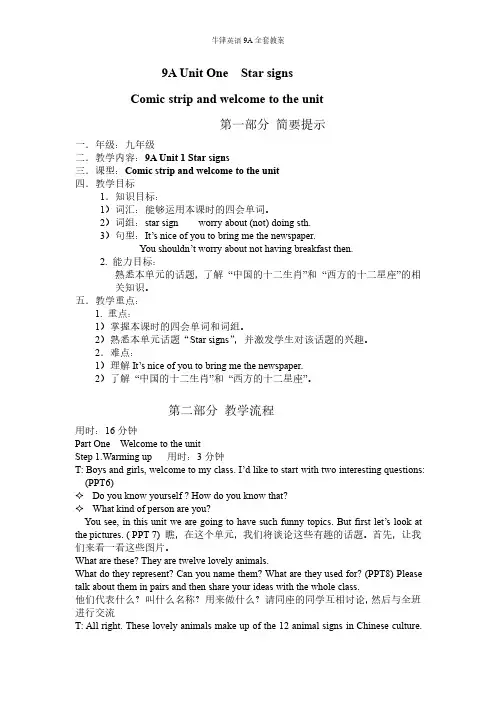
9A Unit One Star signsComic strip and welcome to the unit第一部分简要提示一.年级:九年级二.教学内容:9A Unit1Star signs三.课型:Comic strip and welcome to the unit四.教学目标1.知识目标:1)词汇:能够运用本课时的四会单词。
2)词组:star sign worry about(not)doing sth.3)句型:It’s nice of you to bring me the newspaper.You shouldn’t worry about not having breakfast then.2.能力目标:熟悉本单元的话题,了解“中国的十二生肖”和“西方的十二星座”的相关知识。
五.教学重点:1.重点:1)掌握本课时的四会单词和词组。
2)熟悉本单元话题“Star signs”,并激发学生对该话题的兴趣。
2.难点:1)理解It’s nice of you to bring me the newspaper.2)了解“中国的十二生肖”和“西方的十二星座”。
第二部分教学流程用时:16分钟Part One Welcome to the unitStep1.Warming up用时:3分钟T:Boys and girls,welcome to my class.I’d like to start with two interesting questions: (PPT6)✧Do you know yourself?How do you know that?✧What kind of person are you?You see,in this unit we are going to have such funny topics.But first let’s look at the pictures.(PPT7)瞧,在这个单元,我们将谈论这些有趣的话题。
译林版9Aunit1教案设计.
__________ ( care )
6.Do you mind my ________ ( open ) the window ?
7.The film ________ ( it ) is great fun .
___________________________________________________________________
3.那使我不开心。
_______________________________________________________________
4.人生就像一场赛跑。
4.她总是乐意加班。
5.粗心不仅对于我们自己而且对于病人都将是一种灾难。
6.镇上所有人都钦佩她。
四、用本单元所学的关于人的性格特点的词完成C局部,写一篇小文章介绍一下你自己的特点个性,你以后想做什么工作,以与你的个性是否适合你的工作。
五、根据提示完成下面的句子。
1.You must keep _________(practice) playing the piano everyday .
8.Doctor Wu is doing an o_________ on my grandpa .
9.Either you or he ________ ( be ) going to the cinema with me this evening .
10.Now the house price is higher and higher , and most of us can’t afford _______ ( buy ) a house .
牛津译林英语9A u1l1 welcome to the unit 教案
英语(九年级上册)Unit 1 Know yourselfComic strip & Welcome to the unitI. Teaching aims and learning objectivesBy the end of the lesson, students should be able to:1. use the right words to describe people’s personalities;2. talk about their own personalities and the job they like or dislike;3. learn to cooperate with others and respond to the teacher's instructions actively.II. Teaching contents1. New words and phrases: eat up, creative, curious, energetic, modest, organized, order, keep …in order, show off, grammar, come up with, neither, nor, accountant;2. New structure: Neither my parents nor I think I can make a good accountant.III. Focus of the lesson and predicted area of difficulty1. To talk about people's personalities;2. To talk about jobs and personalities.IV. Teaching proceduresA Comic stripStep 1 Lead inFree talk.T: Today we'll learn Unit 1 Know yourself. People often say what matters most is how you see yourself. Do you know yourself well? Are you a(n) friendly/confident/honest person?【设计意图:通过认识自己的问题导入新课,使学生迅速进入本课话题。
牛津译林版九年级英语上册9A unit1 welcome to the unit学案
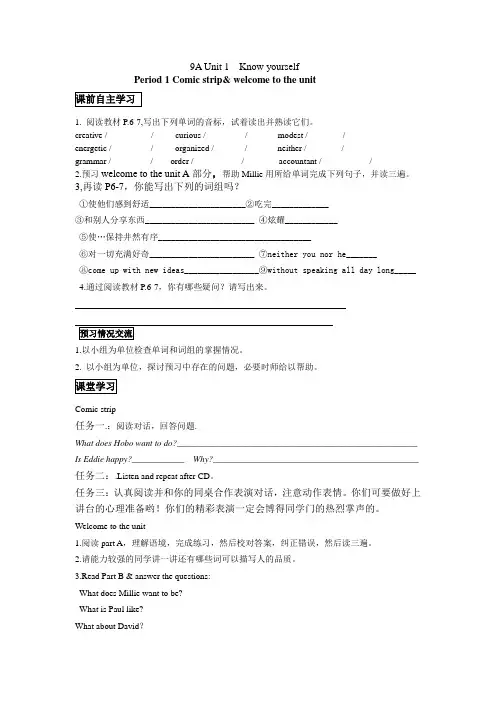
9A Unit 1 Know yourselfPeriod 1 Comic strip& welcome to the unit1. 阅读教材P.6-7,写出下列单词的音标,试着读出并熟读它们。
creative / / curious / / modest / /energetic / / organized / / neither / /grammar / / order / / accountant / /2.预习welcome to the unit A部分,帮助Millie用所给单词完成下列句子,并读三遍。
3,再读P6-7,你能写出下列的词组吗?①使他们感到舒适______________________②吃完_____________③和别人分享东西_________________________ ④炫耀____________⑤使…保持井然有序___________________________________⑥对一切充满好奇________________________ ⑦neither you nor he_______⑧come up with new ideas_________________⑨without speaking all day long_____4.通过阅读教材P.6-7,你有哪些疑问?请写出来。
1.以小组为单位检查单词和词组的掌握情况。
2. 以小组为单位,探讨预习中存在的问题,必要时师给以帮助。
Comic strip任务一.:阅读对话,回答问题.What does Hobo want to do?_______________________________________________________ Is Eddie happy?____________ Why?_______________________________________________ 任务二:.Listen and repeat after CD。
译林牛津版九年级英语上9A Unit 1 Integrated skills 教学设计
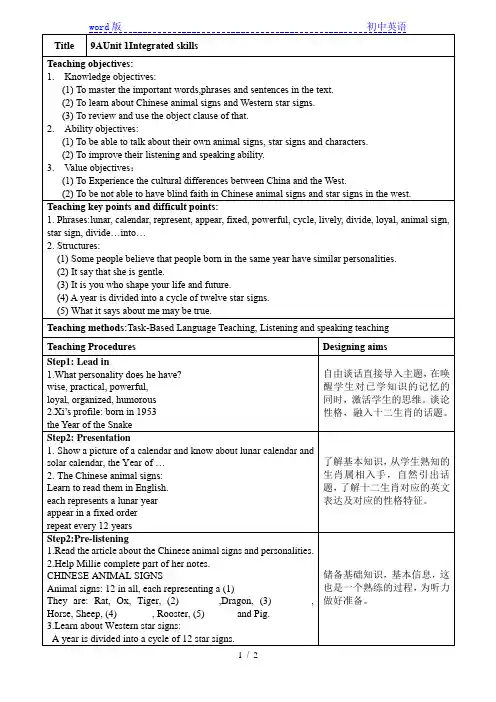
(1) To Experience the cultural differences between China and the West.
(2) To be not able to have blind faith in Chinese animal signs and star signs in the west.
WESTERN SIGNS
Star signs: a cycle of (7)____ star signs
Your star sign: depends on your (8)___________
Some people believe that your star sign may decide your personality.
Step4: Post-listening
Can you introduce yourself like this?
I was born in ________. My animal sign is ______. It says I am _________. What it says about me is/isn’t true. (In fact,…)
2. Structures:
(1) Some people believe that people born in the same year have similar personalities.
(2) It say that she is gentle.
(3) It is you who shape your life and future.
What decides your star sign?
牛津译林版英语九年级上册Unit1教案教学设计
(一)教学重难点
1.重点:本章节的重点在于让学生掌握描述个人兴趣、目标和计划的词汇和句型,如“enjoy”, “achieve”, “My goal is to...”, “I am planning to...”等,并能运用这些语言进行表达和交流。
难点:听力部分的对话和短文理解,以及阅读部分的长篇文章理解和信息提取。学生对复杂句子结构的理解和听力技巧的运用存在一定难度。
4.学生在情感态度与价值观方面,正值青春期,他们对未来充满期待,渴望实现自己的梦想。因此,本章节的教学内容要紧密联系学生的生活实际,引导他们树立正确的价值观,激发他们为实现目标而努力奋斗。
5.针对学生的个体差异,教师应充分运用差异化教学策略,关注每一个学生的成长,提高他们的英语素养,使他们在原有水平上得到提高。
提交形式:线上提交词汇复习的截图或照片,以证明完成情况。
6.家庭作业:布置一份综合性的英语练习,涵盖本节课所学知识。练习内容包括:听力、阅读、写作和翻译等。
提交形式:纸质版作业,教师批改后进行课堂讲评。
二、学情分析
牛津译林版英语九年级上册Unit1的教学对象是九年级学生,他们已经具备了一定的英语基础,掌握了基本的语法知识和词汇量。在此基础上,他们对英语学习有着较高的兴趣和热情,但个体差异较大,学习能力和水平参差不齐。因此,在进行本章节教学时,需关注以下几点:
1.学生在语言表达方面,部分学生能较为流利地运用英语进行交流,而部分学生仍存在发音、语法等方面的困难,需要教师在教学中给予个别关注和指导。
2.教学活动:教师通过PPT展示本节课的词汇和句型,并结合实际生活例子进行讲解,让学生理解并掌握新知识。
3.例句展示:教师给出几个描述个人兴趣和目标的例句,让学生模仿并用自己的语言进行表达。
牛津译林版九年级英语上册9A Unit1单元教案
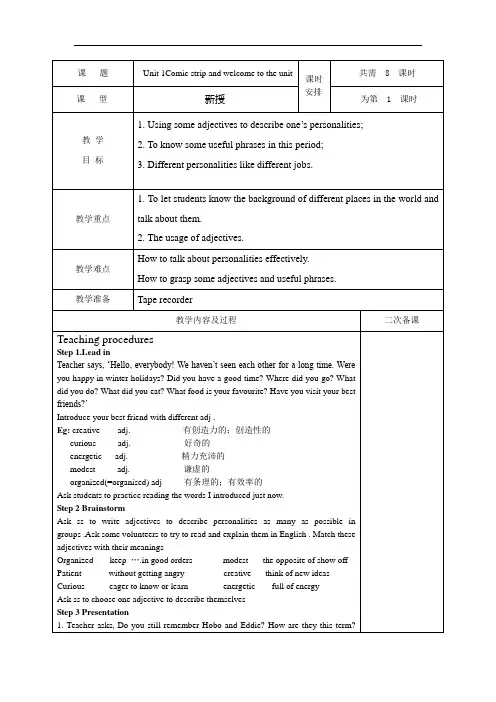
9A Unit1教案Unit 1 Know yourself课题Unit 1Comic strip and welcom e to the unit 主备人:课型新授课时:第 1 课时教学目标1. Using some adjectives to describe one’s personalities;2. To know some useful phrases in this period;3. Different personalities like different jobs.教学重点1. To let students know the background of different places in the world and talk about them.2. The usage of adjectives.教学难点How to talk about personalities effectively.How to grasp some adjectives and useful phrases.教学准备Tape recorder教学内容及过程二次备课Teaching proceduresStep 1.Lead inTeacher sa ys, ‘Hello, everybody! We haven’t seen each other for a long time. Wereyou happy in winter holidays? Did you have a good time? Where did you go? Whatdid you do? What did you eat? What food is your favourite? Have you visit your bestfriends?’Introduce your best friend with different adj .Eg: creative adj. 有创造力的;创造性的curious adj.好奇的energetic adj.精力充沛的modest adj.谦虚的organized(=organised) adj 有条理的;有效率的Ask students to practice reading the words I introduced just now.Step 2 BrainstormAsk ss to write adjectives to describe personalities as many as possible ingroups .Ask some volunteers to try to read and explain them in English . Match theseadjectives with their meaningsOrganized -----keep ….in good orders modest-----the opposite of show offPatient -------- without getting angry creative ----think of new ideasCurious ------- eager to know or learn energetic -----full of energyAsk ss to choose one adjective to describe themselvesStep 3 Presentation1. Teacher asks, Do you still remember Hobo and Eddie? How are they this term? What are they talking about now? Let’s listen to the tape. (Play the tape for the Ss to listen to the dialogue between Hobo and Eddie.)2. Ask some questions about it:What makes generous people feel good?Is Eddie really generous?Why did Hobo eat up all the breakfast?Step4 ExplanationExplain the important phrases and sentences in the dialogue.Step 4 Practice1. Work in pairs and drill the dialogue.2. Ask some Ss to act the dialogue out.Step 5 PresentationA. Some words are often used to describe people's personalities.Help Millie complete the following sentences with the words in the box.B. Millie and her classmates are talking about their own personalitiesand the kind of job they like or dislike. Work in groups and talk about yourselves. Use the conversation below as a model.C. Explain and Practice using the following phrases and sentences.keeps all her things in good order.shows offrepeat grammar rules for us.comes up withNeither my parents nor I think I can make a good accountant.It's terrible for me to work without speaking all day long.Step6 Homework1. Recite the important sentences.2. Preview Reading.板书设计教学反思课题Reading (2) 主备人:课型新授课时安排:第 3 课时教学目标1. To know further information about four persons by close reading2. To cultivate good personality due to the relationship between personality and jobs3. Grasp set phrases and some sentence patterns in this period教学重点1. grasp set phrases and some sentence patterns in this period2. write a short passage about one’s own personality and jobs教学难点1. Get the students to master some words and useful expressions.2.Try to retell the article with their own words教学准备Tape recorder教学内容及过程二次备课Teaching proceduresStep 1 Leading-inAsk some questions about the passage.Step 2 Explanationbe happy with = be satisfied with 对……感到满意a born artist 一个天生的艺术家impress the whole country with his creative work他的富有创造力的作品给全国人民留下深刻的印象win high praise from the art community 赢得艺术团的高度赞扬praise sb for sth 因某事表扬某人give up 放弃(代词放中间)give up doing sth = stop doing sth放弃做某事work for the sales department in a big company 在一家大公司的销售部工作day after day 日复一日the general manager 总经理either ……or …… 要么……要么……,或者……或者……(就近原则)take the lead 处于领先地位,带头fall behind 落后(fall in 生病)be ready to do 准备做某事take on new challenges 接受新的挑战the chief engineer 首席工程师connect……with/to …… 把……和……连接起来be connected with 与……有联系a miss is as good as a mile 差之豪厘,谬以千里(as good as与……几乎一样,简直是)can’t affo rd to do 负担得起(费用、损失、后果)多用于否定句和疑问句中make mistakes 犯错误pay attention to every detail 注意每个细节(to 为介词+ doing sth )work to high standards 工作高标准work with 与……一起工作a pioneer heart surgeon 一位心脏外科手术的带头人can’t be too careful = can never be too careful 再怎么细心也不为过be willing to do sth 愿意做某事devote o neself/ one’s life / time to 把……奉献给……(to为介词,后接名词,代词,动名词)respect sb = have / show respect for sb 尊重,尊敬某人be suitable for 适合Step 3 PracticeFinish some exercises.Step 4 HomeworkDo some exercises.Recite some important sentences.板书设计教学反思课题Grammar (1) 主备人:课型新授课时安排:第 4 课时教学目标1. Use conjunctions “and \but \or\so” correctly2. Learn to make rules about the usages of and \but \or\so3. To cultivate ss’ team sprite by studying in groups教学重点Make rules about the usages of and \but \or\so and use them correctly教学难点How to use and, but, or and so.教学准备CAI paper教学内容及过程二次备课Teaching proceduresStep 1 PresentationPresent some sentences including but, or and so.Step2 ConclusionHelp students conclude the usage of these conjunctions.We use “and" to join ideas that are similar.We use "but" to join ideas that are different.We use "or" to introduce another possibility.(In negative sentences, we use "or" to join two or more ideas.)We use "so" to express the result of sth.Step 3 PracticeDo exercise A on page 12 and check answers.Step 4 Explanationaccept other s’ advice 接受别人的建议think twice (about sth )三思而行be /get angry with sb 生某人的的气be /get angry at/ about sth 因某事而生气worry too much担心太多be patient / impatient with 对……有/ 没有耐心课题Grammar (2) 主备人:课型新授课时安排:第 5 课时教学目标1 Use conjunctions “both…and…,not only …but also …, either …or …, neither …nor …” correctly2 Learn to make rules about the usages of “both…and…,not only …but also …, either …or …, neither …nor …”3 To cultivate ss’ team sprite by studying in groups教学重点Make rules about the usages of “both…and…, not only …but also …,either …or …, neither …nor …教学难点To learn the use of both…and; not only…but also; either…or…; neither…nor…教学准备Tape recorder教学内容及过程二次备课Teaching proceduresStep 1 Revision1.Revise the usage of and\ but\ or \so .2.Give English for these sentences.生活就像赛跑,你要么领先要么落后Life is like a race. You either take the lead or fall behind .粗心对我们和病人都将是一场灾难Carelessness will be a disaster not only to ourselves but also to patientsTom 和Lily 两人都是学生Both Tom and Lily are st udents我和父母都认为我不会是一名好的会计Neither my parents nor I think I can be a good accountantStep 2 Lead-inAsk ss to pay attention to the words underlined. Tell them they arealso conjunctions. They can be used to connect two subjects \predictives\objects \adverbials and so on .Ask ss to read SBP13 and fill in the blanksWe use “both …and …”toWe use “not only …but also …”toWe use “either …or …” toWe use “neither …nor …” toWhen we use these conjunctions ,please pay attention to the form ofverbs . “both…and…”is always plural ,but the verb form after “notonly …but also …\either …or…\neither …nor…”can be plural orsingular ,depending on the subject closer to the verb .Step 3 EXXFill in the blanks with suitable conjunctions1 my father my mother are good teachers2 my father my mother goes to work .we visit my grandparents.3 you I will go there, because there is only one seat left.4 Jackie Chan is a pop singer a famous director.5 You can watch TV do your homework.6 You can read about it from some books on the Internet.Step 4 PracticeAsk ss to do the exercises B1and B2 in SBP14.in groups then check answers.Step 5 SummaryWe us e “both …and …”toWe use “not only …but also …”toWe use “either …or …” toWe use “neither …nor …” toWhen we use these conjunctions, please pay attention to the form of verbs . “both…and…”is always plural ,but the verb form after “not only …but also …\either …or…\neither …nor…”can be plural or singular ,depending on the subject closer to the verb .Step 6 AssignmentRecite the usage of these conjunctions learned in this period.Finish off the paper.板书设计教学反思课题Integrated skills 主备人:课型新授课时安排:第 6 课时教学目标1. To listen and get useful information from the tape,2. To know the difference between animal signs and star signs3. To communicate with each other about animal signs and star signs and what characteristics they represent.教学重点To communicate with each other about animal signs and star signs andwhat characteristics they represent.教学难点How to communicate with each other about animal signs and star signsand what characteristics they represent.教学准备Tape recorder教学内容及过程二次备课Teaching proceduresStep 1 Lead-inAsk them to say something about animals they have known and their characteristics.Read through the table on page 15Use the picture in part A1 to teach them some new words.Discuss the 12 animals by asking the following three questions:1 What other characteristics does this animal have?2 What other animals are loyal/ lively/ practical/ powerful?3 What is your animal sign and does it decide your personalities?Step 2 Pre-listeningGet students to read Part A2 carefully and try to use the information inpart A1 to complete it as much as possibleStep 3 listeningPlay the tape for students then check their answers.Step 4 consolidationDiscuss with students:1 What’s the diff erence between animal sign and star sign?2 Can they decide your personalities? If not, what decides yours?Step 4 practice1 Get students to finish part A3 with the information in Part A1 and A2 asmuch as they can before listening.What does the colour represent?Why does she wear the colour?Do you think they match well?2. Show the advertisements on page 33 and look at them carefully. Tell mewhich one do they like best and choose one picture to write about.课题Task主备人:课型新授课时安排:第 8 课时教学目标1. To understand the uses of charts2. To use charts to mak e notes of a piece of writing教学重点To use charts to make notes of a piece of writing教学难点To learn the use of both…and; not only…but also; either…or…; neither…nor…教学准备Tape recorder教学内容及过程二次备课Teaching proceduresStep1 Lead-in1 Ask them to say something about different classmates and different personalities.What do you think of …? Why?2 Read through the flow chart on page 18 and answer:What personalities does David have?Why do you think so?3 Read Part B and complete the report using the information on page 18.Check the answers and read it.Step 2 Presentation1. Ask the students how to write the article.The article must include:Who will you recommend?1、Be honest rather clever 22.4.264.26.202217:3517:35:59Apr-2217:352、By reading we enrich the mind; by conversation we polish it.二〇二二年四月二十六日2022年4月26日星期二3、All things are difficult before they areeasy.17:354.26.202217:354.26.202217:3517:35:594.26.202217:354.26.2022 4、By other's faults, wise men correct theirown.4.26.20224.26.202217:3517:3517:35:5917:35:595、Our destiny offers not the cup of despair, but the chalice of opportunity. So let us seize it, not in fear, but in gladness. Tuesday, April 26, 2022April 22Tuesday, April 26, 20224/26/20226、I have no trouble being taken seriously as a woman and a diplomat [in Ghana].。
九年级英语上册 Unit 1(A)教案和练习 牛津译林版 教案
2011-2012学年9年级英语(牛津译林版)上册素材(含教案和练习)Unit 1 Starsigns(A)【本讲教育信息】一、教学内容:9A Unit 1 Star Signs二、教学目标:本单元词汇、短语和语言点知识【具体教学过程】(一)词汇1. 反义词Ⅰ. 有些形容词的反义词只需通过在原有词或词根的基础上加前缀就可构成。
常见的这样的前缀有:im-,in- 表示“不,反面”,im-加在字母m,b,p之前。
e.g. impolite不礼貌的,impatient急躁的,没耐心的,inactive 不活跃的un- 表示“动作的反向”e.g. unfair 不公平的,unafraid 不害怕Ⅱ. 还有一些词加上后缀会改变原来的词性.如-ness, -less, -ful等.如:1)加-ness变成名词:sad-sadness, happy-happiness, ill-illness2)加-less构成形容词care-careless, home-homeless, end-endless3)加-ful构成形容词:care-careful, hope-hopeful, cheer-cheerful写出下列词的反义词:active_______________ proud_______________selfish_______________ hard-working_______________strong _______________ patient_______________fair_______________ silly_______________lively_______________ formal_______________happy_______________ stressed_______________2. 词性转换写出下列名词的形容词形式:peace_______________ sadness_______________power_______________ difficulty _______________heat_______________ happiness _______________warmth _______________ energy_______________practice_______________ person_______________success _______________ stress_______________strength _______________ selfishness _______________confidence _______________ elegance _______________写出下列动词的名词形式act _______________ create _______________imagine_______________suit______________ organize_______________lead _______________ argue _______________worry_______________ thought _______________explain______________ express________________随堂巩固练习:用括号中所给词的适当形式填空1) It’s generous of Kitty _____________ (buy) gifts for all of us.2) Yesterday we __________________ (divide) into four groups to discuss the problem.3) Mike is an ________________ doctor. He always quarrels with his ______________ (patient).4) An ______________ person has lots of ____________________ . (energy)5) Failure (失败) is the mother of ___________________. If you want to be ________________, you must work hard, then you will ________________. (success)6) He is clever enough _________________ (solve) this problem.7) The leader gave us a ____________________(confidence) smile.8) This is a ____________________ (create) work.9) Shakespeare created many famous characters. He is an ___________________ (imagine) writer.(二)重点短语P6-91. 有许多吃的喝的have lots to eat and drink2. 担心没早饭吃worry about not having breakfast3. 被分成…… be divided into4. 有相似的性格特征share similar characteristics5. 有时候 at times6. 放弃做某事 give up doing sth.7. 照顾其他人 take care of others8. 攒钱 save money9. 注重细节 pay attention to details10. 和sb. 就……争论 argue with sb. about sth.11. 很幽默 have a good sense of humour/ be humourous12. 梦想某事 dream about sth.P10-191. 关心他人 care about others2. 平等对待每个人 treat everybody equally3. 炫耀 show off4. 将某物传给某人 pass sth to sb.5. 征求sb. 的建议 ask sb. for advice6. 向……解释…… explain… to sb.7. 获得成功 have success8. 给某人买东西 buy sb. sth.9. 在某事上有问题 have problems with sth.10. 记住去做某事 remember to do sth.记住做了某事 remember doing sth.11. 能够很好地组织事情 be able to organize things well12. 想出新点子 e up with new ideasP20-231. 得满分 get full marks2. 作演讲 make a speech3. 推荐某人做…… remend sb. as …4. 暑假的剩余时间 the rest of the summer holiday5. 忘记去做某事 forget to do sth.忘记做了某事 forget doing sth.6. 介意做某事 mind doing sth.7. 具备当一个好主席的所有品质 have all the qualities to be a good chairperson8. 足够自信做这份工作 be confident enough to do the work9. 最合适的人选 the most suitable person10. 讲笑话 tell jokes11. 和…… make friends with sb.(三)语言点知识1. says I’ll have lots to eat and drink today.(P.6)say意为“文字材料)写道,说;显示”e.g. 这则通知上写道:不要入内。
牛津译林版九年级英语上册9A Unit 1第2-3课时教案
牛津译林版九年级英语上册9A Unit 1第二、三课时Reading 主备:Objectives1. To understand what are and what they represent2. To recognize and understand vocabulary about characteristics3. To use adjectives to describe someone’s characteristicsteaching procedures:1. Brainstorm the vocabulary that is used to describe people’s characteristics. Encourage students to explain each word to their classmates.2. Read the passage aloud to students. Ask them to listen carefully to you and follow the text on page 4 and 5.3. Ask one student at a time to read a paragraph. After each paragraph, ask students to say which parts of the text they do not understand. Less able students may find some of the names of the difficult. If so, do not force them to learn them by heart because they are only used here to arouse students’ interest. It is more important for them to learn the adjectives that describe people’s characteristics. This will enable them to complete the Main Task at the end of the unit.4. Ask some questions to check understanding.Part BTeaching procedures1. Before doing Part B, review adjectives used to describe characteristics. Ask students to describe their classmates.2. Ask less able students to work in pairs. Tell them to skip the ones they are not sure about and do the easier ones first. Check answers as a class.Part CTeaching procedures1. Tell students to work in pairs to complete Part C1. When students have completed all the answers, ask them to raise their hands. The first pair to complete the exercise correctly is the winner.2. After students have finished, give the correct answer to each question. Highlight where students can find the answers in the passage. This will help them when correctingtheir own mistakes and provide them with a better understanding of where they went wrong.3. For stronger classes, ask students to correct the incorrect sentences.4. Review key vocabulary learnt in the reading passage. Ask more able students to describe their partners using these adjectives.5. Ask students to do Part C2 on their own and check their answers with their partners. Ask students to refer to the reading passage on page 4 and 5. If students have different answers, ask them to discuss the answers.Part DTeaching procedures1. For weaker classes, write a list of characteristics on the board for students’ reference2. Ask less able students to pick five characteristics that describe themselves and write them in the blanks in part D1. Tell more able students that they can also use characteristics that are not listed on the board. Tell less able students to refer to the reading passage on pages 4 and 5 if they need help with ideas.3. Now, ask students to read the description of their star sign on pages 4 and 5. Ask them to write whether the characteristics listed under their star sign match the characteristics they have listed.4. Ask all those who think their characteristics match their star sign to raise their hands. Then ask all those whose characteristics do not match to raise their hands.5. Do a class survey. Ask students whether they believe in . Count how many say ‘yes’ and how many say ‘no’. Write the numbers on the board. For more able students, ask them to say why they believe or do not believe in .6. Divide the class into pairs. Ask students to write down five words that describe their partner’s characteristics in Part D2.7. Ask students to exchange books and compare what they have written.8. Homework: 《课时练》P3-6。