
牛津译林版七年级下全册单元英语教案unit4教案(表格式)
1.Ask and answer questions like this:
Is your home far from our school?
How do you usually go to school?
2.Practice: Ask student’s to make a similar dialogue like this:
3.Which animal do you like best in the zoo? Tell us where they are.
eg. I like monkeys best. The monkeys are north of the World of Birds.
4.Part B2 “True or false”. If it is false, can you point mistakes? How can we correct them?
Step2Presentation
1.We are going to visit Sunshine Zoo today, what can we see in the zoo?
2.1.Show a picture of pandas and say: Look, what are they?Pandas. They’re very cute. Where do pandas live in the zoo? What do they like to eat? (They live in the panda house, and they like to eat bamboo.)
1.Draw a map, then ask and answer.
--Where’s…?--It’s….
2.Ask students to act in front of the class.
3.Text book P43 Part A.
The students are planning a class trip. Look at themap. First, tell me where Sunshine Middle School is. Then find the places they plan to visit.
(4)Do they have to go up the hill again? (Yes, they do.)
Step7Read and act
1.Listen again, Ss read after the tape recorder.
2.Ask some students to act it out, and they can use their own ideas in the conversation.
Step4Presentation
1.Today, the students are in Sunshine Zoo. They’re seeing many different kinds of animals. Do you know what kinds of animals they are? Listen to the tape and try to find the answers.
Work in pairs and talk about the trip. You can use Simon and Daniel’s conversation as a model.
S1: Where’s Sunshine Park?
S2: It’s north-east of our school.
2.
New words: south north east west south-east north-west south-west north-east.
3.Ask and answer:
--Where’s the park?
--The park is north of our school.
Step2Practice
Show a picture of monkeys and ask: Do you like monkeys? Why? (funny/jump around/make people laugh)
Do pandas like to jump like monkeys do? No, they like to lie down all day long. (lie down/ all day long)
2.Show a picture of lions and say: Monkeys and pandas are very lovely. We all like them. How about lions? Lions are the kings of animal world. They are very dangerous. Don’t go near them. (king/dangerous…)
3.Introduce other new words.
4.Ask students: Which animal do you like best? Why?
Step3Practice
1.Work in pairs, make a conversation like this:
S1: Which animal do you like?
Step5Games
Game1: Now imagine that our classroom is a zoo. There are different sections for different animals. Please work in groups of four. One of the group members will be the guide. He or she should show the three visitors the way to the different animals. The other three students will ask the way to the sections for their favourite animals.
备课
日期
年
教学
课题
Unit4 Finding your way
课时
安排
1
月
日
Comic strip & Welcome to the unit
7
教
学
目
标
能认识有关地点和交通的图标。
能谈论出游和交通方式的话题。
能辨别方位。
重点
能认识有关地点和交通的图标。
能谈论出游和交通方式的话题。
能谈论出游和交通方式的话题。
S1: Is your home far from our school?
S2: No. It’s north of the school, about ten miles away.
S1: How do you come to school?
S2: I come to school by…
3.Simon and Daniel are talking about the trip. Listen to the tape and answer these questions.
2.Read the passage, then work in groups of four. Let’s complete Part B1. Read the introductioncarefully. Try to find each animal’s location in the zoo.
3.Preview Reading.
教学
反思
记住几个常用短语和句子:have to; far away from; threekilometersaway; Don’t be afraid.
有能力的同学背诵P43对话。
备课
日期
年ห้องสมุดไป่ตู้
教学
课题
Unit4 Finding your way
课时
安排
2
月
日
Reading 1
难点
教学过程设计
集 体 备 课
二 次 备 课
Welcome to the unit
Step1Free talk
1.Ask and answerabout directions:
Where do some birds fly in winter?
Where do they fly in spring?
I know the way. Follow me!
Are you sure?
Don’t be afraid. Come with me.
Step6Listen and answer
1.Listen to the tape and answer the question:
Does Hobo, in fact, know the way?
难点
教学过程设计
集 体 备 课
二 次 备 课
Step1Free talk
1.Show some maps,ask and answer:
2.Where’s the…? Do you know the way to the…?
3.Where’s the…? Is it far from our school? How do you get there?
Where are they going for the trip?
Where’s the zoo?
How will they get there?
4.Open your books. Please repeat the conversation after the tape.
牛津译林版初中《英语》七年级下册Unit4 Grammar教学设计

牛津译林版初中《英语》七年级下册Unit4 Grammar教学设计一、教学分析1. 教学内容分析。
本节课教学内容选自译林版初中《英语》七年级下册Unit4中的Grammar 板块。
语法板块主要是针对本单元出现的语言现象进行归纳与总结,通过练习与活动帮助学生了解并掌握语法规则,有助于学生进行与本单元话题相关的语言的输出。
本单元的中心话题Finding your way,讨论的是在旅行过程中如何辨别方位、根据地图识路以及为别人指路。
本课时的中心任务是结合本单元话题,创设真实语境,引导学生对冠词和方位介词的用法进行总结与运用。
2. 学生分析。
本节课授课对象为七年级学生。
经过小学的英语学习,学生已具备一定的听、说、读、写能力。
本节课的语法现象对学生而言并不陌生,但要在一节课内进行冠词和方位介词两个语法点的学习,内容偏多,想要完成并非易事。
3. 教学目标。
针对上述教学内容与学生学情的分析,设定如下教学目标:(1)知识目标:学生能够掌握冠词以及方位介词的基本用法;学生能够理解本课时的重点词汇与短语,如across、inside、outside等。
(2)能力目标:学生能够根据具体语境,使用正确的冠词来描述事物;运用方位介词来表达物体的位置。
(3)学习策略目标:学生能够通过同桌讨论、小组合作的方式,归纳冠词和方位介词的部分语法规则,提高主探究学习的能力。
(4)情感态度目标:学生能够在情景的辅助下,学会帮助他人,与他人分享快乐。
二、教学过程Step1:Lead-in教师向学生问好,询问学生今年去哪里春游的,通过向学生展示红山动物园的照片来引出话题,A trip to the zoo。
[设计意图]通过谈论学生熟悉的话题,轻松自然地导入与学生课外生活相关的话题,化解了学生的紧张情绪,调动了学生的学习积极性。
同时,导出生詞与词组,引出含有冠词的句子,让学生进一步感悟定冠词和不定冠词在具体情景下的运用,为后面的语法学习做好铺垫。
牛津译林版七年级下册Unit 4 教案
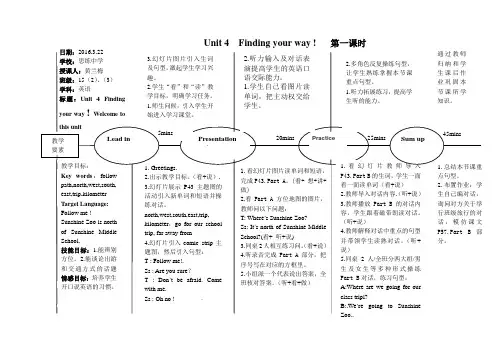
Unit 4 Finding your way ! 第一课时2.提升学教学要素授课人 班级 内容 日期:2016.3.22 学校:思练中学 授课人:黄兰梅 班级:15(2)、(3) 学科:英语 标题:Unit 4 Finding your way ! Welcome to this unit 教学目标: Key words :follow path,north,west,south,east,trip,kilometer Target Language: Follow me ! Sunshine Zoo is north of Sunshine Middle School. 技能目标:1.能辨别方位。
2.能谈论出游和交通方式的话题情感目标:培养学生开口说英语的习惯。
1. Greetings.2.出示教学目标。
(看+说).3.幻灯片展示P43主题图的活动引入新单词和短语并操练对话。
north,west,south,east,trip, kilometer ,go for our school trip, far away from4.幻灯片引入comic strip 主题图,然后引入句型: T : Follow me!. Ss : Are you sure ?T : Don ’t be afraid. Come with me. Ss : Oh no !Presentation5mins25mins20mins 通过教师归纳和学生课后作业巩固本节课所学知识。
Practice2.听力输入及对话表演提高学生的英语口语交际能力。
1.学生自己看图片读单词,把主动权交给学生。
2.多角色反复操练句型,让学生熟练掌握本节课重点句型。
1.听力拓展练习,提高学生听的能力。
1.看幻灯片图片读单词和短语,完成P43.Part A 。
(看+ 想+讲+做)2.看Part A 方位地图的图片,教师问以下问题:T: Where ’s Sunshine Zoo?Ss: It ’s north of Sunshine Middle School?(看+ 听+说) 3.同桌2人相互练习问。
牛津译林版初中英语七年级下册unit4Findingyourway精品教案

牛津译林版初中英语七年级下册初一年级英语学科教案总课题Unit4Finding your way 总课时8 第1 课时课题Comic strip and welcome to the unit课型New 教学目标知识目标1.To introduce the topic of directions and transport. 2.To talk about how to plan a trip. 能力目标1.Consolidate different directions by having dialogues about describing places. 2. Improve spoken English by free talk about a trip. 情感目标To train the Ss to love and help each other. 教学重点1.To develop an understanding of directions 2.To talk about the trip. 教学难点1.To develop an understanding of directions. The zoo is north of the Sunshine park. 2.To talk about their class trip. 课前预习Preview the new words. 教学过程教学环节教师活动学生活动备课札记Step1 Revision Step2 Presentatio n Step3.Practi se Step4. Presentatio n Show Preview tasks for students. Ask them to show it. 1.Teacher ask: In winter, where will the birds fly? In In spring, spring, spring, where where where will will will the the the birds birds birds fly fly back? 2.Show the eight directions . Show Show pictures pictures pictures for for for students students students to to to talk talk about where the places are. Show Show the the the map map map of of of China China China to to to Describe Describe where the provinces are. The teacher says: The students will have a trip. 1. 1. Find Find Find the the the places places places they they they plan plan plan to to to visit visit after listening. 2. Talk about the transport to school. Practice Practice the the the dialogue dialogue dialogue in in in Part Part Part B B B on on 1.Learn the new words on P42-43. 2. Group Work: List the places they want to go and the transport. Students watch the pictures pictures and and and share share share the the answers together. Learn Learn to to to describe describe describe the the directions directions in in in our our our daily daily life. Listen Listen and and and fill fill fill in in in the the boxes in Part A. Talk about in pairs. Step 5 Comic stripStep 6 PracticeStep 7. ExerciseStep8. Homework Page Page 43 43 43 and and and then then then make make make a a a similar similar dialogue with the partner. Show the cartoons for students. Ask: 1.Where are Hobo and Eddie? 2. Can Eddie go down the hill? 3. What does the sign say? Let Ss practice the dialogue and act it out. Group work: Make a dialogue about how to get to your home. Give Give Ss Ss Ss 8 8 8 min min min to to to do do do Ex Ex Ex in in in study study paper. Check the answers. 1. Read the dialogues. 2. 2. Complete Complete Complete the the the exercises exercises exercises in in in your your workbook. 3. Preview reading. Take Take an an an active active active part part part in in the the class class class activity activity activity and and practice speaking English. Watch the cartoons carefully and answer the questions. Read the dialogue and try to act it out in pairs. Discuss in groups. Finish the Ex. in time 教学反思总课题Unit4Finding your way总课时8 第2 课时课题Reading(1)课型New教学目标知识目标1.To know how to read the map and master different directions. 2.To know the names of animals in the zoo and their features. 3.To learn learn to to to show show show directions directions for for others others others and and and give give give the the the right right response to others能力目标1. Guess and understand the meanings of some new words according to the text; 2. Get information about a trip to the zoo by reading several times; 3. Learn to show directions for others and give the right response to others.情感目标Learn how to be good neighbours as middle school students. 教学重点1.Get information about the trip to the zoo by reading several times; 2. Use the text and the skills of reading to review and consolidate what they have learned. 教学难点Aim 2 课前预习Preview the new words. Listen to the tape. 教学过程教学环节教师活动学生活动备课札记Step1. Pre- reading Step2 While-read ing 1. Show pictures to have a revision. Ask Ask ““WhereWhere’’s s thethethe……? ? Do Do Do you you you know know the way to the…?”2. Show more pictures and organize the the students students students to to to ask ask ask and and and answer answer answer in in pairs. 1.Present pictures to tell students “eW e’’re re going going going to to to visit visit visit Sunshine Sunshine Sunshine Zoo Zoo today.today.””Then ask them to answer “What can you see in the zoo?”Show a picture of pandas and 1.teach the new word: bamboo. 2.Show more pictures of other Answer Answer the the the questions questions to review the directions and discuss in pairs. 1. Look at the pictures and answer questions. 2. 2. Learn Learn new new words words and phrases. Step3. Post-reading Step 4 Homework animals to teach more words and phrases. (Write on the blackboard)the other new words in the following reading. municate with students and ask ask ““Which Which animal animal animal do do do you you you like? like? Why?Why?””Give Give students students students an an an example example example and and and ask ask them to practice in pairs: S1: Which animal do you like? S2: I like…………S1: Why? S2: Because……Ask students to complete B3. 2. 2. Ask Ask Ask ““Which Which animal animal animal do do do you you you like like best best in in in the the the zoo? zoo? zoo? Tell Tell Tell us us us where where where they they are.are.””Encourage Encourage students students students to to to tell tell tell how how to to find find find their their their favorite favorite favorite animals animals animals on on on the the map. 3.Do True or False in B2 and correct the mistakes. 4. Group them in groups of four, and ask them to act their dialogues. ( One is is the the the guide guide guide and and and the the the other other other three three three are are visitors) Show Show a a a map map map and and and ask ask ask the the the students students students to to make make a a a dialogue dialogue dialogue about about about asking asking asking and and giving directions. 1. Finish the exercises. 2. Read the text fluently. 3. Discuss and say something something about about about their their favorite animals. 1. Make a dialogue to talk about animals. 2. Fill in the blanks to complete B3. Work in groups and sign sign the the the locations locations locations of of the six kinds of animals in B1. Try Try to to to say say say something something about about how how how to to to get get get to to the places of their favorite animals. 3.Do 3.Do B2 B2 B2 and and and correct correct mistakes mistakes in in in the the the false false sentences. 4. Group work. Some groups act their dialogues in class. Do the exercises. 教学反思总课题Unit4Finding your way总课时8 第3 课时课题Reading(2)课型New教学目标知识目标1 understanding and using the key phrases and sentences in the text. 2 retelling the text in your own words. 3.change into another style of retelling like role-play in this article能力目标Review Review the the the text, text, text, phrases,sentences phrases,sentences phrases,sentences and and and consolidate consolidate consolidate them; them; according to the text and fill in the blanks; retell the text 情感目标Learn how to show directions for others 教学重点1 understanding and using the key phrases and sentences in the text. 2 retelling the text in your own words. 3.change into another style of retelling like role-play in this article 教学难点Aim 2 课前预习Preview the new words. Listen to the tape. 教学环节教学过程学生活动备课札记Step1. Revision Step 2 Presentatio n 1. 1. Play Play Play a a a game game game with with with the the the students students students to to to let let them guess the animals. 2. Ask students to say something about the animals they have learned. 3. Ask the students to read and recite the text by themselves and complete B4. 4. 4. Invite Invite Invite some some some of of of the the the students students students to to to read read the dialogue in roles. 1. Write the important words and phrases phrases on on on the the the blackboard: blackboard: blackboard: e.g. e.g. e.g. laugh, laugh, make sounds, leaf, clever and funny, lie down all day long……2. Show a picture of B1 and help students to recall how to ask and show directions. 1. Guess which animal it is and try to say something about their features. 2. Students read the text and recite it by themselves first. 3. Complete B4 and read the dialogue in pairs. Step 3 Freeback Step 4 Exercise Step 5 Homework 3. Make a summary of giving directions. e.g. e.g. Go Go Go straight straight straight on on on and and and youyouyou’’ll ll findfindfind……; Walk Walk along along along the the the road; road; road; turn turn turn left/right; left/right; left/right; to to the the north north north of of of ……; ; Cross Cross Cross the the the bridge, bridge, bridge, and and youyou’’ll see…4. Encourage the students to put forward their own doubts and help them solve the difficulties. 1. Explain the language points and useful expressions. 2. Let students fill in the blanks according to the important phrases they learn in class to check if they know the text well. 3. 3. Let Let Let the the the students students students retell retell retell the the the text text text with with the key words and phrases. Ask the students to do the exercises on the worksheet. Present the usage of the important phrases, explain them and present some examples 1. Recite the text after class 2. Remember the important vocabulary, phrases and sentences. 1.Students look at the the blackboard blackboard blackboard and and try to remember these words and phrases. 2.Students think about how to ask and show directions. 3. Use these expressions to make make dialogues dialogues dialogues or or show directions. 4. Find out the difficulties difficulties and and and ask ask questions. 1. Learn the language language points points points by by watching and taking notes. 2. 2. Try Try Try to to to use use use these these language language points points points to to fill in the blanks correctly. 3. Retell the text. Students finish the exercises carefully in class 教学反思总 课 题 Unit4 Finding your way总课时 8 第 4课时 课 题Grammar课型New教学目标知识目标1.1.能掌握冠词的用法。
牛津译林版七年级下册Unit4教案

牛津译林版七年级下册Unit4教案Unit 4 Finding your way ! 第一课时2.提升学教学要素授课人班级内容日期:2016.3.22 学校:思练中学授课人:黄兰梅班级:15(2)、(3)学科:英语标题:Unit 4 Finding your way ! Welcome to this unit 教学目标:Key words :follow path,north,west,south,east,trip,kilometer Target Language: Follow me ! Sunshine Zoo is north of Sunshine Middle School. 技能目标:1.能辨别方位。
2.能谈论出游和交通方式的话题情感目标:培养学生开口说英语的习惯。
1. Greetings.2.出示教学目标。
(看+说).3.幻灯片展示P43主题图的活动引入新单词和短语并操练对话。
north,west,south,east,trip, kilometer ,go for our school trip, far away from4.幻灯片引入comic strip 主题图,然后引入句型:T : Follow me!. Ss : Are you sure ?T : Don ’t be afraid. Come with me. Ss : Oh no !Presentation5mins25mins20mins 通过教师归纳和学生课后作业巩固本节课所学知识。
Practice2.听力输入及对话表演提高学生的英语口语交际能力。
1.学生自己看图片读单词,把主动权交给学生。
2.多角色反复操练句型,让学生熟练掌握本节课重点句型。
1.听力拓展练习,提高学生听的能力。
1.看幻灯片图片读单词和短语,完成P43.Part A 。
(看+ 想+讲+做)2.看Part A 方位地图的图片,教师问以下问题:T: Where ’s Sunshine Zoo?Ss: It ’s north of Sunshine Middle School?(看+ 听+说) 3.同桌2人相互练习问。
牛津译林英语七年级下册第四单元全套教案
牛津译林英语七年级下册第四单元全套教案Unit4Finding your way第一课时Comic strip & Welcome to the unit教学过程一、方法指导1.观察Page 42中的图片,提前了解小故事的内容。
2.预习本课时的短语和句型。
二、预习检测根据首字母及汉语提示补全单词1.We are afraid(害怕) of tigers.2.I’m sure(确信) I know the way.ke Park is south(南) of Sunny Garden.4.There was a narrow path(小路) through the forest.5.The children often follow(跟随) the teacher to cross the road after class.Step1情景导入Teacher:Good morning,everyone.Look,I have a map here.When do we need a map?Can you read a map?Step2完成教材Comic strip的任务1.让学生认真听录音,回答下列问题。
(1)Where are Hobo and Eddie?They are on a hill.(2)What does the sign say?The sign says “Dogs this way”.(3)Do they have to go up the hill again?Yes,they do.2.让学生再次听录音,并跟读,注意语音和语调。
3.讲解语言知识点。
4.组织学生两人一组,结对练习对话。
然后找几组学生上台展示,老师点评。
Step3完成教材Welcome to the unit的任务1.呈现Part A的地图,让学生说出图中的东、南、西、北四个方向。
2.老师朗读阴影部分的四个句子,让学生在地图上找出这四个地方的位置。
牛津译林版七年级下册Unit 4《Finding your way》(task)教学设计
牛津译林版七年级下册Unit 4《Finding your way》(task)教学设计一. 教材分析《Finding your way》是牛津译林版七年级下册Unit 4的一篇任务型阅读课文。
课文通过介绍一位游客在伦敦寻找大本钟的过程中,向不同的人询问路线,最终找到目的地。
课文内容涉及到方位词、问路和指路的相关表达,旨在让学生掌握如何用英语询问和描述路线。
教材通过任务型教学法,让学生在实际情境中运用英语,提高学生的语言运用能力。
二. 学情分析七年级的学生已具备一定的英语基础,能够听懂并运用简单的日常用语进行交流。
但学生在实际运用英语描述路线方面可能存在一定的困难,因此教师需针对这一点进行重点指导。
此外,学生对于英语阅读的兴趣会影响他们对课文内容的学习,教师应充分激发学生的学习兴趣,提高他们的阅读积极性。
三. 教学目标1.知识目标:学生能够掌握表示方位的词汇和短语,如up, down, left,right, turn left, turn right等;能够用英语询问和描述路线。
2.能力目标:学生能够在实际情境中运用英语询问和描述路线,提高语言运用能力。
3.情感目标:培养学生乐于助人的品质,学会在遇到困难时,主动向他人寻求帮助。
四. 教学重难点1.重点:表示方位的词汇和短语,以及询问和描述路线的句型。
2.难点:如何将这些词汇和句型运用到实际情境中,进行流畅的交际。
五. 教学方法1.任务型教学法:通过设置各种任务,让学生在实际情境中运用英语,提高语言运用能力。
2.情境教学法:创设生动、真实的情境,激发学生的学习兴趣。
3.交际法:引导学生进行小组合作,进行实况模拟,提高交际能力。
六. 教学准备1.教学课件:制作包含课文内容、图片、动画等的多媒体课件。
2.教学道具:准备一些表示方位的标志,如地图、路标等。
3.练习题:设计一些关于询问和描述路线的练习题。
七. 教学过程1.导入(5分钟)利用课件展示伦敦的风景图片,引导学生谈论自己对伦敦的印象。
牛津译林版七年级下册Unit 4《Finding your way》(Reading II)教学设计
牛津译林版七年级下册Unit 4《Finding your way》(Reading II)教学设计一. 教材分析《Finding your way》是牛津译林版七年级下册Unit 4的一篇阅读文章,主要讲述了一位游客在伦敦游玩时,通过询问警察和阅读地图找到了目的地的经历。
文章涉及到方位词、问路和指路的相关表达,适合学生学习如何在实际生活中运用英语进行问路和指路。
二. 学情分析七年级的学生已经掌握了一定的英语基础词汇和语法知识,具备一定的阅读理解能力。
但对于方位词和问路指路的语言功能,可能还不够熟练。
因此,在教学过程中,需要引导学生通过阅读理解文章内容,掌握相关词汇和表达,提高实际运用英语的能力。
三. 教学目标1.知识目标:学生能够掌握文章中涉及到的方位词和问路指路的相关表达。
2.能力目标:学生能够通过阅读理解文章内容,提高阅读能力;能够运用所学知识,进行简单的问路和指路交流。
3.情感目标:培养学生对英语学习的兴趣,增强自信心,提高合作意识。
四. 教学重难点1.重点:学生能够掌握文章中涉及到的方位词和问路指路的相关表达。
2.难点:学生能够运用所学知识,进行实际的问路和指路交流。
五. 教学方法1.任务型教学法:通过设定具体任务,引导学生参与课堂活动,提高学生的实践能力。
2.情境教学法:创设真实情境,让学生在实际情境中学习并运用英语。
3.合作学习法:引导学生进行小组讨论和合作,提高学生的团队协作能力。
六. 教学准备1.教师准备:备好相关教学材料,如PPT、地图、卡片等。
2.学生准备:预习课文,了解文章大意。
七. 教学过程1.导入(5分钟)利用图片或视频展示伦敦的风景,引导学生谈论他们对伦敦的印象,激发学生的学习兴趣。
2.呈现(10分钟)教师通过PPT展示文章标题和图片,引导学生预测文章内容。
然后,教师 read the passage aloud, and ask students to pay attention to the key words and expressions.3.操练(10分钟)教师设计一些简单的问路和指路的情景,让学生进行角色扮演,练习文章中的相关表达。
牛津译林版英语七下Unit 4《Finding your way》(Grammar)教学设计
牛津译林版英语七下Unit 4《Finding your way》(Grammar)教学设计一. 教材分析《牛津译林版英语七下Unit 4》主要讲述了如何根据地图和路标找到目的地。
本节课的核心语法是情态动词can的用法,表达能力的具体体现。
教材通过具体的语境,让学生学会使用情态动词can来描述能力,同时结合一般现在时,使学生能够熟练运用该语法点进行实际交流。
二. 学情分析七年级的学生已经掌握了情态动词can的基本用法,同时具备了一般现在时的基本运用能力。
但学生在实际运用中,可能会对情态动词can和一般现在时的混合使用产生困惑。
因此,在教学过程中,需要帮助学生巩固已学知识,提高在新的语境中运用语言的能力。
三. 教学目标1.知识目标:学生能够掌握情态动词can的一般现在时用法,学会根据地图和路标找到目的地。
2.能力目标:学生能够在实际情境中运用情态动词can的一般现在时描述自己的能力,并能够正确使用地图和路标。
3.情感目标:培养学生独立思考、合作学习的能力,提高他们对英语学习的兴趣。
四. 教学重难点1.重点:情态动词can的一般现在时用法。
2.难点:情态动词can和一般现在时的混合使用。
五. 教学方法采用情境教学法、任务型教学法和合作学习法。
通过设定具体情境,让学生在完成任务的过程中,学会运用情态动词can的一般现在时描述能力,并能够结合地图和路标找到目的地。
六. 教学准备1.教学PPT:制作包含本节课主要内容、图片、例句等信息的PPT。
2.地图和路标:准备一些地图和路标的图片,用于教学活动。
3.任务单:为学生准备任务单,以便于他们在课堂上完成任务。
七. 教学过程1.导入(5分钟)利用PPT展示一些有趣的地图和路标图片,引导学生谈论他们所熟悉的地图和路标。
教师提问:“Do you like maps and signs? Why?”,让学生自由回答,从而引起学生对地图和路标的兴趣。
2.呈现(10分钟)教师通过PPT呈现本节课的主要内容,包括情态动词can的一般现在时用法,以及如何根据地图和路标找到目的地。
Unit4 牛津译林版英语七年级下册单元教案
初一下学期英语教案Unit4《Finding your way》(编号:)主备人:审核人:【课题】Comic strip & Welcome to the Unit【教学目标】To understand and act out the dialogue;To be able to tell the directions;To love our hometown , to love nature.【教学重、难点】1. To introduce the topic of places and transport.2. To talk about visits and means of transport using model sentences. 【教学方法】Multi-Media【教学过程】Ⅰ.预习情况交流:同学们,你在预习中遇到了哪些难以理解的呢?写出来我们来讨论一下:______________________________________________________Warm-up (presentation)Ask the students on duty to give us a short report about the Sunshine Town.. (集中学生的注意力,锻炼学生的口头表达及听力的能力)Ⅱ. 1.利用多媒体,展示方向标,学习方位词的表达。
2. 练习“be north of….”等句型(采用小马找食物游戏巩固)Ⅲ. Going on a tripIntroduce the topic of place and transport.---How do we get there?---We can go by bus. by air/car/bike/underground(回归教材,引发学生思考并总结去不同地方的不同交通方式)Ⅳ. DiscussionMay Day is coming. Our class is going to organize a trip.Please make a plan trip with your partner. Make your dialogue:A: Let’s go to …B: Good idea. But where is …?A: It’s …of ….B: How can we get there?A: We can get there by….Ⅴ. Listen and answer (书中对话)1.Where are they going?2. Where is it?3. How will they get there?Ⅵ. Task (Talk about a trip you want to go on)A: Where are we going for our trip?B: We’re going to …A: Where’s the …? Is it far away from …B: No. It’s north/south/east/west of …,about …kilometers away.二次备课A: How will we get there.二次备课B: We’ll get there.(此处采用分组合作,竞争机制引发学生的兴趣,活跃课堂)Ⅶ. Listening1.Listen to the tape, answer my question,“Did Hobo, in fact, know the way?”2. Help the Ss to answer.3. Listen again, Ss read after the tape recorder, then dosome exercises.Check the answers with the whole class.4.Read the dialogue by yourselves and find out any questions youdon’t understand.(自读对话,找出不懂的问题,智者善于动脑。
牛津译林版七年级英语下册Unit4Reading教学设计
a.根据文章内容,回答相关问题,提高阅读理解能力。
b.列出文章中出现的一般过去时的句子,并分析其用法。
c.选取文章中的一个段落,进行口头复述,锻炼口语表达能力。
3.小组活动:与同学组成小组,分享自己的写作作业,互相评价并提出建议。每组选取一篇优秀作品,进行展示和朗读。
4.词汇积累:收集并学习关于假期的英语词汇和短语,如“travel”, “sightseeing”, “sunburn”, “beach umbrella”等,以便在未来的英语表达中运用。
5.家庭作业:请家长协助学生完成以下任务:
a.与孩子进行英语对话,询问他们的假期经历,鼓励孩子运用一般过去时进行描述。
4.学生情感态度:七年级学生对英语学习存在一定的兴趣,但部分学生对阅读课缺乏信心,担心自己无法完成任务。因此,教师应关注学生的情感需求,多给予鼓励和表扬,帮助学生树立自信心,激发学习潜能。
5.学生合作能力:小组合作是提高学生口语表达能力、培养合作精神的有效途径。然而,部分学生在小组活动中表现不积极,合作能力有待提高。因此,教师在教学过程中应注重培养学生的合作意识,提高小组合作效果。
2.教师呈现重点词汇和短语,引导学生学习并运用这些词汇描述过去的事情。
师:“Now, let’s learn some new words and phrases about holidays, such as ‘holiday’, ‘activity’, ‘interesting’, and ‘boring’. Try to use them to describe your past holidays.”
2.学生分享学习心得,教师给予肯定和鼓励。