
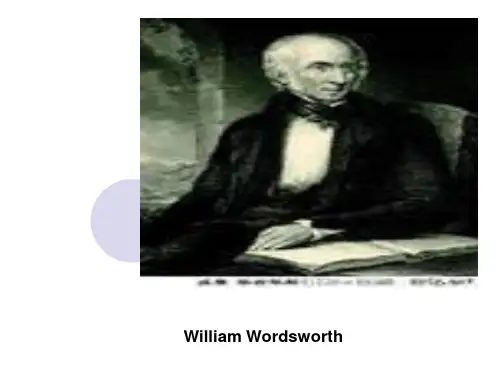
William Wordsworth华兹华斯
1779 - 1787
(1779-1787) William attended theGrammar School in Hawkshead. Got encouragement from the headmaster and then read and write poetry. During these years he made many visits to the countryside, gaining inspiration as the powers of nature exercised their influence.
1813 - 1850
In 1813 they moved to Rydal Mount, where William and Mary stayed until their deaths in 1850 and 1859. While living here, William bought the Rash field, next to St Mary's Church, originally to build a house. The house never materialised. It is now called Dora's Field, and has a splendid display of daffodils. Whilst at Rydal Mount ,William became Distributor of Stamps for Westmorland, and had an office in Church St, Ambleside. In 1820 he published his 'Guide through the District of the Lakes'. In 1842 he became the Poet Laureate, and resigned his office as Stamp Distributor. He helped to choose the site of St Mary's Church, built just below Rydal Mount, and where he was church warden frliam Wordsworth Famous Quotes
Lyrical Ballads
Gravestone of William Wordsworth
The Solitary Reaper
Behold her, single in the field, Yon solitary Highland Lass! Reaping and singing by herself; Stop here, or gently pass! Alone she cuts and binds the grain, And sings a melancholy strain; O listen! For the vale profound Is overflowing with the sound. No nightingale did ever chaunt More welcome notes to weary bands Of travelers in some shady haunt, Among Arabian sands: A voice so thrilling ne'er was heard In spring-time from the cuckoo-bird, Breaking the silence of the seas Among the farthest Hebrides.
1770 - 1779
His childhood was spent largely in Cockermouth and Penrith, his mother's home town. William and Dorothy and his future wife Mary Hutchinson attended infant school in Penrith between 1776 and 1777. William's mother died in Penrith when he was 8. His father died when he was 13, and is buried in the churchyard of All Saints Cockermouth. All Saints church rooms is on the site of the Cockermouth school that William attended as a boy.
1811 - 1813
They lived at Allan Bank for two years, with poet and friend Coleridge. They then moved to the Old Rectory, opposite St Oswald's Church, a cold and damp house, where his two youngest children died.
Born: April 7, 1770 Cookermouth, Cumberland, England Died: April 23, 1850 Rydal Mount, Westmorland, England A major English Romantic poet As one of the greatest lyric poets in the history of English literature.
In 1850 William caught a cold, and he died on 23 April, St George's day, 80 years old. He and Mary who died 9 years later have a simple tombstone in the churchyard of St Oswald's Church in Grasmere, now one of the most visited literary shrines in the world. Opposite Wordsworth House in Cockermouth is a memorial to William Wordsworth unveiled on 7 April 1970, the bicentenary of his birth.
Church and old grammar school just left of centre.
The 17th Century Church of St Michael & All Angels
Church and old grammar school just left of centre.
1799 - 1808
In December 1799, William and Dorothy moved into Dove Cottage, in Grasmere. Dorothy was William's secretary, as William dictated his poetry. In 1802 William married his childhood companion Mary Hutchinson, and the first three of their five children were born. Samuel Taylor Coleridge and Robert Southey moved in to Greta Hall in Keswick. Southey, who was poet laureate from 1813 - 1843, lived there for forty years.
William Wordsworth(1770-1850)
William's home life
In June of that year, Catherine, his fourth child, died of convulsions(痉挛) at age 3; (痉挛) in December, the third child, Thomas, died of pneumonia 肺炎) (肺炎) Mary herself came close to dying from grief, and Dorothy was little better. William wrote a very touching sonnet on Catherine's death some years later, called "Surprised by Joy". His father John was estate agent to Sir James Lowther, who owned the house(Wordsworth House house(Wordsworth House). William has an elder brother Richard, a younger sister Dorothy and two younger brothers John and Christopher.
Will no one tell me what she sings? Perhaps the plaintive numbers flow For old, unhappy, far-off things, And battles long ago: Or is it some more humble lay, Familiar matter of to-day? Some natural sorrow, loss or pain, That has been, and may be again?
威廉华兹华斯
But his uncle to his political activities dissatisfied, not wish again to increase. Are desperate, a has been sympathy and admiration of his old classmates died and left him 900 pounds. And in October 1795, he and dorothy move the country together, achieve close to nature, and discusses his old dream the meaning of life. Dorothy intelligent and considerate, and give he created writing conditions
诗人生平
1787年他进剑桥大学圣约翰学院学习,大学毕业 年他进剑桥大学圣约翰学院学习, 年他进剑桥大学圣约翰学院学习 后去法国 住在布卢瓦。他对法国革命怀有热情, 法国, 后去法国,住在布卢瓦。他对法国革命怀有热情, 认为这场革命表现了人性的完美, 认为这场革命表现了人性的完美,将拯救帝制之 下处于水深火热中的人民。 下处于水深火热中的人民。在布卢瓦他结识了许 多温和派的吉伦特党人。 年华兹华斯回到伦 多温和派的吉伦特党人。1792年华兹华斯回到伦 年华兹华斯回到 仍对革命充满热情。 敦,仍对革命充满热情。但他的舅父对他的政治 活动表示不满,不愿再予接济。正在走投无路时, 活动表示不满,不愿再予接济。正在走投无路时, 一位一直同情并钦佩他的老同学去世, 一位一直同情并钦佩他的老同学去世,留给他 900英镑。于是在 英镑。 英镑 于是在1795年10月,他与多萝西一起 年 月 迁居乡间,实现接近自然并探讨人生意义的宿愿。 迁居乡间,实现接近自然并探讨人生意义的宿愿。 多萝西聪慧体贴, 多萝西聪慧体贴,给他创造了写作条件
经典:William-Wordsworth华兹华斯-英国浪漫主义

Features in literature:
英国诗人全都是大自然的观察者、爱好者和崇拜者。 ■对乡村和大海的热爱 ■对高级动物的喜爱和对一般动物世界的熟悉 ■明显的个人独立性,作家们都很有点个人癖性 ■讲求实际的道德观和人生观,与追求正义的强烈意愿 ■英国浪漫主义在发展过程中的各阶段又有着各自的一些特点
■Birthplace: Cockermouth(科克茅斯), Cumberland(坎伯兰郡),
in the Lake District in 1770. ■Orphanage:
at the age of 14. ■Education:
was educated at Cambridge University in 1787. ■Migration:
1770-1850
9
The Lake Poets 湖畔三才子
■ The Lake Poets: William Wordsworth Samuel Taylor Coleridge
(塞缪尔 泰勒 科勒律治)
Robert Southey
(罗伯特·骚塞)
10
The Lake Poets
They had lived in the lake district in the northwestern part of England and shared a community of literary and social outlook in their work.
20
William Wordsworth's influence
华兹华斯的诗歌理论动摇了英国古典主义诗学的统治,有力地 推动了英国诗歌的革新和浪漫主义运动的发展,因而英美评论家将 华兹华斯的Lyrical Ballads《抒情歌谣集序》称为英国浪漫主义的 宣言。
William Wordsworth 威廉-华兹华斯

(4)Many of the subjects of these poems deal with elements of nature such as birds, daffodils and simple rural folk. (5)The majority of poems in this collection were written by Wordsworth. The poems in Lyrical Ballads are characterized by a sympathy with the poor, simple peasants, a passionate love of nature and the simplicity and purity of the language. (6) Some of the best poems in the collection are: “Lines Written in Early Spring” (“早春诗行”), “The Rime of the Ancient Mariner” (“古舟子咏”; “老水手之行”) “Tintern Abbey” (“丁登寺”).
• 1793 saw Wordsworth's first published poetry with the collections An Evening Walk and Descriptive Sketches. He received a legacy of £900 from Raisley Calvert in 1795 so that he could pursue writing poetry. • In 1797 Wordsworth met Samuel Taylor Coleridge in Somerset. The two poets quickly developed a close friendship .Wordsworth and his sister, Dorothy, moved to Alfoxton House, Somerset, just a few miles away from Coleridge's home in Nether Stowey. Together, Wordsworth and Coleridge (with insights from Dorothy) produced Lyrical Ballads (1798), an important work in the English Romantic movement.
华兹华斯的简介
华兹华斯的简介华兹华斯,英国诗人,剑桥大学圣约翰学院毕业,华兹华斯的诗歌理论动摇了英国古典主义诗学的统治,有力地推动了英国诗歌的革新和浪漫主义运动的发展,下面是店铺搜集整理的华兹华斯的简介,希望对你有帮助。
华兹华斯的简介华兹华斯(William Wordsworth,1770-1850),生于律师之家,1783年他的父亲去世,他和弟兄们由舅父照管,妹妹多萝西(Dorothy)则由外祖父母抚养。
多萝西与他最为亲近,终身未嫁,一直与他作伴。
代表作品有《抒情歌谣集》、《丁登寺旁》等。
1787年他进剑桥大学圣约翰学院学习,大学毕业后去法国,住在布卢瓦。
他对法国革命怀有热情,认为这场革命表现了人性的完美,将拯救帝制之下处于水深火热中的人民。
在布卢瓦他结识了许多温和派的吉伦特党人。
1792年华兹华斯回到伦敦,仍对革命充满热情。
但他的舅父对他的政治活动表示不满,不愿再予接济。
正在走投无路时,一位一直同情并钦佩他的老同学去世,留给他900英镑。
于是在1795年10月,他与多萝西一起迁居乡间,实现接近自然并探讨人生意义的宿愿。
多萝西聪慧体贴,给他创造了写作条件。
华兹华斯的作品特点华兹华斯的小诗清新,长诗清新而又深刻,一反新古典主义平板、典雅的风格,开创了新鲜活泼的浪漫主义诗风。
他的十四行诗雄奇,他的《序曲》(1805)首创用韵文来写自传式的”一个诗人的心灵的成长“,无论在内容和艺术上都开了一代新风。
华兹华斯关于自然的诗歌优美动人,他的这类诗歌的一个突出特点就是--寓情于境,情景交融.这种风格的体现是作者通过对诗歌的题材、诗歌所用的语言以及对诗歌所用的格律、诗体和作者对诗歌词汇的选择体现出来的.华兹华斯的艺术成就他不仅创立理论,而且本人就实践理论。
他与柯尔律治合作的《抒情歌谣集》这本小书所开始的,不止是他们两人的文学生涯,而是一整个英国浪漫主义诗歌运动。
对于中国读者,华兹华斯却不是一个十分熟悉的名字。
能读英文的人当然都看过他的若干小诗,如《孤独的割麦女》(The Solitary Reaper),但不懂英文的人却对他的诗没有多少印象,原因之一是他的诗不好译——哲理诗比叙事诗难译,而华兹华斯写得朴素、清新,也就更不好译了。
华兹华斯文档

华兹华斯华兹华斯(William Wordsworth)是英国浪漫主义诗人,被誉为英国浪漫主义诗歌的奠基人之一。
华兹华斯的诗作以对自然、人性和人类存在的深入思考而为人称道。
本文将介绍华兹华斯的生平事迹、主要诗作以及他对浪漫主义诗歌的贡献。
生平事迹华兹华斯于1770年4月7日出生在英国的克姆布里亚郡。
他是五个孩子中的第二个,父亲约翰·华兹华斯是一个律师。
在他8岁时,母亲去世,父亲也在一年后去世。
作为孤儿,华兹华斯和他的姐姐都由一个长辈照料。
尽管生活经历不太平静,华兹华斯在华兹华斯教区学校接受了良好的教育。
他在那里学习了古典文学和英国文学,以及一些拉丁文和希腊文。
这些学习经历对他的诗歌创作与写作风格产生了很大的影响。
在1787年,华兹华斯进入剑桥大学圣约翰学院。
他在大学期间热衷于探索自然和神秘主义的主题,并展现出对亚当·斯密和波普的经济学和哲学思想的兴趣。
在这段时间里,他也开始了他的写作生涯。
华兹华斯的生活中有两个重要的人物对他的诗歌产生了深远的影响。
第一个是他的妹妹多洛塔,他们之间有着非常亲密的关系,她是华兹华斯的灵感之源。
第二个是他的朋友萨缪尔·泰勒·柯勒律治,他们一起创作了《含苞欲放的艾伦河的朝圣者颂》等著名诗歌作品。
主要诗作华兹华斯的诗作以描写自然景色和人性思考为主要题材,展现了他对人与自然之间联系的感悟。
以下是他的一些主要作品。
《咏柳树》这首诗是华兹华斯最早的作品之一,写给了他的姐姐多洛塔。
诗中描述了柳树在自然中的优美和力量,展示了华兹华斯对大自然的敬畏之情。
柳树,你流动的绿色,你是那么的柔软和坚韧,你伸展着叶子,为了世界带来生命。
我静静地站在你的旁边,感受你的力量和美丽。
你让我体验到了自然的奇迹,也让我思考人类的存在。
柳树啊,你是多么令人着迷,你在我的心中永远绽放着。
《思乡》这首诗反映了华兹华斯对家乡的思念之情。
他在城市生活中感到了孤独和迷失,渴望回到家乡的山水之间。
wordsworth 生平及作品

summer tour to France
After getting his degree in Cambridge
1791, back to France financial difficulties
weakened revolutionary spirit
1797, Coleridge Poet Laureate
Comments on Wordsworth
4. Wordsworth’s good poetry were written first during the ______decade between _____and_____. 1798 1807 When he lived in seclusion, his poems became declined and more and more conservative in thought.
Examples
1) Tintern Abbey(p.203—204) Abbey(p.203— 2)”She Dwelt Among the Untrodden Ways”, from Lucy Ways” Poems 《露西组诗》(p.204— 露西组诗》(p.204— 205)
Comments on His Poetry
“丁登寺杂咏” 丁登寺杂咏” 丁登寺杂咏
Comments on Wordsworth
Besides a deep love for nature, 2. A masterhand in searching and revealing the feelings of the common people Many themes: from rural life Characters: lower classes in the countryside
华兹华斯
• 华兹华斯(William Wordsworth,1770-1850), 英国诗人,华兹华斯生于 律师之家,1783年他的父 亲去世,他和弟兄们由舅 父照管,妹妹多萝西 (Dorothy)则由外祖父母 抚养。多萝西与他最为亲 近,终身未嫁,一直与他 作伴。
诗人生平
• 1787年他进剑桥大学圣约翰学院学习,大学毕业 后去法国,住在布卢瓦。他对法国革命怀有热情, 认为这场革命表现了人性的完美,将拯救帝制之 下处于水深火热中的人民。在布卢瓦他结识了许 多温和派的吉伦特党人。1792年华兹华斯回到伦 敦,仍对革命充满热情。但他的舅父对他的政治 活动表示不满,不愿再予接济。正在走投无路时, 一位一直同情并钦佩他的老同学去世,留给他 900英镑。于是在1795年10月,他与多萝西一起 迁居乡间,实现接近自然并探讨人生意义的宿愿。 多萝西聪慧体贴,给他创造了写作条件。
• “湖畔派”三诗人中成就最高者为华兹华斯。他于1789年和柯勒律治 合作发表了《抒情歌谣集》,华兹华斯和柯尔律治从拥护法国革命变 成反对,于是前者寄情山水,在大自然里找慰藉;后者神游异域和古代, 以梦境为归宿。两人的诗歌合集,题名《抒情歌谣集》,于1798年出版, 《抒情歌谣集》宣告了浪漫主义新诗的诞生。两年后再版,华兹华斯 加了一个长序,在这篇序中,华兹华斯详细阐述了他的浪漫主义文学 主张,主张以平民的语言抒写平民的事物、思想与感情,被誉为浪漫 主义诗歌的宣言。 • 他认为“所有的好诗都是强烈情感的自然流露”(poetry is the spontaneous overflow of powerful feelings),主张诗人“选用人们 真正用的语言”来写“普通生活里的事件和情境”,而反对以18世纪 格雷为代表的“诗歌词藻”。他进而论述诗和诗人的崇高地位,认为 “诗是一切知识的开始和终结,它同人心一样不朽”,而诗人则是“人 性的最坚强的保护者,是支持者和维护者。他所到之处都播下人的情 谊和爱”。 • 此后,华兹华斯的诗歌在深度与广度方面得到进一步的发展,在描写 自然风光、平民事物之中寓有深意,寄托着自我反思和人生探索的哲 理思维。完成于1805年、发表于1850年的长诗《序曲》则是他最具 有代表性的作品。 • 华兹华斯诗才最旺盛的时期是1797至1807年的10年。其后佳作不多, 到1843年被任命为“桂冠诗人”时已经没有什么作品了。然而纵观他 的一生,其诗歌成就是突出的,不愧为继莎品
William Wordsworth
华兹华斯是英国浪漫主义诗人中成就最高的一个, 也是莎士比亚和弥尔顿以后英国最重要的诗人。
一、与柯尔律治共同开创 了英国文学的浪漫主义 时代。 “一切好诗都是强烈感情 的自然流溢” 二、二十世纪欧美新诗理 论的先驱 《抒情歌谣集》 三、“第一位现代诗人” 四、“讴歌自然的诗人” 五、首创了洗尽铅华的新型 的诗歌用语 六、终生定居于田园乡野, 更加接近和关切下层劳动 群众。 七、热心关注国家命运和欧 洲政治形势 八、在诗歌体裁方面,使素 体诗和十四行诗获得了新 的生命和力量。
Daffodils, by William Wordsworth I wandered lonely as a cloud.....
I wandered lonely as a cloud That floats on high o'er vales and hills, When all at once I saw a crowd, A host of golden daffodils; Beside the lake, beneath the trees, Fluttering and dancing in the breeze Continuous as the stars that shine And twinkle on the milky way, They stretched in never-ending line Along the margin of a bay: Ten thousand saw I at a glance, Tossing their heads in a sprightly dance
The waves beside them danced; but they Out-did the sparkling waves in glee: A poet could not but be gay, In such a jocund company: I gazed-and gazed-but little thought What wealth the show to me had brought; For oft, when on my couch I lie In vacant or in pensive mood, They flash upon that inward eye Which is the bliss of solitude And then my heart with pleasure fills And dances with the daffodils.
华兹华斯
LOGO 外国文学史
孤独的收割人
她唱什么 谁能告诉我? 忧伤的音符不断流涌 是把遥远的不幸诉说? 是把古代的战争吟咏? 也许她的歌比较卑谦 只是唱今日平凡的悲欢 只是唱自然的哀伤苦痛—— 昨天经受过 明天又将重逢?
LOGO 外国文学史
孤独的收割人
姑娘唱什么 我猜不着 她的歌如流水永无尽头 只见她一面唱一面干活 弯腰挥镰 操劳不休…… 我凝神不动 听她歌唱 然后 当我登上了山岗 尽管歌声早已不能听到 它却仍在我心头缭绕
LOGO 外国文学史
小组成员:
包栢川、张颖、 孙林、周方圆、 廖珠玉、李小松、邹璐
Makபைடு நூலகம் Presentation much more fun
粼粼波光也跳着舞, 水仙的欢欣却胜过水波; 与这样快活的伴侣为伍, 诗人怎能不满心快乐! 我久久凝望,却想象不到 这奇景赋予我多少财宝。 每当我躺在床上不眠, 或心神空茫,或默默沉思, 它们常在心灵中闪现, 那是孤独之中的福; 于是我的心便涨满幸福, 和水仙一同翩翩起舞
LOGO 外国文学史
早期创作(1770年——1795年) 《黄昏信步》 《景物素描》 中期创作(1796年——1807年) 1802年至1807年是华兹 华斯创作颇丰的时期 诗集《抒情歌谣集》、长诗《 序曲》、《孤独的收割者》、《 颂诗:忆幼年而悟不朽》(《不 朽颂》) 后期创作(1807年——1850年) 《雷阿德迈亚》、《戴翁》、 《漫游》
看 一个孤独的高原姑娘 在远远的田野间收割 一边割一边独自歌唱,—— 请你站住 或者悄悄走过! 她独自把麦子割了又捆 唱出无限悲凉的歌声 屏息听吧!深广的谷地 已被歌声涨满而漫溢!
LOGO 外国文学史
孤独的收割人
还从未有过夜莺百啭 唱出过如此迷人的歌 在沙漠中的绿荫间 抚慰过疲惫的旅客 还从未有过杜鹃迎春 声声啼得如此震动灵魂 在遥远的赫布利底群岛 打破过大海的寂寥
华兹华斯的名言
华兹华斯的名言华兹华斯(William Wordsworth,1770-1850)是英国浪漫主义诗人,以他的诗歌表达了对自然和人类内心世界的探索和赞美。
他的作品深受启发和影响,并对后来的文学创作产生了深远的影响。
以下是华兹华斯的一些名言及其相关参考内容。
1. "Poetry is the spontaneous overflow of powerful feelings: it takes its origin from emotion recollected in tranquility."(诗歌是强烈情感的自然流露:它的起源来源于内心静寂中重新回忆起的情感。
)这句话来自华兹华斯的《论诗歌的概念和未来的前景》(Preface to Lyrical Ballads),他在这里强调了诗歌来自内心深处情感的自发性和内省的重要性。
2. "Fill your paper with the breathings of your heart."(用你心灵的呼吸来填充你的纸张。
)这句话来自华兹华斯的一封信,他鼓励诗人以真挚的情感将自己的内心世界表达出来,并在作品中探索与读者的情感共鸣。
3. "The best portion of a good man's life: His little, nameless, unremembered acts of kindness and of love."(优秀人生的最美好部分:他无名无记的善行和爱。
)这句话出自华兹华斯的长诗《加里忒亚修女》(Tintern Abbey),他在该作中表达了对无私的善行的赞美,并认为这些善行是人生中最珍贵的部分。
4. "The child is father of the man."(孩童是大人的先导。
)这句话出自华兹华斯的诗歌《寓言》,他认为童年时期的经历和体验对个人成长和塑造性格起着关键作用。