
大学英语语法1——主语谓语(1)讲解学习
grandfather.
Fill in the blanks: 1) My grandfather bought the car many years ago. 2) The car was bought many years ago by my grandfather.
• Subjects are nouns and other forms that can function as nouns, such as pronouns, clauses, infinitives and gerunds. A subject usually comes first in a sentence. It is the topic about which the speaker or writer is speaking or writing. For example,
College English Grammar:
Grammar and Writing
Unit 1
Basic parts of a sentence (I)
• Grammar: 1. Subject and predicate 2.Hard-to-find subjects
• Writing: Correcting: Sentence fragments Rewriting: Sentence combining strategies
Fill in the blanks: 1) My grandfather bought the car many years ago. 2) The car was bought many years ago by my grandfather.
• In my garage, there is an old car. It is my grandfather’s gift for my grandmother. _____________. In order to buy this car, my grandfather had been saving his money for quite a few years. He worked as a truck driver for a local grocery chain, and supported a big family on his salary. Needless to say, money was pretty hard to come by that time. According to my grandmother, at the end of the day he would come home and empty his space change into a jar beside the bed. When the jar was full, he would take it to the band.
Subject and predicate
A sentence is a group of words that expresses a complete thought. Every sentence has two basic parts, a subject and a predicate. The subject is the naming part of the sentence, representing the person, place, or thing that performs the action of the verb or expressing the condition or state of the verb.
• I bougБайду номын сангаасt a house for my parents.
• Some of the buried workers are still alive.
• The babies grew nervous from the loud noise.
A verb is often made up of more than one word. The verb that expresses the action or state of being of the subject is called main verb. The word that accompany the main verb is called an auxiliary/ helping verb, which helps the main verb express mood or time by forming various tenses.
• In my garage, there is an old car. _______________. It is a Cadillac, a very classical luxury car, manufactured in 1966. The car has 65.000 original miles on it, but sitting in a damp garage for most of its life didn’t do many favors for it.
Predicates are verbs. A predicate is the doing or being part of the sentence, expressing the action or state of being of the subject. The predicate, often coming after the subject, is the semantic and grammatical center of a sentence.
大学英语语法1-主语谓语
Predicates are typically verb-based and can include additional elements such as objects, complements, and adverbials. They can also be modified by adverbs or adverbial phrases to provide more specific information about the action or state described by the verb.
• Cultural awareness: Learning English grammar also involves understanding the cultural norms and conventions of English-speaking countries. This awareness facilitates cross-cultural communication and enhances one's ability to function effectively in an international context.
predicate
It contains two or more verbs sharing the same subject. For instance, "They laughed and cried at the same time."
Complex
predicate
It includes a main verb and one or more auxiliary verbs or verbals. For example, "He has been working hard all day."
大学英语语法知识
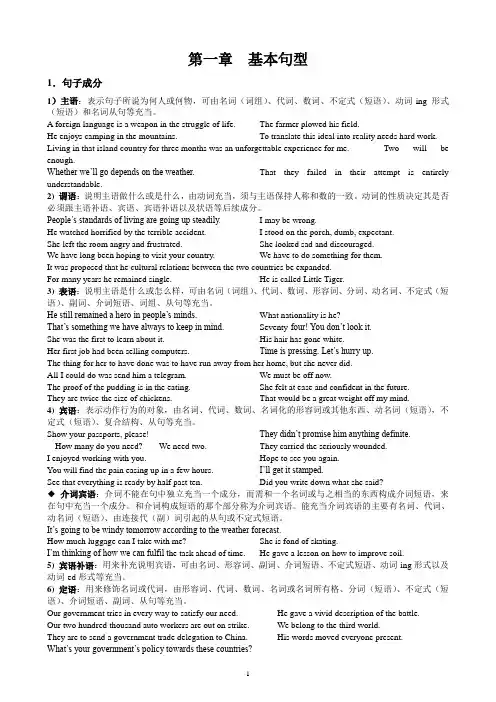
第一章基本句型1.句子成分1)主语:表示句子所说为何人或何物,可由名词(词组)、代词、数词、不定式(短语)、动词-ing 形式(短语)和名词从句等充当。
A foreign language is a weapon in the struggle of life. The farmer plowed his field.He enjoys camping in the mountains. To translate this ideal into reality needs hard work. Living in that island country for three months was an unforgettable experience for me. Two will be enough.Whether we’ll go depends on the weather.That they failed in their attempt is entirely understandable.2) 谓语:说明主语做什么或是什么,由动词充当,须与主语保持人称和数的一致。
动词的性质决定其是否必须跟主语补语、宾语、宾语补语以及状语等后续成分。
People’s standards of living are going up steadily.I may be wrong.He watched horrified by the terrible accident. I stood on the porch, dumb, expectant.She left the room angry and frustrated. She looked sad and discouraged.We have long been hoping to visit your country. We have to do something for them.It was proposed that he cultural relations between the two countries be expanded.For many years he remained single. He is called Little Tiger.3) 表语:说明主语是什么或怎么样,可由名词(词组)、代词、数词、形容词、分词、动名词、不定式(短语)、副词、介词短语、词组、从句等充当。
大学英语语法结构分析知识点汇总

大学英语语法结构分析知识点汇总大学英语的学习中,语法结构的掌握至关重要。
它不仅是理解英语句子和文章的基础,也是正确表达自己思想的关键。
以下为大家汇总了一些重要的大学英语语法结构分析知识点。
一、句子成分句子成分包括主语、谓语、宾语、定语、状语和补语。
主语通常是句子所描述的主体,一般是名词、代词或相当于名词的短语或从句。
例如:“The book is interesting”(这本书很有趣。
)中,“The book”就是主语。
谓语则是表示主语动作或状态的部分,通常是动词。
像“ He studies hard”(他学习努力。
)里,“studies”就是谓语。
宾语是动作的对象,常为名词、代词等。
比如“ She loves music”(她喜欢音乐。
)中,“music”就是宾语。
定语用于修饰名词或代词,比如“ The beautiful girl is my sister”(那个漂亮的女孩是我妹妹。
),“beautiful”就是定语。
状语用来修饰动词、形容词、副词或整个句子,说明时间、地点、原因、方式等。
例如“ He runs fast in the park”(他在公园里跑得很快。
),“fast”和“in the park”都是状语。
补语则是对主语或宾语进行补充说明,比如“ The flower smells sweet”(这花闻起来很香。
),“sweet”就是补语。
二、名词性从句名词性从句包括主语从句、宾语从句、表语从句和同位语从句。
主语从句在句子中充当主语,例如:“What he said is true”(他说的是真的。
)宾语从句在句中作宾语,像“ I don't know where he lives”(我不知道他住哪儿。
)表语从句在系动词之后,充当表语,比如“ T he problem is whetherwe can finish it on time”(问题是我们能否按时完成。
)同位语从句用于解释说明前面的名词,例如“ The news that he won the game is exciting”(他赢得比赛的消息令人兴奋。
大学英语讲义1-10

大学英语讲义1-10语法基本句型句子的主要成分是主语和谓语。
英语的基本句型有五种:主语用S表示,谓语用V表示,宾语用O表示;表语用C表示,宾语补足语也是C。
1.SV (主谓结构)2.SVC (主系表)3.S V O(主谓宾)4.S V O O(主谓+双宾)5.S V O C(主谓宾+宾补)这五种基本句型的特点:都有主语和谓语;而谓语动词类别的不同决定了谓语结构的不同,不同谓语结构决定了它后面所跟的句子成分不同,从而形成不同类型的句子。
1.主谓结构(SV)for example: The fruit store has closed.那家水果店关门了。
They have been singing and dancing for two hours.他们又唱又跳已经两个小时了。
The plane will take off soon.飞机很快就要起飞。
They will fly to London.他们将飞往伦敦。
2.主――系――表(SVC)系动词表示主语的性质、状态。
常用系动词:be, become, look, seem, appear, get, feel, grow(变得), turn(变成), remain (仍然是), come(变得), fall(变得),hold(保持),keep(保持),stand(保持),stay(保持),smell(闻起来),sound (听起来),taste(尝起来)go: 作系动词时,意为:变得The milk has gone bad.牛奶已经变质了。
For example:(1)The motor is out of order.这台电机出了毛病。
(2)Her mother has fallen ill.她母亲生病了。
(3)The weather is getting quite warm.天气变得相当暖和。
(4)The roses smell sweet.这些玫瑰气味很香。
英语中的主语、谓语、宾语、定语、状语、补语和表语
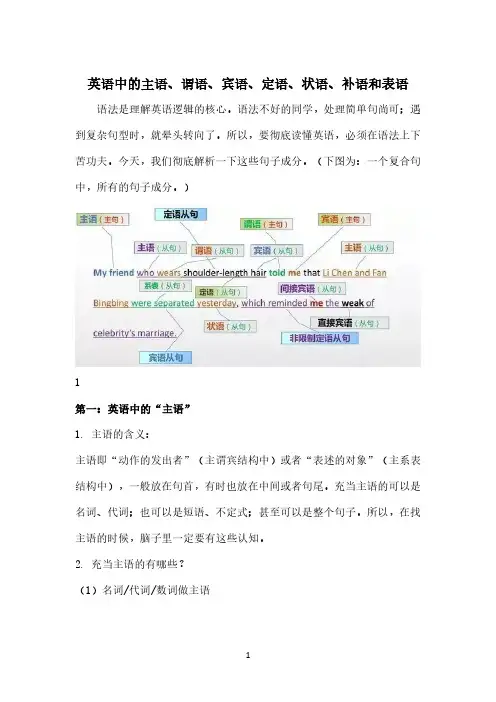
英语中的主语、谓语、宾语、定语、状语、补语和表语语法是理解英语逻辑的核心。
语法不好的同学,处理简单句尚可;遇到复杂句型时,就晕头转向了。
所以,要彻底读懂英语,必须在语法上下苦功夫。
今天,我们彻底解析一下这些句子成分。
(下图为:一个复合句中,所有的句子成分。
)1第一:英语中的“主语”1. 主语的含义:主语即“动作的发出者”(主谓宾结构中)或者“表述的对象”(主系表结构中),一般放在句首,有时也放在中间或者句尾。
充当主语的可以是名词、代词;也可以是短语、不定式;甚至可以是整个句子。
所以,在找主语的时候,脑子里一定要有这些认知。
2. 充当主语的有哪些?(1)名词/代词/数词做主语(2)不定式/名词化短语做主语(3)从句做主语(即主语从句)从句做主语的句子,就是我们学过的“主语从句”。
主语从句可以由连词that/whether引导;也可以由关系代词what/who/which引导;还可以由连接副词how/when/why/where引导。
详情如下:(4)有时为了避免头重脚轻,经常会借助“it”充当形式主语,而真正的主语则放在句尾:(5)“There be …”句型“there be…”比较特殊。
在这种句型中,主语的位置在中间。
比如:There are six beautiful French ladies walking on the street. 大街上有六位漂亮的法国女郎在散步。
2第二:英语中的“谓语”1. 含义:谓语是句子的灵魂,主要用来“陈述主语的状态”或者“表明主语发出的动作”。
2. 分类:简单谓语复合谓语(1)简单谓语:由一个动词或者一个动词短语构成谓语;I love my girlfriend.我爱我的女朋友。
My boss stayed up late last night.我的老板昨晚熬夜了。
(2)复合谓语:① 情态动词/助动词+动词构成② 系动词+表语构成③ 情态动词+系动词:3第三:英语中的“宾语”含义:宾语与主语相对,表示动作的承受者。
英语语法的主谓宾讲解学习
组成句子的各个部分叫句子成分。
英语句子成分有主语,谓语,表语,宾语,宾语补足语,定语,状语等。
顺序一般是主语,谓语,宾语,宾语补足语,而表语,定语,状语的位置要根据情况而定。
1、主语主语表示句子主要说明的人或事物,一般由名词,代词,数词,不定式等充当。
He likes watching TV.他喜欢看电视。
2、谓语谓语说明主语的动作,状态或特征。
一般可分为两类:1),简单谓语由动词(或短语动词)构成。
可以有不同的时态,语态和语气。
We study for the people.我们为人民学习。
2),复合谓语:情态动词+不定式I can speak a little English.我可以说一点英语。
3、表语表语是谓语的一部分,它位于系动词如be之后,说明主语身份,特征,属性或状态。
一般由名词,代词,形容词,副词,不定式,介词短语等充当。
My sister is a nurse.我姐姐是护士。
4、宾语宾语表示动作行为的对象,跟在及物动词之后,能作宾语的有名词,代词,数词,动词不定式等。
We like English.我们喜欢英语。
有些及物动词可以带两个宾语,往往一个指人,一个指物,指人的叫间接宾语,指物的叫直接宾语。
He gave me some ink.他给了我一点墨水。
有些及物动词的宾语后面还需要有一个补足语,意思才完整,宾语和它的补足语构成复合宾语。
如:We make him our monitor.我们选他当班长。
5、定语在句中修饰名词或代词的成分叫定语。
用作定语的主要是形容词,代词,数词,名词,副词,动词不定式,介词短语等。
形容词,代词,数词,名词等作定语时,通常放在被修饰的词前面。
He is a new student.他是个新生。
但副词,动词不定式,介词短语等作定语时,则放在被修饰的词之后。
The bike in the room is mine.房间里的自行车是我的。
6、状语修饰动词,形容词,副词以及全句的句子成分,叫做状语。
大学英语语法之主语
大学英语语法之主语1、主语:(1)由名词、代词(人称代词用主格)、动词不定式、动名词等充当,说明动作是“谁”发出的,主语是句子陈述的对象,说明是谁或什么,表示句子说的是“什么人”,或”什么事“,如“我写字”中的“我”,做出写字这个动作。
“写”则是谓语,“字”是宾语,是接受谓语“写”这个动作的对象,因此是宾语。
如:The painter painted a very nice picture. (画家画了一幅美丽的画。
) / They fought against SARS bravely. (他们英勇地与非典搏斗。
) / To see is to believe. (耳听为虚眼见为实). / Helping animals is to help people. (关心动物就是关心人类。
)(2)动词不定式或动名词做主语时可用it代替,而不定式或动名词移至表语或宾语之后。
如:It is very comfortable to have a Class A seat during the long journey. (在长途旅行中能有个甲等座位简直太愉快轻松了。
) / Eating too much is bad for your health.(=It is bad for your health eating too much.) (吃得太多对你的身体不利。
)(比较好看,避开头重脚轻)(3)口语中常见主语或“主--系”省略:(It is) nothing. ((那)没有什么。
)/ (It) doesn’t matter. ((那)没有关系。
) / (I) thank you. ((我)感谢你。
)(4)反意问句的附加问句,主语必需是代词:The man looksworried, doesn’t he? (这个人看上去很焦急不是吗?) / Tigers are dangerous animals, aren’t they? (老虎是危急的动物不是吗?)(5)祈使句一般省略主语。
主语和谓语精讲
主语主语的用法:主语是句子陈述的对象,说明是谁或什么。
主语可以用这些词类或形式来担任:名词、代词、数词、不定式、动词的ing形式、从句等可作句子的主语。
名词或名词短语作主语Some young people can't settle down to their own business.Weather in our coastal city is nice and cool in summer.代词作主语:This is all I want.Nothing else.She has already left China for Chile.数词作主语:通常被看作整体,谓语动词用单数Three is enough for each of us.Four and five makes nine.Have you worked it out,Jeff?名词化形容词和名词化分词表示一类人作主语,谓语动词常用复数。
The sick and the old need our help.The wounded should be sent to hospital at once.动词不定式或-ing形式作主语:a. 区别动词不定式,不定式作主语表示特定的、一次性的事情;动词的-ing形式作主语表示经常性的、习惯性或职业性的事情;b. V-ing形式和to do不定式作主语时常用it作形式主语,用形容词或名词作表语,常用的句型是:It is + adj./ n. for sb. to do sth. 但如果形容词是:good,worthwhile, useless, use,worth等时后面则用-ing形式。
如:It is necessary for us to master another foreign language.It’s no use crying over the spilt milk.主语从句在句中作主语的名词性从句称为主语从句,主语从句所对应的谓语动词通常用第三人称单数的形式。
第一单元基础语法
第一单元基础语法语法是语言的基础,是用来组织和表达思想的工具。
在学习语言的过程中,掌握基础语法知识是非常重要的。
本文将介绍第一单元的基础语法内容,包括主语和谓语、单数和复数、动词时态、名词的所有格和代词的人称。
一、主语和谓语主语是句子中起名词或代词作用的部分,而谓语则是表达主语行为、状态或属性的动词。
在句子中,主语和谓语通常是不能缺少的。
例如:1. 主语和谓语都是名词:My sister sings beautifully.2. 主语是名词,谓语是动词:They play basketball every Sunday.3. 主语是代词,谓语是动词:She reads a book.二、单数和复数英语中,名词可以是单数形式,也可以是复数形式。
通常情况下,加“-s”或者“-es”可以将名词变为复数。
例如:1. 单数名词:dog, book, apple2. 复数名词:dogs, books, apples需要注意的是,在一些特殊情况下,名词的变化规则可能不同,例如:man-men, child-children。
三、动词时态动词时态表达的是动作或状态发生的时间。
在英语中,常用的时态有过去时、现在时和将来时。
例如:1. 过去时:They went to the park yesterday.2. 现在时:I am reading a book now.3. 将来时:We will visit the museum tomorrow.四、名词的所有格名词的所有格表示名词所属关系或者所具有的特征。
通常在名词后加上“'s”来构成所有格。
例如:1. 单数名词的所有格:Tom's book2. 复数名词的所有格:The students' bags五、代词的人称代词用来替代名词,以避免重复使用。
在英语中,代词包括人称代词和物主代词。
人称代词根据在句子中充当主语、宾语或者宾格而有不同的形式。
英语句子成分主语谓语宾语表语定语状语补语同位语讲解
英语主谓宾表定状补成分精简讲解一.主语:主语(subject) 是一个句子的主题( theme),是句子所述说的主体。
它的位置一般在一句之首。
可用作主语的有单词、短语、从句乃至句子。
1.名词作主语。
A tree has fallen across the road. (倒下横在)Little streams feed big rivers. ( 小河流入大江。
)2.代词用作主语。
You’re not far wrong. (你差不多对了)。
He told a joke but it fell flat. (他说了个笑话,但没有引人发笑)3.数词用作主语。
Three is enough. 三个就够了。
Four from seven leaves three. 7减4余3。
4.名词化的形容词用作主语。
The idle are forced to work. 懒汉被迫劳动。
Old and young marched side by side. 老少并肩而行。
5.副词用作主语。
Now is the time. 现在是时候了。
Carefully does it. 小心就行。
6.名词化的介词作主语。
The ups and downs of life must be taken as they come.7.不定式用作主语。
To find your way can be a problem.你能否找到路可能是一个问题。
It would be nice to see him again.8.动名词用作主语。
Smoking is bad for you. Watching a film is pleasure,but making one is hard work.9.名词化的过去分词用作主语。
The disabled are to receive more money. The deceased died of old age.10.介词短语用作主语。