
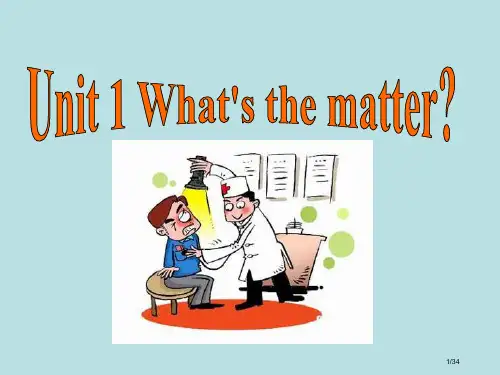
Unit 1 What’s the matter公开课
提出建议
You shouldn’t …
表达希望
I hope you will feel better soon.
Dear Gina , I’m sorry to hear that you have a bad cold, a headache and a fever. Because of the cold weather ,many people have had a cold . I think you should drink lots of hot water and wear warm clothes . You’d better lie down and rest . It’s best for you to go to a doctor and take some medicine. You shouldn’t go to school. It’s important for you to keep healthy. I hope you will feel better soon.
【2013安徽】 B The people in Ya'an have met lots of difficulties, but they haven’t __________hope. A. picked up B. given up C. looked for D. waited for
Writing guide
( ) 1. What is wrong with Lily’s sister? A. She has a bad cold. B. She has a fever. Dialogue 1 C. She has a sore throat. ( )2. Where should Lily be tomorrow? A. At the party. B. At home. C. At work. _________________________________________________ ( )3. What’s the matter with the young man? A. He has a toothache. B. He has stomachache. C. He has a headache. ( )4. When did it start? A. Two days ago. B. Three days ago. Dialogue 2 C. Three weeks ago. ( )5. What shouldn’t he do? A. He shouldn’t take any medicine. B. He shouldn’t eat too many ice creams. C. He shouldn’t go to school.
3.表达祝愿。 祝愿朋友早日康复,用到的句型有
“I hope you will feel better soon.”
高分模板
点出话题
I’m sorry to hear that you have a … In my opinion, you should … You’d better…. It’s best for you to …
(写作指导 )
如何对他人的健康问题提出建议 本单元的话题是谈论健康,围绕身体不适而展开,要求我 们能准确表达出自身健康方面存在的问题,并针对这些疾 病提出合理的建议,从而让我们懂得去关心他人,体贴他 人。 这也是中考和单元测试中常考的话题作文之一。
写作案例
假如你是Mary ,你的好朋友Gina 近来因天气寒冷 得了重感冒,发高烧,头疼得厉害。请你给她 写一封信,给她一些建议,告诉她要注意身体。 要求:80词左右。
D
【2013广西玉林】 B — The meat is ____ delicious. — Yes, but don’t eat _____. A. too much; too much B. much too; too much C. too much ; much too D. much too; much too
小试身手 假如你是Mike ,你的朋友peter近来身体不 好,他常感觉身体疲劳,晚上也休息不好。知道 此事后,你给他写一封信。 在信中,你向他提 了 一些建议:要吃健康的食物,比如牛肉之类 的阳性食物;听音乐放松自己;早睡觉,晚上累 的时候不要学习;每天进行锻炼,保持健康。
请根据以上提示完成此信,信的开头和结尾已给出。
发烧: have a fever
发高烧:have a high fever
Do you know how to learn someone’s health problems? What’s the matter with sb. ? =What’s the trouble with sb. ? =What’s wrong with sb. ?
Write different health problems next to the body parts • • • • • • • Head : have a headache Tooth : have a toothache Stomach: have a stomachache Back : have a sore back /have a backache Throat : have a sore throat Leg : have a sore leg Other problems: 感冒:have a cold /colds 重感冒: have bad colds
【2013安徽】 B You _____ drive your car so fast. It’s very dangerous. A. wouldn’t B. shouldn’t C. couldn’t D. mightn’t 【2013广东】 Boys, don’t lose____ in playing Angry Birds. It is bad for your eyes to play computer games for a long time. A. himself B. yourself C. themselves D. yourselves
中考链接
【2013湖北孝感】 C -_________? - I have a headache and I don’t feel like eating anything. A. How are you B. What can I do for you C. What’s the matter with you D. How do you like it 【2013山东莱芜】 B —Tony, What’s ___ matter with you? — I have _____ toothache. A. a; the B. the; a C. /; the D. the; /
Unit 1 What’s the matter? Self Check
Language goals :
• Talk about health problems and accidents • Give advice
body
身体
parts(部分)of the body
eye face head mouth
思路点拨:
本文以朋友身体不适为主 1.开门见山,点明题意。 线,以提出建议为主要内容,因此首先要描述他 的病情,因为此文的体裁是一封信,可由“I’m sorry to hear that …”引出话题,用到的句型有 “I have a cold /a headache /a fever.”
2.提出建议。针对不同病情,提出不同的建议, ldn’t…”
---你怎么了?---我感冒了。
---What’s the matter with you? ---I have a cold.
---你哥哥怎么了? ---他头痛。
---What’s the matter with your brother? ---He has a headache .
If someone has a health problem, what should he/she do? Can you give some advice?
Alan cut himself . Cindy has a headache .
My cousins have bad colds.
Jack hurt his back playing volleyball.
Let’s listen to the dialogues about health problems.
D 【2013湖北黄石】 Seeing their teacher ___ into the classroom, they stopped ______ at once. A. walk; telling B. entering; to speak C. enter; to tell D. walking; talking A 【2013湖南益阳】 35. He used to _____in a small village, but now he has been used to ____in a big city. A. live; living B. live; live C. living; living
Put these questions and answers in order to make a conversation
2 hurt myself playing soccer. I have a sore leg . ____I ____I 5 think you should see a doctor and get an X-ray. 1 ____What’s the matter? ____What should I do ? 4 ____OK, thanks . I’ll do that now . 6 _____Oh, that doesn’t sound good . 3
2024年What’sthematter公开课上课课件精选
2024年What’s the matter公开课上课课件精选一、教学内容二、教学目标1. 学生能够运用目标词汇和句型询问和描述健康和身体不适。
2. 学生能够在实际场景中进行有效沟通,关心他人身体状况。
3. 学生通过小组合作,提高口语表达和听力理解能力。
三、教学难点与重点1. 教学难点:正确运用词汇描述不同的身体不适,如headache, stomachache等。
2. 教学重点:掌握询问他人身体状况的句型"What’s the matter? How do you feel?",并能灵活运用。
四、教具与学具准备1. 教具:PPT,单词卡片,身体部位道具。
2. 学具:学生用书,活动手册,彩色笔。
五、教学过程1. 导入:通过展示一张描绘各种身体不适的图片,引导学生用英语讨论,激发学习兴趣。
2. 呈现:呈现新词汇和句型,教师通过身体动作和表情,帮助学生理解和记忆。
3. 实践:学生两人一组,用目标句型询问和描述身体不适,进行角色扮演。
4. 互动:开展小组活动,学生模拟医生和患者,运用所学知识进行沟通。
5. 巩固:进行随堂练习,包括填空、选择和句型转换等,巩固所学内容。
六、板书设计1. 中心词汇:sick, hurt, tired, headache, stomachache2. 重点句型:What’s the matter? How do you feel?3. 小组活动:医生与患者角色扮演七、作业设计情景一:小明的朋友小华生病了,小明去探望他,询问他的身体状况。
情景二:小芳在体育课上受伤,老师关心地询问她的情况。
2. 答案示例:情景一:What’s the matter with you, Xiaohua?I have a fever and a sore throat.How do you feel now?I feel a little better, thanks for asking.情景二:Are you okay, Xiaofang?I hurt my ankle when I was playing basketball.How does it feel?It’s a bit swollen and painful, b ut I can still walk.八、课后反思及拓展延伸1. 反思:关注学生在课堂中的参与度,鼓励他们大胆开口说英语,提高口语表达能力。
Unit 1 What’s the matter 公开课一等奖课件
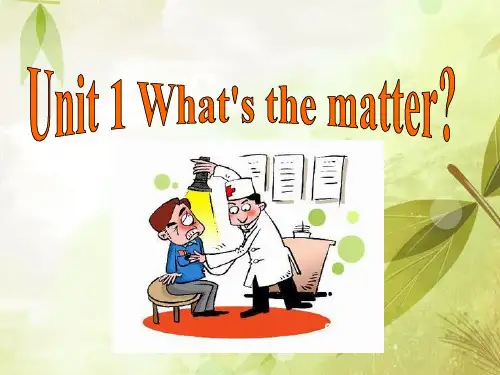
Listen to the conversations again and fill in the blanks.
Conversation 1 Nurse: What’s the matter, Sarah? Girl: I _h_a_v_e_a__co_l_d_. Conversation 2 Nurse: What’s the matter, David? Boy: I _g_o_t_a_s_t_o_m__a_ch__a_ch__e. Conversation 3 Nurse: What’s the matter, Ben? Boy: I _h_a_v_e_a__s_o_re__b_a_c_k_.
Can you name the parts of the body?
matter n. 问题;事情
sore
adj. 疼痛的;酸痛的
have a cold 感冒
stomachache n. 胃痛;腹痛 (stomach)
have a stomachache 胃痛
foot
n. 脚;足
neck
n. 脖子
fever. What did you do on the weekend? Lisa: I played computer games all weekend. Mandy: That’s probably why. You need to take
breaks away from the computer.
Lisa: Yeah, I think I sat in the same way for too long without moving.
Mandy: I think you should lie down and rest. If your head and neck still hurt tomorrow, then go to a doctor.
Unit 1 What’s the matter? part B 课件1-优质公开课-人教新目标8下精品
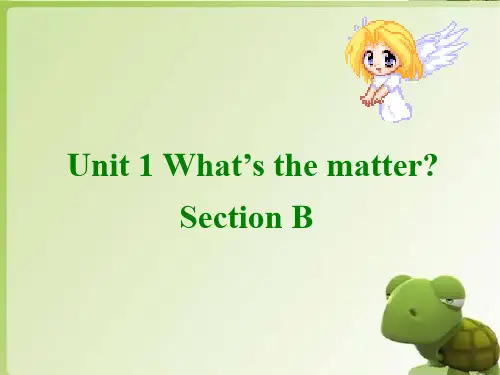
Advice
eat an apple drink some water go to bed early listen to music go to see a doctor eat more food wear less clothes do more exercises ask for help
根据提示给你的英语老师写一张请假条。 have a fever ; doctor told me to stay in bed for two days can’t go to school today ; tomorrow ; hope get well; very soon; thank you Dear Miss Ding: I’m sorry to tell you that I’m not feeling well today.
Teacher: Hello, Jenny! You look tired. Nurse: Well, today was a busy day in my office. One boy hurt hemself in P.E. class.
Teacher: What happened? Nurse: He was running under the hot sun and then he felt sick and fell down. Teacher: Yes, the weather is very hot today.
_____ Clean your face. _____ Put your head back. _____ Put on a clean T-shirt.
_____ Put a bandage on it. _____ Run it under water. _____ Put some medicine on it.
Unit1Whatsthematter市公开课一等奖省优质课获奖课件
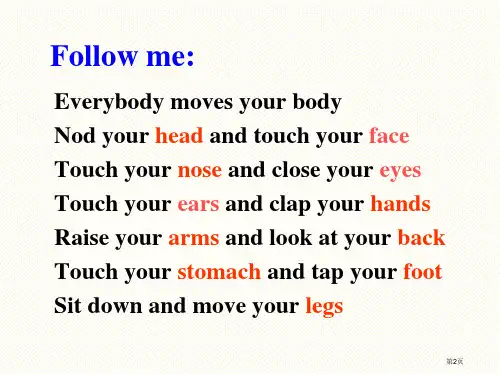
I have a headache. I have a sore throat.
第12页
Work in pairs
请加上你个性化动作
A: What’s the matter? B: I have a …
第13页
第2页
Where is his neck?
ear
face mouth
back arm hand
leg foot(feet)
head, hair eye
nose tooth(teeth) stomach
neck
第3页
Write the correct letter (a-m) for each part of the body.
have a cough
3.胃疼
have a stomachache
4.头疼
have a headache
5.牙疼
have a toothache
6.脖子疼
have a backache
7.嗓子疼, 喉咙疼 haveore back
第8页
What’s the matter?
ear
arm
hand foot
mouth
eye
neck back
stomach head
leg nose
tooth
第4页
Illness: at the doctor’s (在医生诊所)
What’s the matter?
第5页
What’s the matter?
这是问询病人病情时最惯用问句, 意思是 “怎么了?”。当问询某人怎么了,与介词 with连用。
What’s the matterw_i_t_h___ you? 你怎么啦?
unit1whats-the-matter--A-1市公开课一等奖省赛课微课金奖PPT课件
1b、Listen to the conversations again and fill in the blanks.
Conversation 1 Nurse: What’s the matter, Sarah? Girl: I _h_a_v_e_a__co_l_d_. Conversation 2 Nurse: What’s the matter, David? Boy: I _g_o_t_a_s_t_o_m__a_ch__a_ch__e. Conversation 3 Nurse: What’s the matter, Ben? Boy: I _h_a_v_e_a__s_o_re__b_a_c_k_.
fever. What d__id_ you do on the weekend? Lisa: I played computer g_a_m__e_s all weekend.
9/34
What’s the matter with him/her? He /she h_a_s__a_c_o_l_d.
have a cold have a … have a sore …
10/34
1c Look at the picture. What are the students’ problems? Make conversations.
18/34
2d Role-play the conversation.
Mandy: Lisa, are you OK? Lisa: I have a headache and I can’t move my
neck. What should I do? Should I take my temperature? Mandy: No, it doesn’t sound like you have a
公开课获奖《Unit1What’sthematter精品课件
公开课获奖《Unit 1 What’s the matter精品课件一、教学内容本节课选自教材《英语》七年级上册Unit 1 "What’s the matter?"。
详细内容包括:Section A 1a2d,主要围绕询问身体状况和情绪表达,学会使用What’s the matter?和How do you feel?等句型进行交流。
二、教学目标1. 让学生掌握本节课重点词汇和句型,如headache, stomachache等,并能运用这些词汇和句型询问和描述身体状况。
2. 培养学生听说能力和语言表达能力,使他们能在日常生活中运用所学知识进行有效沟通。
3. 培养学生合作精神,提高他们课堂参与度。
三、教学难点与重点1. 教学重点:掌握询问身体状况句型What’s the matter?和How do you feel?,以及相关词汇。
2. 教学难点:正确运用词汇和句型进行情景交际。
四、教具与学具准备1. 教具:多媒体课件、黑板、磁铁、卡片。
2. 学具:学生用书、练习册、笔记本。
五、教学过程1. 导入:通过播放一段关于身体状况短视频,引发学生对本节课话题兴趣。
2. 呈现:展示多媒体课件,呈现本节课重点词汇和句型,引导学生跟读并模仿。
3. 实践:分组进行角色扮演,让学生在真实语境中运用所学知识进行交流。
4. 例题讲解:讲解教材中典型例题,指导学生掌握解题方法。
5. 随堂练习:设计相关练习题,让学生巩固所学知识。
六、板书设计1. 中心话题:Unit 1 What’s the matter?2. 重点词汇:headache, stomachache, fever, dizzy, sore throat等。
3. 重点句型:What’s the matter? How do you feel?七、作业设计1. 作业题目:(1)根据所给图片,用What’s the matter?和How do you feel?编对话。
What’sthematter公开课上课课件(精选)
What’s the matter公开课上课课件(精选)一、教学内容本节课的教学内容选自人教版小学数学五年级下册第五单元《分数的乘除》中的第107页例1和第108页的练习题。
主要内容包括分数乘整数、整数乘分数以及分数乘分数的计算方法,以及与之相关的一些练习题。
二、教学目标1. 让学生掌握分数乘整数、整数乘分数以及分数乘分数的计算方法,能正确进行计算。
2. 培养学生的逻辑思维能力和解决问题的能力。
3. 通过对实际问题的解决,提高学生对分数乘除法的兴趣,增强学生的学习积极性。
三、教学难点与重点1. 教学难点:分数乘分数的计算方法和理解其运算规律。
2. 教学重点:分数乘整数、整数乘分数以及分数乘分数的计算方法。
四、教具与学具准备1. 教具:黑板、粉笔、课件。
2. 学具:练习本、铅笔、橡皮。
五、教学过程1. 实践情景引入:假设有一块巧克力,小明想要将它平均分给4个小朋友,每个小朋友能分到几份?2. 例题讲解:(1)分数乘整数:以例1为例,讲解分数乘整数的计算方法,如1/2×4=2。
(2)整数乘分数:以例2为例,讲解整数乘分数的计算方法,如3×3/4=9/4。
(3)分数乘分数:以例3为例,讲解分数乘分数的计算方法,如2/3×4/5=8/15。
3. 随堂练习:(1)完成练习题第13题,巩固分数乘整数的计算方法。
(2)完成练习题第46题,巩固整数乘分数的计算方法。
(3)完成练习题第79题,巩固分数乘分数的计算方法。
4. 课堂互动:邀请学生上台演示分数乘除法的计算过程,并讲解其计算方法。
六、板书设计1. 分数乘整数:分数×整数=分数(分子乘整数,分母不变)2. 整数乘分数:整数×分数=分数(分子乘整数,分母不变)3. 分数乘分数:分数×分数=分数(分子相乘,分母相乘)七、作业设计1. 完成练习册第1012题。
八、课后反思及拓展延伸1. 课后反思:本节课通过实践情景引入,让学生在实际问题中运用分数乘除法,提高了学生的学习兴趣。
What’s the matter公开课教学课件
What’s the matter公开课教学课件.一、教学内容本节课选自《新概念英语》第二册第四章,详细内容包括:1. 掌握询问对方身体状况的句型“What’s the matter?”;2. 学习并运用常见疾病和症状的词汇,如:headache, stomachache, fever, cold等;3. 了解如何就身体状况进行简单交流。
二、教学目标1. 能够熟练运用句型“What’s the matter?”询问他人身体状况;2. 学会描述自己的疾病和症状,如:I have aheadache/stomachache/fever/cold;3. 提高学生口语表达能力,使他们在实际生活中能够就身体状况进行简单交流。
三、教学难点与重点教学难点:正确运用疾病和症状的词汇进行表达。
教学重点:句型“What’s the matter?”的运用及口语表达能力培养。
四、教具与学具准备1. 教师准备:PPT、卡片、录音机;2. 学生准备:课本、练习本、彩色笔。
五、教学过程1. 实践情景引入(5分钟)利用PPT展示一个病人和医生的场景,引导学生关注并思考如何用英语询问和描述身体状况。
2. 例题讲解(15分钟)① 教师展示卡片,引导学生说出疾病和症状的词汇;② 教师演示句型“What’s the matter?”,并让学生模仿;③ 教师邀请学生上台演示,并进行指导。
3. 随堂练习(10分钟)① 学生两人一组,互相询问并描述身体状况;② 教师挑选几组学生进行展示,并给予评价。
4. 小组讨论(5分钟)六、板书设计1. 句型:“What’s the matter?”;2. 常见疾病和症状词汇:headache, stomachache, fever, cold 等;3. 课堂练习示例。
七、作业设计1. 作业题目:a. 用英语写一篇短文,描述自己或他人的疾病和症状;b. 采访家人或朋友,询问他们的身体状况,并用英语进行记录。
2024年What’sthematter公开课教学课件.
2024年What’s the matter公开课教学课件.一、教学内容二、教学目标1. 能够听懂、会说、会读、会写与询问身体状况相关的词汇和句型。
2. 能够在实际场景中运用所学知识进行有效沟通,询问和表达身体状况。
3. 培养学生的英语交际能力和团队合作精神。
三、教学难点与重点1. 教学难点:询问身体状况的句型和词汇的运用。
2. 教学重点:掌握What’s the matter?这个关键句型以及相关回答。
四、教具与学具准备1. 教具:PPT、黑板、录音机、磁带。
2. 学具:英语课本、练习本、彩色笔。
五、教学过程1. 导入:通过展示一幅描绘人们在医院看病的图片,引发学生对询问身体状况的话题的兴趣。
2. 呈现:教师展示PPT,呈现本节课的词汇和句型,引导学生跟读、模仿。
3. 实践:学生分成小组,进行角色扮演,模拟医院看病场景,运用所学知识进行对话。
4. 例题讲解:教师讲解Unit 1中的对话,分析句型和语法,引导学生理解。
5. 随堂练习:学生完成课本上的练习题,巩固所学知识。
7. 作业布置:布置课后作业,要求学生复习本节课所学内容。
六、板书设计1. 词汇:headache, stomachache, fever, doctor, medicine, feel, ill, what’s the matter?2. 句型:What’s the matter? / How do you feel? / Idon’t feel well. / I have a headache/stomachache/fever.七、作业设计1. 作业题目:根据课堂所学,编写一段关于询问身体状况的对话。
2. 答案示例:A: What’s the matter, Tom?B: I don’t feel well. I have a headache.A: Do you need to see a doctor?B: Yes, I will go to the hospital.八、课后反思及拓展延伸1. 反思:关注学生在课堂上的参与度,及时调整教学方法,提高教学效果。
Unit1What'sthematter(5课时全英文电子教案)
(3)运用所学句型和词汇进行情景对话,表达自己的感受和关心他人。
(4)了解健康生活习惯,提高健康意识。
举例:
-学生能够根据图片或实际情景,使用句型“What's the matter?”询问他人的身体状况。
四、教学流程
(一)导入新课(5分钟)
同学们,今天我们将要学习的是“Unit 1 What's the matter?”这一章节。在开始之前,我想先问大家一个问题:“你们在日常生活中是否遇到过身体不适的情况?”比如头痛、牙痛或胃痛等。这个问题与我们将要学习的内容密切相关。通过这个问题,我希望能够引起大家的兴趣和好奇心,让我们一同探索如何用英语表达身体不适的奥秘。
2.学习描述身体不适的形容词,如:sick, tired, dizzy, sore, hurt等。
3.能够运用所学的句型和词汇进行情景对话,表达自己的感受和关心他人。
4.了解健康生活习惯,提高学生的健康意识。
二、核心素养目标
本章节的核心素养目标旨在培养学生的英语语言能力、思维品质、文化意识及学习能力:
3.重点难点解析:在讲授过程中,我会特别强调身体不适的形容词和句型的正确使用。对于难点部分,比如区分sick和ill,我会通过举例和比较来帮助大家理解。
(三)实践活动(10分钟)
1.分组讨论:学生们将分成若干小组,每组讨论一个与身体不适相关的实际问题。
2.角色扮演:为了加深理解,我们将进行角色扮演活动。这个活动将让学生们实际运用所学知识,模拟就医场景。
1.提高学生的英语语言运用能力,使其能够熟练运用所学句型和词汇描述身体不适和关心他人,达到有效沟通的目的。