
非谓语动词作宾补的比较(百度)(精)
非谓语动词作宾补的比较
姓名:唐长贵
单位:四川省内江市第一中学
英语中某些及物动词后除了要求跟有宾语外,还要求跟有宾语补足语(宾补),句子的意思才能完整。
现在分词、过去分词和不定式三种非谓语动词都可以充当宾补。
但由于它们的形式不同,表示的意义也不同。
现比较如下:
一、现在分词作宾补
现在分词作宾补表示动作当时正在进行,尚未结束,强调动作的发生过程或当时一段时间的状态。
此时,宾语与宾补之间的关系是主动的主谓关系。
下列两类动词之后通常用现在分词作宾补。
1、表“感觉”的动词:see; watch; observe; notice; look at; feel; find; catch; hear; listen to等。
例如:
I heard Tom singing an English song in the next room.
我听见汤姆在隔壁正在唱一首英语歌(汤姆正在发出“唱歌”这个动作。
)On the top of the hill, he could see smoke rising from the chimneys.
站在山顶上,他可以看到缕缕炊烟正在从烟囱里冉冉升起。
(炊烟正在发出“升起”这个动作。
)
He looked around and caught a man putting his hand into the pocket of a passenger. 他环顾四周,无意中发现一个人正在偷旅客的钱包。
(catch sb doing sth.意思是“无意发现某人(正)在做什么”。
)
He was found smoking in the hall, so he was fined heavily.
有人发现他在大厅里抽烟,结果被重罚。
2、表“使役”的动词:have; keep; get; start; send; leave; set等。
例如:
His letter left me feeling pretty bad.
他的信使我感到相当难受。
(指当时那段时间的状态。
)
What she said set me thinking.
她说的话让我深思。
(指当时那段时间“思考”的状态。
)
I’m sorry to keep you waiting so long a time.
很抱歉让您久等了。
(指当时那段时间“等待”的状态。
)
二、过去分词作宾补
过去分词作宾补,强调动作的完成和结果,此时,宾语与宾补之间的关系是被动的主谓关系。
它主要是用在下列三类动词之后。
1、表示“感觉”的动词,主要有see; watch; observe; notice; look at; feel; find;
catch; hear; listen to等。
例如:
When they got there,they found the house burnt down.
他们到那儿时,发现房子已全部烧毁。
(房子已经被“烧掉”,强调结果。
)I heard the song sung yesterday.
昨天我听到有人唱了那首歌。
(歌被人“唱”。
)
2、表示“心理状态”的动词:like; think; expect; want; wish等。
例如:
The waitress asked the American how he liked his steak cooked.
女服务员问那个美国人愿意怎么烹调牛排。
(牛排被“烹调”。
)
I wish my homework finished before five o’clock..
我希望5点前完成我的作业。
(作业被“完成”。
)
3、表示“使役”的动词:have; get; leave; keep; make; order 等。
Don’t leave those things undone..
要把那些事情做完。
(事情被“做”。
)
The teacher couldn’t make himself paid attention to because there was too much noise outside.
老师无法让(学生)集中注意力,因为外面太吵了。
(指老师本人不能被学生“注意”。
)
注意:
使役动词have接过去分词作宾补有两种意义,具体指那种意义,要根据上下语境来确定。
过去分词所表示的动作由主语让他人完成的。
例如:
1) I’ll have my hair cut tomorrow.
明天我要理发。
(虽然头发被理,但这里指主语“我”让理发师理发。
)
2) 过去分词所表示的动作是指主语所经历的一件不好的事情。
例如:
He had his leg broken when he was playing football yesterday.
他昨天打足球的时候,腿被摔断了。
(虽然腿被摔断,但这里指主语的不好的一次经历,与第一点意思显然不一样。
))
三、动词不定式作宾补
在英语中有些动词要求接动词不定式作宾补。
它表示该动作发生在谓语动词之后,属将要发生的动作。
应注意如下几个方面:
1、带to的不定式作宾补。
有这种用法的动词常见的有:ask; tell; get; wish; like;
want; expect; prefer; enable; teach; know; understand; would like; cause; force;
know; intend; permit; request; order; invite; encourage; warn; remind; oblige;
forbid; challenge; drive等。
例如:
Wei Fang asked me to go shopping with her.
魏芳叫我跟她一起去逛商场。
(“逛商场”这个动作发生在“叫”之后。
)Our teacher encouraged us to study harder.
老师鼓励我们努力学习。
(“努力学习”发生在“鼓励:之后。
)
注意:
1)当表示“见解、看法”的动词后带不定式作宾补时,其宾补形式通常是to be 或to have done。
这类词通常有:believe; consider; declare; discover; guess; declare; find; imagine; judge; feel (认为); suppose; think; understand等。
例如:
I consider him to have done wrong.
我认为他做错了。
Later, he discovered the story to be true.
后来,他发现那个故事是真实。
2)表示“好恶”的动词后带不定式作宾补时,不能用于被动。
这类动词主要动词有:like; dislike; prefer; hate; love; want等。
例如:
I hate people to tell lies.
我厌恶人说谎。
Do you prefer me to do the work by myself?
你更愿意我独自做这个工作。
3)某些短语动词后可带不定式作宾补。
这类动词主要有arrange for; ask for; call on; count on; depend on; long for; rely on; wait for等。
例如:
You can not count on Tom to help you.
别指望汤姆能够帮你。
I am waiting for you to reply.
我在等你的答复。
2、省to的不定式作宾补。
这类动词有feel; hear; listen to; have; let; make; see; look
at; notice; observe; watch。
这类动词后的宾补表示该动作已经结束或未来要发生的动作。
应注意:在主动语态中省to,在被动语态中要to, 其中have没有被动式。
例如:
We saw them play football yesterday.
昨天我们看了它们打了足球。
(表示看了“打足球”整个过程。
在主动语态中省to。
)
He was made to stand outside for two hours.
他被要求在外面占了两个小时。
(在被动语态中要加to。
)。
非谓语动词作宾补
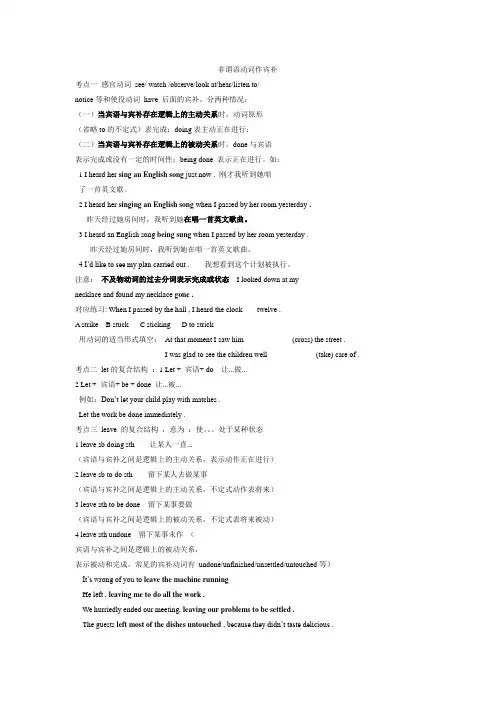
非谓语动词作宾补考点一感官动词see/ watch /observe/look at/hear/listen to/notice等和使役动词have 后面的宾补。
分两种情况:(一)当宾语与宾补存在逻辑上的主动关系时,动词原形(省略to的不定式)表完成;doing表主动正在进行;(二)当宾语与宾补存在逻辑上的被动关系时,done与宾语表示完成或没有一定的时间性;being done 表示正在进行。
如:1 I heard her sing an English song just now . 刚才我听到她唱了一首英文歌。
2 I heard her singing an English song when I passed by her room yesterday .昨天经过她房间时,我听到她在唱一首英文歌曲。
3 I heard an English song being sung when I passed by her room yesterday .昨天经过她房间时,我听到她在唱一首英文歌曲。
4 I’d like to see my plan carried out . 我想看到这个计划被执行。
注意:不及物动词的过去分词表示完成或状态I looked down at mynecklace and found my necklace gone .对应练习: When I passed by the hall , I heard the clock ___ twelve .A strikeB stuckC stickingD to strick用动词的适当形式填空:At that moment I saw him ____________ (cross) the street .I was glad to see the children well ____________ (take) care of . 考点二let的复合结构:1 Let + 宾语+ do 让...做...2 Let + 宾语+ be + done 让...被...例如:Don’t let your child p lay with matches .Let the work be done immediately .考点三leave 的复合结构,意为:使。
高考英语之非谓语动词作宾补,表语,同位语,独立主格

高考英语之非谓语动词作宾补宾补——宾语补足语,即对宾语的补充说明。
这种语法现象出现频率很高,但是,不是所有动词都有宾补。
非谓语作宾补的形式也不尽相同。
本文详细讲解了高考考点的相关内容。
下面举些简单的宾补例子。
例如:——The dog keeps me happy. 那只让我很开心。
(形容词作宾补)——Don’t let me at home 不要让我待在家。
(介词短语作宾补)——We made him monitor. 我们选他作班长。
(名词作宾补)1.to do 作宾语补足补。
(1)某些特定词后接宾语,再接to do 作宾补。
句中的宾语常为非谓语的逻辑主语,即宾语发出非谓语的动作。
表主动,将要。
形式为:V.+ sb./sth. to do.例如:——Your mom asked you to go home and have dinner.你妈妈叫你回家吃饭。
解析:you 发出to go 和have 动作,即两者之间为主动关系。
表将要。
——Parents don’t allow their children to eat too much sugar.父母不允许他们的孩子吃太多的糖。
解析:children 发出to eat 动作,表主动,将要。
—— Students are not allowed to swim in the river.学生们不允许到河里游泳。
解析:将此被动句变成主动句:——not allow students to swim in the river. 所以还是to swim 作宾补。
常用的同类动词:advise 建议allow /permit 允许beg 祈求require/ request/demand 要求ask 询问,要求cause 导致encourage鼓励expect 盼望forbid 禁止force 强迫intend 意图invite 邀请order 命令persuade 说服prefer喜欢teach/instruct教remind提醒tell告诉want想要warn 警告wish 希望promise 答应注:下列词,用在被动句中,做主语补足语。
非谓语动词的三种形式及用法区别
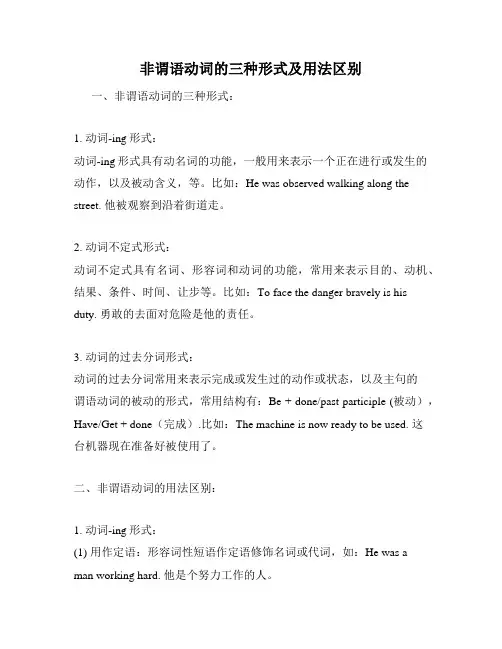
非谓语动词的三种形式及用法区别一、非谓语动词的三种形式:1. 动词-ing形式:动词-ing形式具有动名词的功能,一般用来表示一个正在进行或发生的动作,以及被动含义,等。
比如:He was observed walking along the street. 他被观察到沿着街道走。
2. 动词不定式形式:动词不定式具有名词、形容词和动词的功能,常用来表示目的、动机、结果、条件、时间、让步等。
比如:To face the danger bravely is his duty. 勇敢的去面对危险是他的责任。
3. 动词的过去分词形式:动词的过去分词常用来表示完成或发生过的动作或状态,以及主句的谓语动词的被动的形式,常用结构有:Be + done/past participle (被动),Have/Get + done(完成).比如:The machine is now ready to be used. 这台机器现在准备好被使用了。
二、非谓语动词的用法区别:1. 动词-ing形式:(1) 用作定语:形容词性短语作定语修饰名词或代词,如:He was aman working hard. 他是个努力工作的人。
(2) 用作表语:Ing 形式的短语作表语,表示一个正在进行的动作或状态,如:His job is repairing the machine. 他的工作是修理机器。
2. 动词不定式形式:(1) 作宾补:动词不定式作宾补表示“目的”,“动机”,“结果”,“条件”,“时间”,“让步”等。
如:He came here to do something for us. 他来这里为我们做一些事情。
(2) 作状语:动词不定式作状语,表示“目的”,“动机”,“条件”,“时间”,“让步”等。
如:She always goes out for a walk to relax herself. 她总是出去散步来放松自己。
非谓语动词作宾语补足语讲解与练习(修订版)
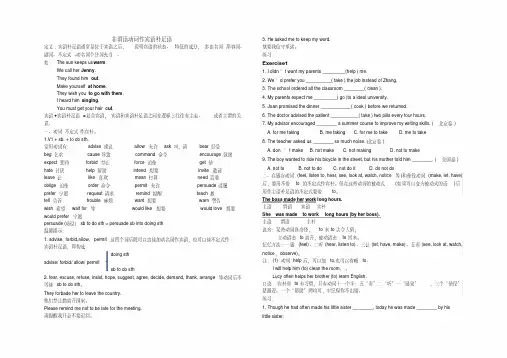
非谓语动词作宾语补足语定义:宾语补足语通常是位于宾语之后,说明宾语的状态、特征的成分,多由名词,形容词、副词、不定式,动名词个分词充当.如:The sun keeps us warm.We call her Jenny.They found him out.Make yourself at home.They wish you to go with them.I heard him singing.You must get your hair cut.宾语+宾语补足语=复合宾语,宾语和宾语补足语之间在逻辑上往往有主表、或者主谓的关系.一、动词不定式作宾补。
1.V1 + sb. + to do sth.常用动词有:advise 建议allow 允许ask 叫,请bear 忍受beg 乞求cause 导致command 命令encourage 鼓励expect 期待forbid 禁止force 迫使get 使hate 讨厌help 帮助intend 想要invite 邀请leave 让like 喜欢mean 打算need 需要oblige 迫使order 命令permit 允许persuade 说服prefer 宁愿request 请求remind 提醒teach 教tell 告诉trouble 麻烦want 想要warn 警告wish 希望wait for 等would like 想要would love 想要would prefer 宁愿persuade (劝说)sb to do sth = persuade sb into doing sth温馨提示:1.advise, forbid,allow, permit 这四个词后既可以直接加动名词作宾语,也可以接不定式作宾语补足语,即构成doing sthadvise/ forbid/ allow/ permitsb to do sth2.fear, excuse, refuse, insist, hope, suggest, agree, decide, demand, thank, arrange 等动词后不可接sb to do sth。
非谓语动词作宾语补足语讲解与练习(修订版)(可编辑修改word版)

非谓语动词作宾语补足语定义:宾语补足语通常是位于宾语之后,说明宾语的状态、特征的成分,多由名词,形容词、副词、不定式,动名词个分词充当.如:The sun keeps us warm.We call her Jenny.They found him out.Make yourself at home.They wish you to go with them.I heard him singing.You must get your hair cut.宾语+宾语补足语=复合宾语,宾语和宾语补足语之间在逻辑上往往有主表、或者主谓的关系.一、动词不定式作宾补。
1.V1 + sb. + to do sth.常用动词有:advise 建议allow 允许ask 叫,请bear 忍受beg 乞求cause 导致command 命令encourage 鼓励expect 期待forbid 禁止force 迫使get 使hate 讨厌help 帮助intend 想要invite 邀请leave 让like 喜欢mean 打算need 需要oblige 迫使order 命令permit 允许persuade 说服prefer 宁愿request 请求remind 提醒teach 教tell 告诉trouble 麻烦want 想要warn 警告wish 希望wait for 等would like 想要would love 想要would prefer 宁愿persuade (劝说)sb to do sth = persuade sb into doing sth温馨提示:1.advise, forbid,allow, permit 这四个词后既可以直接加动名词作宾语,也可以接不定式作宾语补足语,即构成doing sthadvise/ forbid/ allow/ permitsb to do sth2.fear, excuse, refuse, insist, hope, suggest, agree, decide, demand, thank, arrange 等动词后不可接sb to do sth。
todo、doing和done作补语地比较

to do、doing和done 作补语的比较一、在介词with后作宾补的非谓语动词形式1. with+宾+done,表示宾语与过去分词在逻辑上是被动关系,且意味着该动作已经完成或无时间性;2.with+宾+doing,表示宾语与现在分词在逻辑上是主动关系,且表示动作的持续进行;3.with+宾+to do,则表示将来的动作,宾语与不定式在逻辑上可以是主动关系也可以是被动关系,注意此时的不定式不是作宾补而是作宾语的定语了。
如:1.The murderer was brought in, with his hands ______behin d his back. (全国卷)A. being tiedB. having ti edC. to be tiedD. tied【分析】答案选D。
his hand与tie 是被动关系,且带进时应己捆绑好了,表示“被动、完成”用过去分词作宾补。
2.With a lot of difficult problems ________, the newly-el ected president is having a har d time. (上海春)A. settledB. settingC. to settleD. being settled【分析】答案选C。
由语境可知,问题还没有解决,用不定式指将来的动作。
3.Peter soon fell asleep with the light still (burn).【分析】彼得很快睡着了,灯仍然亮着。
burning表示持续进行。
二、其宾语后可用分词或不定式的4个动词在leave, want, get, have等动词的宾语后面可接doing、done或to do。
现分述如下:①leave…doing让…一直(主动、持续进行);leave…to do让…去做(主动、将来);leave…done(被动)。
如:1)Don’t leave the water _____ while you brush your teeth. (天津卷)A. runB. runningC. be ing runD. to run【分析】答案选B。
非谓语动词做宾语
非谓语动词做宾语,及宾补的总结一.动名词做宾语的口诀: 即:动词+v.ing考虑建议盼原谅,承认推迟没得想避免错过继续练,否认完成就欣赏禁止想象才冒险,不禁介意准逃亡难以忍受始反对,想要成功坚持忙习惯放弃有困难,导致专心防道歉。
解析:(记住口诀中对应的动词,)第一句包含的动词有:consider, suggest/advise, look forward to, excuse/pardon,第二节包含的动词有:admit, delay/put off, fancy(想像,想要),第三句包含的动词有:avoid, miss, keep/keep on, practice,第四句包含的动词有:deny(否认,拒绝), finish, enjoy/appreciate(欣赏), 第五句包含的动词有:forbid, imagine, risk(冒险)第六句包含的动词有:can't help, mind, allow/permit, escape.第七句包含的动词有:can't stand(难以忍受),set about 开始,着手,object to(反对),第八句包含动词有:feel like(想要),succeed in (成功),stick to(坚持) ,insist on(坚持,强调,坚决要求),be busy (in)(忙于做某事)第九句包含的动词有:be used/accustomed to(习惯于…),give up(放弃), have difficulty/trouble (in), (做某事有困难)第十句包含的动词有:lead to(导致), devote to(将…奉献给;把…专用于), prevent……from……(预防,防止),apologize for(为……道歉), 此外,have a good/wonderful/hard time (in), spend time (in),thank you for, pay attention to, aim at 目的在于,旨在;瞄准;企图,accuse…of…控告;谴责,get down to(开始认真处理,对待), etc.二. 通常只能接不定式作宾语的动词:(即:动词+to do) 记忆口诀如下:同意提出做计划,要求答应来帮忙。
非谓语动词作宾语补足语的用法及区别-六级语法
英语中有些及物动词后除了要求跟有宾语外,还要求跟有宾语补⾜语(简称为宾补),句⼦的意思才能完整。
宾语和宾补⼀起构成复合宾语,它们之间的关系是逻辑上的主谓关系。
英语中的三种⾮谓语动词(即V-ing形式、V-ed形式和不定式)都可以充当宾补。
但它们的形式不同,表⽰的意义不同。
在⼤学英语四级考试中出现了很多⾮谓语动词作宾补的试题。
本⽂结合这些试题讲⼀下这三种⾮谓语动词作宾补的⽤法及区别。
⼀、V-ing形式作宾补V-ing形式作宾补,表⽰动作的过程,即动作正在进⾏,尚未结束。
宾语与宾补之间是主动的逻辑主谓关系。
它主要是⽤在下列两类动词之后。
1.感觉动词,主要有see,hear,watch,observe,notice,feel,find,catch,look at,listen to等。
如:◇Suddenly he heard someone knocking gently on the window.忽然他听见有⼈轻轻敲窗⼦。
◇On the top of the hill,he could see smoke rising from the chimneys in the village.站在⼭顶上,他可以看到村⾥升起了缕缕炊烟。
如果宾语与宾补之间是被动的逻辑主谓关系,则要⽤V-ing形式的被动语态being done。
如:◇(?A?)Corn originated in the New World andthus was not known in Europe until Columbus found it _____ in Cuba.(CET-4,2000. 1-45)A)being cultivatedB)been cultivatedC)having cultivatedD)cultivating◇(?D?)The children went there to watch the iron tower _____ .(CET-4,1990.1-55)A)to erectB)erectingC)be erectedD)being erected◇You will find the matter being talked about all over the town.你会发现城⾥到处都在谈论这件事。
(完整版)非谓语动词作宾语补足语讲解与练习(修订版)
非谓语动词作宾语补足语定义:宾语补足语通常是位于宾语之后,说明宾语的状态、特征的成分,多由名词,形容词、副词、不定式,动名词个分词充当.如:The sun keeps us warm.We call her Jenny.They found him out.Make yourself at home.They wish you to go with them.I heard him singing.You must get your hair cut.宾语+宾语补足语=复合宾语,宾语和宾语补足语之间在逻辑上往往有主表、或者主谓的关系.一、动词不定式作宾补。
1.V1 + sb. + to do sth.常用动词有:advise 建议allow 允许ask 叫,请bear 忍受beg 乞求cause 导致command 命令encourage 鼓励expect 期待forbid 禁止force 迫使get 使hate 讨厌help 帮助intend 想要invite 邀请leave 让like 喜欢mean 打算need 需要oblige 迫使order 命令permit 允许persuade 说服prefer 宁愿request 请求remind 提醒teach 教tell 告诉trouble 麻烦want 想要warn 警告wish 希望wait for 等would like 想要would love 想要would prefer 宁愿persuade (劝说)sb to do sth = persuade sb into doing sth温馨提示:1.advise, forbid,allow, permit 这四个词后既可以直接加动名词作宾语,也可以接不定式作宾语补足语,即构成doing sthadvise/ forbid/ allow/ permitsb to do sth2.fear, excuse, refuse, insist, hope, suggest, agree, decide, demand, thank, arrange 等动词后不可接sb to do sth。
(完整版)2.非谓语动词作宾补(解析版)
非谓语动词作宾补(Non-verbals as OC)
• 10.With everything well ____(arrange), he left the office.
• 11.With time _______(permit) , we plan to hold a class meeting.、
非谓语动词作宾补(Non-verbals as OC)
• 1.I had my wallet _____ (steal) on a bus last month.
• 2.The villagers got many trees ____(plant) just then.
• 3.She found the door ____(break) into when she came back.
非谓语动词作宾补(Non-verbals as OC)
• 7.I heard the song ____(sing) in English. • 8.He felt himself ____(cheat). • 9.With many brightly-colored flowers
____(come) out around the building ,his house looks like a beautiful garden.
非谓语动词作宾补(Non-verbals as OC)
• 19.The last time we saw the boy _______(swim) in the river was last week.(hear, notice, observe, watch)
• 20. The villagers got their kids ___ (help) them in the fields.