
ILO 133号公约(船员舱室设备)--中英文
C133 Accommodation of Crews (Supplementary Provisions) Convention, 1970The General Conference of the International Labour Organisation,Having been convened at Geneva by the Governing Body of the International Labour Office, and having met in its Fifty-fifth Session on 14 October 1970, andNoting that the Accommodation of Crews Convention (Revised), 1949, lays down detailed specifications concerning such matters as sleeping accommodation, mess and recreation rooms, ventilation, heating, lighting and sanitary facilities on board ship, andConsidering that in the light of the rapidly changing characteristics of both the construction and the operation of modern ships further improvements in crew accommodation can be provided, andHaving decided upon the adoption of certain proposals with regard to crew accommodation, which is the second item on the agenda of the session, andHaving determined that these proposals shall take the form of an international Convention supplementing the Accommodation of Crew Convention (Revised), 1949,adopts this thirtieth day of October of the year one thousand nine hundred and seventy the following Convention, which may be cited as the Accommodation of Crews (Supplementary Provisions) Convention, 1970: 第133号公约 1970 年船员起居舱室(补充条款)公约国际劳工组织全体大会,经国际劳工局理事会召集于1970 年10 月14 日在日内瓦举行第55 届会议,注意到《1949 年船员起居舱室公约(修正本)》对船上卧室、餐室、文娱室,通风、取暖、照明和卫生设备已作了详细规定,考虑到由于现代船舶制造和操作性能变化很快,应进一步改善船员起居舱室的条件,经议决采纳本届大会议程第2 项所列关于船员起居舱室的若干提议,经决定这些提议应采取国际公约的方式,以补充《1949 年船员起居舱室公约(修正本)》,于1970 年10 月30 日通过下述公约,此公约得称为《1970 年船员起居舱室(补充条款)公约来源:英文: “Maritime Service Library” --> " ILO" / 中文: 上海国际海事信息与文献网 /news/detail.jsp?id=13366此中文本与英文版原版粗略对照过,未发现明显不同。
》PART I. GENERAL PROVISIONSArticle 11. This Convention applies to every sea-going ship, whether publicly or privately owned, which is engaged in the transport of cargo or passengers for the purpose of trade or is employed for any other commercial purpose, which is registered in a territory for which this Convention is in force, and of which the keel is laid, or which is at a similar stage of construction, on or after the date of coming into force of the Convention for that territory.2. National laws or regulations shall determine when ships are to be regarded as seagoing ships for the purpose of this Convention.3. This Convention applies to tugs where reasonable and practicable.4. This Convention does not apply to--(a) ships of less than 1,000 tons;(b) ships primarily propelled by sail, whether or not they are fitted with auxiliary engines;(c) ships engaged in fishing or in whaling or in similar pursuits;(d) hydrofoils and air-cushion craft.5. Provided that the Convention shall be applied where reasonable and practicable to--(a) ships between 200 and 1,000 tons; and(b) the accommodation of persons engaged in usual sea-going routine in ships engaged in whaling or in similar pursuits. 第一部分 总 则第1 条1.本公约适用于在本公约生效的领土上登记的、无论公有或私有的、从事货物或旅客运输或为任何其他商业目的受雇的和在本公约对该领土生效之日或之后安放龙骨或处于类似建造阶段的一切海船。
2.国家法律或条例应决定船舶何时被视为本公约所指的海船。
3.在合理可行时,本公约适用于拖船。
4.本公约不适用于:(a)小于1000 吨的船舶;(b)帆船,不论其是否配备辅机;(c)从事捕鱼或捕鲸或同类作业的船舶;(d)水翼船和气垫船。
5.如果合理可行,本公约适用于:(a)200~1000 吨的船舶;和(b)在捕鲸或类似作业的船舶上从事海上日常工作人员的起居舱室。
6. Provided also that any of the requirements applicable by virtue of Article 3 of this Convention may be varied in the case of any ship if the competent authority is satisfied, after consultation with the organisations of shipowners and/or the shipowners and with the bona fide trade unions of seafarers, that the variations to be made provide corresponding advantages as a result of which the over-all conditions are not less favourable than those which would result from the full application of the provisions of the Convention; particulars of all such variations shall be communicated by the Member concerned to the Director-General of the International Labour Office.7. Provided further that the competent authority shall, after consultation with the organisations of shipowners and/or the shipowners and with the bona fide trade unions of seafarers, determine the extent to which it is appropriate, taking into consideration the need for off-duty accommodation, to make exceptions or to diverge from the provisions of this Convention in the case of--(a) sea-going ferries, feeder ships and similar ships which are not continuously manned with one permanent crew;(b) sea-going ships when repair personnel are carried temporarily in addition to the ship's crew;(c) sea-going ships engaged on short voyages which allow members of the crew to go home or to make use of comparable facilities for part of each day.Article 2In this Convention--(a) the term ship means a vessel to which the Convention applies;(b) the term tons means gross register tons;(c) the term passenger ship means a ship in respect of which there is in force either (i) a passenger ship safety certificate issued in accordance with the provisions of the International Convention for the Safety of Life at Sea for the time being in force, or (ii) a passenger certificate; 6.根据本公约第3 条,可以修改适用于任何船舶的任一要求,只要主管当局经与船东组织和/或船东和真诚的海员工会协商后深信将要进行的修改能提供相应的有利条件且由此使所有条件不次于完全实施本公约规定所产生的条件;有关会员国应将所有这种修改的细节送交国际劳工局局长。
2013最新SOLAS公约讲解课件资料
它被认为是关于船舶与船员管理最为重要的国际公约
之一,在国际上受到高度重视
愿共同制订统一原则和有关规则,以增进海上人命安
全。
——摘自《SOLAS公约》条款
一、什么是SOLAS公约
在IMO制定所有与海上安全有关的国际公约中,
SOLAS公约是最重要,也是最早的一个。
为什么是最重要、最早?
海上交通工程
课程计划
一.什么是SOLAS公约
二.SOLAS公约产生的背景和意义 三.SOLAS公约框架结构
四.SOLAS公约相关名词解释
五.SOLAS公约第一章总则部分 六.SOLAS公约发展动态
一、什么是SOLAS公约
SOLAS公约是《国际海上人命安全公约》的简称。
(International Convention for the Safety of Life at Sea)
制定了第二个SOLAS公约 1948年,由于《1929年公约》存在的问题及更好地 总结第二次世界大战期间发生事故的教训,通过了第 三个SOLAS公约。 1960年、1974年分别在修订前一个公约的基础上制 定了新的SOLAS公约。 并且1974年SOLAS公约为现行公约。我国于1980年1 月7日加入了该公约。
五、SOLAS公约第Ⅰ章总则部分
(一)SOLAS 1974附则第Ⅰ章总则主要内容 主要内容包括3节21条 第一节(适用范围、定义等),共5条。第一节对于公
约的适用范围、有关名词的定义、适用公约的例外、免 除以及规则的生效等内容作了详细的规定。 适用范围:适用于从事国际航行的船舶;本规则各章适 用于何种船舶与适用范围,在各章中详加规定。 除另有明文规定外,本规则不适用于下列船舶: 1、军用舰艇和运兵船。 2、小于500总吨的货船。 3、非机动船。 4、制造简陋的木船。 5、非营业性的游艇。 6、渔船。
船员舱室设备(2004)

11适用范围1.1除另有明文规定者外,本篇适用于悬挂中华人民共和国国旗的国内航行海船,但不适用于下列船舶:(1)军用船舶;(2)帆船和机帆船;(3)从事捕鱼、捕鲸或类似作业的船舶。
小于1000总吨的国内航行海船参照本篇规定办理。
1.2 1999年9月1日以前建造的船舶作重大改建或变动,在可能范围内,应尽量满足本篇的要求。
1.3在合理和可行时,本篇也适用于拖船和从事海上一般作业的船上工作人员的居住舱室。
1.4船员舱室设备还应符合本法规总则与第1篇的适用规定。
2定义2.1本篇所用名词定义如下:(1)船员舱室:系指供船员用的卧室、餐厅、卫生问、医务室和休息室等;(2)高级船员:系指船上的大副、二副、三副、大管轮、二管轮、三管轮、电机员、事务长、报务主任、报务员、医生和引水员等;(3)普通船员:系指除船长、轮机长和高级船员以外的其他船员。
21卧室1.1卧室应位于最高载重线以上船的中部或后部。
当船舶的尺度、类型或营运条件受限制,卧室布置在船的中部或后部为不可能时,经同意,卧室可布置在船的前部,但无论如何不能布置在防撞舱壁之前。
对客船,在照明和通风满意的情况下,经同意,卧室可布置在最高载重线以下,但不得直接布置在作业通道的下方。
油船、散装运输危险化学品船和散装运输液化气体船等的船员舱室布置,应符合本法规有关篇章的要求。
报务员的卧室应尽可能靠近无线电工作室,但不能设在其内。
1.2普通船员卧室的最高定员,除客船为4人1间外,其他船舶一般为2人l 问。
1.3高级船员卧室一般为1人1间。
1.4等于或大于3000总吨的船舶,如有可能,应为船长、轮机长和大副提供1间与卧室相邻的会客室或工作室。
1.5船员卧室的人均甲板面积一般应不小于表1.5的规定。
1.6配有与卧室相邻的会客室或工作室时,该会客室或工作室的甲板面积一般应与表1.5中普通船员(单人间)要求相同。
1.7船长和轮机长的卧室甲板面积应不小于表1.5中高级船员要求的甲板面积。
solas公约及其修正案术语清单xls
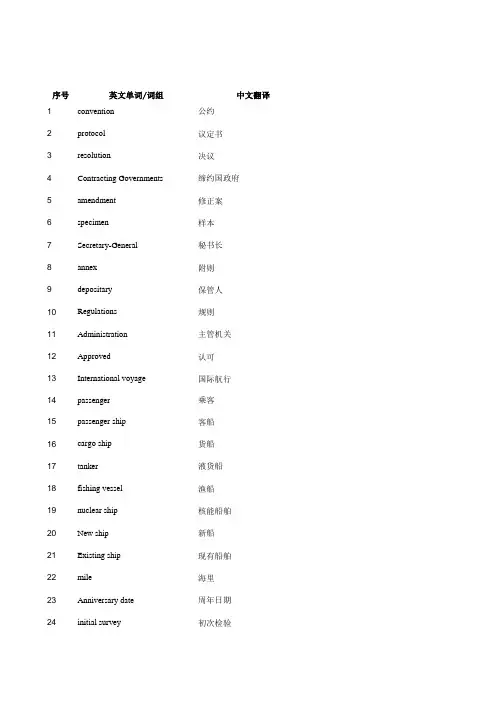
147 Ro-ro space
滚装处所
148 Ro-ro passenger ship
客滚船
149 Steel or other equivalent material 钢或其他等效材料
150 Sauna 151 Service space
桑拿房 服务处所
152 Special category space
主竖区 不燃材料 燃油装置 开式滚装处所
142 Open vehicle space 143 Passenger ship 144 Prescriptive requirement 145 Public space
开式车辆处所 客船 规定性要求 公共处所
146
Rooms containing furniture and 设有限制失火危险的家具和陈 furnishings of restricted fire risk 设的房间
59 Auxiliary steering gear
辅助操舵装置
60
Normal operational and habitable condition
正常操作和居住条件
61 Emergency condition
紧急状态
62 Main source of electrical power 主电源
63 Dead ship condition
瘫船状态
64 Main generaboard
主配电板
66 Emergency switchboard
应急配电板
67
Emergency source of electrical power
应急电源
68 Power actuating system
SOLAS公约

背景--1912年泰坦尼克号事件
概述
1912年4月,英国建造的一艘46000GT的超级 豪华邮轮“泰坦尼克”号在从英国的南安普顿 港驶往美国的纽约。 1912年4月14日,船上时间夜里11时40分, 泰坦尼克号撞上冰山; 4月15日凌晨2时20分,船裂成两半后沉入大 西洋。 泰坦尼克号海难为和平时期死伤人数最惨重的 海难之一。船上1500多人丧生。
公约性质
《SOLAS74公约》主要包含为增进航运安全的 各种各样的强制性措施。 性质转变: 1.由原来的“纯技术”公约变成“技术管理” 公约,在指导思想上发生巨大转变,意识到人 为因素在确保海上安全和防止海洋污染中所起 的重要作用。 2.将原有的公约范围从原有的船舶扩大到岸基。
大舜号事件
公约内容
1.公约正文(13条) 2.公约附则(12章) 3.议定书 4.若干修正案 正文包括公约的一般定义,适用范围、法律、 规则,不可抗力情况==
公约的核心部分是公约的附则
《SOLAS74公约》附则目录
1.总则(适用范围、定义、检验与证书和事故) 2.构造(船舶结构,分舱与稳性,机电设备, 防火、探火和灭火) 3.救生设备与装臵 4.无线电通信 5.航行安全 6.货物装运
《国际海上人命安全公约》
-SOLAS公约
SOLAS=The International Convention for the Safety of Life at Sea 宗旨:旨在对船舶及设备、船员操作、公司管理 和船旗国管理等实施有效控制,从而保障海上人 命安全的公约。 目的:提供船舶构造安全、设备安全和安全操作 的最低标准,同时要求船旗国有义务确保悬挂其 船旗的船舶达到这一要求。 证据:船舶达到公约标准的证据是必须持有公约 规定的有效证书
国际卫生条例2005世界卫生组织-船舶检查及船舶卫生证书签发推荐
1951年,《国际公共卫生条例》首次实施(1955-1956、1960、1963和1965年分别进行过修改)。1969年,该条例更名为《国际卫生条例》(1972、1981和2005年进行了修改)。《国际公共卫生条例》主要是针对六种严重传染病进行监控:霍乱、鼠疫、黄热病、天花、回归热和斑疹伤寒。在1973年和1981年修改后,《国际卫生条例》(以下简称《条例》或IHR)适用范围缩小为霍乱、鼠疫、黄热病三种应通报的检疫传染病,也就是说,一旦发生这些疾病,受染成员国需向世界卫生组织通报。
防回流装置
指安装在(饮用水)水管或者废水管中用以阻止液体在压力下降的情况下逆流的机械装置。一种经核准的预防回流装置通常安装在饮用水输送管道和气有直接或可能连接的连接处。即在生活饮用水输送系统和其他非生活饮用水源,如其他液体、混合物、物质等之间。一些防回流装置经设计后用于持续性水压以下,另外一些则为非压力类型。止回阀类型的特点是;当管道水流量大时,阀门的阀瓣摆向凹处,关闭通道,以阻止液体逆流。
20世纪90年代初,一些已知传染病再次爆发,如霍乱在南美洲部分国家流行、鼠疫在印度流行;还出现了一些新发传染病,如埃博拉出血热。为此,1995年第48届世界卫生大会形成了对《条例》进行修改的决议。2005年5月23日,第58届世界卫生大会上以WHA58.3决议形式通过了新修订的《条例》,并在2007年6月15日正式生效。
消毒
指采用卫生措施利用化学或物理因子的直接作用控制或杀灭人体或动物身体表面或行李、货物、集装箱、交通工具、物品和邮包中(上)的传染性病原体的程序。
便于清洁的
其用料和装配用一般清洁方法和清洁用品便能彻底清洁的。
覆盖
对防鼠区,可采纳的非防鼠材料的角、四周或其他外露的边角,加盖或覆盖。覆盖所用线条要用防鼠材料,宽度足以盖住啃咬边角,并且牢固连接。
ILO 32及152号公约(起重设备)-中英文

Page 2 of 14
Article 3
(1) When a ship is lying alongside a quay or some other vessel for the purpose of the processes, there shall be safe means of access for the use of the workers at such times as they have to pass to or from the ship, unless the conditions are such that they would not be exposed to undue risk if no special appliance were provided.
(b) dangerous footways over bridges, caissons and dock gates shall be fenced to a height of not less than 2 feet 6 inches (75 cm.) on each side, and the said fencing shall be continued at both ends to a sufficient distance which shall not be required to exceed 5 yards (4 m. 50).
SOLAS公约救生设备相关要求
本章所规定的救生设备和装置应经主管机关认可。 þ 除按照本条 ñ 和 ó 的规定外, 主管机关应确保该项救生设备和装置: ÿ 在救生设备和装置进行认可之前, ðþ 按照本组织的建议ÿ 进行试验, 确认其符合本章和规则的要求; 或 并使主管机关满意。 ð ÿ 业已成功地经受实质上等效于该项建议所规定的试验, 主管机关应确保该项设备或装置: ú 在新颖救生设备或装置进行认可之前, 并 按 照本 组织 的 建 议þ 已 经 鉴 ðþ 提供至少等效于本章和 规 则 所规 定的 安全标 准, 定和试验; 或 并使主管机关满意。 ð ÿ 业已成功地经受实质上等效于该项建议的鉴定和试验, ò 主管机关所采用的认可程序还应包括继续认可或撤消认可的条件。 主管机管应确信该救生设备和 ñ 在接受主管机关原先未予认可的救生设备和装置之前, 装置符合本章和规则的要求。 如其详细的技术规定未列入规则时, 应使主管机关满意。 ó 本章所要求的救生设备, 第ñ条 生产试验
PDF 文件使用 "pdfFactory Pro" 试用版本创建
ÿÿ 救生艇筏的登乘与降落布置 ………………………………………………………(þýü) 第 ûú 节 救生设备和装置的要求 ……………………………………………………(þýù) …………………………………………………………………………(þýù) ÿø [未列标题] 第ú节 其 他 ………………………………………………………………………(þýù) ÿ÷ 训练手册和船上训练用设备 ………………………………………………………(þýù) ÿö 船上维护保养须知 …………………………………………………………………(þýý) ÿü 应变部署表与应变须知 ……………………………………………………………(þýý)
船舶与海洋工程专业常用词汇英汉对照
commuter交通船
compartment舱室
compass罗经
concept design概念设计
connecting tank连接水柜
constant-pitch propeller定螺距螺旋桨
constraint condition约束条件
container集装箱
aft peak bulkhead艉尖舱壁
aft peak tank艉尖舱
aileron副鳍
air cushion vehicle气垫船
air diffuser空气扩散器
air intake进气口
aircraft carrier航空母舰
air-driven water pump气动水泵
airfoil气翼,翼剖面,机面,方向舵
classification society船级社
cleat系缆扣
clipper bow飞剪型船首
clutch离合器
coastal cargo沿海客货轮
cofferdam防撞舱壁
combined cast and rolled stem混合型艏柱
commercial ship营利用船
commissary spaces补给库舱室,粮食库
brake drum刹车卷筒
brake hydraulic cylinder制动液压缸
brake hydraulic pipe刹车液压管
breadth extreme最大宽,计算宽度
breadth moulded型宽
breakbulk件杂货
breasthook艏肘板
bridge桥楼,驾驶台
bridge console stand驾驶室集中操作台
防止海员工伤事故公约英文版
防⽌海员⼯伤事故公约英⽂版CONVENTION No. 134 Convention concerning the Prevention of Occupa-tional Accidents to Seafarers第134号公约颁布⽇期:19701030 实施⽇期:19730217 颁布单位:⽇内⽡ [Date of coming into force: 17 February 1973.] The General Conference of the International Load Organization, Having been convened at Geneva by the Governing Body of theInternational labour Office, and having met in its Fifty-fifth Session on14 October 1970, and Noting the terms of existing international labour Conventions andRecommendations applicable to work on board ship and in port and relevantto the prevention of occupational accidents to seafarers, and inparticular of the Labour Inspection (Seamen) Recommendation, 1926, thePrevention of Industrial Accidents Recommendation, 1929, the Protectionagainst Accidents (Dockers) Convention (Revised), 1932, the MedicalExamination (Seafarers)Convention, 1946, and the Guarding of MachineryConvention and Recommendation, 1963, and Noting the terms of the Safety of Life at Sea Convention, 1960, andthe Regulations annexed to the International Load Line Convention asrevised in 1966, which provide for a number of safety measures on boardship which provide protection for persons employed thereon, and Having decided upon the adoption of certain proposals with regard toaccident prevention on board ship at sea and in port, which is the fifthitem on the agenda of the session, and Having determined that these proposals shall take the form of aninternational Convention, and Noting that, for the success of action in the field of accidentprevention on board ship, it is important that close co-operation bemaintained in their respective fields between the International LabourOrganization and the Inter-Governmental Maritime ConsultativeOrganization, and Noting that the following standards have accordingly been framed withthe co-operation of the Inter-Governmental Maritime ConsultativeOrganization, and that it is proposed to seek its continuing co-operationin the application of these standards, adopts this thirtieth day ofOctober of the year one thousand nine hundred and seventy the followingConvention, which may be cited as the Prevention of Accidents (Seafarers)Convention, 1970: Article 1 1. For the purpose of this Convention, the term “seafarer” covers allpersons who are employed in any capacity on board a ship, other than aship of war, registered in a territory for which the Convention is inforce and ordinarily engaged in maritime navigation. 2. In the event of any doubt whether any categories of persons are tobe regarded as seafarers for the purpose of this Convention, the questionshall be determined by the competent authority in each country afterconsultation with the shipowners' and seafarers' organizations concerned. 3. For the purpose of this Convention, the term “occupationalaccidents” covers accidents to seafarers arising out of or in the courseof their employment. Article 2 1. The competent authority in each maritime country shall take thenecessary measured to ensure that occupational accidents are adequatelyreported and investigated, and comprehensive statistics of such accidentskept and analysed. 2. All occupational accidents shall be reported and statistics shallnot be limited to fatalities or to accidents involving the ship. 3. The statistics shall record the numbers, nature, caused and effectsof occupational accidents, with a clear indication of the department onboard ship-for instance, deck, engine or catering-and of the area-forinstance, at sea or in port-where the accident occurred. 4. The competent authority shall undertake an investigation into thecauses and circumstances of occupational accidents resulting in loss oflife or serious personal injury, and such other accidents as may bespecified in national laws or regulations. Article 3 In order to provide a sound basis for the prevention of accidentswhich are due to particular hazards of maritime employment, research shallbe undertaken into general trends and into such hazards as are brought outby statistics. Article 4 1. Provisions concerning the prevention of occupational accidentsshall be laid down by laws or regulations, codes of practice or otherappropriate means. 2. These provisions shall refer to any general provisions on theprevention of accidents and the protection of health in employment whichmay be applicable to the work of seafarers, and shall specify measuresfor the prevention of accidents which are peculiar to maritime employment. 3. In particular, these provisions shall cover the following matters: (a) general and basic provisions; (b) structural features of the ship; (c) machinery; (d) special safety measures on and below deck; (e) loading and unloading equipment; (f) fire prevention and fire-fighting; (g) anchors, chains and lines; (h) dangerous cargo and ballast; (i) personal protective equipment for seafarers. Article 5 1. The accident prevention provisions referred to in Article 4 shallclearly specify the obligation of shipowners, seafarers and othersconcerned to comply with them. 2. Generally, any obligation on the shipowner to provide protectiveequipment or other accident prevention safeguards shall be accompanied byprovision for the use of such equipment and safeguards by seafarers and arequirement that they comply with the relevant accident preventionmeasures. Article 6 1. Appropriate measures shall be taken to ensure the properapplication of the provisions referred to in Article 4, by means ofadequate inspection or otherwise. 2. Appropriate measures shall be taken to ensure compliance with theseprovisions. 3. All necessary steps shall be taken to ensure that inspection andenforcement authorities are familiar with maritime employment and itspractices. 4. In order to facilitate application, copies or summaries of theprovisions shall be brought to the attention of seafarers,for instance bydisplay in a prominent position on board ship. Article 7 Provision shall be made for the appointment, from amongst the crew ofthe ship, of a suitable person or suitable persons or of a suitablecommittee responsible, under the Master, for accident prevention. Article 8 1. Programmes for the prevention of occupational accidents shall beestablished by the competent authority with the co-operation ofshipowners' and seafarers' organizations. 2. Implementation of such programmes shall be so organized that thecompetent authority, shipowners and seafarers or their representativesand other appropriate bodies may play an active part. 3. In particular, national or local joint accident preventioncommittees or ad hoc working parties, on which both shipowners' andseafarers' organizations are represented, shall be established. Article 9 1. The competent authority shall promote and, in so far as appropriateunder national conditions, ensure the inclusion, as part of theinstruction in professional duties, of instruction in the prevention ofaccidents and in measures for the protection of health in employment inthe curricula, for all categories and grades of seafarers, of vocationaltraining institutions. 2. All appropriate and practicable measures shall also be taken tobring to the attention of seafarers information concerning particularhazards, for instance by means of official notices containing relevantinstructions. Article 10 Members, with the assistance as appropriate of intergovernmental andother international organizations, shall endeavour, in co-operation witheach other, to achieve the greatest possible measure of uniformity ofother action for the prevention of occupational accidents. Article 11 The formal ratifications of this Convention shall be communicated tothe Director-General of the International Labour Office for registration. Article 12 1. This Convention shall be binding only upon those Members of theInternational Labour Organization whose ratifications have been registeredwith the Director-General. 2. It shall come into force twelve months after the date on which theratifications of two Members have been registered with theDirector-General. 3. Thereafter, this Convention shall come into force for any Membertwelve months after the date on which its ratification has beenregistered. Article 13 1. A Member which has ratified this Convention may denounce it afterthe expiration of ten years from the date on which the Convention firstcomes into force, by an act communicated to the Director-General of theInternational Labour Office for registration. Such denunciation shall nottake effect until one year after the date on which it is registered. 2. Each Member which has ratified this Convention and which does not,within the year following the expiration of the period of ten yearsmentioned in the preceding paragraph, exercise the right of denunciationprovided for in this Article, will be bound for another period of tenyears and, thereafter, may denounce this Convention at the expiration ofeach period of ten years under the terms provided for in this Article. Article 14 1. The Director-General of the International Labour Office shallnotify all Members of the International Labour Organization of theregistration of all ratifications and denunciations communicated to him bythe Members of the Organization. 2. When notifying the Members of the Organization of the registrationof the second ratification communicated to him,the Director-General shalldraw the attention of the Members of the Organization to the date uponwhich the Convention will come into force. Article 15 The Director-General of the International Labour Office shallcommunicate to the Secretary-General of the United Nations forregistration in accordance with Article 102 of the Charter of the UnitedNations full particulars of all ratifications and acts of denunciationregistered by him in accordance with the p r o v i s i o n s o f t h e p r e c e d i n g A r t i c l e . / p > p b d s f i d = "1 1 8 " > 0 0 A r t i c l e 1 6 / p > p b d s f i d = " 1 1 9 " > 0 0 A t s u c h t i m e s a s i t m a y c o n s i d e r n e c e s s a r y t h e G o v e r n i n g B o d y o f t h e I n t e r n a t i o n a l L a b o u r O f f i c e s h a l l p r e s e n t t o t h e G e n e r a l C o n f e r e n c e a r e p o r t o n t h e w o r k i n g o f t h i s C o n v e n t i o n a n d s h a l l e x a m i n e t h e d e s i r a b i l i t y o f p l a c i n g o n th e a g e n d a o f t h e C o n f e r e n c e t h e q u e s t i o n o f i t s r e v i s i o n i n w h o l e o r i n p a r t . / p > p b d s f i d = " 12 0 " > 0 0 A r t i c l e 1 7 / p >。
II_C13_18船检规范中英文对照
13.1一般说明:13.1.1应船东申请并经本社总部同意,船体的特别检验可由船体循环检验代替。
13.1.2船体循环检验将船体特别检验的所有项目分散在特检周期中,以循环的方式进行,以使船体及其它装置的每一部分在一个特检周期内至少被检验一次,而且对任一项目的两次检验的间隔期不超过船体特别检验周期。
13.1.3实行船体循环检验的船舶,不能取消和改变其保持船级的其它检验。
13.1.4实行船体循环检验的船舶,如船龄在10年或10年以上,则其海水压载舱内部检查的循环周期应为2.5年,每个特检周期确保海水压载舱能够进行二次内部检查。
对于按此规定进行船体循环检验的船舶,其中间检验的海水压载舱内部检查可视为已包含在循环检验项目之内,中间检验的其余项目完成即可视认为中间检验完成。
13.1.5如果船东在船体特别检验之间申请启动船体循环检验,执行检验单位应将船体特别检验项目安排在申请之日至船体特别检验到期时间内,作为首次循环。
在完成首次循环后,船东可协同本社当地的机构重新将特检项目安排在一个船体特别检验周期内。
13.1.6进行船体循环检验的船舶,应授予船级符号附加标志:CHS(Continuous Hull Survey),并在船体入级证书中注明。
13.2适用范围:船体循环检验适用于除油船、混装船、散货船和化学品船以外的船舶。
对于特检周期少于5年的船舶(船级符号为4/5或3/5),原则上不允许实施船体循环检验。
13.3申请和评审(初次申请)船东或其代理人对其船舶实施船体循环检验的申请,可书面向CCS总部入级部或船藉港分社或执行检验的CCS单位提出,CCS执行检验单位在接到船东申请后,应立即向总部入级部书面报告,入级部在对申请船舶进行审查合格后,可同意进行船体循环检验的初次检验工作。
CCS执行单位在收到总部的书面许可后,按相关程序进行评审,评审合格后,执行检验单位编制船体循环检验项目单并执行有关检验。
船东或其代理人的书面申请应包括一份船舶舱室布置图的复印件。