
大学英语四级听力练习
The following questions are based on the passage you have just heard.
D 1.A)Americans.C)Central Asian people.
B)Germans.D)They invented it themselves.
B)In Germany.C)In America.D)Both A and B.
A 2.A)In Central
Asia.
A 3.A)It could be eaten with hands.C)It was rolled in a steak.
B)It was the same as sandwich.D)Its meat was cooked.
C 4.A)the process of hamburger-making
B)the popularity of the hamburger
C)the origin and development of the hamburger
D)the influence of the hamburger
Passage Two
The following questions are based on the passage you have just heard.
B 5.A)What we can learn from our colleagues.
B)How to identify and get good working habits.
C)How to behave before your boss.
D)Problems in university education.
B 6.A)He may have difficulty making friends with his colleagues.
B)He may have to handle a lot of unfamiliar situations.
C)He may feel uncomfortable in the new circumstance.
D)He will find his office is so different from his classroom.
D 7.A)They are not well-educated.
B)They failed to work hard enough at school.
C)New colleagues are often difficult to get along with.
D)What they learned in class is not adequate for their new life.
C 8.A)To find a worker and follow him closely.
B)To find a person you admire and make friends with him.
C)To find a person you respect and watch carefully how he acts.
D)To find a model and admire him.
A 9.A)Beginners just from universities.C)Company managers.
B)University authorities.D)Job applicants.
Passage Three
The following questions are based on the passage you have just heard.
C 10.A)150 years ago.C)3,000 years ago.
B)In the year 1553.D)In the 18th century.
D 11.A)To preserve fish.C)To punish criminals.
B)To help heal wounds.D)To preserve dead bodies.
A 12.A)For stealing salt.
B)For selling salt without permission.
C)For taking salt from the king’s table.
D)For making salted fish.
B 13.A)He would lose his life.C)He would lose all his salt.
B)He would lose one ear.D)He would be heavily fined.
C 14.A)In front of important guests.C)In front of the king.
B)In front of less important guests.D)In the middle of the table.
Stamp-collecting, once exclusively the (15)_ _ _ _ _ of small boys and an all-consuming (16)_ _ _ _ _ _ _ for the older enthusiast, has now (17)_ _ _ _ _ _ the target of financial speculators. Stamps are both (18)_ _ _ _ _ _ _ _ and negotiable (19)_ _ _ _ _ _ _ _ and have thus (20)_ _ _ _ _ _ _ _ _ investors with no knowledge of the subject. However, many of these people have burned their (21)_ _ _ _ _ _ _ as all forms of investment require (22)_ _ _ _ _ _ _ _ _ _ _ knowledge.
There are many cautionary tales. The Post Office issued three stamps to commemorate the 1966 World Cup held in England. When England won the Cup, the fourpenny value was overprinted with the words “England Winners”
(23)_ _ _ _ _ _ _ _ _ _ _ _ _ _ _ _ _ _ _ _ _ _ _ _ _ _ _ _ _ _ _ _ _ _ _ _ _ _ _ _ _
_ _ _ _ _ _ _ _ _ _ _ _ _ _ _ _ _ _ _ _ _ _ _ _ _ _ _ _ _ _ _ _ _ _ _ _ _ _ _ _ _ _ _ _ _ _ _ _ _ _ _ _ _ _ _ _ _ _ _ _ _ _ _ _ _ _ _ _ _ _ _ _ _ _ _ _ _ _ _ _ _ _ _ _ _ _ However, interesting stamps ― partic ularly stamps from the nineteenth century in good condition ― will always be a sound investment. (24)_ _ _ _ _ _ _ _ _ _ _ _ _ _ _ _ _ _ _ _ _ _ _ _ _ _ _ _ _ _ _ _ _ _ _ _ _ _ _ _ _ _ _ _ _ _ _ _ _ _ _ _ _ _ _ _ _ _ _ _ _ _ _ _ _ _ _ _ _ _ _ _ _ _ _ _ _ _ _ _ _ _ _ _ _ _ _ _ _ _ _ _ _ _ _ _ _ _ _ _ _ _ _ _ _ _ _ _ _ _ _ _ _ _ _ _ _ _ _ _ _ _ _ _ _ _ _ _ _ _ _ _ _ _ _ _ _ _ _ _ _ _ . Surprisingly the first stamp ever issued, the British 1840 Penny Black, is not that much of a rarity and will never have the value of, say, the Mauritius One Penny of 1859\。
2023年12月大学英语四级听力试题
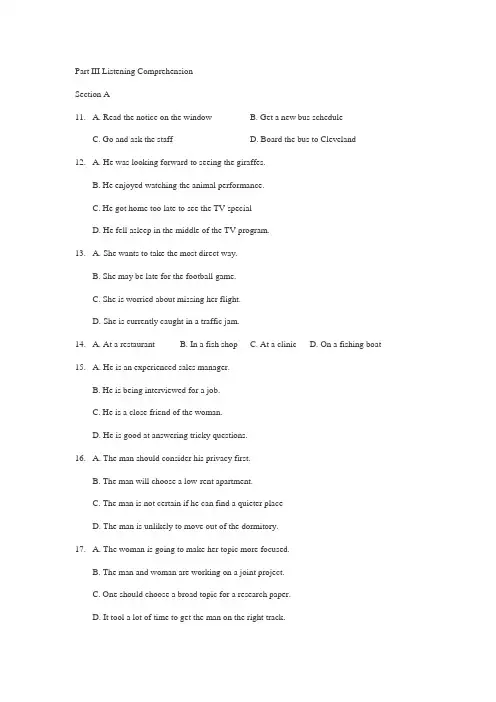
Part III Listening ComprehensionSection A11. A. Read the notice on the window B. Get a new bus scheduleC. Go and ask the staffD. Board the bus to Cleveland12. A. He was looking forward to seeing the giraffes.B. He enjoyed watching the animal performance.C. He got home too late to see the TV specialD. He fell asleep in the middle of the TV program.13. A. She wants to take the most direct way.B. She may be late for the football game.C. She is worried about missing her flight.D. She is currently caught in a traffic jam.14. A. At a restaurant B. In a fish shop C. At a clinic D. On a fishing boat15. A. He is an experienced sales manager.B. He is being interviewed for a job.C. He is a close friend of the woman.D. He is good at answering tricky questions.16. A. The man should consider his privacy first.B. The man will choose a low-rent apartment.C. The man is not certain if he can find a quieter placeD. The man is unlikely to move out of the dormitory.17. A. The woman is going to make her topic more focused.B. The man and woman are working on a joint project.C. One should choose a broad topic for a research paper.D. It tool a lot of time to get the man on the right track.18. A. They went camping this time last year.B. They didn’t quite enjoy their last picnic.C. They learned to cooperate under harsh conditions.D. They weren’t experienced in organizing picnics.Questions 19 to 22 are based on the conversation you have just heard.19. A. H e likes Sweden better than England.B. He prefers hot weather to cold weather.C. He is an Englishman living in Sweden.D. He visits London nearly every winter.20. A. The bad weather B. The gloomy winter C. The cold houses D. The long night21. A. Delightful B. Painful C. Depressing D. Refreshing22. A. They often stay up late reading B. They work hard and play hardC. They like to go camping in summerD. They try to earn more and spend more Questions 23 to 25 are based on the conversation you have just heard.23. A. English Literature B. Management C. French D. Public Administration24. A. English teaching B. Staff trainingC. Careers guidanceD. Psychological counseling25. A. Its generous scholarships B. Its worldwide fameC. Its well-designed coursesD. Its pleasant environmentSection BPassage One26. A. Characteristics of Japanese artists B. Some features of Japanese cultureC. The art of Japanese brush paintingD. The uniqueness of Japanese art27. A. To calm themselves down B. To enhance concentrationC. To show their impatienceD. To signal lack of interest28. A. How listeners in different cultures show respectB. How speakers can win approval from the audienceC. How speakers can misunderstand the audienceD. How different Western and Eastern art forms arePassage Two29. A. Directing personnel evaluation B. Buying and maintaining equipmentC. Drawing up plans for in-service trainingD. Interviewing and recruiting employees30. A. Some of his equipment was damaged in a fireB. The training program he ran was a failureC. Two of his workers were injured at workD. Two of his employees committed theft31. A. A better relationship with his boss B. Advancement to a higher positionC. A better-paying job in another companyD. Improvement in the company’s management32. A. She has more self-confidence than ChrisB. She works with Chris in the same divisionC. She has more management experience than ChrisD. She is competing with Chris for the new jobPassage Three33. A. They help us see the important values of a cultureB. They guide us in handling human relationshipsC. They help us express ourselves more effectivelyD. They are an infinite source of human knowledge34. A. Their wording may become different B. The values they reflect may changeC. Their origins can no longer be tracedD. They may be misinterpreted occasionally35. A. Certain values are shared by a large number of culturesB. Some proverbs are assuming more and more importanceC. Old proverbs are constantly replaced by new onesD. Certain values have always been central to a cultureSection CDictationOur lives are woven together. As much as I enjoy my own 36________. I no longer imagine I can get through a 37________ day, much less all my life, 38________ on my own. Even if I am on 39________ in the mountains, I am eating food someone else has grown, living in a house some else has built, wearing clothes someone else has 40________ from cloth woven by others, using 41________ someone else is distributing to my house. 42________ of interdependence is everywhere. We are on this 43________ together.As I was growing up, 44______________________________________________________. “Make your own way”, “stand on your own two feet”, or my mother’s favorite remark when I was face-to-face with consequences of some action: “Now that you’ve made your bed, lie on it!” Total independence is a dominant theme in our culture, I imagine that 45________________________ ________________________________. But the teaching was shaped by our cultural images, and instead I grew up believing that I was supposed to be totally “independent”and consequently became very reluctant to ask for help.46________________________________________________________________________.12月四级真题参照答案完整版听力Section A:11. B) Go and ask the staff。
大学四级CET4历年真题听力(附文本)(2024)
2024/1/30
13
听力文本中的文化背景知识
英美国家文化习俗
了解英美国家的节日、风俗、习 惯等,有助于更好地理解听力文 本中的相关内容。
教育体制和校园生活
熟悉英美国家的教育体制和校园 生活,可以更好地融入听力文本 所描述的情境中。
社会热点和时事政治
掌握当前的社会热点和时事政治 ,有助于理解短文类听力文本中 涉及的相关话题。
扩大词汇量,熟悉常用的 短语和表达方式,有助于 更好地理解听力材料中的 信息。可以通过阅读、听 力练习和记忆单词等方式 来积累词汇和短语。
在备考过程中,要注意提 高自己的听力速度。可以 通过听一些速度较快的英 语材料来逐渐适应和提高 自己的听力速度。同时, 也要注意训练自己在有限 的时间内准确地捕捉关键 信息。
2024/1/30
考试技巧点拨
总结了听力考试中的高分技巧,帮助学员更好地应对考试。
26
THANKS
感谢观看
2024/1/30
27
多角度练习
通过不同的练习方式,如精听、泛听、听写等,全面提高听力水平。
2024/1/30
注重积累
在听力练习过程中,注意积累常用的词汇、短语和表达方式,提高语 言感知能力。
定期自测与反思
定期进行自测,了解自身的听力水平和进步情况,并针对存在的问题 进行反思和调整学习方法。
22
06
总结回顾与展望
2024/1/30
模拟试题难度分析
2024/1/30
词汇难度
涉及大学四级考试大纲要求的词汇,包括一些专业术语和常用表 达。
语速和语音
语速适中,发音清晰,符合大学英语四级考试听力部分的要求。
题型多样性
包含多种题型,如选择题、填空题和判断题,以全面考察学生的听 力理解能力。
大学英语新四级考试听力练习及答案.doc

大学英语新四级考试听力练习及答案基本上对于四级英语听力的试题,大学英语老师在课堂上讲解之后,就会针对其答案进行解析。
下面是给大家整理的大学英语新四级考试听力练习及答案,供大家参阅!大学英语新四级考试听力练习题及答案听力真题:7.Q: What does the woman suggest?A) They go to the seaside.B) They set off early.C) They go sightseeing.D) They wait for a fine day.8.Q: Why did the woman remember James so well?A) He was late for school on the first day.B) He had a funny face.C) He was the first person she met at school.D) He liked to show off in class.听力原文:7.M: It seems we ll have another fine day tomorrow.Let s go to the seaside.W: OK, but we ll have to leave very early, or else we llget caught in the traffic.Q: What does the woman suggest?参考译文:男:看起来明天又是好天。
我们去海边吧。
女:好啊,可是我们必须很早就出发,否则我们会赶上交通堵塞的。
问:女子提出了什么建议?答案解析:正确答案为B。
对话中男子说明天是好天,建议去海边。
女子表示同意,提议要早点出发,不然会赶上交通堵塞。
可知,女子的建议是早点出发,因此B 项正确,set off是出发,动身的意思。
A,他们去海边,对话中这是男子的建议,因此A项与对话内容不符,排除。
四级英语听力怎么练习
四级英语听力怎么练习
要想提高四级英语听力,可以采取以下几种方法:
1. 日常听力训练:通过听英语歌曲、看英语电影、听英语广播或播客
来提高听力水平。
这些材料可以帮助你熟悉不同的口音和语速。
2. 四级真题练习:定期做四级听力真题,熟悉考试的题型和难度。
通
过模拟考试环境,可以提高应试能力。
3. 词汇积累:扩充词汇量是提高听力理解能力的基础。
可以通过背单词、学习词组搭配来加强记忆。
4. 听力技巧训练:学习一些听力技巧,如预测、关键词捕捉、同义替
换等,这些技巧可以帮助你更快地理解听力内容。
5. 口语练习:口语和听力是相辅相成的。
通过练习口语,可以加深对
语言结构和发音的理解,从而提高听力。
6. 听力笔记:在听英语材料时,尝试做笔记,记录关键信息。
这不仅
可以锻炼你的听力,还能提高你的信息捕捉能力。
7. 参与讨论:加入英语学习小组或论坛,与其他学习者讨论听力材料,这样可以从不同角度理解听力内容。
8. 定期复习:定期复习听过的材料,巩固记忆,避免遗忘。
9. 利用技术工具:使用英语听力软件或APP,它们通常提供不同难度
的听力练习和即时反馈。
10. 保持耐心和持续性:提高听力是一个渐进的过程,需要耐心和持续的努力。
不要因为一时的困难而放弃。
大学生英语四级考试听力真题及答案完整版【最新】

大学生英语四级考试听力真题及答案完整版Part II Listening Comprehension (25 minutes)Section ADirections: In this section, you will hear three news reports. At the end of each news report, you will hear two or three questions. Both the news report and the questions will be spoken only once. After you hear a question, you must choose the best answer from the four choices marked A), B), C) and D). Then mark the corresponding letter on Answer Sheet 1 with a single line through the centre.Questions 1 and 2 are based on the news report you have just heard.1. A) Her friend Erika. C) Her grandfather.B) Her little brother. D) Her grandmother.2. A) By taking pictures for passers-by. C) By selling lemonade and pictures.B) By working part time at a hospital. D) By asking for help on social media.Questions 3 and 4 are based on the news report you have just heard.3. A) Finding cheaper ways of highway construction.B) Generating electric power for passing vehicles.C) Providing clean energy to five million people.D) Testing the efficiency of the new solar panel.4. A) They can stand the wear and tear of natural elements.B) They can be laid right on top of existing highways.C) They are only about half an inch thick.D) They are made from cheap materials.Questions 5 to 7 are based on the news report you have just heard.5. A) Endless fighting in the region. C) Inadequate funding for research.B) The hazards from the desert. D) The lack of clues about the species.6. A) To observe the wildlife in the two national parks.B) To identify the reasons for the lions’disappearance.C) To study the habitat of lions in Sudan and Ethiopia.D) To find evidence of the existence of the “lost lions”.7. A) Lions walking. C) Some camping facilities.B) Lions’tracks. D) Traps set by local huntersSection BDirections:In this section, you will hear two long conversations. At the end of each conversation, you will hear four questions. Both the conversation and the questions will be spoken only once. After you hear a question, you must choose the best answer from the four choices marked A), B), C), and D). Then mark the corresponding letter on Answer Sheet 1 with a single line through the centre.Questions 8 to 11 are based on the conversation you have just heard.8. A) Her ‘lucky birthday’. C) Her wedding anniversary.B) A call from her dad. D) A special gift from the man.9. A) Gave her a big model plane. C) Took her on a trip overseas.B) Bought her a good necklace. D) Threw her a surprise party.10. A) The gift her husband has bought.B) The trip her husband has planned.C) What has been troubling her husband.D) What her husband and the man are up to.11. A) He will be glad to be a guide for the couple’s holiday trip.B) He will tell the women the secret if her husband agrees.C) He is eager to learn how the couple’s holiday turns out.D) He wants to find out about the couple’s holiday plan.Questions 12 to 15 are based on the conversation you have just heard.12. A) They are sensitive to the dynamics of a negotiation.B) They see the importance of making compromises.C) They know when to adopt a tough attitude.D) They take the rival’s attitude into account.13. A) They know how to adapt. C) They know when to make compromises.B) They know when to stop. D) They know how to control their emotion.14. A) They are patient. C) They learn quickly.B) They are good at expression. D) They uphold their principles.15. A) Make clear one's intentions. C) Formulate one's strategy.B) Clarify items of negotiation. D) Get to know the other side.Section CDirections: In this section, you will hear three passages. At the end of each passage, you willhear three or four questions. Both the passage and the questionswill be spoken onlyonce. After you hear a question, you must choose the best answer from the fourchoices marked A), B), C), D). Then mark the corresponding letter on AnswerSheet 1 with a single line through the centre.Questions 16 to 18 are based on the passage you have just heard.16. A) When America's earliest space program started.B) When the International Space Station was built.C) How many space shuttle missions there will be.D) How space research benefits people on Earth.17. A) They accurately calculated the speed of the orbiting shuttles.B) They developed objects for astronauts to use in outer space.C) They tried to meet astronauts' specific requirements.D) They tried to make best use of the latest technology.18. A) They are extremely accurate. C) They were first made in space.B) They are expensive to make. D) They were invented in the 1970s.Questions 19 to 21 are based on the passage you have just heard.19. A) It was when her ancestors came to America.B) People had plenty of land to cultivate then.C) It marked the beginning of something new.D) Everything was natural and genuine then.20. A) They believed in working for goals. C) They had all kinds ofentertainment.B) They enjoyed living a living a life of ease. D) They were known to be creative.21. A) Chatting with her ancestors. C) Polishing all the silver work.B) Furnishing her country house. D) Doing needlework by the fire.Questions 22 to 25 are based on the passage you have just heard.22. A) Use a map to identify your location. C) Sit down and try to calm yourself.B) Call your family or friends for help. D) Try to follow your footprints back.23. A) You may find a way out without your knowing it.B) You may expose yourself to unexpected dangers.C) You may get drowned in a sudden flood.D) You may end up entering a wonderland.24. A) Look for food. C) Start a fire.B) Wait patiently. D) Walk uphill.25. A) Inform somebody of your plan. C) Check the local weather.B) Prepare enough food and drink. D) Find a map and a compass.参考答案:1.B) Her little brother.2.C) By selling lemonade and pictures.3.C) Providing clean energy to five million people.4.B) They can be laid right on top of existing highways.5.A) Endless fighting in the region.6.D) To find evidence of the existence of the “lost lions”.7.B) Lions’tracks.8.D) A special gift from the man.9.D) Threw her a surprise party.10.B) The trip her husband has planned.11.C) He is eager to learn how the couple’s holiday turns out.12.A) They are sensitive to the dynamics of a negotiation.13.B) They know when to stop.14.C) They learn quickly.15.D) Get to know the other side.16.D) How space research benefits people on Earth.17.B) They developed objects for astronauts to use in outer space.18.A) They are extremely accurate.19.C) It marked the beginning of something new.20.A) They believed in working for goals.21.D) Doing needlework by the fire.22.C) Sit down and try to calm yourself.23.B) You may expose yourself to unexpected dangers.24.D) Walk uphill.25.A) Inform somebody of your plan.。
大学英语新四级考试听力专题训练及参考答案
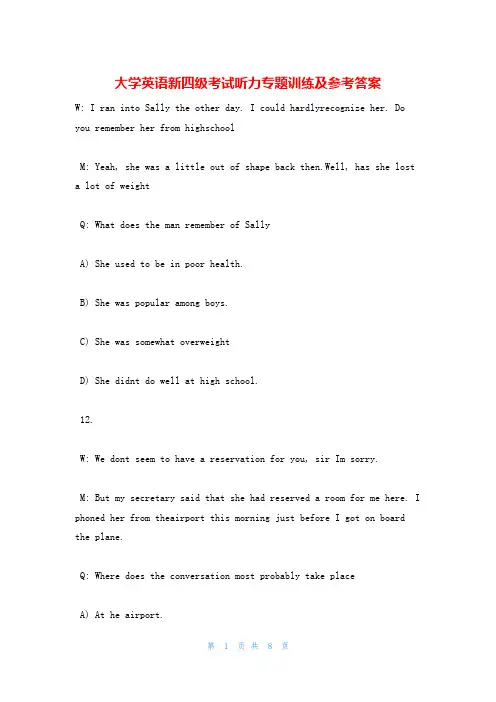
大学英语新四级考试听力专题训练及参考答案W: I ran into Sally the other day. I could hardlyrecognize her. Do you remember her from highschoolM: Yeah, she was a little out of shape back then.Well, has she lost a lot of weightQ: What does the man remember of SallyA) She used to be in poor health.B) She was popular among boys.C) She was somewhat overweightD) She didnt do well at high school.12.W: We dont seem to have a reservation for you, sir Im sorry.M: But my secretary said that she had reserved a room for me here. I phoned her from theairport this morning just before I got on board the plane.Q: Where does the conversation most probably take placeA) At he airport.B) In a restaurant.C) In a booking office.D) At the hotel reception.答案解析:11.女:我那天遇到萨莉了。
我几乎没认出来她。
你还记得她高中时的样子吗男:嗯,我记得。
她那时身材有些走样。
她现在瘦了很多吗问:男人记得萨莉的什么事情答:out of shape身材走样,lose weight减肥,体重减轻,从男人话中能看出,萨利当年有些胖,因此正确答案为C,她当时有些胖。
大学英语四级听力训练及答案
大学英语四级听力训练及答案训练自己的英语四级听力,你是否会想起之前的大学时光?下面是店铺给大家整理的大学英语四级听力训练及答案,供大家参阅!大学英语四级听力训练及答案听力真题:Conversation Two23.A. They are describing a new dustbin.B. They are discussing the protection ofenvironment.C. They are collecting used batteries.D. They are looking forward to attending a lecture.24.A. To make full use of the metals left.B. To protect the forest resources from being destroyed.C. To call for stopping using plastic meal-boxes.D. To awaken people to the environmental problem.25.A. She will attend the lecture.B. She will draw up a program.C. She will join the "Green Movement".D. She is not sure what she will do.答案解析:Conversation TwoM: Have you noticed the new dustbin downstairs, at the entrance of the main building?W: Yeah, of course. It looks funny, though, like a battery. What's it for? Is it really for garbage?M: Not really. Actually it's a dustbin for used batteries.W: Used batteries? What do you mean by that? Why do weneed a special dustbin for used batteries?M: Well, you know there are still a lot of heavy metals left in used batteries, so by recycling the batteries, [23]we can not only make full use of the metals left, but also prevent the environment from being polluted.W: Oh, I see. Can this work? Our efforts are too insignificant.M: Even though we are not ecologists or biologists, there is still a lot we can do. [24]The Student Union is sponsoring a one-month program called "Green Movement", which is aimed at making more and more students aware of serious environmental problems we are facing now.W: Sounds quite exciting-"Green Movement". What, for example, can I do?M: Well, quite a lot. For one thing, you can stop using those plastic meal-boxes and disposable wooden chopsticks. Plastic meal-boxes do great harm to the environmentand disposable chopsticks are a big waste of forest resources. [25]Well, there will be a lecture tomorrow afternoon at four o'clock. You may attend if you are interested.W: [25]Tomorrow afternoon... let me think... yeah, I happen to be free. I will go there.Questions 23 to 25 are based on the conversation you have just heard.23. What are the two speakers doing?正确答案:B解析:主旨题。
大学英语新四级考试听力练习及参考答案
大学英语新四级考试听力练习及参考答案大学英语新四级考试听力练习题及参考答案听力真题:7.Q: What does the man meanA) He needs another job as research assistant.B) He asked Professor Williams for assistance.C) He assists Professor Williams with his teaching.D) He is doing research with Professor Williams.8.Q: What do we know from the womans replyA) She thought there were no tickets left for the show.B) She thought the seats on the left side were fully occupied.C) The show was planned a long time ago.D) The audience were deeply impressed by the show.听力原文:7.W: John, are you doing research for ProfessorWilliams this semesterM: Actually, I am working as his teaching assistant.Q: What does the man mean参考译文:女:约翰,你这学期是在帮威廉斯教授做研究吗男:实际上,我是他的助教。
问:男子什么意思答案解析:正确答案为C。
对话中男子说他是teaching assistant助教,即协助教授教学,因此C项正确。
A,他需要另一份研究助理的工作,与对话内容不符,排除。
B,他请威廉斯教授协助,对话中是男子协助威廉斯教授,B项与对话内容不符,排除。
【2024版】大学英语四级听力考试套题练习及原文解析
可编辑修改精选全文完整版大学英语四级听力考试套题练习及原文解析大学英语四级听力考试套题练习及原文解析Rome wasn't built in a day.work harder and practice more.your hardworking will be rewarded by god one day.god is equal to everyone!以下是店铺为大家搜索整理的大学英语四级听力考试套题练习及原文解析,希望能给大家带来帮助!Part Ⅲ Listening Comprehension (35 minutes)Section ADirections: In this section, you will hear 8 short conversations and 2 long conversations. At the end of each conversation, one or more questions will be asked about what was said. Both the conversation and the questions will be spoken only once. After each question there will be a pause. During the pause, you must read the four choices marked A), B), C) and D), and decide which the best answer is. Then mark the corresponding letter on Answer sheet 2 with a single line through the centre.Questions 11 to 18 are based on the conversation you have just heard.11. A) Get some small change. B) Find a shopping center.C) Cash a check at a bank. D) Find a parking meter.12. A) Shopping with his son. B) Buying a gift for a child.C) Promoting a new product. D) Bargaining with a salesgirl.13. A) Taking photographs. B) Enhancing images.C) Mending cameras. D) Painting pictures.14. A) He moved to Baltimore when he was young.B) He can provide little useful information.C) He will show the woman around Baltimore.D) He will ask someone else to help the woman.15. A) He is rather disappointed. B) He is highly ambitious.C) He can’t face up to the situation D) He knows his own limitation.16. A) She must have paid a lot B) She is known to havea terrific figure.C) Her gym exercise has yielded good results.D) Her effort to keep fit is really praiseworthy.17. A) Female students are unfit for studying physics.B) He can serve as the woman’s tutor.C) Physics is an important course at school.D) The professor’s suggestion is constructive.18. A) Indifferent. B) Doubtful. C) Pleased. D) Surprised.Questions 19 to 22 are based on the conversation you have just heard.19. A) He prefers the smaller evening classes. B) He has signed up for a day course.C) He has to work during the day. D) He finds the evening course cheaper.20. A) Learn a computer language. B) Learn data processing.C) Buy some computer software. D) Buy a few coursebooks.21. A) Thursday evening, from 7:00 to 9:45. B) From September 1 to New Year’s eve.C) Every Monday, lasting for 12 weeks. D) Three hours a week,45 hours in total.22. A) What to bring for registration. B) Where to attend the class.C) How he can get to Frost Hall. D) Whether he can use a check.Questions 23 to 25 are based on the conversation you havejust heard.23. A) A training coach. B) A trading adviser.C) A professional manager. D) A financial trader.24. A) He can save on living expenses. B) He considers cooking creative.C) He can enjoy healthier food. D) He thinks take-away is tasteless.25. A) It is something inevitable.B) It is frustrating sometimes.C) It takes patience to manage. D) It can be a good thing.Section BDirections: In this section, you will hear 3 short passages. At the end of each passage, you will hear some questions. Both the passage and the questions will be spoken only once. After you hear a question, you must choose the best answer from the four choices marked A), B), C) and D). Then mark the corresponding letter on Answer Sheet 2 with a single line through the centre.Passage OneQuestions 26 to 28 are based on the passage you have just heard.26. A) There were no planets without moons. B) There was no air or water on Jupiter.C) Life was not possible in outer space. D) The mystery of life could not be resolved.27. A) It has a number of active volcanoes. B) It has an atmosphere like the earth’s.C) It has a large ocean under its surface. D) It has deep caves several miles long.28. A) Light is not an essential element to it. B) Life can form in very hot temperatures.C) Every form of life undergoes evolution. D) Oxygen is not needed for some life forms.Passage TwoQuestions 29 to 31 are based on the passage you have just heard.29. A) Whether they should take the child home.B) What Dr. Mayer’s instructions exactly were.C) Who should take care of the child at home.D) When the child would completely recover.30. A) She encourages them to ask questions when in doubt.B) She makes them write down all her instructions.C) She has them act out what they are to do at home.D) She asks them to repeat what they are supposed to do.31. A) It lacks the stability of the printed word. B) It contains many grammatical errors.C) It is heavily dependent on the context. D) It facilitates interpePassage ThreeQuestions 33 to 35 are based on the passage you have just heard.32. A) Job security. B) Good labour relations.C) Challenging work. D) Attractive wages and benefits.33. A) Many tedious jobs continue to be done manually.B) More and more unskilled workers will lose jobs.C) Computers will change the nature of many jobs.D) Boring jobs will gradually be made enjoyable.34. A) Offer them chances of promotion.B) Improve their working conditions.C) Encourage them to compete with each other.D) Give them responsibilities as part of a team.35. A) They will not bring real benefits to the staff.B) They concern a small number of people only.C) They are arbitrarily set by the administrators.D) They are beyond the control of ordinary workers.Section CDirections: In this section, you will hear a passage three times. When the passage is read for the first time, you should listen carefully for its general idea. When the passage is read for the second time, you are required to fill in the blanks numbered from 36 to 43 with the exact words you have just heard. For blanks numbered from 44 to 46 you are required to fill in the missing information. For these blanks, you can either use the exact words you have just heard or write down the main points in your own words. Finally, when the passage is read for the third time, you should check what you have written.注意:此部分试题在答题卡2上。
大学英语四级听力历年试题及答案
2000年1月大学英语四级(CET-4)真题试卷 (2)2000年6月大学英语四级(CET-4)真题试卷 (5)2001年1月大学英语四级(CET-4)真题试卷 (8)2001年6月大学英语四级(CET-4)真题试卷 (11)2002年1月大学英语四级(CET-4)真题试卷 (13)2002年6月大学英语四级(CET-4)真题试卷 (16)2003年1月大学英语四级(CET-4)真题试卷 (19)2003年6月大学英语四级(CET-4)真题试卷 (21)2003年9月大学英语四级(CET-4)真题试卷 (24)2003年12月大学英语四级(CET-4)真题试卷 (27)2004年6月大学英语四级(CET-4)真题试卷 (30)2005年1月大学英语四级(CET-4)真题试卷 (31)2005年6月大学英语四级(CET-4)真题试卷 (33)2005年12月大学英语四级(CET-4)真题试卷 (36)2006年6月17日大学英语四级(CET-4)真题试卷 (39)2006年12月23日大学英语新四级(CET-4)真题试卷 (42)2007年12月22日大学英语四级(CET-4)真题试题B卷 (46)2008年6月大学英语四级考试A卷真题 (51)2008年12月大学英语四级考试A卷真题 (56)2009年6月英语四级考试真题与答案 (61)2009年12月英语四级考试真题与答案 (65)2000年1月大学英语四级(CET-4)真题试卷1. A) The woman is a close friend of the man.B) The woman has been working too hard.C) The woman is seeing a doctor.D) The woman is tired of her work.2. A) This apple pie tastes very good.B) His mother likes the pie very much.C) This pie can’t match his mother’s.D) His mother can’t make apple pies.3. A) Take a walk.B) Give a performance.C) Listen to the music.D) Dance to the music.4. A) Read an article on political science.B) Present a different theory to the class.C) Read more than one article.D) Choose a better article to read.5. A) The woman would understand if she did Mary’s job.B) The woman should do the typing for Mary.C) The woman should work as hard as Mary.D) The woman isn’t a skillful typist.6. A) He wants to make an appointment with Mr. Smith.B) He wants to make sure that Mr. Smith will see him.C) He wants to change the time of the appointment.D) He wants the woman to meet him at three o’clock.7. A) He gets nervous very easily.B) He is an inexperienced speaker.C) He is an awful speaker.D) He hasn’t prepared his speech well.8. A) She didn’t like the books the man bought.B) There wasn’t a large selection at the bookstore.C) The man bought a lot of books.D) She wanted to see what the man bought.9. A) Buy a ticket for the tem o’clock flight.B) Ask the man to change the ticket for her.C) Go to the airport immediately.D) Switch to a different flight.10. A) Dr. Lemon is waiting for a patient.B) Dr. Lemon is busy at the moment.C) Dr. Lemon has lost his patience.D) Dr. Lemon has gone out to visit a patient.Passage oneQuestions 11 to 14 are based on the passage you have just heard.11. A) A car outside the supermarket.B) A car at the bottom of the hill.C) Paul’s car.D) The sports car.12. A) Inside the car.B) At the foot of the hill.C) In the garage.D) In the supermarket.13. A) The driver of the sports car.B) The two girls inside the car.C) The man standing nearby.D) The salesman from London.14. A) Nobody.B) The two girls.C) The bus driver.D) Paul.Passage TwoQuestions 15 to 17 are based on the passage you have just heard.15. A) His friend gave him the wrong key.B) He didn’t know where the back door was.C) He couldn’t find the key to his mailbox.D) It was too dark to put the key in the lock.16. A) It was getting dark.B) He was afraid of being blamed by his friend.C) The birds might have flown away.D) His friend would arrive any time.17. A) He looked silly with only one leg inside the window.B) He knew the policeman wouldn’t believe him.C) The torch light made him look very foolish.D) He realized that he had made a mistake.Passage ThreeQuestions 18 to 20 are based on the passage you have just heard.18. A) The threat of poisonous desert animals and plants.B) The exhaustion of energy resources.C) The destruction of oil wells.D) The spread of the black powder from the fires.19. A) The underground oil resources have not been affected.B) Most of the desert animals and plants have managed to survive.C) The oil lakes soon dried up and stopped evaporating.D) The underground water resources have not been polluted.20. A) To restore the normal production of the oil wells.B) To estimate the losses caused by the fires.C) To remove the oil left in the desert.D) To use the oil left in the oil lakes.AnswerCADCA BBCDB CDAAA BBDDC2000年6月大学英语四级(CET-4)真题试卷1. A) She is not interested in the article.B) She has given the man much trouble.C) She would like to have a copy of the article.D) She doesn’t want to take the trouble to read the article.2. A) He saw the big tower he visited on TV.B) He has visited the TV tower twice.C) He has visited the TV tower once.D) He will visit the TV tower in June.3. A) The woman regrets having taken up much of the professor’s time.B) The woman regrets having taken up much of the professor’s time.C) The woman knows the professor has been busy.D) The woman knows the professor has run into trouble.4. A) He doesn’t enjoy business trips as much as he used to.B) He doesn’t think he is capable of doing the job.C) He thinks the pay is too low to support his family.D) He wants to spend more time with his family.5. A) The man thought the essay was easy.B) They both had a hard time writing the essay.C) The woman thought the essay was easy.D) Neither of them has finished the assignment yet.6. A) In the park.B) Between two buildings.C) In his apartment.D) Under a huge tree.7. A) It’s awfully dull.B) It’s really exciting.C) It’s very exhausting.D) It’s quite challenging.8. A) A movie.B) A lecture.C) A play.D) A speech.9. A) The weather is mild compared to the past years.B) They are having the coldest winter ever.C) The weather will soon get warmer.D) The weather may get even colder.10. A) A mystery story.B) The hiring of a shop assistant.C) The search for a reliable witness.D) An unsolved case of robbery.Passage oneQuestions 11 to 14 are based on the passage you have just heard.11. A) They want to change the way English is taught.B) They learn English to find well-paid jobs.C) They want to have an up-to-date knowledge of English.D) They know clearly what they want to learn.12. A) Professionals.B) College students.C) Beginners.D) Intermediate learners.13. A) Courses for doctors.B) Courses for businessmen.C) Courses for reporters.D) Courses for lawyers.14. A) Three groups of learners.B) The importance of business English.C) English for Specific Purposes.D) Features of English for different purposes.Passage TwoQuestions 15 to 17 are based on the passage you have just heard.15. A) To show off their wealth.B) To feel good.C) To regain their memory.D) To be different from others.16. A) To help solve their psychological problems.B) To play games with them.C) To send them to the hospital.D) To make them aware of its harmfulness.17. A) They need care and affection.B) They are fond of round-the-world trips.C) They are mostly form broken families.D) They are likely to commit crimes.Passage ThreeQuestions 18 to 20 are based on the passage you have just heard.18. A) Because it was too heavy.B) Because it did not bend easily.C) Because it did not shoot far.D) Because its string was short.19. A) It went out of use 300 years ago.B) It was invented after the short bow.C) It was discovered before fire and the wheel.D) It’s still in use today.20. A) They are accurate and easy to pull.B) Their shooting range is 40 yards.C) They are usually used indoors.D) They took 100 years to develop.AnswerCCBDB DACDD DABCB AACBA2001年1月大学英语四级(CET-4)真题试卷1. A) Get some change form Jane.B) Use the woman’s phone.C) Go look for a pay phone.D) Pay for the phone call.2. A) At a bookstore.B) In a workshop.C) At an art gallery.D) In a department store.3. A) She’s bought the man a pair of glasses today.B) She will help the man to catch up.C) She is worried about the man’s health.D) She has bought the man an up-to-date map.4. A) He is going to give a talk on fishing.B) He thinks fishing is a good way to kill time.C) He has the same hobby as Susan’s father.D) He is eager to meet Susan’s parents.5. A) He finds the presentation hard to follow.B) He considers the presentation very dull.C) He thinks Professor White has chosen an interesting topic.D) He speaks highly of the presentation.6. A) High quality paper.B) A typewriter.C) A bookshelf.D) Some stocks.7. A) They go to the seaside.B) They set off early.C) They go sightseeing.D) They wait for a fine day.8. A) He was late for school on the first day.B) He had a funny face.C) He was the first person she met at school.D) He liked to show off in class.9. A) Her car can stand any crash.B) Her car is not as good as his.C) Her car is maintained as well as his.D) Her car is kept in good condition.10. A) She is too busy to go.B) She doesn’t want to wait long.C) She’s willing to go swimming.D) She enjoys the wonderful weather.Passage oneQuestions 11 to 13 are based on the passage you have just heard.11. A) He was once a friend of the ruler.B) He was a tax collector.C) He was a government official.D) He was once a school teacher in India.12. A) To declare new ways of collecting tax.B) To entertain those who had made great contributions to the government.C) To collect money from the persons invited.D) To reward outstanding tax collectors.13. A) They tried to collect more money than the ruler asked for.B) They were given some silver and gold coins by the ruler.C) They were excused from paying income tax.D) They enjoyed being invited to dinner at the ruler’s palace.Passage TwoQuestions 14 to 16 are based on the passage you have just heard.14. A) They liked traveling.B) They wanted to find a better place to live in.C) They were driven out of their homes.D) The reasons are unknown.15. A) They try to put up with Gypsies.B) They are envious of Gypsies.C) They are unfriendly to Gypsies.D) They admire the musical talent of the Gypsies.16. A) Special schools have been set up for them.B) Permanent homes have been built for them.C) They are now taught in their own language.D) They are now allowed to attend local schools.Passage ThreeQuestions 17 to 20 are based on the passage you have just heard.17. A) The causes are obvious.B) The causes are very complicated.C) The causes are familiar.D) The causes are not well understood.18. A) Regular driver training.B) Improved highway design.C) Stricter traffic regulations.D) Better public transportation.19. A) Highway crime.B) Poor traffic control.C) Confusing road signs.D) Drivers’ errors.20. A) Designing better cars.B) Building more highways.C) Increasing people’s awareness of traffic problems.D) Enhancing drivers’ sense of responsibility.AnswerBCBCD ABADC DCADC ABBDA2001年6月大学英语四级(CET-4)真题试卷1. A) A math teacher and his colleague.B) A teacher and his student.C) A librarian and a student.D) A student and his classmate.2. A) Tony thought the experiment was well done.B) Tony finished the experiment last night.C) Tony could not continue the experiment.D) Tony had expected the experiment to be easier.3. A) She wants to save money to buy a piano.B) The present apartment is too expensive.C) She can’t put up with the noise.D) She had found a job in a neighbouring area.4. A) He has made great progress in his English.B) He is not very interested in English songs.C) He is a student of the music department.D) He is not very enthusiastic about his English lessons.5. A) In a car.B) On the street.C) In a restaurant.D) At home.6. A) His injury kept him at home.B) He was too weak to see the doctor.C) He didn’t think it necessary.D) He failed to make an appointment.7. A) 5:10.B) 5:00.C) 4:30.D) 5:15.8. A) The man is talking with his boss.B) The man needs help.C) The man is complaining.D) The man likes his job.9. A) Wear a new dress.B) Attend a party.C) Go shopping.D) Make a silk dress.10. A) He exaggerated his part.B) He played his part quite well.C) He was not dramatic enough.D) He performed better than the secretary.AnswerDCCDB CCCBA2002年1月大学英语四级(CET-4)真题试卷1. A) She has to post a letter instead.B) She has to turn down the man’s request.C) She’s not sure if the computer is fixed.D) She can’t send the message right now.2. A) He didn’t get the book he needed.B) He had no idea where the book was.C) The library is closed on weekends.D) He was not allowed to check out the book.3. A) Play a tape recorder.B) Take a picture.C) Repair a typewriter.D) Start a car.4. A) The woman rejected the man’s apology.B) The woman appreciated the man’s offer.C) The man had forgotten the whole thing.D) The man had hurt the woman’s feelings.5. A) The woman is meeting the man at the airport.B) They are complaining about the poor airport service.C) They are discussing their plan for Christmas.D) The man is seeing the woman off.6. A) She plans to go to graduate school.B) She will drop out of school.C) She will stop working and concentrate on her studies.D) She will take a part-time job.7. A) He needs another job as research assistant.B) He asked Professor Williams for assistance.C) He assists Professor Williams with his teaching.D) He is doing research with Professor Williams.8. A) She thought there were no tickets left for the show.B) She thought the seats on the left side were fully occupied.C) The show was planned a long time ago.D) The audience were deeply impressed by the show.9. A) Mr. Long’s briefing was unnecessarily long.B) The woman should have been more attentive.C) Mr. Long’s briefing was not relevant to the mission.D) The woman needn’t have attended the briefing.10. A) In a bank.B) In a school.C) In a clothing store.D) In a barbershop.Passage oneQuestions 11 to 13 are based on the passage you have just heard.11. A) Because the bird couldn’t repeat his master’s name.B) Because the bird screamed all day long.C) Because the bird uttered the wrong word.D) Because the bird failed to say the name of the town.12. A) The cruel master.B) The man in the kitchen.C) The pet bird.D) The fourth chicken.13. A) The bird bad finally understood his threat.B) The bird managed to escape from the chicken house.C) The bird had learned to scream back at him.D) The bird was living peacefully with the chickens.Passage TwoQuestions 14 to 16 are based on the passage you have just heard.14. A) They are kept in open prisons.B) They are allowed out of the prison grounds.C) They are ordered to do cooking and cleaning.D) They are a small portion of the prison population.15. A) Some of their prisoners are allowed to study or work outside prisons.B) Most of their prisoners are expected to work.C) Their prisoners are often sent to special centers for skill training.D) Their prisoners are allowed freedom to visit their families.16. A) They are encouraged to do maintenance for the training centre.B) Most of them get paid for their work.C) They have to cook their own meals.D) They can choose to do community work.Passage ThreeQuestions 17 to 20 are based on the passage you have just heard.17. A) Because they have a driving license.B) Because they have received special training.C) Because the traffic conditions in London are good.D) Because the traffic system of the city is not very complex.18. A) Two to four months.B) About three weeks.C) At least half a year.D) Two years or more.19. A) Government officers are hard to please.B) The learner has to go through several tough tests.C) The learner usually fails several times before he passes it.D) The driving test usually last tow months.20. A) They don’t want their present bosses to know what they’re doing.B) They want to earn money from both jobs.C) They cannot earn money as taxi drivers yet.D) They look forward to further promotion.DAADD CCABA DCADA BBDBC2002年6月大学英语四级(CET-4)真题试卷1. A) His father.B) His mother.C) His brother.D) His sister.2. A) A job opportunity.B) A position as general manager.C) A big travel agency.D) An inexperienced salesman.3. A) Having a break.B) Continuing the meeting.C) Moving on to the next item.D) Waiting a little longer.4. A) The weather forecast says it will be fine.B) The weather doesn’t count in their plan.C) They will not do as planned in case of rain.D) They will postpone their program if it rains.5. A) He wishes to have more courses like it.B) He finds it hard to follow the teacher.C) He wishes the teacher would talk more.D) He doesn’t like the teacher’s accent.6. A) Go on with the game.B) Draw pictures on the computer.C) Review his lessons.D) Have a good rest.7. A) She does not agree with Jack.B) Jack’s performance is disappointing.C) Most people will find basketball boring.D) She shares Jack’s opinion.8. A) The man went to a wrong check-in counter.B) The man has just missed his flight.C) The plane will leave at 9:14.D) The plane’s departure time remains unknown.9. A) At a newsstand.B) At a car dealer’s.C) At a publishing house.D) At a newspaper office.10. A) He wants to get a new position.B) He is asking the woman for help.C) He has left the woman a good impression.D) He enjoys letter writing.Passage oneQuestions 11 to 13 are based on the passage you have just heard.11. A) They are interested in other kinds of reading.B) They are active in voluntary services.C) They tend to be low in education and in income.D) They live in isolated areas.12. A) The reasons why –people don’t read newspapers are more complicated thanassumed.B) There are more uneducated people among the wealthy than originally expected.C) The number of newspaper readers is steadily increasing.D) There are more nonreaders among young people nowadays.13. A) Lowering the prices of their newspapers.B) Shortening their news stories.C) Adding variety to their newspaper content.D) Including more advertisements in their newspapers.Passage TwoQuestions 14 to 17 are based on the passage you have just heard.14. A) A basket.B) A cup.C) A egg.D) An oven.15. A) To let in the sunshine.B) To serve as its door.C) To keep the nest cool.D) For the bird to lay eggs.16. A) Branches.B) Grasses.C) Mud.D) Straw.17. A) Some are built underground.B) Some can be eaten.C) Most are sewed with grasses.D) Most are dried by the sun.Passage ThreeQuestions 18 to 20 are based on the passage you have just heard.18. A) To examine the chemical elements in the Ice Age.B) To look into the pattern of solar wind activity.C) To analyze the composition of different trees.D) To find out the origin of carbon-14 on Earth.19. A) The lifecycle of trees.B) The number of trees.C) The intensity of solar burning.D) The quality of air.20. A) It affects the growth of trees.B) It has been increasing since the Ice Age.C) It is determined by the chemicals in the air.D) It follows a certain cycle.DAADB CADDA CDCBB CAACD2003年1月大学英语四级(CET-4)真题试卷1. A) They are both anxious to try Italian food.B) They are likely to have dinner together.C) The man will treat the woman to dinner tonight.D) The woman refused to have dinner with the man.2. A) It’s only for rent, not for sale.B) It’s not as good as advertised.C) It’s being redecorated.D) It’s no longer available.3. A) Colleagues.B) Husband and wife.C) Employer and employee.D) Mother and son.4. A) She contacts her parents occasionally.B) She phones her parents regularly at weekends.C) She visits her parents at weekends when the fares are down.D) She often call her parents regardless of the rates.5. A) The next bus is coming soon.B) The bus will wait a few minutes at the stop.C) There are only two or three passengers waiting for the bus.D) They can catch this bus without running.6. A) The assignment looks easy but actually it’s quite difficult.B) The assignment is too difficult for them to complete on time.C) They cannot finish the assignment until Thursday.D) They have plenty of time to work on the assignment.7. A) The man will go to meet the woman this evening.B) The man and the woman have an appointment at 7 o’clock.C) The woman can’t finish making the jam before 7 o’clock.D) The woman won’t be able to see the man this evening.8. A) She’s learned a lot from the literature class.B) She’s written some books about world classics.C) She’s met some of the world’s best writers.D) She’s just back from a trip round the world.9. A) The exam was easier than the previous one.B) Joe is sure that he will do better in the next exam.C) Joe probably failed in the exam.D) The oral part of the exam was easier than the written part.10. A) She is tired of driving in heavy traffic.B) She doesn’t mind it as the road conditions are good.C) She is unhappy to have to drive such a long way every day.D) She enjoys it because she’s good at driving.BDDBA DBACB2003年6月大学英语四级(CET-4)真题试卷1. A) At a theatre.B) At a booking office.C) At a railway station.D) At a restaurant.2. A) The man is inviting the woman to dinner.B) The woman is too busy to join the man for dinner.C) The woman is a friend of the Stevensons.D) The man is going to visit the Stevensons.3. A) The professor’s presentation was not convincing enough.B) The professor’s lecture notes were too complicated.C) The professor spoke with a strong accent.D) The professor spoke too fast.4. A) The furnished apartment was inexpensive.B) The apartment was provided with some old furniture.C) The furniture in the market was on sale every Sunday.D) The furniture he bought was very cheap.5. A) The man is thinking about taking a new job.B) The man likes a job that enables him to travel.C) The man is sure that he will gain more by taking the job.D) The man doesn’t want to stay home and take care of their child.6. A) Take the GRE test again in 8 weeks.B) Call to check his scores.C) Be patient and wait.D) Inquire when the test scores are released.7. A) She read it selectively.B) She went over it chapter by chapter.C) She read it slowly.D) She finished it at a stretch.8. A) He was kept in hospital for a long time.B) He was slightly injured in a traffic accident.C) He was seriously wounded in a mine explosion.D) He was fined for speeding.9. A) Wait for a taxi.B) Buy some food.C) Go on a trip.D) Book train tickets.10. A) It’s not as hard as expected.B) It’s too tough for some students.C) It’s much more difficult than people think.D) It’s believed to be the hardest optional course.Questions 11 to 13 are based on the passage you have just heard.11. A) Anxious and worried.B) Proud and excited.C) Nervous and confused.D) Inspired and confident.12. A) His father scolded him severely.B) His father took back the six dollars.C) His father made him do the cutting again.D) His father cut the leaves himself.13. A) One can benefit a lot from working with his father.B) Manual labourers shouldn’t be looked down upon.C) One should always do his job earnestly.D) Teenagers tend to be careless.Questions 14 to 16 are based on the passage you have just heard.14. A) He ran a village shop.B) He worked on a farm.C) He worked in an advertising agency.D) He was a gardener.15. A) It was stressful.B) It was colorful.C) It was peaceful.D) It was boring.16. A) His desire to start Iris own business.B) The crisis in his family life.C) The decline in his health.D) His dream of living in the countryside.Questions 17 to 20 are based on the passage you have just heard.17. A) Because there are no signs to direct them.B) Because no tour guides are available.C) Because all the buildings in the city look alike.D) Because the university is everywhere in the city.18. A) They set their own exams.B) They select their own students.C) They award their own degrees.D) They organize their own laboratory work.19. A) Most of them have a long history.B) Many of them are specialized libraries.C) They house more books than any other university library.D) They each have a copy of every book published in Britain.20. A) Very few of them are engaged in research.B) They were not awarded degrees until 1948.C) They have outnumbered male students.D) They were not treated equally until 1881.DADDA CABCC BCCCA BDBBB2003年9月大学英语四级(CET-4)真题试卷1. A) Give Bob a phone call.B) Go and pick Bob up.C) Go look for Bob.D) Wait for Bob.2. A) She is working in the city.B) Life in the suburbs is lonely.C) Jobs are easier to find in the city.D) It’s less expensive living in the city.3. A) In a printing shop.B) At a publishing house.C) At a bookstore.D) In a library.4. A) The woman be more careful next time.B) They try to think of a solution.C) The woman find a spare key.D) They come downstairs.5. A) Sending an e-mail.B) Working in an office.C) Talking on the phone.D) Doing spelling practice.6. A) Buy something for the picnic.B) Go shopping with the man.C) Go for a ride around town.D) Have a picnic.7. A) The woman misplaced her class permit for biology.B) The woman arrived for registration too early.C) The woman missed registration for the biology course.D) The woman got a wrong class permit.8. A) The woman likes the weather in New York very much.B) The woman will stay in New York a long time.C) The man is planning to visit New York.D) It’s quite cold in New York now.9. A) The old lady sitting next to the couple likes toys very much.B) An old lady took the couple’s suitcase for her own.C) The couple’s suitcase was stolen in the restaurant.D) The man forgot to put the toys in their suitcase.10. A) She’s flying to Hong Kong.B) She’s going to buy an air ticket.C) She’s going to say good-bye to Bill.D) She’s leaving for Hong Kong with Bill.Passage OneQuestions 11 to 13 are based on the passage you have just heard.11. A) They him only retired workers.B) They each do jobs they are good at.C) They close the hotel during low seasons.D) They employ as few workers as possible.12. A) Staff training.B) Book-keeping.C) Cleaning and washing up.D) Gardening and flower arranging.13. A) They have their hotel beautifully decorated.B) They provide delicious food.C) They make their guests feel at home.D) They give parties regularly for their visitors.Passage TwoQuestions 14 to 17 are based on the passage you have just heard.14. A) To withdraw his deposit.B) To cash a cheek.C) To rob the bank.。