
2020春人教PEP版六年级英语下册教案-Unit 3 第六课时
第六课时课时内容B Let’s check、Let’s wrap it upC story time课时分析本课时是人教版六年级下册第三单元第六课时,与前几课时紧密相连。
围绕“本单元的重点词汇和句型”展开。
主要通过Let’s check.和Let’s wrap it up.检测本单元的A,B部分的核心句型的理解以及掌握动词过去式的不规则变化。
Story time复习巩固了前几课时学过的谈论假期活动的句型How was your holiday? Where did you go? How did you go there? What did you do? Did you…? 同时,进一步深化了unusual trip的概念。
引导学生热爱科学,培养学生的语言表达能力,激发学习英语的兴趣,树立学好英语的信心,增强团队合作意识。
本课时是对前几课时重点知识的回顾和总结。
学好了本节课的知识,那么学生对本单元的重点已经能够熟练掌握。
本课时的的重点是动词过去式的不规则变化以及本单元四会短语、句子的听、说、读、写和运用。
本课时包括Let’s check 、Let’s wrap it up 和story time三个板块。
Let’s check 分为两个部分。
第一部分为听力判断活动,呈现了四幅图。
学生学会从图片信息中推测考查点,做到有目的、有针对性地听录音,完成听力任务。
第二部分为听录音回答问题,用于考查学生能否用单元核心词汇和句型回答问题。
Let’s check 重点培养学生良好的听力习惯,帮助学生逐渐提高学生的听力水平。
Let’s wrap it up. 板快呈现了四组不规则动词的原形和过去式,两幅恐龙的插图。
插图的呈现帮助学生了解恐龙的生活习性,丰富学生的课外知识。
Story time板讲述的是Zoom做了一个梦:Zoom去了太空旅行,回来后和Zip一起谈论他的太空旅游,最后发觉原来是自己做了一个梦。
此故事阅读性强,浅显易懂,情节有趣,想象力丰富,激发学生阅读的兴趣。
通过故事的学习,复习巩固本单元所学语言,在增加语言的输入的同时,体会阅读的乐趣。
本课时是复习课,话题比较多。
在设计教学过程时,遵循以学生为主的原则,引导学生自主学习。
Let’s wrap it up. 让学生自己归纳,总结,培养学生的独立思考的能力。
Story time.采用整体感知、深入学习、表演故事等形式巩固语言,发展语言。
教师要全面调动学生的积极性,让学生在轻松的氛围中掌握知识。
课时目标(1)能够较好的完成Let’s check,培养学生良好的听力习惯。
(2)能够理解和归纳不规则动词的变化形式。
(3)能够读懂Zoon和Zip对话的小故事。
(4)通过故事复习巩固本单元的重点语言。
(5)能够表演故事,恰当运用故事中的语言。
(6)培养学生学习英语的兴趣,增强团队合作意识。
课时重难点1.重点(1)能够较好的完成Let’s check,培养学生良好的听力习惯。
(2)能够理解和归纳不规则动词的变化形式。
(3)通过故事复习巩固本单元的重点语言。
(4)能够表演故事,恰当运用故事中的语言。
2.难点能够表演故事,恰当运用故事中的语言。
教学准备:课件、录音机、磁带、词卡、Zoom, Zip头饰教学过程Step 1GreetingT: Good morning, everybody.Ss: Morning, teacher.T: How are you today?Ss: I’m fine, thanks. And you?T:I’m fine, too. What’s the weather like today?Ss: It’s sunny/windy…T; Yeah, it’s a sunny day. So I feel happy. What did you do last night?S1: I watched TV.S2: I read a book.S3: I…T: Last night, I cleaned my room and washed my clothes. I was tired. But I feel betternow. How do you feel now?Ss: We’re happy/ tired/ …设计意图:通过师生之间谈论天气、心情等话题,拉近师生之间的距离,为正式进入学习而准备。
Step 2 Lead inSing a song.T: Oh. It doesn’t matter. Let’s sing an English song together. “Tell me about your holiday”. Ok?Ss: Ok.(教师播放歌曲,师生共同演唱。
)教学资源:课件设计意图:歌曲“Tell me about your holiday”,在前面的课时中已经学过了。
歌曲的演唱,带动了全体学生的参与,活跃了课堂气氛。
Step 3 Presentation1. Let’s wrap it up.(1)教师依次展示单词go, ride, hurt, buy, sleep, have, see,学生快读出和拼出动词的过去式。
例如:教师展示单词go, 学生说出went, W-E-N-T,went。
(2)学生拿出事先准备好的上述单词的词卡,在词卡上写出动词的过去式。
(3)小组核对。
(4)两人任选其中的一些动词过去式造句。
(5)观察动词的过去式,你发现了什么?这些动词的过去式是不规则的。
(6)出示恐龙图片,与学生谈论恐龙的习性。
T: Look at the pictures. What are they?Ss: Dinosaurs.T: What do you know about “Dinosaur”?(教师和学生谈论恐龙生活的信息,丰富学生的课外知识。
)(7)看图,完成课文练习,核对答案。
(8)观察下面几组不规则动词的过去式,找找有什么规律。
(9)单词接龙游戏。
游戏规则:小组成员互相接龙,说出动词am/is, are, eat, drink, run 的过去式。
例如:四人一组,第一人说出D ,第二人说R ,第三人说A ,第四人说N ,接着第一人说K ,第二人说出drank 喝。
教学资源:学生自制词卡、课件设计意图:引导学生多观察,自己进行归纳和总结,培养学生的自主学习的能力,锻炼学生的思维能力。
2. Let ’s check.T: Now look at these pictures. (Let ’s check.图片) What did they do?(1) Listen and Write T (true) F (false).a. 学生逐一看图,尝试推测它们表达的意思和听力要求。
b. 播放本部分录音,完成听力判断练习。
c. 师生核对结果,订正。
(2)Listen again and answers the questions.a.要求学生听前先读题,尝试猜测问题的答案。
b.播放录音,完成练习。
c.小组核对,整理。
教师订正。
教学资源:录音机、磁带设计意图:先猜测图意,从图中推测考查点,培养学生听前预测的习惯,帮助学生逐渐提高听力水平。
3. Let ’s chantT: Boys and girls, do you remember the chant? (课件展示儿歌,熟悉儿歌。
)Can you say?Ss: Yes.T: Ok. Let ’s chant.男生说问句,女说答句。
教师说问句,学生说答句。
教学资源:课件设计意图:本课时话题较多,学生容易产生疲劳。
此时伴随着美妙的节奏,朗朗上口的儿歌,活跃了课堂,吸引了学生的注意,巩固了知识,缓解了学生的疲劳,为过渡到下文做好了铺垫。
4. Learn “Story time”(1)T: I went to Beijing last summer holiday, Where did you go on your holiday?S1: I went to Sanya.S2: I went to Xinjiang.S3: I went to Shanghai.…T: Did you have a nice trip?Ss: Yes.T: Zoom had an unusual trip. Where did he go? Look at the story.(2)观看动画,阅读文本,整体感知。
a. 带着问题读故事。
Where did he go?How did he go there?b. 解决问题,指名说。
T: Where did Zoom go?S1: He went to the moon.( 板书moon, 利用插图教学单词,领读,延伸mooncake。
)T: He went to the moon. He can’t believe it.(板书单词believe, 领读,指名读,理解句子,齐读句子。
)T: How did he go there? (引导学生回答。
.)Ss: He went there by spaceship.(板书spaceship,将单词spaceship拆开教学。
让学生自己根据a的发音规律,读出space,理解space,指名读spaceship,领读,齐读。
)(3)再次阅读,理清故事情节。
T: How was Zoom’s holiday?Ss: It was fun.T: What did he see?Ss: He saw Chang’e, the rabbit and the tree.(课件呈现嫦娥、兔子、大树在月亮上的图片,并给学生讲“嫦娥奔月”的故事。
)T: Did he take any pictures?Ss: No.T: Why didn’t he take pictures?(引导学生回答。
)Ss: It’s a dream. (板书dream,领读,指名读,拼读,齐读。
)(4)播放录音,跟读故事。
(先尝试揣摩人物的感情和语气,再模仿朗读。
)(5)两人分角色朗读。
教学资源:课件设计意图:先初步欣赏动画整体感知,了解大意,接着再次阅读故事,处理细节,加深对故事内容和结构的把握,提高学生的阅读理解能力。
Step 4 Presentation将全班分成几个大组,以小组为单位排演故事,然后指定小组在班上表演故事。
教学资源:自制Zoom, Zip头饰设计意图:表演故事,是深受学生的喜爱的一种表现形式。
通过表演能调动学生的听觉、-视觉等多种感官,增加语言的输入,激发学生的兴趣,提高学生的综合语言能力。
Step 5: SummaryT: What did you learn about this lesson?学生自由发言,教师小结。
人教版新课标PEP小学英语六年级下册Unit 3教案教学设计(6课时)

人教版新课标PEP小学英语六年级下册Unit 3教案教学设计(6课时)Unit 3 Last Weekend教学设计(6课时)一、单元教学内容话题:What did you do?功能:动词过去式在具体情境中的基本使用方法。
语言结构:句型:What did you do yesterday? I played football/ watched TV …What did you do last weekend? I went fishing/ went to a park …Did you read books? Yes , I did./ No, I didn’t.词汇:watched TV, washed clothes, cleaned the room, played football, v isited grandparents, went to a park,went swimming, read a book, went fishing, went hiking.二、单元教学目标1、能力目标(1)能够对过去某人所做的事情进行问答,如:What did you do yesterday? I v isited my grandparents.(2)能够用一般过去时的一般疑问句形式询问别人过去某个时间所做的事情并作答。
如:D id you go fishing last weekend? Yes, I did. No, I didn’t.(3)能够对某人过去某天所做的事情进行简单地叙述。
如:Zhang Peng visited his g randparents yesterday.(4)能够听懂会唱歌曲At the zoo2、知识目标(1)能够掌握A,B部分Let’s learn,Let’s talk中的四会单词和四会句子。
(2)能够听,说,认读A,B部分Let’s talk中的句子。
六年级下册英语教案-Unit 3 人教PEP版
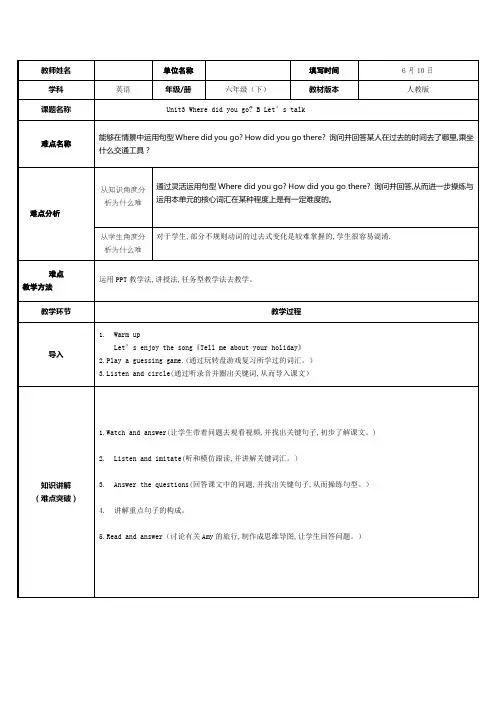
(难点突破)
1.Watch and answer(让学生带着问题去观看视频,并找出关键句子,初步了解课文。)
2.Listen and imitate(听和模仿跟读,并讲解关键词汇。)
3.Answer the questions(回答课文中的问题,并找出关键句子,从而操练句型。)
4.讲解重点句子的构成。
难点分析
从知识角度分析为什么难
通过灵活运用句型Where did you go? How did you go there? 询问并回答,从而进一步操练与运用本单元的核心词汇在某种程度上是有一定难度的。
从学生角度分析为什么难
对于学生,部分不规则动词的过去式变化是较难掌握的,学生很容易混淆.
难点
教学方法
3.Do a survey and make up a new dialogue.(做一个调查报告并编造一个新的对话。)
小结
This lesson we have learned(今节课我们学习了)
1.-Where did you go?
-I went to ____.
2.-How did you go there?
运用PPT教学法,讲授法,任务型教学法去教学。
教学环节
教学过程
导入
1.Warm up
Let’s enjoy the song《Tell me about your holiday》
2.Play a guessing game.(通过玩转盘游戏复习所学过的词汇。)
3.Listen and circle(通过听录音并圈出关键词,从而导入课文)
-I went there by____.
3.-What did you do?
人教PEP版六年级英语下册Unit 3 教案(全)
3.重点句型:
(1)—How was your summer holiday? —It was good.
(2)—Where did you go over the winter holiday?
—My family and I went to Sanya.
S2:It/Yesterday was...
T:What did you do yesterday?
S3:I (did)...yesterday. (用前几课时所学的词组作答)
2. Chain-drill:
S3: I (did)...yesterday. What did you do yesterday?
W:Hmm! I played football.
板书句型:What did you do last weekend? I played football.学生朗读。
(2)教师配带John的头饰T: Look, John comes to our class. He wants to find who cleaned the classroom last weekend.
先看题,再听录音做题。
创设情境,进行趣味游戏,活跃课堂气氛。
分角色朗读,教师可以对语音、语调掌握得好的学生进行表扬,并且鼓励其他人向他学习。
作业设计
1.熟读Let’s talk部分课文。
2.自主预习B部分Let’s learn新课。
板书设计
Unit 3Where did you go?
What did you do last weekend?
以师生互动游戏的方式回顾上个单元重点知识并导入新一单元的学习。对于在游戏环节表现优秀的学生,教师给予适当表扬或奖励(小奖品)。
人教pep版六年级下册英语全册配套教案设计Unit 3 教案(全)

Unit 3 Where did you go?Part A教学内容Let’s learn, Listen, answer and write, Let’s try, Let’s talk教学目标【知识目标】1.四会词汇:went, camp, went camping, fish, went fishing, rode, hurt2.三会词汇:fell, off, Labour Day, mule, Turpan, could, till3.重点句型:(1)—Where did you go? —I went to a forest park.(2)—Did you go to Turpan? —Yes,we did.【能力目标】1.能够听、说、读、写四会词汇,能够听、说、认读三会词汇。
2.能够对某人去过的地方和所做的事情进行问答。
如:Where did yougo? I went to…What did you do yesterday? I visited my grandparents.3.能够用一般过去时的一般疑问句形式询问别人过去某个时间所做的事情并作答。
如:Did you go fishing last weekend? Yes,I did./No,Ididn’t.【情感目标】自由地谈论去过的地方和做过的事情,激发学生对过去经历的美好回忆。
热爱生活,学会分享,增进友谊。
教学重点1.能听、说、读、写过去式单词went,rode,hurt和词组went camping,went fishing等;能正确使用动词过去式。
2.能利用“Where did you go ?What did you do ?”互相询问去过的地方和做过的事情,并能根据实际情况灵活作答。
教学难点1.掌握本部分的新单词并利用过去式的变化进行描述。
2.灵活运用“Where did you go ?” “What did you do ?”谈论去过的地方和做过的事情。
新人教版PEP六年级英语下册教案—Unit 3 教案(全)3

二.Presentation(新课呈现)
1.讲解read and write—diary
What happened to Wu Yifan’s family?
教学过程来自2.总结文本中的所有动词的一般过去式。
Was rode sat took ate bought ate did
教学难点
能够听懂,读懂并内化Read and write
教具学具
磁带录音机
教学内容
个人修改设计
教
学
过
程
一.Warm—up(热身)
How was your holiday and what did he do?
He ate fresh food.
He went swimming.
He took pictures.
教具学具
磁带录音机
教学内容
个人修改设计
教
学
过
程
一.Warm—up(热身)
1.Free talk
T: Did you go to Sanya?
S: Yes, I did.
T: Do you like it?
S:Yes, I do.
二.新课呈现(Presentation)
1.学习重点句型:
How did you go there?
学科电子教案
主备人:总第13课时
教学内容
Unit3 Part A let’s try and Let’s talk
课型
新授
教学目标
1. What happened?Where did you go?
2.Mt.Tianshan,Turpan,fell,hurt, rode,saw,eat,be ready
【人教pep版】2020年春六年级英语下册Unit 3 Part A Let's learn.说课稿
Unit 3 Where did you go ?Hello, everyone. Today I’m very pleased to have an opportunity to talk about some of my teaching ideas. My topic is Part A Let’s learn from Unit 3 Where did you go ,Grade 6. It is made up of four parts.Part 1 My understanding of this lessonThe analysis of the teaching material:This lesson talks about verbs. It plays a very important part in the English teaching of this unit. By studying this, Ss can learn more new verbs. At the same time, we should get the students to understand some difficult sentences better. The Ss should do some listening, speaking and writing, too. Of course, the Ss should receive some moral education. Let the Ss understand the verbs better,. Teaching aims:1. Knowledge aim: Understand the words and expressions.2. Ability aim: Make new conversations.3. Emotional aim: Make the Ss care about themselves, and study hard to make better life.Key points / Teaching important points:How to use the verbs to make new conversations..Teaching difficult points:1. Use your own words to make new conversations..2. Discuss where they went and what they did.Something about the Ss:1.The Ss have known something about what sb did in the past.2. They don’t often use English to express themselves and communicate with others.3. Some Ss are not active in the class because they are afraid of making mistakes.Part 2 My teaching theories, methods and aidsBefore dealing with this lesson, I’ll do my best to carry out the following theories: Make the Ss the real masters in class while the teacher himself acts as director;Combine the language structures with the language functions; Let the students receive some moral education while they are learning the English language.Teaching method:Double activities teaching methodQuestion-and-answer activity teaching methodWatch-and-listen activityFree discussion methodTeaching aids:1.some cards2.some objects3. a tape recorder4. the blackboardPart 3. Teaching steps / proceduresI have designed the following steps to train their ability of listening, speaking, reading and writing.The entire steps are:Greetings, Revision, Lead-in and reading, Preparation for details of the lesson, Consolidation, Discussion, Homework.Step 1 GreetingsGreet the whole class as usual.Step 2. Revision1. T: Act,let the Ss guess.2.Ask students some questions to revise the last lesson(show them on the screen).a. What did you do last Saturday?b. What did he do last Sunday?c. What did he do yesterday?d.What did you do last Monday?Step 3. Lead-in and preparationShow them some pictures and let them talk each other, and then use the pictures about places and the things we or they did in the past . Purpose: Arouse the students’interest of study.Bring in new subject: Where we or they went and what we or they did there.Method: Talk about the pictures , read the words and expressions and act.Purpose: Help the Ss remember the words and expressions best. Step 5. Play a game.Look, act and guess.Purpose: Make the Ss learn the expressions best and feel interesting. Step 6. ConsolidationRead the words and expressions , finish the conversation. Purpose: Let the Ss can communicate better.Step 7. DiscussionShow them some words and expressions, let the Ss talk freely. Purpose: Give the Ss much ,they can give us more.Step 8. Listening and exercise.Purpose:Improve the Ss listening and writing ability .Step 9. SummaryLet the Ss make a summary.Purpose:Let the Ss remember the lesson better.Step 10. HomeworkRead the words and expressions and make new conversations.Part 4. Blackboard designUnit 3 Where did you go?A: Where did you go_____? go went camping / fishing B: I went to ____________. ride rode a horseA:What did you do there? rode a bikeB: I ___________________. hurt hurt my footThat’s all , Thank you for listening!。
2020春人教PEP版六年级英语下册教案-Unit 3 单元概述与课时安排
Unit 3 Where did you go?单元整体分析本单元是人教版英语六年级下册的第三单元,单元的话题是“Where did you go?”本单元通过不同的场景,提供了表达过去的时间去了哪里,乘坐什么交通工具的句型结构。
共三个版块A 部分, B 部分和C 部分。
A 部分包括重点词组和情景对话,共两个课时。
第一课时呈现了John 五月十一和五月十二日的博客分享,引出四会词组和句型Where did you go...? I...What did you do there? I...第二课时Amy 去John 的家探望受伤的John, 通过照片分享John 在五一假期活动的场景,巩固句型Where did you go...? I...What did you do there? I...A 部分重点掌握词组和句型Where did you go...? I...What did you do there? I...B部分包括重点词组、情景对话和读和写,共三个课时。
第一课时通过Amy 和吴一凡聊自己暑假活动的场景,很自然的引出了句型How was your summer holiday?第二课时吴一凡和Amy 在学校遇见Sarah, 三人讨论寒假的场景,呈现了询问对方寒假去哪里,怎么去那,在那做了什么事情? 的句型。
第三课时通过呈现吴一凡的日记,拓展和运用本单元所学的知识。
B 部分重点是掌握词组和句型How was your summer holiday? Where did you go over the winter holiday? How did you go there? What did you do there? C 部分包括B 部分的听力测试、归纳不规则动词的变化形式和C部分的故事,共一课时。
重点是复习巩固本单元所学重点词汇和句型。
在课堂教学中,首先要整体把握本单元的教学内容,理清与第二单元之间的联系,了解学生的基本学情,确立教学重点和教学难点,然后围绕本单元主题Where did you go?”,展开教学设计。
Unit 3 Where did you go?Part A教案设计-人教版(三起)英语六年级下册
活动设计意图:通过观看视频和图片能充分调动学生的整体感观,提高参与度,并且游戏教学能够寓教于乐,激发了学生的学习兴趣,让他们对此记忆深刻,在学习知识的同时形成了积极的学习态度,又很好地巩固所学知识。
4)听录音朗读单词和句型
5)复述约翰的周六故事
请几位学生扮演约翰的一家人演周六的活动
Step3. Consolidation
1) Make a survey
提示:要求用句型Where did you go last summer/winter holiday?和What did you do ?来提问班上的同学。
Name
Where?
What?
Wu Yifan
媒介运用:PPT、调查表
媒介运用:图片、PPT、视频
活动设计意图:通过教师的暑假活动带出John的周六假期活动,观看视频引出约翰去了一个森林公园。并通过图片训练Where did you go ? I went to ….句型。视频的设置目的是把五个新单词串成一个简短的故事,情境中教学单词,以便学生记忆单词。
Step2. Presentation and practice
to Zhaoqing . He ate good
food…
4.Summing
Summing up
1. Words:
rode a horse, rode a bike, went camping, went fishing, hurt my foot.
2.Sentences:
Where did you go last Saturday? I went to a forest park. What did you do there? I rode a bike.
2020春PEP版六年级英语 下册 Unit 3 全单元教案
Unit 3 Where did you go?Part A 第一课时Let's try & Let's talk教学目标:1.能听懂Let's try并完成Tick and cross.2.能理解Let's talk并能听说认读下列句子:What happened? Are you all right? I'm OK now. Where did you go? It looks like a mule. Did you go to Turpan? Yes, we did.3.能听说认读单词fell off, mule, could, till, Labour Day, Turpan 教学重点:1. 听说认读句子:What happened? Are you all right? I'm OK now. Where did you go? It looks like a mule. Did you go to Turpan? Yes, we did.2. 理解句子:I fell off my bike last Saturday and hurt my foot.教学过程:Step 1: Warm up1.复习Let's learn. Eg: rode a horse. I rode a horse last weekend.2. Free talk. --Where did you go last Sunday/ Saturday?-- I went to a forest park.-- What did you do there?-- I rode a bike. / ...Step 2: Presentation1.教读并理解重点单词和句型: fell off, mule, could, till, LabourDay, TurpanWhat happend? Are you all right? I'm OK now. Where did you go?It looks like a mule. Did you go to Turpan? Yes, we did.I fell off my bike last Saturday and hurt my foot.2.学生听录音,老师教读对话。
(人教PEP)六年级英语下册教案 Unit3 第六课
unit3 last weekend第六课时教学设计一、教学设计思路本课时的主要教学内容是动词短语原形及过去式的综合运用。
本课时中,教师可以首先通过Do you like to play outdoors导入;然后,让学生观察并讨论Let’s read部分的三幅图,初步了解短文的内容,接着教师运用提问的方式引导学生学习Let’s read部分的重要短语;在学生理解短文后,通过Let’s check和小组共同完成task time的形式评价学生对本单元语言的综合用能用能力。
二、教学目标(一)知识听、说、认读Let’s read部分的短语并完成文后练习。
完成Task time中的任务。
完成Let’s check部分的练习。
(二)能力能综合运用动词的过去时。
能运用一般过去式简单描述自己过去某一时间的活动。
(三)情感通过有趣的小短文培养学生学习英语,运用英语的兴趣。
三、教学重点听、说、认读Let’s read部分的短语并完成文后练习。
难点是认读一些新语言,如:We read funny tongue twisters together. Suddenly my kite fl ew into the lake. I was very grateful to him….四、教学媒体1.Let’s read部分的三幅图。
2.录音机及磁带3.教学课件。
五、教学过程1.导入1)Daily greeting2)教师播放歌曲动画I like to play outdoors3)Free talkHow is the weather today?Do you like sports?What sports do you like?Do you like a dog?Do you like tongue twisters? Let’s read some tongue twisters together.…2.呈现新课1)Let’s readT: We all like play outdoors. What did Zhang Peng do outdoors? Do you want to know?教师以课件展示Let’s read部分的图片,让学生首先根据图片进行猜测,对图片进行简单描述,如:He read a book with Mike.He flew a kite in the park.There was a dog in the river.…教师引导分析短文:T: Zhang Peng read funny tongue twisters with Mike. Who can read a tongue twister?鼓励学生说一段学过的绕口令。