
七年级英语上册复习学案(全册)人教新课标
七年级上册复习教案Unit 1 My name’s Gina.一、Numberszero one two three four five six seven eight nine ten二、Telephone numbersEnglish name:first name +(middle name)+ family name eg. Jim Brown First name (given name) & Family name (last name)三、Expressions自我介绍(Introduce yourself)My name is Tony .OR:I’m Tony .Tony .询问对方/他人姓名:1.–What’s your name?--My name is …/ I am …2. –What’s his/her name?--His/Her name is…3. –What’s your family name/first name?--My family name/first name is…4. –What’s his/he r family name/first name?--His/her family name/ first name is…问候他人(Greet people)--Nice to meet you.--Nice to meet you.询问和给出电话号码(Ask for &give telephone number)–What’s your/his/her telephone number?--My/His/Her telephone number is 220-1345.OR: --I t’s+号码.四、Grammar1、be ( is \ am \ are) 动词用法:口诀:I 用am , you 用are , is 用于她他它(she \ he \ it)单数形式用is , 复数形式要用are.Eg. I am a student.You are my teacher.She is a girl. He is a boy. It is a penWhat is your name?My phone number is 220-1234.2、本单元出现的形容词性物主代词(Pronouns for ownership)my/your/his/her均为形容词性物主代词,其后面必须跟上用于表示“人”或“物”的名词。
eg:my/your/his/her +backpack/book/baseball/rulers/clocksmy/your/his/her + father/mother/cousin/parents/friendsUNIT 2 This is my sister.一、家庭成员1、father/mother(parent)father&mother(parents)2、grandfather(grandpa)/grandmother(grandma)=grandparentgrandfather &grandmother = grandparents3、uncle/aunt brother/sister/cousin son/daughter4、grandson/granddaughter二、this these that those 的用法These are books. Those are cars.三、人称代词、物主代词he-his she-her it- its they- their I- my we -our you- your We are students. This is our classroom.He is a new student His name is Tom.四、单数和复数(注意一致性)Eg. This is my book. These are my books.That is her friend. Those are her friends.名词单数变复数的方法.1.一般在名词后+S ruler rulers2.以s sh ch x 等结尾+es bus buses watch watches3.以辅音字母+y结尾改Y为i + es strawberr y strawberr ies4.不规则man men woman women child children五、介绍他人,确认人物介绍他人1、This/That is (not)my sister / his brother / Tom .2、These/Those are (not)her parents / friends .确认人物1、--Is this/that your father ?--Yes,it is./No,it isn’t.2、--Are these/those Jim’s friends ?--Yes,they are ./No,they aren’t.3、--Is he/she your brother/sister ?--Yes,he/she is ./No,he/she isn’t.4、--Are they your sister’s friends?--Yes,they are./No,they aren’t.六、知识点1、thank you for…= thanks for…谢谢你的…eg:Thank you for your help / your pen.谢谢你的帮助/钢笔.2、the photo/picture of your family你的全家福/全家人的照片my family photo 我的全家福/全家人的照片3、a picture of Jim 一张吉姆的照片(照片上是吉姆)Jim’s picture 吉姆的一张照片(不是别人的)Unit 3 Is this your pencil?一、确认物主关系(Identify ownership)--Is this/that your backpack?(单数)--Yes,i t is .It’s my backpack ./--No,it isn’t .It’s his backpack .二、指明物主关系(Point out ownership)--This/That is(not)his baseball.(单数)三、失物招领(Lost &found)1、招领启事2、寻物启事四、Expression--What’s this \that in English?--It’s a \ an … .--How do you spell it? (Spell it, please.) (Can you spell it?)-- P-E-N. ( P-E-N. ) (Yes, P-E-N. )五、知识点(Language points)1、lost &found (case)失物招领(箱)in the lost &found case 在失物招领箱里2、school ID card 学生证3、call sb. at 7320567 拨打电话7320567找某人/打电话找某人,电话号码是73205674、a set of keys 一串钥匙5、in English 用英语Unit 4 Where’s my schoolbag?一重点词汇:table, bed, ,bookcase,sofa, chair, deskCD, clock, math book, video tape, hat, ect二、表示地点或位置的介词1 in : 大家好!我是介词in,我性格内向,非常害羞,总爱躲在某个物体的里面2 on :Hi, everyone!我是介词on, 我最喜欢和某一物体的表面“亲密接触”。
3 under : Hello!我是介词on 的弟弟under,我常与on 唱反调,喜欢待在某物的下面。
[拓展]4 behind 表示“在......后面”,常指一个物体在另一个物体的后面。
5 next to 紧挨着;在......旁边:与......邻接6 between 表示“在两者之间”,通常与and连用7 near表示“在......附近”三、重要句型、语法询问位置1、--Where is your pencil ?--It’s on the desk / in the backpack/ under the chair .2、--Where are my books ?--They’re in the drawer / on the dresser.指明位置1、The basketball is(not)under the table .Her skirt is(not)on the bed .2、The keys are(not)in the drawer .My shoes are(not)under the bed .确认位置1、--Is his eraser in the pencil case ?--Yes,it is ./ No,it isn’t .2、--Are her socks in the bag ?- -Yes,they are ./ No,they aren’t .(where is=where’s, where与are不缩写)Eg:(1) Where’s my schoolbag? It’s under the table.(2)Where a re your books? They’re on the sofa.(3)Where is the computer game? It’s under the bed.(4)Where are his/ her keys? They’re on the table.(5)A: Where’s the clock?B: I don’t know. Is it on the desk?A: Yes, it is./NO, it isn’t.2 辨析(1)desk与table二者都有“桌子”之意,但desk指供读书、写字、办公用的桌子,一般带抽屉;table侧重于指吃饭、喝茶或其他用途的桌子,通常没有抽屉。
(2)on the bed与in bed二者都有“在床上”之意,但on the bed指东西在床上;in bed指卧床/睡在床上。
3情态动词can(1)表示能力“会,能”eg:--Can you / he / she / they play tennis ?--Yes,I / he / she / they can .No,I / he / she / they c an’t.(2)表示有礼貌地征询对方意见或许可“你能…吗?”eg:--Can you help me ?--Sure/Certainly/Of course.(肯定回答)Sorry,I can’t.(婉言拒绝)Unit 5 Do you have a soccer ball ?体育器材大比拼。
人教版七年级上册英语 U7 复习学案
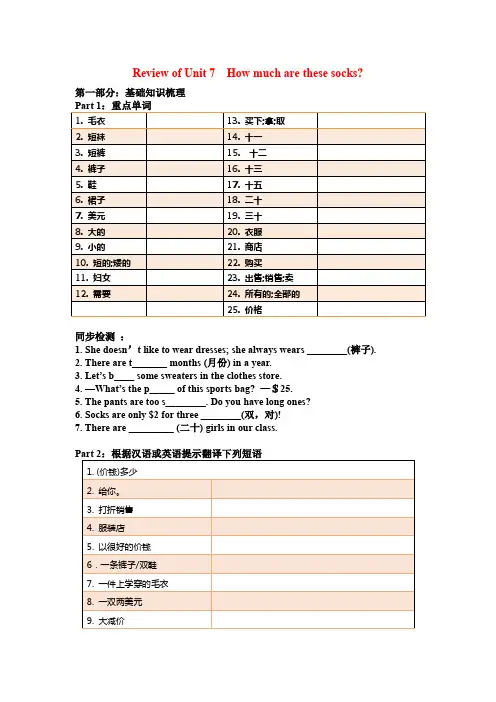
Review of Unit 7 How much are these socks?第一部分:基础知识梳理同步检测:1. She doesn’t like to wear dresses; she always wears ________(裤子).2. There are t_______ months (月份) in a year.3. Let’s b____ some sweaters in the clothes store.4. —What’s the p_____ of this sports bag? —$25.5. The pants are too s________. Do you have long ones?6. Socks are only $2 for three ________(双,对)!7. There are _________ (二十) girls in our class.同步检测:It is Saturday today and Lucy doesn’t go to school. She goes shopping. She 6. _______________a new schoolbag school. She also wants to 7._______________a bag her mom on Mother’s Day. She walks on the street and sees an ad outside a shop. It says, “8. _______________Mrs. Cat’s Bag Shop. You can buy the newest bags 9. _______________.” Lucy goes into the shop and sees all kinds of bags. They all 10. _______________.A young lady asks, “What can I do for you?”Lucy says, “Well, I want a bag for my mom.”“11. _______________this black one?” the lady asks.“My mom doesn’t like black. Blue is her favorite,” says Lucy.The young lady shows Lucy a small blue bag and Lucy loves it.“12. _______________is it?” Lucy asks.“It’s 150 yuan,” the lady answers.“Oh, that’s too expensive!” Lucy is surprised.“We sell our bags 13. _______________. It is a nice bag and it is worthy(值得)of 150 yuan,”the lady says.Lucy doesn’t have so much money, so she doesn’t buy it. She leaves the bag shop and goes into another shop. The shop 14. _______________sunglasses _______________women. In the end, Lucy buys 6. _______________sunglasses.书面表达本单元的话题是“购物”,主要学习谈论商品的价格、表达感谢以及商品销售广告。
新人教版七年级英语上册全册复习 导学案 unit7(section1a-2e)

2.补全单词。
1.---Hmis the hat? ----It’s 8 d..
2.----Wathe trousers?
----T15 yuan..
3.I wa pof socks.
4.I’ll t______ the jacket.
1、完成P371a。(要求:将答案填在书上。)
2、完成P371c。(要求:能熟练的朗读对话,并且会翻译。)
3、
Step4Listen and read(听一听,读一读)
1、完成P37 1b部分。(要求:在1a中圈出所听到的物品)
2、完成P38 2a部分。(要求:听录音并跟读单词)
3、完成P38 2b部分。(要求:听对话圈出所听到的物品)
?
3.句型转换。
1.I like these shorts..(变一般疑问句)?
(对问句做肯定回答),。
2. I like these shorts. (变否定句)。
3. The sweater is16 doll are10 dollars.(对画线部分提问)
5、我不喜欢吃冰激凌,我不想变胖。
______________________________________________________________________
6、我喜爱水果。我认为它很健康。
Step 2 New words and phrase (新单词词组和句子)
1.找出下列新单词和词组
饮食习惯________ ___________想做某事
2.翻译并背诵下列句子。
.1、我喜欢水果,但是我不喜欢蔬菜。
2、汤姆喜欢胡萝卜吗?
【人教新目标】2021年七年级英语上册(全集)复习导学案汇总

(人教新目标)七年级英语上册(全册)复习导学案汇总Unit 1 My name’s Gina【复习目标】1. 熟练掌握本单元的重点词汇和短语。
2. 熟练掌握本单元的重难点。
【学习过程】Step 1: 词汇听写Step 2: 重难点集训1.am,is与are辨析am,is,are 的基本意思为“是”,但在句中通常不翻译出来。
★be动词记忆口诀:I用___________,you 用___________,___________ 连着他(he)她(she)它(it)。
单数名词用___________,复数名词用___________。
变疑问,___________,句末问号莫丢弃;变否定,更容易,be 后___________莫忘记;疑问否定任你变,句首大写莫迟疑。
★be动词与人称代词或疑问词构成的缩略形式:I am = ___________ he is = ___________ she is = ___________it is =___________ we are =___________ you are =___________they are =___________ what is = ___________where is = ___________【注意】this和is一般不缩写。
Ⅰ.用be动词的适当形式填空。
1.—How _________ you?—I _________fine.2.—What _________ that in English?—It _________ a pen.3.She and I _________ in China.4.—Who _________ Mr.Webb?—He _________ Jane's father.Ⅱ.按要求完成下列句子5.I'm Mary Miller.(改为一般疑问句)__________________ Mary Miller?6.His first name is Tom.(改为缩略形式)His first _________Tom.7.Is she Linda?(作否定回答)__________________8.I'm Jim Green.(改为同义句)_________________________2.no与not辨析★no可作副词,用于否定的回答或陈述;也可作形容词,直接用于名词前。
七年级上册英语复习教案人教版

七年级上册英语复习教案人教版教案标题:七年级上册英语复习教案(人教版)教学目标:1. 复习七年级上册英语课程内容,巩固学生对基础知识的掌握。
2. 提高学生的听、说、读、写能力,培养学生的综合语言运用能力。
3. 培养学生的学习兴趣和自主学习能力。
教学重点:1. 复习并巩固七年级上册英语课程的重点知识点。
2. 提高学生的语言表达和交流能力。
教学难点:1. 帮助学生理解并运用所学的语法知识。
2. 培养学生的英语听力和口语表达能力。
教学准备:1. 教材:七年级上册英语教材(人教版)。
2. 多媒体设备:电脑、投影仪等。
3. 教学辅助工具:课件、练习册等。
教学过程:Step 1:复习单词和词组(时间:15分钟)1. 利用多媒体展示单词和词组的图片,帮助学生回忆并复习所学的单词和词组。
2. 分组进行单词竞赛,鼓励学生积极参与,加深记忆。
Step 2:复习语法知识(时间:20分钟)1. 复习一般现在时、一般过去时和一般将来时的构成和用法,通过举例和练习巩固学生的理解。
2. 运用多媒体展示相关语法知识的例句和练习题,帮助学生掌握语法规则。
Step 3:复习对话和口语表达(时间:20分钟)1. 选择一些对话情境,让学生进行角色扮演,提高他们的口语表达能力。
2. 利用录音设备播放一些对话,让学生跟读并模仿语音语调,提高他们的听力和口语表达能力。
Step 4:复习阅读理解(时间:15分钟)1. 选择一篇适合学生水平的短文,让学生阅读并回答相关问题,检测他们的阅读理解能力。
2. 引导学生分析短文的结构和语言特点,提高他们的阅读能力和语言分析能力。
Step 5:复习写作技巧(时间:15分钟)1. 提供一些写作题目,让学生进行写作练习,培养他们的写作能力。
2. 通过互相交换作文并互评,帮助学生改进写作技巧和提高写作水平。
Step 6:课堂小结和反馈(时间:5分钟)1. 对本节课的内容进行小结,强调学生的学习成果和进步。
2. 鼓励学生提出问题和建议,以便更好地改进教学方法和内容。
2024年新人教英语七年级上册unit 1复习学案
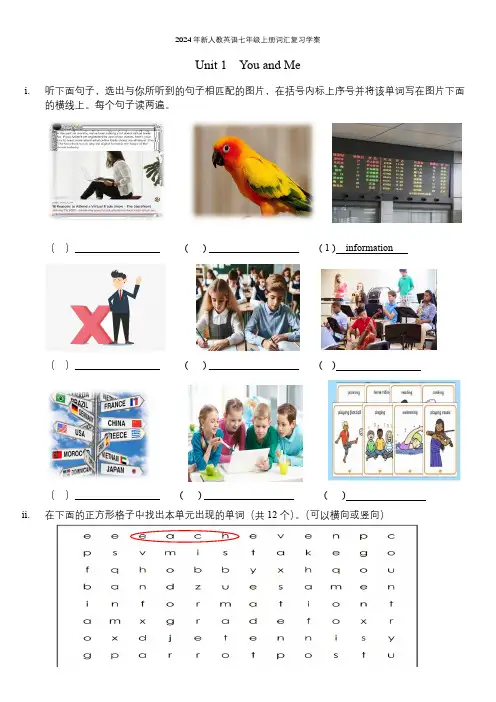
Unit 1 You and Mei.听下面句子,选出与你所听到的句子相匹配的图片,在括号内标上序号并将该单词写在图片下面的横线上。
每个句子读两遍。
()_________________ ( ) __________________ ( 1 ) information()_________________ ( ) __________________ ( )()_________________ ( ) __________________ ( )ii.在下面的正方形格子中找出本单元出现的单词(共12个)。
(可以横向或竖向)iii.连连看1.get to know about Mr Smith and Peter2.Emma’s last name is Peter Brown.3.We are each other4.the information is Smith5.Peter’s full name in the same class.6.I play the guitar to be your friend.7.I live in Beijing with my parents.8.I’d like in the school band.iv.完成下面的crosswords.v.填空。
用be (is, am, are) 的正确形式填空。
1)She ______ a Chinese teacher.2)Jacob __________ from the US.3)Liam and Ben ________ my best friends.4)We _______ in Class 2401.5)You _______ wrong. Sorry.用特殊疑问词(how old, what, who, why, where)填空。
1)___________’s your name?2)___________ are you from?3)_______________ are you?4)_________ are your hobbies?5)_________ grade are you in?6)______________ classmates are there in your class?7)___________’s your best friend in your class?8)_________ is she/he your best friend?vi.回答上一题第二部分的8个问题,并写成小短文。
新人教版七年级英语上册总复习学案
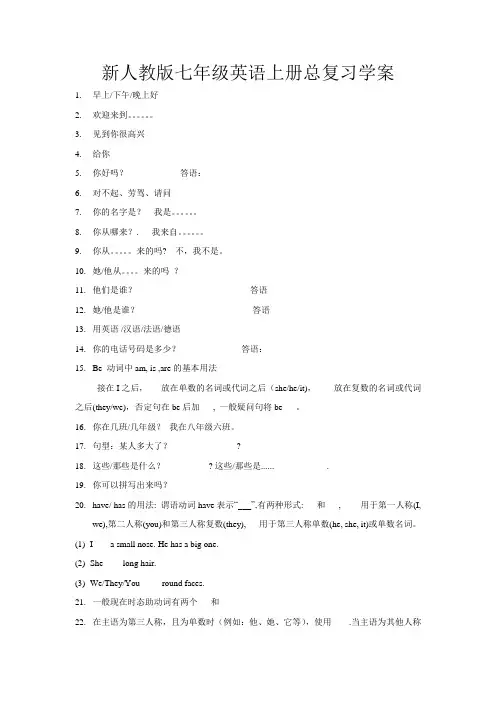
新人教版七年级英语上册总复习学案1.早上/下午/晚上好________2.欢迎来到。
________3.见到你很高兴________4.给你___________5.你好吗?____________答语:__________________6.对不起、劳驾、请问_________________7.你的名字是?我是。
__________________________8.你从哪来?. 我来自。
9.你从。
来的吗? 不,我不是。
_____________________________10.她/他从。
来的吗?______________________11.他们是谁?________________________答语__________________12.她/他是谁?_________________________答语___________________13.用英语 /汉语/法语/德语______________________14.你的电话号码是多少?_____________ 答语:________________15.Be 动词中am, is ,are的基本用法____接在I之后,___放在单数的名词或代词之后(she/he/it),___ 放在复数的名词或代词之后(they/we),否定句在be后加___, 一般疑问句将be___。
16.你在几班/几年级?我在八年级六班。
___________________________17.句型:某人多大了?_______________?18.这些/那些是什么?__________? 这些/那些是......____________.19.你可以拼写出来吗?_______________________20.have/ has的用法: 谓语动词have表示“___”,有两种形式:___和___, ____用于第一人称(I,we),第二人称(you)和第三人称复数(they),___用于第三人称单数(he, she, it)或单数名词。
新人教版七年级英语上册全册复习 导学案 Unit 4 (1a-2d)
3、翻译下列短语或句子。
在书包里______________________在沙发上_________________
在椅子下面____________________在书桌上_____________________
___________ ______ _______? ____ ___ ___________________________? ___________________.
4、书包在哪里?它在桌子底下。
__________________? ______________________.
我的电子游戏______________________我的书包在床上。______________________
你的字典在哪里?它在书桌上。_____________________________________________
4、句型转换。
1、Myschoolbag isunder the chair.(对划线部分提问) ___________________________.
3、那些是她的钥匙吗?是的,它们是她的。
________________________________________________________
4、我丢失了我的学生证,我必须找到它。__________________________________
Step2New wordsand prase(新单词词组和句子)
2、我会熟练的运用所学句型—where’s the schoolbag?—it’s under/on/in the…
人教版七年级英语上册全册学案
人教版七年级英语上册全册学案第一篇范文:人教版初中英语七年级上册全套学案英语学科新目标人教版七年级上学期英语学案第1课时Unit 1 My name 's Gina (总第1课时)Section A 1a―2c【学习目标】:1、熟悉掌握词汇name clock 等2、学会介绍自己并询问他人姓名,能够利用所学知识进行打招呼.3、能听懂听力对话并能对根据听力对话进行自由交际.【学习重点】:使学生学会打招呼和介绍自己,并询问他人姓名的句型.Nice to meet you . What's your name ? My name is ......【学习过程】:一、自主学习(教师寄语:Knowledge is power.)学习任务一: 熟悉掌握词汇name ,clock1、认真观察第一页的图画,小组讨论你所认识的物品的英语单词. 2,、试着写出含有的物品的英语单词.3、小组竞赛,展示( 看谁总结的多, 写的准确)学习任务二: 学会介绍自己并询问他人姓名,能够利用所学知识进行打招呼.1、教师自我介绍,引导学生介绍自己.A: Hello , I am Gina , What's your name ?B: My name is Alan .2、小组竞赛, 两人一组,询问他人姓名,介绍自己.3,、分角色朗读1A对话.学习任务三: 能听懂听力对话并能对根据听力对话进行自由交际.1,、听录音, 给1B 的对话编号.2、根据听力对话进行自由交际.3、小组竞赛, 展示对话交际。
二、合作共建(教师寄语:Many hands make light work. )小组讨论我们所学的英语名字和汉语名字的区别, 如何用英语拼写你的名字?三、系统总结(教师寄语:No man can do two things at once.)1,、归纳你所学到的问候语.2、自己编写一个打招呼并询问姓名的小对话.四、诊断评价(一)单项选择.1. _______your name ? My name is Gina .A. WhatB. What'sC. WhoD. which2. Good morning , Miss Wang ! _____________!A. HelloB.HiC. Nice to meet youD. Good morning3. I _______Sally , What______ your name ?A. am ,isB. is , amC. is , isD.am, am4. ______name is Li lei .A. IB. I amC. MyD. you5.― _______, What's your name ?― John Green .A. HiB. OkC. sorryD. Excuse me(二)写出下列单词的完全形式, 并写出汉语意思.I'm _________ __________ what's __________ ________name 's ___________ __________(三)写出下列单词.时钟_______ 我的________ 你的___________ 名字_______ 遇见_________(四)尝试翻译下列句子.1. 见到你很高兴. _________________________________.2.我叫王小雨. ____________________________________.3. 你叫什么名字? ____________________________________(五)根据情景补全对话.A: Good afternoon !B: ____________________!A; I ______Lucy . _________your name ?B: My ______ is Jim . Nice to ______you !A: _______________________________.五、【课后反思】(教师寄语:Never do things by halves)第2课时Unit 1 My name 's Gina.(总第2课时)Section A (1a―2c)【学习目标】:1、熟练掌握本课6个单词.2、学会询问他人姓名及介绍他人姓名.3、能听懂有关谈论他人姓名的对话并进行自由交际. 【学习重点】:询问他人姓名及介绍他人姓名的句型. 一、自主学习(教师寄语:Knowledge is power.)学习任务一: 熟练读写本课6个单词.1.个人自渎,记忆本课单词.2.小组互相检查单词读写情况.3.根据汉语写出下列英语单词并展示.学习任务二: 运用句型:What's his / her name?His / Her name is .... 进行自由交际.1.小组合作,理解并熟读下列短语,并写出汉语意思.my nane ( )your name ( )his name ( )her name ( )2.个人理解下列对话,并且两人合作练习.A:Hello! What's your name?B:My name is Gina.A:Nice to meet you.B:Nice to meet you,too.A:What's her name?B:Her name is Jenny.3.小组合作,练习自己的对话.4. 对抗组开展竞赛,展示自己的对话.学习任务三: 听听力完成2a,2b.1.个人看图,理解四幅图画,思考图画中人是在谈论他人还是对方.2.听听力,给四幅图画编号.3. 小组为单位,熟读2b中的名字。
(整套)(人教新目标)七年级英语上册复习导学案全集(vip专享)
(人教新目标)七年级英语上册(全册)复习导学案汇总Unit 1 My name’s Gina【复习目标】1. 熟练掌握本单元的重点词汇和短语.2. 熟练掌握本单元的重难点.【学习过程】Step 1: 词汇听写Step 2: 重难点集训1.am, is与are辨析am, is, are 的基本意思为“是”, 但在句中通常不翻译出来.★be动词记忆口诀:I用___________, you 用___________, ___________ 连着他(he)她(she)它(it).单数名词用___________, 复数名词用___________.变疑问, ___________, 句末问号莫丢弃;变否定, 更容易, be 后___________莫忘记;疑问否定任你变, 句首大写莫迟疑.★be动词与人称代词或疑问词构成的缩略形式:I am = ___________ he is = ___________ she is = ___________it is =___________ we are =___________ you are =___________they are =___________ what is = ___________where is = ___________【注意】this和is一般不缩写.Ⅰ.用be动词的适当形式填空.1.—How _________ you?—I _________fine.2.—What _________ that in English?—It _________ a pen.3.She and I _________ in China.4.—Who _________ Mr.Webb?—He _________ Jane's father.Ⅱ.按要求完成下列句子5.I'm Mary Miller.(改为一般疑问句)__________________ Mary Miller?6.His first name is Tom.(改为缩略形式)His first _________Tom.7.Is she Linda?(作否定回答)__________________8.I'm Jim Green.(改为同义句)_________________________2.no与not辨析★no可作副词, 用于否定的回答或陈述; 也可作形容词, 直接用于名词前. 如: —Is he John?他是约翰吗?—No, he is Jack.不, 他是杰克.He has no books.他一本书也没有.★not只能用作副词, 用于be动词、助动词或情态动词后, 构成否定形式. 如: S he is not a student.她不是一名学生.3.good, fine与nice辨析good, nice, fine 都含有“好”的意思, 但用法存在区别:★go od主要指“人的品质好”或“东西的质量好”等.★nice着重强调人们的感觉, 含有“漂亮的”“美妙的”“美味的”等意思.★fine侧重于表示“质量精细”或“身体健康”, 也可以表示“天气晴朗”等.Ⅰ.单项选择.( )12.________ afternoon, Ms.Gree n.A.Fine B.Nice C.Good D.Than ks( )13.—How are you?—I'm ________.Thank you.A.good B.yes C.nice D.fineⅡ.根据汉语意思完成句子.14.他是我的好朋友.——————————————————————————15.见到你很高兴.————————————————————————————4.a, an与the辨析★a, an都是不定冠词, 只用在单数可数名词前, 表示一(人、事、物). ___________用在以辅音音素开头的名词前面; ___________用在以元音音素开头的名词前面.如: ___________一支铅笔; ___________一位老人.★the为定冠词, 用法口诀如下:特指双方熟悉, 上文已经提及; 世上独一无二, 方位名词乐器;某些专有名词, 外加复数姓氏; 序数词最高级, 习惯用语要特记.用a, an或the填空, 不需要填冠词的填“/”.16.—Is this ___________ cup?—Yes, it is. ___________ cup is white.17.—What's his ___________ first name?—Jack.And his ___________ last name is Green.18.—What's that in___________ English?—It's ___________telephone.19.Her friend works(工作) in ___________ middle school.St ep 3: 实战演练1.在线检测: 请你在平台完成Unit 1 My name`s Gina单元检测), 提交后自己看错题及解析.Unit 2 This is my sister【复习目标】1. 熟练掌握本单元的重点词汇和短语.2. 熟练掌握本单元的重难点.【学习过程】Step 1: 词汇听写Step 2: 重难点集训1.of的用法★of意为“……的”, 常用来表示所属关系. 表示无生命物体的所属关系常用“所有物+of+所属物”的形式. 如:a map of the world一张世界地图desks and chairs of our school我们学校的桌椅学以致用Ⅰ.按要求完成下列句子1.It's her family photo.(改为同义句)It's a ________________her family.2.this, a, photo, his, school, is, of(连词成句)________________________________Ⅱ.根据汉语意思完成句子, 每空一词.3.那是一张中国地图.That is ________________.4.这条狗的名字是蔻蔻.The ________________ is Coco.2.here倒装句的用法★在英语中以here开头的句子常用倒装句式, 其结构为“Here+is/are+主语(名词或名词短语)”. 当主语是可数名词单数或不可数名词时, 动词用is; 当主语是可数名词复数时, 动词用are. 如:Here i s a pencil.这里有一支铅笔.Here are some apples for you.这里有一些苹果给你.【拓展】here引导的倒装句中, 代词充当句子的主语, 常用部分倒装. 即“Here+代词+is/are”. 如:Here you are.给你.学以致用Ⅰ.单项选择.( )5.—________your pictures.They're very nice.—Thanks.A.Here is B.Here are C.He is D.She is( )6.Here________a pen for your sister.A.am B.is C.are D.aren'tⅡ.根据汉语意思完成句子.7.这里有四幅图画.________________ four ______________.8.这里有一件紫色的夹克衫.________________ a purple jacket.9.这里有三个橙子.________________ three ____________.3.who的用法★who为疑问代词, 意为“谁”, 用来询问人物关系或身份等. 回答时, 若主语为单数, 根据人物的性别选用代词he或she; 若主语为复数, 应用代词they. 常用结构为“Who +be动词+某人?”, 其回答为He is…/She is…/They are…学以致用Ⅰ.单项选择.( )10.—________is that girl?—She's my friend, Jenny.A.How B.What C.Where D.Who( )11.—Who are they?—________.A.They are my friendsB.She is my friendC.Those a re my friendsD.Those are my friendⅡ.对句中画线部分提问.12.The man is Tom's__uncle.________________ the man?13.These two girls are my__cousins.________________ these two girls?4.this, that, these与those辨析★these意为“这些”, 表示复数意义, 指较近的物体, 其单数形式为this(这; 这个).★those意为“那些”, 表示复数意义, 指较远的物体, 其单数形式为that(那; 那个).学以致用Ⅰ.单项选择.( )14.—Are these your friends?—Yes, ________ are.A.this B.that C.these D.they( )15.________ dogs are yellow.________ are my dogs.A.Those; They B.They; ThoseC.That; Those D.This; TheyⅡ.用this, that, these, those填空.16.—Are ________________your books?—No. My books are over there.17.—Are________________ your pictures on the desk over th ere?—Yes, they are.18.—Hello. __________ is Jane. Is ______________Bob?—Yes, speaking.Step 3: 实战演练1.在线检测: 请你在平台完成Unit 2 This is my sister.单元检测), 提交后自己看错题及解析.参考答案重难点集训学以致用Ⅰ.1.photo of2.This is a photo of his school.Ⅱ. 3.a map of China.4.name of the dog2.here倒装句的用法学以致用Ⅰ.BBⅡ.7. Here are , pictures.8.Here is9.Here are oranges.3.who的用法学以致用Ⅰ.DAⅡ. 12.Who is13.Who are4.this, that, these与those辨析学以致用Ⅰ.DAⅡ. 16. these_17. those18. This , thatUnit 3 Is this your pencil 【复习目标】1. 熟练掌握本单元的重点词汇和短语.2. 熟练掌握本单元的重难点.【学习过程】Step 1: 词汇听写Step 2: 重难点集训1.some的用法★some作形容词时, 可以修饰复数可数名词, 也可以修饰不可数名词. 如:There are some students in the classroom.教室里有一些学生.There is some milk in the glass.杯子里有一些牛奶.★some作代词时, 可单独使用, 也可接o f, 作主语时谓语动词的单复数形式由其后的名词决定. 如:Some of the money is mine.有一些钱是我的.学以致用Ⅰ.单项选择.( )1.Some ________ are in the pencil box.A.computers B.pen C.picture D.erasers( )2.An orange and ________ cards are in the box.A.a B.some C.one D.an( )3.________ in the school library.A.A teacher are B.A teachers areC.Some teachers is D.Some teachers areⅡ.根据汉语意思完成句子, 每空一词.4.我们在那幅图画中能看见一些手表.We can see _______ _________ in the picture.5.我有一些蓝色的盒子.I have ______ blue _______.2. must的用法★must是情态动词, 意为“必须”, 无时态和人称的变化, 后接动词原形, 表示义务或命令. 如:You must find your lost pen.你必须找到你丢失的钢笔.学以致用Ⅰ.单项选择.( )6.My English book is lost. I ________ find it.A.am B.do C.can D.mustⅡ.根据汉语意思完成句子, 每空一词.7.我们必须帮助他.We _______ _______ _______.8.我必须用英语说吗?_______ I _______ it in English?3.thank的用法thank作动词, 意为“感谢; 谢谢”, 常用结构:★thank (sb.)for (doing) sth., 表示“感谢(某人)做了某事”. 如:Thank you for your letter.谢谢你的来信.★Thank you和Thanks常单独使用, 作为表达谢意的礼貌用语. 其常见答语: You are welcome./That's all right./That's OK./Don't mention it./It's a plea sure.学以致用单项选择.( )9.Thank you ________ your computer.A.of B.to C.for D.at( )10.—Your pencil box is nice.—________.A.Yes B.No C.Thank you D.It isn't nice( )11.—Thank you.—________.A.You, too B.Excuse meC.Nice to meet you D.You're welcome( )12.—Have a good day!—________.A.OK B.Thank youC.Good morning D.I'm fine4.What about…?的用法★Wha t about…?意为“……怎么样?……好吗?”, about为介词, 其后可接名词、代词或动词-ing形式, 常用于询问或打听消息, 向对方提出建议, 征询对方的看法或建议, 与how about可互换使用. 如:What about your uncle now?你的叔叔近来好吗?What about a cup of tea?喝一杯茶怎么样?What about the TV play?那个电视剧怎么样?I am from Beijing.What about you?我来自北京, 你呢?学以致用Ⅰ.单项选择.( )13.—________ the black jacket?—It's nice.A.What B.How C.Who D.What about( )14.—I'm fine.________?—I'm fine, too.A.Are you Alan B.Is this your bookC.What about you D.Who are you( )15.What about ________ swimming?A.go B.goes C.going D.to goⅡ.同义句转换, 每空一词.16.My schoolbag is blue. Is your schoolbag blue, too?My schoolbag is blue. _______ _______ yours?17.This pen is Eric's. How about that pencil?This pen is Eric's. _______ _______ that pencil?Step 3: 实战演练1.在线检测: 请你在平台完成Uni t 3 Is this your pencil?单元检测, 提交后自己看错题及解析.参考答案重难点集训1.some的用法学以致用Ⅰ.DBDⅡ. some watches5.some boxes.2. must的用法学以致用Ⅰ.DⅡ. 7.must help him.8. Must say3.thank的用法学以致用CCDB4.What about…?的用法学以致用Ⅰ.DCCⅡ. 16.What/How about17.What aboutUnit 4 Where’s my schoolbag【复习目标】1. 熟练掌握本单元的重点词汇和短语.2. 熟练掌握本单元的重难点.【学习过程】Step 1: 词汇听写Step 2: 重难点集训1.where的用法★where是疑问副词, 意为“在哪里; 到哪里”, 常用来引导特殊疑问句, 用于询问某人或某物的位置. 基本结构: Where+be动词+限定词+名词?其中be动词的单复数形式取决于其后的名词. 如:—Where is your mom?你的妈妈在哪里?—She is in the garden.她在花园里.—Where are those pencils?那些铅笔在哪里?—They are in the pencil box.它们在铅笔盒里.学以致用Ⅰ.单项选择.( )1.—________ is my sister, Mom?—In her room.A.Who B.What C.Where D.How( )2.—Where ________ your CDs?—On the TV.A.is B.are C.be D.am( )3.—________ my tape player?—On the table.A.Where B.Where is C.Where are D.How is( )4.—Where is that radio?—________ under the chair.A.This is B.That is C.It is D.They are( )5.—________?—They're on the sofa.A.Where are my books B.Where is my bookC.Where's my books D.Where my books areⅡ.根据汉语意思完成句子, 每空一词.6.——他的书包在哪里?——在课桌下面.—__________ his schoolbag?—It's __________ the desk.7.——你的父母在哪里?——他们在客厅里.—__________ __________ your parents?—They're in the living room.2.ask的用法★ask作动词, 意为“询问”, 对应词为answer, 意为“回答”. 如: Can I ask you a question?我能问你一个问题吗?★ask作动词, 意为“要求; 请求”, 常用结构:ask sb.for sth.问某人要某物ask sb.for help.向某人寻求帮助ask sb.to do sth.要求某人做某事学以致用单项选择.( )8.You can ask the teacher ________ your computer game.A.to B.for C.in D.at( )9.Our teacher asks us ________ hard.A.study B.to study C.is D.to be3.and与but辨析★and意为“和; 又; 而”, 常位于句中, 用来连接并列的成分, 表示并列或顺承关系. 如:There is a pen and a book on the desk.桌子上有一支钢笔和一本书.★but意为“但是”, 用来连接并列的成分, 表示语义上的转折. 如:I like blue, but my sister likes pink.我喜欢蓝色, 但是我的姐姐喜欢粉色.学以致用Ⅰ.单项选择.( )10.I am looking for(寻找) my pen everywhere, ________ I can't find it.A.but B.and C.too D.for( )11.My sister________ I are tidy, ________my brother isn't.A.and; and B.but; but C.and; but D.but; andⅡ.用and或but完成下列句子.12.I have a new watch, __________ I don't like it.13.These are my parents, __________ those are my friends.4.in与on辨析★in意为“在……里”, 常指某人/物在某范围空间里.★on意为“在……上”, 强调某物在另一物体的表面上.【拓展】in the tree 与on the tree都表示“在树上”, in the tree指外来的附在树上的事物; on the tree指树本身自然生长出来的事物.学以致用Ⅰ.用适当的方位介词填空.14.Look!There is a little cat __________the tree.15.—Where are Jim and his father?—They're __________ the sofa.Ⅱ.根据汉语意思完成句子16.那面墙上有一些画.There are some pictures __________ .17.钥匙在沙发上面.The keys __________ the sofa.18.地图在书包里.The map __________ the schoolbag.Step 3: 实战演练1.在线检测: 请你在平台完成Unit 4 Where’s my schoolbag?单元检测, 提交后自己看错题及解析.参考答案重难点集训where的用法学以致用Ⅰ.CBBCAⅡ.—Where's ,under7.—Where areask的用法学以致用BBand与but辨析学以致用Ⅰ.ACⅡ.12. but 13. andin与on辨析学以致用Ⅰ. 14.in15.onⅡ.16. on the wall.17.are on18.is inUnit 5 Do you have a soccer ball【复习目标】1. 熟练掌握本单元的重点词汇和短语.2. 熟练掌握本单元的重难点.【学习过程】Step 1: 词汇听写Step 2: 重难点集训1.let的用法★let作动词, 常用于let sb./sth.do sth.结构, 表示“让某人/某物做某事”.★let's 是let us 的缩写形式, us意为“我们”, 是we的宾格, 放在动词let后作宾语. let's开头的祈使句结构为“Let's do sth.”, 意为“(让)我们做某事吧”, 表示说话人的建议或请求. 肯定回答一般用“OK.”, “All right.”等, 否定回答一般用“Sorry, I…”等. 如:—Let's play basketball!让我们打篮球吧!—OK.好的.学以致用Ⅰ.单项选择.( )1.—I can't spell it.—Let me ________ you.A.helping B.helps C.to help D.help( )2.—Let's ________ volleyball now.—That sounds good.A.plays B.play C.playing D.to play( )3.Let ________ play computer games.A.they B.their C.them D.theirs( )4.—Let's play ping-pong.—________ Let's go.A.Great! B.That's boring.C.I have a volleyball. D.I don't like ping-pong.Ⅱ.用括号内所给单词的适当形式填空.5.Let _______(I) get the jacket for you.6.Let's_______ (go) to the library now.2. play的用法★play意为“参加(比赛或运动)”, 其后常接球类、棋牌类名词作宾语.【注意】play与球类或棋牌类名词连用时, 球类或棋牌类名词前不加任何冠词.学以致用Ⅰ.单项选择.( )7.—It's a fine day.Let's play________basketball.—OK.A.a B.an C.the D./( )8.Peter can play________soccer, but he can't play________piano.A.the; the B.the; / C./; the D./; aⅡ.根据汉语意思完成句子, 每空一词.9.李娜打网球而不打排球.Li Na_______ _______ but she doesn't_______ _______.10.下课后我们做运动吧!Let's_______ _______ after class.3. sound的用法★sound在句中作连系动词, 意为“听起来”, 其后接形容词作表语. “That+soun ds +形容词”意为“那听起来……”. 这一句型常用于口语中, 用于表示对某事的看法或态度. 学以致用Ⅰ.单项选择.( )11.—Do you like Li Qi?—Yes.His new CD________good.A.sound B.sounds C.look D.looksⅡ.用括号内所给单词的适当形式填空.12.—Let's watch TV.—That_______ (sound) boring.13.—I like to watch TV.—That sounds_______ (relax).4.have与there be辨析★have表示“有”, 强调所属关系, 在句中作谓语时, 主语位于have之前, 当主语是第三人称单数时, have要变成has.★there be句型表示“(某地)有某人或某物”, 强调存在, there be句型中主语位于be动词之后, 且be动词要与最近的主语在人称和数上保持一致.学以致用Ⅰ.单项选择.( )14.—Does he ________ a soccer ball?—Yes, he does.He ________ four.A.have; have B.have; has C.has; have D.has; has( )15.I ________ a baseball and my friend ________ a volleyball.A.has; has B.have; have C.have; has D.has; have( )16.—________ you ________ a picture of the school?—Yes.A.Do; have B.Do; has C.Does; have D.Does; hasⅡ.用have或there be的适当形式填空.17.He_______ a nice watch.18. _______ a book and three pens on the desk.19.What does Mike_______?Step 3: 实战演练1.在线检测: 请你在平台完成Unit 5 Do you have a soccer ball?单元检测, 提交后自己看错题及解析.参考答案重难点集训1.let的用法学以致用Ⅰ.DBCAⅡ.5.me 6. go2. play的用法学以致用Ⅰ.DCⅡ. 9. plays tennis, play volleyball.10.play sports3. sound的用法学以致用Ⅰ.BⅡ. 12.sounds13.relaxing4.have与there be辨析学以致用Ⅰ.BCAⅡ.17. has 18. There__is19. haveUnit 6 Do you like bananas?【复习目标】1. 熟练掌握本单元的重点词汇和短语.2. 熟练掌握本单元的重难点.【学习过程】Step 1: 词汇听写Step 2: 重难点集训1.well与good辨析★well用作副词, 常置于动词之后, 表示程度“好; 满意地”; 也可用作形容词, 指“身体好”. 如:The boy can swim very well.这个男孩游泳游得很好.★good是形容词, 常置于名词之前作定语, 指人的品质或物品的质量好, 也可用于系动词后作表语. 如:Mr.Wang is a good teacher.王老师是一位好老师.学以致用Ⅰ.单项选择.( )1.—Do they eat ________ at school every day?—Yes, they do.A.good B.nice C.fine D.well( )2.—Your English is________.—Thank you.A.good B.well C.bad D.OK( )3.Susan is a ________ student and she does ________ at school.A.well; good B.good; good C.well; well D.good; wel lⅡ.用good或well填空.4.—Does h is friend play football_________?—No, he doesn't.5.—Let's play volleyball after class.—That sounds _________.6.—Is this a_________ book?—Yes, it is.7.—How is your father?—He is _________.Thank you.2.chicken的用法★chicken作名词, 意为“鸡肉”, 此时为不可数名词; 意为“小鸡”时, 是可数名词, 复数形式为chickens.【拓展】与chicken类似的词有orange, 表示“橙汁”时为不可数名词, 表示“橙子”时为可数名词, 其复数形式为oranges.学以致用单项选择.( )8.My grandmother has many ________, because I like eating ________. A.chicken; chickens B.chickens; chickenC.chickens; chickens D.chicken; chicke n( )9.I'm thirsty.I would like to drink some ________.A.orange B.an orangeC.oranges D.a bottle of orange3.want的用法★want为动词, 意为“需要; 想要”, 常用结构:want sth.想要某物want to do sth.想要做某事want sb.to do sth.想要某人做某事学以致用Ⅰ.单项选择.( )10.My schoolbag is old(旧的).I ________ a new(新的) one.A.meet B.want C.do D.play( )11.Tom wants ________ basketball with us.A.play B.to play C.plays D.pla ying( )12.S he wants ________ to get some apples for her.A.them B.they C.their D.theirsⅡ.将下列句子翻译成英语.13.我想要一本词典._________14.午饭她想吃汉堡包._________15.凯特想要我帮助她._________4.have, eat, take与drink辨析★have既可以指“吃”, 也可以指“喝”. 当与meal以及表示三餐的名词连用时, 多用have. 如: have breakfast吃早餐, have dinner吃正餐, have a meal吃一顿饭.★eat多用来表示“吃”. 如: eat an apple吃苹果.★take作“吃”、“喝”讲时比较少见, 主要用于“服药”, 如: take medicine服药.★drink习惯上用于喝水、茶、奶、咖啡等饮料, 一般不作“吃”讲. 如: drink some juice喝一些果汁.Step 3: 实战演练1.在线检测: 请你在平台完成Unit 6 Do you like bananas?单元检测, 提交后自己看错题及解析.参考答案重难点集训1.well与good辨析学以致用Ⅰ.DADⅡ.4. well?5.good.6. good7.well2.chicken的用法学以致用BA3.want的用法学以致用Ⅰ.BBAⅡ.将下列句子翻译成英语.13.I__want__a__dictionary.14.She__wants__to__eat__hamburgers/burgers__for__lunch.15. Kate__wants__me__to__help__her.Unit 7 How much are these socks【复习目标】1. 熟练掌握本单元的重点词汇和短语.2. 熟练掌握本单元的重难点.【学习过程】Step 1: 词汇听写Step 2: 重难点集训1.how much与how many辨析★how much用来询问物体的价格时, 后面既可接复数可数名词, 又可接不可数名词; 常用结构: How much+be+名词?=What's the price of+名词. 当how much用来询问数量时, 后面只接不可数名词. 如:How much are these shorts?这些短裤多少钱?How much water do you drink every day?你每天喝多少水?★how many用来询问可数名词的数量, 后接可数名词的复数形式.学以致用Ⅰ.单项选择.( )1.—________ are the black trousers?—They are 15 dollars.A.Where B.How C.What color D.How much( )2.—________ books do you have?—150.A.How many B.How much C.How old D.How much moneyⅡ.用many或much 填空.3.How______is that skirt?4.How______people are there in your family?5.How _______rice do you need?6.How _______bread is there in the box?2. pair的用法★pair为可数名词, 常用于“数词+pair(s)+of”结构, 当数词大于1时, pair要用复数形式, 该结构后接“成对出现”的名词, 如shoes(鞋), gloves(手套), glasses(眼镜), trousers(裤子), socks(短袜), scissors(剪刀)等.学以致用Ⅰ.单项选择.( )7.This pair of trousers ________ 35 dollars.A.does B.do C.is D.ar e( )8.—What do they want to buy?—________.A.Three pair of sockB.Three pairs of sockC.Three pair of socksD.Three pairs of socksⅡ.根据汉语意思完成句子, 每空一词.9.他想要一双蓝色的鞋.He wants______ ______ ______ blue shoes.10.这条白色的短裤多少钱?How m uch ______ this______ ______ white shorts?11.这些袜子价格合理.These______ ______ ______ ______ at very good prices.3.buy, sell与sale辨析★buy作动词, 意为“购买”, 后常接名词或代词做宾语. 常用结构: buy sb.sth.=buy sth.for sb.给某人买某物.★sell作动词, 意为“出售”, 常用结构: sell sth. to…把某物卖给……; sell sth.for+价格, 以……价格出售; sell out卖完.★sale作名词, 意为“出售”, 常用结构: for sale待售; on sale特价出售.学以致用单项选择.( )12.—Shall we go to the bookstore?—All right!I hear there are many good books ________.We can ________ some.A.for sale; sell B.on sale; buy C.in sale; sell D.on sale; sell( )13.We can ________ books ________ the bookstore.A.sell; on B.bu y; from C.sell; from D.buy; to4. look, see与watch辨析★look指集中注意力地“看”, 强调“看”的动作. 单独使用时, 用来引起对方的注意. 如:Look!Tom is over there.看!汤姆在那儿.★see强调“看”的结果, 意为“看见; 看到”. 如:How many birds can you see in the tree?你能看到树上有多少只鸟儿?★watch强调“专注地看”, 有欣赏的意味, 常用于看电视、球赛等. 如:Do you watch TV at night?你晚上看电视吗?学以致用Ⅰ.单项选择.( )14.—Does Tom's grandf ather ________ TV in the evening?—Yes, he does.A.look B.see C.watch D.play( )15.Boys and girls, please ________ at the picture.A.watch B.look C.see D.needⅡ.用look, watch或see的适当形式填空.16.—Does your brother want______ the soccer game on TV?—No, he doesn't.17.Do these photos______very nice?18. ______!That boy is my classmate.19.—What can you ______in the picture?—A desk and two ch airs.Step 3: 实战演练1.在线检测: 请你在平台完成Unit 7 How much are these socks?单元检测, 提交后自己看错题及解析.参考答案重难点集训1.how m uch与how many辨析学以致用Ⅰ.DAⅡ.3. much4. many5. much_6. much_2. pair的用法学以致用Ⅰ.CDⅡ.9. a pai r of10.is ,pair of11.pairs of socks are3.buy, sell与sale辨析学以致用BB4. look, see与watch辨析学以致用Ⅰ.CBⅡ.用look, watch或see的适当形式填空.16.to_watch17. look18. Look19.seeUnit 8 When is your birthday 【复习目标】1. 熟练掌握本单元的重点词汇和短语.2. 熟练掌握本单元的重难点.【学习过程】Step 1: 词汇听写Step 2: 重难点集训1.happy的用法★happy为形容词, 意为“愉快的; 高兴的”, 在句中既可作定语, 又可作表语. 常用结构: be happy to do sth.很高兴做某事; be happy for sb.为某人感到高兴.【拓展】名词形式为happiness, 反义词为unhappy.学以致用Ⅰ.单项选择.( )1.—It's nice to meet you here, Dale.—I'm ________ to see you, too.A.late B.happy C.first D.easy( )2.—________ birthday to you, Eric!—Thank you.A.Nice B.Good C.Well D.HappyⅡ.根据汉语意思完成句子, 每空一词.3.你的朋友有一个幸福的家庭吗?________ your friend________ ________ ________ family?4.我很高兴帮助你.I'm very________ ________ ________ you.2.when的用法★when为疑问副词, 意为“什么时候”, 常用来引导特殊疑问句, 基本结构为“When +一般疑问句?”, 用来对时间进行提问. 回答时常用介词at, in或on等组成的表示时间的介词短语.学以致用Ⅰ.单项选择.( )5.—________do you have a book sale?—It's on December 3rd.A.How B.What C.When D.Who( )6.—When is your cousin's birthday?—________ on June 2nd.A.You're B.She's C.We're D.It'sⅡ.对句中画线部分提问, 每空一词.7.They want to come here on__December__24th.________ ________ they want to come here?8.The English test is on__November__29th.________ ________ the English test?3.how old的用法★how old意为“多大年纪”, 常用句型“How old+be动词+主语?”相当于“What +be动词+one's age?”. 回答时用“主语+be动词+基数词(+years/mont hs old)”.学以致用Ⅰ.单项选择.( )9.—________is your daughter?—She's ten months old.A.How old B.How C.What D.Where( )10.—________?—I'm sixteen.A.How many years are you B.How are youC.How old are you D.How much are youⅡ.按要求完成下列句子, 每空一词.11.Miss Jones is twenty-five__years__old.(对画线部分提问)________ ________ is Miss Jones?12.What's your sister's age?(改为同义句)________ ________ ________ your sister?4.on, in与at辨析★on表示具体的某一天. 如: on July 10th, 2017表示2017年7月10日.★in表示一天中的上午/下午/晚上或某年/月. 如: in the morning在早上; in May 在五月.★at表示具体到某一时刻. 如: at five 在五点钟.学以致用Ⅰ.单项选择.( )13.—When is your School Day?—It's ________ March 14th.A.in B.on C.at D.to( )14.My mother's birthday is ________ September.A.on B.at C.in D.for( )15.His sis ter always comes here ________ eight ________ the morning.A.on; at B.in; at C.at; in D.at; onⅡ.根据句意, 用in, on或at填空.16.Let's meet________ 9: 30 next Monday morning.17.Our School Day is ________ November 25th.18.What activities do you have________ October?19.I was born________ a cold(寒冷的) morning in May.Step 3: 实战演练1.在线检测: 请你在平台完成Unit 8 When is your birthday?单元检测, 提交后自己看错题及解析.参考答案1.happy的用法学以致用Ⅰ.BD.Ⅱ. 3. Does , have a happy4. happy to help2.when的用法学以致用Ⅰ.CDⅡ.7. When do8. When is3.how old的用法学以致用Ⅰ.ACⅡ.11.How old12.How old is4.on, in与at辨析学以致用Ⅰ.BCCⅡ.16. at 17. on 18. in 19. onUnit 9 My favorite subject is science.【复习目标】1. 熟练掌握本单元的重点词汇和短语.2. 熟练掌握本单元的重难点.【学习过程】Step 1: 词汇听写Step 2: 重难点集训eful的用法★useful作形容词, 意为“有用的; 有益的”, 在句中既可作定语, 又可作表语. 常用结构: be useful for/to…对……有用.学以致用单项选择.( )1.I think it is ________ useful book.A.an B.a C.the D./( )2.—Why do you like English?—Beca use I think it is very ________.A.useful B.difficult C.tidy D.boring( )3.The dictionary is ________ for my daughter.I want to buy it.A.cool B.interesting C.useful D.free2.finish的用法★finish意为“结束; 完成”, 用作及物动词时后接名词、代词或动词-ing形式. 如:Finish your homework this afternoon.今天下午完成你的作业.Finish it on time, please.请按时完成它.Can you finish read ing the book in a week?一周内你能读完这本书吗?学以致用Ⅰ.单项选择.( )4.Our last class________at 4: 30 in the afternoon.A.has B.have C.finish D.finishes( )5.—Can I go out to play football, Mom?—When you________your homework, you can go out.A.take B.finish C.help D.call( )6.—When will you finish________computer games?—At 9: 30.A.playing B.plays C.play D.to playⅡ.用括号内所给单词的适当形式填空.7.The meeting __________(finish) at 11: 50 in the morni ng.8.She plays sports after she finishes __________ (eat) dinner.3.because, but与so辨析★because意为“因为”, 表示原因, 常用于回答why引导的特殊疑问句; 也可用于连接两个具有因果关系的句子.★but意为“但是”, 表示转折关系.★so意为“因此”, 表示因果关系.学以致用Ⅰ.单项选择.( )9.Jenny likes Tuesday________her favorite subject is on Tuesday.A.after B.but C.so D.because( )10.—Would you like to go to the concert with me tonight?—I'd love to, ________ I can't.I have a lot of homework to do.A.because B.and C.but D.s oⅡ.对句中画线部分提问, 每空一词.11.Liu M in is very happybecause_she_will_go_to_Beijing_with_her_family_next_week.__________ __________ Liu Min very happy?4.relaxing与relaxed辨析★relaxing 意为“令人放松的”, 一般修饰物. 如:Music is relaxing.音乐是令人放松的.★relaxed意为“感到放松的”, 一般修饰人. 如:I am very relaxed on weekends.我周末感到非常放松.【拓展】类似用法的词还有interesting与interested; boring与bored; surprising 与surprised等.学以致用单项选择.( )12.People are really ________ on the beach in summer(夏季).A.relaxed B.relaxing C.relax D.to relax( )13.Watching movies makes me ________.A.relaxing B.relaxed C.to relax D.relaxes( )14.—What kind of books do you like?—I like storybooks. They're very ________.A.boring B.bore d C.interest ed D.interestingStep 3: 实战演练1.在线检测: 请你在平台完成Unit 9 My favourite subject is science.单元检测, 提交后自己看错题及解析.参考答案重难点集训eful的用法学以致用BAC2.finish的用法学以致用Ⅰ.DBAⅡ. 7 .finishes 8. eating3.学以致用Ⅰ.DCⅡ.11.Why is4.relaxing与relaxed辨析学以致用ABD1在一次踏青活动中,我认识了彩虹,一个皮肤很白的小美女。
七年级英语上册复习学案(全册)人教新课标
七年级上册复习教案Unit 1 My name’s Gina.一、Numberszero one two three four five six seven eight nine ten二、Telephone numbersEnglish name:first name +(middle name)+ family name eg. Jim Brown First name (given name) & Family name (last name)三、Expressions自我介绍(Introduce yourself)My name is Tony .OR:I’m Tony .Tony .询问对方/他人姓名:1.–What’s your name?--My name is …/ I am …2. –What’s his/her name?--His/Her name is…3. –What’s your family name/first name?--My family name/first name is…4. –What’s his/he r family name/first name?--His/her family name/ first name is…问候他人(Greet people)--Nice to meet you.--Nice to meet you.询问和给出电话号码(Ask for &give telephone number)–What’s your/his/her telephone number?--My/His/Her telephone number is 220-1345.OR: --I t’s+号码.四、Grammar1、be ( is \ am \ are) 动词用法:口诀:I 用am , you 用are , is 用于她他它(she \ he \ it)单数形式用is , 复数形式要用are.Eg. I am a student.You are my teacher.She is a girl. He is a boy. It is a penWhat is your name?My phone number is 220-1234.2、本单元出现的形容词性物主代词(Pronouns for ownership)my/your/his/her均为形容词性物主代词,其后面必须跟上用于表示“人”或“物”的名词。